Category: influential reading material


IMG_3528

[p.9-10]

Why is the measure of love loss?

…You said, ‘I love you’.  Why is it that the most unoriginal thing we can say to one another is still the thing we long to hear? ‘I love you’ is always a quotation.  You did not say it first and neither did I, yet when you say it and when I say it we speak like savages who have found three words and worship them.  I did worship them but now I am alone on a rack hewn out of my own body.

…love demands expression. It will not stay still, stay silent, be good, be modest, be seen and not heard, no.  It will break out in tongues of praise, the high note that smashes the glass and spills the liquid.  It is no conservationist love. It is a big game hunter and you are the game.  A curse on this game.  How can you stick at a game when the rules keep changing? I shall call myself Alice and play croquet with the flamingos. In Wonderland everyone cheats and love is Wonderland isn’t it? Love makes the world go round. Love is blind. All you need is love. Nobody ever died of a broken heart. You’ll get over it… It’s the clichés that cause the trouble. A precise emotion seeks a precise expression. If what I feel is not precise then should I call it love? It is so terrifying, love, that all I can do is shove it under a dump bin of pink cuddly toys and send myself a greetings card saying ‘Congratulations on your Engagement’. But I am not engaged I am deeply distracted.  I am desperately looking the other way so love won’t see me.

IMAG0559

I arrived late and missed Miliwanga Wurrben but both wonderful and powerful to see the work of young artists presented at Scribe.

Hannah Donnelly read some segments of recent work – dystopian young adult fiction exploring the long term impacts of climate change in Australia.  Asking the audience questions between readings like:

  • what Country do you live on?
  • what water system is on the Country where you live?
  • what is your future? …your children’s future?

Prompting important self-reflection on the ways we are (or aren’t) aware of the impacts of climate change and the ways we’re complicit in not taking good care of Country.

HANNAH DONNELLY

Hannah Donnelly is a Wiradjuri writer who grew up on Gamilaroi Country. She is the creator of Sovereign Trax, an Indigenous music blog which aims to foreground the consumption of music that speaks to collective stories and identities. Hannah’s writing experiments with speculative fiction and Indigenous responses to climate change.


IMAG0561

It’s hard to find words to describe what Jack Sheppard shared – all about words but using few he shared a story using his body and video footage of two friends who recently committed suicide, the piece capturing the evolution of his grief, healing and response to that.  Their stories are written on his body and he carries them with him. This evoked the sense of a beginning in an ending and possibility in a situation that feels hopeless. Where he is, they are. The gift of his work was holding space for the piece to mean whatever it might seem or need to mean to each person watching it… below is my attempt to express some of what that was for me watching him.

JACK SHEPPARD

The Honouring is a presentation of a physical theatre work in development, paying homage to Indigenous life and culture in its hardships, beauty and spirituality. Using movement, dialogue, video installations and poetry, the work is influenced by Aboriginal and Torres Strait Islander totems and landscape, with the story journeying to parts of Australia of deep significance to Jack Sheppard.


Pen to heart
writing is a full body experience
physical and not just head.
Disparate ideas and pieces of a life
you try to fit together
but they don’t come.
Voice.
Listen.
What are you trying to say?
What are you trying to read?
Winds blow,
walking in your own mess,
dance like no one is watching.
All about words but silent.
I lost my voice again today…
Cuddle up to the pieces
keeping you warm at night.
Collect the pieces up,
we must nurture the ghosts
that lie down with us,
check and care for them.
Shedding clothes,
layers of skin,
who we are.
Naked, unfolding a
piece of paper with the
whole story.
Reflection of self
wraps around you
like a cocoon.
Lie with the dead,
those we can’t save.
I want to sleep but I can’t.
Awake, I’m still awake.

Talitha Fraser


img_3305

Local cafe, local community, local coffee, local story… what are the stories of your neighbourhood? Are you listening out for them?
This is a story from mine…

img_3358

So, what is the Common Galaxia? 

Around one kilometre north of where the mouth of the Maribyrnong nudges its way into the Yarra on the tip of Port Melbourne, the bends of the river flatten out into a strait of slow water.

This stretch of river is home to the Common Galaxia, an entirely unremarkable and utterly fascinating little fish. Silvery and fantailed, found in half the rivers of the world, the Common Galaxia, as singular fish, live for a year but, as a species, outlast everything built around them.

For thousands of years the Common Galaxias propped up the lifecycle of the Saltwater River, feeding the eel and bigger fish and, in turn, feeding the Wurundjeri people. In 1835, Europeans sailed into the river and cut through the scrub and, over the next century-and-a-half, the steady march of industry – from tanners to candle makers and metal works to acid factories – started crowding the banks of the Maribyrnong. In short time, the little whitebait had a lot more to worry about than Southern Black Bream or Short-finned Eel making a meal of them.

Not only did the Common Galaxias have to adapt to their river home becoming more industrial waste than water, they were forcefully relocated as the join between the Maribyrnong and the Yarra at Footscray was closed to continue the line of wharves along the river. The waterway had become something lived on rather than lived in. But the little fish refused to give up, laying low and holding on among the weeds that clung to the riverbank.

And things have a way of coming back around. The city grew. Industries changed. The river is running a little easier again as homes have replaced factories and parks dot the river bends where the docks once stood. The deep heart of the river still beats strong through a small silvery fish, hardly known but vital to this stretch of land and water. The Common Galaxia is a tiny reminder that nature will survive everything we build, and you can only ever borrow a spot on the bends of a river. A spot like this one…


Common Galaxia Cafe in Seddon, Melbourne
– more to it than just good coffee…


img_8303

p.86-87

“I spent the mornings writing letters in answer to advertisements in the paper; in the afternoons I went for walks round the creek.  I was experiencing a sense of freedom and elation that my failure to find work could not subdue. The renewing of my association with the clean world became almost an identification with tree and bird and sun.  The sharpness of my pleasure in rediscovery was sometimes so intense I could have shouted and flung my arms wide or lain with my face against the earth listening to music only the enchanted hear.

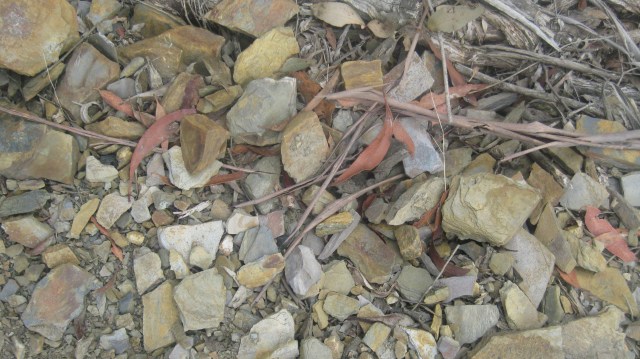
Quartz gravel, dry gum-leaves, bleached twigs and pieces of bark were rich with meaning. The floor of the bush was a narrative poem, the bush an evocation.

Shadow and sunlight, reaching limbs of trees, the rustle of grass, shapes and colours and odours, demanded a complete absorption to uncover the heart of their beauty. I felt I had been imprisoned for a lifetime in a dungeon and now, freed, the revelation of a communicating beauty lying confined in all that I was seeing brought with it a frustrating awareness of my inability to release it so that it would surround men and women for ever. There was an anguish in this unattainable desire, and tear, and a sense of deprivation.

I wanted to proclaim my message, if not in books then by talking.

Sometimes I had attempted, when stirred by the sight of a spider orchid, maybe, or the flight of a bird, to take adults on a fanciful journey of the spirit, in search of a truth beyond what the eye was seeing. It demanded of them an emotional response suggestive of children and this they could rarely give. They associated it with immaturity.

Shielded by books and facts and their belief in accepted authorities, they were incapable of becoming participants in wonder, only kindly and critical observers of those experiencing it. The years of development they had left behind were sprinkled with stars – the sharp lights of remembered experiences. The same experiences in later years never created a light.

What was once a magical experience becomes commonplace with repetition and there comes a time in the lives of most people when the eyes and ears fail to register an unadulterated wonder and excitement, but are used as instruments to revive memories that flicker like a match for a moment and die away.  It had all happened before; it would happen again.  But I knew that each moment contained something unknown, something never experienced before, an enchantment only it could provide.”

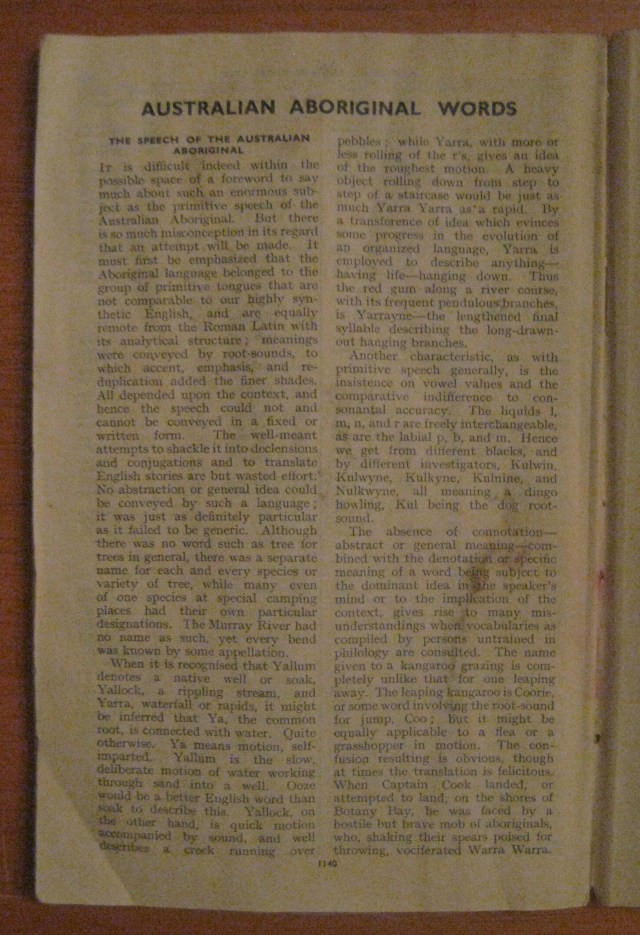
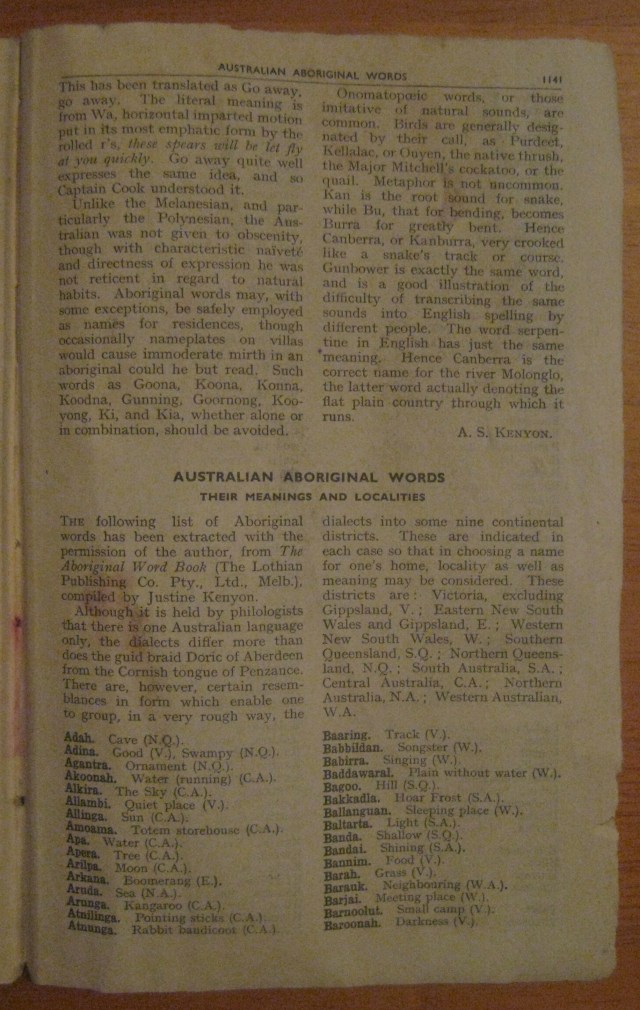
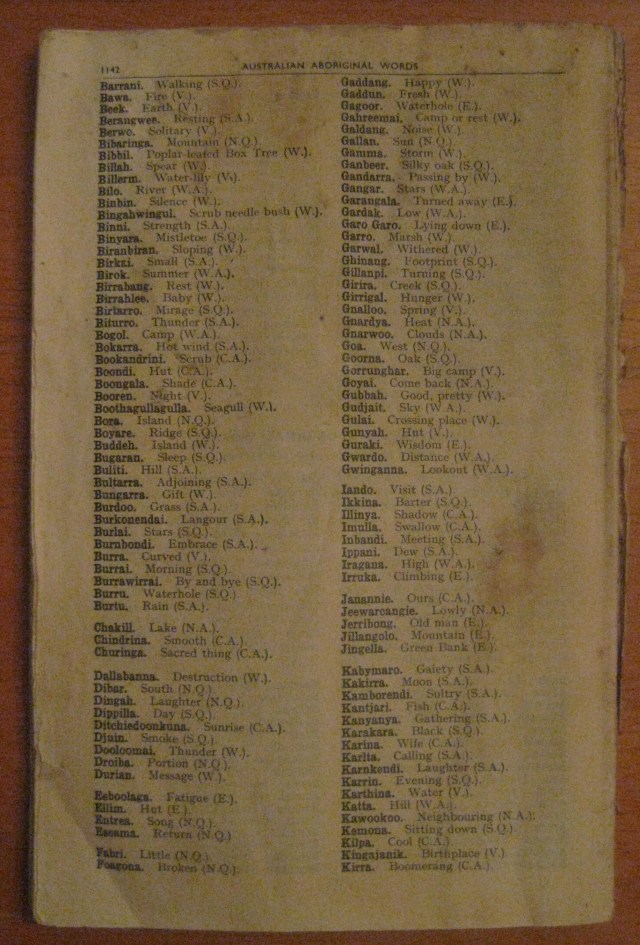
Walking home one night, I came across what looked like a torn up dictionary outside the McDonalds on Ballarat Rd.  I’m into a bit of upcycling and paper craft – it makes sense to use books/paper that are being thrown out anyway and this has little illustrations… No cover, torn in sections, mouldy and weathered, unwanted… except for me who’s picking up rubbish thinking “Cute.” and “Score!”

Looking more closely once I got my prize home, I realise it’s not a dictionary but rather some sort of encyclopaedia and it’s old. Really old. Old enough that it’s quite offensive – mostly for its omissions rather than what it explicitly says, for example in a section called “Australia’s History: Chief events in chronological order…”spanning 1788-1939, I can see only one reference made regarding an aboriginal person or place and that was “1876 Death of Truganini, last of Tasmanian aborigines”.  I look her up online to know her story.

A visitor on country myself, I have not (and continue) not to know very much about what right relationship looks like between people and the land. Not having the right words and being afraid of saying the wrong ones, I try and stay silent. To listen and to learn. I have heard people talk about their family members, homes, and culture being lost through colonisation. I have heard them talk about losing language and here am I finding some lying by the side of the road. I find myself wishing I could give it back to who it belongs to.


img_3592img_3593img_3595

imag0381

Within the grip of winter, it is almost impossible to imagine the spring. The gray perished landscape is shorn of color. Only bleakness meets the eye; everything seems severe and edged. Winter is the oldest season; it has some quality of the absolute. Yet beneath the surface of winter, the miracle of spring is already in preparation; the cold is relenting; seeds are wakening up. Colors are beginning to imagine how they will return. Then, imperceptibly, somewhere one bud opens and the symphony of renewal is no longer reversible. From the black heart of winter a miraculous, breathing plenitude of color emerges.

The beauty of nature insists on taking its time. Everything is prepared. Nothing is rushed. The rhythm of emergence is a gradual slow beat always inching its way forward; change remains faithful to itself until the new unfolds in the full confidence of true arrival. Because nothing is abrupt, the beginning of spring nearly always catches us unawares. It is there before we see it; and then we can look nowhere without seeing it.


With thanks to Dusk for sharing this when I needed to hear it.
An excerpt of a meditation from From To Bless the Space Between Us by John O’Donohue 


img_2370

Merciful God, we offer to you the fears in us that have not yet been cast out by love


Let us pray for all who suffer, and ask that God would give us peace:

For all who have died in the violence of war,
conflicts or acts of terror,
each one remembered and known to God.
May God give peace

For those who love them in death as in life,
offering to God the distress of our grief
and the sadness of our loss.
May God give peace

For all the peace-keepers and peacemakers,
and all who are in danger this day,
remembering especially their families and friends.
May God give peace

For those whose lives are disfigured by war,
conflict, acts of terror or injustice,
calling to mind in penitence the anger and hatreds of humanity
May God give peace

For all who bear the burden and privilege of leadership,
political, military and religious; asking for gifts of wisdom
and resolve in the search for reconciliation and peace.
May God give peace

For our country Australia, its land and seas;
its struggles in adversity, its courage and hope;
for tolerance and our respect for one another,
and our commitment for justice and reconciliation for all
May God give peace

O God of truth and justice,
we hold before you those whose memory we cherish,
and those whose names we’ll never know.
Help us to lift our eyes above the torment of this broken world, and
grant us the grace to pray for those who wish us harm.
As we honour the past,
may we put our faith in your future;
for you are the source of life and hope,
now and forever.

Amen


img_2374

img_2206

img_2075

“Old words do not reach across the new gulfs, and it is only in vision and oracle that we can chart the unknown and new-name the creatures.

Before the message there must be the vision, before the sermon, the hymn, before the prose, the poem.

Before any new theologies however secular and radical there must be a contemporary theopoetic.  The structures of faith and confession have always rested on hierophanics and images. But in each new age and climate the theopoetic of the church is reshaped in inseparable relation to the general imagination of the time.”

– from the foreword to Grace Confounding: Poems


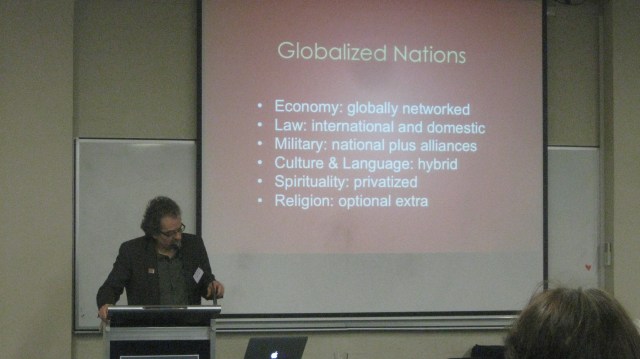
On the weekend of 24-25 September Whitley College hosted a conference called Constitutions and Treaties: Law, Justice, Spirituality – these are notes from session 9 of 9. We acknowledge that this gathering, listening and learning occurred of the land of the Wurundjeri People of the Kulin Nations and offer our respects to their elders past and present, and all visiting Aboriginal and Torres Strait Island visitors present.


img_1490

Line through Papua New Guinea, literally nations were “dividing the world between them”.

img_1491

img_1493

Roger Williams, Baptist theologian, a dissenting voice to the Doctrine of Discovery model – wanted to respect Native Americans, house church on Rhode Island for 6 years. Had to go to England at one point – needed a patent or would be annexed.

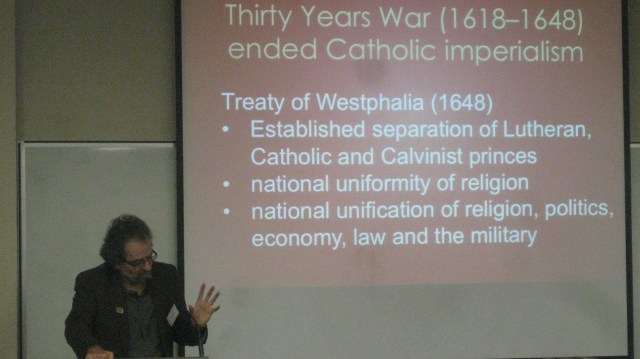
The Treaty of Westphalia was the end of the 30 Year war. No right to divide the world in two.  Move from Empires to a rise of nation states.

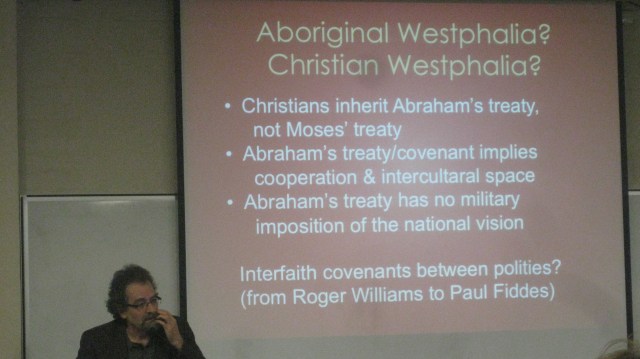
If we think of the Treaty of Waitangi as an interfaith covenant, what are the implications of that? The phrasing of the words “you will acknowledge no other gods above me” implies an acknowledgement of other gods existing. There is a danger when uniformity is a presumption.  What kinds of covenants can we imagine between polities (e.g. could a treaty have some reference to God or Creator Spirit with Bundjil and representatives of Bundjil’s land)? Any covenants (treaties) would need to be local. Can Christian churches model this?
Made under sovereignty of God (not state/federal Government)?


Entering a treaty under State/Federal terms legitimises them and their system, it’s not being legitimised ourselves.


Being hard isn’t the same as being not worth doing.


What does “local” mean/look like to people who know who they are/where they’re from.

Lutherans practiced a vernacular theology – learned the language of those they lived with whereas as other denominations refused to learn the language (and used theological grounds for that) you have to learn/imposing my theology…