Category: influential reading material


IMG_9047

As a nation we have not been taught about our own black heroes, we learn about great civil rights leaders from around the world. Dr Martin Luther King and Rosa Parks are familiar within our vernacular however the black freedom fighters of our own country are left out of the history books.  From first contact through to today we have Aboriginal leaders like William Cooper that have shifted the course of history, that have resisted the colonial order of the nation and have led us in the ongoing goal to de-colonise our space, for equality, for better living condition, for health and legal care, for land rights.  These are the legacies that are left to be continued by the next generation of Aboriginal women and men.

The ‘tide of history’ has not washed away our connections to country or culture, it is our sovereign right and it is our obligation to our old people to maintain these.


“We must continue seeking for our rights”
William Cooper 1934

“We must realise that there is a greater purpose for us than to exist for ones’ own life”
Uncle Alf ‘Boydie’ Turner 2009
IMG_9049

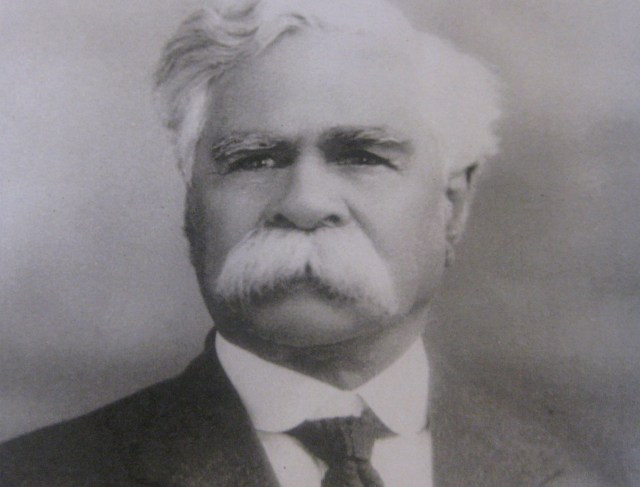
William Cooper
Source: Museum Victoria

Yorta Yorta man Mr William Cooper had a vision for his people to live a better life, to be treated as equal citizens in a land that as he stated, by ‘divine right’ was theirs.  His story is remarkable and of great courage and strength, he fought for not only  his people but for others around the world being persecuted.  William was a humanitarian on a mission to create change.

Born on the banks of the Dungala (Murray River) in 1861 William lived his youth witnessing the frontier of change.  He saw the destruction of his homelands and the dispossession of Aboriginal and Torres Straight Islander people across the country but his strength as a proud Yorta Yorta man could not be taken and he dedicated his life to fighting for better rights of his people.

William had many hardships in his life, losing two children including Daniel Cooper who lost his life fighting in the First World War and also two wives, in this time raising his family in regional Victoria and NSW travelling to where he could work.  As an elderly man he moved from Cummeragunja mission to Melbourne to be able to receive the old age pension.  This was a time where many Aboriginal people were fleeing missions across the state, walking off in the hope for better living conditions and making their way to Melbourne.  The West, Fitzroy and Northcote were community hubs of Aboriginal people congregating, building a life in the city.

In this time he formed the Australian Aborigines League (AAL) and they would meet at his house in Footscray.  The AAL demanded that Aboriginal people should enjoy the same rights as all Australians. William became secretary and began writing many letters and petitionings to government on behalf of the AAL calling for civil rights and changes in government policy.  In this time he led many significant protests including a petition to King George V calling for Aboriginal representation in parliament.  He and the AAL also supported the Cummerangunja walk off in protest of the appalling living conditions and brutality inflicted on the community.  In 1938 William led a deputation from Footscray, walking into the city where thy presented the German Consulate with a letter demanding the Nazi government stop the ‘cruel persecution of the Jewish people’, this is the only known protest of its kind recorded in the world at that time.  Both his petition to the King and the deputation’s letter to the German government were refused.  William in his life time wrote over eighty letters petitioning for Aboriginal rights, equality and human rights and he never gave up the fight and his vision for a better future for his people.

This legacy has been carried on by his descendants including his grandson Uncle Alf ‘Boydie’ Turner who in recent years has accomplished his grandfathers work getting a new petition to Queen Elizabeth.  With his great nephew Kevin Russell and other family and supporters, he re-enacted the deputation to the city, marching to the German Consulate and handing over the letter that his Grandfather had tried to do many years before.

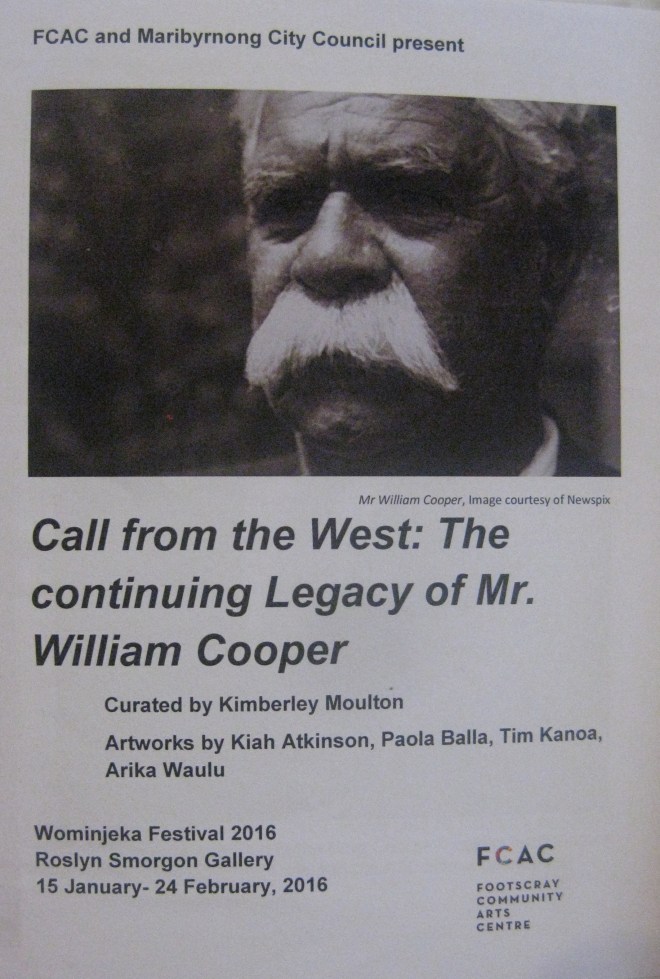
Four Koorie artists in this exhibition respond to notions of legacy and current political realities for our community.

Kiah Atkinson is an emerging artist and a relative of Mr William Cooper, Kiah’s sound piece tracks William’s journey from Yorta Yorta country to Footscray, creating an audio journey.

Paola Balla is an artist, writer and activist whose work ‘the homes that we had known’ is a personal story of connection to William through her Great Grandmother Mariah or ‘Puppa’ as she was known, who travelled 1500km on her own to attend the Day of Mourning in 1938.  Paola’s installation includes a bed frame with earth, leaves and flowers from her country; a poetic reflection to the hardship of mission life that her grandmother Rosie describes in a poem.  Paola commemorates the struggle of our ancestors whilst highlighting the strong Aboriginal women who were protesting and raising families in some of the most challenging conditions.

Tim Kanoa is a photographer who has been capturing the recent rallies against the forced closure of Aboriginal communities in WA.  Tens of thousands of people gathered to protest in 2015 and Tim’s work Ignite looks at how the legacy of protest and standing up continues to burn strong.

Arika Waulu’s work legacyliveson is a powerful meditation on sovereignty and the next generation of activists.  Arika’s projection of the 2015 rallies led by the Warriors of Aboriginal Resistance along with an illustrated portrait of William is projected onto a wall of paper bark visas which are representations of sovereign nations.

Kimberley Moulton
Yorta Yorta


The ‘tide of history’ has not washed away our connections to country or culture, it is our sovereign right and it is our obligation to our old people to maintain these.

Reflection questions:

What does  the term ‘legacy’ evoke?

What is the significance of the actions of Uncle Alf ‘Boydie’ Turner and Kevin Russell?
What do you think Uncle Turner means when he refers to a ‘greater purpose’?

What ways do you/do you not feel connected to country and culture?

What vision do you have for a whole or healed world?
What could/are you doing to participate in building that vision to be a reality?

Do you think Aboriginal people have the same rights as other people in Australia now?

IMG_5947.JPG

PRAYER

[p.31]

Lord Jesus, now that beneath those world-forces you have become truly and physically everything for me, everything about me, I shall gather into a single prayer both my delight in what I have and my thirst for what I lack; and following the lead of your great servant I shall repeat those enflamed words in which, I firmly believe, the christianity of tomorrow will find its increasingly clear portrayal:

‘Lord, lock me up in the deepest depths of your heart; and then, holding me there, burn me, purify me, set me on fire, sublimate me, until I become utterly what you would have me be, through the utter annihilation of my ego.’

[p.33]

Glorious Lord Christ: the divine influence secretly diffused and active in the depths of matter, and the dazzling centre where all the innumerable fibres of the manifold meet; power as implacable as the world and as warm as life; you whose forehead is of the whiteness of snow, whose eyes are of fire, and whose feet are brighter than molten gold; you whose hands imprison the stars; you who are the first and the last, the living and the dead and the risen again; you who gather into your exuberant unity every beauty, every affinity, every energy, every mode of existence; it is you to whom my being cried out with a desire as vast as the universe, ‘In truth you are my Lord and my God’.

‘Lord, lock me up within you’: yes indeed I believe – and this belief is so strong that it has become one of the supports of my inner life.

[p.34]

This is the criterion by which I can judge at each moment how far I have progressed within you.  When all the things around me, while preserving their own individual contours, their own special savours, nevertheless appear to me as animated by a single secret spirit and therefore as diffused and intermingled within a single element, infinitely close, infinitely remote; and when locked within the jealous intimacy of a divine sanctuary, I yet feel myself to be wandering at large in the empyrean of all created being: then I shall know that I am approaching that central point where the heart of the world is caught in the descending radiance of the heart of God.

***

Through a marvellous combination of your divine magnetism with the charm and the inadequacy of creatures, with their sweetness and their malice, their disappointing weakness and their terrifying power, do you fill my heart alternately with exaltation and distaste; teach it the true meaning of purity: not a debilitating separation from all created reality but an impulse carrying one through all forms of created beauty; show it the true nature of charity: not a sterile fear of doing wrong but a vigorous determination that all of us together shall break open the doors of life; and give it finally – give it above all – through an ever-increasing awareness of your omnipresence, a blessed desire to go on advancing, discovering, fashioning and experiencing the world so as to penetrate ever further and further into yourself.

[p.35]

It is to your body in this its fullest extension – that is, to the world become through your power and my faith the glorious living crucible in which everything melts away in order to be born anew; it is to this that I dedicate myself with all the resources which your creative magnetism has brought forth in me: with the all too feeble resources of my scientific knowledge, with my religious vows, with my priesthood, and (most dear to me) with my deepest human convictions.  It is in this dedication, Lord Jesus, I desire to live, in this I desire to die.

206.JPG

The following are some of the values which outline the purpose and core ideology of the community and are used to guide and inform our decision-making. It is always good to start off a new year checking in – are these still relevant? how are we doing? what might these look like in the year ahead?

Partnering with God

We value the opportunity of participating in the Missio Dei (mission of God). Through persistence in prayer, we seek to recognise where God is at work in Footscray, and become co-workers with Christ.
Biblical basis: Psalm 127:1, Luke 18:7, 1 Cor 3:9

In it for the long haul

We value being a constant in an inconsistent world, expecting and persevering through hard times.  Our long-term commitment allows us to build trust and respect with those in our community, as we try to reflect God’s unconditional love and grace.
Biblical basis: Hebrews 10:36

Being amongst the people

We value sharing life with our neighbours, as a real expression of the kingdom amongst the marginalised. Our everyday involvement and identification means our mission is not so much what we do, but who we are.
Biblical basis: John 1:14, Philippians 2:1-11

Seeking justice for the poor

We value God’s priority for the poor and seek to prioritise the marginalised of Footscray.  We do not want to just show mercy, but instead offer in our lives, in voice and activity, with those who we seek to serve.
Biblical basis: Jeremiah 22:16, James 2: 1-5

Becoming family

We value the intimacy of relationship we can have with Christ, and the belonging found in growing closer to God and therefore to each other.  Our goal is to be family for those facing loneliness and social isolation.
Biblical basis: 1 John 3:16-18, John 13: 34-35

Being honest about who we are

We value the humility and forgiveness required to live transparent lives in community.  We want to submit to each other in accountability and honesty, allowing Christ to use our weaknesses and failings.
Biblical basis: 2 Corinthians 12:9-10, 2 Corinthians 3:18

Doing the hard yards

We value servanthood in the big and the small – choosing to do the “crappy” stuff.  We want to be people of personal and spiritual maturity (enduring personal cost) in order that the vision is accomplished.
Biblical basis: James 5:7-11

Travelling light

We value the difference that can be made when we sacrifice personal gain, pouring out our rich resources in an act of worship.  Through simplicity, good stewardship and a common commitment to sharing our lives with others, we seek to lessen the power imbalance in Footscray.
Biblical basis: Luke 9:23-24


IMG_7064

IMG_7068

IMG_7069

IMG_7045

[p.28-29]

COMMUNION

If the Fire has come down into the heart of the world it is, in the last resort, to lay hold on me and to absorb me.  Henceforth I cannot be content simply to contemplate it or, by my steadfast faith, to intensify its ardency more and more in the world around me. What I must do, when I have taken part with all my energies in the consecration which causes its flames to leap forth, is to consent to the communion which will enable it to find in me the food it has come in the last resort to seek.

So, my God, I prostrate myself before your presence in the universe which has now become living flame: beneath the lineaments of all that I shall encounter this day, all that happens to me, all that I achieve, it is you I desire, you I await.

It is a terrifying thing to have been born: I mean, to find oneself, without having willed it, swept irrevocably along on a torrent of fearful energy which seems as though it wished to destroy everything it carries with it.

What I want, my God, is that by a reversal of forces which you alone can bring about, my terror in the face of the nameless changes destined to renew my being may be turned into an overflowing joy at being transformed into you.

First of all I shall stretch out my hand unhesitatingly towards the fiery bread which you set before me.  This bread, in which you have planted the seed of all that is to develop in the future,I recognise as containing the source and the secret of the destiny you have chosen for me. To take is, I know, to surrender myself to forces which will tear me painfully away from myself in order to drive me into danger, into laborious undertakings, into a constant renewal of idea, into an austere detachment where my affections are concerned. To eat is to acquire a taste and an affinity for that which in everything is above everything – a taste and an affinity which will henceforth make possible for me all the joys by which my life has been warmed.  Lord Jesus, I am willing to be possessed by you, to be bound to your body and led by its inexpressible power towards those solitary heights which by myself I should never dare to climb.  Instinctively, like all mankind, I would rather set up my tent here below on some hill-top of my own choosing.  I am afraid, too, like my fellow-men, of the future too heavy with mystery and too wholly new, towards which time is driving me. Then like these men I wonder anxiously where life is leading me… May this communion bread with the Christ clothed in powers dilate the world free me from my timidities and heedlessness! In the whirlpool of conflicts and energies out of which must develop my power to apprehend and experience your holy presence, I throw myself, my God, on your word. The man who is filled with an impassioned love of Jesus hidden in the forces which bring increase to the earth, him the earth will lift up, like a mother, in the immensity of her arms, and will enable him to contemplate the face of God.


IMG_6897

Found this in an op shop and am loving it so can only imagine I will have to restrain myself from a public rendering of the entire tome… I’m not apologising for that… I think its too beautiful.

[p.24-25]

Through our thoughts and our human experiences, we long ago became aware of the strange properties which make the universe so like our flesh:

like the flesh it attracts us by the charm which lies in the mystery of its curves and folds and in the depths of its eyes,

like the flesh, it disintegrates and eludes us when submitted to our analyses or to our fallings off and in the process of its own perdurance;

as with the flesh, it can only be embraced in the endless reaching out to attain what lies beyond the confines of what has been given to us.

All of us, Lord, from the moment we are born feel within us this disturbing mixture of remoteness and nearness; and in our heritage of sorrow and hope, passed down to us through the ages, there is no yearning more desolate than that which makes us weep with vexation and desire as we stand in the midst of the Presence which hovers about us nameless and impalpable and is indwelling in all things.

Now, Lord, through the consecration of the world the luminosity and fragrance which suffuses the universe take on for me the lineaments of a body and a face – in you.  What my mind glimpsed through its hesitant explorations, what my heart craved with so little expectation of fulfillment, you now magnificently unfold for me: the fact that your creatures are not merely linked together in solidarity that none can exist unless all the rest surround it, but that all are so dependent on a single central reality that a true life, borne in common by them all, gives them ultimately their consistence and their unity.

Shatter, my God, through the daring of your revelation the childishly timid outlook that can conceive of nothing greater or more vital in the world than the pitiable perfection of our human organism.


IMG_6825

IMG_6826

IMG_6828

IMG_6831

IMG_6832

IMG_6833

IMG_6834

The most significant religious events recounted in the Bible do not occur in ‘temples made with hands.’ The most important religion in that book is unorganized and is sometimes profoundly disruptive of organization. From Abraham to Jesus, the most important people are not priests but shepherds, soldiers, property owners, workers, housewives, queens and kings, manservants and maidservants, fishermen, prisoners, whores, even bureaucrats. The great visionary encounters did not take place in temples but in sheep pastures, in the desert, in the wilderness, on mountains, on the shores of rivers and the sea, in the middle of the sea, in prisons…. Religion, according to this view, is less to be celebrated in rituals than practiced in the world.

In moving house I have a new route to walk to the train station, to work, to the shops…this is the word on the street…

IMG_5012

IMG_5276

IMG_5720

IMG_6061.JPG

IMG_6060.JPG

IMG_5900.JPG

IMG_5908

Some fine Saturday I would like to recommend you idle away an afternoon doing the Billibellary’s Walk at the University of Melbourne.  I work in the precinct so it felt like a good fit to contextualise what was happening in this specific place 300 years ago, 200 years ago, 100 years ago, now… or maybe what’s not happening…?


Billibellary’s Walk

Wominjeka. Welcome to Wurundjeri Country

Billibellary’s Walk is named after the Ngurungaeta, or clan head, of the Wurundjeri people at the time of Melbourne’s settlement. The walk is a cultural interpretation of the University’s Parkville campus landscape that provides an experience of connection to Country which Wurundjeri people continue to have, both physically and spiritually.

The walk is designed to help participants hear the whispers and songs of the Wurundjeri people that lie within the University of Melbourne’s built environment. The walk alerts us to signs and stories that may not be apparent to visitors, but which provide some insight into the experience of the Wurundjeri people of the Woiwurrung language group who have walked the grounds upon which the University now stands for more than 40,000 years. It is intended to provide the impetus for further exploration of issues pertinent to the Aboriginal community.

http://www.murrupbarak.unimelb.edu.au/

Smart phone App


IMG_5911

The actual talking-point sites around the campus don’t often have a strong link to what you’re talking through but probably understanding that little remains from earlier times is precisely part of the journey they are taking you on.  I was lucky enough to do it with Samara from the Indigenous Hospitality House in Carlton so the talking points and questions were enriched by having someone along so much more deeply invested and holding wisdom in cultural awareness.  You could do it as a tourist, as a social studies class, as someone seeking to hear truth… being open to ideas, history, stories and what they have to teach us about the impacts of colonisation.  You could do it as someone who likes to look at a big, tall, beautiful tree and know that it’s been there since before you came along and will stand for many years after you go – bearing witness.

IMG_5914

The walk poses a lot of questions.  It doesn’t necessarily have the answers.  You have to sit in that. Not having the answers.  This is something we’re still living out hey…

I find myself getting fired up as our conversation canvasses: religion, authoritarianism, institutionalisation….  from colonisation to terrorism to the Royal Commission investigating child abuse… it all somehow feels like the same thing and it feels broken.

“We’re not going to be the ones who fix it” Samara points out.

“Then who?” I demand.

“We be a part of it.”

This walk invites you to do that.  Be a part of it.


IMG_5915