
Check out Marcus’s blog entry on the Questions of Jesus which explains why Seeds is based on queries and advices. None of us has all the answers but we can be good company for one another while we try and work it out!
Category: influential reading material
He’s not the God of answers; he’s the God of questions. He uses events of history to interrogate us and ask us how we will live and deal with them.
– Franciscan monk speaking after the earthquake that damaged the Basilica of At Francis of Assisi in 1997 (cited in “Ally” by Karen Traviss)

A quote from A Two-Part Invention by Madeleine L’Engle
…most growth has come during times of trial. Trial by fire. Fire as an image of purification is found all through literature. Dante speaks of the fire of roses. George MacDonald’s Curdie has to plunge his hands deep into the burning fire of roses. In Scripture we read, “Our God is a consuming fire”. God is “like a refiner’s fire”. Moses saw God in a burning bush, a bush which was burned and was not consumed, as we are to be burned by this holy fire and yet not consumed. We are to be refined in the fire like silver. Shadrach, Meshach, and Abednego walked through the flames. The Spirit descended and descends in tongues of fire.
Satan has tried to take fire over as his image, teasing, tormenting us with the idea of the flames of hell. Dante understood the wrongness of this in having the most terrible circle of hell be cold.
Coldness of the last circle of hell; coldness of heart; lack of compassion; treating people as objects; pride, setting ourselves apart from the “others” – all these are cold.
It is a terrible choice: the purifying fire of the Creator or the deathly cold fire of Satan.
Soon after I became a Christian I was given a copy of “The Fight” by John White – basically a primer on Christian living for the newly converted, I can’t remember much about it except that I recall earnestly working my way through some questions at the end of each chapter and tucking these answers inside. My point, almost 15 years on, it that with a title like this I can’t say I wasn’t warned and yet I believe I’d like to register a complaint… does discipleship have to be this hard? It does. It is the crucible that burns away the impurities and transforms or the seed that dies for a plant to grow and produce fruit.
“Will you lay down your life for me?”
You have to choose a path less travelled, and keep choosing it, again and again. ‘Disciple’ and ‘discipline’ are based on the same root word “to learn”. All manner of things will be well, not necessarily the ones you had planned, and you will be blessed abundantly. You will give more than you knew you had, find more that you knew to look for. But, fair warning, it will be hard work, it is a lifelong struggle against the tide of dominant culture and ‘empire’.
An exercise in stretching the metaphor but I wonder whether if there’s so much to see in the questions in Mark whether there might not also be something in his exclamations if they serve as an indication of the things he felt strongly about/speaks to with authority…?
1:25 Be silent and come out of him!
1:25 A new teaching – with authority!
1:40 Be made clean!
2:7 It is blasphemy!
2:12 We have never seen anything like this!
3:11 You are the Son of God!
3:34 Here are my mother and my brothers!
4:3 Listen!
4:9 Let anyone with ears to hear listen!
4:39 Peace! Be still!
5:8 Come out of the man, you unclean spirit!
5:41 Little girl, get up!
6:2 What deeds of power are being done by his hands!
7:9 You have a fine way of j the commandment of God in order to keep your tradition!
8:33 Get behind me, Satan!
9:7 This is my Son, the Beloved; listen to him!
9:23 If you are able! – All things can be done for the one who believes.
9:24 I believe, help my unbelief!
9:25 You spirit that keeps this boy from speaking and hearing, I command you, come out of him, and never enter him again!
10:24 Children, how hard it is to enter the kingdom of God!
10:47 Jesus, Son of David, have mercy on me!
11:9 Hosanna! Blessed is the one who comes in the name of the Lord!
11:10 Blessed is the coming kingdom of our ancestor David! Hosanna in the highest heaven!
11:21 Rabbi, look!
12:38-39 Beware of the scribes, who like to walk around in long robes, and to be greeted with respect in the market places, and to have the best seats in the synagogues and places of honor at banquets.
13:1 Look, Teacher, what large stones and what large buildings!
13:6 Many will come in my name and say, ‘I am he!’ and they will lead many astray.
13:21 And if anyone says to you at that time, ‘Look! Here is the Messiah!’ or ‘Look! There he is!’ – do not believe it.
14:41 Enough! The hour has come; the Son of Man is betrayed into the hands of sinners.
14:45 “Rabbi!” and kissed him.
14:63 You have heard his blasphemy!
14:65 Prophesy!
15:14 Crucify him!
15:18 Hail, King of the Jews!
15:29-30 Aha! You who would destroy the temple and build it in three days, save yourself, and come down from the cross!
15:39 Truly this man was God’s Son!
I’ve been reading Binding the Strong Man by Ched Myers, it’s a much more challenging way of reading the bible than I’ve ever been exposed to before, and not just because I needed a dictionary beside me to understand it, it’s really grounded in something real and therefore relevant – for the first time the bible isn’t some collection of myths and legends or a problem solving oracle. Basically I can’t read it and not help feeling moved to respond and called to discern what this looks like for my own context… is that not what a bible study should be?
In Ched’s words (p.11) Mark’s gospel originally was written to help imperial subjects learn the hard truth about the world and themselves. He does not pretend torepresent the Word of God dispassionately or impartially, as if that word were innocuously universal in its appeal to rich and poor alike. His is a story by, about, and for those committed to God’s work of justice, compasison and liberation in the world. To modern theologians, like the Pharisees, Mark offers no “signs from heaven” (Mark 8:11). To scholars, who, like the cheif priests, refuse to ideologically commit themselves, he offers no answer (Mark 11:30-33). But to those willing to raise the wrath of the empire, Mark offers a way of discipleship (Mark 8:34)
Here are some questions I pondered on my way to work one day – what are you discussing as you walk along? what things?



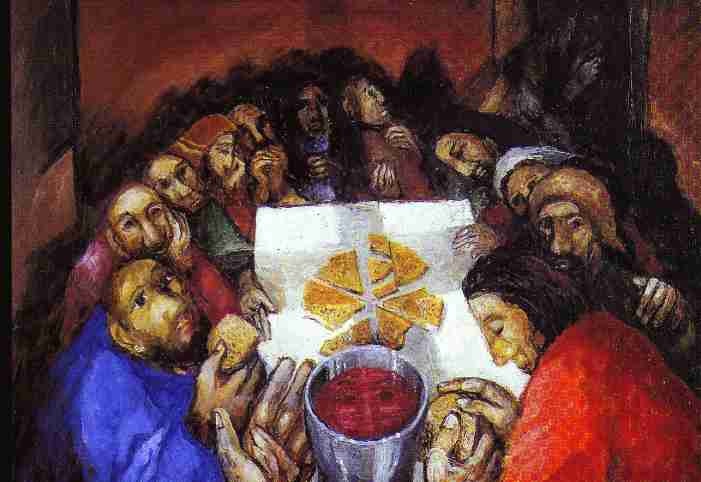 The last Supper by Sieger Köder
– an excerpt from Care of the Soul by Thomas Moore, p.253-54…
Faith is a gift of spirit that allows the soul to remain atteached to its own unfolding. When faith is soulful, it is always planted in the soil of wonder and questioning. It isn’t a defensive and anxious holding onto certain objects of belief, because doubt, as its shadow, can be brought into a faith that is fully mature.
Imagine a trust in yourself, or another person, or in life itself, that doesn’t need to be proved or demonstrated, that is able to contain uncertainty. People sometimes put their trust in a spiritual leader and are terribly betrayed if that person then fails to live up to ideals. But a real trust of faith would be to decide whether to trust someone, knowing that betrayal is inevitable because life and personality are never without shadow. The vulnerability that faith demands could be matched by an equal trust in oneself, the feeling that one can survive the pain of betrayal.
In soul faith there are always at least two figures – the “believer” and the “disbeliever”. Questioning thoughts, drifting away temporarily from commitments, constant change in one’s understanding of on’s faith – to the intellect these may appear to be weaknesses but to the soul they are the necessary and creative shadow which actually strengthens faith by filling it out and ridding it of its perfectionism. Both the angel of belief and the devil of doubt play constructive roles in a full-rounded faith. The third part of the trinity is life in the flesh lived with deep trust.
One of the liturgies that we use at the Seeds table picks up some similar themes so I want to stick it in here so they’re read together –
It would not have been God’s table
On their own, the bread and wine are nothing.
To become a foretaste and a promise
of love made real and a world made whole,
they need a story and a blessing
and a people who believe…
It would not have been God’s table
if they hadn’t all been gathered around it:
the betrayer and the friend
the power-hungry and the justice seeker
the faithful and the fickle.
When Jesus poured the wine, and the bread was broken;
when everyone could eat –
the outcast and the beloved
the arrogant and the gracious
the wrong-doer and the wrongly done by –
the table became a foretaste
of love made real
and of a world made whole.
Your company at the table, [guest],
will include the betrayer and the beloved
the wrong-doer and the wrongly done by.
It would not be God’s table without them.
And the promise is
that when you are together,
when you tell the story and give the blessing
when you break the bread and pour the wine
you will discover a foretaste
of love made real
and of a world made whole.
By Cheryl Lawrie, Uniting Church Australia
I re-read “5 Love Languages” today by Gary Chapman. Trying to do some work on actively identifying and naming some emotional needs so can try and take steps to see them fulfilled. Think I’m predominantly fluent in ‘acts of service’ – certainly that’s what I speak. I don’t think I’m very good at asking for things. It doesn’t count if it’s something someone ‘has’ to do for me. I want them to want to do it. Even chocolate or baking, it’s the act of thinking of me and doing something for me that matters more than the gift itself. This is closely linked with the type-2 Enneagram also, the belief that I need to do things for other people to be deserving of their love. I am treating love like a commodity. I am subscribed to the Enneathought for the day and last week one was: Love is not a commodity and is not scarce – this is one of those fundamental truth things that I probably need to be reminded of every day because I find it so hard to believe. I know not everyone is into these frameworks/tools but I can certainly say for myself that they have been really helpful in giving me a language to talk about things I’d otherwise leave unsaid and taken me on a journey of self-awareness – how much of my disappointment in life/relationships is about my own issues and expectations that I haven’t communicated with anyone about? I need to take some responsibility for managing myself. Luckily, the trick, with the enneagram stuff at least, is that awareness is enough – the change and transformation will come just through being conscious of our own behaviour. There’s a Jean Varnier quote that discusses the difference between loving community vs. loving people and gaining community. These are tools for learning how to love people well, even yourself.
When Mother Teresa was asked why she worked for the destitute and dying, she shocked the interviewer with the answer, “I do this to combat the Hitler in me.”
Mahatma Ghandi was speaking about much the same thing when he said, “When I see a man doing good, I seek to be like that man. When I see a man doing evil, I look to my own heart.”
Wise words. Unless we know and own, our own potential for evil, we are working with a grave handicap, for in the mystery of paradox, what is shadow in our lives, is the point of potential growth. Darkness is light unborn. Winter is preparation for Spring. Fear is always ready to be sacrificed to love. That is at the heart of the mystery that took Jesus to the cross and through to the resurrection.
It’s probably true that the poetry of metaphor and parable can make journey seem complex. I love story “sign posts” because I’m a writer, a dreamer. But the reality of our journey with Jesus is very simple. The tool of journey is love. The inhibitor is fear. The writer of the first letter of John put it succinctly. There is no fear in love but perfect love casts out all fear.
We know fear but as our capacity for love increases, so does the fear diminish. I find it useful to gauge my own actions and reactions with that measure. Does this come from love? Or does it come from fear? It’s a simple test and it usually works.
Here is an old Hassidic story about fear, which is a personal favourite. Some of you may have heard it before, but it is worth repeating. I find it very powerful.
There was once a holy man who went on a long journey. Unfortunately, he left his house open and while he was away a band of monsters moved in and made themselves at home. The man came back. He opened the front door and at once the monsters rushed at him. Quickly, he slammed the door shut. He prayed to God, took a deep breath and opened the door again. Once more the monsters came at him. As they did so, he bowed and acknowledged their presence. When he did that, half the monsters disappeared but the half that was left were the biggest. They snarled, showed their teeth and pounced on the man. He offered them hospitality, asked if he could get them food and drink. At that, all the monsters disappeared except the chief. Now this monster was huge, with enormous jaws and great sharp teeth. Moreover, it was not going to be put off. It lunged at the man, it’s mouth open wide. As it came close, the man put his head in the monster’s mouth. The chief of the monsters also vanished, and the man had his house back.
From time to time I sit with that story in order to find my chief fear and put my head in its mouth. It’s an ongoing exercise.
There is no perfection for us in life school. Thank God for that. Perfection has very little room for growth. We claim our errors and try to learn from them and our frailty, far from being a source of concern, is reason for gratitude. It is our God-given growing space.
We can summarise the stages of the personal journey more or less like this:
1. In early stages we can experience chaos as we are called to step into a larger space. 2. We can feel aloneness, vulnerability. 3. We become aware of remarkable God incidence, teachers, guidance, learning patterns, everything is there at the time when we need it. 4. We enter into the mystery of paradox. 5. We become aware that God’s word is all around us. We discover the parables of nature. 6. We have an overwhelming sense of the interconnectedness of everything. 7. There us a peace that comes with simplicity, a freedom, a lightness and enhanced sense of humour. 8. We have a knowing without words. 9. There is awareness that the foundation of the universe, is love. 10. We know that separation from God is an illusion.
The journey into paradox is one of true freedom and rejoicing. It is well expressed in this verse by American poet Leonard Cohen:
Ring the bells that still can ring.
Forget your perfect offering.
There is a crack in everything.
That’s how the light gets in.
Joy Cowley
I’m sure this is a time of year when everyone feels a lot of pressure – things to finish off before the end of the year, things to do, people to see, the quandary between the things I think/feel and the things I think I’m supposed to think/feel at this time of year…
I couldn’t sleep last night so I got up and started baking, found something soothing in following basic instructions, getting my hands dirty, feeling like I was making something – tangible evidence of results from work which I can sometimes be frustrated by not feeling day to day, I knew I was on prayers today but I felt like my head was in such a clamour that even if God were guiding me to some words of inspiration here – I couldn’t hear them.
It’s tempting to want to retreat from everything – get away from the commercialisation and the crowds, and family responsibilities – then my Christmas could be “holy”. But then I’m also running away from the lesson of Incarnation, the enfleshing of God —the lesson that we who are followers of Jesus don’t run from the secular stuff; but rather we try to transform it.
a book called…
The Whisper of Christmas . . . . . . . . . . . Joe E. Pennel, Jr., Nashville, Upper Room, 1984, p. 61
says “There is no evidence of any kind regarding the date of Jesus’ birth. His nativity began to be celebrated on Dec. 25 in Rome during the early part of the fourth century (AD 336) as a Christian counterpart to the pagan festival, popular among the worshipers of Mithras, called Sol Invictis, the Unconquerable Sun. At the very moment when the days are the shortest and darkness seems to have conquered light, the sun passes its nadir. Days grow longer, and although the cold will only increase for quite a long time, the ultimate conquest of winter is sure. This astronomical process is a parable of the career of the Incarnate One. At the moment when history is blackest, and in the least expected and obvious place, the Son of God is born…”
…a wiry tree growing up strong in a place where a tree shouldn’t be

Invite you to take something from the plate and to find something sustaining in something simple and home made, to smell the ginger, cinnamon, vanilla and chocolate.
I thought we could sit in silence, however you feel comfortable, and just “be”… after a minute or two, I’m going to play something instrumental – invite you to slow your breathing…. let everything that’s in your head, everything going on, rise up and then let it go… I invite you to be open to the advent of God.
Perhaps try and recapture some of the wonder… mystery… and believing in fragile miracles that can make this time of year meaning-full and transforming for us. Once the music is going feel free to light a candle, or speak prayers aloud if you like…
Wominjeka, Haere mai, Maliu mai, Dynnargh… w elcome our God of wonder…
I know that something in Covey’s book (7 Habits) crystalised the need I felt to leave my job. Part of the transition I hope but I feel overwhelmed, I feel raw, I feel afraid… I don’t know if this will be what I thought it would, I don’t know if I will be who people thought I was. I am afraid that there isn’t ‘enough’ to hold my role together, or rather perhaps, hold me together in my role but I cannot name what I need. I only feel sad.
For a group who talk a lot I don’t know that we say what we should say – I feel sometimes that my ears roar with all that is unsaid and I cannot hear what the person in front of me is saying over the ringing in my ears. False pride, false self, false humility. Reading in Tim Costello’s book “Streets of Hope” tonight he cites Nelson Mandela’s inauguration speech to the effect that “most of us are afraid not of our inadequacies but of our power to be ourselves”. Am I afraid of others or am I afraid of me?
Is it supposed to be this lonely? A regardless of how many people are around us do we ultimately travel alone? My hobby pastor thanked me for my faithfulness yesterday it doesn’t seem fair to accept gratitude for that – I just am and broken at that, of what worth? Why do I exclude myself from God’s grace? A community of broken people making broken offerings, there can be no other explanation.
 itellyouarise