Category: radical discipleship


When Mother Teresa was asked why she worked for the destitute and dying, she shocked the interviewer with the answer, “I do this to combat the Hitler in me.”

Mahatma Ghandi was speaking about much the same thing when he said, “When I see a man doing good, I seek to be like that man. When I see a man doing evil, I look to my own heart.”

Wise words. Unless we know and own, our own potential for evil, we are working with a grave handicap, for in the mystery of paradox, what is shadow in our lives, is the point of potential growth. Darkness is light unborn. Winter is preparation for Spring. Fear is always ready to be sacrificed to love. That is at the heart of the mystery that took Jesus to the cross and through to the resurrection.

It’s probably true that the poetry of metaphor and parable can make journey seem complex. I love story “sign posts” because I’m a writer, a dreamer. But the reality of our journey with Jesus is very simple. The tool of journey is love. The inhibitor is fear. The writer of the first letter of John put it succinctly. There is no fear in love but perfect love casts out all fear.

We know fear but as our capacity for love increases, so does the fear diminish. I find it useful to gauge my own actions and reactions with that measure. Does this come from love? Or does it come from fear? It’s a simple test and it usually works.

Here is an old Hassidic story about fear, which is a personal favourite. Some of you may have heard it before, but it is worth repeating. I find it very powerful.

There was once a holy man who went on a long journey. Unfortunately, he left his house open and while he was away a band of monsters moved in and made themselves at home. The man came back. He opened the front door and at once the monsters rushed at him. Quickly, he slammed the door shut. He prayed to God, took a deep breath and opened the door again. Once more the monsters came at him. As they did so, he bowed and acknowledged their presence. When he did that, half the monsters disappeared but the half that was left were the biggest. They snarled, showed their teeth and pounced on the man. He offered them hospitality, asked if he could get them food and drink. At that, all the monsters disappeared except the chief. Now this monster was huge, with enormous jaws and great sharp teeth. Moreover, it was not going to be put off. It lunged at the man, it’s mouth open wide. As it came close, the man put his head in the monster’s mouth. The chief of the monsters also vanished, and the man had his house back.

From time to time I sit with that story in order to find my chief fear and put my head in its mouth. It’s an ongoing exercise.

There is no perfection for us in life school. Thank God for that. Perfection has very little room for growth. We claim our errors and try to learn from them and our frailty, far from being a source of concern, is reason for gratitude. It is our God-given growing space.

We can summarise the stages of the personal journey more or less like this:

1. In early stages we can experience chaos as we are called to step into a larger space. 2. We can feel aloneness, vulnerability. 3. We become aware of remarkable God incidence, teachers, guidance, learning patterns, everything is there at the time when we need it. 4. We enter into the mystery of paradox. 5. We become aware that God’s word is all around us. We discover the parables of nature. 6. We have an overwhelming sense of the interconnectedness of everything. 7. There us a peace that comes with simplicity, a freedom, a lightness and enhanced sense of humour. 8. We have a knowing without words. 9. There is awareness that the foundation of the universe, is love. 10. We know that separation from God is an illusion.

The journey into paradox is one of true freedom and rejoicing. It is well expressed in this verse by American poet Leonard Cohen:

Ring the bells that still can ring.
Forget your perfect offering.
There is a crack in everything.
That’s how the light gets in.


Joy Cowley

I’m sure this is a time of year when everyone feels a lot of pressure – things to finish off before the end of the year, things to do, people to see, the quandary between the things I think/feel and the things I think I’m supposed to think/feel at this time of year…

I couldn’t sleep last night so I got up and started baking, found something soothing in following basic instructions, getting my hands dirty, feeling like I was making something – tangible evidence of results from work which I can sometimes be frustrated by not feeling day to day, I knew I was on prayers today but I felt like my head was in such a clamour that even if God were guiding me to some words of inspiration here – I couldn’t hear them.

It’s tempting to want to retreat from everything – get away from the commercialisation and the crowds, and family responsibilities – then my Christmas could be “holy”.  But then I’m also running away from the lesson of Incarnation, the enfleshing of God —the lesson that we who are followers of Jesus don’t run from the secular stuff; but rather we try to transform it.

a book called…

The Whisper of Christmas . . . . . . . . . . . Joe E. Pennel, Jr., Nashville, Upper Room, 1984, p. 61

says     “There is no evidence of any kind regarding the date of Jesus’ birth. His nativity began to be celebrated on Dec. 25 in Rome during the early part of the fourth century (AD 336) as a Christian counterpart to the pagan festival, popular among the worshipers of Mithras, called Sol Invictis, the Unconquerable Sun. At the very moment when the days are the shortest and darkness seems to have conquered light, the sun passes its nadir. Days grow longer, and although the cold will only increase for quite a long time, the ultimate conquest of winter is sure. This astronomical process is a parable of the career of the Incarnate One. At the moment when history is blackest, and in the least expected and obvious place, the Son of God is born…”

…a wiry tree growing up strong in a place where a tree shouldn’t be

Invite you to take something from the plate and to find something sustaining in something simple and home made, to smell the ginger, cinnamon, vanilla and chocolate.

I thought we could sit in silence, however you feel comfortable, and just “be”…    after a minute or two, I’m going to play something instrumental  –  invite you to slow your breathing….                   let everything that’s in your head, everything going on, rise up and then let it go…       I invite you to be open to the advent of God.

Perhaps try and recapture some of the wonder… mystery… and believing in fragile miracles that can make this time of year meaning-full  and transforming for us.  Once the music is going feel free to light a candle, or speak prayers aloud if you like…

Wominjeka, Haere mai, Maliu mai, Dynnargh… w elcome our God of wonder…

I know that something in Covey’s book (7 Habits) crystalised the need I felt to leave my job.  Part of the transition I hope but I feel overwhelmed, I feel raw, I feel afraid… I don’t know if this will be what I thought it would, I don’t know if I will be who people thought I was. I am afraid that there isn’t ‘enough’ to hold my role together, or rather perhaps, hold me together in my role but I cannot name what I need. I only feel sad.

For a group who talk a lot I don’t know that we say what we should say – I feel sometimes that my ears roar with all that is unsaid and I cannot hear what the person in front of me is saying over the ringing in my ears. False pride, false self, false humility.  Reading in Tim Costello’s book “Streets of Hope” tonight he cites Nelson Mandela’s inauguration speech to the effect that “most of us are afraid not of our inadequacies but of our power to be ourselves”. Am I afraid of others or am I afraid of me?

Is it supposed to be this lonely?  A regardless of how many people are around us do we ultimately travel alone? My hobby pastor thanked me for my faithfulness yesterday it doesn’t seem fair to accept gratitude for that – I just am and broken at that, of what worth? Why do I exclude myself from God’s grace? A community of broken people making broken offerings, there can be no other explanation.

Mobile hospitality


Fortnightly we do a blanket run – load blankets, a thermos of hot coffee and some bikkies on a trolley (in summer we switch to ice blocks and juice) and wander the streets and laneways of Melbourne on Sunday nights from about 9pm.

When we first started to do the run and we weren’t sure where we might find people, we’d often reflect on what we might look for ourselves in a place to sleep and then look for places that met those criteria – somewhere dark, sheltered from wind/rain, private…  it was interesting to learn that actually well-lit and populated places are much safer, for everyone actually but especially for a single woman. This was important in coming to understand why the issue of homelessness can feel like a ‘visible’ one. We did not end up needing to look very hard at all to find people to share hospitality with.

Three runs in a row we walked past a woman sleeping on the mat out the front of a jewellery store on a main street in the CBD.  Each time we saw her we offered her coffee or blankets and she didn’t speak – either mutely shaking her head or ignoring us completely.

The fortnight after that…?  We sat together for twenty minutes over a cup of coffee.  She told me her name, offered me a cigarette and told me a little about her three imaginary friends who were sitting with us.

The fortnight after that…? Just a silent head shake “no”

After that…?

I haven’t seen her since.

This isn’t a story about sharing the ‘good news’.  She didn’t start coming to the free lunch we run.  I didn’t advocate for her on any issue or find her housing or work or bring about reconciliation with her family.  I have no idea if she even needed any of that.

It’s hard sometimes not knowing what has happened to someone.  I noticed you were gone and I hope that you’re ok.

We take turns running prayers at the start of admin meeting and Blythe is projecting a video on the wall of bread being made: ingredients mixed, kneading, left to rise… In Matthew 13:33 Jesus says “the kingdom of heaven is like yeast that a woman took and mixed in with three measures of flour until all of it was leavened.”

Without notice the yeast begins to permeate the dough and the dough begins to rise, Jesus said “follow me” without saying where he was going but promising transformation.  A God of broken people and broken places, he asks us to leave what we know and go into wilderness desert. Far we have come, far we must go. We believe in a God of rebuilt places and rebuilt people.

This is where the concept of liminal space was first introduced to me:


We have left point A but have not arrived at point B yet.  The liminal space is the in between-ness of being neither here nor there.  These transitional phases – they are not necessarily a comfortable place to be, it is hard to know what to be sure of, but we can have a default to view change as negative and it is not always so.  God led the Israelites into the desert for 40 years, many of them complained and sought to return to the relative comfort of slavery (regular meals!) under the Egyptians. “In that way I will test them, whether they will follow my instruction or not.” (Ex 16:4) Perhaps we can begin to see these liminal spaces as an opportunity for growth and learning, with the assurance that God is with us as a broken person in a broken place.

Far we must go – but we need not go alone.

As the yeast transforms the bread, so knowing God yields subtle transformation in our lives. Be present to the transformation that is happening around you…

How would completing the sentence, “the kingdom of heaven is like…” or “the economy of God is like…”  look like in your context?

Earlier this year Samara wrote some for us, here are some that she came up with:

The Economy of God is like…

…a residents’ group who lived in the heart of the city.  One day a woman buzzed level 8 demanding assistance.  One of the residents invited her in and spent the day helping her contact Hanover, giving her access to the phones and accompanying her to apply for crisis housing.  Finally when the resident was tired and fed up after a day of being bossed around, she invited the woman over to her place for dinner.

The Economy of God is like…
…a street and hospitality group whose regular retreat campsite was destroyed by bushfire.  Some people who had experienced loss and homelessness wanted to help out, so a BBQ and cake stall was organised.  When the time came to set up the stall on Collins St, the food was all prepared but the people who’d suggested the event were not available.  Instead of cancelling, some others stepped in and ran the stall.  They sold many sausages and cupcakes, and they raised twice as much money as they had expected.  And there were two plates full of cakes left over to enjoy the next day!

The Economy of God is like…
…a youth and schools team who ran a seminar for a feisty bunch of Year 9s who thought the homeless had it easy.  When they started complaining that homeless people should have their Centrelink payments cut and go and get a job, the presenter who’d experienced homelessness explained how his 14 year old kids would end up visiting him on the street…and some of the Year 9s changed their minds!

The Economy of God is like…
…a fundraising team who went to a training day on finances.  When they got there they discovered that they were the youngest in the room by 15 years and that all the baby boomers in the room were terrified of the Global Financial Crisis.  The fundraising team spoke soothingly to them and invited them to lunch at Credo.

The Economy of God is like…
…an open meal in a basement where they invested in litres of coloured paint but no dishwasher.

I shifted over from NZ in July & started connecting regularly with Seeds from about October 2007. I have spent a lot of time since then trying to figure out exactly what “community” is. Marcus regularly talks about this concept of “growing home”, meeting to prepare and share a meal together, to be neighbours and engaged in the community together – that’s where church happens.

This tapped into this greater struggle I already had going in my head: relating to missing family and friends back home, to feeling like I have no support networks here. In a new city nothing is familiar; the streets, street/place names, the skyline, the public transport system – going out, it feels like you need to arm yourself for a hostile environment.  Can feel vulnerable and insecure all the time.

When I started learning about the work of Urban Seed, I approached it based on the assumption that I would be on the ‘giving help to homeless people’ side of the service. I didn’t realise that actually, I am homeless myself…

“homelessness” is nothing to do with not having a house. Urban Seed doesn’t provide housing, Urban Seed provides an opportunity to be connected in a community. Feels like a really profound revelation for me – my definition of homeless was quite narrow:

Homeless: Without a home. Persons who lack permanent housing.

But in reality, homelessness is:

Homeless: ‘An inadequate experience of connectedness with family and/or community.

If we use the latter definition, does that change the number of homeless people you know?

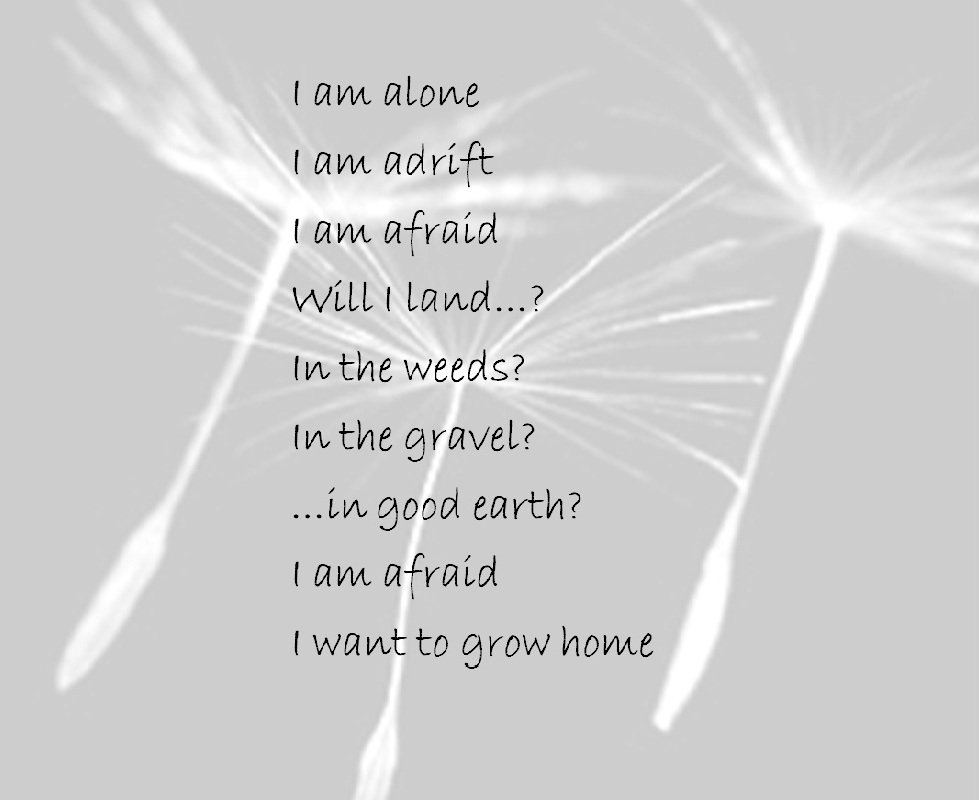
The picture at the top is a poem I wrote when in this space – trying to express something of my experience of the state of homelessness…

This is loosely based on the parable of the farmer in the gospels (Matthew), the farmer scatters seed and the stuff on the road gets eaten by birds, the seed in rocky ground grows but gets scorched and some landed in the weeds and got choked but some landed in good earth and produced 100/60/30x what was planted.

I have times when I wonder whether shifting here was the right thing to do. I keep waiting to see one of those big signs like you have on the highways here that say WRONG WAY, TURN BACK! I am afraid that I might not flourish here, that I might not find good earth I which to put down strong roots.

Marcus pointed out that we’re all homeless, all on a journey back to our heavenly home – having to leave the home we know, that’s part of our history.

This kingdom of faith is now your home country. You belong here… God is building a home. He is using you in what he is building. He used the apostles and prophets for the foundation. Now he’s using you, fitting you in brick by brick, stone by stone, seed by seed with Jesus as the cornerstone that holds everything together. We see it taking shape day after day…  (slight paraphrasing, Ephesians 2:19-22)

I was feeling adrift, like I wasn’t connected to anything, reading this was really grounding, it gave me something concrete to hold onto – it was such a relief to have something I felt certain about.

Maybe I’ve been homesick all my life, homesick for heaven, and because all of the things that made my life full I couldn’t see it as clearly.  Perhaps because my environment was known and familiar I could pretend that was enough, and it’s only through shifting to a new country that I’ve had to question what I think I know.

2 Corinthians 5:4 reads “For while we are in this tent, we groan and are burdened, because we wish to be clothed with our heavenly dwelling, so that what is mortal may be swallowed up by life.”  Perhaps the pursuit of happiness in this life is really part of the search for home, a search for heaven.  Maybe this life is never meant to be completely satisfactory, the passage goes on to say God has given us the Spirit as a deposit, guaranteeing what is to come. So we have this Spirit within us that is always longing for God, to be with God… longing for home.

For a lot of people in the pursuit of happiness, they express dissatisfaction with their tents by redecorating them or damaging them. Perhaps no one’s quite sure what our home’s supposed to be, we live by faith not by sight, but it seems we’re all agreed that it’s something other than what we have.  What we’re pursuing is change, what we long for is to grow home…

Now when I go back to NZ I found it very valuable in helping me to see how much progress I’ve made towards growing a home here. Urban Seed is helping me do that, helping a lot of people do that. That’s what Urban Seed/Seeds is about: It’s about providing good earth, where people can put down some roots and grow, it’s about providing spaces where people who feel homeless can experience connectedness while on the journey to grow home.