Category: the art of discipleship


IMG_0690

We are running a fortnightly bible study following our community dinner looking at the exegesis (interpretation) of the bible passages that underpin each of our community values. You can read the list of Values here so you know what’s coming up next.

These values can be relevant whatever context you live and work in just make the Word you own.


Value 2: In it for the long haul

We value being a constant in an inconsistent world, expecting and persevering through hard times.  Our long-term commitment allows us to build trust and respect with those in our community, as we try to reflect God’s unconditional love and grace.

Biblical basis: Hebrews 10:36


Let’s read the value together… what words/phrases stand out?

  • persevering through hard times…
  • constant…
  • try to reflect God’s unconditional love…


Read the bible. What words/ideas stand out?
What can we learn from the bible about living the Value: In it for the long haul?


Hebrews 10:19-25; 32-39

 19 Therefore, my friends,[g] since we have confidence to enter the sanctuary by the blood of Jesus, 20 by the new and living way that he opened for us through the curtain (that is, through his flesh), 21 and since we have a great priest over the house of God, 22 let us approach with a true heart in full assurance of faith, with our hearts sprinkled clean from an evil conscience and our bodies washed with pure water.23 Let us hold fast to the confession of our hope without wavering, for he who has promised is faithful. 24 And let us consider how to provoke one another to love and good deeds, 25 not neglecting to meet together, as is the habit of some, but encouraging one another, and all the more as you see the Day approaching.

32 But recall those earlier days when, after you had been enlightened, you endured a hard struggle with sufferings, 33 sometimes being publicly exposed to abuse and persecution, and sometimes being partners with those so treated. 34 For you had compassion for those who were in prison, and you cheerfully accepted the plundering of your possessions, knowing that you yourselves possessed something better and more lasting. 35 Do not, therefore, abandon that confidence of yours; it brings a great reward. 36 For you need endurance, so that when you have done the will of God, you may receive what was promised. 37 For yet

“in a very little while,
the one who is coming will come and will not delay;
38 but my righteous one will live by faith.
My soul takes no pleasure in anyone who shrinks back.”

39 But we are not among those who shrink back and so are lost, but among those who have faith and so are saved.

 – NRSV


Reflection time… followed by sharing time.

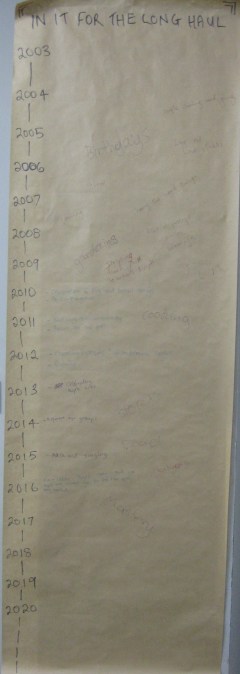
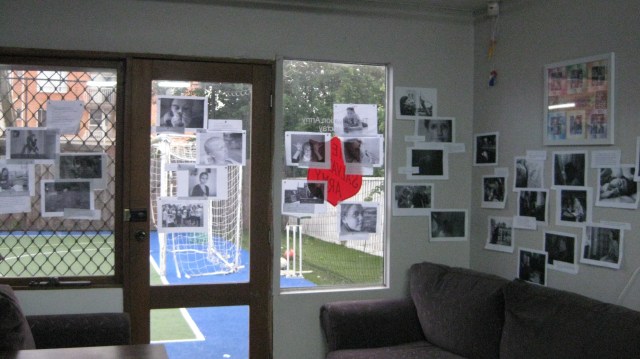
The photos around the walls of this house are a testament to the “long haul” of this community, let’s get up and have a look at these photos…

  • what can you see?
  • what should we keep doing?
  • what keeps you coming back?
  • how can we “consider how to provoke one another to love and good deeds”


IMG_0703

Here are some of the things that have kept us going for the long haul, encourage us when things are tough and inspire us to want to be here in Footscray for another 10 years!

⊕  celebrating people’s’ lives  ⊕  birthdays ⊕ people coming and going  ⊕  growing up together  ⊕  smiling  ⊕  gardening  ⊕  sharing the hard things  ⊕  participating in rites of passage like births, baptisms and marriages  ⊕  celebration of big and small things  ⊕  grieving together  ⊕  serving the community  ⊕  cooking  ⊕  having fun and being silly together  ⊕  focus on the poor  ⊕  playing sport  ⊕  playing music and singing  ⊕  being creative  ⊕  having mastery/learning of new skills  ⊕  Other people come and go. People are always here.  You feel like you are needed.  ⊕  different age groups  ⊕  sharing food  ⊕

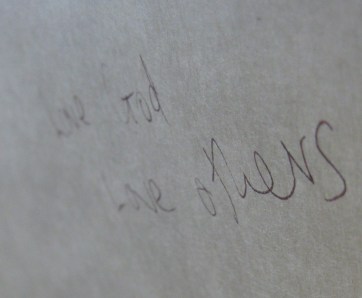
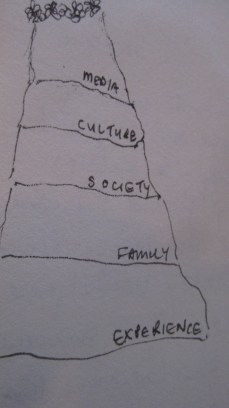
As we sat with this, Ash observed that there is a stripping down faith to what’s important that happens in all of this… what is that?
IMG_0706 - Copy

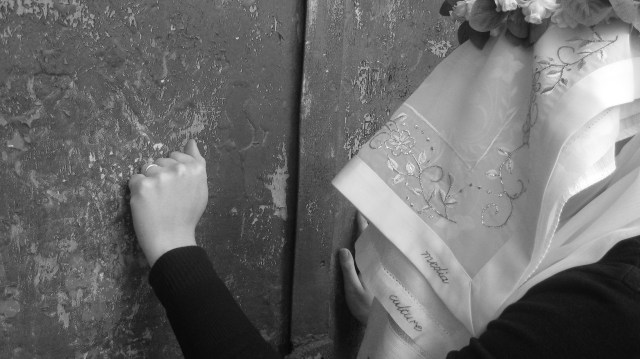
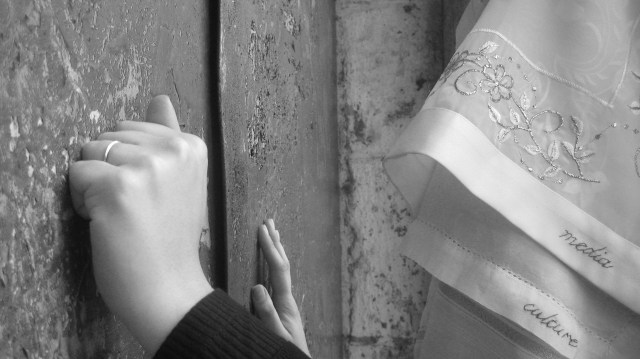
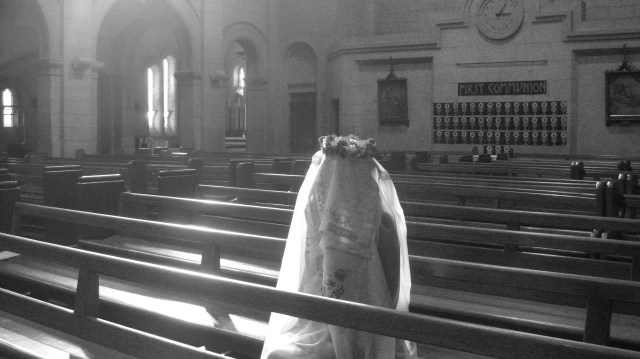
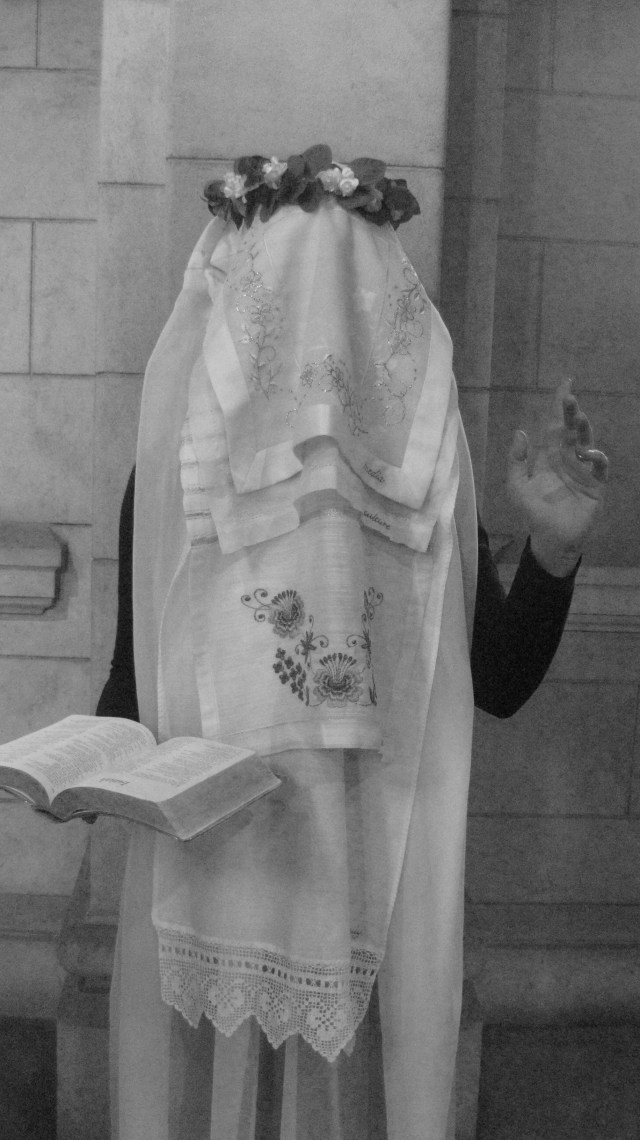
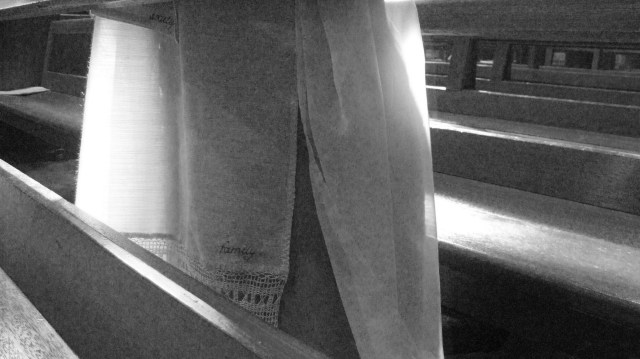
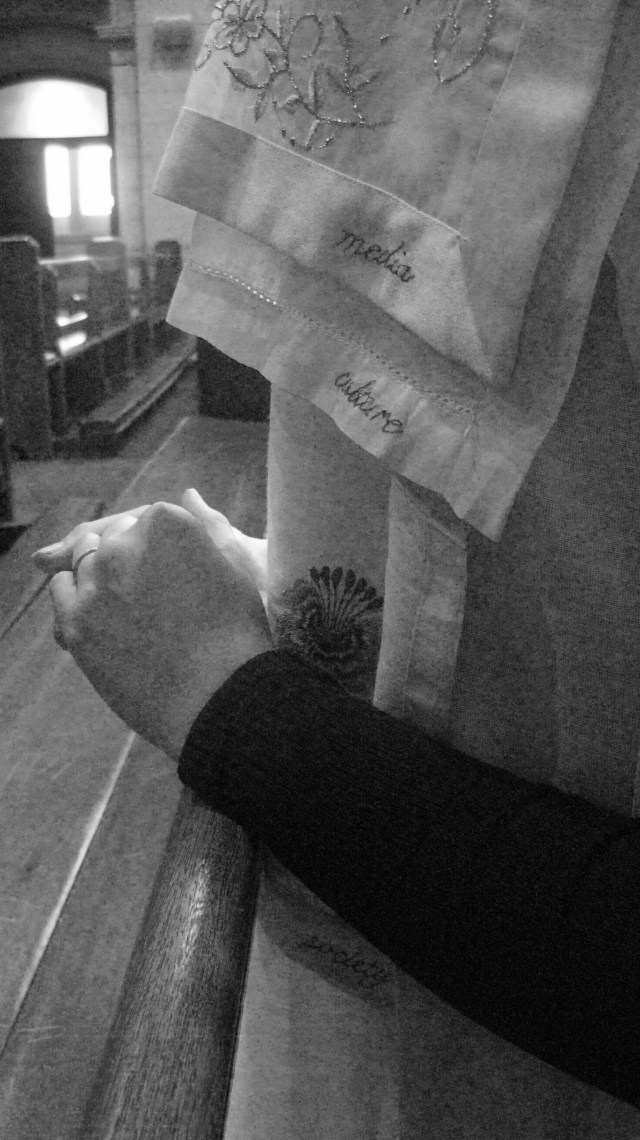
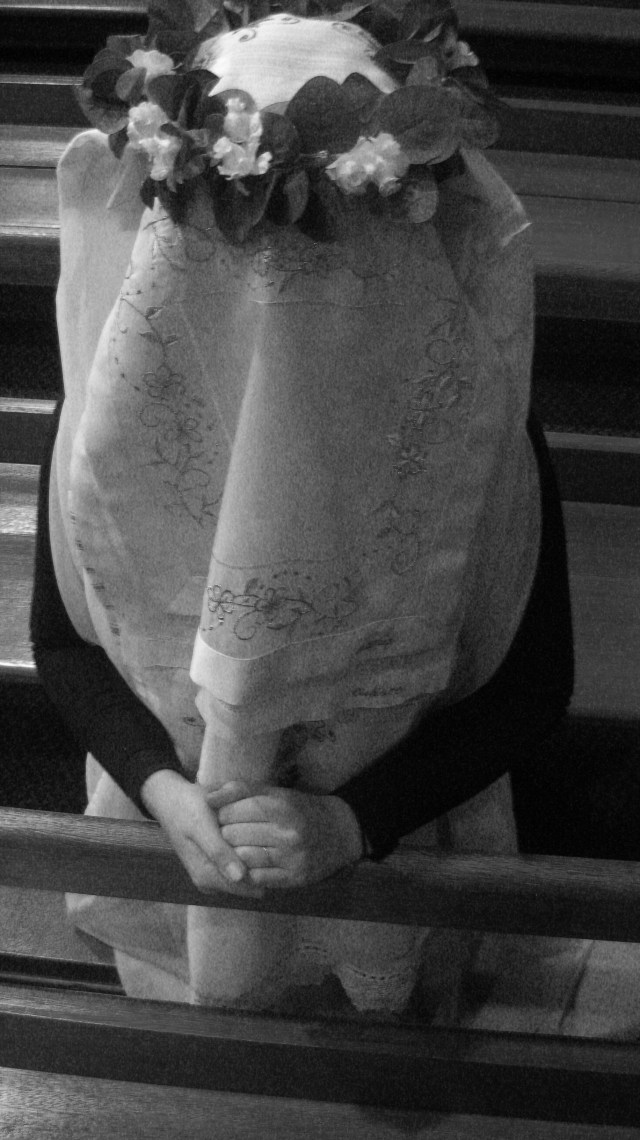
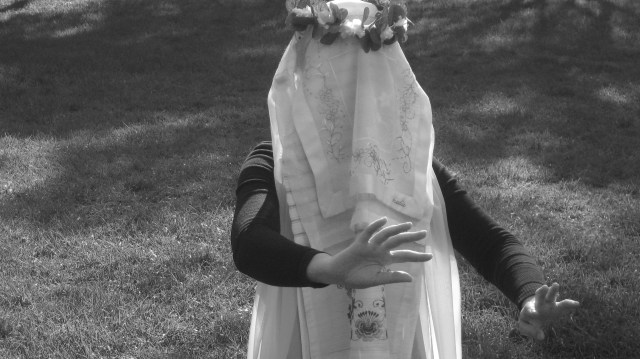
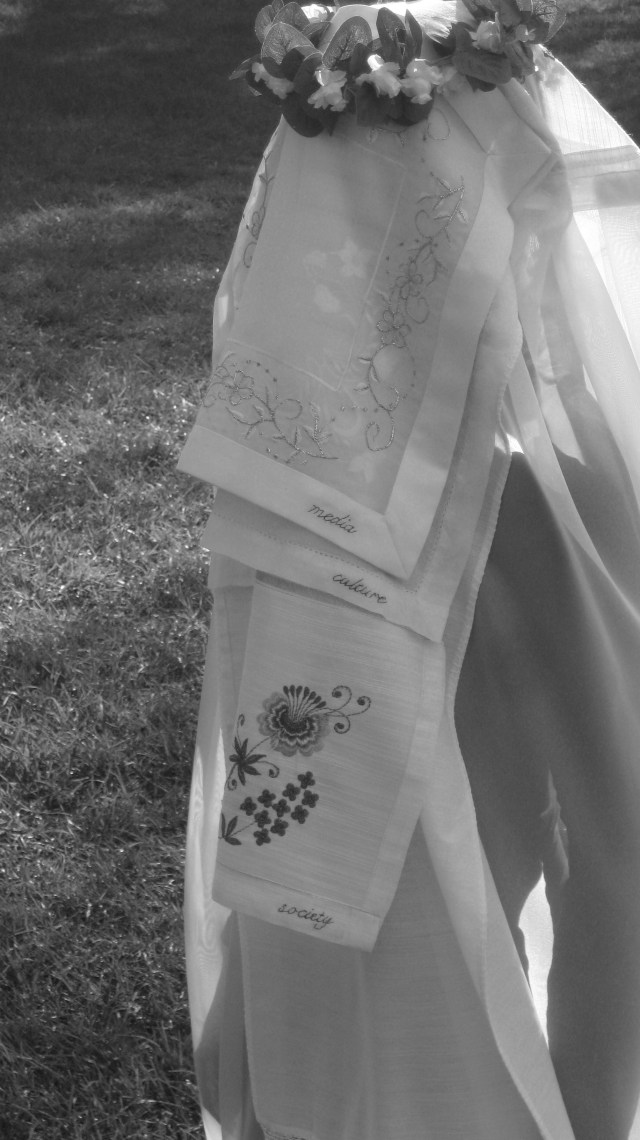
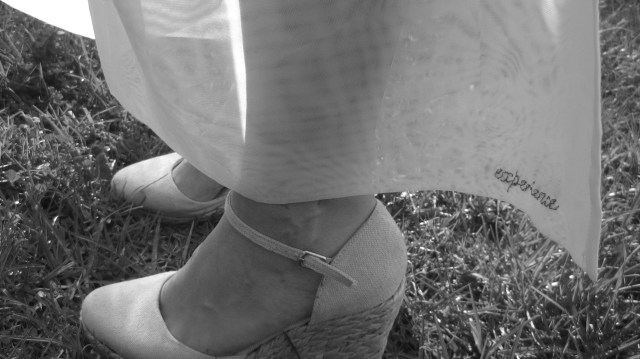
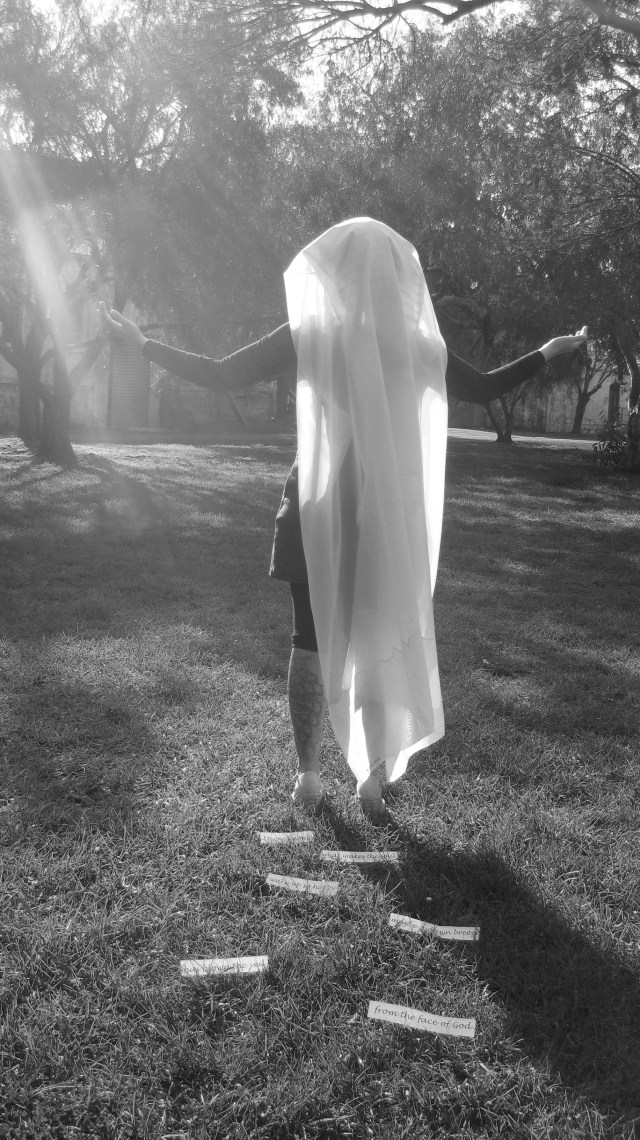
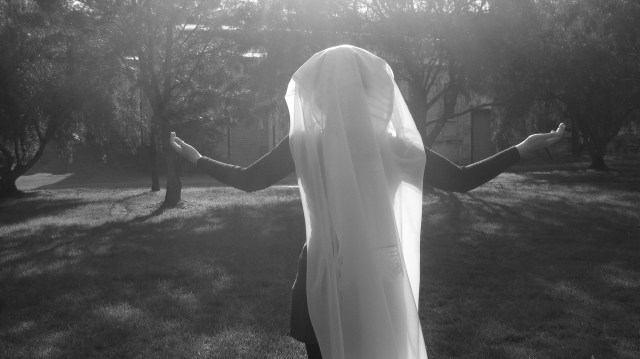
IMG_0063I have been struggling recently… just figuring out how to exist well in a world where so much feels obfuscated by the power of things unseen to influence and affect my life.  Things and people that seek to control my choices by limiting my choices. As a way of praying, personal confession and speaking to powers I wanted to somehow create a physical metaphor for the ideas circling in my head and this is how the idea for the veil came about.
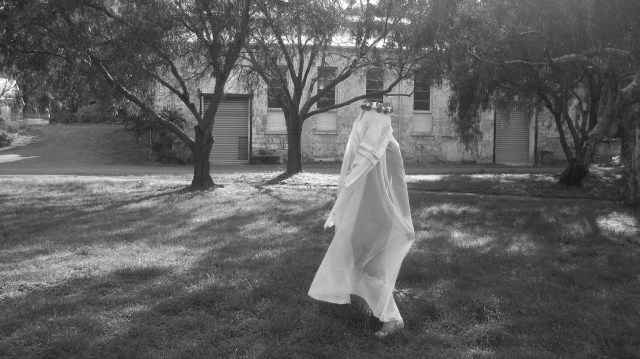
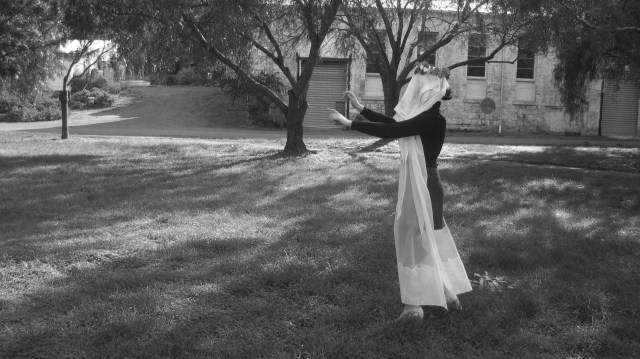
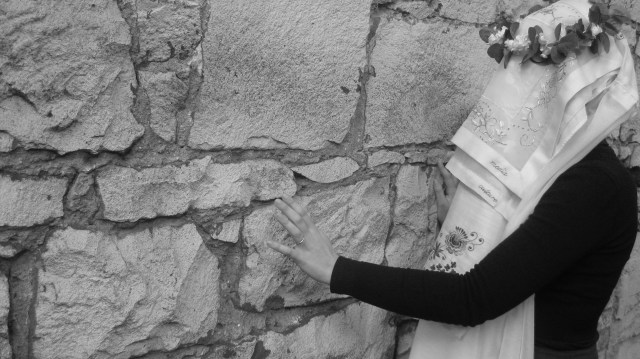
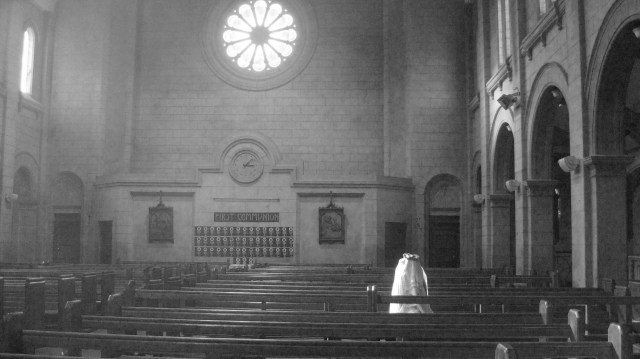
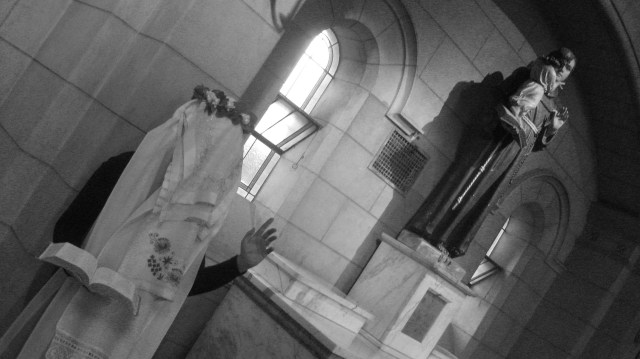
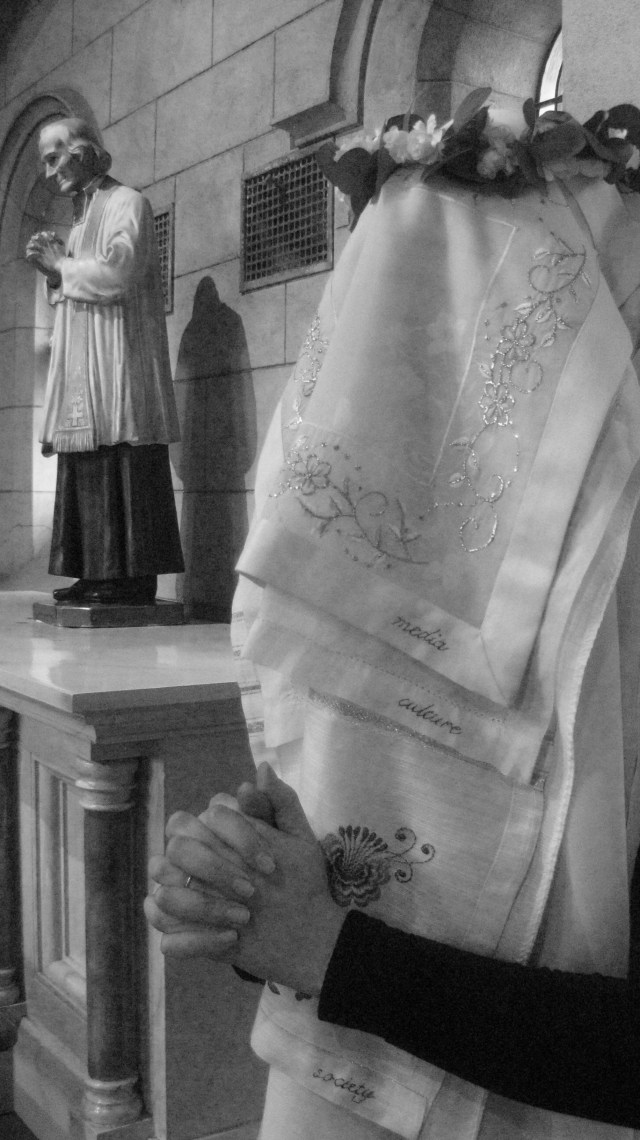
What follows here is a series of images that seeks to playfully and prayerfully explore, critique, live-into-being the answer to some of my own questions around this idea of what barriers are coming between us and being able to see God clearly…

Here are some of my queries:

In what ways does this veil shelter or smother me?

How can we know and be known through such thickness that clouds and blinds us?

At a recent team planning day, the facilitator mentioned that the church “as we know it” has 17 years left… it’s dying.  What does this mean if we reflect on the Church as the Bride of Christ? Is the church glorious? …holy and without blemish? ready?

Ephesians 5:25 Husbands, love your wives, even as Christ also loved the church, and gave himself for it; 26 That he might sanctify and cleanse it with the washing of water by the word, 27 That he might present it to himself a glorious church, not having spot, or wrinkle, or any such thing; but that it should be holy and without blemish.

Revelation 19:7 Let us be glad and rejoice, and give honour to him: for the marriage of the Lamb is come, and his wife hath made herself ready.8 And to her was granted that she should be arrayed in fine linen, clean and white: for the fine linen is the righteousness of saints.9 And he saith unto me, Write, Blessed [are] they which are called unto the marriage supper of the Lamb. And he saith unto me, These are the true sayings of God.

The Greek word ecclesia, for church, means “The called-out (ones)” i.e. the church is its people, if the institutional church as we know it dies – what does that mean for the called? Does God become a widower?

What does it look like to live with full access to God? How can we remove the veil that creates separation between God and humankind?

Covenant symbols in Christianity: BRIDAL VEIL
“Not only does the bridal veil show the modesty and purity of the bride and her reverence for God, it reminds us of the Temple veil which was torn in two when Christ died on the cross. The removing of the veil took away the separation between God and man, giving believers access into the very presence of God. Since Christian marriage is a picture of the union between Christ and the church, we see another reflection of this relationship in the removal of the bridal veil. Through marriage, the couple now has full access to one another. (1 Corinthians 7:4)” [from about.com]

How might we compare and contrast this invisible veil with a hijab or niqab? What is visible and what is hidden by them?

I first wore the headscarf at the age of 18 (with no pressure to wear it from parents at all even though they are very devout religious leaders in our community). My reason for wearing it was that I was at a point in my life where I was growing in my faith journey and wanted to make my surrender to God visible. For me the headscarf was an extension of my prayer (it is exactly what I wear when I pray).  The act of wearing a scarf had nothing to do with a man, whether it was my father, brother or husband. In fact, my husband did not see me without a scarf until we were engaged. This in itself raises an interesting function that many women who wear the scarf also acknowledge- that the scarf can liberate their bodies from the insistent objectification of women in the public space. It demands that people deal with them based on their intellect, values, manners, behavior, ideas, etc and not based on their looks. Quite a strong feminist statement.            – Dr Nora Amath

Is the Church lost? What is it looking for? What does it need? What does it pray for? Is it lonely? Is it static? Is it dead/dying?

IMG_0204

IMG_0206

IMG_0174

IMG_0180

IMG_0181

IMG_0295

IMG_0284


IMG_0337

IMG_0338

IMG_0343

IMG_0301

IMG_0335

IMG_0321

IMG_0314

IMG_0219

IMG_0220

IMG_0234

IMG_0275

IMG_0276

IMG_0278

IMG_0262

IMG_0265

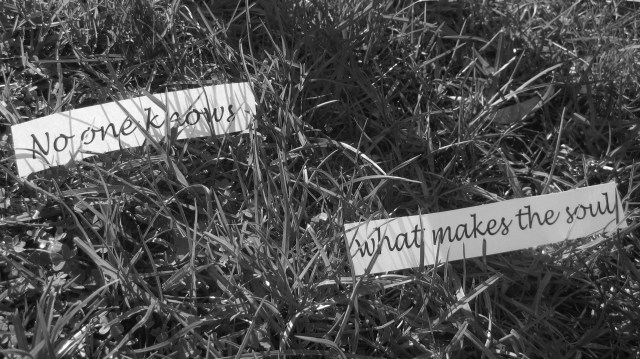
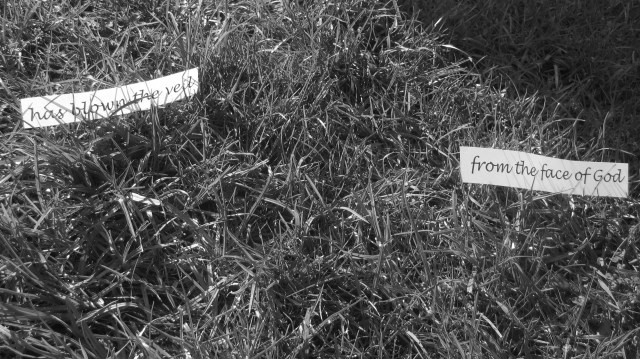
No one knows what makes the soul
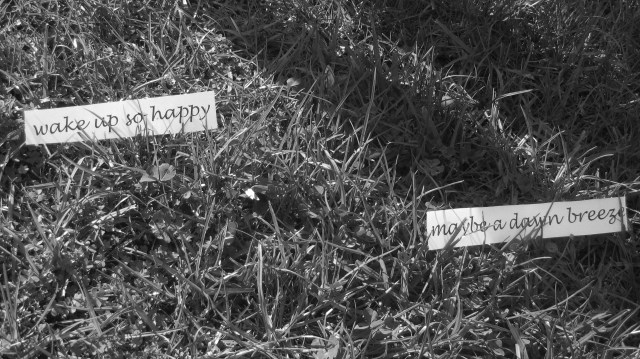
wake up so happy

Maybe a dawn breeze has blown the veil
from the face of God.

~ Rumi


IMG_0146

We are running a fortnightly bible study following our community dinner looking at the exegesis (interpretation) of the bible passages that underpin each of our community values. You can read the list of Values here so you know what’s coming up next.

These values can be relevant whatever context you live and work in just make the Word you own.


Value 1: Partnering with God

We value the opportunity of participating in the Missio Dei (mission of God). Through persistence in prayer, we seek to recognise where God is at work in Footscray, and become co-workers with Christ.

Biblical basis: Psalm 127:1, Luke 18:7, 1 Cor 3:9


Let’s read the value together. What words stand out? Any you don’t know?

What does being a partner mean? What are some different examples of partners?

business partner, relationships, sport teams, partner in crime, duet…

What sorts of things do partners do for each other?

work together, help out, trust, backup in tough times, share responsibility…

Read the bible. What words/ideas stand out?


Psalm 127:1-2

Unless you’ve commissioned the building project, LORD,
……..attempting construction would be futile.
Unless you’re in charge of security, LORD,
……..our gates and guards are a waste of effort.
We could work ourselves to the bone for nothing;
……..first on the job in the morning, last home at night,
…………….and what would we have to show for it?
……..Nothing but heartaches and ulcers.
You, LORD, long for us to slow down.
……..We can relax and trust in your loving care.


©2000 Nathan Nettleton LaughingBird.net


Luke 18: 1-8

Jesus told this story to encourage people to be persistent in prayer and never lose heart:

Once upon a time there was a town magistrate who took no notice of God and had no respect for anyone. There was a widowed woman in the town who had very little in the way of resources or influence, but who kept contacting the magistrate and demanding that he take action to protect her rights in a dispute with a powerful opponent. For a while he just kept brushing her off, but eventually he said to himself, “I couldn’t care less what happens to this woman, and all her talk of God’s justice means nothing to me; but I’m going to give her what she wants because I’m sick to death of her nagging and I just want to get her off my back.”

And the Lord commented on his story, saying:

“Do you hear the point in what the callous magistrate is saying? If he can be pressured into acting for justice, can’t you see how much more certain it is that God will bring about justice for those who have dedicated themselves to God and cry out for help night and day. Will God brush them off and ignore their pleas. You can take it from me: God will waste no time in bringing about justice for them. And yet, will the New Human find much of that sort of persistent faith on earth when he makes his entrance?

©2001 Nathan Nettleton LaughingBird.net

1 Cor 3:5-9

 Who do you think Paul is, anyway? Or Apollos, for that matter? Servants, both of us—servants who waited on you as you gradually learned to entrust your lives to our mutual Master. We each carried out our servant assignment. I planted the seed, Apollos watered the plants, but God made you grow. It’s not the one who plants or the one who waters who is at the center of this process but God, who makes things grow. Planting and watering are menial servant jobs at minimum wages. What makes them worth doing is the God we are serving. You happen to be God’s field in which we are working.

 The Message


Reflection time

What can we learn from the bible about living the value of “Partnering with God”?

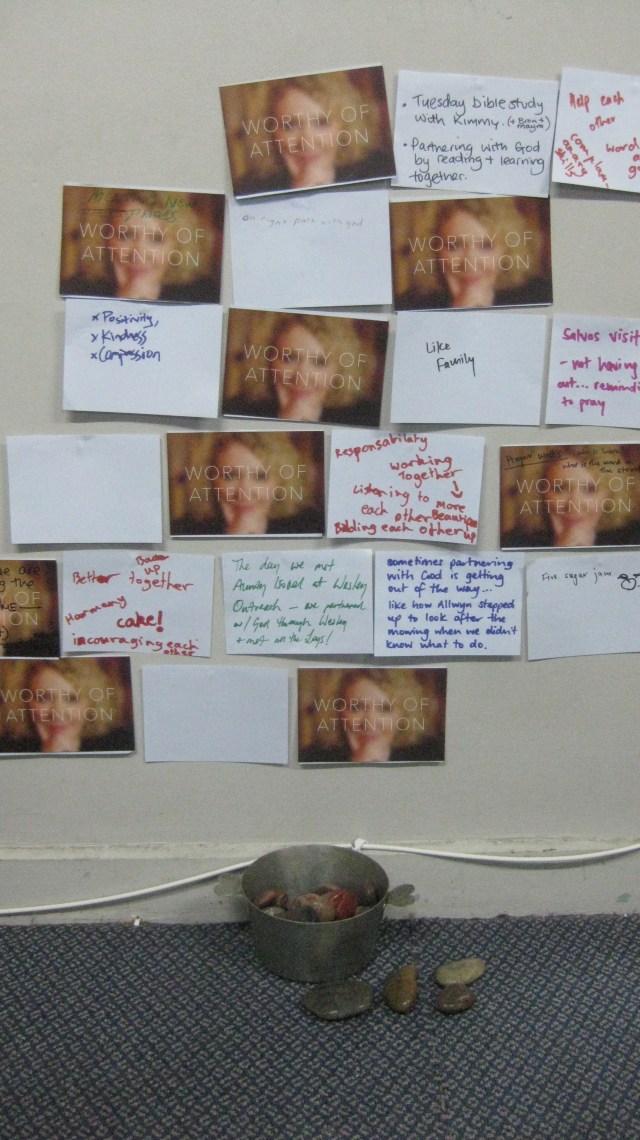
  • Building bricks… Some of these things that we said partners do for each other – how are we doing them for God now? Or how could we start? Share a story…
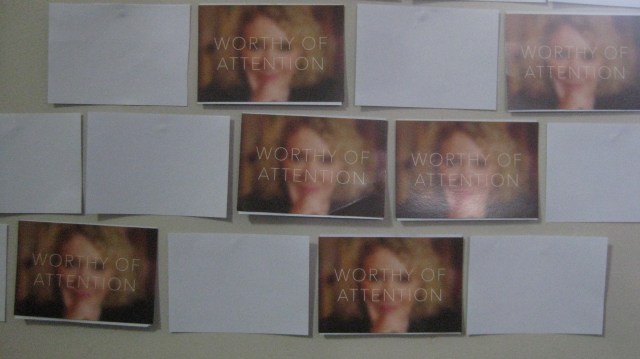
  • Postcards… Persistence in prayer… what is God telling us is worthy of attention in Footscray? What should we focus on?
  • Stones… is there anything that should be left out of what we are building together here? What are the things that stop us choosing the right bricks?


IMG_0154

Artwork by Aysha Tufa

I’m spending my weekend popping in and out of varied sessions of the Footscray Arts Centres West Writers Forum – the description for a workshop I made it to today reflected on language:

As our world grows smaller and people become more familiar with one another through daily cross-cultural interactions, what stops us from finding ourselves or losing ourselves in each other’s stories? Is translation the final frontier in creative writing? Can we achieve fluid creative and cultural exchanges through the translation of stories? Or will some things always remain lost in translation? Join moderator Mridula Nath Chakraborty in conversation with academics Sanaz Fotouhi and Dr Nadia NiazLily Yulianti Farid and Josiane Behmoiras for this panel.

 Lots of different ideas came through –

The minute you write – let it go.
It will mean something different to every reader.
You can put forward your intention for the words
but that may or may not be picked up.

Josianne Behmoiras

Contextual translation is more important that word-by-word.
You need to translate meaning to a medium your audience can understand…

The interpreter makes their own “work”.

Dr Nadia Niaz

The original word in Buginese “Mukkunrai”
had to remain to carry the meaning – the English translation
“female” doesn’t capture all of the cultural meaning.
(on the title of her short story collection)

Lily Youlanti

All of us find ourselves constantly
translating and transitioning,
asking: “Where do I sit?”

Sanaz Fotouhi

This quote got shared; Charles Simic’s take on the magical absurdity of translating poetry: “It’s that pigheaded effort to convey in words of another language not only the literal meaning of a poem but an alien way of seeing things … To translate is not only to experience what makes each language distinct, but to draw close to the mystery of the relationship between word and thing, letter and spirit, self and world.” (and the article I found it in from The New Yorker mentions many of the panel-referenced works re the translation movement in Japan).

This panel of five had cultural tails in the following languages: French, Hebrew, Latino, Turkish, Kurdish, Buginese, Bahasa, Urdu, Bengali and more I’m sure… a lot of the focus of the session was around translating into English and how you break into, speak into, build an audience amongst English (white middle-class) readers (they are mostly the ones buying books/running the theatres/festivals/publishing houses, etc.).

I found myself thinking about Te Reo Māori (the native language of New Zealand where I am from) and how few speakers there are – there is a need to find reasons to use this language.  What might it look like to translate poems – not word for word – but their meaning.   This kind of interpretation lends itself to crafting something new. What does it mean to take the words I have written to be grounded back into where I come from? What might I discover through that process? Like the Treaty of Waitangi we will end up with 3 versions: original English, Māori translation and then a translation of the Māori back into English… apologies to anyone fluent in Māori who reads these as I’m bound to make gaffes in grammar and word choice… {if you want to collaborate on correct translations get in touch!}

i.

I sit down in the middle of the river

The river sits in the middle of me

Won’t you come and sit by the river?

Sit by the river awhile with me

ii.

Enoho au ki roto i te awa
Aparima enohoana ki roto iho
Haere tahi i roto ki te awa?
Haere mai ki te Mātāpuna a muri ngākau ahau

iii.

I sit down in the middle of the river
Aparima* sits always at the heart of who I am
Will you keep me company at the river?
You are welcome at the Source that sits at the heart of me

(* Aparima is the name of the river that I identify with in my mihi, it denotes the acknowledgment of place/where I am from)


i.

There is Room at the Table (originally written as a song to welcome asylum seekers/boat people coming to Australia, used at a Welcome Picnic outside a local detention centre)

There is room at the table x3
Let them in, let them stay

There is room at the border x3
Let them in, let them stay

There is room in our hearts x3
Let them in, let them stay

There is hope for a new tomorrow x3
Let them in, let them stay

ii.

He wāhi anō kai roto i te tēpu mo tētahi atu tangata?
Haere mai ra, haere mai ra, haere mai ra
Haere mai, nau mai, e ngā iwi e

He wāhi anō kai roto i te rohe mo tētahi atu tangata?
Haere mai ra, haere mai ra, haere mai ra
Haere mai, nau mai, e ngā iwi e

He wāhi anō kai roto i te to tatou ngākau mo tētahi atu tangata?
Haere mai ra, haere mai ra, haere mai ra
Haere mai, nau mai, e ngā iwi e

Nāu te rourou, nāku te rourou ka ora te manuwhiri
Haere mai ra, haere mai ra, haere mai ra
Haere mai, nau mai, e ngā iwi e

iii.

Is there space at the table for one more person?
Welcome, everyone is welcome

Is there space at the border for one more person?
Welcome, everyone is welcome

Is there space in our hearts for one more person?
Welcome, everyone is welcome

We will all contribute what we have and there will be enough to share
Welcome, everyone is welcome


Queries:

What is notable about the differences in the English translations?

What does such an exercise tell us about the significance of interpretation in translation?

If you look up mihi (tradition Maori introduction – reference in poem 1) and karanga (traditional Maori welcome – style observed in poem 2), does this change your understanding of these poems meaning? How?

Any reflections on Simic’s idea that: “To translate is not only to experience what makes each language distinct, but to draw close to the mystery of the relationship between word and thing, letter and spirit, self and world.”?

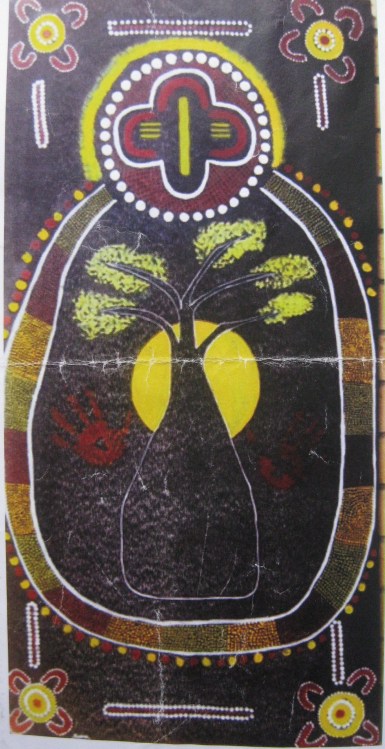
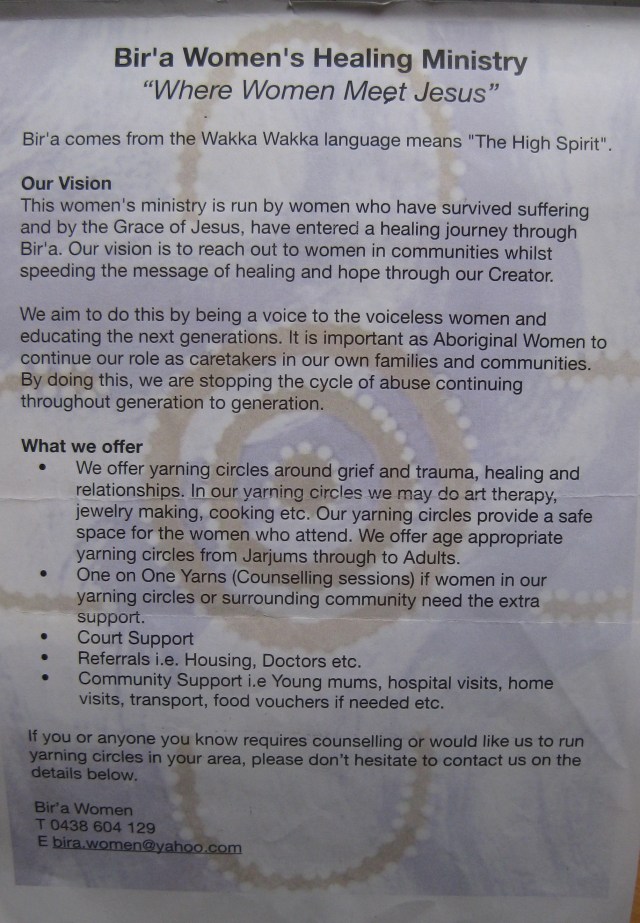
IMG_0080It was a privilege to meet Aunty Sharyn Bird on Thursday night – she was sharing her story and talking about the initiative Bir’a Women’s Healing Ministry she has started up that: raises awareness about abuse (emotional, domestic and sexual), encourages survivors to speak out, and gathers support for survivors .

It’s not for me to try and tell anyone else’s story but if there’s an opportunity for you to hear Aunty Sharyn (or participate in a yarning circle yourself!) I would encourage you to take it. A visual representation of her story told in a painting (left)

I have been drawn to the way in the gospels Jesus’ touch heals but then he “hears her whole truth” [Mark 5:33] and she is healed again.  There is more than one layer to our healing.

What role can/does truth-telling and story-sharing have in our healing and wellbeing?

We need people willing to ask us our story; safe space to tell it; someone to listen.  Our wholeness (being healed and whole – all we were created to be) is tied up with being known, heard, understood…

How do we make/take time for this?

Aunty Sharyn held such a space – generosity in that  – and a lot of compassion.


You can read more about Bir’a below and make a gift to support their work through Jisas Wantaim ref: BiraWomen.

IMG_0079

The session put me in mind of the Cheryl Lawrie poem “This is my Body” from Easter – how might we engage in our own re-membering and bringing it about for others?

What do our re-membered selves look like?

What is one thing you could do right now to go from where you are now towards the ‘whole and healed’ version of you?


IMG_6174

Christmas: A story about a Middle East family seeking refuge.

Tonight we will share together time singing carols and at contemplative stations that invite us to engage in reflection around and respond to this Christmas message. We will reflect on ideas of welcome, hospitality, divinity and explore those gifts extended to us in those advent ideas of hope, joy, peace and love in our troubled times.

Prayer stations are essentially several points of “focus” that invite you to encounter God in some way. You can spend all your time at one or make your way around several, or all of them, as you like – spending as much or as little time at each of them as you like. They are not in any special order.

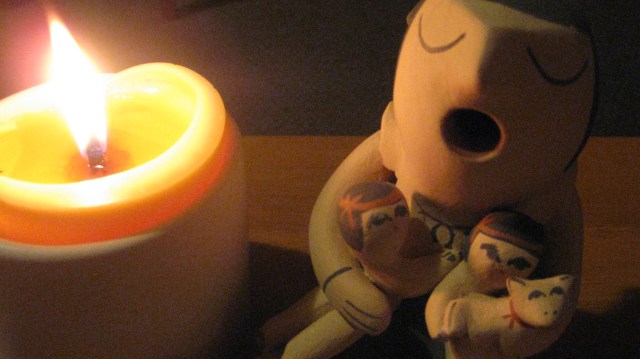
This space is for silent, personal reflection. Each station generally has something to read and something to do that invites you to respond to what you have read, such as lighting a candle.

Using the charming children’s story by Mem Fox called Wombat Divine, we look at the roles that we are called to play in this Story we all participate in. What role can you play?


As we receive cards from distant friends and family, and our papers and social media are filled with what might be deemed bad news, it can be hard to know how to respond – let’s take a moment to hang those words, phrases and images that feel meaningful, for ourselves, our neighbours, our country, our world. What has been weighing on you lately?


At the set table we can “meet” some of those guests who show up in Luke’s narrative of the nativity – relatives, shepherds, angels… These guests are interspersed with images from the recent Beyond Borders photo exhibition documenting unique stories of asylum seekers and refugees.  How do you respond to unexpected guests?


We come together for more carols by the nativity scene in the Chapel when there is an opportunity to make a gift in support of the work of the staff and patients at the Al-Ahli Arab Hospital, the only hospital serving the 1.4 million population of Palestinians living in the violence-devastated Gaza Strip.  Hope where there is seemingly no hope.  An image of a mother and her child in juxtaposition to the nativity.


IMG_6226

love is born

Leunig

IMG_5678

Welcome, we acknowledge that we gather on the land of which the people of the Kulin Nations have been custodians since time immemorial.

This is our fourth in a series called The Art of Discipleship where we showcase the material of different books and engage with their material creatively.

WEEK FOUR

The activity this week is taken from:

Women of Spirit: Woman’s Place in Church and Society

This Australian book by Janet Nelson and Linda Walter looks at how church and society both have ways that they tells us what  we are and aren’t supposed to do and how we are and aren’t supposed to look.  How can we reinterpret our self-esteem and identity understanding ourselves to be made in the image of God?

As has been done before, in a Seeds small group and a Women’s Circle at Surrender, images of women doing sacred ordinary things are blu tacked around the room with bible verses referring to women, where God is speaking to women and where “feminine” metaphors are applied e.g. God: “As a mother comforts her child, so I will comfort you; you shall be comforted in Jerusalem.” (Isaiah 66:13) or “How often have I desired to gather your children together as a hen gathers her brood under her wings, and you were not willing!” (Matthew 23:27).

This time we also had images of men juxtaposed with this “feminine” language and imagery.

So we had a time of some music playing while people walked around the room ( a reflection space created with pictures, bible passages, mirrors) immersed in these images and words and people were invited to grab a verse or image if it spoke to them and bring back and sit when they were ready.

  • What stands out?
  • What jars? What resonates?
  • What image/text do you have? – tell us about it

Read the story of The Bunyip of Berkeley’s Creek (a theme of the main book)

  • What does it mean to dwell in this idea that: God delights in you!!?
  • Where do you look for your identity? Sense of self?

“If this is my experience, it means that something of the greatest importance is happening.  It means that God is inviting me to discover “Him” no longer as another beside me but as my own deepest and truest self.  He is calling me into the experience of meeting Him to the experience of finding my identity in Him.  I cannot see Him because He is my eyes.  I cannot hear Him because He is my ears.  I cannot walk to Him because He is my feet. And if apparently I am alone and He is not there that is because He will not separate His presence from my own.  If He is not anything at all, if He is nothing, that is because He is no longer another.  I must find Him in what I am or not at all. (Williams 1976)” p.171

How might seeing yourself in the image of God change your life/the way you live?

Using a camera, take some pictures of yourself – not a “selfie” that is about looking your best/who you’re with/what you’re doing but perhaps some part of your body you feel critical of, somehow a part that captures your ‘self’that you might feel critical of – scroll back through the images you have taken and prayerfully try and hear what God is saying to you in the mix of how you feel about yourself.

IMG_5679.JPG

IMG_5115

People can share their photos (if they feel comfortable to do so).
Discuss how the exercise makes you feel or what it gets you thinking about.

Close with the ‘Greeting Circle’ from p.194  – go around the circle blessing each person.
Blessed are you among wo(men) ____________________ [name]
For you have found favour in God’s sight.


IMG_5264

Welcome, we acknowledge that we gather on the land of which the people of the Kulin Nations have been custodians since time immemorial.

This is our third in a series called The Art of Discipleship where we showcase the material of different books and engage with their material creatively.

WEEK THREE

The activity this week is taken from:

Binding the Strong Man: A Political Reading of Mark’s Story of Jesus


This book by Ched Myers looks at the book of Mark as a manifesto for radical discipleship — i.e., Jesus as exemplar of nonviolent resistance to the powers-that-be in his day, and ergo in ours.  We will be reading Mark, all of it, in one go and sitting in the queries; “What do the questions Jesus poses to the disciples have to say to us today?”

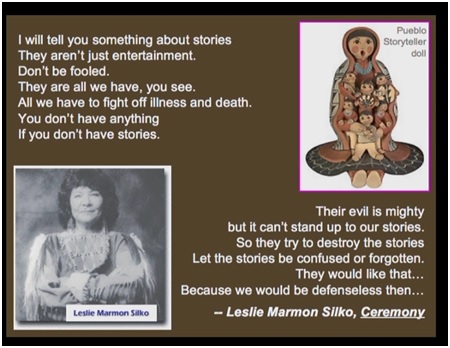
The Word is removed from us in time and space. We all tell stories and know how to tell stories. It is a common language that bridges other cultural gaps between us. These stories are not just entertainment but they actually educate and nourish us. BUT because they are good and healing stories, there are powers out there that will try to destroy them or… “let them be confused or forgotten” – BUT these evil powers cannot stand up to these stories (a statement of faith – conviction -hope that there is a power greater than what we face).  So what we are doing, reading scripture is counter cultural – sitting down and sharing, taking time.

silko

Radical – arising from or going to a root or source. From latin radicalis, having roots.

Radical simply means to go to the roots. Twin task of going to roots of tradition in scripture and in spirituality and in social solidarity and in roots of our contemporary pathologies to deal with root causes and not symptoms.

What are the current issues these stories could be informing?

  • War Israel/Palestine/Afghanistan/Syria/Russia
  • Riots/protests throughout middle east – for democracy and Europe/America in relation to global financial crisis.
  • Isaiah 14.:8: strategic asset Cedars of Lebanon, oil of the ancient times. What was empire then and what is it now? Phonecia, Babylon, Rome – clear cut the cedars for masts for ships and bearing poles for temples. Ecological justice.
  • Matt 1-2, Luke 1-2 Christmas story sentimentalised – imperial violence and human displacement, infanticide as a matter of domestic policy.
  • Road to Emmaus – story of courage and resistance, within a few days of crucifixion. Easter Luke 16:31 – under the shadow of death, not a zen walk down a country road. What is the meaning of the death of our leader for our movement.
  • Immigration/boat people – Isaiah 56, scripture and restorative justice – right using the bible to exclude immigrants and gay people. Radical
  • Matthew 18 restorative justice, ambassadors of reconciliation 2 Corinthians 5:16-6:2.

Draw parallels and analogies with our current context.

  • Ambassadors in chains Ephesians 2-3 & MLK letter from a Birmingham jail (Eph 3:10, 6:1)

How does the story read in our own context?

allegory

As we read be mindful of the following:

  • Oral tradition – uses language to set the scene – are we at the seaside or in the city now?  Look for introduction of new characters, new settings, changes in plot.  Often read the bible like a 5 minute segment out of an entire movie  – how can you understand what’s going on when you come in part way through the story? Need to rebuild critical literacy.
  • We can romanticise the Roman Empire – nothing nice about it.  I am a descendant of the colonising empire – British Empire, conquest, world sovereignty, racial superiority and global management.  Empire looks very different from the bottom IMG_5266up, than the top down – victims are always reminded of their vassalage. Money replaced with that with an image of Emperor or Queen.  The Romans were driven out of Judea and then they struck back. Jerusalem was laid siege, conquered and burned.  The book of Mark was written during this war.  Empire can be defined as the rule of the centre over the periphery.
  • Mark 1:7 baptiser – One is coming who is stronger than I am.  Power contesting power.  Not baptised with only water but the holy spirit and fire.  Baptism was and is a personal and political statement in a social context calling on the Holy Spirit of water and fire out in the undomesticated wilderness against the struggle of empire.
  • “True evangelical faith cannot lie dormant. It clothes the naked, it feed the hungry, it comforts the sorrowful, it shelters the destitute, it serves those that harms it, it binds up that which is wounded, it has become all things to all people” Menno Simons 16th century.  This is a discipleship of struggle and resistance as well as renewal.  Will it have a cost?  Baptism into Christ and into Christs death.  When Jesus was baptised he went right under into the Jordon, shedding  everything of socialisation – rises up completely unobligated to empire.  Jesus was baptised into a specific watershed/river, a specific story, a specific (un)kingdom.


Working from the same copy, read the – whole – book of Mark aloud in one session. The document below, to help with the sense on one whole flowing story (as the oral tellers would speak it), has had all chapter and verse numeration and story “titles” removed.

Mark stripped back

First thoughts?
Sound/feel different than it usually does? What stands out?
Have some general discussion around the ‘mindful’ notes re our ideas about – stories, empire, baptism, discipleship…

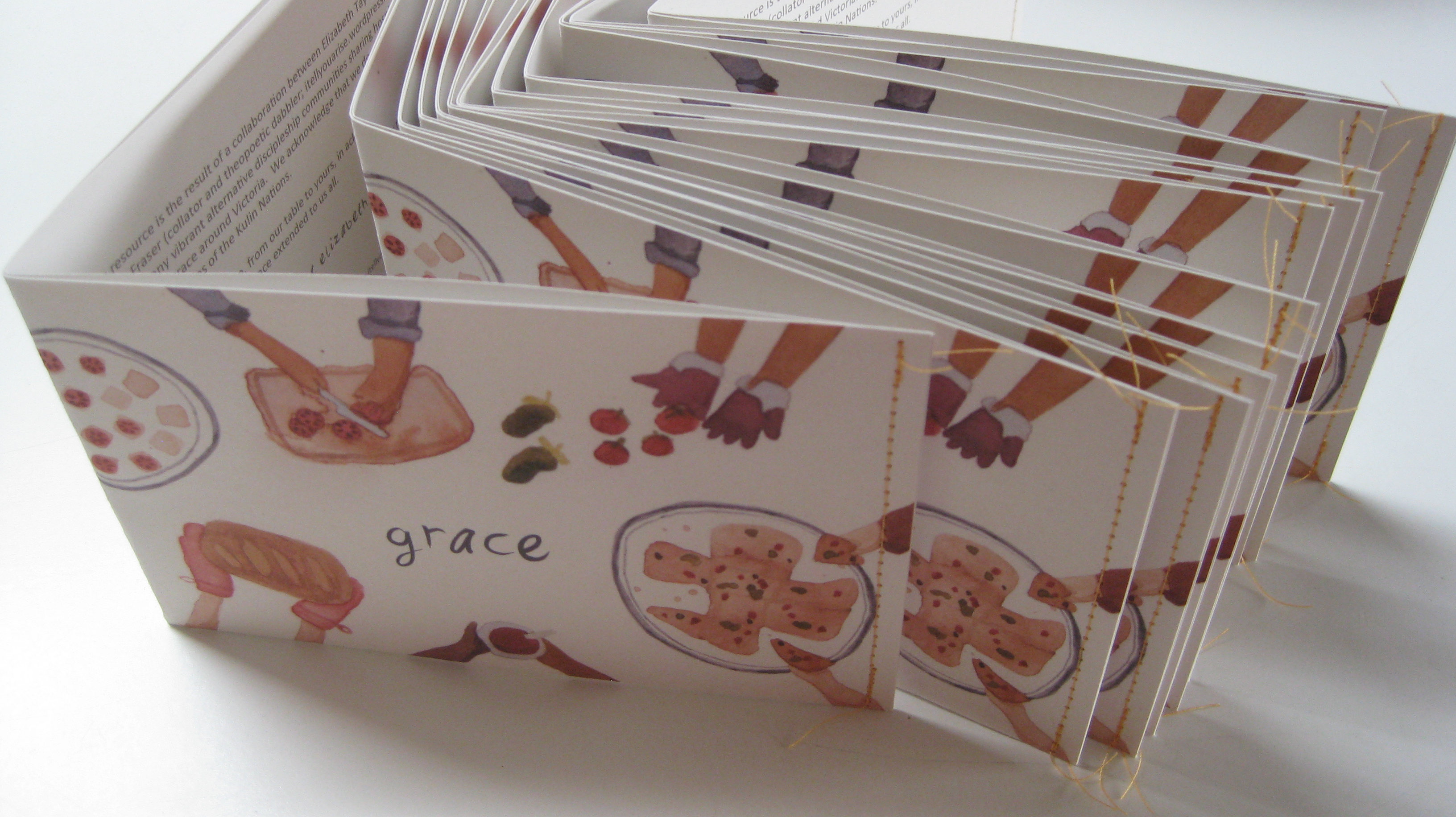
grace

“You should share communion together,
it has a unique power to unite beyond words”
Peter (Chappo) Chapman

Very pleased to present this little number…

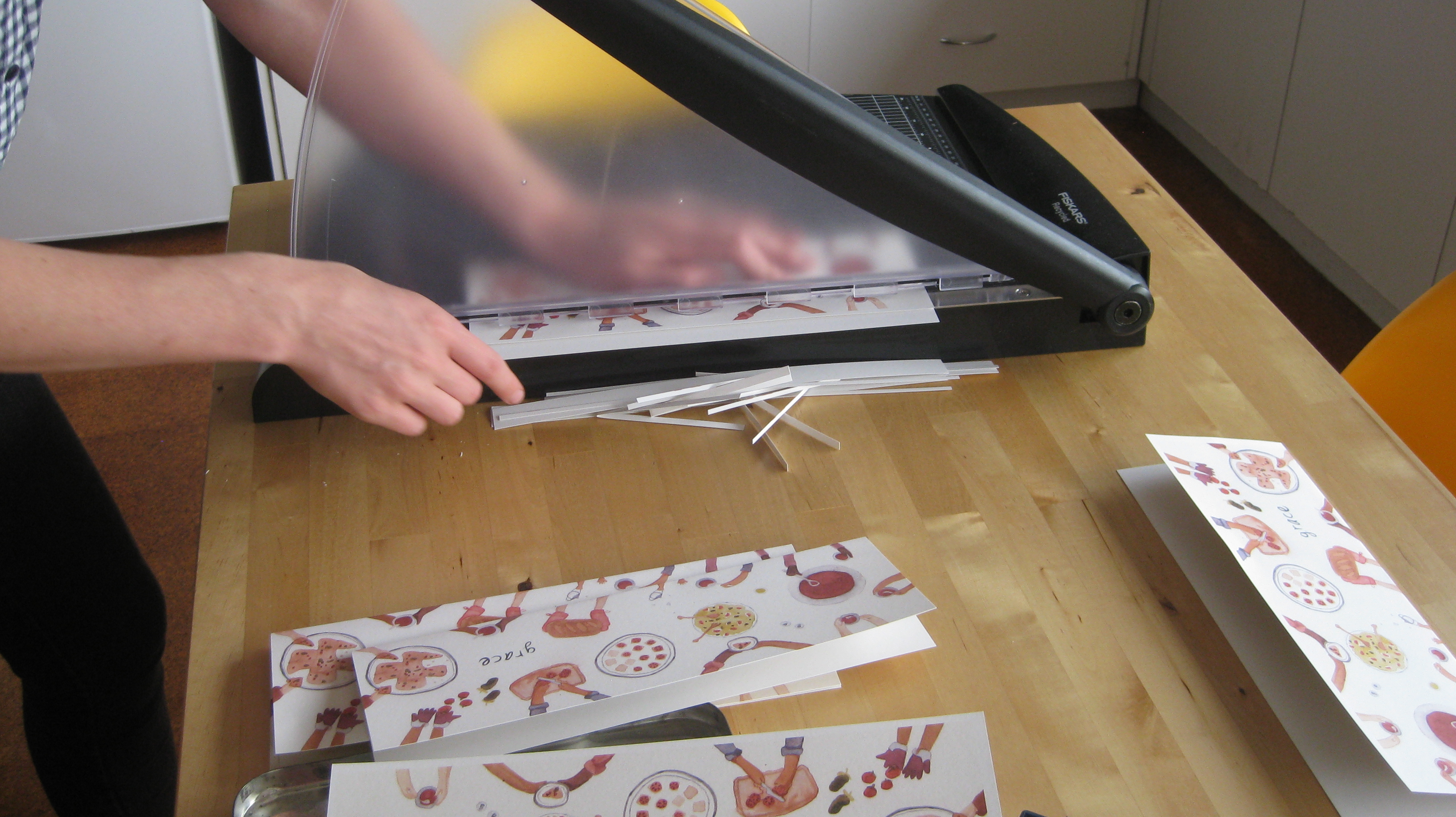
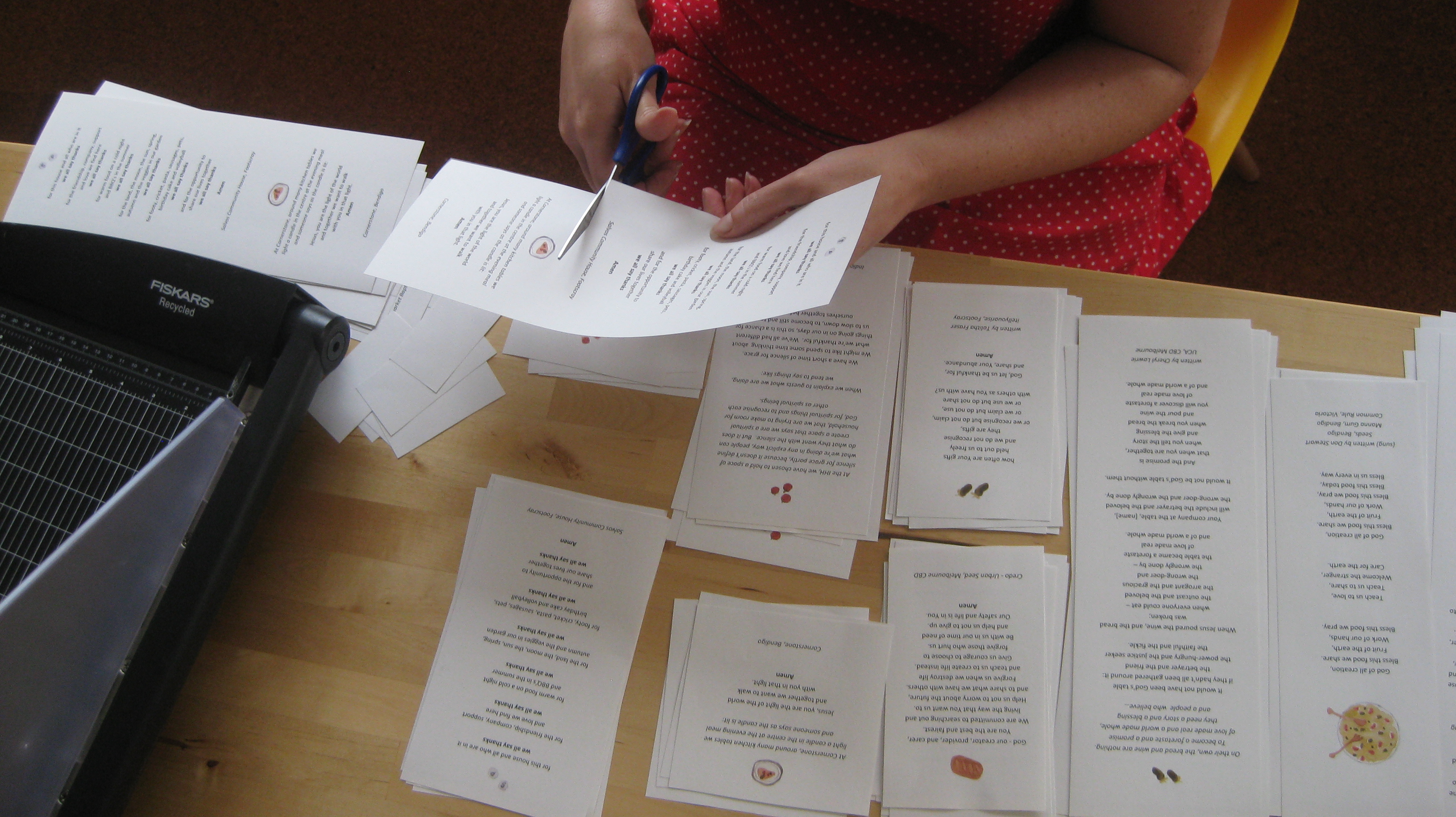
This resource is the result of a collaboration between Elizabeth Taylor, myself and the many vibrant alternative discipleship communities sharing hospitality and, indeed, grace around Victoria. Such as: Common Rule, Cornerstone, Footscray Salvos, GraceTree, Indigenous Hospitality House,  MannaGum, Missio Dei,  Newmarket Baptist Church, Seeds, The Cave & Transfiguration Community, UCA, Urban Seed and the many more who serve, share and speak grace spontaneously, silently or scarcely – you know who are.  We acknowledge that we do so on the land of the peoples of the Kulin Nations.

We decided to make this as a kind of snapshot in time of radical discipleship expression in and around Melbourne and to encourage one another – we don’t often get to get around the table together but we do go back to our separate spaces and share meals in community.

Elizabeth’s beautiful and colourful visual images were inspired by the language of the prayers, varied and lovely. Done in a loose watercolour style we are offered a birdseye view of a table full of food, with hands around the edges sharing and eating, different types of food, the hands that prepare and acknowledgement of the earth that produces.

We share this abundance, from our table to yours,
in acknowledgement and celebration of the bigger Grace extended to us all.

Free PDF (or LMS accessibility supported copy) available by request.

IMG_5172

IMG_5175

IMG_5173