Category: uncategorized


IMG_6290

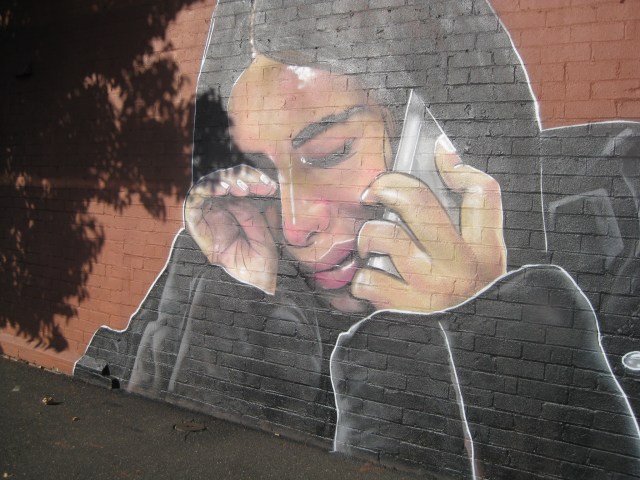
You can buy artworks by Abbas Al Aboudi here. Abbas does original works or can replicate your favourite photo… Below is a bit about Aboudi’s life and where this image came from. I asked for a copy of this, an image previously painted, because living through these times I wanted to capture something by asylum seekers for asylum seekers that speaks in their own voice to their own experience of these times. Also, because something of the image speaks to my own journey of starting to write/find my voice.

Painting a lifeline

Turning to art in desperation, he has discovered a way of processing the trauma and depression that threatened to engulf him. Exhibiting daring colour sense, he creates works that are fresh and haunting. One picture shows Aboudi′s handcuffed hands holding a pencil and references the humiliation he experienced while still a resident of the camp.

An Australian refugee advocate had sent him some painting supplies. When he went to pick them up from the parcel delivery centre, the camp guards would not let him back in with them. His pleas falling on deaf ears, Aboudi was at least able to secrete his supplies in a hiding place outside the camp. Later a sympathetic guard helped him smuggle them in. Others depict the despair and hopelessness which is the daily bread of asylum seekers on Nauru. Most of the refugees, including Al Aboudi, can’t return to their countries of origin for fear of persecution and Australia doesn’t allow any refugees into the country who arrived by boat post-July 2013. For many, the future looks bleak.

A glimmer of hope

Al Aboudi, who recently celebrated his twenty-eighth birthday in austere conditions, cracks a shy smile. About a month ago, he was asked by the contracting company that runs the Nauru detention centre whether he would like to be resettled in the United States. Three hours of thorough vetting and several weeks later and still no word.

All Abbas Al Aboudi can do is paint and hope.

My Art is My Saviour, Qantara.de, March 2017

Demonstrators in Australia held paintings by Alaboudi in August this year [2016] during nationwide protests urging the government to end offshore detention of refugees.

Alaboudi was heartened by this use of his canvases, which depict the conditions faced by refugees, such as a child behind bars and a portrait of Omid Masoumali, an Iranian who burnt himself alive on Nauru in May.

The Madness is Eating Us Alive, South China Morning Post, Oct 2016


IMG_6145

IMG_6092

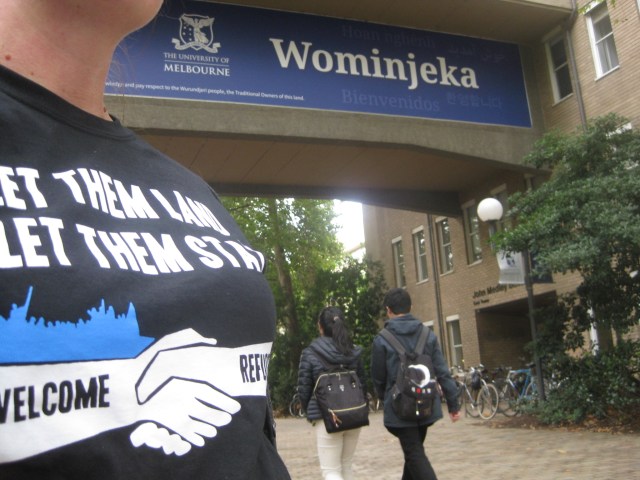
Today is the day of action/vigil by health, education and community work sector supporters of the ‘Let them land, Let them stay’ campaign to support the closing of off-shore detention centres.  I wear a T-shirt and think: “This is little enough surely.”

Those doctors, nurses, teachers and  psychiatrists working in the detention centres are at the ethical frontline of this issue. The High Court says it’s illegal, PNG government agrees, the UN declares it a violation of human rights. The support workers have to sign gag orders in order to be allowed in but once there…  you have to ask yourself: If I stop work in protest, who will do what little work is allowed? If I speak up will I be fired? Will I be prosecuted? will I be allowed back here? Will my actions affect the conditions here to be worse for the refugees or other staff who might come after me?

First do no harm.

But it’s too late for that. what can we do second? What can we do 4-5 years on for these refugees who are waiting for a place that feels like safe haven?

The bus, the train, the bus, walking across campus. The T-shirt says something and people are reading it. Like doing actions on the high holidays that implicate the structures and powers of the church, wearing this at Uni (and presumably hospitals, schools, etc.) implicates the power and structures of those agencies. Jesus heals, hears their whole truth and they are healed again (Mark 5:25-34).  Jesus’ power heals but then he sits with the woman, with the foreigner, with the unclean and personally engages the message ‘you are other’ with the message ‘you are mine‘.

I imagine someone denouncing me: “You’re not even a doctor, or nurse, or teacher…” and I think, “Yeah, I’m not. I’m not a trained, qualified, practising professional and I still think this is important, how is it you don’t?”

These people are not ‘other’, they’re ours.

Video: Australia’s Detention Camps


Red road

IMG_5961


red road
blood road runs
red road runs blood
road runs red
red blood road
runs red


Talitha Fraser

IMG_5957


bones pressed
make way for progress
your lips will say no more
no one knows where
the roads leads
but we follow it anyway
to the end
to The End.


Talitha Fraser

IMG_5874

Pleasure is when love and its object meet.
To love is to eat.
To love is to give oneself to be eaten. (p.84)

The Latin languages preserve an intuition which seems to be absent from English.  Their words for ‘knowledge’ and ‘taste’ come from the same root. Sapere, in Latin, means both to ‘know’ and to ‘have flavour’. In my language, saber – to know, and sabor taste.  Eating and knowing have the same origin.  To know something is to feel its taste, what it does to my body.  Reality is not rawness, the ‘things-in-themselves’. Reality is the result of the alchemic transformation by fire, the food which is taken inside my body. (p.85-86)

The dead man: the raw.
But it was transformed by the fire of the villagers’ imagination.
And they, themselves, were resurrected by participating in the anthropophagic ritual…

The body is a kitchen.
Without the fire that burns inside,
the fire of hunger,
desire,
longing,
imagination
there cannot be any hope of resurrection, because we are what we eat. (p.87)


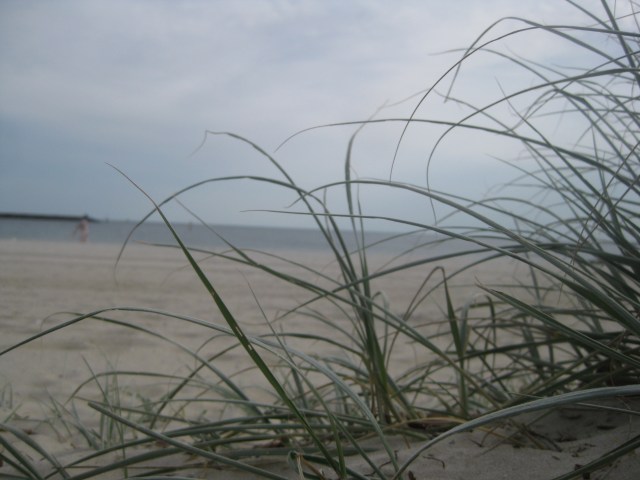
The sky is my canvas

IMG_5573

the sky is my canvas
the sea is my paint
the sand is my brush
can I capture You?

Talitha Fraser

IMAG0809

In another place we said that the body is a thin web of flesh woven around a void. When we cook the void becomes active: Fire. Longing. It burns and transforms… For this to happen the kitchen must become a place of destruction.  Knives are sharpened in order to cut. Fire is lit, in order to boil and burn. If it is true that cooking joins together what nature has separated, it is also true that cooking puts asunder what is joined in nature. The raw must cease to exist for something different to appear. One must die first, in order to be resurrected… The man had to be dead in order to be ‘eaten’ by the villagers. ‘My flesh is meat, indeed, and my blood is drink, indeed. Except you eat my flesh and drink my blood you have no life in you’ (John 6: 55, 53) (p.83)

Cooking,
alchemy,
the fire of the stone and the fire of desire transubstantiate
the raw into a new substance,
and the body,
in the darkness where taste dwells,
reencounters its lost blessedness.

When food is taken, the power of the kitchen is also taken inside our bodies. The disciples of Emmaus reported that they felt something burning inside, as they ate. Their eyes were opened, and they knew. Vision and knowledge come through eating. The body is resurrected through eating… (p.84)

Eating is more that feeding: it has to do with remembrance. ‘Eat and drink in remembrance…’ But we do not remember what is buried in a chronological time. The past is gone, forever; it is a time which no longer exists… we remember only what is still present, and yet forgotten. Remembering is the awakening of what was sleeping, the resurrection of what had been buried (p.85)

A moment

IMG_4869

I sit waiting
purple spikes of sage
speak to me
the espaliered apples
are sick but I know
of nothing I can do for them
grass tips curl and furl
frizzy foliage too silly
to be taken seriously.
Soak in the stillness
before the trams and trains
the crowds and noise
and pay attention.


Talitha Fraser

IMG_4872