
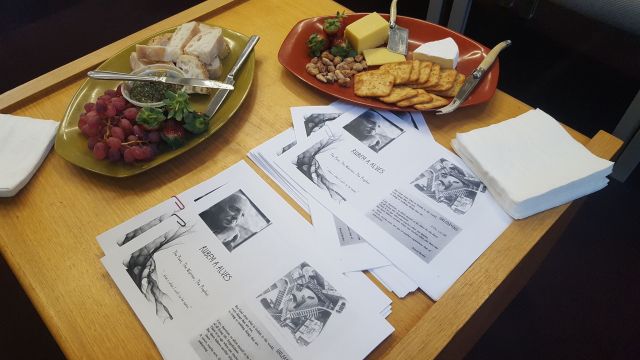
Was Rubem Alves a poet, psychoanalyst, theologian, or philosopher? Yes.
Somewhere beyond tidy definition and cataloguing “The Poet, The Warrior, The Prophet” is an invitation to visit a place that you’ve been before but forgotten you knew.
In the same way the Eucharist is a poetic ritual of anthropophagy Rubem asks us to take in his words and be changed by them.
Gleanings shared with the Spiritual Reading Group at the Carmelite Centre, Middle Park – 19 June 2018.
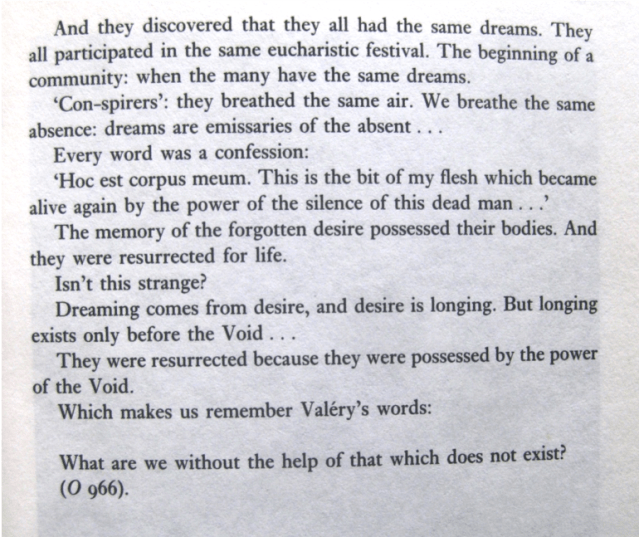
In his article “An Anthropophagous Ritual, “ Rubem Alves wrote:
Anthropophagy is the eating of human flesh – cannibalism, something savage. But so-called savages don’t think so. A tribe of Brazilian Indians who practices anthropophagy justified it thus: “You who call yourselves civilised don’t love your dead. You made deep holes and bury them to be eaten by worms. We, on the other hand, love our dead. We don’t want them to be dead. But they are dead! There is only one way to keep them alive: if we eat them. If we eat them, their flesh and blood continue to live on in our own bodies.
Anthropophagy isn’t done for nutritional reasons. It isn’t a barbecue. It’s a magical ceremony. It is believed that, by eating the dead, their virtues are incorporated into those who eat them. Psychoanalysts agree. They believe that our personality is formed by successive anthropophagus meals at which we devour a piece of one person, a piece of another… the Eucharist is a poetic ritual of anthropophagy: “This bread is my body; eat of it. This wine is my blood: drink of it.”
…that is what I wish. To be eaten.
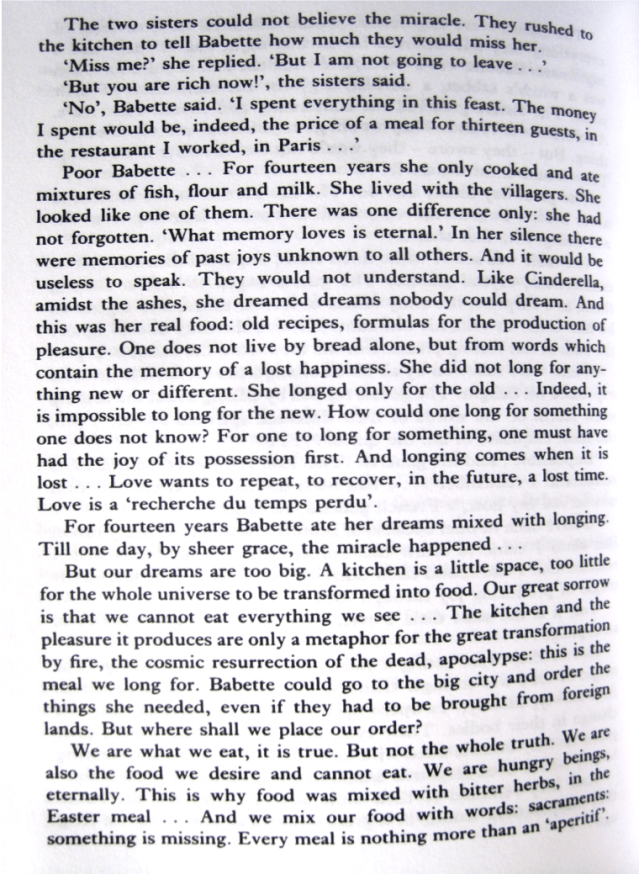
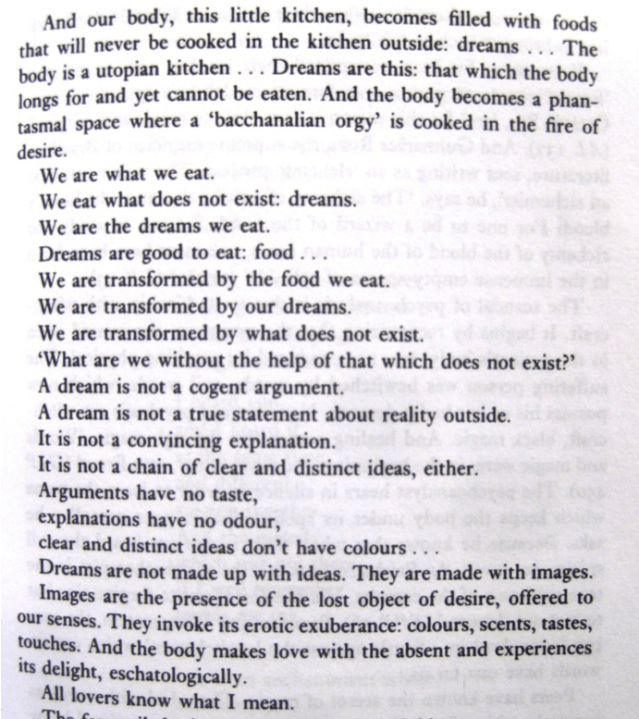
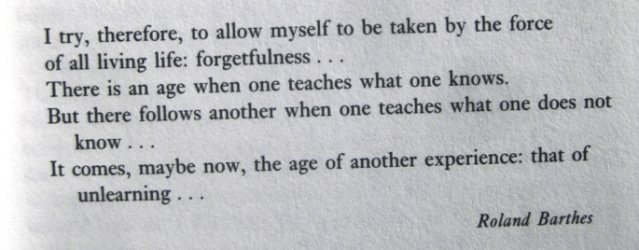
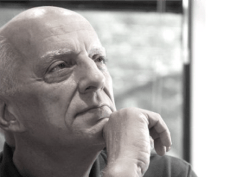 Rubem Alves died on the of 19 July 2014, aged 80 – almost exactly 4 years ago – this material we’re about to read was originally delivered at the 1990 Edward Cadbury Lectures in the University of Birmingham, segments of 8 talks given over two weeks and our invitation today is to read Alves work and take him in. Rubem Alves had a pretty extraordinary view of life and way of expressing that descriptively to others.
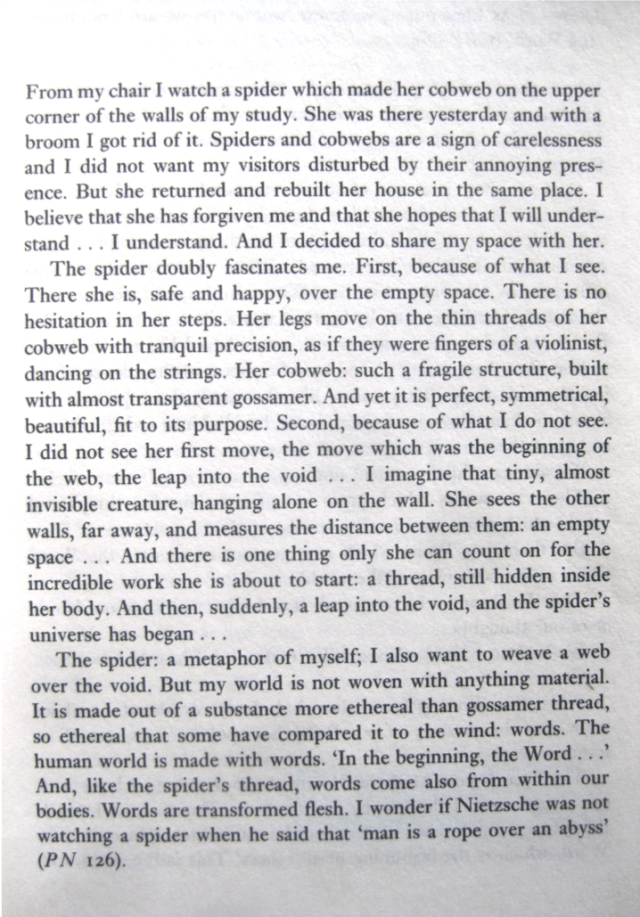
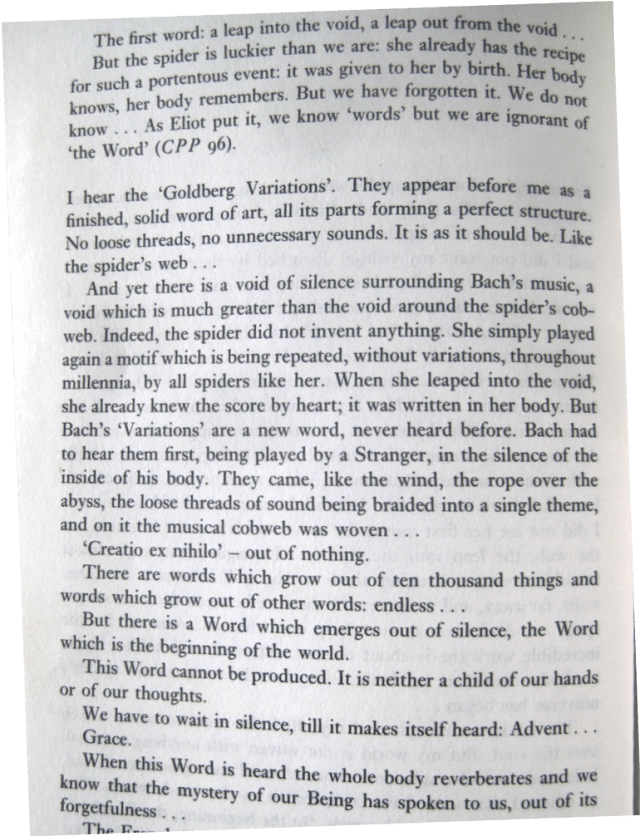
Although Stanley Hopper and David Miller are credited with coining the term theopoetics, and Amos Wilder’s “Theopoetics: Theology and the Religious Imagination” is considered the seminal text of the field, Rubem Alves’ writing takes credit as a premium model of the style – combining theology and poetry.
Theopoetics is an interdisciplinary field of study that combines elements of narrative theology, poetic analysis, process theologyand postmodern philosophy.
Amos Wilder says: “Old words do not reach across the new gulfs, and it is only in vision and oracle that we can chart the unknown and new-name the creatures. Before the message there must be the vision, before the sermon, the hymn, before the prose, the poem.” Rubem calls us into an encounter of the Mystery of the Divine saying:
“it’s not science that can explain this,
but our lived embodied experiences.”
Rubem Alves was a forerunner of the liberation theology movement and key to the transformation of Christian social ethics in light of this thinking. He was a writer, a psychoanalyst, a theologian, an educator, a storyteller, a poet…During his career, Alves collaborated with notable personalities such as Peter Maurin, Dorothy Day, and Paulo Freire. He was widely read and frequently included art and quotes from the work of others in confluence with his own including writers such as Rilke, Emily Dickinson, Tolstoi, e.e.cummings, Bonhoffer, and Sigmund Freud among others – 74 different references in these lectures alone… you gain from this a sense of a man who is listening to the world and taking it in. These lectures perhaps the map of some of Alves’ anthopophagus meals. Alves was a prolific writer contributing over 100 books, some of these translated into six different languages, children’s books (“Happy Oysters Don’t Make Pearls”) and many articles on education, philosophy and religion.
Rubem Alves was born in a small rural town, Boa Esperança, Minas Gerais, of Brazil in1933. His father was once rich but went broke during the depression and his family had to move to Rio de Janeiro where he was seen as a “hick” from the country. This crisis was also what led his family to the church as, unable to afford to send the children to school, the family accepted assistance from Presbyterian missionaries to get their children an education. After high school Alves studied theology, doing outreach to factory workers, then returning to his home state to serve as a pastor amongst simple and poor people (1957). His religion was practiced and interpreted from the perspective of the poor. Less about sin, and more about love and freedom, Alves saw religion as a means to improve the world of the living rather than guaranteeing something to people once they’re dead. Much of what resonates in his writing is the way he takes ordinary human things and makes them sacred. The honesty with which he does this, asks listeners to consider the truth of themselves and invites them to know that as wholeness. He writes about bodies, love, death, food, communion – universal themes… and he writes beautifully… believing:
“…the goal of our struggle for justice and all political struggles is for the world to be more beautiful. Poverty is horrid, it’s ugly. Poverty is death, death of children, suffering. These are terrible things! They must end!”
In 1959, he married Lídia Nopper and they had three children together — Sergio, Marcos, and Raquel. Through the 1960s, Alves alternated between service as a Presbyterian parish pastor and study as a graduate researcher in theology. Alves went to New York to do his Masters but flew back to Brazil following the US-supported military coup of 1964. The Presbyterian Church of Brazil chose six intellectuals as scapegoats and offered these names to the new military dictatorship to avert persecution themselves. Immediately upon his return to Brazil, rather than being reunited with his wife and children, Alves had to go into hiding. With assistance from Brazilian Freemasons and the Presbyterian Church in the United Stateshe returned to the US covertly 8 weeks later and secured an invitation from Princeton Theological Seminary to commence doctoral studies there – where he hated it – he was not allowed to write using similes or poetry and thought this writing his ugliest. Alves received the lowest possible grade that was still a pass for his PhD. ( A Theology of Human Hope. Washington: Corpus Books. Revised version of his doctorate thesis, originally titled Towards a Theology of Liberation.) Of this academic theological approach Alves commented:
“Theology is not a net that is woven in order to capture God in its meshes,
for God is not a fish but Wind that no one can hold.
Theology is a net which we weave for ourselves so that
we may stretch out our body in it”
When he eventually returned to Brazil in 1974, Rubem became a University Professor. Having been expelled by the denomination he belonged to, Rubem (along with other communities and pastors) had a painful period of isolation and dispersion until 1978, when together they founded the National Federation of Presbyterian Churches which, from 1983 on was named the United Presbyterian Church of Brazil (IPU). Rubem made significant contribution to the founding documents of this new church and it was said of this work by The Rev. Sonia Gomes Mota: “He was not interested in giving us moral lessons or transmitting the absolute and indisputable truth. As a good theologian, philosopher and educator, he was more interested in making us think, reflect and question the immutable truths of theology and urged us to envision new possibilities and new ways of living our faith. Rubem led us to deserts and invited us to be gardeners and planters of hope.”
Born in a context of political and social oppression,preaching and teaching of God’s word as well as social programmes such as nurseries, sewing workshops, health centres, psychological services, and literacy courses are just a few examples of the integrated activities developed by these new church communities. They were the first Presbyterian church in Brazil to ordain women.
Alves once remarked,
“Prophets are not visionaries who announce a future that is coming. Prophets are poets who design a future that may happen. Poets suggest a way.”
Rubem Alves would go on to add psychotherapy to his portfolio and establish his own clinic. In later life, although he maintained a pastoral and prophetic touch with the people he encountered, Rubem’s association with institutional religion became more detached as he came to believe that space, that curiosity, that out of the “nothing” offered by poetry, more good could come than of liberation theology.


 From Bill Wylie-Kellermann’s newest release


 itellyouarise