
Latest Entries »
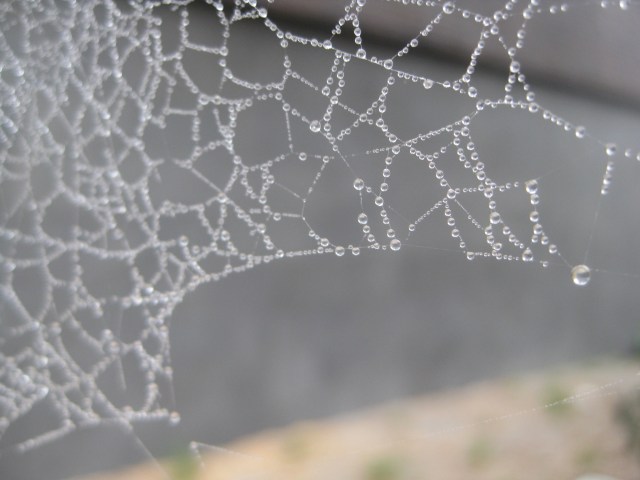
Rubem Alves tells a story of a spider, safe and happy over empty space – building her house – no hesitation and with precision. Fragile yet perfect, symmetrical, beautiful, fit to its purpose. “…I did not see her first move, the move which was the beginning of the web, the leap into the void…” (p.3)
What the spider needs to fulfil her intention is within her body. “Her body knows, her body remembers. But we have forgotten it.” (p.4)
Rubem Alves tells a story of a boy who found the body of a dead man
washed up on the edge of a seaside village.
There is only one thing to do with the dead: they must be buried.
In that village it was the custom for the women to prepare the dead for burial,
so the women began to clean the body in preparation for the funeral.
As they did, the women began to talk and
ponder about the dead stranger.
He was tall… and would have had to duck his head to enter their houses.
His voice… was it like a whisper or like thunder.
His hands… they were big. Did they play with children
or sail the seas or know how to caress and embrace a woman’s body.
The women laughed
“and were surprised as they realised that the funeral had become resurrection:
a moment in their flesh, dreams, long believed to be dead,
returning… their bodies alive again”. (p.24)
The husbands, waiting outside, and watching what was happening,
became jealous of the drowned man
as they realised he had power which they did not have.
And they thought about the dreams they had never had…
Alves ends this part of the story by telling that they finally buried the dead man.
But the village was never the same again.
“The dead man did not say one single word.
He was full of silence.
And his silence was the space of remembrance.
His dead body was full of their lost memories…” (p.31)
“Hoc est corpus meum. This is the bit of my flesh which became alive again by the power of the silence of this dead man…
What are we without the help of that which does not exist? – Valerie” (p.35)
Acts 17:22-31
Then Paul stood in front of the Areopagus and said, “Athenians, I see how extremely religious you are in every way. For as I went through the city and looked carefully at the objects of your worship, I found among them an altar with the inscription, ‘To an unknown god.’ What therefore you worship as unknown, this I proclaim to you. The God who made the world and everything in it, he who is Lord of heaven and earth, does not live in shrines made by human hands, nor is he served by human hands, as though he needed anything, since he himself gives to all mortals life and breath and all things. From one ancestor he made all nations to inhabit the whole earth, and he allotted the times of their existence and the boundaries of the places where they would live, so that they would search for God and perhaps grope for him and find him—though indeed he is not far from each one of us. For ‘In him we live and move and have our being’; as even some of your own poets have said, ‘For we too are his offspring.’
Since we are God’s offspring, we ought not to think that the deity is like gold, or silver, or stone, an image formed by the art and imagination of mortals. While God has overlooked the times of human ignorance, now he commands all people everywhere to repent, because he has fixed a day on which he will have the world judged in righteousness by a man whom he has appointed, and of this he has given assurance to all by raising him from the dead.”
(NRSV)
Reading 1: (Read through twice) What word or passage touches/speaks to you?
Reading 2: How does this word/passage touch your life/experience?
Reading 3: How are we called into being/doing by this word/passage?


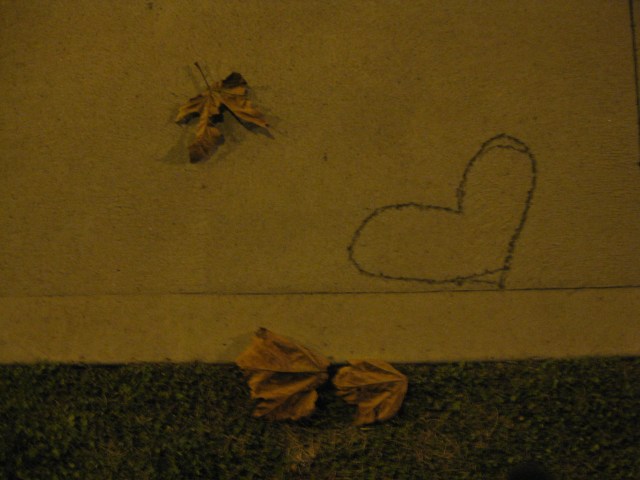
God said: Let the dark be dark.
Let the stars shine properly.
And let darkness with no stars
heal the damage caused by light.
Men said: Let there be light all
night through, where there is no-one
much or no-one at all, let
the gathered haze from street-lamps,
undying brand-names, full-blaze
unpopulated windows
stain the undersides of clouds
even when nights are cloudless.
God said: Light itself needs rest.
Some things are best seen, unseen,
in darkness unhindered by
Great Light. Me, for example.

It’s a new day and I like it.
Soft folds of cotton wool mist crept in while we were sleeping and I don’t ask:
“What is out there?”

but:
“What might be out there?”
As the shrouding evokes wonder and possibility.
The noise of the world seems slightly muffled and its bustle muted.

Maybe in our bruised and weary brokenness God says I will hold you tenderly in cotton wool today and hold you safe.
A whimsy perhaps of my battered brain.
“The idea that we live life in a straight line, like a story, seems to me to be increasingly absurd and, more than anything, a kind of intellectual convenience. I feel that the events in our lives are like a series of bells being struck and the vibrations spread outwards, affecting everything, our present, and our futures, of course, but our past as well. Everything is changing and vibrating and in flux.”
In a rare interview since the death of his 15-year-old son, the singer reveals his struggle to write and reconnect with the world after the tragedy.

You can buy artworks by Abbas Al Aboudi here. Abbas does original works or can replicate your favourite photo… Below is a bit about Aboudi’s life and where this image came from. I asked for a copy of this, an image previously painted, because living through these times I wanted to capture something by asylum seekers for asylum seekers that speaks in their own voice to their own experience of these times. Also, because something of the image speaks to my own journey of starting to write/find my voice.
Painting a lifeline
Turning to art in desperation, he has discovered a way of processing the trauma and depression that threatened to engulf him. Exhibiting daring colour sense, he creates works that are fresh and haunting. One picture shows Aboudi′s handcuffed hands holding a pencil and references the humiliation he experienced while still a resident of the camp.
An Australian refugee advocate had sent him some painting supplies. When he went to pick them up from the parcel delivery centre, the camp guards would not let him back in with them. His pleas falling on deaf ears, Aboudi was at least able to secrete his supplies in a hiding place outside the camp. Later a sympathetic guard helped him smuggle them in. Others depict the despair and hopelessness which is the daily bread of asylum seekers on Nauru. Most of the refugees, including Al Aboudi, can’t return to their countries of origin for fear of persecution and Australia doesn’t allow any refugees into the country who arrived by boat post-July 2013. For many, the future looks bleak.
A glimmer of hope
Al Aboudi, who recently celebrated his twenty-eighth birthday in austere conditions, cracks a shy smile. About a month ago, he was asked by the contracting company that runs the Nauru detention centre whether he would like to be resettled in the United States. Three hours of thorough vetting and several weeks later and still no word.
All Abbas Al Aboudi can do is paint and hope.
My Art is My Saviour, Qantara.de, March 2017
Demonstrators in Australia held paintings by Alaboudi in August this year [2016] during nationwide protests urging the government to end offshore detention of refugees.
Alaboudi was heartened by this use of his canvases, which depict the conditions faced by refugees, such as a child behind bars and a portrait of Omid Masoumali, an Iranian who burnt himself alive on Nauru in May.
The Madness is Eating Us Alive, South China Morning Post, Oct 2016
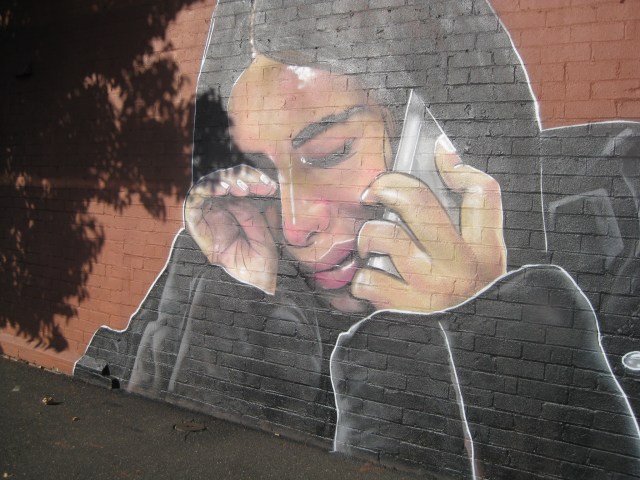
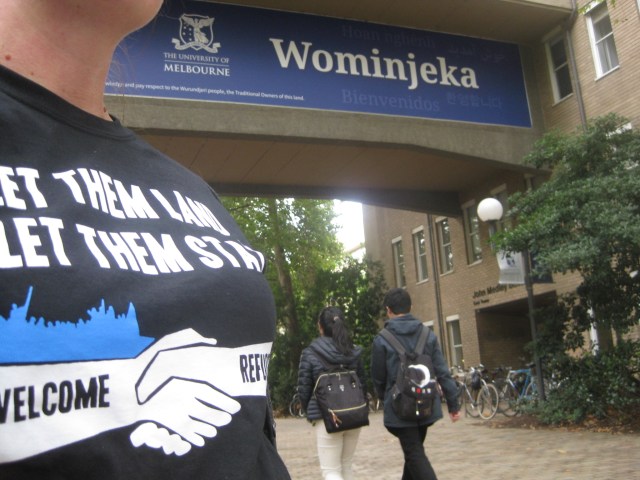
Today is the day of action/vigil by health, education and community work sector supporters of the ‘Let them land, Let them stay’ campaign to support the closing of off-shore detention centres. I wear a T-shirt and think: “This is little enough surely.”
Those doctors, nurses, teachers and psychiatrists working in the detention centres are at the ethical frontline of this issue. The High Court says it’s illegal, PNG government agrees, the UN declares it a violation of human rights. The support workers have to sign gag orders in order to be allowed in but once there… you have to ask yourself: If I stop work in protest, who will do what little work is allowed? If I speak up will I be fired? Will I be prosecuted? will I be allowed back here? Will my actions affect the conditions here to be worse for the refugees or other staff who might come after me?
First do no harm.
But it’s too late for that. what can we do second? What can we do 4-5 years on for these refugees who are waiting for a place that feels like safe haven?
The bus, the train, the bus, walking across campus. The T-shirt says something and people are reading it. Like doing actions on the high holidays that implicate the structures and powers of the church, wearing this at Uni (and presumably hospitals, schools, etc.) implicates the power and structures of those agencies. Jesus heals, hears their whole truth and they are healed again (Mark 5:25-34). Jesus’ power heals but then he sits with the woman, with the foreigner, with the unclean and personally engages the message ‘you are other’ with the message ‘you are mine‘.
I imagine someone denouncing me: “You’re not even a doctor, or nurse, or teacher…” and I think, “Yeah, I’m not. I’m not a trained, qualified, practising professional and I still think this is important, how is it you don’t?”
These people are not ‘other’, they’re ours.
Video: Australia’s Detention Camps


 itellyouarise