Tag Archive: Aboriginal


img_1396

On the weekend of 24-25 September Whitley College hosted a conference called Constitutions and Treaties: Law, Justice, Spirituality – these are notes from session 1 of 9. We acknowledge that this gathering, listening and learning occurred of the land of the Wurundjeri People of the Kulin Nations and offer our respects to their elders past and present, and all visiting Aboriginal and Torres Strait Island visitors present.


Purpose: How to get somewhere

Constitutions: Tell us what to do and how to get there

Why?: Need to ask, where are these taking us to? What are we going to do with it?

The German word grundnorm (basic norm) combines big + what is normal.

American Constitution says: “We hold these truths to be self-evident: that all men are created equal…” this is a basic norm of their constitution and yet there was slavery at the time.  What is constitutional for one group is not for others.

Is constitutional recognition worth fighting for in the Australian context?

If you are given a legal personality this gives you a legal identity/makes you an entity (you can transact).  Constitutional recognition would give Aboriginal people legal personality.

Here we use a Westminster/Western model of constitution – a link back to the UK. White men put the document together – it represented their idea of society then and for the future.  Section 128 allows for the constitution to be changed (function for change provided for in its creation).

What are the founding values and guiding principles?

Cooper vs. Stuart Crown gave 40 acres then wanted to take 7 acres back – appealed to the Privy Council in the UK.  Land that was not “cultivated” was considered not claimed.

Aboriginal people are currently mentioned in only 2 sections of the Constitution. For the purposes of counting in the Census they will have a value of “0” (zero) and in the Exclusion Clause which allows for Parliament to make laws specific to race (applying to anyone not white). This is legalised discrimination. The law makers had the view that Aboriginal people would disappear – either by dying off or being bred out… we are still here!

Following WW2 there was a movement to say collectively we cannot allow for the extermination of an entire people.  Some human values are UNIVERSAL regardless of what some countries and governments might do.  UN developed International law which includes a convention against racial discrimination “No legal or moral authority for laws based on race”.  Australian law has vetoed land purchase in Queensland, High COurt MABO decision recognised Native title in 1992 > Aboriginal people exist.  There is a fundamental clash between the constitution and the law – it is at odds with itself and it needs to be synchronised.

How are we getting there? What will we do when we get there?

I want to see… language, law, culture, spirituality, kindness, interconnectedness to land and animals, respect for neighbours, storytelling and learning… survive.

Recognising is the first step.  We can’t have a conversation if you can’t see me.

The State of Victoria is looking into making a treaty.Section 109 of the Constitution allows for laws that are inconsistent but if it comes to a ruling Federal law would prevail. If the vehicle we take is a treaty – what is in it? protecting/including what?

When applying law there is a sense that we should be able to go back to the original ‘intent’ of the law (read it in context) – it is a legal fiction that we can know or that we do know what that is. “Democracy” when it arrived was for landed white men, then all white men, white men and white women, now voters (excluding prisoners)… what democracy means has changed over time.


Te Tiriti O Waitangi and Pakeha-Maori Conversations: What Hope for Change? – Maria Bargh

Strong Spirit in Community Development – Grant Paulson

Repentance and Treaty? – Ray Minniecon

Primal Faith and Ancient Treaty: Precedents on the Abraham Trail – Norm Habel

What might the Australian Church look like in the face of the sovereignty of the First Peoples? – Chris Budden

A Paradoxical Hospitality – Robert Hoskin and Naomi Wolfe

Aboriginal sources and Aboriginal sovereignty – Joanna Cruickshank

Pulling together the threads – Mark Brett


IMG_1499.JPG

On the weekend of 24-25 September Whitley College hosted a conference called Constitutions and Treaties: Law, Justice, Spirituality – these are notes from session 2 of 9. We acknowledge that this gathering, listening and learning occurred of the land of the Wurundjeri People of the Kulin Nations and offer our respects to their elders past and present, and all visiting Aboriginal and Torres Strait Island visitors present.


Overview

  • connections and alliances in the 1800s
  • implications of Te Tiriti (The Treaty) today
  • the need for constitutional change
  • the role of Pakeha as allies


Waitangi Tribunal Northland Enquiry Part 1, Te Paparahi o Te Raki: “Māori did not cede sovereignty to the British Crown in 1840…”

1826 – Ships built at the Te Horeke shipyard,  1830 sailed to Sydney and seized because they had no flag… Māori start seeking symbols of sovereignty…

1831 – Māori petition sent from Nga Puhi to King William IV.

1833 – Busby responds with “friendship and alliance” between Nu Tireni and Great Britain.

1826 – Ships built at the Te Horeke shipyard,  1830 sailed to Sydney and seized because they had no flag… Māori start seeking symbols of sovereignty…

1835 – Declaration of Independence and get a flag.

1836 – King formally acknowledges this.

1837 – Captain Hobson arrives, sent by Lord Normanby to acquire sovereignty.

Most Māori signed the Māori version of the Te Tiriti (500+), around 40 signed the English version. Where a treaty is created with indigenous peoples and is later in contention:

  • decision is made against the drafter
  • preference is given to the indigenous version

The Treaty sets out that:

  1. The Queen looks after Britons
  2. Māori look after Māori
  3. Māori have equal citizen rights with British

verbally – assurance of religious freedom was included.

There were wars through 1850s, 1860s and 1870s – New Zealand had the highest British military presence in the world at that time.

Need for constitutional changes:

ONGOING BREACHES Crown is recidivist – inherent in the systemic power of the institution.

There are 7 designated Māori seats in the NZ Parliament. This recognises the self-sovereignty of Māori as set out in Te Tiriti as providing for equal governance (rather than a minority preferencing which would assume e.g. Pacific Island people should have seats also). The number of seats is determined by the number of voters on the Māori Electoral roll.

Provision is made for a similar determination at a local government level – only two of 78 local authorities are/have set up Māori constituencies/wards.  Mayor Andrew Judd of New Plymouth lost his seat over advocating on this issue.

Anglican Church in New Zealand provides a model of three tikanga (systems of governance) – Māori, Pākehāand Pasifika – sharing equal authority but working in partnership. Each group meets in their own “house” then in the treaty house and make decisions by consensus.

There is a Kingitanga movement and also an Independent Constitutional Transformation Working Group – Matike Mai Aotearoa.

Need the ways of being yourself ‘self-determination’ – elections, processes, representation and also mutual spaces to meet and decide things together.


img_1399

On the weekend of 24-25 September Whitley College hosted a conference called Constitutions and Treaties: Law, Justice, Spirituality – these are notes from session 3 of 9. We acknowledge that this gathering, listening and learning occurred of the land of the Wurundjeri People of the Kulin Nations and offer our respects to their elders past and present, and all visiting Aboriginal and Torres Strait Island visitors present.

What are the drivers and transcendent values that inspire us?
What are the pathways to change?

9830410   We live in a polemic/binary time… issues like gay marriage, immigration… seem to have no middle ground – you are either for or against. Tolerance for diversity is at an all time low.

This way of arguing gets used manipulatively too… if you aren’t with me you’re against me – in ways that close the conversation down… what are some examples we can think of?

  • faith and justice
  • recognised and sovereignty
  • for the intervention or for child abuse

It is an Aristotelian idea: 2 ideas – thrash them out = one truth

Previously you had to be broad spectrum because you couldn’t afford to alienate anyone. Now the ways we access media and communications, we get exactly what we want to hear – an echo chamber…

  • hard to hear voices from the edges
  • hard to hear, listen, and engage different ideas
  • minimal dialogue and openness to being convinced

Need a strong spirit to imagine a non-polemic future… how do we change without losing our souls?aboriginal-spirituality

What is lost and found in translation?  Getting a (white fulla) education… what do I lose of my own culture and identity?
Industrial revolution and reason vs. everything has sacred significance.

Government talks to a small slice of who we are and how we understand the world.

I want to explore the sacred internal emotional resources that sustain and empower people:

Land, language, law, kinship, ceremony – 5 areas that make up a Strong Spirit.

img_1961Polemics can replace cultural identity… what do you do when a section of your strong spirit has been lost or damaged?

Identity not fused with the fight… not defined by or stuck in the fight. Overcome by the oppression/pain of where we are.

  • conservation (what we don’t want to lose)
  • restoration (actions to restore/share/teach/pass on)
  • innovation (new and adaptive ways)
  • respect (is our work underpinned by mutual respect?)

Strong Spirit audit tool: what have we got/not got?

img_1962

We need to remember who we are.
When our weapons for warfare start to look like our colonisers I start to worry.

(not just post-colonial reactions)


CAR AS A METAPHOR FOR TREATY/CONSTITUTION

Can’t rely on vehicles as they are (old and rusted car), won’t get us the whole way (breaks down) we need a new way of getting there (highly modified car).

walk on country
reconnect with people and place
“I’m going back in my memory” (one word that means this), where are you going?[at the kitchen table, able to reflect and be present at the same time]
pilgrimages
dardirri (deep listening)
yarning circles
dinner table
dreams
poems

img_1398


On the weekend of 24-25 September Whitley College hosted a conference called Constitutions and Treaties: Law, Justice, Spirituality – these are notes from session 4 of 9. We acknowledge that this gathering, listening and learning occurred of the land of the Wurundjeri People of the Kulin Nations and offer our respects to their elders past and present, and all visiting Aboriginal and Torres Strait Island visitors present.

Knowledge puffs up (self), love builds up (others) – Ray’s Dad… and 1 Cor 8:1

What do we know we know? What do we know we don’t know?


img_1400

img_1402

img_1403

img_1404img_1405

img_1406

img_1407

img_1408

img_1409

img_1410

img_1412

img_1413

img_1414

img_1415

img_1416

img_1417

img_1421

img_1423

img_1424

img_1425

On the weekend of 24-25 September Whitley College hosted a conference called Constitutions and Treaties: Law, Justice, Spirituality – these are notes from session 5 of 9. We acknowledge that this gathering, listening and learning occurred of the land of the Wurundjeri People of the Kulin Nations and offer our respects to their elders past and present, and all visiting Aboriginal and Torres Strait Island visitors present.


img_1427

img_1428

img_1429

img_1430

img_1431

img_1432

img_1433

img_1434

img_1435

img_1437

img_1438

img_1440

img_1441

img_1442

img_1443

img_1444

img_1448

Need to recognise culture AND faith.  Deal was made with me and with the land.  Parity not vassal treaty. Joshua violated the treaty.

What if churches dared to take the lead and make an apology – a sacred apology?

Primal is the one we share. Abraham recognised the Creator Spirit… El Elyon – Maker of Sea and Sky. Abraham made a treaty with the indigenous people of Canaan.


sacred-apology-norm-habel

On the weekend of 24-25 September Whitley College hosted a conference called Constitutions and Treaties: Law, Justice, Spirituality – these are notes from session 6 of 9. We acknowledge that this gathering, listening and learning occurred of the land of the Wurundjeri People of the Kulin Nations and offer our respects to their elders past and present, and all visiting Aboriginal and Torres Strait Island visitors present.


“Wrongs to Rights”

i ways we talk about sovereignty

ii Treaty

iii acts of resistance

iv identity of the church


WAYS WE TALK ABOUT SOVEREIGNTY

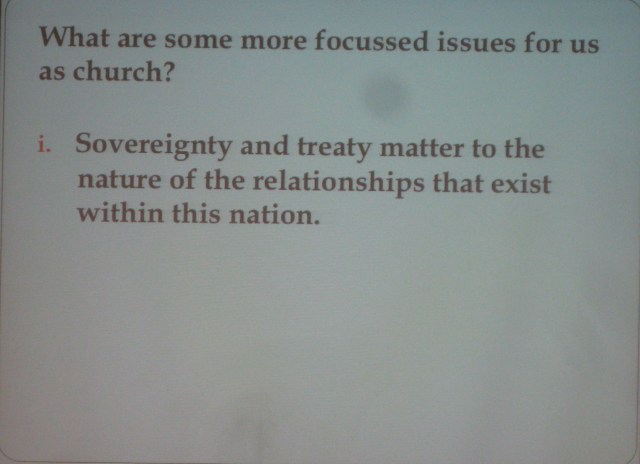
Ask what does it mean for the identity of the church to recognise First People? Always about wealth: land, labour, wealth… when talking of treaty/constitutions always become justifying narratives. We cannot ignore the material component.

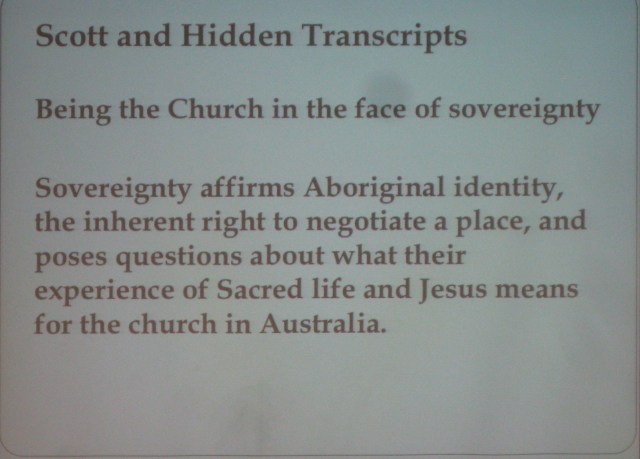
 Sovereignty? People aren’t sure about what the word means.

Confuses meaning when indigenous people are asking for it.

Rights and claims continuously negotiated e.g. human rights (allows some limits/accountability)

Four themes:

i ‘external’ or ‘internal’ authority. Boats vs. states/federal government.

ii power of institutions or powers of people

iii be sorted out legally or negotiated politically e.g. State of Victoria negotiating a Treaty.

iv sovereignty is capable of being shared > not absolute (Pakeha and Maori)


  1. separate and independent nation
  2. starting point to achieve rights and social inclusion
  3. authority inherent in them as individuals and as a people


Assertion: sovereignty reframing ongoing negotiating of claims in the community > nature of our settlement and how they live here.

Not disadvantage or reparations but ‘ancestral occupation’.  Not a gift of ours to give.

Recognises First People are a people with their own culture, land, language… have inherent rights.  Opens up a new negotiation for settlement.


img_1454


TREATY

‘shared house’ analogy… if you move in to a share house together there are rules – have to pay your share of rent, food, utilities… if some random moves in and uses everything. Eventually someone will say, we were here first – pay the board or move out.  There is a need to recognise our sovereignty.


img_1456

ACT OF RESISTANCE

Narrative of explanation (public ideology that justifies current system e.g. invisible). Can’t critique publicly. Another narrative told in private places.

Did Jesus tell stories in public areas – in ways that didn’t threaten powers (used language and metaphors they didn’t understand) but reaches ‘those with ears to hear’. [hidden transcript]

Worth doing things people don’t understand – not taken seriously by Government but gives hope to those in the know.

What are you trying to fit into?


img_1457

ISSUES FACING CHURCH

i   church needs to weigh in on issue of sovereignty

ii   church came in with the invaders – there is an existing sacred relationship with the land (invite us to share that story)

iii   church needs to confront issues of land and reparation – material reparation (Zacharius)

iv   recognition challenges ideas of how we speak of faith and salvation.  Creation/sinned message makes indigenous relationship to land (sinful) need salvation/assimilation of this idea into church à trusted. Make it personal…

How does recognition of indigenous people alter my understanding of gospels?

Understand gospels in relation to /context of existing indigenous relationship to land not politicising the gospels with a liberation theology that retrospectively tries to make sense of that, this is not “special interest group theology” (black, feminist, etc.)

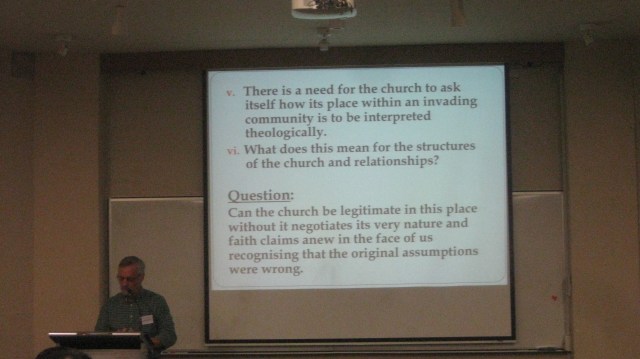
v   churches places within or on invading community is to be interpreted theologically .

vi   what does this mean for the structures of church and relationships?

vii   still a need to hear and honour history as a foundation for present and future relationships… own/confess/change it…

img_1458


IMG_7300


Facilitated by Christop Booth from the Indigenous Hospitality House, in this bible study series we will seek to make connections between the story of the nation of Israel told in Lamentations and our own national story. We will look to see whether this book may help us to address our shared histories of displacement and endeavour to distill how we might move forward as a nation in light of the biblical example.

Connection to Community

Who do you think of as community?

What forms of sharing are undertaken within these communities? (what is personal, what is communal?)

Read Lamentations 5

What type of people made up the Israelite community?

What did they share together? What experiences/materials/stories?

How connected were the Israelite people to one another at the time this poem was written?

What do we think of when we think of Aboriginal communities?

Watch clip from move The Sapphires [singing for soldiers during the war, Manager is injured and they’re separated, have to decide to go on or go back]

What kind of sharing takes place?

What part does shared suffering play in the building of community or extent of connectedness experienced?

Does being Aboriginal increase the likelihood of connection experienced by an individual? Does belief in God?

Can we identify any other factors which promote community building and connectedness?

How might we offer and/or provide aspects if community connectedness for others and ourselves at a local, national and international level?


IMG_9047

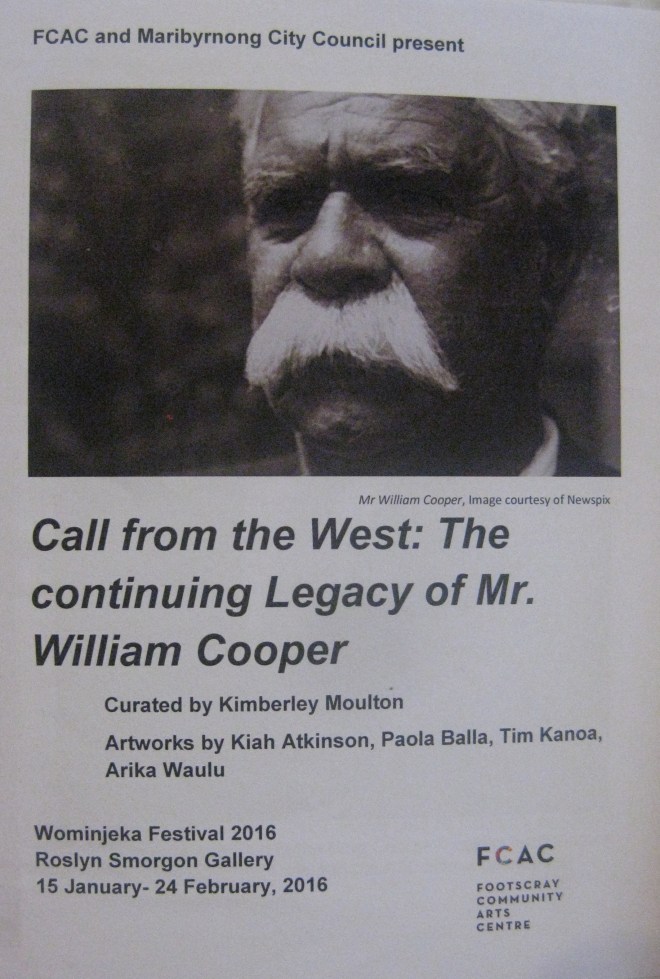
As a nation we have not been taught about our own black heroes, we learn about great civil rights leaders from around the world. Dr Martin Luther King and Rosa Parks are familiar within our vernacular however the black freedom fighters of our own country are left out of the history books.  From first contact through to today we have Aboriginal leaders like William Cooper that have shifted the course of history, that have resisted the colonial order of the nation and have led us in the ongoing goal to de-colonise our space, for equality, for better living condition, for health and legal care, for land rights.  These are the legacies that are left to be continued by the next generation of Aboriginal women and men.

The ‘tide of history’ has not washed away our connections to country or culture, it is our sovereign right and it is our obligation to our old people to maintain these.


“We must continue seeking for our rights”
William Cooper 1934

“We must realise that there is a greater purpose for us than to exist for ones’ own life”
Uncle Alf ‘Boydie’ Turner 2009

IMG_9049

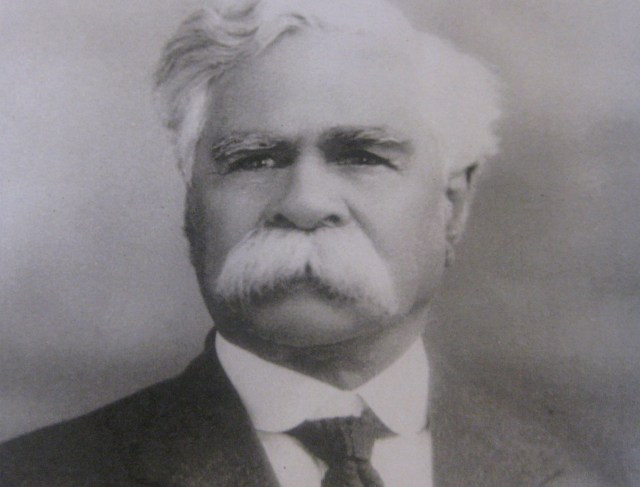
William Cooper
Source: Museum Victoria

Yorta Yorta man Mr William Cooper had a vision for his people to live a better life, to be treated as equal citizens in a land that as he stated, by ‘divine right’ was theirs.  His story is remarkable and of great courage and strength, he fought for not only  his people but for others around the world being persecuted.  William was a humanitarian on a mission to create change.

Born on the banks of the Dungala (Murray River) in 1861 William lived his youth witnessing the frontier of change.  He saw the destruction of his homelands and the dispossession of Aboriginal and Torres Straight Islander people across the country but his strength as a proud Yorta Yorta man could not be taken and he dedicated his life to fighting for better rights of his people.

William had many hardships in his life, losing two children including Daniel Cooper who lost his life fighting in the First World War and also two wives, in this time raising his family in regional Victoria and NSW travelling to where he could work.  As an elderly man he moved from Cummeragunja mission to Melbourne to be able to receive the old age pension.  This was a time where many Aboriginal people were fleeing missions across the state, walking off in the hope for better living conditions and making their way to Melbourne.  The West, Fitzroy and Northcote were community hubs of Aboriginal people congregating, building a life in the city.

In this time he formed the Australian Aborigines League (AAL) and they would meet at his house in Footscray.  The AAL demanded that Aboriginal people should enjoy the same rights as all Australians. William became secretary and began writing many letters and petitionings to government on behalf of the AAL calling for civil rights and changes in government policy.  In this time he led many significant protests including a petition to King George V calling for Aboriginal representation in parliament.  He and the AAL also supported the Cummerangunja walk off in protest of the appalling living conditions and brutality inflicted on the community.  In 1938 William led a deputation from Footscray, walking into the city where thy presented the German Consulate with a letter demanding the Nazi government stop the ‘cruel persecution of the Jewish people’, this is the only known protest of its kind recorded in the world at that time.  Both his petition to the King and the deputation’s letter to the German government were refused.  William in his life time wrote over eighty letters petitioning for Aboriginal rights, equality and human rights and he never gave up the fight and his vision for a better future for his people.

This legacy has been carried on by his descendants including his grandson Uncle Alf ‘Boydie’ Turner who in recent years has accomplished his grandfathers work getting a new petition to Queen Elizabeth.  With his great nephew Kevin Russell and other family and supporters, he re-enacted the deputation to the city, marching to the German Consulate and handing over the letter that his Grandfather had tried to do many years before.

Four Koorie artists in this exhibition respond to notions of legacy and current political realities for our community.

Kiah Atkinson is an emerging artist and a relative of Mr William Cooper, Kiah’s sound piece tracks William’s journey from Yorta Yorta country to Footscray, creating an audio journey.

Paola Balla is an artist, writer and activist whose work ‘the homes that we had known’ is a personal story of connection to William through her Great Grandmother Mariah or ‘Puppa’ as she was known, who travelled 1500km on her own to attend the Day of Mourning in 1938.  Paola’s installation includes a bed frame with earth, leaves and flowers from her country; a poetic reflection to the hardship of mission life that her grandmother Rosie describes in a poem.  Paola commemorates the struggle of our ancestors whilst highlighting the strong Aboriginal women who were protesting and raising families in some of the most challenging conditions.

Tim Kanoa is a photographer who has been capturing the recent rallies against the forced closure of Aboriginal communities in WA.  Tens of thousands of people gathered to protest in 2015 and Tim’s work Ignite looks at how the legacy of protest and standing up continues to burn strong.

Arika Waulu’s work legacyliveson is a powerful meditation on sovereignty and the next generation of activists.  Arika’s projection of the 2015 rallies led by the Warriors of Aboriginal Resistance along with an illustrated portrait of William is projected onto a wall of paper bark visas which are representations of sovereign nations.

Kimberley Moulton
Yorta Yorta


The ‘tide of history’ has not washed away our connections to country or culture, it is our sovereign right and it is our obligation to our old people to maintain these.

Reflection questions:

What does  the term ‘legacy’ evoke?

What is the significance of the actions of Uncle Alf ‘Boydie’ Turner and Kevin Russell?
What do you think Uncle Turner means when he refers to a ‘greater purpose’?

What ways do you/do you not feel connected to country and culture?

What vision do you have for a whole or healed world?
What could/are you doing to participate in building that vision to be a reality?

Do you think Aboriginal people have the same rights as other people in Australia now?

IMG_5908

Some fine Saturday I would like to recommend you idle away an afternoon doing the Billibellary’s Walk at the University of Melbourne.  I work in the precinct so it felt like a good fit to contextualise what was happening in this specific place 300 years ago, 200 years ago, 100 years ago, now… or maybe what’s not happening…?


Billibellary’s Walk

Wominjeka. Welcome to Wurundjeri Country

Billibellary’s Walk is named after the Ngurungaeta, or clan head, of the Wurundjeri people at the time of Melbourne’s settlement. The walk is a cultural interpretation of the University’s Parkville campus landscape that provides an experience of connection to Country which Wurundjeri people continue to have, both physically and spiritually.

The walk is designed to help participants hear the whispers and songs of the Wurundjeri people that lie within the University of Melbourne’s built environment. The walk alerts us to signs and stories that may not be apparent to visitors, but which provide some insight into the experience of the Wurundjeri people of the Woiwurrung language group who have walked the grounds upon which the University now stands for more than 40,000 years. It is intended to provide the impetus for further exploration of issues pertinent to the Aboriginal community.

http://www.murrupbarak.unimelb.edu.au/

Smart phone App


IMG_5911

The actual talking-point sites around the campus don’t often have a strong link to what you’re talking through but probably understanding that little remains from earlier times is precisely part of the journey they are taking you on.  I was lucky enough to do it with Samara from the Indigenous Hospitality House in Carlton so the talking points and questions were enriched by having someone along so much more deeply invested and holding wisdom in cultural awareness.  You could do it as a tourist, as a social studies class, as someone seeking to hear truth… being open to ideas, history, stories and what they have to teach us about the impacts of colonisation.  You could do it as someone who likes to look at a big, tall, beautiful tree and know that it’s been there since before you came along and will stand for many years after you go – bearing witness.

IMG_5914

The walk poses a lot of questions.  It doesn’t necessarily have the answers.  You have to sit in that. Not having the answers.  This is something we’re still living out hey…

I find myself getting fired up as our conversation canvasses: religion, authoritarianism, institutionalisation….  from colonisation to terrorism to the Royal Commission investigating child abuse… it all somehow feels like the same thing and it feels broken.

“We’re not going to be the ones who fix it” Samara points out.

“Then who?” I demand.

“We be a part of it.”

This walk invites you to do that.  Be a part of it.


IMG_5915

Facilitated by Mehrin Almassi from the Indigenous Hospitality House, in this bible study series we will seek to make connections between the story of the nation of Israel told in Lamentations and our own national story. We will look to see whether this book may help us to address our shared histories of displacement and endeavour to distill how we might move forward as a nation in light of the biblical example.

Connection to Creator (Spirit)

What do we think of when we hear the word Spirit? What do we think of when we hear the words Spirit of God?
What do we think about when we hear the term Creator Spirit?
What do we think is meant by each of these phrases? Are they related? Could they be?

Read Lamentations 3

Did the Israelite people have a sense of the Spirit of God – the Creator Spirit?
What was God like for the people of Israel? What was their experience of relating to God?
How do we relate to and/or experience God? Is our experience different to that of the Israelites? If so, can we think why?

Let’s read the Boon Wurrung Story.

What might this story teach us about the way the Boon Wurrung people experience the Creator Spirit?
What may this story teach us about the importance of our own stories in relation to local, national and international issues?
How else might we apply important narratives of the past to current situations needing attention?

Kids Activity

In parallel to grown ups run a kids session: talk about pictures as stories, songlines and place.

Will need:

  • messy clothes (if painting)
  • paint and brushes and/or lots of sticky dot stickers
  • paper
  • photos (bring along some or a camera to take some on the day)

What do you like about stories?
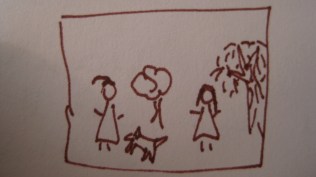
Look at this image? What is this a picture of?

IMG_6499


(girls, dog, trees…)

This picture tells the story of the time Talitha and Bron went to the park with Gracie.

11834903_10153063761386868_8866957583155349394_o

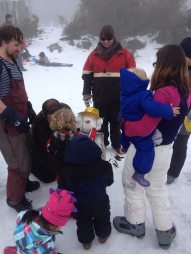
 What about this image? what’s happening here? who was there? but they aren’t in the picture… how do you know they were there?

(pictures can capture a “moment”, some part of a bigger memory, tobogganing and snow angels, other friends… reminder of something bigger that we can no longer see)

Pictures have two things, a place and a “happening”.

Using your pictures so far, talk about where they are happening and what is happening.

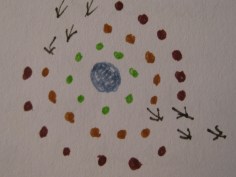
IMG_6501Indigenous stories tell something about a place and also about something happening there.

WHERE: Maybe there is a waterhole (blue), things grow there (green), drier sand/soil as you move away (orange), day rocks (red).

WHAT: An animal comes to the watering hole and then goes (tracks).

Ask children to share a memory, a story, and make a picture – collectively or individually (age depending). Then ask of each: Where is your story taking place? What is happening there?

How would you feel if you couldn’t got there again?  If you couldn’t do that again? (sad)

Today the grown ups are talking about the story of lamentations – a lament is a sound of grief and sorrow.  That’s what people in the story did when they couldn’t go back to the place they remembered or do the things they used to do there.

Learning:

our stories and our pictures can be used to tell each other about places we haven’t been and things we haven’t done, remembering and reminders can comfort us when we feel sad

let’s take a photo now, today of all of us together, making and telling stories so that we have a memory-capture. It’s good to take photos and write stories and make pictures because they help us remember

take your picture now to a grown up – tell them your story – use things inside the picture and outside the picture