Of communion, Jesus says I will not take this drink again until
I drink it new with you in my Father’s kingdom.
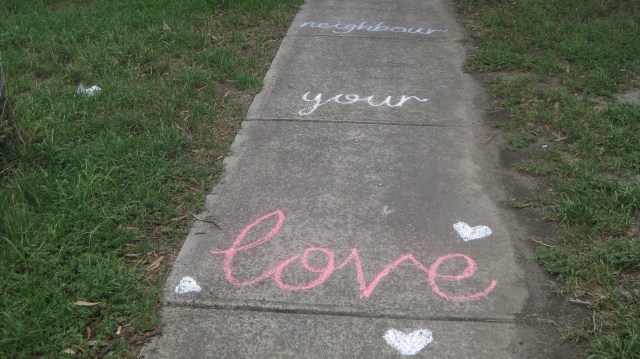
On Sunday 14 February we held a picnic lunch at the immigration detention centre in Maribyrnong. The first Sunday of Lent (and Valentines Day- let’s show the love) would often have a focus theme of a continued call to conversion the intention of the picnic was to physically create the space we would like to live in – that kingdom where Jesus might join us for a drink – even if only for an hour. How can we make that grass verge feel like space of celebration and welcome? How can we extend the expression of hospitality and welcome that we would like to see shown to refugees and asylum seekers?
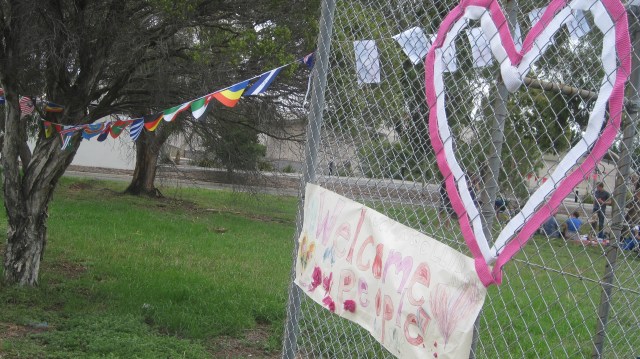
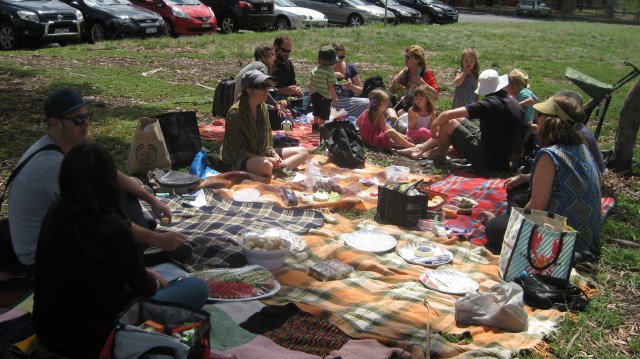
With yarn bombing, banners, different flags, welcome in different languages, families and at each picnic blanket a spare place set at the table – a visual demonstration that there is room at the table for the ‘other’ and enough food to share.
In the face of the continued and indefinite detention of refugees and asylum seekers including children and New Zealanders now the second highest number of those held in off-shore detention – we seek to respond with an act of hospitality, an act of welcome, and act of love – witnessing there is room at THIS communion table.
***
Wominjeka, we acknowledge that we gather on the land of which the Wurundjeri people of the Kulin Nation have gathered since time immemorial to tell stories, sing songs and share food together. We are gathered here today to do a little of all these things ourselves: tell stories, sing songs and share some food together around this idea of showing welcome to refugees and asylum seekers and we have chosen a specific place, time and context in which to do that.
We are standing here in the carpark of what is now the VicUni Student Village…this used to be the site of the Pyrotechnic Section of an Explosives Factory (1942) which was built to produce flares, tracers and smoke grenades during the Second World War… a section of this was converted to the Maribyrnong Migrant Hostel (1966). Over here behind us is the new purpose-built Maribyrnong Immigration Detention Centre (1983) – we are standing where refugees and migrants have been arriving for the last 50 years.
We are standing here at a particular time. Today is Sunday 14 February, the first Sunday of Lent and Valentines Day – let’s show the love! The first Sunday of Lent would often have a focus theme of a continued call to conversion and the intention of this picnic is to physically create the kingdom space we would like to live in – demonstrating the kind of welcome and abundant hospitality we as Christians believe Jesus might extend and asking of our own discipleship how we feel called to respond.
We are gathering during a particular context. The Premier of our own state has come out against the federally legislated law, medical practitioners are refusing to sign off of returning patients to off-shore detention and the UN has condemned the treatment of refugees as breaching human rights… the government, media, society are all sending strong messages – in an environment that seems more focused on reacting out of fear than love, how might we respond with clarity and compassion?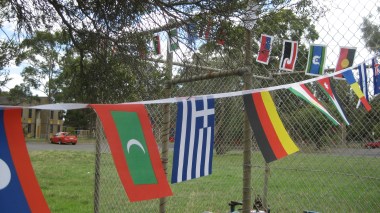
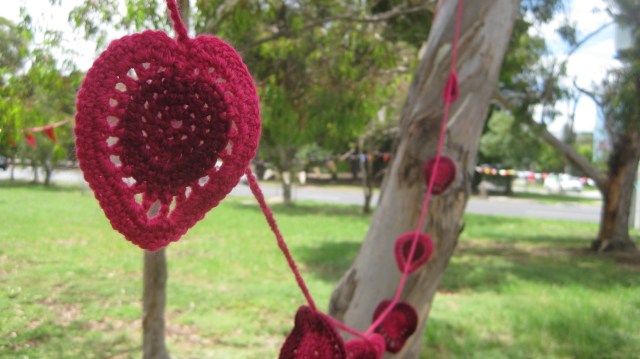
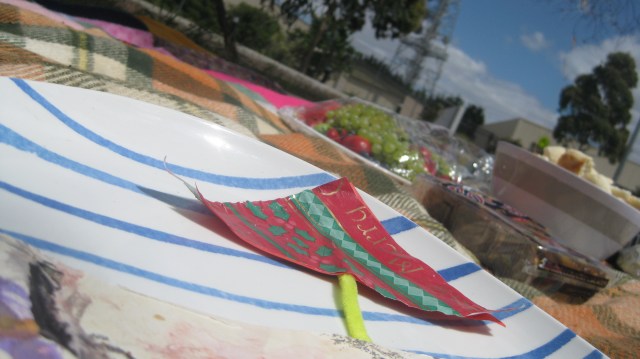
We have folded layers of symbolism into our picnic today… you can see the crocheted heart bunting by Bron for Valentines Day, we have flags representing some of those countries and cultures making up the population of those in our detention centres, and we have empty plates – places set at the table for the ‘other’. We live with asylum 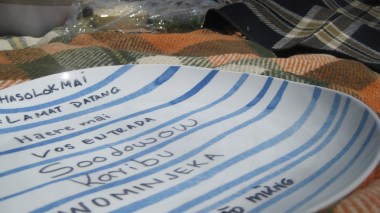 seekers and refugees, we invited them to write the word WELCOME in the language of their cultures on one of the plates and symbolically be represented here and we remember those stories that are still unfolding.
That is about as much story as there is from me, so let’s move on to the singing! We’re very lucky to have Sam here to be the lead liturgist today so look to her for any cues – we’re not going to sing these through a set number of times or anything, we’ll just keep going until she signals otherwise.
So, I will invite you to stand if you want to, in this place, at this time in this context and sing with me, this is not a new idea… we sing in the tradition of so many justice movements: civil rights, suffragettes, apartheid, slavery…in the words of Ched Myers to “Sing about it, until it can be realised”.
This first one is from the Ngatiawa River Monastry, up the Kapiti Coast of New Zealand, a contemporary contemplative community retreat centre.
Given for you [link here to original version on the Ngatiawa website]
This is my body given for you
Remember me.
This is my blood of forgiveness,
Remember me.
Tricia Watts is an Australian singer, composer, she’s used singing and dance for advocacy and therapy and to call people to unite in heart and voice. This next song is from her resource titled ‘Sanctuary’. We want to offer Sanctuary, we want to link hand in hand, we want to hear the voice of justice cry.
Justice Cry
Hear the voice of justice cry,
Moving through our land,
Ringing out o’er hills and plains,
Linking hand in hand.
Well, I guess the credit or the blame for this one is on me… many of you will have heard of the Love Makes A Way movement. They have undertaken a variety of actions but in particular sitting in politicians offices and praying for them has attracted media coverage. What might be less known, is that while the actions are being undertaken inside, there is a support team outside praying, singing and bearing witness to, and holding vigil with, what happens within. Samara has been one of the people playing that part and collating a Love Makes A Way song book. And as we were talking about it once we remarked the we were drawing heavily on the Freedom songs of the civil rights movement but their style and language were written for a particular context and a particular time – certainly we can borrow their songs but Samara posed the questions “Where are our songs? Where is the style or the voice arising out of our own context?” This song came out of trying to answer that… as I looked at the Freedom songs I felt like they communicated grief but called for hope, they were often short and memorable because as your walking around you need songs people can just pick up even if they don’t have the words in front of them. I wrote this trying to find words for a situation I don’t have words to explain. You might feel moved to offer your own words here in a verse … there is room for the children, there is room in our playgrounds… feel free to lead us! Speaking specifically to context, this was originally written “Let them in, let them in” but with the Sanctuary #LetThemStay initiative just this past week as we were rehearsing we changed it to read “Let them in, let them stay”
There is room
There is room at the table (x3)
Let them in, let them stay.
There is room at the border (x3)
Let them in, let them stay.
There is room in our hearts (x3)
Let them in, let them stay.
There is hope for a new tomorrow (x3)
Let them in, let them stay.
Flowing on from the last song and our desire to have local songs coming out of our own context, I had a look around for who might already be producing words that hold this sense of lament and hope, short and memorable… this led me to make up the melody for the round you’re about to hear to Leunigs Love Is Born. I think Leunig is a bit of a prophet, speaking out of hope and darkness, on behalf of many voices… I think “love is born”.
Love is Born [link here to a recording by Nathan Brailey]
Love is born with a dark and troubled face
When hope is dead and in a most unlikely place
Love is born,
Love is always born.
Love is born,
Love is always born.
This little ‘set’ wouldn’t be complete without a rousing Hallelujah chorus from the Freedom songs of the civil rights movement – it’s hard to know who to give credit to because groups of musicians gathered for “Sing for Freedom” workshops and wrote them together. These songs were written to be a call for integration and confrontation of the status quo. African-Americans in the 60s in the South were singing “We’re gonna sit at the welcome table”, today we have to acknowledge that we’re already sitting at the welcome table, or the welcome picnic blanket… Again, you might be moved to call out a chorus of your own making! {e.g. We’re gonna share our songs and stories} By Samara’s hand now we will sing “they’re” as we aspirationally hold space and hope that those inside will one day come outside and join us at this table.
They’re gonna sit at the welcome table
They’re gonna sit at the welcome table
They’re gonna sit at the welcome table one of these days (hallelujah)
They’re gonna sit at the welcome table
Sit at the welcome table one of these days (one of these days)
They’re gonna feast on milk and honey
They’re gonna feast on milk and honey one of these days, (hallelujah)
They’re gonna feast on milk and honey
Feast on milk and honey one of these days (one of these days)
A-ll God’s chil-dren gonna sit to-ge–ther
Yes, a-ll God’s chil-dren gonna sit together one of these days (hallelujah)
A-ll God’s child-ren gonna sit to-ge–ther
All God’s children gonna sit together, one of these days (one of these days)
They’re gonna sit at the welcome table
Yes, they’re gonna sit at the welcome table one of these days, (hallelujah)
They’re gonna sit at the welcome table
Sit at the welcome table one of these days (one of these days)
Sit at the welcome table one of these days, (one of these days)
Gonna sit at the welcome table one of these days (one of these days)
Thanks so much for making the time today to come here – to stand, to sing, in a particular place, at a particular time, in a particular context to say something.
Let’s enjoy the picnic!
Further rough notes for those interested in the background of how this picnic came about:
Last year, Mayra and I went to a conference called the Kinsler Institute and heard an amazing activist and speaker Bill Wylie-Kellerman doing a session on ‘Liturgy as Activism’. He is the Minister of an Episcopal Church in Detroit where they’re experiencing some severe water cut offs and he described a Good Friday Stations of the Cross walk where they stood outside the water company, at the river, at block where there is only one house with people still living in it… there was something about singing or praying or standing in a particular place, at a particular time, in a particular context to say something that made it more powerful.
We came back from that conference inspired to imagine what a Stations of the Cross walk might look like for our own context here in Footscray – we went to the Palms Motel where they provide crisis accommodation for people experiencing homelessness, we went to the river and reflected on the impacts of climate change, we came here to the Maribyrnong detention centre … most of you will know of the Christian tradition of communion, sharing bread and wine together, this is done symbolically because Jesus says ‘I won’t eat this again with you until I see you in my Father’s kingdom’. In a church we have communion and we eat it as a reminder of that promise… well, we came here and compared what it must feel like for refugees who take a long and dangerous journey to get here, who expect to find shelter, and safety and hospitality and instead… we passed around an empty cup and an empty plate as a symbol of the kind of hospitality people have experienced arriving here.
Of communion, Jesus says I will not take this drink again until
I drink it new with you in my Father’s kingdom.
We decided on Sunday 14 February we would hold a picnic lunch at the immigration dentention centre in Maribyrnong.
The first Sunday of Lent (and Valentines Day- let’s show the love) would often have a focus theme of a continued call to conversion the intention of the picnic was to physically create the space we would like to live in – that kingdom where Jesus might join us for a drink – even if only for an hour. How can we make that grass verge feel like space of celebration and welcome? How can we extend the expression of hospitality and welcome that we would like to see shown to refugees and asylum seekers?
With yarn bombing, banners, different flags, welcome in different languages, families and at each picnic blanket a spare place set at the table – a visual demonstration that there is room at the table for the ‘other’ and enough food to share.
In the face of the continued and indefinite detention of refugees and asylum seekers including children and New Zealanders now the second highest number of those held in off-shore detention – we seek to respond with an act of hospitality, an act of welcome, and act of love – witnessing there is room at THIS communion table.
Why here? A conversion of the New Pyrotechnic Section of the Explosives Factory Maribyrnong established in 1942 to produce flares, tracers and smoke grenades – the Maribyrnong Migrant Hostel first opened in 1966. Part of an ambitious assisted migration scheme that was implemented by the Commonwealth government in the late 1940s in order to increase Australia’s population. Until it was discontinued in 1981, this program saw thousands of British, European and Asian migrants start a new life in this country, temporarily accommodated in government hostels until they were able to buy or rent a house of their own. The Hostel has accommodated migrants from almost every national group that has arrived in Australia since World War II. Initially these were people from Britain and Europe but the later migrants arrived from Asia and South America and people escaping political upheavals in places such as Hungary, Chile and Vietnam. The hostel at various times also accommodated naval personnel, apprentices and evacuees from Darwin after Cyclone Tracy in 1974. Attempts by migrants to personalise their surrounding are apparent in a mural of windmills and tulips by Dutch migrants painted on the side of one of the surviving concrete bunker structures and a mural of an Asian scene that appears to have been painted by Vietnamese migrants on a section of wall of one of the ammunition stores located next to the Phillip Centre. This building also includes a number of paintings by children on its walls. Staff of the migrant centre also erected a large aviary attached to the former electrical substation that was part of the pyrotechnic works. (onmydoorstep.com.au/heritage-listing/35583/former-maribyrnong-migrant-hostel). These site spaces are now occupied by Victoria University and in the last few years used predominantly for student accommodation.
The current, purpose-built, Maribyrnong Immigration Detention Centre (IDC) was opened in 1983, set up for people who have over-stayed their visas, had their visa cancelled, or who have been denied entry into the country through international airports and seaports. Unlike the Broadmeadows IDC which has been home to families and children, Maribyrnong IDC has been home for mostly adult single male detainees identified as medium/high risk and therefore it is a site that has had higher security.
In June, the Australian Citizenship Amendment (Allegiance to Australia) Bill 2015 was passed. The Citizenship Act has always said that if a foreign citizen or foreign national fights for a foreign country at war with Australia, they automatically cease to be an Australian citizen. Fair enough. The Bill adds three new categories of circumstances which will bring about the same result.
- Fighting for a terrorist organisation – still with you…
- Convictions for certain offences – if you’re a foreign citizen or national and you are convicted of any of a long list of criminal offences, your citizenship will automatically cease.
- Acting inconsistently with your allegiance to Australia – what does that even mean?
The protocol is that ASIO notices you’ve done a particular thing and tells the Immigration Minister who deports you. To do that, he has to accept that the factual allegations are correct. You have no right to be heard before he does so. You can contest it later but by this time you’re already on a plane.
(you can read more about this here if you’re interested: abc.net.au/news/2015-06-25/bradley-how-you-could-lose-your-citizenship/6572382)
At 30 December 2015, there were 1,792 people in held immigration detention facilities. Of these 1,792 people, around 18.6 per cent were from Iran, 10.2 per cent were from New Zealand, 8.0 per cent were from Sri Lanka, 6.5 per cent were from China and 6.3 per cent were from Vietnam. (Department of Immigration and Border Protection).
New immigration laws brought into effect back in December 2014 mean that anyone who has served a jail sentence of 12 months or more in Australia could be deported. “We don’t want people who get into trouble, who have a criminal record, and those who fit into that category will have their visas cancelled and sent back to where they came from,” Australian senator Ian Macdonald said, saying that New Zealanders can’t expect special treatment.
“We love our cousins across the ditch but they must be subject to the same laws as everyone else.” [ The Australian, 29 Sept 2015]
It may be that New Zealanders thought they were being treated by the same laws as everyone else when they were convicted, served time and released just as an Australian might be. That once they had observed due process and due punishment they were free to resume normal life, 5000 New Zealanders have done time in the last 10 years and these changes mean they can retrospectively be sent home. I’m not trying to be permissive or whitewash anything these people have done. Clearly they are convicted criminals all. But surely we must ask whether it is fair to punish them now, again, a new law applied to an old crime? These who might have family here, work here, barrack for an AFL team here… is it justifiable? Is it justice?
With all these legislative changes, the population of the Maribyrnong IDC has housed both of these groups – convicted criminals whose visas are cancelled and are being sent back to where they came from side by side with refugees seeking asylum and safety. I can’t find a number for 2015 but between 2010-2014 the number of “boat people” identified as legitimate refugees is over 90% in each year. The treatment of the asylum seekers and the treatment of the criminals is the same. “Hard-line” centre managers from the prison system have been brought in – ex-prison guards who have a very different culture and mentality to officers who have been trained to guard asylum seekers amidst outbreaks of racial violence and hunger strikes .
People come to Australia with the hope of a better life but they are kept in the same place, and in many ways treated similarly, as criminals. A friend of ours who has visited here – a refugee herself – has shared stories of the intimidation to herself of the conditions of entry; the boredom, the frustration, the fear, the hopelessness, the despair of those she met inside. She had her own complex needs but returned again and again not only to meet the hunger for Arabic home cooking, but for stories and news of life outside.
The latest development is this: all refugees in Maribyrnong are due to be moved to Broadmeadows which has recently had a high security upgrade. They were due to be moved already but it hasn’t happened yet – we have no way of knowing if this will occur prior to 14th of February. This comes at a high cost to those at Broadmeadows IDC because along with the higher fence, more guards and greater security screening, comes heavier dehumanisation.
And, you know, some of the symbolism of our picnic is lost.
Or is it?
What a contrast over fifty years between a hostel and a prison, between encouraging people to move to Australia and border control to keep them out… but this place, this space, is where weapons were made that were used during World War II then offered a new start to some of the refugees of that conflict. What has been used for building harm in this place has been transformed for building hope before… maybe we can build it again.





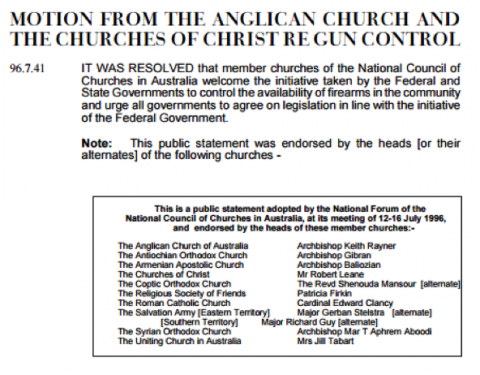 When changes to gun laws were first proposed, the member churches of the National Council of Churches welcomed the initiative and urged government to agree on and pass the legislation.


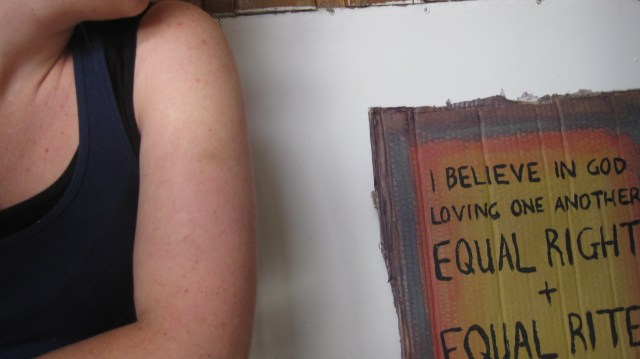
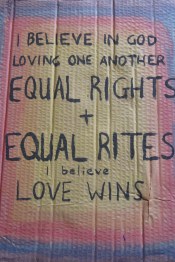 signs to the marriage equality march – do I carry them facing inwards until I get there? Am I going to draw negative attention from people that are anti-gay or anti-Christian? You are making a choice, to set yourself out, apart, from ‘normal’ people going about their ‘normal’ day, doing ‘normal’things.
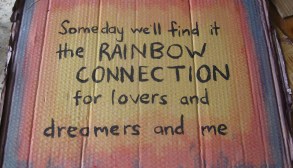 anything and I am almost disappointed… let’s do it, let’s talk about how we’re treating one another. People see the signs – rainbow broadcasting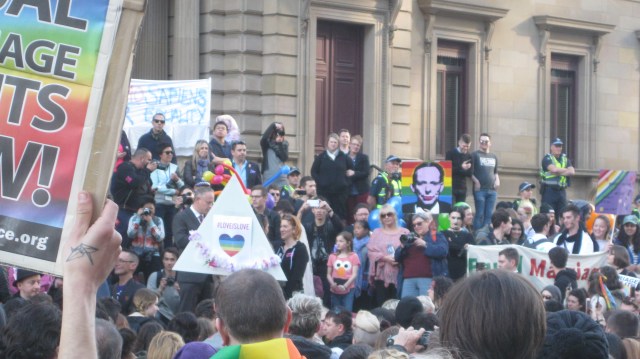
 itellyouarise