Tag Archive: justice


img_1514

We are running a fortnightly bible study following our community dinner looking at the exegesis (interpretation) of the bible passages that underpin each of our community values. You can read the list of Values here so you know what’s coming up next.

These values can be relevant whatever context you live and work in just make the Word you own.


Value 4: Seeking justice for the poor

We value God’s priority for the poor and seek to prioritise the marginalised of Footscray.  We do not want to just show mercy, but instead offer our lives, in voice and activity, with those who we seek to serve.

Biblical basis: Jeremiah 22:16, James 2: 1-5


Let’s read the value together… what words/phrases stand out?

Who do we think are “the poor”?

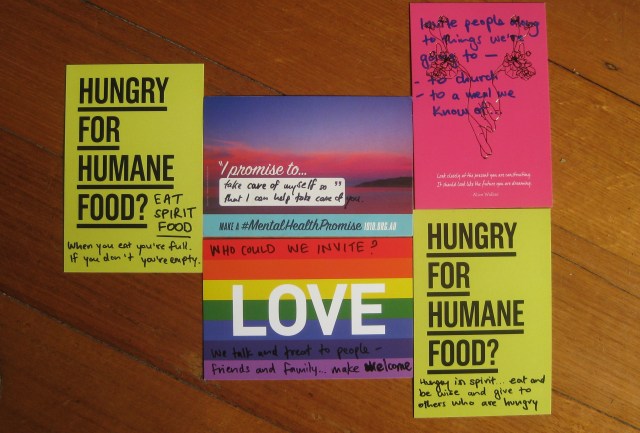
Those who are poor in heart? in spirit? or without money?  It’s those who are poor in spirit that are worst off = those who feel empty.  When you eat you’re full. If you don’t eat you’re empty.

We need to be helping one another more.

Read the bible. What words/ideas stand out?
What can we learn from the bible about living the Value: Seeking justice for the poor?

Jeremiah passage brought to mind people such as Donald Trump and Gina Rinehart…

Who gets behind and left out? What kinds of people?

What does it mean to “have a huge head-start in the faith stakes”?
Know how to be grateful.


Jeremiah 22: 16-17

“Doom to him who builds palaces but bullies people,

who makes a fine house but destroys lives,

Who cheats his workers

and won’t pay them for their work,

Who says, ‘I’ll build me an elaborate mansion

with spacious rooms and fancy windows.

I’ll bring in rare and expensive woods

and the latest in interior decor.’

So, that makes you a king—

living in a fancy palace?

Your father got along just fine, didn’t he?

He did what was right and treated people fairly,

And things went well with him.

He stuck up for the down-and-out,

And things went well for Judah.

Isn’t this what it means to know me?”

God’s Decree!

“But you’re blind and brainless.

All you think about is yourself,

Taking advantage of the weak,

bulldozing your way, bullying victims.”

The Word became flesh and blood,

and moved into the neighbourhood.

We saw the glory with our own eyes,

the one-of-a-kind glory,

like Father, like Son,

Generous inside and out,

true from start to finish.


The Message


James 2: 1-10

……..Sisters and brothers, if you really believe in our glorious Lord Jesus Christ, how come you still play favourites? If people walk into one of your meetings and you make a fuss of the ones dressed up to the nines and looking a million dollars, ushering them to the best seats in the house, while at the same time turning up your nose at those dressed like battlers, down on their luck, telling them to stand out in the foyer, aren’t you practicing apartheid, segregating God’s children? You’re as crooked as a judge who bases your sentence on the length of your skirt!

……..Get this straight in your minds, dear friends. God has turned the world’s opinion polls upside down. Those who have been deprived of what the world values have a huge head-start in the faith stakes. Their names are at the top of the list of those who God has chosen to inherit the riches of the kingdom. All who love God have an equal share in God’s promises, but you’re insulting some of them by means-testing your welcome.


©2002 Nathan Nettleton LaughingBird.net


Reflection time… followed by sharing time.

Who are “the poor” in Footscray?

Offer our lives – in voice and activity…

  • what ways are we doing this now?
  • what ways could we start?


IMG_7321

Of communion, Jesus says I will not take this drink again until
I drink it new with you in my Father’s kingdom.

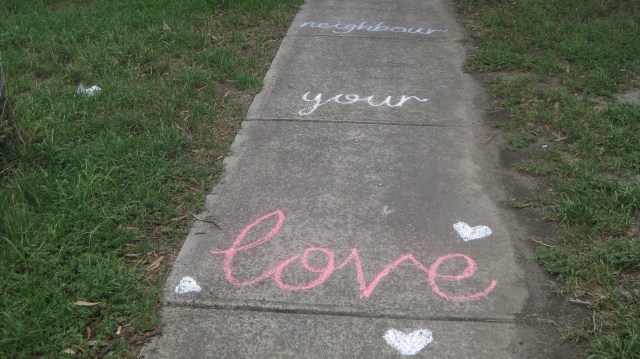
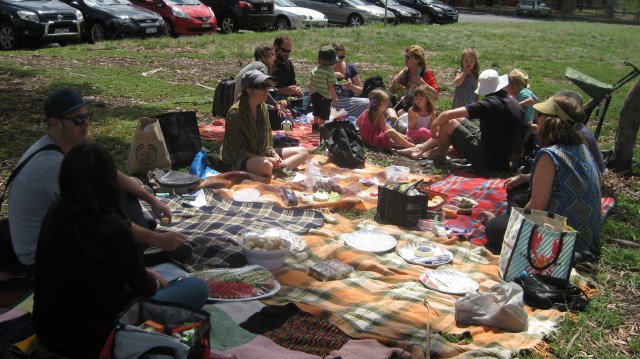
On Sunday 14 February we held a picnic lunch at the immigration detention centre in Maribyrnong. The first Sunday of Lent (and Valentines Day- let’s show the love) would often have a focus theme of a continued call to conversion the intention of the picnic was to physically create the space we would like to live in – that kingdom where Jesus might join us for a drink – even if only for an hour. How can we make that grass verge feel like space of celebration and welcome? How can we extend the expression of hospitality and welcome that we would like to see shown to refugees and asylum seekers?

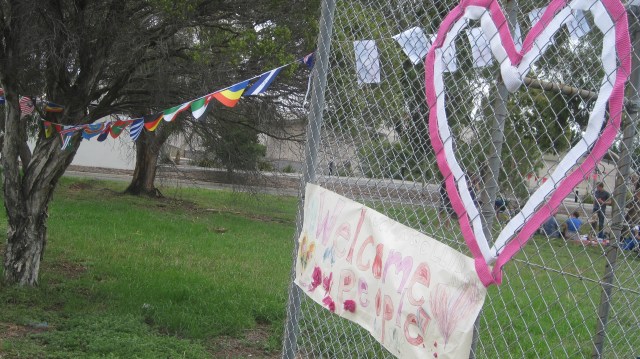
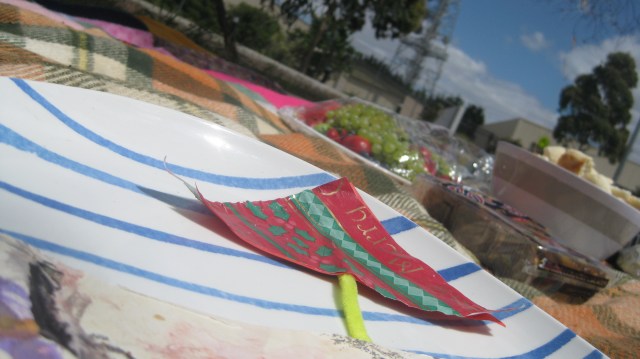
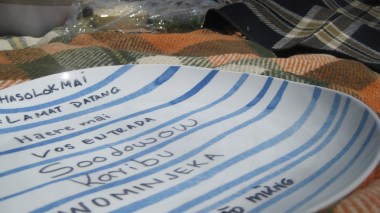
With yarn bombing, banners, different flags, welcome in different languages, families and at each picnic blanket a spare place set at the table – a visual demonstration that there is room at the table for the ‘other’ and enough food to share.

In the face of the continued and indefinite detention of refugees and asylum seekers including children and New Zealanders now the second highest number of those held in off-shore detention – we seek to respond with an act of hospitality, an act of welcome, and act of love – witnessing there is room at THIS communion table.

***
IMG_7367

Wominjeka, we acknowledge that we gather on the land of which the Wurundjeri people of the Kulin Nation have gathered since time immemorial to tell stories, sing songs and share food together. We are gathered here today to do a little of all these things ourselves: tell stories, sing songs and share some food together around this idea of showing welcome to refugees and asylum seekers and we have chosen a specific place, time and context in which to do that.
IMG_7364

We are standing here in the carpark of what is now the VicUni Student Village…this used to be the site of the Pyrotechnic Section of an Explosives Factory (1942) which was built to produce flares, tracers and smoke grenades during the Second World War… a section of this was converted to the Maribyrnong Migrant Hostel (1966). Over here behind us is the new purpose-built Maribyrnong Immigration Detention Centre (1983) – we are standing where refugees and migrants have been arriving for the last 50 years.

We are standing here at a particular time.  Today is Sunday 14 February, the first Sunday of Lent and Valentines Day – let’s show the love! The first Sunday of Lent would often have a focus theme of a continued call to conversion and the intention of this picnic is to physically create the kingdom space we would like to live in – demonstrating the kind of welcome and abundant hospitality we as Christians believe Jesus might extend and asking of our own discipleship how we feel called to respond.
IMG_7346

We are gathering during a particular context.  The Premier of our own state has come out against the federally legislated law, medical practitioners are refusing to sign off of returning patients to off-shore detention and the UN has condemned the treatment of refugees as breaching human rights… the government, media, society are all sending strong messages – in an environment that seems more focused on reacting out of fear than love, how might we respond with clarity and compassion?IMG_7334
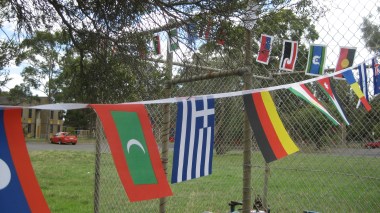
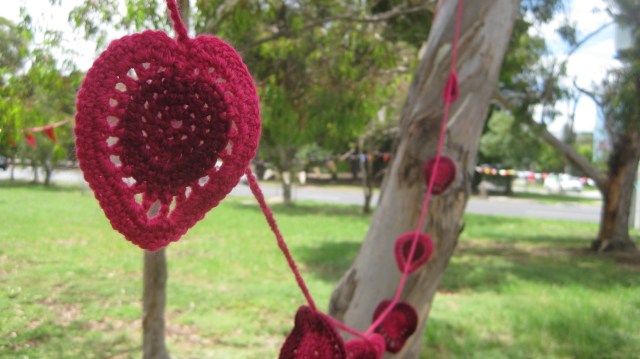
We have folded layers of symbolism into our picnic today… you can see the crocheted heart bunting by Bron for Valentines Day, we have flags representing some of those countries and cultures making up the population of those in our detention centres, and we have empty plates – places set at the table for the ‘other’.  We live with asylum IMG_7343seekers and refugees, we invited them to write the word WELCOME in the language of their cultures on one of the plates and symbolically be represented here and we remember those stories that are still unfolding.
That is about as much story as there is from me, so let’s move on to the singing! We’re very lucky to have Sam here to be the lead liturgist today so look to her for any cues – we’re not going to sing these through a set number of times or anything, we’ll just keep going until she signals otherwise.

So, I will invite you to stand if you want to, in this place, at this time in this context and sing with me, this is not a new idea… we sing in the tradition of so many justice movements: civil rights, suffragettes, apartheid, slavery…in the words of Ched Myers to “Sing about it, until it can be realised”.

This first one is from the Ngatiawa River Monastry, up the Kapiti Coast of New Zealand, a contemporary contemplative community retreat centre.


Given for you  [link here to original version on the Ngatiawa website]

 This is my body given for you

Remember me.

This is my blood of forgiveness,

Remember me.


Tricia Watts is an Australian singer, composer, she’s used singing and dance for advocacy and therapy and to call people to unite in heart and voice. This next song is from her resource titled ‘Sanctuary’.   We want to offer Sanctuary, we want to link hand in hand, we want to hear the voice of justice cry.


Justice Cry

Hear the voice of justice cry,

Moving through our land,

Ringing out oer hills and plains,

Linking hand in hand.


Well, I guess the credit or the blame for this one is on me… many of you will have heard of the Love Makes A Way movement. They have undertaken a variety of actions but in particular sitting in politicians offices and praying for them has attracted media coverage. What might be less known, is that while the actions are being undertaken inside, there is a support team outside praying, singing and bearing witness to, and holding vigil with, what happens within. Samara has been one of the people playing that part and collating a Love Makes A Way song book. And as we were talking about it once we remarked the we were drawing heavily on the Freedom songs of the civil rights movement but their style and language were written for a particular context and a particular time – certainly we can borrow their songs but Samara posed the questions “Where are our songs? Where is the style or the voice arising out of our own context?” This song came out of trying to answer that… as I looked at the Freedom songs I felt like they communicated grief but called for hope, they were often short and memorable because as your walking around you need songs people can just pick up even if they don’t have the words in front of them. I wrote this trying to find words for a situation I don’t have words to explain. You might feel moved to offer your own words here in a verse … there is room for the children, there is room in our playgrounds… feel free to lead us! Speaking specifically to context, this was originally written “Let them in, let them in” but with the Sanctuary #LetThemStay initiative just this past week as we were rehearsing we changed it to read “Let them in, let them stay”


There is room

There is room at the table (x3)

Let them in, let them stay.


There is room at the border (x3)

Let them in, let them stay.


There is room in our hearts (x3)

Let them in, let them stay.


There is hope for a new tomorrow (x3)

Let them in, let them stay.


Flowing on from the last song and our desire to have local songs coming out of our own context, I had a look around for who might already be producing words that hold this sense of lament and hope, short and memorable… this led me to make up the melody for the round you’re about to hear to Leunigs Love Is Born.  I think Leunig is a bit of a prophet, speaking out of hope and darkness, on behalf of many voices… I think “love is born”.


Love is Born [link here to a recording by Nathan Brailey]

Love is born with a dark and troubled face

When hope is dead and in a most unlikely place

Love is born,

Love is always born.

Love is born,

Love is always born.

This little ‘set’ wouldn’t be complete without a rousing Hallelujah chorus from the Freedom songs of the civil rights movement – it’s hard to know who to give credit to because groups of musicians gathered for “Sing for Freedom” workshops and wrote them together.  These songs were written to be a call for integration and confrontation of the status quo.  African-Americans in the 60s in the South were singing “Were gonna sit at the welcome table”, today we have to acknowledge that we’re already sitting at the welcome table, or the welcome picnic blanket… Again, you might be moved to call out a chorus of your own making! {e.g. We’re gonna share our songs and stories} By Samara’s hand now we will sing “they’re” as we aspirationally hold space and hope that those inside will one day come outside and join us at this table.


They’re gonna sit at the welcome table

They’re gonna sit at the welcome table

They’re gonna sit at the welcome table one of these days (hallelujah)

They’re gonna sit at the welcome table

Sit at the welcome table one of these days (one of these days)


They’re gonna feast on milk and honey

They’re gonna feast on milk and honey one of these days, (hallelujah)

They’re gonna feast on milk and honey

Feast on milk and honey one of these days (one of these days)


A-ll God’s chil-dren gonna sit to-gether

Yes, a-ll God’s chil-dren gonna sit together one of these days (hallelujah)

A-ll God’s child-ren gonna sit to-gether

All God’s children gonna sit together, one of these days (one of these days)


They’re gonna sit at the welcome table

Yes, they’re gonna sit at the welcome table one of these days, (hallelujah)

They’re gonna sit at the welcome table

Sit at the welcome table one of these days (one of these days)

Sit at the welcome table one of these days, (one of these days)

Gonna sit at the welcome table one of these days (one of these days)


Thanks so much for making the time today to come here – to stand, to sing, in a particular place, at a particular time, in a particular context to say something.

Let’s enjoy the picnic!
IMG_7347


Further rough notes for those interested in the background of how this picnic came about:

Last year, Mayra and I went to a conference called the Kinsler Institute and heard an amazing activist and speaker Bill Wylie-Kellerman doing a session on ‘Liturgy as Activism’.  He is the Minister of an Episcopal Church in Detroit where they’re experiencing some severe water cut offs and he described a Good Friday Stations of the Cross walk where they stood outside the water company, at the river, at block where there is only one house with people still living in it… there was something about singing or praying or standing in a particular place, at a particular time, in a particular context to say something that made it more powerful.

We came back from that conference inspired to imagine what a Stations of the Cross walk  might look like for our own context here in Footscray – we went to the Palms Motel where they provide crisis accommodation for people experiencing homelessness, we went to the river and reflected on the impacts of climate change, we came here to the Maribyrnong detention centre … most of you will know of the Christian tradition of communion, sharing bread and wine together, this is done symbolically because Jesus says ‘I won’t eat this again with you until I see you in my Father’s kingdom’. In a church we have communion and we eat it as a reminder of that promise… well, we came here and compared what it must feel like for refugees who take a long and dangerous journey to get here, who expect to find shelter, and safety and hospitality and instead…  we passed around an empty cup and an empty plate as a symbol of the kind of hospitality people have experienced arriving here.

Of communion, Jesus says I will not take this drink again until
I drink it new with you in my Father’s kingdom.

We decided on Sunday 14 February we would hold a picnic lunch at the immigration dentention centre in Maribyrnong.

The first Sunday of Lent (and Valentines Day- let’s show the love) would often have a focus theme of a continued call to conversion the intention of the picnic was to physically create the space we would like to live in – that kingdom where Jesus might join us for a drink – even if only for an hour. How can we make that grass verge feel like space of celebration and welcome? How can we extend the expression of hospitality and welcome that we would like to see shown to refugees and asylum seekers?

With yarn bombing, banners, different flags, welcome in different languages, families and at each picnic blanket a spare place set at the table – a visual demonstration that there is room at the table for the ‘other’ and enough food to share.

In the face of the continued and indefinite detention of refugees and asylum seekers including children and New Zealanders now the second highest number of those held in off-shore detention – we seek to respond with an act of hospitality, an act of welcome, and act of love – witnessing there is room at THIS communion table.

Why here? A conversion of the New Pyrotechnic Section of the Explosives Factory Maribyrnong established in 1942 to produce flares, tracers and smoke grenades – the Maribyrnong Migrant Hostel first opened in 1966. Part of an ambitious assisted migration scheme that was implemented by the Commonwealth government in the late 1940s in order to increase Australia’s population. Until it was discontinued in 1981, this program saw thousands of British, European and Asian migrants start a new life in this country, temporarily accommodated in government hostels until they were able to buy or rent a house of their own. The Hostel has accommodated migrants from almost every national group that has arrived in Australia since World War II. Initially these were people from Britain and Europe but the later migrants arrived from Asia and South America and people escaping political upheavals in places such as Hungary, Chile and Vietnam. The hostel at various times also accommodated naval personnel, apprentices and evacuees from Darwin after Cyclone Tracy in 1974. Attempts by migrants to personalise their surrounding are apparent in a mural of windmills and tulips by Dutch migrants painted on the side of one of the surviving concrete bunker structures and a mural of an Asian scene that appears to have been painted by Vietnamese migrants on a section of wall of one of the ammunition stores located next to the Phillip Centre. This building also includes a number of paintings by children on its walls. Staff of the migrant centre also erected a large aviary attached to the former electrical substation that was part of the pyrotechnic works. (onmydoorstep.com.au/heritage-listing/35583/former-maribyrnong-migrant-hostel).  These site spaces are now occupied by Victoria University and in the last few years used predominantly for student accommodation.

The current, purpose-built, Maribyrnong Immigration Detention Centre (IDC) was opened in 1983, set up for people who have over-stayed their visas, had their visa cancelled, or who have been denied entry into the country through international airports and seaports.  Unlike the Broadmeadows IDC which has been home to families and children, Maribyrnong IDC has been home for mostly adult single male detainees identified as medium/high risk and therefore it is a site that has had higher security.

In June, the Australian Citizenship Amendment (Allegiance to Australia) Bill 2015 was passed.  The Citizenship Act has always said that if a foreign citizen or foreign national fights for a foreign country at war with Australia, they automatically cease to be an Australian citizen. Fair enough. The Bill adds three new categories of circumstances which will bring about the same result.

  1. Fighting for a terrorist organisation – still with you…
  2. Convictions for certain offences – if you’re a foreign citizen or national and you are convicted of any of a long list of criminal offences, your citizenship will automatically cease.
  3. Acting inconsistently with your allegiance to Australia – what does that even mean?

The protocol is that ASIO notices you’ve done a particular thing and tells the Immigration Minister who deports you. To do that, he has to accept that the factual allegations are correct. You have no right to be heard before he does so. You can contest it later but by this time you’re already on a plane.

(you can read more about this here if you’re interested: abc.net.au/news/2015-06-25/bradley-how-you-could-lose-your-citizenship/6572382)

At 30 December 2015, there were 1,792 people in held immigration detention facilities. Of these 1,792 people, around 18.6 per cent were from Iran, 10.2 per cent were from New Zealand, 8.0 per cent were from Sri Lanka, 6.5 per cent were from China and 6.3 per cent were from Vietnam. (Department of Immigration and Border Protection).

New immigration laws brought into effect back in December 2014 mean that anyone who has served a jail sentence of 12 months or more in Australia could be deported.  “We don’t want people who get into trouble, who have a criminal record, and those who fit into that category will have their visas cancelled and sent back to where they came from,” Australian senator Ian Macdonald said, saying that New Zealanders can’t expect special treatment.
“We love our cousins across the ditch but they must be subject to the same laws as everyone else.” [ The Australian, 29 Sept 2015]

It may be that New Zealanders thought they were being treated by the same laws as everyone else when they were convicted, served time and released just as an Australian might be.  That once they had observed due process and due punishment they were free to resume normal life, 5000 New Zealanders have done time in the last 10 years and these changes mean they can retrospectively be sent home.  I’m not trying to be permissive or whitewash anything these people have done. Clearly they are convicted criminals all. But surely we must ask whether it is fair to punish them now, again, a new law applied to an old crime?  These who might have family here, work here, barrack for an AFL team here… is it justifiable?  Is it justice?

With all these legislative changes, the population of the Maribyrnong IDC has housed both of these groups – convicted criminals whose visas are cancelled and are being sent back to where they came from side by side with refugees seeking asylum and safety.  I can’t find a number for 2015 but between 2010-2014 the number of “boat people” identified as legitimate refugees is over 90% in each year.  The treatment of the asylum seekers and the treatment of the criminals is the same. “Hard-line” centre managers from the prison system have been brought in – ex-prison guards who have a very different culture and mentality to officers who have been trained to guard asylum seekers amidst outbreaks of racial violence and hunger strikes .

People come to Australia with the hope of a better life but they are kept in the same place, and in many ways treated similarly, as criminals.  A friend of ours who has visited here – a refugee herself – has shared stories of the intimidation to herself of the conditions of entry; the boredom, the frustration, the fear, the hopelessness, the despair of those she met inside. She had her own complex needs but returned again and again not only to meet the hunger for Arabic home cooking, but for stories and news of life outside.

The latest development is this: all refugees in Maribyrnong are due to be moved to Broadmeadows which has recently had a high security upgrade. They were due to be moved already but it hasn’t happened yet – we have no way of knowing if this will occur prior to 14th of February.  This comes at a high cost to those at Broadmeadows IDC because along with the higher fence, more guards and greater security screening, comes heavier dehumanisation.

And, you know, some of the symbolism of our picnic is lost.

Or is it?

What a contrast over fifty years between a hostel and a prison, between encouraging people to move to Australia and border control to keep them out… but this place, this space, is where weapons were made that were used during World War II then offered a new start to some of the refugees of that conflict.  What has been used for building harm in this place has been transformed for building hope before… maybe we can build it again.

IMG_9047

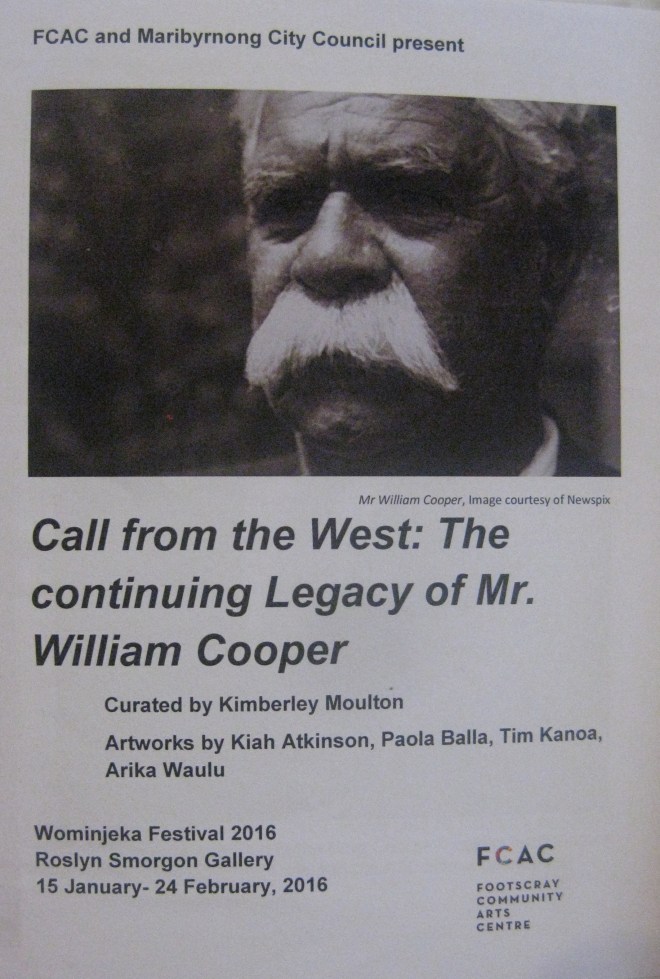
As a nation we have not been taught about our own black heroes, we learn about great civil rights leaders from around the world. Dr Martin Luther King and Rosa Parks are familiar within our vernacular however the black freedom fighters of our own country are left out of the history books.  From first contact through to today we have Aboriginal leaders like William Cooper that have shifted the course of history, that have resisted the colonial order of the nation and have led us in the ongoing goal to de-colonise our space, for equality, for better living condition, for health and legal care, for land rights.  These are the legacies that are left to be continued by the next generation of Aboriginal women and men.

The ‘tide of history’ has not washed away our connections to country or culture, it is our sovereign right and it is our obligation to our old people to maintain these.


“We must continue seeking for our rights”
William Cooper 1934

“We must realise that there is a greater purpose for us than to exist for ones’ own life”
Uncle Alf ‘Boydie’ Turner 2009

IMG_9049

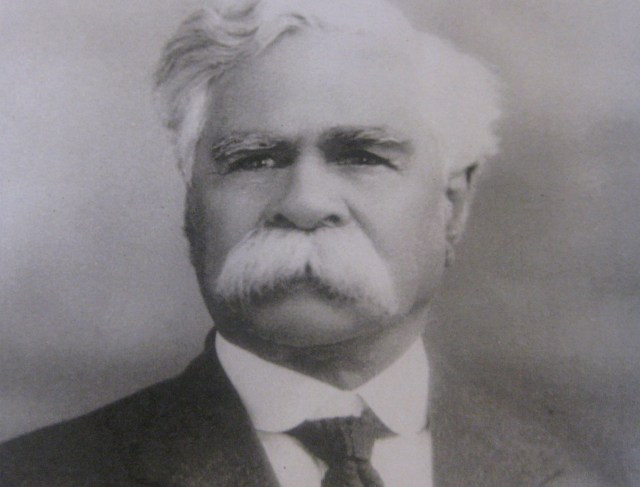
William Cooper
Source: Museum Victoria

Yorta Yorta man Mr William Cooper had a vision for his people to live a better life, to be treated as equal citizens in a land that as he stated, by ‘divine right’ was theirs.  His story is remarkable and of great courage and strength, he fought for not only  his people but for others around the world being persecuted.  William was a humanitarian on a mission to create change.

Born on the banks of the Dungala (Murray River) in 1861 William lived his youth witnessing the frontier of change.  He saw the destruction of his homelands and the dispossession of Aboriginal and Torres Straight Islander people across the country but his strength as a proud Yorta Yorta man could not be taken and he dedicated his life to fighting for better rights of his people.

William had many hardships in his life, losing two children including Daniel Cooper who lost his life fighting in the First World War and also two wives, in this time raising his family in regional Victoria and NSW travelling to where he could work.  As an elderly man he moved from Cummeragunja mission to Melbourne to be able to receive the old age pension.  This was a time where many Aboriginal people were fleeing missions across the state, walking off in the hope for better living conditions and making their way to Melbourne.  The West, Fitzroy and Northcote were community hubs of Aboriginal people congregating, building a life in the city.

In this time he formed the Australian Aborigines League (AAL) and they would meet at his house in Footscray.  The AAL demanded that Aboriginal people should enjoy the same rights as all Australians. William became secretary and began writing many letters and petitionings to government on behalf of the AAL calling for civil rights and changes in government policy.  In this time he led many significant protests including a petition to King George V calling for Aboriginal representation in parliament.  He and the AAL also supported the Cummerangunja walk off in protest of the appalling living conditions and brutality inflicted on the community.  In 1938 William led a deputation from Footscray, walking into the city where thy presented the German Consulate with a letter demanding the Nazi government stop the ‘cruel persecution of the Jewish people’, this is the only known protest of its kind recorded in the world at that time.  Both his petition to the King and the deputation’s letter to the German government were refused.  William in his life time wrote over eighty letters petitioning for Aboriginal rights, equality and human rights and he never gave up the fight and his vision for a better future for his people.

This legacy has been carried on by his descendants including his grandson Uncle Alf ‘Boydie’ Turner who in recent years has accomplished his grandfathers work getting a new petition to Queen Elizabeth.  With his great nephew Kevin Russell and other family and supporters, he re-enacted the deputation to the city, marching to the German Consulate and handing over the letter that his Grandfather had tried to do many years before.

Four Koorie artists in this exhibition respond to notions of legacy and current political realities for our community.

Kiah Atkinson is an emerging artist and a relative of Mr William Cooper, Kiah’s sound piece tracks William’s journey from Yorta Yorta country to Footscray, creating an audio journey.

Paola Balla is an artist, writer and activist whose work ‘the homes that we had known’ is a personal story of connection to William through her Great Grandmother Mariah or ‘Puppa’ as she was known, who travelled 1500km on her own to attend the Day of Mourning in 1938.  Paola’s installation includes a bed frame with earth, leaves and flowers from her country; a poetic reflection to the hardship of mission life that her grandmother Rosie describes in a poem.  Paola commemorates the struggle of our ancestors whilst highlighting the strong Aboriginal women who were protesting and raising families in some of the most challenging conditions.

Tim Kanoa is a photographer who has been capturing the recent rallies against the forced closure of Aboriginal communities in WA.  Tens of thousands of people gathered to protest in 2015 and Tim’s work Ignite looks at how the legacy of protest and standing up continues to burn strong.

Arika Waulu’s work legacyliveson is a powerful meditation on sovereignty and the next generation of activists.  Arika’s projection of the 2015 rallies led by the Warriors of Aboriginal Resistance along with an illustrated portrait of William is projected onto a wall of paper bark visas which are representations of sovereign nations.

Kimberley Moulton
Yorta Yorta


The ‘tide of history’ has not washed away our connections to country or culture, it is our sovereign right and it is our obligation to our old people to maintain these.

Reflection questions:

What does  the term ‘legacy’ evoke?

What is the significance of the actions of Uncle Alf ‘Boydie’ Turner and Kevin Russell?
What do you think Uncle Turner means when he refers to a ‘greater purpose’?

What ways do you/do you not feel connected to country and culture?

What vision do you have for a whole or healed world?
What could/are you doing to participate in building that vision to be a reality?

Do you think Aboriginal people have the same rights as other people in Australia now?

Yesterday I attended the book launch of “The Jihad of Jesus” by Dave Andrews… that’s a title that’ll get your attention…

I feel it takes a little explanation so I’m going to take the liberty of including Dave’s Preface here so that he is introducing the material in his own words…

“I do not write this an an expert. I am not.

I do not write this as a specialist. I am not.

I simply write this as a Christian, in conversation with Muslim friends, seeking to find a way we can struggle for love and justice that is true to the best of our traditions.

I am writing this for Christians who are concerned about the way Jesus has been (mis)represented by well-known crusading combative pastors, like Mark Driscoll.

I am writing this for Muslims who are concerned about the way jihad has been (mis)represented by well known militant extremist preachers, like Abubakar Shekau.

And I am writing this for people who subscribe to neither religion, but watch with horror, as Christians and Muslims slaughter one another in the name of God.

For many people jihad and Jesus are totally contradictory, mutually exclusive options.  You must choose the one or the other.  You cannot have both.  Given our present situation, Muslims would tend to choose jihad, Christians would tend to choose Jesus.

But it is my contention that – rightly understood -you can’t have one without the other.  in spite of the fact this may seem heresy to Muslims and/or Christians, I contend you cannot rightly pursue jihad without Jesus, or rightly pursue Jesus without jihad.

Reza Aslan’s book Zealot sets forth the case that Jesus was not simply a pious spiritual teacher, but actually a radical messianic activist. Of this there is no doubt.  Both Muslims and Christians believe Jesus was the Masih or the Messiah.  The debate is about what his radical messianic activism meant in the context of his time and what his radical messianic activism means in the context of the violence and counter-violence in our time.

If, as some would argue, Reza Aslan is right, Jesus could be a model for violent jihad.  But if, as I argue, Ahmad Shawqi is right, Jesus would be a model of nonviolent jihad: as

Kindness, chivalry an humilty were born on the day Jesus was born.  No threat, no tyranny, no revenge, no sword, no raids, no bloodshed did he use to call to the new faith.

The Jihad of Jesus is the sacred nonviolent struggle for justice.”

Dave Andrews, Bribane 2015

http://www.jihadofjesus.com

daveandrews.com.au

Nora (short, coloured, Muslim, woman) speaks first which is an important signal I think – the medium is the message.  She and her family build their home in a new development and meet with the neighbours regarding fence options and collectively decide not to have them but have the children stay, play, eat together… different religions, different cultures… five months later 9/11 happened.  She said “The fences will go up now” and they didn’t. Not until many years later when the family was to move.  They were known and, known, they were accepted.  Muslims make up 2.2% of the population in Australia (2011 census) – not likely to meet one but the culture of fear is being fed.  Nora felt called to speak out but Christians wouldn’t listen – “You won’t be accepted if you don’t remove your scarf”, serving her pork and giving her copies of the bible… someone suggested she meet Dave and she didn’t want to, this books captures 7+ years of the shared conversations that followed.

Dave (yes… tall, white, Christian, male) speaks second.  We believe in the same Abrahamic God- need to start where we agree and then explore other areas.  When 9/11 happened, Dave went to his local mosque and said “I’m sorry, they’re going to try and make it them and us (set us against each other) may I come in and join you in prayer as an act of solidarity?”

He gave Nora a copy of this books manuscript and has included her comments in footnotes where she has disagreed with him – minority/dissenting voice included.

Steps forward:

(Buy and read this book I reckon’!)

  • talk about it
  • live it out yourself
  • tell stories
  • invite others in
  • celebrate the wins


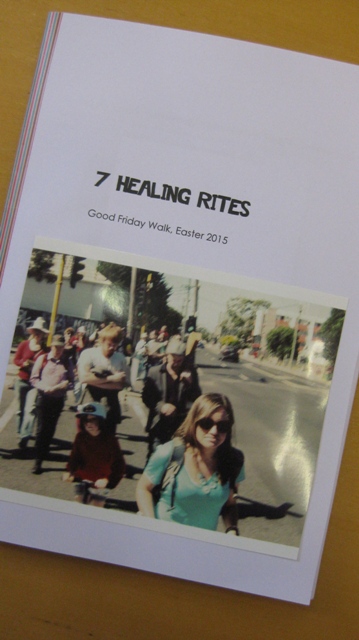
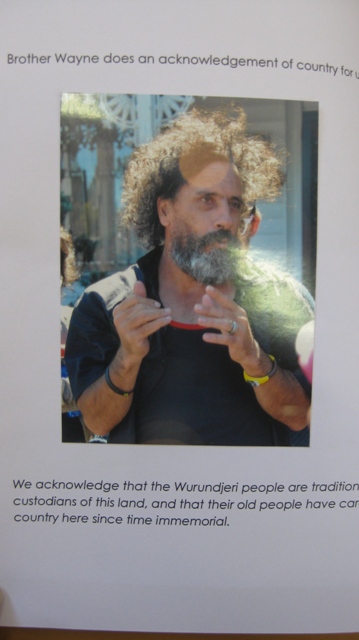
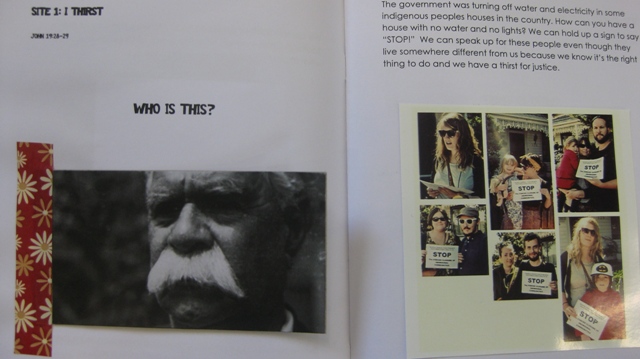
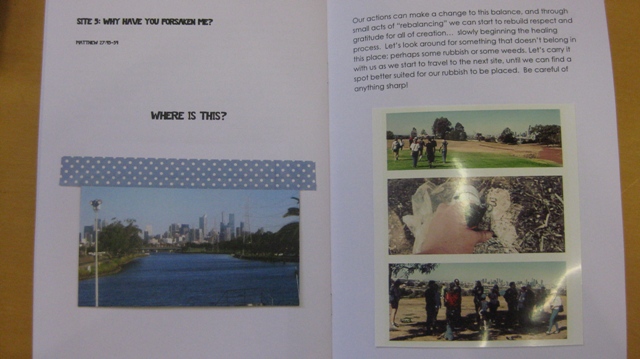
Further to our Stations of the Cross walk on Good Friday I made a lift-the-flap book for each of the families that participated.  How can we bring the messages of the high holidays into the everyday?  Kids know who cartoon and TV characters are because they are shown images of them, if we want them to learn to recognise our elders we must show images and share the words of these people… you cannot know what you haven’t learned, what you haven’t learned you cannot love.

007 - Copy

008 - Copy

009

012 - Copy

protest

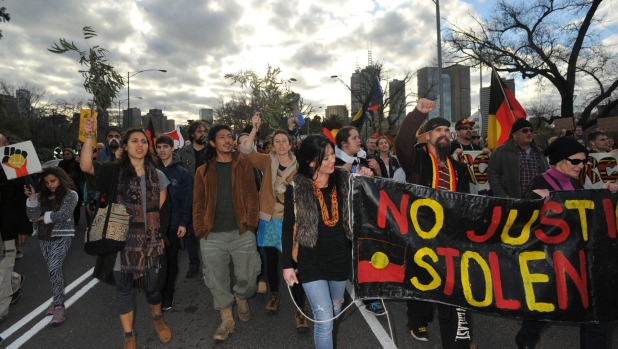
Protesters make their way across Princes Bridge. Photo: Joe Armao

This month the Government announced that they were going to turn off/stop maintaining access to water, electricity, etc. in multiple rural indigenous communities and this protest came very quickly in response.  We like to think that “taking the land away” or dispossession was something that happened long ago and far away and has nothing to do with me but then something like this happens to bring it front and centre and our willful blindness is confronted by the reality: this is still an issue and it is still happening.

These are the words the protestors called in chorus:

“Always was, always will be, Aboriginal land”

Talk to me about economics. Talk to me about closing the supermarket so people had to travel for food, closing the school so families with children had to travel or move, talk to me about closing the petrol station – it might be true that some of these communities have only 4 people living in them but there used to be many more.

“Always was, always will be, Aboriginal land”

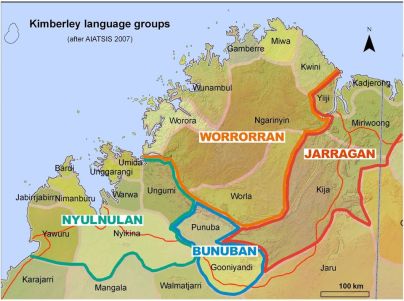
Talk to me about land and place.  There’s hardly any of them, why should they get special treatment? They can move to the nearest big town… to give you a sense of scale Kimberley is c. 3 times the size of England and has a population of 40-50K people.  The nearest town is, well, pretty darn far away – what we white fullas can forget is that indigenous Australia is a lot kimberleymore like Europe, made up of many different countries with their own language, and myths, and dances and traditions… this map on the left is rough overview of the First Nations Peoples and language groups in Kimberley.  This is their map of how they see the world –  we wouldn’t expect it to be reasonable to ask the Italians to move to the nearest town in France and give up everything that informs their own unique culture and identity and we should not ask it of Aboriginal people here either.

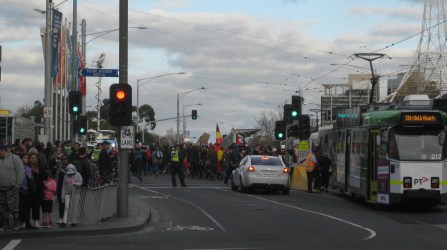
photo credit: kimberleyfoundation.org.au

“Always was, always will be, Aboriginal land”

Talk to me about civilisation.  We brought civilisation with us, did we not?  Are these people not better off because we bought them farming and livestock and tools and machinery they didn’t have before?  We brought in the piped water and wired electricity and overrode the old ways with our better new ways…?  There might not be many left who remember and could live by the old ways.  We’ve created a dependence and now you want to take the civilisation away? Did our civilisation include the law, and does the law include provision for human rights like access to water?  What is civilisation?

“Always was, always will be, Aboriginal land”IMG_5269

Tell me a story.  Tell me who your people are and where you are from.

At the start of some (too few) events, ceremonies or proceedings you might hear an Acknowledgement of Country… We acknowledge that we gather on the land of which the Peoples of the Kulin Nations have been custodians since time immemorial.  I went to a cultural awareness training day with Aunty Doreen Garvey-Wandin a few years ago and she did this activity with sticky dots to illustrate how Aboriginal people have lived here for 50,000 years – if each dot is equivalent to 1,000 years – then this black drawing, on the very last dot, represents the 200 years of contact/settlement with us white fellas.  We are a blip on a landscape that was here long before we came.  We need to understand and be reminded of our place in the story of things from Aboriginal peoples point of view. While, I’m here I’ll point out that this is what makes “Australia Day” also so hard.  It marks (and celebrates) the anniversary of colonisation over the culture that had existed here many thousands of years prior.  These acknowledgements should not be empty words.  We eat, we play, we gather, we work – on land where indigenous people were here before us – doing those things first – for many, many years.

“Always was, always will be, Aboriginal land”

Talk to me about belonging.  Do we “belong” here?  I think there is something in the psyche of all of us asking this question because at some level, perhaps we sense the truth of having displaced others to enjoy the space we now hold.  I am from New Zealand, and we have our own history and yet unfolding story of fair trade for land, foreshores and fish – and who should be the custodians of these things.  We need to respect Traditionally Acquired Knowledge more than we do because people lived and ate seasonably and sustainably and can probably teach us a thing or two about living well in this climate and speak wisely into other current social issues.  Do I belong here in this crowd? It can be easy to feel smug – Maori is taught in our schools, we had a treaty and are hearing settlement claims, we have a Ministry for Maori Development… but that is not enough: Te Whiti, a Maori Chieftain, exhorts us to “Ask that mountain” – the land itself bears 076witness to what takes place beyond any particular action of my lifetime whether we have done everything that we can to make things right.  How might the Great Barrier Reef answer? Or Uluru? or The Big Pit in Kalgoorlie? I was proud to see the Maori flag raised and carried alongside the Aboriginal flag in solidarity.  Others who have experienced displacement themselves – they do not forget.  We need to recognise that living in a world that has more languages, more dances, more patterns, more stories makes it a more enriching place for all of us and is worth protecting and defending by us all.
We chant it together.  We claim and proclaim it publicly:

“Always was, always will be, Aboriginal land”

“When you haven’t got a homeland or place to go, you lose your identity,and personality and you become sick.
Where are these communities going to go?”

Indigenous activist, Rieo Ellis

Thanks to ANTaR for this summary of the issue:

Announcement to discontinue funding essential services in remote communities

  • In September 2014 the Federal Government announced that it would no longer fund essential municipal services including supply of power, water, and management of infrastructure in remote Aboriginal communities in Queensland, Victoria, NSW, Western Australia, and Tasmania, despite having done so for decades.
  • The South Australian government refused to sign an agreement, and the Western Australian government signed an agreement with the Federal Government for funding of $90 million which would fund services until June 2016.
  • The WA government announced that it would not pick up the bill beyond that time and would instead close between 100 and 150 of the 274 remote Aboriginal communities in the state.
  • The decisions by both the Federal and the State Governments occurred without any consultation with Aboriginal people in the affected communities.

How many people live in these communities

According to the WA Department of Aboriginal Affairs, there are around 12,000 Aboriginal people currently living in the 274 communities in WA, with around 1,300 living in 174 of the smallest. In 115 of those communities, there are around 500 people in total, or an average of 4.4 people per community.

What will the impact be of shutting down communities

Premier Barnett himself acknowledged that closing communities would:

“…cause great distress to Aboriginal people who will move, it will cause issues in regional towns as Aboriginal people move into them.”

Professor Patrick Dodson, Yawuru man from the Kimberley, who authored a review of small homeland communities for the NTgovernment said closing down communities would:

“…be disastrous, increasing access to drugs and alcohol and exacerbating social tensions,  which would flow on to antisocial behaviour and incarceration. The immediate consequences would be to create an internal refugee problem for the indigenous people.

He also said that breaking people’s connection to land:

“…would threaten the survival of Aboriginal knowledge and culture, because in towns people were restricted from camping, lighting fires, hunting and fishing.” 

What criteria will be used to close communities

It is not known where any closures might occur, nor what criteria might be used.  In fact, there has been great anxiety and uncertainty over this, particularly as no consultation has occurred prior to the statement being made by Premier Barnett.

The Federal Government prepared a document in 2010 titled “Priority Investment Communities – WA” which categorised 192 of 287 remote settlements as unsustainable. The majority of those assessed as unsustainable are in the Kimberley, with 160 communities in the region.

Non-Indigenous communities

We could not find any examples of government decisions to refuse to fund essential municipal services for non-Indigenous communities, including small communities in remote areas in WA. For example, the non-Indigenous community of Camballin (of about 300 people) is located near Looma (an Aboriginal community of around 370 people) in the Kimberly. Looma will be assessed by the Western Australian government for funding whereas Camballin will not.

101

one might imagine
that not getting
what one wants
is some sort of
punishment but,
in fact,
it is merely life
the trick of it
is to want less
then when expectations
are exceeded there
is a margin for joy

SABBATH ECONOMICS #1

step1: consult and consider
step2: discern and decide
step3: imagine and implement
step4: get on with it
step5: falter and fail
step6: try and terminate
step7: substitute and subvert
step8: outcomes unanticipated

SABBATH ECONOMICS #2

love makes a way

in the face of unwelcome
love makes a way
against powers politic
love makes a way
counter to public feeling
love makes a way
to closed fist, reach open hand
love makes a way
traveller greeting fellow traveller
love makes a way
love makes a way

 
Talitha Fraser

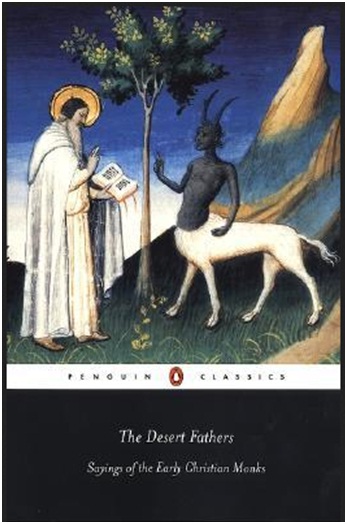
desert fathersA hermit said, ‘When you flee from the company of other people, or when you despise the world and worldlings, take care to do so as it if were you who was being idiotic’. (p83)

A brother sinned and the presbyter ordered him to go out of church.  But Bessarion got up and went out with him, saying, ‘I, too, am a sinner.’ (p84)

In Scetis a brother was found guilty.  They assembled the brothers, and sent a message to Moses telling him to come.  But he would not come.  The the presbyter sent again saying, ‘Come, for the gathering of monks is waiting for you.’
Moses got up and went.  He took with him an old basket, which he filled with sand and carried on his back.
They went to him and said, ‘What does this mean, abba?’
He said, ‘My sins run out behind me and I do not see them and I have come here today to judge another.’
They listened to him and said no more to the brother who had sinned but forgave him. (p85)

If you are angry with your brother for any kind of trouble that he gives you, that is anger without a cause (Matt 5:22) But if anyone wants to seperate you from God, then you must be angry with him. (p100)

If a man answers before he has heard, it is foolishness to him and discredit (Ecclesiastes 11:8). If you are asked, speak; if not, say nothing. (p102)


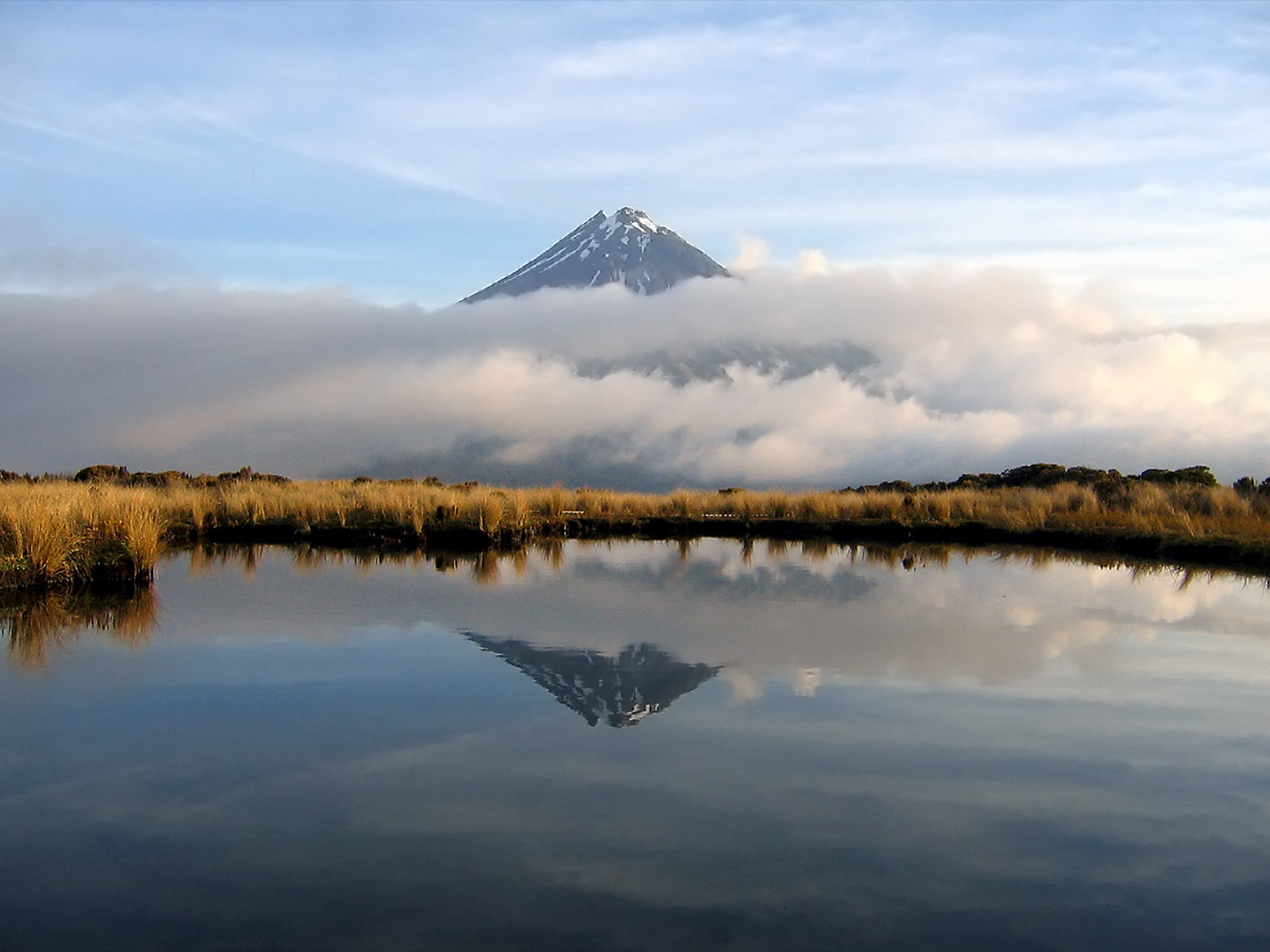
                                                           (photo of Mount Taranaki, Richard Crowsen)

Maori continued with the task unarmed and, to a person, they declined to respond to aggression when removed. Go, put your hands to the plough. Look not back. If any come with guns and swords, be not afraid. If they smite you, smite not in return. If they rend you, be not discouraged. Another will take up the good work. If evil thoughts fill the minds of the settlers and they flee from their farms to the town, as in the war of old, enter not . . . into their houses, touch not their goods nor their cattle. My eye is over all. I will detect the thief, and the punishment shall be like that which fell upon Ananias. When the ploughmen asked Tohu what they should do if any of their number were shot, he replied, ‘Gather up the earth on which the blood is spilt and bring it to Parihaka’ (Scott, pp 56-57).


February 6th  is Waitangi Day in New Zealand, the anniversary of the signing of the Treaty  of Waitangi in 1840. To the British this achieved full sovereignty and government of the country but Maori  thought, while giving authority to govern, they would still be entitled to manage their own affairs in their own way.  Similarly to Australia Day on January 26th being known as “Invasion Day” to the First Peoples of that nation, Waitangi Day is often attended by protest as well as being a celebration of nationhood.

What perhaps not enough New Zealand settler descendants may know is that there were Taranaki chieftains who never signed the Treaty of Waitangi, steadfast in their refusal to acknowledge foreign sovereignty in preference for maintaining their own way of life on their own land – the pa at Parihaka became a sanctuary for Maori forced, fought, deceived off their land. Likened forerunners to Ghandi  and Martin Luther King, Te Whiti and Tohu ran a campaign of non-violence spanning 40 years sheltering the dispossessed.

The Waitangi Tribunal[1] published “The Taranaki Report: Kaupapa Tuatahi” in 1996 saying, “ If war is the absence of peace, the war has never ended in Taranaki, because that essential prerequisite for peace among peoples, that each should be able to live with dignity on their own lands, is still absent and the protest over land rights continues to be made.”  Contrary to the belief held by many New Zealanders that in an acknowledged first equal language, proportional representation in government and other policies we might be considered advanced in our journey of equality and reconciliation, in fact we are the only colonising country where there is no land held and managed autonomously by the indigenous population (Ch.8 Parihaka).

The title of Dick Scott’s book is a quote from Te Whiti, Chieftain at Parihaka who says:

Ask that mountain – here before us, it will be here when we are gone – that mountain as witness, can we honestly say that we have done everything we can? That everything is ‘right’?

These are the questions we need to ask ourselves and the stories that should continue to be told if we are to participate in the journey of healing between the people and the land.

It is often difficult to know where to start in confronting these issues, I have more questions than answers yet I have hope.  I have ordered a T-shirt from the Emmaus Rd community, on the front it reads Arohamai which means “sorry” or “forgive me” and on the back are a list of some of the injustices as occurred over those 40 years and are carried yet in our dreams and bones today:

I’M SORRY FOR THE

// INVASION OF YOUR VILLAGE – 5th NOV
// UNJUST ARREST AND EXILING OF TE WHITI AND TOHU
// LOOTING BY THE ARMED CONSTABULARY / 8th NOV
// DESTRUCTION OF THE WHARENUI & CROPS / 20th NOV
// FORCIBLE EJECTION OF 1,556 PEOPLE FROM THEIR HOMES /20th NOV
// RAPE OF YOUR WOMEN
// CONGENITAL SYPHILLIS IN YOUR CHILDREN

ALSO FOR THE:

// IMPRISONMENT WITHOUT TRIAL OF 420 PLOUGHMEN AND 216 FENCERS FOR TWO YEARS
// DEVASTATING EFFECT ON THEIR WIVES AND CHILDREN
// UNJUST CONFISCATION OF YOUR LAND
// BACKDATING OF LEGISLATION TO MAKE LEGAL THE GOVT’S ILLEGAL ACTS

AND OUR FAILURE AS A NATION TO FACE THESE ISSUES

In her Booker Prize Winning novel The Bone People Keri Hulme writes, “I was taught that it was the old people’s belief that this country, and our people, are different and special. That something very great had allied itself with some of us, had given itself to us.  But we changed. We ceased to nurture the land.  We fought amongst ourselves. We were overcome by those white people in their hordes. We were broken and diminished. We forgot what we could have been, that Aotearoa was the shining land.  Maybe it will be again… (p.364)

I will wear this T-shirt as an act of public witness, as a peacemaker wanting to put things right personally and as someone who believes the people of New Zealand are different and special and in faith that the mountain will stand to see a shining land, whole and restored, again.


[1] The Waitangi Tribunal was established in 1975 by the Treaty of Waitangi Act 1975. The Tribunal is a permanent commission of inquiry charged with making recommendations on claims brought by Maori relating to actions or omissions of the Crown that breach the promises made in the Treaty of Waitangi. The full text of The Taranaki Report: Kaupapa Tuatahi can be found on the website http://www.waitangitribunal.govt.nz/.