Tag Archive: stories


On Writing…

12615553_10208956638538959_4864462156527056558_o

Recently I had a look at the stats page of this blog and realised I had missed, if I had thought to consider it, a 5 year milestone of writing.  So and so number of posts, so and so number of visitors to the page over those 5 years – what do those numbers mean?  When I created this page in Feb 2011, it was September before I posted anything to it.  I felt like I had to know the answers to all these questions: who are your audience? why are you writing?

I suppose I still don’t really know the answers to those questions but I suppose I care less that I do not know.  I will confess I have been known to answer facetiously “I write because I get something out of it, if you get something out of it – it’s Gods fault”. Do what you want with that.

I think all I ever hold of anything are fragments.  One of the reasons I think I’ve found it hard to classify “what I’m writing” or “who for”, is that what I post here is so mixed – things I write, things other people write, stories, poems, quotes, photos… life.  These aren’t considered think pieces or articles, I don’t have any 5-point plans to answer any of your questions, I’m not here to teach you anything or be an expert about anything.

I write because…

I participated in a bible study session with my small group towards the end of last year… it’s small, and I’ve known some of them a long time but, despite this, as we’re introducing the topic for discussion I can sometimes get this hot flush through my body, a rising sense of discomfort, I’m not sure I agree with what you’re saying but I can’t articulate why.   In the interim, others weigh in: “I haven’t heard it put like that before…”, “I agree…”

What I have to express at this time is “I’m not sure I agree with that…” or “That isn’t how I would see it”.  The difficulty in expressing that, is that it begs the obvious follow up questions “How do you see it?” or “What do you think is happening in the passage instead?” I know I don’t have the answers for those questions yet.

What is the value in pointing out to someone you think there’s an alternative interpretation if you cannot articulate it? My silence is my mind working a mile a minute to process what I’m thinking but in the meantime the conversation moves on – there is further affirming of the original interpretation and as each layer/next question is applied to the text, they are read within the lens of this.

Now I am still working on what I think but there is increasing pressure – it was going to be awkward suggesting an alternative interpretation to one person (what if the ‘revelation’ of this study hangs on the basis of this suggested interpretation?) but now others have concurred and the conversation has moved on, jumping in now will actually be disruptive and, as others also agreed with the original interpretation, I feel as if need to ‘make a case’ solid or justifiable enough to de-rail the conversation.

I opt out of the chat, no new input until I can get my head around the initial idea. Session winds down and I take my journal and sit outside and scribble – it helps me to think about an idea to take it out and look at it.

I write to say the things unsaid and to know myself better.   We need to communicate in different ways, yes, and we need to listen in different ways and have different spaces to communicate in. I write to explore what all these might be and what I might be.


I write because…

Lydia Wylie-Kellerman wrote a beautiful sermon for Pentecost and also to honour her Dad’s 10 years of ministry at St Peter’s Episcopal Church in Detroit… asking what does it mean for us to be followers of a subversive Storyteller?  Some excerpts:

“Stories are about communication, about when to listen and when to speak, and understanding in our own language…”

“Storytelling spaces are disappearing.”

“Telling stories is an act of resistance. It is part of discipleship. It is movement work. Stories are provocative and powerful while at the same time nourishing. They hold us. They remind us who we are. They help us know who we want to become.”

With social media the world seems terribly small sometimes – just these past weeks my Facebook feed has been filled with the trial outcome of the rape of a woman at Stanford and now this terrible shooting at the gay bar Pulse in Orlando (on a Trans and Latino/Latinx night on Puerto Rican Heritage Day during Pride Month).  There would have been a time when such events were beyond the scope of knowing occurring far away but now, for days at a time, we are touched by layers of pain from such events.  I don’t personally know anyone impacted first hand by these events but I know many impacted by the ripples as each new headline flashes up like a neon sign advertising darkness.  “My FB feed has been filled”… I think of the native wisdom of the story of the two wolves  and wonder if I have not lost my appetite.  You see it’s not the stories of rescue, or redemption, or hope that seem to go ‘viral’ but the brokenness that seems to be replicated over and over again until it is part of the perpetuating harm itself.  Is there any way it could be different? What choices are we making about what stories, voices, news, good news, we are perpetuating?  What is in the ‘feed’ you are serving?

Jenny Peek at Yale Divinity School puts it like this: “I don’t want this fear to have the final word, because all too often fear is at the root of our hatred, disgust, and division. So instead I want to share a verse that continues to give me hope and direction even in times like this:

1 John 4:11-12 – Beloved, since God loved us so much, we also ought to love one another. No one has ever seen God; but if we love one another, God lives in us, and his love is made complete in us.”

I write because I want to read stories that nourish me (and I try not to ask of others what I’m not willing to do myself). I want us to understand and to love one another.  The world is inexplicably wounded and inexhaustibly good… tell me about that… don’t leave out the inexhaustibly good part.


I write because…

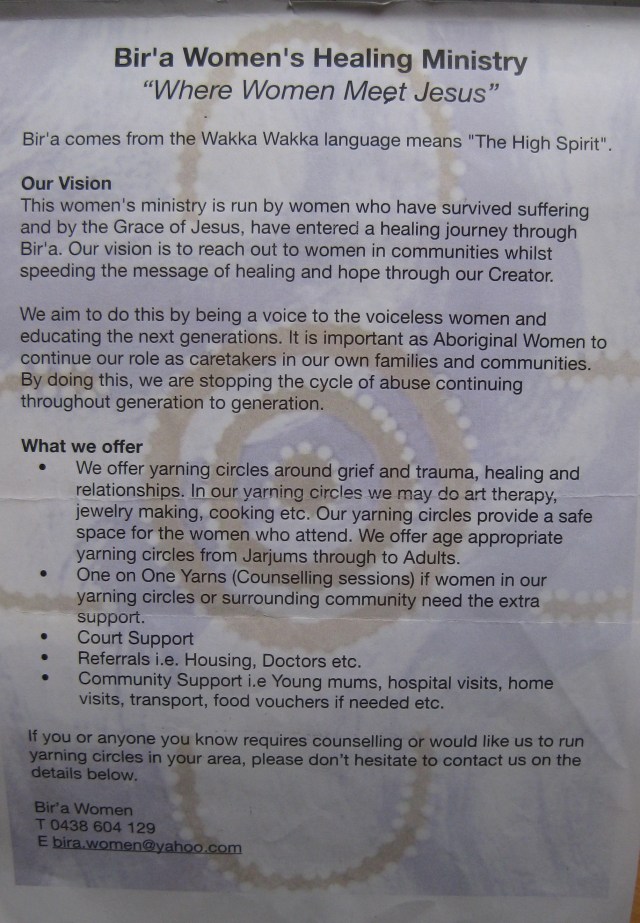
Last month I was privileged to meet Aunty Sharyn an Indigenous Christian leader from Brisbane and hear her story.  A vocation rising out of her own personal experience, Aunty Sharyn has started up B’ira – a significant community ministry addressing domestic violence and sexual abuse in Indigenous communities. Bir’a Women’s Ministry (Bir’a is Wakka Wakka Language for ‘High Spirit’) is all about when ‘Women meet Jesus’. They run yarning circles – providing a safe space to talk through grief, trauma, healing and relationships and do art therapy for when we can’t find, or just don’t have, the words to describe what has happened to us. I was put in mind of the women in Mark (5:21-43).

Jesus is walking along with his disciples  and a leader of the Synagogue comes along asking for healing for his daughter who is unwell. Jesus agrees to come, yet along the way a bleeding woman who, against all purity codes, reaches out to touch a Jewish man in the desperation and hope of being healed. This woman reaches out for and takes what will heal her.  v.29 “Immediately her haemorrhage stopped; and she felt in her body that she was healed of her disease.” but v.33-34 goes on to say  “the woman, knowing what had happened to her, came in fear and trembling, fell down before him, and told him the whole truth.  He said to her, “Daughter, your faith has made you well; go in peace, and be healed of your disease.”  She had already been healed of the physical symptoms (v.29), this second healing (v.34) addresses the mental anguish of what the disease had cost. Exclusion from temple which was a central part of life, if she had a husband perhaps he left – not being able to touch what she had touched or share intimacy, to spend time with her would be to take on the limitations of impurity and ritual cleaning yourself, perhaps people worried they might catch the disease, perhaps the priests tried various means and methods of cleansing or praying out demons… what isolation and exclusion had this woman known over these 12 years?  How long does it take to pour out this tale of grief, fear and loneliness?  Long enough for the Synagogue leader’s daughter to die – does one person’s healing come at the cost of another’s? No.

I write because I want to encounter God, I want to be heard and healed and whole, and for others to have that too.  What part does truth telling have to play in our healing? {personal, family, community, political…?} We need times and spaces to hear the whole truth, we need to be willing to tell our truth, we need to be willing to listen.

You see.  All I have are fragments. Fragments of listening, voices – others and my own – word weaving or stitching together some patchwork of understanding from stories…

I don’t know that you can call this “feminist theology”.  This is only what theology has ever been – codified collective human experience – stories, poems, liturgy, literature, prophecy and cultural influences trying to understand the shape of something bigger and beyond ourselves.

It is not finished.

On salvation

IMAG0151

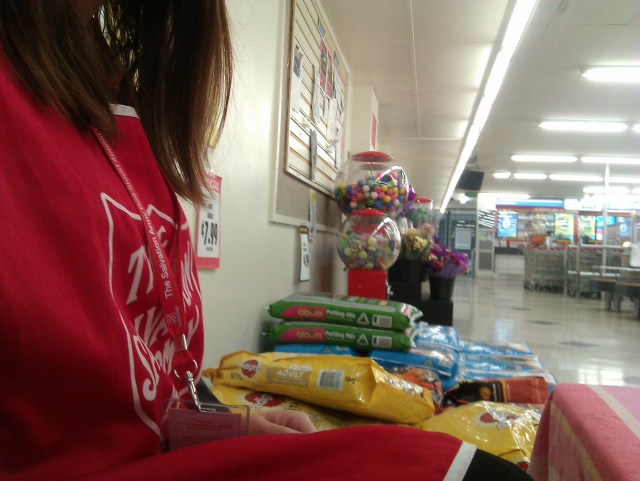
I am sitting in the local supermarket collecting for Red Shield Appeal. A pensioner has just given generously and thanks me for my generosity taking the time to sit there.

“I don’t like people… I love people.
We need to support each other… I believe this… be there for each other.
Salvation?? I give for this Salvation…”

I come home and look up the word “salvation”.

From the latin salvatio – being saved or protected from harm or being saved or delivered from some dire situation.

Imagine for a moment an army, a large number of people, committed to saving and protecting people from harm, an army of people committed to saving and protecting those who find themselves in some dire situation… religion aside – that still might be something to believe in.

I might sometimes worry that collecting takes me away from my core work – it is good to have this reminder that it provides an opportunity for others to participate in it.

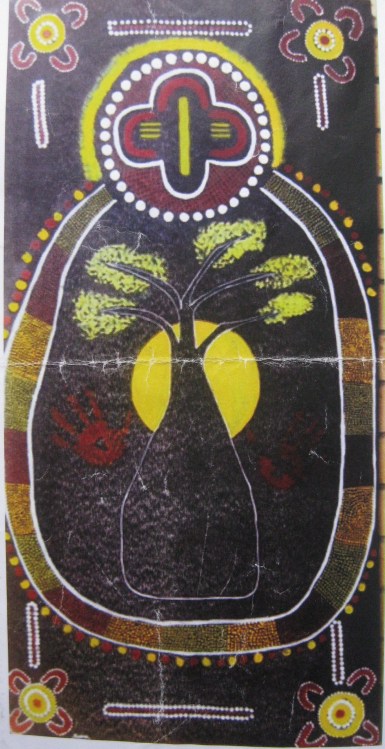
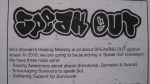
IMG_0080It was a privilege to meet Aunty Sharyn Bird on Thursday night – she was sharing her story and talking about the initiative Bir’a Women’s Healing Ministry she has started up that: raises awareness about abuse (emotional, domestic and sexual), encourages survivors to speak out, and gathers support for survivors .

It’s not for me to try and tell anyone else’s story but if there’s an opportunity for you to hear Aunty Sharyn (or participate in a yarning circle yourself!) I would encourage you to take it. A visual representation of her story told in a painting (left)

I have been drawn to the way in the gospels Jesus’ touch heals but then he “hears her whole truth” [Mark 5:33] and she is healed again.  There is more than one layer to our healing.

What role can/does truth-telling and story-sharing have in our healing and wellbeing?

We need people willing to ask us our story; safe space to tell it; someone to listen.  Our wholeness (being healed and whole – all we were created to be) is tied up with being known, heard, understood…

How do we make/take time for this?

Aunty Sharyn held such a space – generosity in that  – and a lot of compassion.


You can read more about Bir’a below and make a gift to support their work through Jisas Wantaim ref: BiraWomen.

IMG_0079

The session put me in mind of the Cheryl Lawrie poem “This is my Body” from Easter – how might we engage in our own re-membering and bringing it about for others?

What do our re-membered selves look like?

What is one thing you could do right now to go from where you are now towards the ‘whole and healed’ version of you?


love

Some notes from the Surrender panel session:

Loving Welcome or Fear and Hate?
The displacement of people and rapid rise of refugees is a global challenge. How can we as ordinary everyday people in local communities be part of Christ’s alternative of loving welcome rather than feel overwhelmed by the voices of fear and hate?


In what way you are currently involved with asylum seekers or refugees?

I live at the Salvos Community House in Footscray with Bron – House Manager, Maria and her son who are asylum seekers from East Timor, and Hawo and Omar and their family – refugees from Somalia.  There’s ten of us who live in and many others who work, visit or are part of the community coming and going.

How did you come to be doing this work?
I’ve been a member of several intentional communities, Urban Seed working with the homeless community in Melbourne CBD, Seeds City then Seeds Footscray… participation required asking of myself “who is my neighbour?” and seeking to live a life more engaged with those around me.  I remember intentionally working as an admin at Urban Seed – looking at the residents there and saying “I could never do that”.  It was only two weeks after I moved into the house at Droop St September last year that the opportunity to invite Hawo and her family to join us arose… you could say I fluked it!
I’ll be honest, I had ideas about what living there would be like – I had just moved in and was unpacking things and setting things up.  I felt both grief and incovenience when I had to re-pack things so recently unpacked to make room for these guys moving in.  I remember going for a walk with stuff running through my head, “How is this going to work? How can I make them feel welcome or at home here, when I hardly feel at home here myself? How can I teach them where things go when I don’t know where they go?” I wasn’t really paying attention to where I was going and a street I thought cut through turned out to be a dead-end so I had to backtrack on myself the way I had come. As I turned back, I crossed to walk on the other side of the street and found a basket of clean clothing sitting out in hardwaste.  And I picked it up and I carried it home with me.  It feel like a symbol of Providence.  God saying, “I will give you what you need, when you need it and send no more than you can carry” and really understanding that not to be just practical needs but spiritual and emotional needs as well.
How has this work changed you and your community? What have you learnt?
The house has been a hub for lots of projects and having a lot more people living-in is a big shift in focus for the community, there are less spaces available for projects as more people need the kitchen, the lounge, the bathroom… these areas on the ground floor of the main house used to be common space and kept really tidy for external groups coming in, we just can’t maintain that when its lived in and used by so many.  This is a valuable factor in the community therapy model that sees us learn from one another by sharing life together. That main floor bathroom is used by Hawo and her family who are Muslim and wash several times a day prior to praying – water is splashed over the sinks and floor and then we walk in and out… it’s hard not to look at the “muddy” footprints on the floor and think it’s dirty.  Do they make my bathroom dirty or do I profane the place the prepare to pray?  Living together gives us the opportunity to confront our ideas of what we might consider is the ‘normal’ or the ‘right’ way of doing things. It’s a privilege, and a discipline, to lean into that learning curve. 
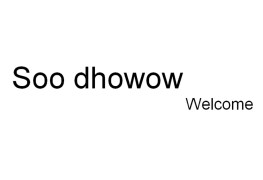
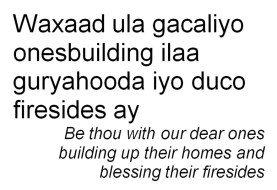
When Hawo and her family first came to move in we wanted to make them feel welcome so we put up a sign that said “Welcome” in Somalian and English, laminated a Somalian proverb about hearth fires burning indicating which cupboards in the kitchen would be theirs, made a noticeboard that had magnets with all our names, photos, days of the week, house activities… you know what? They weren’t literate in Somalian let alone English.  You set out with these good intentions and more often than not you get it wrong.  We all of us try to say and do the right thing and can often end up saying and doing the wrong thing – that is true of ANY family.
What is the best thing about it?
Moments of synergy in our multicultural and interfaith mix are pretty special… one morning I woke early and couldn’t get back to sleep so I wandered out into the garden and read 7 Sacred Pauses by the light of my phone, that’s a poetic, monastic rhythm of prayer, and as I came back in I passed Hawo coming out of washing in the bathroom to go to her prayer mat in the lounge. By the time Hawo has prayed, Maria and her son will rise to say their morning Catholic prayers together… we don’t all pray together, at the same time or in the same way but we do all pray.  The food is pretty amazing too!
What is one of the greatest challenges?
One of the greatest challenges for me is being an introvert and finding a balance of time by myself that’s fairly quiet, noise generally can be issue – for instance Bron does shift work as an emergency vet nurse and might need to sleep during the day – but as you hear the prayer ululations on someones phone as they move from room to room, the sounds of cooking and being able to tell who it is by what time of day it is, there is music, TV  and conversation (continuously!) that represents the rapid language and cultural assimilation  of our newest housemates, the soccer pitch is almost as likely to have a Somalian singing clap-dance as a kick-round happening… there is a rhythm, or a life-beat, to these sounds that shapes our sense of home…and I can always go out!
Have you got involved in any of the political dimensions of the asylum seeker ‘issue’? If so, how has that connected with the loving welcome you are extending in your context?
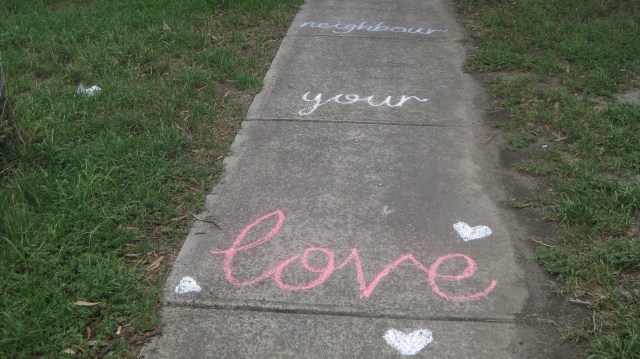
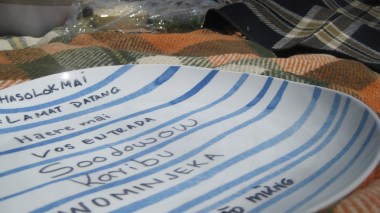
We engage in a few different ways, we’d attend rally’s and vigils, write letters of support, accompany housemates to appointments as needed.  Recently we hosted a picnic outside the Maribyrnong Immigration Detention Centre on the first Sunday of Lent as a demonstration of the act of welcome we’d like to see extended to refugees and asylum seekers arriving in Australia. We invited our housemates to write the word “welcome” in their languages of origin on a plate and set that at a place at the table, creating space for the ‘other’ a symbol of hospitality and what we have to share… there is room at the table. We sang some songs from the Love Makes a Way movement and linked the event to the #LetThemStay initiative.
For people who are wondering how they might engage with refugees and asylum seekers, do you have any words of advice?
Well, personally, I’ve needed the intentional community model – to move in where the connections and relationships already exist.  I can’t make a case for connecting with refugees and asylum seekers over any other calling but I would encourage everyone to consider for themselves the question “Who is my neighbour?”.   Know yourself – do what comes naturally for you. If your feeling reckless, you might pray: “Here I am, send me”.  God is already at work in your neighbourhood and in the lives of those you know… don’t take the approach that you have to start up something new, ask instead to see where God is already working and how to get alongside.
What we do isn’t that “special”.  A sacred, ordinary day for me might look like going to a local cafe for a Vietnamese roll with Maria and hearing the latest on her VISA uncertainty, she currently re-applies every 3 months.  I can’t do anything about that, but I can listen and hold some of the fear of that uncertainty with her.  I get back to the house and work with Mohammed on some Newstart job applications, it takes us 2 hours to do four applications – it might be faster if I did it myself but that doesn’t develop his independence to be able to do it on his own. The apricot tree in our backyard is fruiting so I collect it all and start to make jam not thinking through the sheer volume of sugar required to see the project through – everyone raids their supplies to get me over the line and it takes finishing off 8 packets of five different kinds of sugar to get  the jam over the line.  We are all in this together, meeting one anothers needs and everyone has something to give. 
Is there anything else you would like to say today?
I think there is an epidemic of loneliness – not just for refugees and asylum seekers making a new start but all of us – despite our advances in technology and communication – maybe because of them.  What I think everyone is looking for is home, belonging and family.  How can we share our home? How can we invite people to feel belonging? How can we be family to one another?

IMG_7321

Of communion, Jesus says I will not take this drink again until
I drink it new with you in my Father’s kingdom.

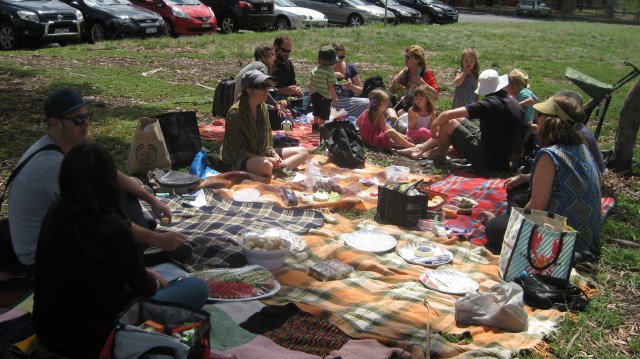
On Sunday 14 February we held a picnic lunch at the immigration detention centre in Maribyrnong. The first Sunday of Lent (and Valentines Day- let’s show the love) would often have a focus theme of a continued call to conversion the intention of the picnic was to physically create the space we would like to live in – that kingdom where Jesus might join us for a drink – even if only for an hour. How can we make that grass verge feel like space of celebration and welcome? How can we extend the expression of hospitality and welcome that we would like to see shown to refugees and asylum seekers?

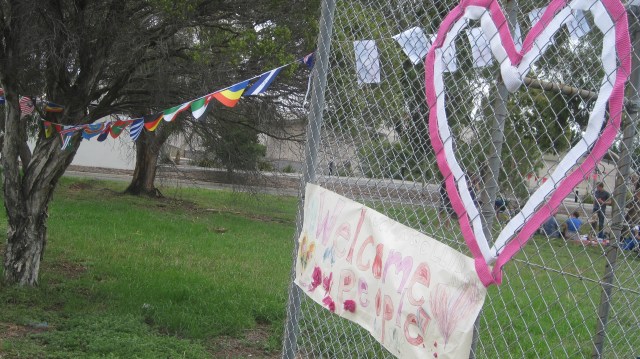
With yarn bombing, banners, different flags, welcome in different languages, families and at each picnic blanket a spare place set at the table – a visual demonstration that there is room at the table for the ‘other’ and enough food to share.

In the face of the continued and indefinite detention of refugees and asylum seekers including children and New Zealanders now the second highest number of those held in off-shore detention – we seek to respond with an act of hospitality, an act of welcome, and act of love – witnessing there is room at THIS communion table.

***
IMG_7367

Wominjeka, we acknowledge that we gather on the land of which the Wurundjeri people of the Kulin Nation have gathered since time immemorial to tell stories, sing songs and share food together. We are gathered here today to do a little of all these things ourselves: tell stories, sing songs and share some food together around this idea of showing welcome to refugees and asylum seekers and we have chosen a specific place, time and context in which to do that.
IMG_7364

We are standing here in the carpark of what is now the VicUni Student Village…this used to be the site of the Pyrotechnic Section of an Explosives Factory (1942) which was built to produce flares, tracers and smoke grenades during the Second World War… a section of this was converted to the Maribyrnong Migrant Hostel (1966). Over here behind us is the new purpose-built Maribyrnong Immigration Detention Centre (1983) – we are standing where refugees and migrants have been arriving for the last 50 years.

We are standing here at a particular time.  Today is Sunday 14 February, the first Sunday of Lent and Valentines Day – let’s show the love! The first Sunday of Lent would often have a focus theme of a continued call to conversion and the intention of this picnic is to physically create the kingdom space we would like to live in – demonstrating the kind of welcome and abundant hospitality we as Christians believe Jesus might extend and asking of our own discipleship how we feel called to respond.
IMG_7346

We are gathering during a particular context.  The Premier of our own state has come out against the federally legislated law, medical practitioners are refusing to sign off of returning patients to off-shore detention and the UN has condemned the treatment of refugees as breaching human rights… the government, media, society are all sending strong messages – in an environment that seems more focused on reacting out of fear than love, how might we respond with clarity and compassion?IMG_7334
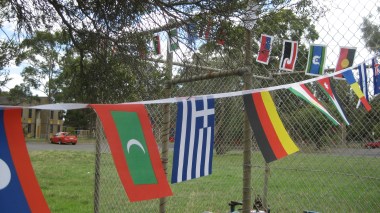
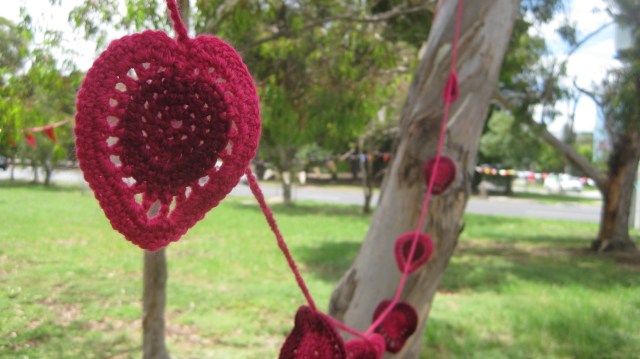
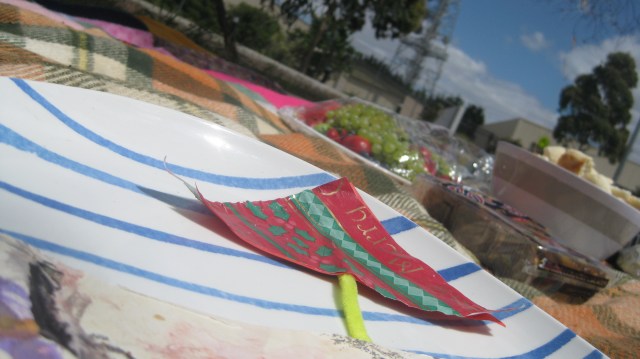
We have folded layers of symbolism into our picnic today… you can see the crocheted heart bunting by Bron for Valentines Day, we have flags representing some of those countries and cultures making up the population of those in our detention centres, and we have empty plates – places set at the table for the ‘other’.  We live with asylum IMG_7343seekers and refugees, we invited them to write the word WELCOME in the language of their cultures on one of the plates and symbolically be represented here and we remember those stories that are still unfolding.
That is about as much story as there is from me, so let’s move on to the singing! We’re very lucky to have Sam here to be the lead liturgist today so look to her for any cues – we’re not going to sing these through a set number of times or anything, we’ll just keep going until she signals otherwise.

So, I will invite you to stand if you want to, in this place, at this time in this context and sing with me, this is not a new idea… we sing in the tradition of so many justice movements: civil rights, suffragettes, apartheid, slavery…in the words of Ched Myers to “Sing about it, until it can be realised”.

This first one is from the Ngatiawa River Monastry, up the Kapiti Coast of New Zealand, a contemporary contemplative community retreat centre.


Given for you  [link here to original version on the Ngatiawa website]

 This is my body given for you

Remember me.

This is my blood of forgiveness,

Remember me.


Tricia Watts is an Australian singer, composer, she’s used singing and dance for advocacy and therapy and to call people to unite in heart and voice. This next song is from her resource titled ‘Sanctuary’.   We want to offer Sanctuary, we want to link hand in hand, we want to hear the voice of justice cry.


Justice Cry

Hear the voice of justice cry,

Moving through our land,

Ringing out oer hills and plains,

Linking hand in hand.


Well, I guess the credit or the blame for this one is on me… many of you will have heard of the Love Makes A Way movement. They have undertaken a variety of actions but in particular sitting in politicians offices and praying for them has attracted media coverage. What might be less known, is that while the actions are being undertaken inside, there is a support team outside praying, singing and bearing witness to, and holding vigil with, what happens within. Samara has been one of the people playing that part and collating a Love Makes A Way song book. And as we were talking about it once we remarked the we were drawing heavily on the Freedom songs of the civil rights movement but their style and language were written for a particular context and a particular time – certainly we can borrow their songs but Samara posed the questions “Where are our songs? Where is the style or the voice arising out of our own context?” This song came out of trying to answer that… as I looked at the Freedom songs I felt like they communicated grief but called for hope, they were often short and memorable because as your walking around you need songs people can just pick up even if they don’t have the words in front of them. I wrote this trying to find words for a situation I don’t have words to explain. You might feel moved to offer your own words here in a verse … there is room for the children, there is room in our playgrounds… feel free to lead us! Speaking specifically to context, this was originally written “Let them in, let them in” but with the Sanctuary #LetThemStay initiative just this past week as we were rehearsing we changed it to read “Let them in, let them stay”


There is room

There is room at the table (x3)

Let them in, let them stay.


There is room at the border (x3)

Let them in, let them stay.


There is room in our hearts (x3)

Let them in, let them stay.


There is hope for a new tomorrow (x3)

Let them in, let them stay.


Flowing on from the last song and our desire to have local songs coming out of our own context, I had a look around for who might already be producing words that hold this sense of lament and hope, short and memorable… this led me to make up the melody for the round you’re about to hear to Leunigs Love Is Born.  I think Leunig is a bit of a prophet, speaking out of hope and darkness, on behalf of many voices… I think “love is born”.


Love is Born [link here to a recording by Nathan Brailey]

Love is born with a dark and troubled face

When hope is dead and in a most unlikely place

Love is born,

Love is always born.

Love is born,

Love is always born.

This little ‘set’ wouldn’t be complete without a rousing Hallelujah chorus from the Freedom songs of the civil rights movement – it’s hard to know who to give credit to because groups of musicians gathered for “Sing for Freedom” workshops and wrote them together.  These songs were written to be a call for integration and confrontation of the status quo.  African-Americans in the 60s in the South were singing “Were gonna sit at the welcome table”, today we have to acknowledge that we’re already sitting at the welcome table, or the welcome picnic blanket… Again, you might be moved to call out a chorus of your own making! {e.g. We’re gonna share our songs and stories} By Samara’s hand now we will sing “they’re” as we aspirationally hold space and hope that those inside will one day come outside and join us at this table.


They’re gonna sit at the welcome table

They’re gonna sit at the welcome table

They’re gonna sit at the welcome table one of these days (hallelujah)

They’re gonna sit at the welcome table

Sit at the welcome table one of these days (one of these days)


They’re gonna feast on milk and honey

They’re gonna feast on milk and honey one of these days, (hallelujah)

They’re gonna feast on milk and honey

Feast on milk and honey one of these days (one of these days)


A-ll God’s chil-dren gonna sit to-gether

Yes, a-ll God’s chil-dren gonna sit together one of these days (hallelujah)

A-ll God’s child-ren gonna sit to-gether

All God’s children gonna sit together, one of these days (one of these days)


They’re gonna sit at the welcome table

Yes, they’re gonna sit at the welcome table one of these days, (hallelujah)

They’re gonna sit at the welcome table

Sit at the welcome table one of these days (one of these days)

Sit at the welcome table one of these days, (one of these days)

Gonna sit at the welcome table one of these days (one of these days)


Thanks so much for making the time today to come here – to stand, to sing, in a particular place, at a particular time, in a particular context to say something.

Let’s enjoy the picnic!
IMG_7347


Further rough notes for those interested in the background of how this picnic came about:

Last year, Mayra and I went to a conference called the Kinsler Institute and heard an amazing activist and speaker Bill Wylie-Kellerman doing a session on ‘Liturgy as Activism’.  He is the Minister of an Episcopal Church in Detroit where they’re experiencing some severe water cut offs and he described a Good Friday Stations of the Cross walk where they stood outside the water company, at the river, at block where there is only one house with people still living in it… there was something about singing or praying or standing in a particular place, at a particular time, in a particular context to say something that made it more powerful.

We came back from that conference inspired to imagine what a Stations of the Cross walk  might look like for our own context here in Footscray – we went to the Palms Motel where they provide crisis accommodation for people experiencing homelessness, we went to the river and reflected on the impacts of climate change, we came here to the Maribyrnong detention centre … most of you will know of the Christian tradition of communion, sharing bread and wine together, this is done symbolically because Jesus says ‘I won’t eat this again with you until I see you in my Father’s kingdom’. In a church we have communion and we eat it as a reminder of that promise… well, we came here and compared what it must feel like for refugees who take a long and dangerous journey to get here, who expect to find shelter, and safety and hospitality and instead…  we passed around an empty cup and an empty plate as a symbol of the kind of hospitality people have experienced arriving here.

Of communion, Jesus says I will not take this drink again until
I drink it new with you in my Father’s kingdom.

We decided on Sunday 14 February we would hold a picnic lunch at the immigration dentention centre in Maribyrnong.

The first Sunday of Lent (and Valentines Day- let’s show the love) would often have a focus theme of a continued call to conversion the intention of the picnic was to physically create the space we would like to live in – that kingdom where Jesus might join us for a drink – even if only for an hour. How can we make that grass verge feel like space of celebration and welcome? How can we extend the expression of hospitality and welcome that we would like to see shown to refugees and asylum seekers?

With yarn bombing, banners, different flags, welcome in different languages, families and at each picnic blanket a spare place set at the table – a visual demonstration that there is room at the table for the ‘other’ and enough food to share.

In the face of the continued and indefinite detention of refugees and asylum seekers including children and New Zealanders now the second highest number of those held in off-shore detention – we seek to respond with an act of hospitality, an act of welcome, and act of love – witnessing there is room at THIS communion table.

Why here? A conversion of the New Pyrotechnic Section of the Explosives Factory Maribyrnong established in 1942 to produce flares, tracers and smoke grenades – the Maribyrnong Migrant Hostel first opened in 1966. Part of an ambitious assisted migration scheme that was implemented by the Commonwealth government in the late 1940s in order to increase Australia’s population. Until it was discontinued in 1981, this program saw thousands of British, European and Asian migrants start a new life in this country, temporarily accommodated in government hostels until they were able to buy or rent a house of their own. The Hostel has accommodated migrants from almost every national group that has arrived in Australia since World War II. Initially these were people from Britain and Europe but the later migrants arrived from Asia and South America and people escaping political upheavals in places such as Hungary, Chile and Vietnam. The hostel at various times also accommodated naval personnel, apprentices and evacuees from Darwin after Cyclone Tracy in 1974. Attempts by migrants to personalise their surrounding are apparent in a mural of windmills and tulips by Dutch migrants painted on the side of one of the surviving concrete bunker structures and a mural of an Asian scene that appears to have been painted by Vietnamese migrants on a section of wall of one of the ammunition stores located next to the Phillip Centre. This building also includes a number of paintings by children on its walls. Staff of the migrant centre also erected a large aviary attached to the former electrical substation that was part of the pyrotechnic works. (onmydoorstep.com.au/heritage-listing/35583/former-maribyrnong-migrant-hostel).  These site spaces are now occupied by Victoria University and in the last few years used predominantly for student accommodation.

The current, purpose-built, Maribyrnong Immigration Detention Centre (IDC) was opened in 1983, set up for people who have over-stayed their visas, had their visa cancelled, or who have been denied entry into the country through international airports and seaports.  Unlike the Broadmeadows IDC which has been home to families and children, Maribyrnong IDC has been home for mostly adult single male detainees identified as medium/high risk and therefore it is a site that has had higher security.

In June, the Australian Citizenship Amendment (Allegiance to Australia) Bill 2015 was passed.  The Citizenship Act has always said that if a foreign citizen or foreign national fights for a foreign country at war with Australia, they automatically cease to be an Australian citizen. Fair enough. The Bill adds three new categories of circumstances which will bring about the same result.

  1. Fighting for a terrorist organisation – still with you…
  2. Convictions for certain offences – if you’re a foreign citizen or national and you are convicted of any of a long list of criminal offences, your citizenship will automatically cease.
  3. Acting inconsistently with your allegiance to Australia – what does that even mean?

The protocol is that ASIO notices you’ve done a particular thing and tells the Immigration Minister who deports you. To do that, he has to accept that the factual allegations are correct. You have no right to be heard before he does so. You can contest it later but by this time you’re already on a plane.

(you can read more about this here if you’re interested: abc.net.au/news/2015-06-25/bradley-how-you-could-lose-your-citizenship/6572382)

At 30 December 2015, there were 1,792 people in held immigration detention facilities. Of these 1,792 people, around 18.6 per cent were from Iran, 10.2 per cent were from New Zealand, 8.0 per cent were from Sri Lanka, 6.5 per cent were from China and 6.3 per cent were from Vietnam. (Department of Immigration and Border Protection).

New immigration laws brought into effect back in December 2014 mean that anyone who has served a jail sentence of 12 months or more in Australia could be deported.  “We don’t want people who get into trouble, who have a criminal record, and those who fit into that category will have their visas cancelled and sent back to where they came from,” Australian senator Ian Macdonald said, saying that New Zealanders can’t expect special treatment.
“We love our cousins across the ditch but they must be subject to the same laws as everyone else.” [ The Australian, 29 Sept 2015]

It may be that New Zealanders thought they were being treated by the same laws as everyone else when they were convicted, served time and released just as an Australian might be.  That once they had observed due process and due punishment they were free to resume normal life, 5000 New Zealanders have done time in the last 10 years and these changes mean they can retrospectively be sent home.  I’m not trying to be permissive or whitewash anything these people have done. Clearly they are convicted criminals all. But surely we must ask whether it is fair to punish them now, again, a new law applied to an old crime?  These who might have family here, work here, barrack for an AFL team here… is it justifiable?  Is it justice?

With all these legislative changes, the population of the Maribyrnong IDC has housed both of these groups – convicted criminals whose visas are cancelled and are being sent back to where they came from side by side with refugees seeking asylum and safety.  I can’t find a number for 2015 but between 2010-2014 the number of “boat people” identified as legitimate refugees is over 90% in each year.  The treatment of the asylum seekers and the treatment of the criminals is the same. “Hard-line” centre managers from the prison system have been brought in – ex-prison guards who have a very different culture and mentality to officers who have been trained to guard asylum seekers amidst outbreaks of racial violence and hunger strikes .

People come to Australia with the hope of a better life but they are kept in the same place, and in many ways treated similarly, as criminals.  A friend of ours who has visited here – a refugee herself – has shared stories of the intimidation to herself of the conditions of entry; the boredom, the frustration, the fear, the hopelessness, the despair of those she met inside. She had her own complex needs but returned again and again not only to meet the hunger for Arabic home cooking, but for stories and news of life outside.

The latest development is this: all refugees in Maribyrnong are due to be moved to Broadmeadows which has recently had a high security upgrade. They were due to be moved already but it hasn’t happened yet – we have no way of knowing if this will occur prior to 14th of February.  This comes at a high cost to those at Broadmeadows IDC because along with the higher fence, more guards and greater security screening, comes heavier dehumanisation.

And, you know, some of the symbolism of our picnic is lost.

Or is it?

What a contrast over fifty years between a hostel and a prison, between encouraging people to move to Australia and border control to keep them out… but this place, this space, is where weapons were made that were used during World War II then offered a new start to some of the refugees of that conflict.  What has been used for building harm in this place has been transformed for building hope before… maybe we can build it again.

Reframing narrative

IMG_6507


IMG_5908

Some fine Saturday I would like to recommend you idle away an afternoon doing the Billibellary’s Walk at the University of Melbourne.  I work in the precinct so it felt like a good fit to contextualise what was happening in this specific place 300 years ago, 200 years ago, 100 years ago, now… or maybe what’s not happening…?


Billibellary’s Walk

Wominjeka. Welcome to Wurundjeri Country

Billibellary’s Walk is named after the Ngurungaeta, or clan head, of the Wurundjeri people at the time of Melbourne’s settlement. The walk is a cultural interpretation of the University’s Parkville campus landscape that provides an experience of connection to Country which Wurundjeri people continue to have, both physically and spiritually.

The walk is designed to help participants hear the whispers and songs of the Wurundjeri people that lie within the University of Melbourne’s built environment. The walk alerts us to signs and stories that may not be apparent to visitors, but which provide some insight into the experience of the Wurundjeri people of the Woiwurrung language group who have walked the grounds upon which the University now stands for more than 40,000 years. It is intended to provide the impetus for further exploration of issues pertinent to the Aboriginal community.

http://www.murrupbarak.unimelb.edu.au/

Smart phone App


IMG_5911

The actual talking-point sites around the campus don’t often have a strong link to what you’re talking through but probably understanding that little remains from earlier times is precisely part of the journey they are taking you on.  I was lucky enough to do it with Samara from the Indigenous Hospitality House in Carlton so the talking points and questions were enriched by having someone along so much more deeply invested and holding wisdom in cultural awareness.  You could do it as a tourist, as a social studies class, as someone seeking to hear truth… being open to ideas, history, stories and what they have to teach us about the impacts of colonisation.  You could do it as someone who likes to look at a big, tall, beautiful tree and know that it’s been there since before you came along and will stand for many years after you go – bearing witness.

IMG_5914

The walk poses a lot of questions.  It doesn’t necessarily have the answers.  You have to sit in that. Not having the answers.  This is something we’re still living out hey…

I find myself getting fired up as our conversation canvasses: religion, authoritarianism, institutionalisation….  from colonisation to terrorism to the Royal Commission investigating child abuse… it all somehow feels like the same thing and it feels broken.

“We’re not going to be the ones who fix it” Samara points out.

“Then who?” I demand.

“We be a part of it.”

This walk invites you to do that.  Be a part of it.


IMG_5915

IMG_5264

Welcome, we acknowledge that we gather on the land of which the people of the Kulin Nations have been custodians since time immemorial.

This is our third in a series called The Art of Discipleship where we showcase the material of different books and engage with their material creatively.

WEEK THREE

The activity this week is taken from:

Binding the Strong Man: A Political Reading of Mark’s Story of Jesus


This book by Ched Myers looks at the book of Mark as a manifesto for radical discipleship — i.e., Jesus as exemplar of nonviolent resistance to the powers-that-be in his day, and ergo in ours.  We will be reading Mark, all of it, in one go and sitting in the queries; “What do the questions Jesus poses to the disciples have to say to us today?”

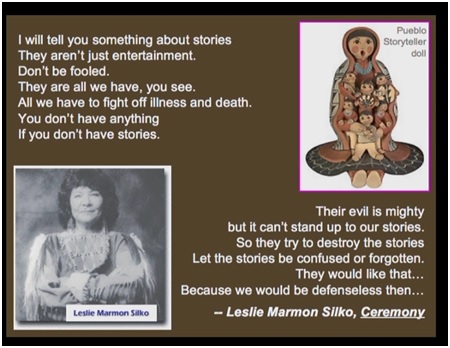
The Word is removed from us in time and space. We all tell stories and know how to tell stories. It is a common language that bridges other cultural gaps between us. These stories are not just entertainment but they actually educate and nourish us. BUT because they are good and healing stories, there are powers out there that will try to destroy them or… “let them be confused or forgotten” – BUT these evil powers cannot stand up to these stories (a statement of faith – conviction -hope that there is a power greater than what we face).  So what we are doing, reading scripture is counter cultural – sitting down and sharing, taking time.

silko

Radical – arising from or going to a root or source. From latin radicalis, having roots.

Radical simply means to go to the roots. Twin task of going to roots of tradition in scripture and in spirituality and in social solidarity and in roots of our contemporary pathologies to deal with root causes and not symptoms.

What are the current issues these stories could be informing?

  • War Israel/Palestine/Afghanistan/Syria/Russia
  • Riots/protests throughout middle east – for democracy and Europe/America in relation to global financial crisis.
  • Isaiah 14.:8: strategic asset Cedars of Lebanon, oil of the ancient times. What was empire then and what is it now? Phonecia, Babylon, Rome – clear cut the cedars for masts for ships and bearing poles for temples. Ecological justice.
  • Matt 1-2, Luke 1-2 Christmas story sentimentalised – imperial violence and human displacement, infanticide as a matter of domestic policy.
  • Road to Emmaus – story of courage and resistance, within a few days of crucifixion. Easter Luke 16:31 – under the shadow of death, not a zen walk down a country road. What is the meaning of the death of our leader for our movement.
  • Immigration/boat people – Isaiah 56, scripture and restorative justice – right using the bible to exclude immigrants and gay people. Radical
  • Matthew 18 restorative justice, ambassadors of reconciliation 2 Corinthians 5:16-6:2.

Draw parallels and analogies with our current context.

  • Ambassadors in chains Ephesians 2-3 & MLK letter from a Birmingham jail (Eph 3:10, 6:1)

How does the story read in our own context?

allegory

As we read be mindful of the following:

  • Oral tradition – uses language to set the scene – are we at the seaside or in the city now?  Look for introduction of new characters, new settings, changes in plot.  Often read the bible like a 5 minute segment out of an entire movie  – how can you understand what’s going on when you come in part way through the story? Need to rebuild critical literacy.
  • We can romanticise the Roman Empire – nothing nice about it.  I am a descendant of the colonising empire – British Empire, conquest, world sovereignty, racial superiority and global management.  Empire looks very different from the bottom IMG_5266up, than the top down – victims are always reminded of their vassalage. Money replaced with that with an image of Emperor or Queen.  The Romans were driven out of Judea and then they struck back. Jerusalem was laid siege, conquered and burned.  The book of Mark was written during this war.  Empire can be defined as the rule of the centre over the periphery.
  • Mark 1:7 baptiser – One is coming who is stronger than I am.  Power contesting power.  Not baptised with only water but the holy spirit and fire.  Baptism was and is a personal and political statement in a social context calling on the Holy Spirit of water and fire out in the undomesticated wilderness against the struggle of empire.
  • “True evangelical faith cannot lie dormant. It clothes the naked, it feed the hungry, it comforts the sorrowful, it shelters the destitute, it serves those that harms it, it binds up that which is wounded, it has become all things to all people” Menno Simons 16th century.  This is a discipleship of struggle and resistance as well as renewal.  Will it have a cost?  Baptism into Christ and into Christs death.  When Jesus was baptised he went right under into the Jordon, shedding  everything of socialisation – rises up completely unobligated to empire.  Jesus was baptised into a specific watershed/river, a specific story, a specific (un)kingdom.


Working from the same copy, read the – whole – book of Mark aloud in one session. The document below, to help with the sense on one whole flowing story (as the oral tellers would speak it), has had all chapter and verse numeration and story “titles” removed.

Mark stripped back

First thoughts?
Sound/feel different than it usually does? What stands out?
Have some general discussion around the ‘mindful’ notes re our ideas about – stories, empire, baptism, discipleship…

Facilitated by Mehrin Almassi from the Indigenous Hospitality House, in this bible study series we will seek to make connections between the story of the nation of Israel told in Lamentations and our own national story. We will look to see whether this book may help us to address our shared histories of displacement and endeavour to distill how we might move forward as a nation in light of the biblical example.

Connection to Creator (Spirit)

What do we think of when we hear the word Spirit? What do we think of when we hear the words Spirit of God?
What do we think about when we hear the term Creator Spirit?
What do we think is meant by each of these phrases? Are they related? Could they be?

Read Lamentations 3

Did the Israelite people have a sense of the Spirit of God – the Creator Spirit?
What was God like for the people of Israel? What was their experience of relating to God?
How do we relate to and/or experience God? Is our experience different to that of the Israelites? If so, can we think why?

Let’s read the Boon Wurrung Story.

What might this story teach us about the way the Boon Wurrung people experience the Creator Spirit?
What may this story teach us about the importance of our own stories in relation to local, national and international issues?
How else might we apply important narratives of the past to current situations needing attention?

Kids Activity

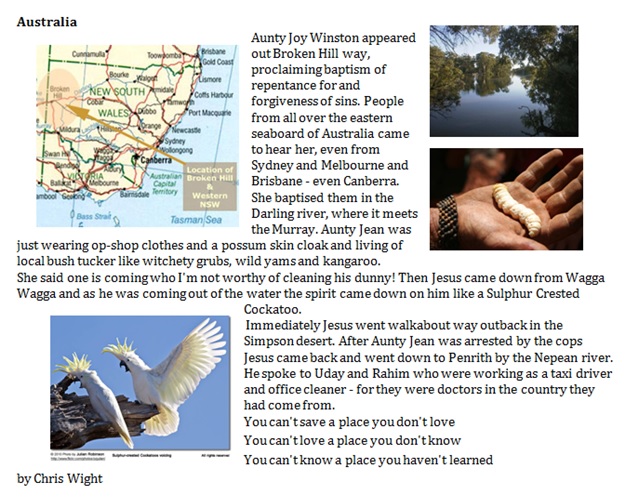
In parallel to grown ups run a kids session: talk about pictures as stories, songlines and place.

Will need:

  • messy clothes (if painting)
  • paint and brushes and/or lots of sticky dot stickers
  • paper
  • photos (bring along some or a camera to take some on the day)

What do you like about stories?
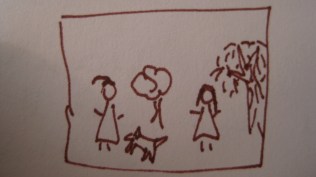
Look at this image? What is this a picture of?

IMG_6499


(girls, dog, trees…)

This picture tells the story of the time Talitha and Bron went to the park with Gracie.

11834903_10153063761386868_8866957583155349394_o

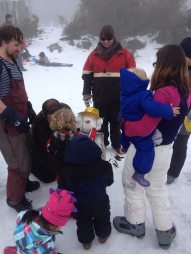
 What about this image? what’s happening here? who was there? but they aren’t in the picture… how do you know they were there?

(pictures can capture a “moment”, some part of a bigger memory, tobogganing and snow angels, other friends… reminder of something bigger that we can no longer see)

Pictures have two things, a place and a “happening”.

Using your pictures so far, talk about where they are happening and what is happening.

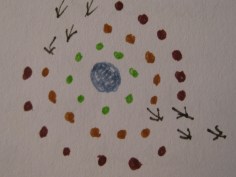
IMG_6501Indigenous stories tell something about a place and also about something happening there.
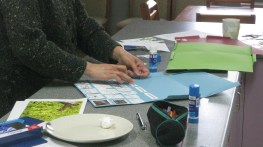
WHERE: Maybe there is a waterhole (blue), things grow there (green), drier sand/soil as you move away (orange), day rocks (red).

WHAT: An animal comes to the watering hole and then goes (tracks).

Ask children to share a memory, a story, and make a picture – collectively or individually (age depending). Then ask of each: Where is your story taking place? What is happening there?

How would you feel if you couldn’t got there again?  If you couldn’t do that again? (sad)

Today the grown ups are talking about the story of lamentations – a lament is a sound of grief and sorrow.  That’s what people in the story did when they couldn’t go back to the place they remembered or do the things they used to do there.

Learning:

our stories and our pictures can be used to tell each other about places we haven’t been and things we haven’t done, remembering and reminders can comfort us when we feel sad

let’s take a photo now, today of all of us together, making and telling stories so that we have a memory-capture. It’s good to take photos and write stories and make pictures because they help us remember

take your picture now to a grown up – tell them your story – use things inside the picture and outside the picture


Wake up

My alarm went off at 7.30am. “Wha-?” Snooze.

Why did I set it early again? Not work… Oh. I remember I need to walk to Maidstone via an ATM to collect a network repeater I bought off the local Buy/Swap/Sell Facebook group.

The alarm sounds again. Snooze.

This is not how I thought my weekend was going to go… I had Friday/Saturday clear – maybe to write and have some sacred space. One housemate is away at a wedding and school holidays have started, things will be quiet around the house.  Yet somehow a conversation has started up about supporting a family of refugees who are staying in two rooms at The Palms. They’re approved for housing but the waiting list could mean anywhere between days and months or, let’s face it, months and years before a 5 bedroom place with disability access comes up.  At the motel they will run through their income for a fortnight purely on accommodation leaving nothing for transport and food.  It seems on Monday they will move in with us.

I wonder whether anyone might imagine that this is some extraordinary thing?

The room swap for my shift-working housemates’ peace may now be a bit redundant.  We have four bathrooms between three units which felt very luxurious not to have to negotiate, though to cycle through 6 new others might take some negotiation, similarly with the use of the kitchen when dinner is in progress.  My head keeps going through the details – need: beds, bedding, another fridge…

The alarm sounds again. Snooze.

…and more internet, which means a wireless signal repeater, which means you have to get up now and go and collect it.


The signal repeater is in place.  The signal is extending further than it did before but it’s not any stronger.

These are the the basic tenets of our faith: I was homeless and you gave me shelter, hungry and you gave me something to eat, disconnected and you gave me connection.

This is what we are called to.

Is how it will inconvenience us the place to start our discernment about it?

I believe in Your ability to provide not only the practical and material things but also for the mental, emotional and spiritual needs of our community.

I do not need to be able to see the way forward as long as I can see You in what we are setting out to do – trusting that You know all that has been, is, and will be.

This is it. Are you ready?


I confess I cried a little today, re-packing and putting away boxes I had unpacked with such gratitude only days before, to make space for the others coming.  I go and walk it off: “Who is this space home for? It’s called a’share house’, what were you expecting? I want to build a foundation that is strong. Rooted.  I have lived here two weeks. Who am I to extend safety and stability to anyone else?”

I turn up a side street to get home only to realise it is a dead end. I double-back on myself and notice a cane basket of clothes out as hard waste on the verge.  I pick it up and carry it with me… a physical manifestation of providence… feel the weight of this, touch it, look at it, take it with you. Providence.  And, somehow, I feel better.

Reassured of my physical capacity for carrying things.


We try and create a sense of welcome.

We know there’s limited language between us so we create a bi-lingual, pictorial noticeboard that will have all our names, where we are, what we’re doing. We clear out, clean and label the cupboards our new roommates can use in the kitchen and decorate with a Somali proverb we think speaks to the the sense of home we want to create.

IMG_5018  IMG_5021

somali welcome  somali proverb

And yeah.

They are not literate in Somali or English.

So, just in case anyone is ever wondering whether it is an extraordinary thing to live with a family of refugees, this is how it comes about: a series of small and ugly thoughts, some big, bright, beautiful thoughts, and some well-meaning but misguided good intentions.

Sometimes you say the wrong thing, sometimes you do the wrong thing.
Sometimes you say the right thing, sometimes you do the right thing.
You can do that in any family.

I am blessed in the trying.
My life is more noisy, more colourful, more crazy and I am the happier for it.
It starts when you stop pressing “Snooze”.