Tag Archive: transformation


IMG_5874

Pleasure is when love and its object meet.
To love is to eat.
To love is to give oneself to be eaten. (p.84)

The Latin languages preserve an intuition which seems to be absent from English.  Their words for ‘knowledge’ and ‘taste’ come from the same root. Sapere, in Latin, means both to ‘know’ and to ‘have flavour’. In my language, saber – to know, and sabor taste.  Eating and knowing have the same origin.  To know something is to feel its taste, what it does to my body.  Reality is not rawness, the ‘things-in-themselves’. Reality is the result of the alchemic transformation by fire, the food which is taken inside my body. (p.85-86)

The dead man: the raw.
But it was transformed by the fire of the villagers’ imagination.
And they, themselves, were resurrected by participating in the anthropophagic ritual…

The body is a kitchen.
Without the fire that burns inside,
the fire of hunger,
desire,
longing,
imagination
there cannot be any hope of resurrection, because we are what we eat. (p.87)


IMAG0792

An outsider would not have noticed any visible changes. The same skies, the same seas. The same faces… But they know that everything was different. Their banal everyday life which they knew with such familiarity had been transfigured,  They had been given new eyes and the solid objects and stone faces which filled their space became transparent. It was as if they saw invisible things which were visible only to those who had seen the angel troubling the waters of the pool – the dead man.

Normal mirrors reflect things which are present; but dreams show things which are absent… their stories about the dead man were stories about themselves. Stories not about what they were (that is what they saw when they looked in their mirrors…) but stories about what they desired to be: this is what they saw as they faced their dreams…

Inside our flesh, and mixed with the noises of Death, there is written an indelible story of beauty.  And even without knowing we know that we are destined to this happiness: the Prince must meet Sleeping Beauty.

The villagers remembered. Their stories were the return of a lost time: the past, desired, repressed, forgotten, dead, resurrected from the grave.

…How could I explain to her that the story was always happening in the present just because it had never happened in the past, in the far distant land?

…the beautiful wants to return… its time is sacred; it is reborn every morning; it is the time of resurrection.

…Once upon a time, in a far distant land…” : a cloud of mist covers the narrative to conceal its real time and space which are ‘now’ and ‘here’… the ‘once upon a time, in a far distant land’ is a metaphorical was of speaking about a present loss.

p.39-41, The Poet, the Warrior, the Prophet

IMG_6364

“… a subtle moment, a reversal occurs.  I know longer drink the wine. It is the wine which drinks me. I have been ‘drunk’ by it. I am drunk. Now it is not the wine which enters my body. It is the wine which holds me inside a glass and drinks me, and I enter into a totally different world, a strange world which I don’t know.  My body is possessed by ‘spirits’ which had remained outside till that moment. ‘In vino veritas’: in wine truth abides.

The eucharist: If the body and the blood were assimilated into our bodies, they would become what we are. But the eucharist is the reversal of normality: we eat and drink the bread and the wine, but it is the bread and the wine which eats us. We are to become what they are: the body and the blood of Christ.”

p.14-15, The Poet, the Warrior, the Prophet

img_2614

We are running a fortnightly bible study following our community dinner looking at the exegesis (interpretation) of the bible passages that underpin each of our community values. You can read the list of Values here so you know what’s coming up next.

These values can be relevant whatever context you live and work in just make the Word you own.


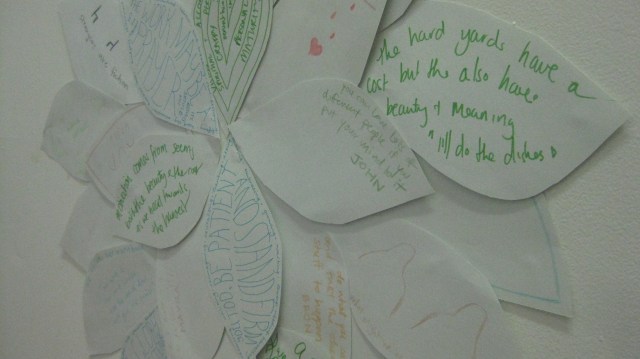
Value 7: Doing the hard yards

We value servanthood in the big and the small – choosing to do the “crappy” stuff.  We want to be people of personal and spiritual maturity (enduring personal cost) in order that the vision is accomplished.

Biblical basis: James 5:7-11


Let’s read the value together. What stands out?

“We value” – this is about making personal choices to value things differently than most of the rest of the world… not a flashy project, it doesn’t attract attention.

Trusting there is purpose in the crappy stuff.

 Need to acknowledge the way our current situation impacts my approach to this value, how would my/our interpretation differ if we weren’t crisis.

Is it ‘given’ that in order for the vision to be accomplished, it needs to cost me?


James 5: 7-10

My friends, be patient as you wait for the Lord to return. Be as patient as the farmers. Farmers sow their crops and then have to wait patiently, hoping for good seasonal rains, because the harvest that pays their bills ripens in its own good time. There is nothing they can do to hurry it up. You can’t hurry the Lord up either, so be patient. Stay focused though, and condition yourselves, because the arrival of the Lord is not far off.

My friends, don’t go whinging and putting each other down. If you do, you’ll find yourselves having to answer for it. The judge could reopen the case against you at any moment.

Take as your role models the prophets who brought us God’s message in the past. They really suffered for their stand, but they hung in there, never giving up, and their patience paid off.  11 That’s because God cares, cares right down to the last detail.

©2002 Nathan Nettleton LaughingBird.net


“This work could be a prayer; its results should not concern me”

Thomas Merton


“There are two basic motivating forces: fear and love. When we are afraid, we pull back from life. When we are in love, we open to all that life has to offer with passion, excitement, and acceptance. We need to learn to love ourselves first, in all our glory and our imperfections. If we cannot love ourselves, we cannot fully open to our ability to love others or our potential to create. Evolution and all hopes for a better world rest in the fearlessness and open-hearted vision of people who embrace life.”

John Lennon


Read the bible. What words/ideas stand out? What can we learn from the bible about living the Value of “Doing the hard yards”?

Being patient sounds passive – I’m bad at that!

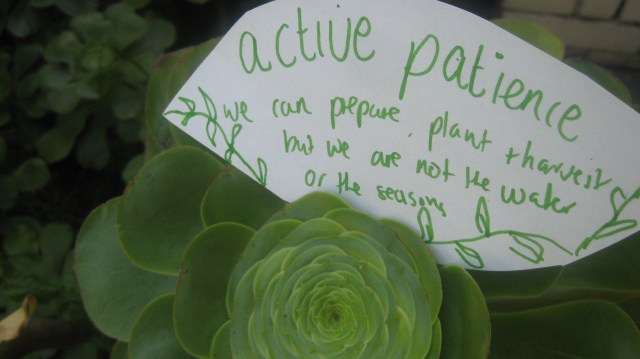
It’s not passive it’s active! “stay focused”… “condition yourselves”… farmers till, plant, fertilise, prepare the soil… still required to exercise what is within your ability to influence, power, control. There are things we can do but then there are things we can’t… we have to rely on God for those.

Begin work or make choices with an outcome in mind but often things don’t go as we plan, despite this things work out.

You have to do what you can and trust the other stuff to happen. 

Often in Christian circles the personal cost component can become competitive and be worn as a badge-of-honour.

Perspective makes a difference – choosing, for example, to work part time could be perceived as a ‘cost’ but for us, from our perspective it feels like an opportunity.

You can love different people if you put you mind to it. A lot of people don’t go out of their way… instead they love to put people down.

Standing up for someone when you notice the truth. When they can’t stand up for themselves.


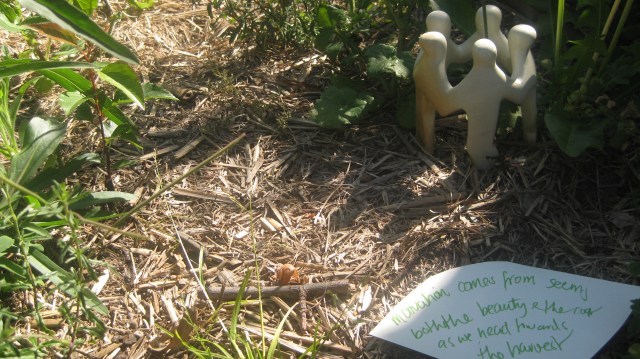
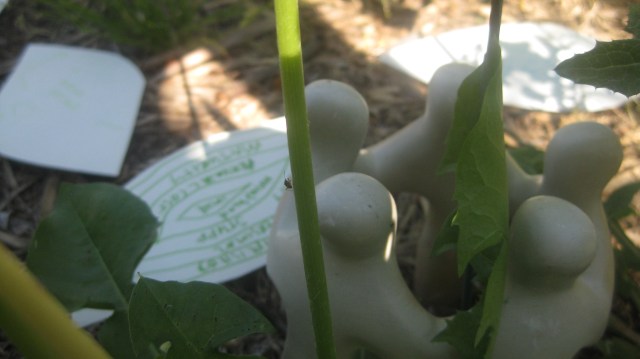
Taking this idea of where our influence ends and God’s begins let’s write down on these “seeds” what we know and what we don’t know, doing what we can, planting them and leaving the growing to God remembering “we need to learn to love ourselves first, in all our glory and imperfections”
img_2596

…all we can do is plant our seeds and trust that the outcomes that come, while not what we might imagine,  work toward the vision of God being accomplished.
 

img_2560


img_2627

imag0381

Within the grip of winter, it is almost impossible to imagine the spring. The gray perished landscape is shorn of color. Only bleakness meets the eye; everything seems severe and edged. Winter is the oldest season; it has some quality of the absolute. Yet beneath the surface of winter, the miracle of spring is already in preparation; the cold is relenting; seeds are wakening up. Colors are beginning to imagine how they will return. Then, imperceptibly, somewhere one bud opens and the symphony of renewal is no longer reversible. From the black heart of winter a miraculous, breathing plenitude of color emerges.

The beauty of nature insists on taking its time. Everything is prepared. Nothing is rushed. The rhythm of emergence is a gradual slow beat always inching its way forward; change remains faithful to itself until the new unfolds in the full confidence of true arrival. Because nothing is abrupt, the beginning of spring nearly always catches us unawares. It is there before we see it; and then we can look nowhere without seeing it.


With thanks to Dusk for sharing this when I needed to hear it.
An excerpt of a meditation from From To Bless the Space Between Us by John O’Donohue 


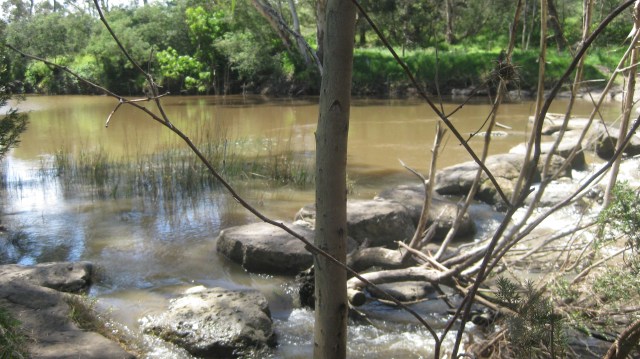
The river water

img_2113

The river water

runs high and fast.

Unknown depths,

cloudy murk obscuring

what is usually

so clear.

The season

is changing.

The high tide

lifts debris that has

been stuck since the last

spring storms

and carries it away.

In the run-off and rain

new biodiversity are

introduced, seeds from

places never seen here

downstream.

The land alters under

the authority of this new flow

the landscape – forever changed.

Not better, not worse, but new.

Talitha Fraser

img_9817

Ch 2, p8

“The surrender of faith does not happen in one moment but is an extended journey, a trust walk, a gradual letting go, unlearning and handing over… to finally surrender ourselves to healing, we have to have three spaces opened up within us – and all at the same time: our opinionated head, our closed-down heart, and our defensive and defended body… the work of ‘a Power greater than ourselves’, and it will lead to great luminosity and seeing.”

Richard Rohr

imag0216


God
I acknowledge my
inabilities,
my smallness,
my powerlessness
to affect any change
least of all
to myself
take me and make me
something beautiful
to You
take me and make me
something beautiful.

Amen.

Talitha Fraser


img_9450

Starting to read this together at Sunday Group – here are some teasers from the intro…


xvii    When Christianity loses its material/physical/earthly interests, it has very little to say about how God actually loves the world into wholeness.


xxii    Substance addictions like alcohol and drugs are merely the most visible form of addiction, but actually we are all addicted to our own habitual way of doing anything, our own defenses, and most especially, our patterned way of thinking, or how we process our reality.  The very fact we have to say this shows how much we are blinded inside of it.  By definition you can never see or handle what you are addicted to.  It is always hidden and disguised as something else. As Jesus did with the demons of gerasa, someone must say, “What is your name?”(Luke 8:30).  The problem must be correctly named before the demon can be exorcised.  You cannot heal what you do not first acknowledge.


xxiv

we suffer to get well.

we surrender to win.

we die to live

we give it away to keep it.

This counterintuitive wisdom will forever be resisted as true, denied and avoided, until it is forced upon us – by some reality over which we are powerless – and if we are honest, we are all powerless in the presence of full Reality.


You can buy Breathing Under Water by Richard Rohr (or any of his other titles) from the Centre for Action and Contemplation website.

img_9504

I am changed, am I not?
All glory be to You Life-Changer
I am not who I was
I am made new
All of who I am, in You
Ruined for anything else
And grateful, bone-deep, for that
If I am rendered fit for Your purpose
Let me not lament what is lost
But give voice to joy what has been found
You are the belonging
My heart has hungered for
Fill and spill from me
And I will know a life well-spent
I will know a life lived
I will know life
Not death, never death
But life with You

Talitha Fraser