Category: influential reading material


The Indigenous Hospitality House are hosting learning circles on a breadth of topics. Here are Samara’s reflections on the Quaker session. Photo credit to IHH.

quaker-circle

Start with silence – business meetings, weddings, funerals, protests… this is an intentional mechanism for listening to the prophetic voice.
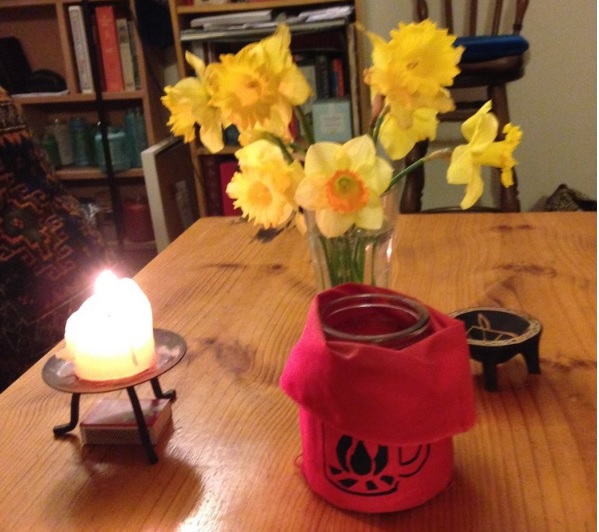
On the table in front of us we have flowers [something from creation], the Bible, and “our book” [the Quaker queries and advices].
Calm, relax, let go, forget day/tasks/concerns.
Be present.
For me this is often about my body yielding and a remembering of the nature of love to change.
A service might go an hour or more, let’s try and go for 10 mins and close with “Thank you friends”
These spaces
– don’t critique
– not intellectually analysing/deconstructing
…but hearing spiritually.
Spaces are to address spiritual wellbeing. To provide a space to see and understand spiritually.
Quakers believe no priest of minister can do it for you. The hour of silence is an hour of active worship. You will be changed. There is an expectation of that.
Someone might ask a question aloud… [Quakers might reference their queries and advices book if relevant]. They do not give “answers”
Only you have your own answer to deepen your spiritual life.
e.g. “I want to talk about why I’m sad…”
“We can, but what makes you happy?”
The process reframes.
SILENCE
– together
– connected to others present
– not worried about what your thinking (don’t stress if you start but a shopping list, but…)
– take a thought, dwell on it as you need to – may or may not become ministry.
– no veil(s) between me and God
– ministry uncanny to what’s on your heart/mind.


img_0740img_0746img_0736img_0733img_0735img_0737img_0738img_0743

img_0385

p.44

I do not trouble my spirit to vindicate itself or be understood
I see that the elementary laws never apologise…
I exist as I am, that is enough
If no other in the world be aware I sit content…
I know the amplitude of time
The pleasures of heaven are with me, and the pains
of hell are with me.


img_0378


p.31

Who need be afraid of the merge?
Undrape… you are not guilty to me, nor stale nor discarded.


Walt Whitman – Leaves of Grass

img_0376


img_0681-copy

img_0360

img_0359

img_0363

img_0364


2016-wwf-artwork-by-aysha-tea_02_web-890x500

West Writers Festival Artwork by Aysha Tea

When they speak, it is scientific; when we speak, it is unscientific;
When they speak, it is universal; when we speak, it is specific;
When they speak, it is objective; when we speak, it is subjective;
When they speak, it is neutral; when we speak, it is personal;
When they speak, it is rational; when we speak, it is emotional;
When they speak, it is impartial; when we speak, it is partial;
When they speak, they have facts; when we speak, we have opinions;
When they speak, they have knowledge; when we speak, we have experiences.
These are not simple semantic categorizations; they possess a dimension of power that maintains hierarchical positions. We are not dealing here with simple semantic, but rather with a violent hierarchy, which defines who can speak.

Grada Kilomba

Epistemic struggle

  • imperial based identity
  • colonised
  • don’t think of themselves as “indigenous”, they don’t need to
  • needs to critique; not only the centre but different voices (otherwise issues remain invisible)
  • speak to defining powers
  • theorising as a community member not for. Invited to participate for skills not your cultural identity.
  • protect space – doesn’t respect all knowledge and doesn’t deserve all knowledge


Decolonising the Narrative

Characteristics

  • is an epistemic struggle
  • not answering set questions, it sets the questions
  • changes terms of the enunciation/conversation
  • process not fixed point
  • creates pluriversality, rather than universality
  • makes visible the epistemological zero-point*


* EPISTEMOLOGICAL ZERO-POINT “Europeans are people who do not know their place because they have not explored it yet. People living there have situated knowledge and knowledge grounded in their experiences… Operating under the hubris of zero-point blinds you to the fact that other people, with their own existence and knowledges, do not have the same problems that you have and therefore could care less about your knowledge, until the moment that you impose it on them and tell them they do not know about themselves what you know about them.  You conclude that they are inferior and ignorant, that their reasoning is defective, that their sense of beautiful doesn’t exist. You do not stop to think that they are as ignorant of your interests and values as you are of theirs. However, you assume you “know” them because you describe them and include them in your system of knowledge and in your epistemic architectonic.” – Walter Mignolo

example:

“What are you?”

 “I’m Vietnamese. What are you?”

“Nothing”

Vietnamese can’t be “nothing” without white people. White is the canvas of the world.

Who has the imperial power to “welcome”? We need to decolonise our aesthetic.  Initiatives must critique to be de-colonising.

e.g. “Real Australians say welcome” – posters do not critique or #RefugeesWelcome these are not decolonising initiatives.


Walter Mignolo on Decolonial Thinking

  • who is the knowing subject? What is his/her material apparatus on enunciation? (Who gets to say who can speak or when?) Construction of visibility.
  • what kind of knowledge/understanding is s/he engaged in generating, and why?
  • who is benefitting or taking advantage of such-and-such knowledge or understanding
  • what institutions (universities, media, foundations, corporations) are supporting and encouraging such knowledge and understanding e.g. Rhodes scholars – took the statue down. Yale cafeteria staff smashed a window depicting slaves.


Being an advocate is speaking to my cohort…
awareness brings change


Artwork by Aysha Tufa

I’m spending my weekend popping in and out of varied sessions of the Footscray Arts Centres West Writers Forum – the description for a workshop I made it to today reflected on language:

As our world grows smaller and people become more familiar with one another through daily cross-cultural interactions, what stops us from finding ourselves or losing ourselves in each other’s stories? Is translation the final frontier in creative writing? Can we achieve fluid creative and cultural exchanges through the translation of stories? Or will some things always remain lost in translation? Join moderator Mridula Nath Chakraborty in conversation with academics Sanaz Fotouhi and Dr Nadia NiazLily Yulianti Farid and Josiane Behmoiras for this panel.

 Lots of different ideas came through –

The minute you write – let it go.
It will mean something different to every reader.
You can put forward your intention for the words
but that may or may not be picked up.

Josianne Behmoiras

Contextual translation is more important that word-by-word.
You need to translate meaning to a medium your audience can understand…

The interpreter makes their own “work”.

Dr Nadia Niaz

The original word in Buginese “Mukkunrai”
had to remain to carry the meaning – the English translation
“female” doesn’t capture all of the cultural meaning.
(on the title of her short story collection)

Lily Youlanti

All of us find ourselves constantly
translating and transitioning,
asking: “Where do I sit?”

Sanaz Fotouhi

This quote got shared; Charles Simic’s take on the magical absurdity of translating poetry: “It’s that pigheaded effort to convey in words of another language not only the literal meaning of a poem but an alien way of seeing things … To translate is not only to experience what makes each language distinct, but to draw close to the mystery of the relationship between word and thing, letter and spirit, self and world.” (and the article I found it in from The New Yorker mentions many of the panel-referenced works re the translation movement in Japan).

This panel of five had cultural tails in the following languages: French, Hebrew, Latino, Turkish, Kurdish, Buginese, Bahasa, Urdu, Bengali and more I’m sure… a lot of the focus of the session was around translating into English and how you break into, speak into, build an audience amongst English (white middle-class) readers (they are mostly the ones buying books/running the theatres/festivals/publishing houses, etc.).

I found myself thinking about Te Reo Māori (the native language of New Zealand where I am from) and how few speakers there are – there is a need to find reasons to use this language.  What might it look like to translate poems – not word for word – but their meaning.   This kind of interpretation lends itself to crafting something new. What does it mean to take the words I have written to be grounded back into where I come from? What might I discover through that process? Like the Treaty of Waitangi we will end up with 3 versions: original English, Māori translation and then a translation of the Māori back into English… apologies to anyone fluent in Māori who reads these as I’m bound to make gaffes in grammar and word choice… {if you want to collaborate on correct translations get in touch!}

i.

I sit down in the middle of the river

The river sits in the middle of me

Won’t you come and sit by the river?

Sit by the river awhile with me

ii.

Enoho au ki roto i te awa
Aparima enohoana ki roto iho
Haere tahi i roto ki te awa?
Haere mai ki te Mātāpuna a muri ngākau ahau

iii.

I sit down in the middle of the river
Aparima* sits always at the heart of who I am
Will you keep me company at the river?
You are welcome at the Source that sits at the heart of me

(* Aparima is the name of the river that I identify with in my mihi, it denotes the acknowledgment of place/where I am from)


i.

There is Room at the Table (originally written as a song to welcome asylum seekers/boat people coming to Australia, used at a Welcome Picnic outside a local detention centre)

There is room at the table x3
Let them in, let them stay

There is room at the border x3
Let them in, let them stay

There is room in our hearts x3
Let them in, let them stay

There is hope for a new tomorrow x3
Let them in, let them stay

ii.

He wāhi anō kai roto i te tēpu mo tētahi atu tangata?
Haere mai ra, haere mai ra, haere mai ra
Haere mai, nau mai, e ngā iwi e

He wāhi anō kai roto i te rohe mo tētahi atu tangata?
Haere mai ra, haere mai ra, haere mai ra
Haere mai, nau mai, e ngā iwi e

He wāhi anō kai roto i te to tatou ngākau mo tētahi atu tangata?
Haere mai ra, haere mai ra, haere mai ra
Haere mai, nau mai, e ngā iwi e

Nāu te rourou, nāku te rourou ka ora te manuwhiri
Haere mai ra, haere mai ra, haere mai ra
Haere mai, nau mai, e ngā iwi e

iii.

Is there space at the table for one more person?
Welcome, everyone is welcome

Is there space at the border for one more person?
Welcome, everyone is welcome

Is there space in our hearts for one more person?
Welcome, everyone is welcome

We will all contribute what we have and there will be enough to share
Welcome, everyone is welcome


Queries:

What is notable about the differences in the English translations?

What does such an exercise tell us about the significance of interpretation in translation?

If you look up mihi (tradition Maori introduction – reference in poem 1) and karanga (traditional Maori welcome – style observed in poem 2), does this change your understanding of these poems meaning? How?

Any reflections on Simic’s idea that: “To translate is not only to experience what makes each language distinct, but to draw close to the mystery of the relationship between word and thing, letter and spirit, self and world.”?

img_0039

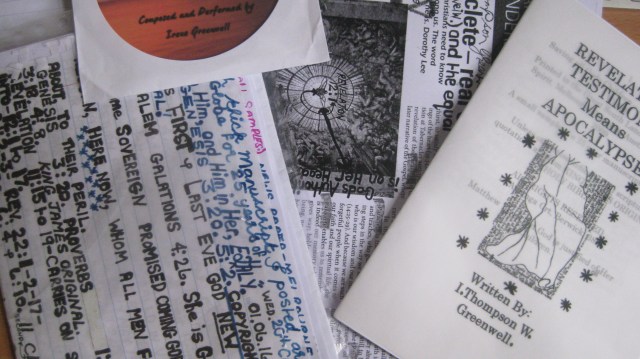
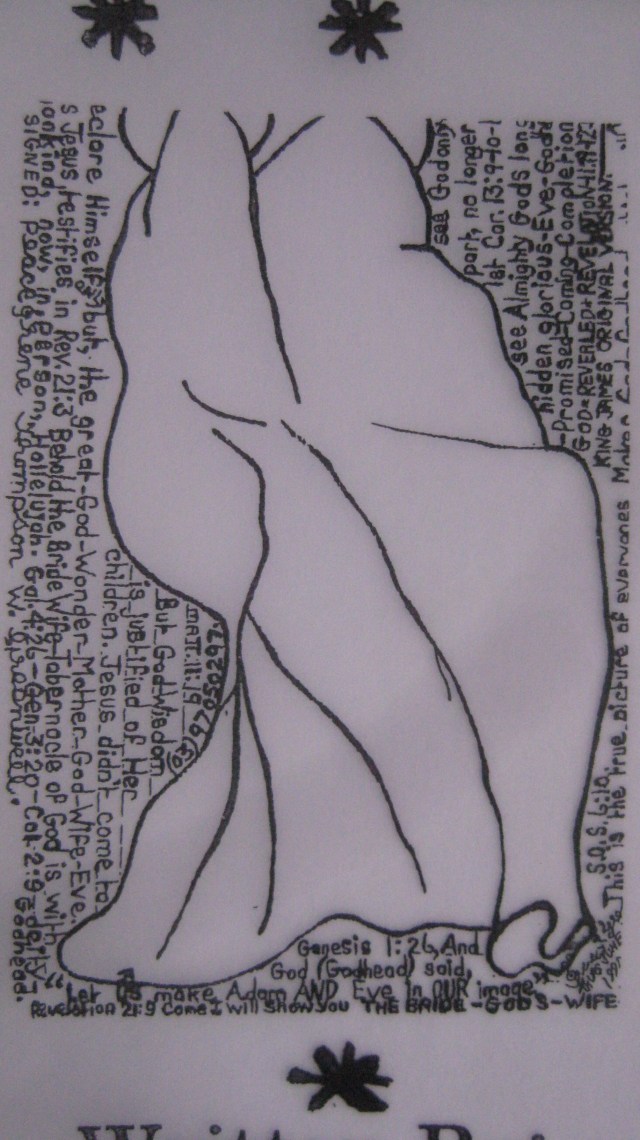
I had the privilege of meeting Mrs. ITWG… in musing on voice, centre and margins, what is heard and not heard I have permission to share with you what she shared with me.

img_0040img_0041img_0042img_0043img_0044img_0046img_0047img_0048img_0049img_0050img_0055img_0056img_0057

img_0035

Randomly yes, I am bringing you the graffiti from the women’s toilets of a well-known Melbourne pub as a juxtaposition to the Leunig and Mother Teresa and such… from promoting social justice issues, expressions of love/hate, to relationship advice… it’s arguably, not that different – you can learn a lot from this type of bathroom wall wisdom… you might not like it all or agree with it… but you will assuredly learn something.


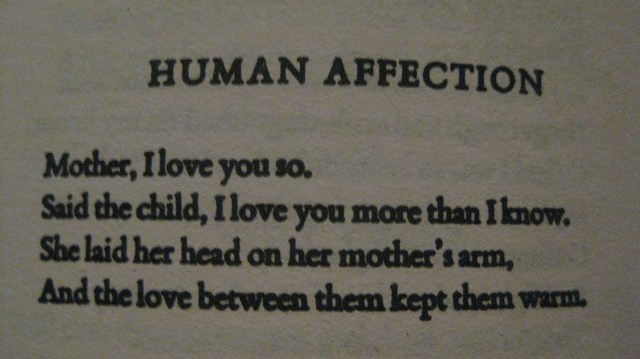
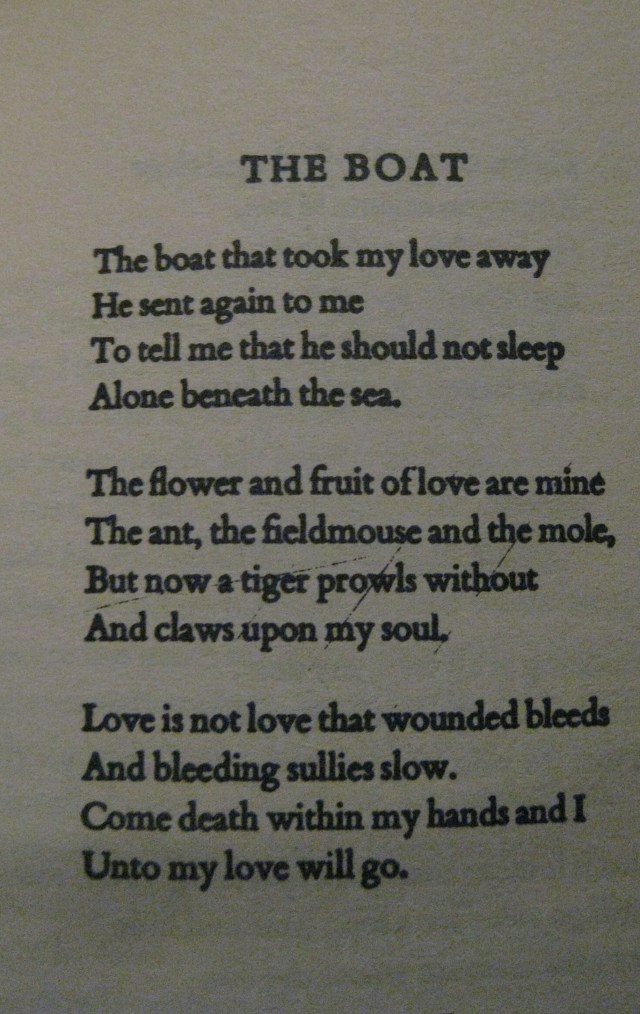
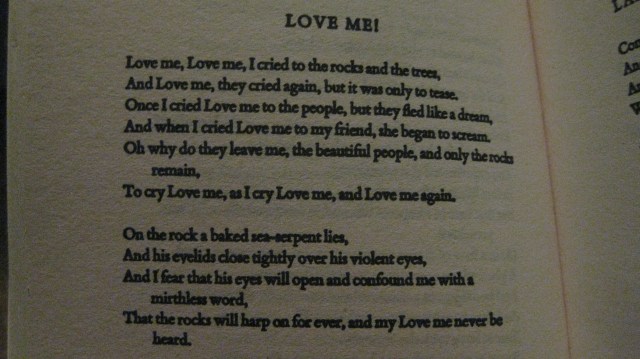
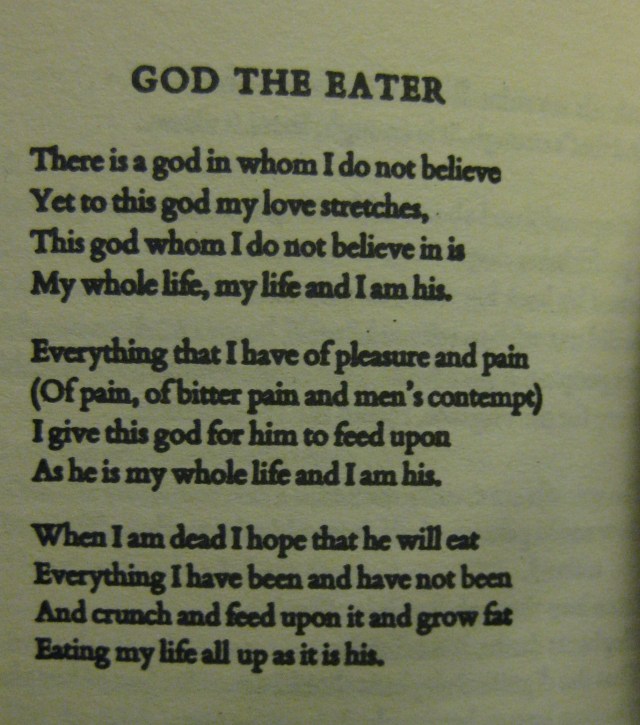
Housesitting and off the shelf of an extraordinary library I discover the poetry of Stevie Smith… I think she and I have become friends and I just may have to visit again…

img_9980

img_9974

img_9975

img_9979