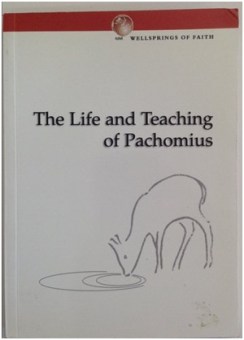
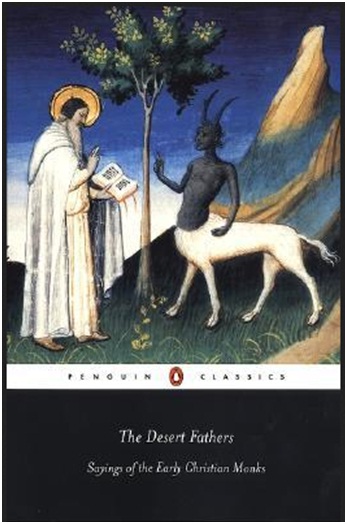
 This year I am thinking a bit about the idea of “community”, what does it take to have a “good” one (sustainable/functional/inclusive/etc.) how is leadership/eldership developed? what structure does this the community have? how do people join or leave? are there basic components that are essential then localised variations? What has been tried before and how did that work or not? Pachomius is part of going back to the Desert Fathers (and Mothers) and seeing what their communities were like… some common themes so far include:
– limiting company, food, sleep, talking
– living apart/in the desert
– working only enough to live and trusting to God’s provision for anything beyond that
– rhythm of prayer and fasting
– people would travel to visit/seek wisdom/join because they heard about their dedicated faith
– humility in service
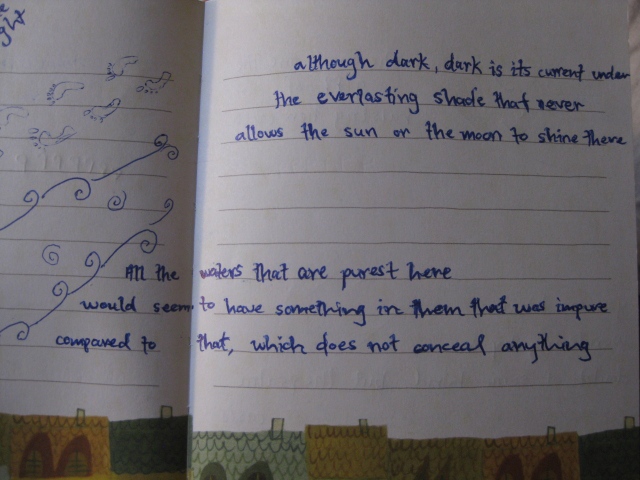
Some chips of wisdom from Pachomius… reflect on the question Where is your shining light?
It is not good to ask unnecessary questions. Speak only for the salvation of souls, because it is written: one who is faithful in small things will be faithful in great. (p46) Lk16:10
Up! Do not stay with the dead. My son, do good deeds like the friends of God. (Heb 6:12) Do not sleep: act!
And make your neighbour do good deeds, for you have made yourself responsible for him. (Prov 6:1-6)
Get up! Do not stay with the dead. and Christ will give you light (Eph 5:14) and grace will flower in you (2 Cor 4:16,17) (p280)
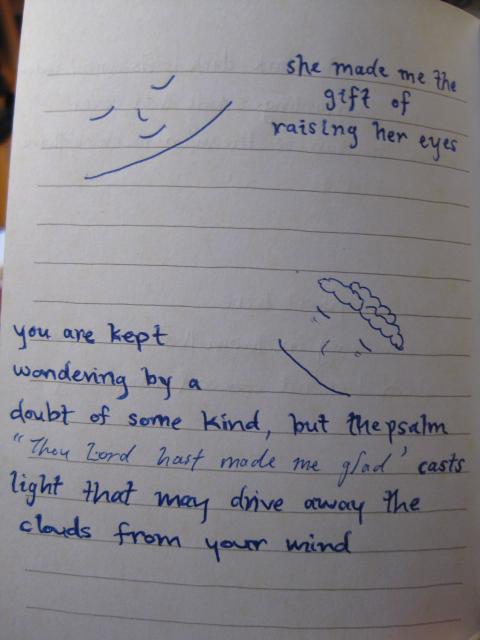
When a thought keeps troubling you, be patient, waiting for God to give you back your peace (p81)
If you give bread when you have plenty of it are you being truly good? And if you are downhearted when you are in need you are not truly poor in spirit. But the bible says of the saints that they are in need of everything, they go through all sorts of troubles, and they are ill-used. (Heb 11:37) But they are proud of having to undergo these things (Rom 5:3)(p85)
Bearing hard things with joy
Joyfully undergo any troubles. If you knew the honour which is the reward for undergoing troubles you would not ask God to take them away. Yes, when you are weeping in your prayer, and when you are watching long hours for God’s help, that is of more value to you than to let yourself get soft and be made a prisoner (p87)
My son, run from the desires of the body. They cloud the mind and stop you from coming to the knowledge of the secrets of God (Mt13:11). They make you a stranger to the words of the Holy Spirit, and you will not be able to carry the cross of Christ or keep your hearts attention on praising God. Do not eat more thn you need or you will not be able to taste the things of God (p89).
Run from earthly honours
You, my son, run from the soft life of this world. Then you will be happy with the life to come. Do not be careless. Letting the days go by, for then Death will come to you suddenly and his servants, the faces of fear (Rev 9:7-11), come round you and cruelly take you of to their dark place of terror, fear and pain. Do not be sad when you are cursed by men: be deeply sad when you sin – this is the true curse – and you go away bearing the wound of your sin. From my heart I urge you to scorn honours. Pride is the Devil’s own weapon. It was with this arm of pride that he worked his deceit against Eve. He said to her: “Take and eat the fruit of the tree and your eyes will be opened and you will be like gods” (Gen 3:5) She listened to him and thought it true. She desired the glory of being like God and her own humn glory ws taken away, and you, if you go after the glory which comes from men it will keep you from the glory which comes from God. It was different for Eve. No one had told her that the evil spirit would test her. That is why the Word of God came and took flesh of the Virgin Mary to free all the offspring of Eve. (p93)
God is living in you, you should be living in him
Look for what is good everywhere, be without deceit. Be like the gentle sheep. They are fleeced but say nothing (Is 53:7). Do not go from place to place sayng: I will find God here, I will find him there (Mt 24:23). God has said: I am everywhere in heaven and on earth (Jer 23:24). And again: If you cross over water I am with you. The waves will not swallow you (Is43:2). My son, you should realise that God is in you, so that you may have life in him, in his law and commands. Look: the thief was on the cross and he went into paradise, but Judas was among the Apostles and he handed his Lord over to people who hated him. Rahab was a prostitute and she was counted among the saints (Jos 2:25), but see, Eve was in paradise, and the spirit of Evil led her into sin (Gen3). Job was on a dungheap, and they say he was like his Lord, but see Adam was in God’s garden and he did not do as God commanded. The angels were in heaven and God threw them out (2 Peter 2:4), Elijah and Enoch were on earth, but they were taken up to heaven (2Kgs2:11;Heb11:5). SO we should see God in every place and look for his help at all times (Ps104:4) (p94-95)
My son, run to God, for he made you, and it was for you that he underwent those sufferings. For he said by the mouth of the Prophet Isaiah: I offered my back to the whips and my head to the blows. I did not turn my face away from the shame. (Is50:6) (p99)
To love is to build up (1Cor8:1) (p103)
Yes, even if we keep our virginity, and choose to live in poverty and solitude. God will still say to us: “Give me back my goods with interest” (Mt25:27) Angrily he will say to us: “Where is your robe for the bridal-feast? (Mt22:11,12) Where is your shining light? (Mt5:15,16; 25:10-12) (p107)
We must attend to ourselves and recognise God’s gifts. (p107)
Humility is the greatest strength
More than all this, we have been given humility. It keeps all God’s gifts safe. It is that great and holy strength which the Son of God put on when he came into the world. Humility is a strengthening wall and a storehouse for God’s gifts, protective clothing to keep us safe in the fight, and healing for every wound. At the time of the Exodus the Hebrews made soft linens and things of gold for the tabernacle. But at God’s order they covered it all over with a tent of goats hair (Ex26:7-11,14). Humility is least prized among men but in the eyes of God it is of great value. If we obtain it, we shall be able to crush underfoot all the power of the Evil One. God himself has said: “Who is the man to whom I look? He that is humble and gentle.” (Is66:2) (p110-111)
Let us keep watch with a good heart
Let us fight against ourselves in all ways that we are able. Let us put to death our bad desires and we shall become new men, in purity. Let us loves others, and we shall be friends of Christ, who is friend of all men and women. We have given our oath to God that our life will be monastic, which is to love, and for that we keep virginity not only of body but the virginity that is a weapon against every sin. (p112)
God commands us to work, not to have a soft living but to have enough to help the poor (p113)
Keep your strength of purpose (p114)
Use well every day of your existence and in the morning think what you will offer to God that day (p115)
Without delay, look for a safe place by yourself with God. Be by yourself with Christ, weeping, and the Spirit of Jesus will speak to you through your thoughts. (p117)
“Forgive me Lord. I have given pain to your image.” (Gen1:26) (p117)

 itellyouarise