Category: influential reading material


                                                           (photo of Mount Taranaki, Richard Crowsen)

Maori continued with the task unarmed and, to a person, they declined to respond to aggression when removed. Go, put your hands to the plough. Look not back. If any come with guns and swords, be not afraid. If they smite you, smite not in return. If they rend you, be not discouraged. Another will take up the good work. If evil thoughts fill the minds of the settlers and they flee from their farms to the town, as in the war of old, enter not . . . into their houses, touch not their goods nor their cattle. My eye is over all. I will detect the thief, and the punishment shall be like that which fell upon Ananias. When the ploughmen asked Tohu what they should do if any of their number were shot, he replied, ‘Gather up the earth on which the blood is spilt and bring it to Parihaka’ (Scott, pp 56-57).


February 6th  is Waitangi Day in New Zealand, the anniversary of the signing of the Treaty  of Waitangi in 1840. To the British this achieved full sovereignty and government of the country but Maori  thought, while giving authority to govern, they would still be entitled to manage their own affairs in their own way.  Similarly to Australia Day on January 26th being known as “Invasion Day” to the First Peoples of that nation, Waitangi Day is often attended by protest as well as being a celebration of nationhood.

What perhaps not enough New Zealand settler descendants may know is that there were Taranaki chieftains who never signed the Treaty of Waitangi, steadfast in their refusal to acknowledge foreign sovereignty in preference for maintaining their own way of life on their own land – the pa at Parihaka became a sanctuary for Maori forced, fought, deceived off their land. Likened forerunners to Ghandi  and Martin Luther King, Te Whiti and Tohu ran a campaign of non-violence spanning 40 years sheltering the dispossessed.

The Waitangi Tribunal[1] published “The Taranaki Report: Kaupapa Tuatahi” in 1996 saying, “ If war is the absence of peace, the war has never ended in Taranaki, because that essential prerequisite for peace among peoples, that each should be able to live with dignity on their own lands, is still absent and the protest over land rights continues to be made.”  Contrary to the belief held by many New Zealanders that in an acknowledged first equal language, proportional representation in government and other policies we might be considered advanced in our journey of equality and reconciliation, in fact we are the only colonising country where there is no land held and managed autonomously by the indigenous population (Ch.8 Parihaka).

The title of Dick Scott’s book is a quote from Te Whiti, Chieftain at Parihaka who says:

Ask that mountain – here before us, it will be here when we are gone – that mountain as witness, can we honestly say that we have done everything we can? That everything is ‘right’?

These are the questions we need to ask ourselves and the stories that should continue to be told if we are to participate in the journey of healing between the people and the land.

It is often difficult to know where to start in confronting these issues, I have more questions than answers yet I have hope.  I have ordered a T-shirt from the Emmaus Rd community, on the front it reads Arohamai which means “sorry” or “forgive me” and on the back are a list of some of the injustices as occurred over those 40 years and are carried yet in our dreams and bones today:

I’M SORRY FOR THE

// INVASION OF YOUR VILLAGE – 5th NOV
// UNJUST ARREST AND EXILING OF TE WHITI AND TOHU
// LOOTING BY THE ARMED CONSTABULARY / 8th NOV
// DESTRUCTION OF THE WHARENUI & CROPS / 20th NOV
// FORCIBLE EJECTION OF 1,556 PEOPLE FROM THEIR HOMES /20th NOV
// RAPE OF YOUR WOMEN
// CONGENITAL SYPHILLIS IN YOUR CHILDREN

ALSO FOR THE:

// IMPRISONMENT WITHOUT TRIAL OF 420 PLOUGHMEN AND 216 FENCERS FOR TWO YEARS
// DEVASTATING EFFECT ON THEIR WIVES AND CHILDREN
// UNJUST CONFISCATION OF YOUR LAND
// BACKDATING OF LEGISLATION TO MAKE LEGAL THE GOVT’S ILLEGAL ACTS

AND OUR FAILURE AS A NATION TO FACE THESE ISSUES

In her Booker Prize Winning novel The Bone People Keri Hulme writes, “I was taught that it was the old people’s belief that this country, and our people, are different and special. That something very great had allied itself with some of us, had given itself to us.  But we changed. We ceased to nurture the land.  We fought amongst ourselves. We were overcome by those white people in their hordes. We were broken and diminished. We forgot what we could have been, that Aotearoa was the shining land.  Maybe it will be again… (p.364)

I will wear this T-shirt as an act of public witness, as a peacemaker wanting to put things right personally and as someone who believes the people of New Zealand are different and special and in faith that the mountain will stand to see a shining land, whole and restored, again.


[1] The Waitangi Tribunal was established in 1975 by the Treaty of Waitangi Act 1975. The Tribunal is a permanent commission of inquiry charged with making recommendations on claims brought by Maori relating to actions or omissions of the Crown that breach the promises made in the Treaty of Waitangi. The full text of The Taranaki Report: Kaupapa Tuatahi can be found on the website http://www.waitangitribunal.govt.nz/.
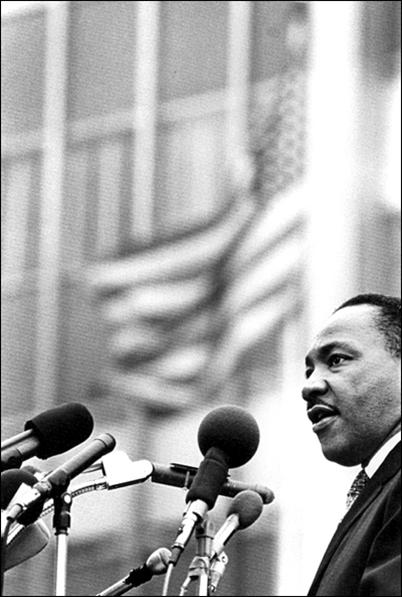
 

Yesterday I attended a service at the Bethel African Methodist Episcopal Church. On the eve of Martin Luther Kings birthday it felt significant to visit somewhere where I was the ‘other’, I think I thought that experience would be something I was there to learn from, but we were met with a warmth and welcome that moved me in a way that is hard to express in words… “there is no such thing as a visitor in the house of God because we are all one body are we not?” and then hugged by almost everyone there – and not a formal, awkward or side-on hug – but a proper drawing in to the warmth of another person and being held in their arms. How can anyone doubt their welcome in the face of such hospitality?

The service started with a responsive litany:

Pastor: A child once dreamed the Voice was calling his name Samuel; fishermen once heard the Voice when a young man bid them follow; And still the Voice beckons today… can you hear?

Congregation: Here I am. Send me

Pastor: Moses protested vehemently as the Voice spoke at the burning bush; Mary stood amazed as the Voice proclaimed impending birth; And still the Voice beckons today… can you hear?

Congregation: Here I am. Send me

Rosa Parks followed the Voice to the front of the bus; Martin Luther King Jr. Heard the Voice as the bullet shattered; And still the Voice beckons today… can you hear?

Congregation: Here I am. Send me

The Voice beckons from humble places… in the tears of hungry children, in the cries of the frail and frightened elderly, in the pleas of those whose dreams have been too long deferred; and still the Voice beckons today… can you hear?

Congregation: Here I am. Send me

All: A timid believer pauses to listen to the Voice; a struggling church hears the Voice and turns; And the voice still beckons today… can you hear?


Psalm 37:23-26
The LORD makes firm the steps  of the one who delights in him;
though he may stumble, he will not fall,  for the LORD upholds him with his hand.
I was young and now I am old,  yet I have never seen the righteous forsaken
or their children begging bread.
They are always generous and lend freely;  their children will be a blessing

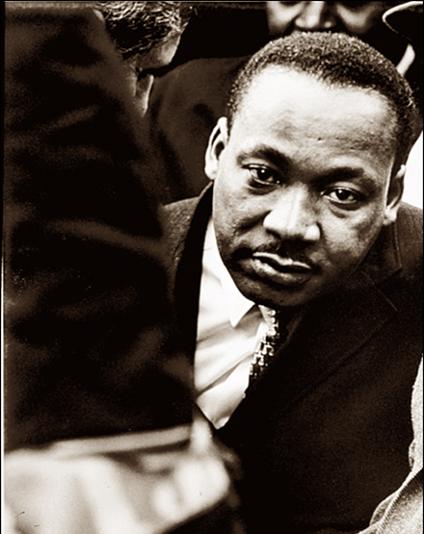
Rev Dr Martin Luther King was a compelling orator and a good man. God works through good people – not perfect people.  He once said “Injustice anywhere is a threat to justice everywhere”, we know his legacy in the civil rights movement in America, but did you know he advocated for South Africans in the struggle against apartheid, was an anti-war activist of the Vietnam war – he didn’t only care about desegregation, but voter registration, education and housing…?

“Why are you talking about having no bread? Do you still not see or understand? Are your hearts hardened?  Do you have eyes but fail to see, and ears but fail to hear?” saith the Lord (Mk 8:17-18)

Martin Luther King said, “The ultimate measure of a man is not where he stands in moments of comfort and convenience, but where he stands at times of challenge and controversy.” A strong representative for Black civil rights, many advisors thought it would dilute their agenda for King to advocate on other issues, but he believed so strongly in what was right, in all matters of justice being equal even as all people are created equal that he was willing to pay the cost of losing those friendships and in the end his life (King was shot while in Memphis speaking to the rights of the city sanitation workers).  He received threats against himself, his family, and his home but he kept doing the work he was called to.

“You do not have in mind the concerns of God, but merely human concerns. Whoever wants to be my disciple must deny themselves and take up their cross and follow me.For whoever wants to save their life will lose it, but whoever loses their life for me and for the gospel will save it. ” saith the Lord  (Mk 8:33-36)

Martin Luther King said, “Darkness cannot drive out darkness; only light can do that. Hate cannot drive out hate; only love can do that. In the End, we will remember not the words of our enemies, but the silence of our friends. Life’s most persistent and urgent question is, ‘What are you doing for others?’ “  Today at lunch we reflected on the life of Martin Niemoeller a German U-Boat commander, turned Lutheran pastor, prisoner then pacifist who said:

“First they came for the Jews and I did not speak out, because I was not a Jew.
Then they came for the Communists and I did not speak out, because I was not a Communist.
Then they came for the trade unionists and I did not speak out, because I was not a trade unionist.
Then they came for me and there was no one left to speak out for me.

“But what about you? Who do you say I am?” saith the Lord (Mk 8:29)

What is God calling you to? What does the still small Voice say to you at night as you fall asleep? What does the Voice say to you in the rising and setting of the sun or the flight of a bird? What does the Voice say to you as you check on your sleeping children before finding your own rest? What does the Voice say to you when you are watching the news or reading the paper? “What is the essence of being a prophet? A prophet is a person who holds God and men in one thought at one time, at all times. Our tragedy begins with the segregation of God, with the bifurcation of the secular and sacred. We worry more about the purity of dogma than about the integrity of love. We think of God in the past tense and refuse to realize that God is always present and never, never past; that God may be more intimately present in slums than in mansions, with those who are smarting under the abuse of the callous.” From “Religion and Race,” in The Insecurity of Freedom, pp. 110-111.

“Take courage! It is I. Do not be afraid.”.” saith the Lord (Mk 6:50)

Martin Luther King is perhaps less well known for saying, “I don’t mind saying to you tonight that I’m tired of the tensions surrounding our days. I don’t mind saying to you tonight that I’m tired of living every day under the threat of death. I have no martyr complex. I want to live as long as anybody in this building tonight and sometimes I begin to doubt whether I’m going to make it through. I must confess I’m tired.”

Rev Dr Martin Luther King was a compelling orator and a good man, a prophet and a witness of our time and yet ‘just’ a human man.    Jesus said, “Blessed are they that hear the word of God and keep it”  (Luke 11.28) By Jesus’ definition, for women as well as men, biology is not destiny. Rather spiritual commitment is destiny. [An] internal willingness to cooperate with the larger plan of God.  The same kind of blessedness is available to every person, Jesus implies, whether that person happens to be male or female, healthy or crippled, old or young, single or married (Mollenkott, 1977) The pastor at Bethel said, “Do you have air in your lungs? Blood pumping through your heart? …then the Lord is not finished with you yet, the Lord is not finished with you yet.”

The Voice beckons today… can you hear it? The best thing we could do to honour this man and continue his legacy would be to listen to that Voice and answer “Here I am Lord, send me.”


On Monday I was able to sit in on Ched and Elaine running a webinar for a class on restorative justice (the students are studying their “Ambassadors of Reconciliation” publications) and they made moving reference to a trip they made to Birmingham where they were  able to visit a memorial of the Children’s March a critical moment in the non-violent civil rights movement where “on 2 May, more than a thousand African American students skipped their classes and gathered at Sixth Street Baptist Church to march to downtown Birmingham. As they approached police lines, hundreds were arrested and carried off to jail in paddy wagons and school buses. When hundreds more young people gathered the following day for another march, commissioner Bull Connor directed the local police and fire departments to use force to halt the demonstration. Images of children being blasted by high-pressure fire hoses, clubbed by police officers, and attacked by police dogs appeared on television and in newspapers and triggered outrage throughout the world.”

Monday 16th January is Martin Luther King day here in the US, here is an article by Ched to inspire and challenge us to dream of creative ways to love…

“…to see what will become of his dream.”
Martin and Jesus

Ched Myers, January, 2005

Not long after Martin Luther King was killed, the great American rabbi Abraham Heschel asserted that the very future of our country might well depend upon how the legacy of this extraordinary man would be handled.

Unfortunately, the way King is officially honored on our national holiday has little to do with the leader of the most significant religious and political movement in U.S. history, which dramatically and permanently changed the landscape of American race relations.  Rather, King is portrayed as a lovable, harmless icon of peace and tolerance.  King’s legacy has been widely domesticated, captive to street names and prayer breakfasts.  And his revolutionary message gets typically reduced to a vague and sentimental sound-byte—”I have a dream”—which apparently can mean anything to anyone.

King’s real public voice, however, was prophetic in every sense of the word.  His oratory was often polarizing and upsetting to the status quo—and even moreso, his campaigns of militant civil disobedience.   This “subversive” voice is perhaps best heard in his famous “Beyond Vietnam: A Time to Break the Silence” speech, delivered on April 4, 1967 at the Riverside Church in New York (for the text and an audio excerpt go to www.drmartinlutherkingjr.com/beyondvietnam.htm).

In this talk, King—who was by then a famous civil rights leader and Noble Peace prize recipient—publicly articulated his opposition to the Vietnam war for the first time.  Government authorities—most notably FBI chief J. Edgar Hoover—were furious that King had joined his considerable moral authority to the anti-war movement.  It is not surprising that exactly one year later almost to the hour, the prophet was gunned down in Memphis.

The Vietnam war was, of course, an earlier example of the U.S. trying to secure “regime change” in a foreign country, as is the current case in Iraq.  Thus the real King is highly inconvenient for a materialistic, militaristic and racist nation that has canonized him and then ignored his clarion call to overturn those “giant triplets” of evil.

Interestingly, the same can be said of another prophet, Jesus of Nazareth.  The portrait we get in the gospels—of an anointed man who ministered among the poor, relentlessly challenged the rich and powerful, and was executed as a political dissident—is a far cry from the stained glass window Christ we encounter in churches.

It seems to be a pattern in human culture: we are far more comfortable with dead prophets than living ones.  We honor them publicly only after they are safely disposed of, after which they are put on display in museums and shrines.  Jesus understood well this tendency:  “Woe to you!” he exclaimed, “For you build the tombs of the prophets whom your ancestors killed” (Luke 11:47).

One of Dr. King’s colleagues, Rev. James W. Lawson, a Methodist minister who still works tirelessly for justice here in Los Angeles, likes to say that if you want to understand King you must look at Jesus.  Yes, he means that King was a committed Christian disciple, who understood the call of the gospel to advocacy for the oppressed and nonviolent resistance to injustice.  King prayed as he picketed, he preached to presidents, and he challenged Christians to take their faith out to the streets.

But Lawson means more than that.  There are uncomfortable parallels between the Jesus story and the ministry of King.  Both came from ethnic minority communities who suffered great discrimination.  Both spent time listening to the pain of the dispossessed and broken.  Both worked to build social movements of commitment and conviction.  Both proclaimed God’s justice in ways that got them into trouble with the authorities.  Both were involved in dramatic public protests that resulted in arrest and jail.  Both were deemed a threat to national security, and had their inner circles infiltrated by government informers.  And both were killed by the authorities because of their work and witness.

It seems to me , however, that the converse also applies: If you want to understand Jesus, look at King.  That is to say, the more you study the history of the civil rights movement, the more the gospels come alive.  Most Christians tend to think of Jesus in a highly spiritualized, even romanticized way, as if he was always bathed in light, clothed in white, everybody’s best friend.  But Jesus didn’t get whacked because he was a nice guy and joined hands with folk singing “We are the World.”  His times were as contentious and conflicted as King’s or ours, his choices were costly, the risks real.

If we take the time to learn about the challenges that Dr. King faced trying to build a social movement for integration in the teeth of the hostile system of American apartheid, it can help us re-imagine how difficult it must have been for Jesus.  Jesus’ world was not the fantasy-scape we so often imagine the Bible to inhabit, but a terrain not unlike that of the U.S. in 1968, a world of government surveillance and conspiracy, of imperial “justice” meted out by good old boys who can hardly contain their glee when the prophet is killed, then issue stern calls for law and order in the wake of the “tragic death” that they engineered.

Jesus, too, was hemmed in by all the political factions of first century Palestinian society.  He had to navigate death threats from without and dissent from within his movement; he had as colleagues only a tiny group of feckless, knuckle-headed and betrayal-bound companions.  So let’s keep it real: struggling for the Kingdom of God in a world held hostage by tyrants, terrorists, militarists, and kingpins, a world that seems to merit only ambivalence from toothless religious leaders and insular academics and distracted young folks—it’s hard work.

Yet both Jesus and King believed that the movement for God’s justice is worth giving our lives to—which they invited us to do.  It wasn’t that King was so peculiar, says Lawson; it’s that he seems that way to us because we haven’t yet found the commitment and courage to try to change the world .  If Jesus or King seem like remote historical figures to us, it is only because we haven’t engaged in the struggle for which they lived and died (and in different ways, live still).

But everything they were trying to fix is still broken. And the kinds of folks they sought to heal and to liberate are still crying out for compassion and justice.  King protested the war in Indochina because “the poor of America are paying the double price of smashed hopes at home and death and corruption abroad… The great initiative in this war is ours. The initiative to stop it must be ours.”  The same case could be made of the current war in Iraq and the growing poverty in our own country.  But how often was that message heard during the public paeans to King delivered by politicians and preachers over the recent national holiday?

Ultimately, then, a real encounter with Jesus or with Martin will call into question all our comfortable certainties about our selves and our society.  For these prophets call us to defend the poor, but we instead lionize the rich; they tell us that our weapons cannot save us, but we instead watch with rapt fascination when bombs drop on Baghdad;  they challenge us to forgo idolatry, but we instead keep looking for that next cool thing to buy.  Above all, these prophets warn us that the only way of salvation in a world locked down by the spiral of violence is the way of nonviolent, sacrificial, creative love.  That the only way to true transformation in a world of deadened conscience and numbing conformity is the way of committed discipleship.

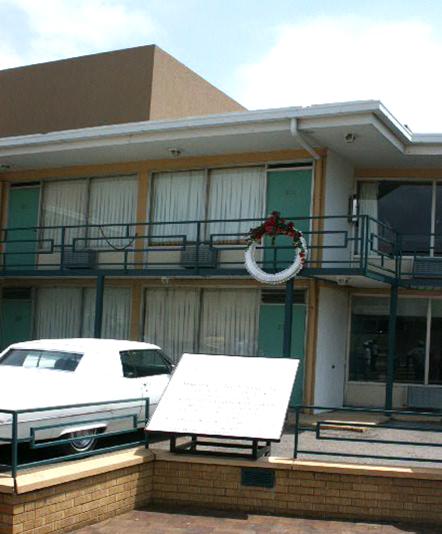
Dr. King was gunned down on the balcony of the Lorraine motel in Memphis, which has been turned into the National Civil Rights museum.  Just below that balcony is a memorial plaque (above).  The only words inscribed on it are from Genesis 37:19-20, the taunt of Joseph’s scheming brothers:  “Behold, here cometh the dreamer…  Let us slay him… and we shall see what will become of his dreams.”  Every time I stand before that plaque, I weep.

We do well to honor the real Martin Luther King, a child of the church and a treasure to the nation, who followed his Lord in life and death.  The question of what will become of his dream, however, remains posed to us like an unresolved chord.  It invites us to discipleship in a world still captive to racism, militarism and poverty.

This is an edited version of a talk Ched gave to students at Concordia University in Irvine, CA on Jan 21, 2005.
 
 
Next open webinar: Jan 19, 5:45-7:15 pm PST:  Webinar:  Mark’s Call to Discipleship in Socio-political and Economic Context” only $9.50, you can sign up at http://www.chedmyers.org/blog/2012/01/03/2012-monthly-bcm-webinar-series-begins-jan-19-your-mark

I arrived Sunday and am settling into life in Oak View –

so far we breakfast at 7.30am and have a reading from the Anabaptist Prayer Book “Take Our Moments and Our Days”, we have a lunchtime (scrummy bean burritos!) post-prandial reflection from “All Saints: Daily Reflections on Saints, Prophets and Witnesses for Our Time” by Robert Ellsberg, before dinner I’m reading a little something from the Anglican English/Maori Book of Common Prayer “The New Zealand Liturgy 1970” and we will be reading aloud of an evening – potentially – “Ask That Mountain” which is the story of Parihaka, a little-known Maori chieftain who was doing non-violent resistance before Ghandi*.  But not on Tuesdays, when we will take turns at leading Vespers, or Thursdays when we will be praying through prayer points from a community called Sabeel in Jerusalem with whom Ched & Elaine have a connection… and, uh, we haven’t had a conversation about my specific study plan yet.

I’m rolling in the big leagues of Type 5! And yet,

The main foci of the BCM are as follows:

1. Radical Discipleship in the Christian tradition
2. Education “between the seminary, sanctuary and the streets”
3. Full spectrum restorative justice & peacemaking
4. Biblical literacy with an emphasis on social context
5. Movement history and interconnectivity
6. Ecojustice and sustainability
7. Indigenous justice/racism/Truth & Reconciliation

The importance of the story of their name ‘Bartimaeus’ is in the discipleship journey from the “blindness of denial to the sight of engagement” (Ched) and as Lanza del Vasto would say (one of my new Saints) “one could not hope to resolve the problems of the world as long as one was a part of them”… There is a sense of solidarity in learning together.  Ched and Elaine are inviting me (us!) into their discipleship journey and I just hope I can keep up!

Na, i tenei kapua nui o nga kaiwhakaatu e karapoti nei i a tatou, whakarerea e tatou nga whakataimaha katoa, me to hara whakaeke tata, kia manawanui hoki tatou ki te oma i te omanga e takoto nei i to tatou aroaro.          Hiperu 12:1

Since we are surrounded by so great a cloud of witnesses, let us lay aside every weight, and sin which clings so closely and let us run with perseverence the race that is set before us.                                                 Hebrews 12:1

*note that Ched is providing me with these resources I didn’t bring them with me and can claim no prior knowledge!

Last night we had “Prayers in the Pergola” reflecting on Armistice day and peace, William Stringfellows article ‘The Marks of Involvement’ was referenced:

“Christians are those who take history very seriously.  They regard the day-to-day existence of the world realistically, as a way of acknowledging and honouring God’s own presence and action in the real world in which human beings live and fight and love and vote and work and die. And Christians know, more sensitively and sensibly than other people, that this is a fallen world, not an evil world but the place in which death is militant and aggressive and at work in all things. Christians know that in this world in which, apart from God’s work in all things, death is the only meaning, all relationships have been broken and all human beings suffer enstrangement from one another and alienation from themselves. Of all people, Christians are the most blunt and relentless realists.  They are free to face the world as it is without flinching, without shock, without fear, without surprise, without embarrassment, without sentimentality, without guile or disguise. They are free to live in the world as it is.”

How are we living into this understanding of reality? We are called to see and understand… perhaps especially those things at which it is uncomfortable to look too closely. We do not live in isolation. In a world where war and violence affect so many – not only today’s fight but the generationally wounded – how can we speak resurrection and hope into that?


A staff member shared this reflection at prayers a few months ago:

A person kneels to contemplate a tree and to reflect the troubles and joys of life. It is difficult to accept that life is difficult; that love is not easy and that doubt and struggle, suffering and failure, are inevitable for each and every one of us. We seek life’s ease. We yearn for joy and release, for flowers and the sun. And although we may find these in abundance we also find ourselves lying awake at night possessed by the terrible fear that life is impossible. Sometimes when we least expect it we wake up overwhelmed by a massive sense of loneliness, misery, chaos and death: appalled by the agony and futility of existence. It is difficult indeed to accept that this darkness belongs naturally and importantly to our human condition and that we must live with it and bear it. It seems so unbearable. Nature, however, requires that we have the darkness of our painful feelings and that we respect it and make a bold place for it in our lives. Without its recognition and acceptance there can be no true sense of life’s great depth, wherein lies our capacity to love, to create and to make meaning. A person kneels to contemplate a tree and to reflect upon the troubles and joys of life. The person imagines mornings and evenings in a great forest of prayers, swarming and teeming with life… The person is learning how to pray.

Prayer Tree – Leunig

Jean Varnier in “Community & Growth” says:

I am more and more struck by people in community who are dissatisfied. When they live in small communities, they want to be in larger ones, where there is more nourishment, where there are more community activities, or where the liturgy is more beautifully prepared.  And when they are in large communities, they dream of ideal small ones.  Those who have a lot to do dream of having plenty of time for prayer; those who do have a lot of time for themselves seem to get bored and search distractedly for some sort of activity which will give a sense to their lives. And don’t we all dream of the perfect community, where we will be at peace and in complete harmony, with a perfect balance between the exterior and the interior, where everything will be joyful?

It is difficult to make people understand that the ideal doesn’t exist, that the personal equilibrium and they harmony they dream of come only after years and years of struggle, and that even then they come only as flashes of grace and peace.  If we are always looking for our own equilbrium, I’d say even if we are looking too much for our own peace, we will never find it, because peace is the fruit of love and service to others… look instead at your brothers and sisters in need.  Be close to those God has given you in community today… everything will resolve itself through love.
More and more I am coming to understand that it is our brokenness that binds us rather than our perfection.  In a consumer society where it always feel like the grass is greener somewhere else it is important to buy-in somewhere and commit to growth in your own patch of the neighbourhood.  In owning the brokenness and needs I bring to community I am humbled to extend to others the welcome I myself receive.  Those plants I want to see the fruit of? I have to help them grow… I pray that you will know  a flash of grace and peace this week.


Sabbath Economics: Negative Capital (Debt)

In a time of global economic crises and the Occupy Wall Street campaign it is interesting to reflect on debt and the role it plays in our lives. There were an estimated 488 million debit cards and 686 million credit cards in circulation in the United States in 2009 and an estimated 36 million debit cards and 16 million credit cards in circulation in Australia. (Source: Euromonitor International, January 2010).  Historically the dominant cultural driver has been religion or government – it is currently commerce.

The Jesus movement also stood in opposition to the dominant economic model of debt bondage in his day, modelling instead what Ched Myers calls “a re-communitized economy of generalized reciprocity of sharing and cooperation” (p.34)

How much debt does your household have? What are some ways we can imagine living beyond the bondage of this debt?

Is not life more than food and the body more than clothing?

——-

Talitha: (Unmarried/No dependents/Renting) I was raised to live within my means – to buy things second hand, pick up a bargain when things are on special, then when that money is needed further on because the car breaks down or something the resources are there, my family wasn’t wealthy but we had ‘enough’. It was interesting to reflect on how for all of us our childhood contexts were deeply impacting on our relationship with money as adults.  How do we role model good stewardship to our own children/the children in our community when they often aren’t participants in the financial choices that we make? A debt load such as a mortgage is a really deep commitment by families to embed themselves in this neighbourhood, a stability that is vital to my own capacity to be here,  but then to service that they need to work more hours – are there ways that I could help the families in my community pay of their mortgages faster, thereby ‘freeing’ them up? What other good work might happen?

 I liked playing with the concept of a credit card slip that is a gentle reminder of the bigger cost of spending beyond the purchase price. Want one for your wallet? Send no money now, for just 3 easy purchase payments of… lol, if there’s interest I’ll make ‘em free.  Keen to think about whether we could have a bit of a communal giving account to which I transfer the money that I would otherwise have spent on something I don’t really need – if I see that money as ‘excess’ to my needs, to what better use could I be putting it? E.g. I probably get a neck & shoulder massage at the mall four-six times a year, if I made a conscious decision to do massage swaps with someone in my community instead then 1) that would probably be another way we’re able to deliberately connect and 2) this might give me $120-180 for the kitty – and a reward of this stewardship would be being able to decide together on a purpose to put that towards that benefits others.

Also recommend checking out the Christians for Occupy page, we follow a God who isn’t far away but here among us – he would have been amongst the 99% but he would have left us to go and find the 1%. Yeah, we are called to solidarity with the poor but also to invite Zaccheus to share a meal at our table, how can we keep having conversations about finance that aren’t polarising and invite others to know another layer of richness in their life – that generosity is a gift that blesses the giver as well as the receiver?

You are called

You are called.

Check out this post by Christop and be affirmed in ‘knowing’ you are a contributing part of the body of Christ.

“Sabbath Economics”… is the conviction that God’s creation is abundant, and that there is enough for all – if we live within the limits of our needs instead of by our cravings (p5)

Over the coming months the Footscray Girl Fridays will be reading Sabbath Economics: HouseholdPractices by Matthew Colwell and invite you to discern and discuss with us.

Chapter One: Surplus Capital

This chapter uses a great analogy of comparing an investment to a horse: “You can have a horse and use only what the horse produces (the manure); or you can use the horse itself, and not just what comes out of it.” (p25)

We often focus on the return of our investments but what are we actually investing in? How can we make the principle and the return work for the fulfillment of our values?

How many loaves have you?


(picture from: http://www.onlinegardenertips.com)


Talitha: (Unmarried/No dependents/Renting) I went as far as opening a trade shares account once but I could never quite bring myself to transfer money over to it.  There’s something scary to me about a million+ people ‘out there’ deciding the value of any given thing in the ‘market’ on a given day.  It is faceless and I’m giving the power to assign worth over to people I don’t know.  I even struggle with superannuation and insurance and a sense that these are first world constructs that replace community – if we live in a community where people look out for one another wouldn’t we provide for one another in need and care for one another if sick or old?  I don’t think I want to buy into that construct because it doesn’t feel like the ‘way it should be’, luckily I don’t have assets or dependents yet so I can stay on the fence a while longer!  Urban Seed  recently shifted their banking to be with mecu they have sustainable practices with economic, environmental and social outcomes such as tree planting to offset a car loan or buying land that is set aside for conservation to offset a mortgage.  I think I have a bit of a brain block about how much work it might be to switch banks, I think they sound cool but don’t change my own practice (in our chat last Friday we talked about printing out the boring paper work and completing it together so we’d have some support and accountability around this!).  Last year to boost the economy Kevin Rudd gave us all a tax break and Seeds/MannaGum ran a bit of a campaign called “Manna from Kevin” …here was some surplus income, how could we think deeply about how we spend it?  One couple put on a free breakfast for everyone who lived in their street – some thought the invitation was a practical joke but some really close friendships have grown out of that first shared meal together.  Another small group together decided to pool their stimulus package giving them $10K to create a job to pay someone half a day a week to do work in their community.  I thought about it myself for a long time – I’m not from a wealthy family and I don’t earn a lot now – $1,000 represents a large amount in my world.  What is my duty to my family?  what about those things I could improve in my own situation like replacing a fridge which is small and every shelf is broken and it doesn’t even stay that cold so milk goes off really quickly… I had to go through a bit of a process around reflecting on the fact that if I was going to give it grudgingly then I shouldn’t give it all, just spending it on myself would be as bad.  If I was going to give it away I should do so freely and joyfully – with open hands. This actually took a few months of praying about it, reading some of the bible passages that relate to money (Mark 12: 41, Luke 16, Matthew 20…), I started to hear the stories come in of how other people’s money was bringing about such good results… by this time I knew I wanted to give away my money too but I felt a bit embarrassed that I hadn’t wanted to do it straight from the start so I gave it all away without ever telling anyone about it – it went to a variety of things but one I have an ongoing connection with is KIVA  essentially they make microloans to people who would get turned down by a bank for being too small, or risky, or would take too long to repay – it’s often something small re-roofing their house or buying a bicyle so they can deliver flowers not just sell them at their front door to build their business – I like the idea of empowering people to change their own lives and once their initial loan is repaid I can choose to re-lend it to another borrower.  That initial ‘investment’ has allowed me to make 18 different loans so far. KIVA is US based I think, a quick google search brings up Australian sites http://www.microloanfoundation.org.au/ and http://www.opportunity.org.au/ that might be worth checking out…  I think the last few years has seen a huge shift in how I see money – I think it needs to move around or it becomes stagnant, good gifts go into gaps – keep giving, keep getting. I bless and am blessed and there is ‘enough’.  In the same way that money, as paper and metal, carries the value that humanity all agrees to rather than what it is materially worth, I’ve come to give it a different value of its worth in my life – it’s on the same level as any resource of time or skill that I could volunteer to something. Those aren’t resources you can ‘bank’ you just have to make good choices about how you use what you have at any given time.  Does that make sense?  Activist Philip Berrigan said “Hope is where your ass is”, well, I’m putting my money there too.

Naomi (Married/No dependants/RentingMy basic philosophy thus-far: work for fun not for money, don’t spend more than you earn and don’t worry your head off about tomorrow. I like it simple.

Having pretty recently got married, it dawned on me that it’s probably about time that I grow up and think a bit about money, money, money. We got the joint account … but it hasn’t progressed much further.

To get ahead in life, there are a lot of things I “should” be doing with my money – figuring out the tax breaks, buying a property or two, working a job that pays a decent wage and making my way up the corporate ladder, investing in the stockmarket. The thing is, in comparison to the majority of the world, I’m already ahead in life. Far ahead.

The money I have represents power. Every choice I make with what to do with my dollars, makes an impact. $2 milk at Coles, where the prices are down, sure is enticing to the hip-pocket, but is it the ethical choice? Rent or buy? Drop a few coins in to the busker’s hat, or not? And I haven’t got a clue what my super money is doing while I’ve got my back turned!

And so what do I do when faced with the overwhelming and over-my-head financial options? I put the paperwork aside and the decision making off for a rainy day.

So our Girl Friday chat was a refreshing breath of honest questioning. We can talk all we want about the concepts of Sabbath Economics (and believe me, I do want to chat & see it more!) but what does it mean for our real, daily actions with our money? None of us has it figured out, yet, but the corporate desire to make some headway is encouraging.

Check out Ched Myer’s article on the Biblical Vision of Sabbath Economics. I’m still working my way through it. Hope to comment more.

342 PACIFICA 19 (OCTOBER 2006)
Vignette, Janet Turpie- Johnstone

Growing up by the wild seas of our Southern Ocean. Deep green waters, that are both terrifying and beautiful, in one. Deep green waters that disappear over an unseeing horizon. Local yet universal. Familiar yet strange. Portland was and is my “home”. A place of pain and of joy. On every return home, is to revisit all the pangs of childhood and adolescence. It is like a rehearsal for some play, going over the old so as to know the new. Experiencing it all again and again, feeling the sting of the salt of old wounds, weaving them into the fresh, making life vital and real in the now. How easy it is to just respond as habit teaches, I know this, I have been here before. Habit is part of the mix, but it is not the whole and each habit needs to be refreshed so as not to become the whole. Stale and hard, salted out of life, or fresh sprinkled lightly with some zest, is the offering I make. On looking back I look inwards, and find that the secret journey is the real one. The one from inside, the one from where I know I am alive, where I transform the habits into reality. Where I call to this world, “I am that I am”. There is no need for any other explanation, I just know that I am. How Biblical, but how cheeky. There the familiar and the strange, coming together in the story of one woman’s life.

Think it’s a pretty important part of the journey to re-visit where you came from and reflect on how far you’ve come, this first ‘home’ can act as a bit of a lodestone drawing us back to the roots of our identity and the formational experiences that led us to become who we are.

Some reflections on “Terra Nullius”

What does it mean to be ‘somebody’? There is an irony in the indigenous people here believing the colonisers to be ghosts and the colonisers ‘not being able to see’ the natives. To take what is there, then take more than what you need is to create imbalance between people, the Spirit and the land. A synergy lost. Disease. Dis-ease. Can we truly be comfortable living here with the history of this land? Settlement. What does it mean to be settled? Maybe in the same way the land was ‘nobodies’ it was ‘anybodies’ – like the ocean, like clouds… if you love something you have to let it go. How much is there to be gained in letting go of control/ownership of the land? There is a quote on the wall at the Jewish museum which says “if you do not have land, but have memory of land, then you can make a map”. The land is something carried in the heads and hearts of the indiginous people – how are they allowed to live out what is in their heads and hearts? Hospitality in this land is not reciprocal, we need to make space to receive what they want to give us – not prescribed expectations.

Staff conference day – 1 July