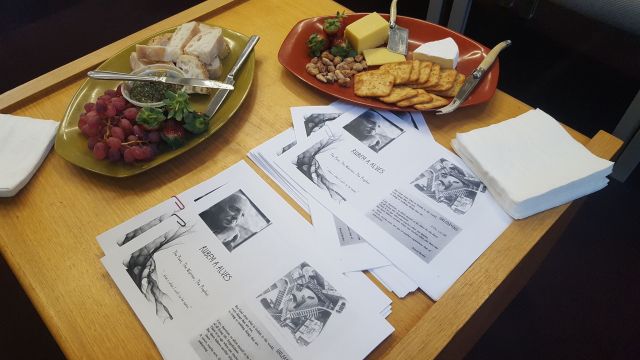
Category: influential reading material


44322770_1842041522547816_8494632372963115008_o


Leviticus 19:33-34 New International Version (NIV)

33 “‘When a foreigner resides among you in your land, do not mistreat them. 34 The foreigner residing among you must be treated as your native-born. Love them as yourself, for you were foreigners in Egypt. I am the Lord your God.”


This slideshow requires JavaScript.


Leader          Hear our cries of frustration, guilt, and anger, O God
                        As the voices of refugees are silenced by fear and the pursuit of power

Voices of lament

1 Hear our cries in despair – we cannot find our way home from here!
2 We seek a way to solve this
3 We seek a way to speak truthfully
4 We seek a way to bring change
1 Hear our cries in confusion as the issue is complex, the solutions are slow and the answers are never simple
2 The debate is loud and vicious as people seek to score points for power while detaining and compounding damage on vulnerable people
3 Why can we not see the public leaders who have compassion?
4 Why can we not find the public dreamers of justice?
1 Why can we not hear the public proclaimers of hope?
2 Hear our cries in despair at the powerlessness we feel,
3 To make the story turn out right
4 To overturn the actions done in our name
1 To inspire our neighbourhoods to renewed minds
2 To infect the public discourse with grace


…to infect the public discourse with grace.

20181101_194851

field of purple daisies

The pause between moments
Smells like woodsmoke
Feels like velvet
Sounds like rain
Tastes like dark chocolate
Looks like purple fire.

Between inhale and exhale
There is a whole lifetime
Between past and present
Universes coalesce and dissolve
The world of between
Non-existent, never-ending.

We live there sometimes
Stopping our hearts to live between the beats
Unable to stop the world around us
Unwilling to let go and let time roll forward.
It cannot last, we know this,
But living in the pause can soothe
Can comfort and strengthen us
Allowing us to hold on to the peace of between
And face the inexorable now.


Becky Ellen-Johnson
Kapiti #NZWOMANPOETS

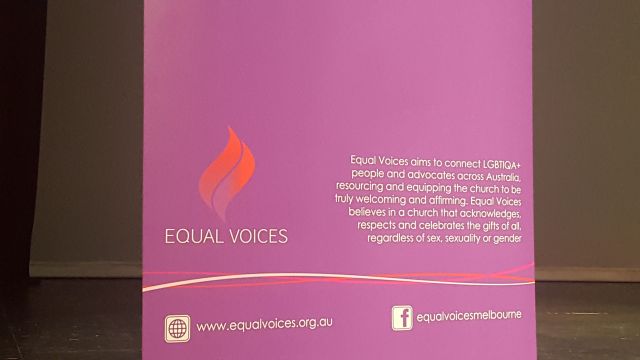
Equal voices Conference Melbourne October 2018 banner

There are lots of things I could write about the Equal Voices conference.  The conference covered a lot of topics and held space for a diversity of expression and experience of intersection of gender, sexuality and Christianity. Particularly powerful over the weekend were vignettes shared by ordinary people at the start of main sessions… framing, contextualising and grounding everything else. Five minutes to canvas their story and be heard.   Five vulnerable and incredibly courageous minutes.

Theirs are not my story to tell.

If you have 5 minutes to spare reading on this topic, here’s what I’ll say and pay attention because this is important.

I found myself feeling righteous anger listening to some people’s stories and some people’s sessions. Sometimes family, ministers, friends, society… say incredibly insensitive and wounding things. Sometimes this is by accident but sometimes it’s on purpose.

I realised that I, the ally, was getting angry but that other attendees and participants were not and once I noticed this I found someone to ask about it. Their answer went something like this: “Oh, I used to get angry, I used to try and explain, I used to try and work on change that relationship for that person to accept me but I don’t do that now. I’m tired. There’s just a few people I worry about, like my Mum, and everyone else I just don’t care.”

 I didn’t survey the room. This community of people were already processing a lot this weekend but take a moment to scale that up… it’s not that this person doesn’t care, it’s that they care too much, so it’s a personal cost they bear everytime they have to defend their Being to someone they expected to love them. They are resigned to it.

If you have someone in your life right now who is vulnerably, courageously, sincerely and repeatedly trying to explain something to you about their gender identity or sexuality, TUNE IN. They care about your opinion, they care about their relationship with you and  they are trying to share their life with you. They are trying to share their Self with you.

Do not think that silence is compliance, that silence is agreement, that silence is you winning…

…it’s more likely that in that silence that person is making a very difficult choice about whether they can afford the capacity to be around you anymore, to explain anymore, to give you 5 minutes anymore. Maybe in that 5 minutes, you lost. You lost them.

5 minutes.

A lot can change in 5 minutes.

Someone can cut you out of their life in 5 minutes. Someone can take their life in 5 minutes.
In 5 minutes, someone can share their Self with you. Maybe you hear a story told in someone elses voice at a conference and for the first time hear your own and you know you’re not alone.

Equal voices Conference October 2018 banner

Deep, deep thanks to the Equal Voices Melbourne organisers and all you vulnerable and courageous storytellers… especially the ones whose stories we haven’t heard. Be assured, we want to meet You.


A rainbow doesn’t have pink I tell her
If God wanted girls to wear that colour
you’d see it in the sky.

Fingering each rack with disappointment
she rejects a blue top, a skirt in purple
even a belt in sparkles and gold.

Grandma, you don’t understand
everyone has pink
Barbie has a pink car and shoes.

Pink is weak, silly and girlie, I grumble
you need a colour that shows your strength
a royal blue or brilliant yellow.

She leads me to the teen department
a field of sequined and shiny black leather.
Witches are strong, she says and grins.


Martha Morseth
Dunedin #NZWOMANPOETS

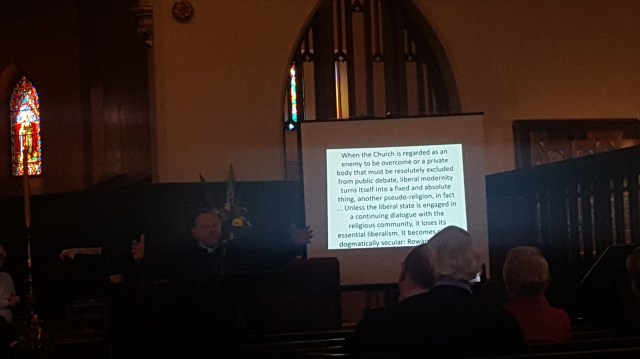
Highlights from the Institute for Spiritual Studies Spring Symposium  – 22 September 2018 at St Peter’s, Eastern Hill.


“I have almost reached the regrettable conclusion that the Negro’s great stumbling block in his stride toward freedom is not the White Citizen’s Counciler or the Ku Klux Klanner, but the white moderate, who is more devoted to “order” than to justice; who prefers a negative peace which is the absence of tension to a positive peace which is the presence of justice”

– Martin Luther King Jr, Letter from a Birmingham Jail


Rod Bower Institute for Spiritual Studies 2018

The church is seen as in collusion with the state to uphold ‘order’, but order cannot triumph over justice.
– Rod Bower


Robin Whittaker Institute for Spiritual Studies 2018

Coptic Christians in Egypt prevented from practicing their faith, being caught with a bible in North Korea and being sent to a work camp… these Christians are being persecuted. In Australia, Christians are not being persecuted. In fact, those identifying as LGBTIQ+ experience more violence and more harm for their beliefs, noting of course that those are not discrete groups. Some of those who spoke up within conservative Christian organisations did lose their jobs during the plebiscite. The persecution for beliefs was occurring within the Church.

– Robin Whittaker


We have freedom of belief and manifest those beliefs as actions. Our actions might conflict with someone else’s.  It comes down to our idea of God.  Or that question: “What would Jesus do?” God offers us relational freedom.  We are each of us free to choose God or not. If we choose yes, that belief is relational. Our belief requires a relationship with God but also with and between other people. Whether they believe what you do or not. The same freedom offered to us, freedom from power and sin and death, we should offer to others. It’s freedom for justice and for all humanity.

– Robin Whittaker


God is revealed at the point we give up our power and give up our position.  We should care more about that…  align with the powerless.

– Robin Whittaker


PANEL Q&A: Christianity in the Public Sphere

Q&A panel Institute for Spiritual Studies 2018

We carry the Christian message in how we think. It doesn’t need to be explicitly “Christian” eg. instead of using the term ‘good stewardship’ you might say ‘responsible use of resources’… same thing, different language.

– Stephen Duckett


Any metric needs the context of the values you are trying to promote. Christians in the public domain need to argue ALWAYS that economics is not the only metric that should be used as measure.

– Stephen Duckett


All theology is political e.g. gender… Our theology will inform down the line… ethics, values, school curriculum.  Our theology has to be right and we have to be able to critique and correct what it means.

– Robin Whittaker


Question: I assume the panel share values. But what about Christianity’s values on asylum seekers, LGBTIQ+… Christians are finding ourselves on opposite sides. Yet asking for privilege on the basis of Christian faith… but don’t we hold fundamental Christian truths in common?

What are the first order theological claims?
Perhaps the Trinity, Jesus… second-order… transfiguration.
Christians have always been on opposite sides.
Conservative voices speak loudest.
Things not first-order have been made first order…
a test case for whether you’re a Christian…
goes back to Paul on circumcision,
a battle for the heart of Christianity.

– Robin Whittaker

There are some issues where those of us on the panel probably believe differently. Identity politics and virtue signalling happen on both sides of every debate. we need to be able to handle difference and have conversations about them, not make a shibboleth out of them, make them tribal distinctions.  Tone and posture are critical for engagement to be possible.

– Gordon Preece


Question: The church seem to speak when they should shut up and are silent when they should speak up… why is the institutional church self-marginalising in society and against the will of God?

It’s that dance between order and justice and how these things dance with one another.  I’d like to be where the UCA got. To live and stay together as loving and gracious human beings. I hope Anglicans could get to that point. It models to the world hope that we can live together as people who can disagree.

– Rod Bower


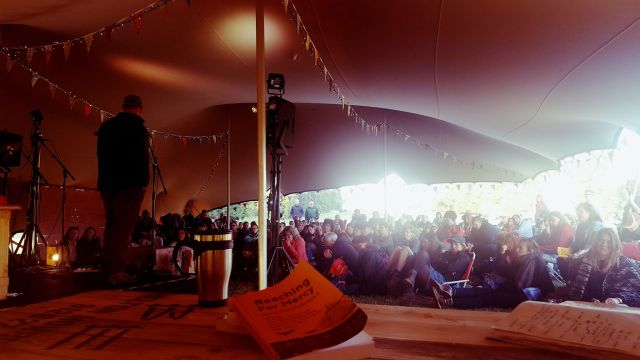
Reaching for Mercy Greenbelt 2018 Proost Talitha Fraser

“Here is poetry arising from the beautiful souls of poets you have passed on the street, never knowing they carried words that must be spoken… the poems are at times angry howls of protest or cries of lament, at other times they are saturated with hope.”

What makes a poem spiritual/Christian and therefore worthy of inclusion in this anthology? This is not an easy question to answer, at least in part because poetic spirituality is not a familiar part of our dominant religious culture. I have found it helpful to read the poetry written by the Sufi poets- Attar, Rumi, Sanai etc. They write poems that are not about instruction or impartation of theological truth (although they might achieve both) neither are they always about ‘God’ at all- rather they are written by people seeking truth, beauty and honesty. Sometimes they tip over into mysticism, as if what they are writing has gone beyond even their own understanding. Poetry like this creates open spaces for our spirituality to adventure; we feel it as much as we understand it…we just ‘know’ it when we read it. The poem soars inside us.

…So here we are. The starting page of a new book. A book full of people reaching for mercy.

Chris Goan

It has been a privilege over the past year to work with Chris Goan the curator of Proosts’ Poetry Collection Vol. 2 “Reaching for Mercy” and to travel to the UK for it’s launch at the Greenbelt Festival. Chris has a way of seeing people and holding space for how they see the world that’s captured and collated in this lovely collection by 8 editors and over a 100 contributors from all over the world… it’s not just “pretty” poetry, it’s protest too. Across all the themes: truth, wild, resisting, lament, hope, post truth, everyone is welcome, whole… there is a poignant paradox of sure hope and disbelieving grief in responding to the way the world is.  I think this collection speaks to our times. I hope it speaks to you.


Our model at events is to read one of our own poems and one by another contributor as a way of bringing that broader community of beautiful ordinary souls together. These are the pieces I read at Greenbelt…

God, did you see the news today?

God, did you see the news today?
We’re killing one another.
We’re killing in places killing has gone on so long we don’t know how to stop…
We’re killing next door.
We’re killing one another.

God, did you see the news today?
We’re laying waste to the world
to consume, consume, consume
an appetite “stuff” cannot sate.
Our elders know. Our elders tell us.
We ignore their wisdom.

God, did you see the news today?
People are saying hateful, hurtful things
what is right, what is wrong
what is holy, what is profane
…as if we know. As if we could know.

God, did you see the news today?
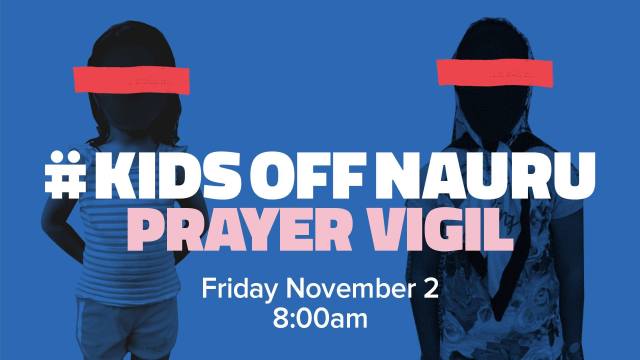
Were you there when we turned the boats away?
We are denying people food, electricity, sanitation, shelter, medical care…
We are denying people their basic human rights.

People are grieved and weary.
Longing for a world that is different
but not knowing where to start.
Not knowing how to start.
All victims, variously blind.

I’m not pointing fingers, I’m raising my hand.
I need Your help. We need Your help.

Amen.


And I was also very proud to read this piece written by my sister Abby. It felt significant to feel like I was representing some voice of Australia and New Zealand all the way around the world. It includes language and it includes my family. It speaks to home, belonging and identity… thanks for your work and words Mana Wahine… x


My Truth belongs to me
Abby Wendy

My Truth belongs to me. I will hold it tight, hold it close.
I will bury it deep.
My truth is a tūrangawaewae for the roots of my heart.
I will water it.
My truth is a nesting place for my wairua.

My truth is reflected in ten thousand random moments.
I am shining like the sun in the secret power of my own unique truth.

My truth requires no scientific proof – I believe it.
My truth requires no majority support – I believe it.

If I whisper my truth in your ear, will you stand with me? Would you trample the roots of my heart, buried deep, in my sacred place of belonging? Where will my spirit rest, if my truth becomes ash?

I will hold it tight, hold it close.
I will bury it deep.
My Truth belongs to me.


Copies of this book are available from Proost, if you know me it might be worth waiting as I’ll likely do a bulk order to Australia and you can get one from me directly if that’s easier… If you haven’t heard of it, Proost is a small publishing outlet aimed at gathering together resources from the creative edges of Church. Proost have lots of interesting stuff on their site – animations, songs, Easter and Advent resources, books… so have a look around while you’re there!

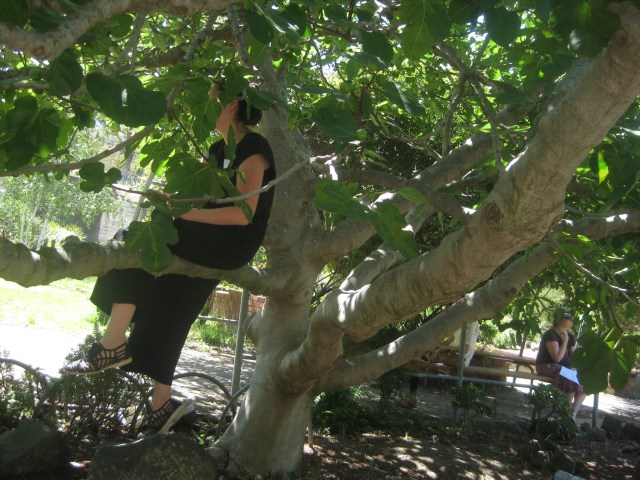
woman sitting in a fig tree Pipemakers park

Thin the slung chain,
silky slack, infrangible;
blood beads heavier than water.

Birthed we are like Russian dolls,
one from another from another,
mother, daughter, granddaughter,
red smudges on each cheek.

You stand at the open window
being never too happy in your own
time & place as she is always,
straddling blowsy branches, singing.

I bend between, frisking marjoram,
twisting in weedy aisles a breathing
space. The bright links burn on my neck.


Bernadette Hall
Alexandra, Central Otago #NZWOMANPOETS

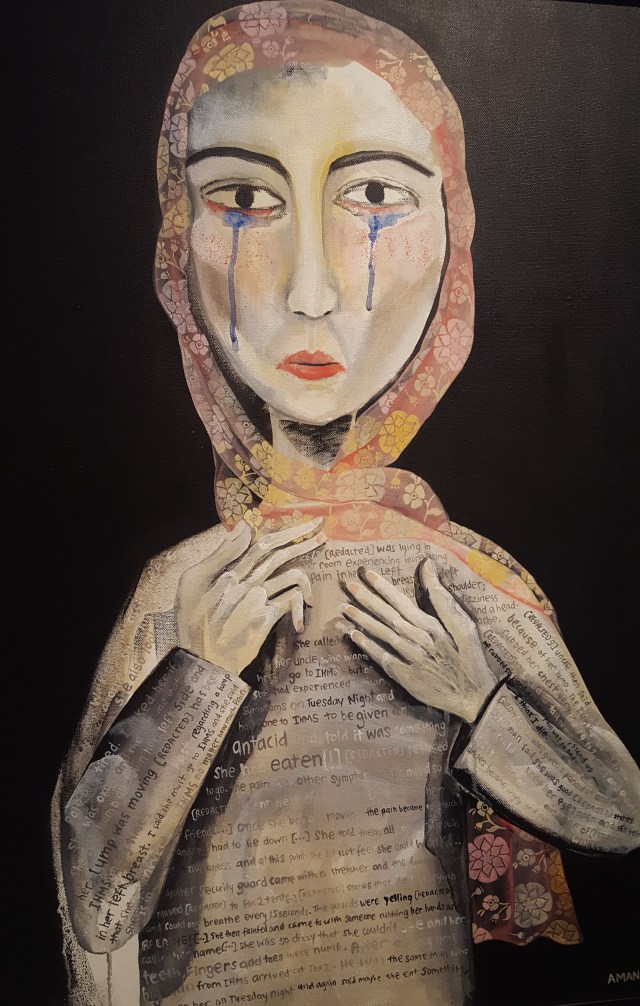
All We Can’t See: Illustrating the Nauru Files – a powerful exhibition as part of Melbourne Art Week that invites artists to respond to the redacted case file notes from Nauru… the images giving a human face to the human cost of the experience of being on the receiving end of Australia’s policy of offshore detention.

all we don't know exhibition fortyfivedownstairs melbourne August 2018 refugees Nauru files

all we don't know exhibition fortyfivedownstairs melbourne August 2018 refugees Nauru files


all we don't know exhibition fortyfivedownstairs melbourne August 2018 refugees Nauru files

rubem Alves spiritual reading group Carmelite centre for spirituality middle park theopoetics

Was Rubem Alves a poet, psychoanalyst, theologian, or philosopher? Yes.

Somewhere beyond tidy definition and cataloguing “The Poet, The Warrior, The Prophet” is an invitation to visit a place that you’ve been before but forgotten you knew.

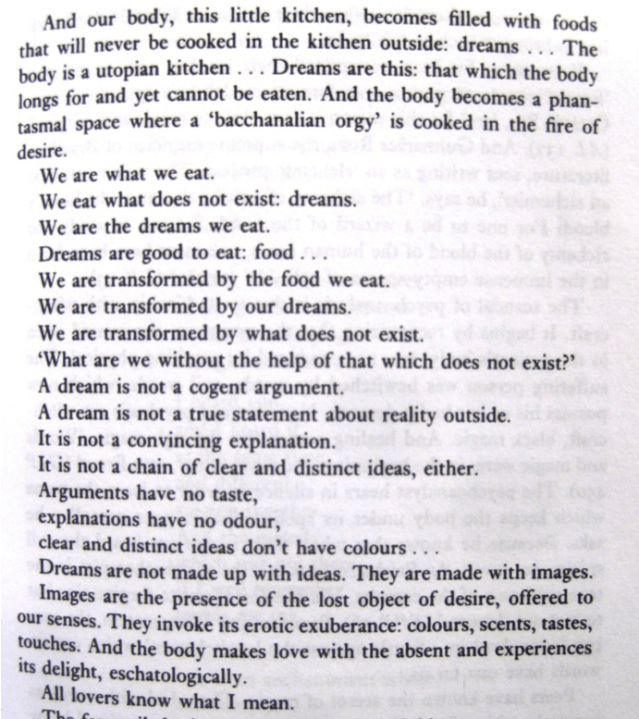
In the same way the Eucharist is a poetic ritual of anthropophagy Rubem asks us to take in his words and be changed by them.

Gleanings shared with the Spiritual Reading Group at the Carmelite Centre, Middle Park –  19 June 2018.


In his article “An Anthropophagous Ritual, “ Rubem Alves wrote:

Anthropophagy is the eating of human flesh – cannibalism, something savage. But so-called savages don’t think so. A tribe of Brazilian Indians who practices anthropophagy justified it thus:  “You who call yourselves civilised don’t love your dead.  You made deep holes and bury them to be eaten by worms. We, on the other hand, love our dead. We don’t want them to be dead.  But they are dead! There is only one way to keep them alive: if we eat them. If we eat them, their flesh and blood continue to live on in our own bodies. 

Anthropophagy isn’t done for nutritional reasons. It isn’t a barbecue. It’s a magical ceremony.  It is believed that, by eating the dead, their virtues are incorporated into those who eat them. Psychoanalysts agree. They believe that our personality is formed by successive anthropophagus meals at which we devour a piece of one person, a piece of another… the Eucharist is a poetic ritual of anthropophagy: “This bread is my body; eat of it. This wine is my blood: drink of it.”

…that is what I wish. To be eaten.
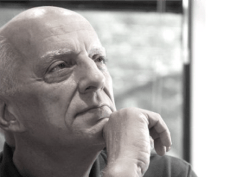
 

rubem Alves theopoetics the poet, the warrior, the prophetRubem Alves died on the of 19 July 2014, aged 80 – almost exactly 4 years ago – this material we’re about to read was originally delivered at the 1990 Edward Cadbury Lectures in the University of Birmingham, segments of 8 talks given over two weeks and our invitation today is to read Alves work and take him in. Rubem Alves had a pretty extraordinary view of life and way of expressing that descriptively to others.
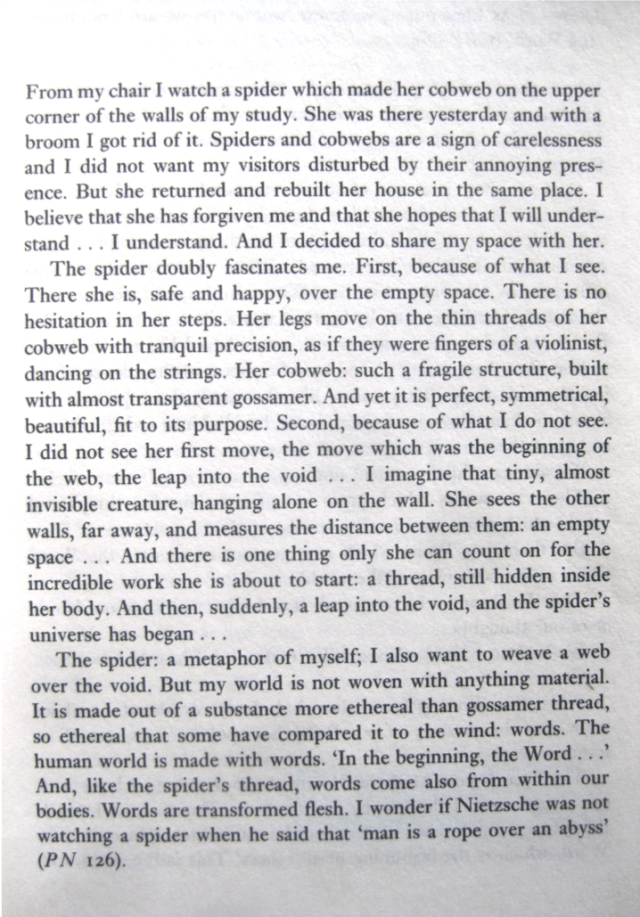
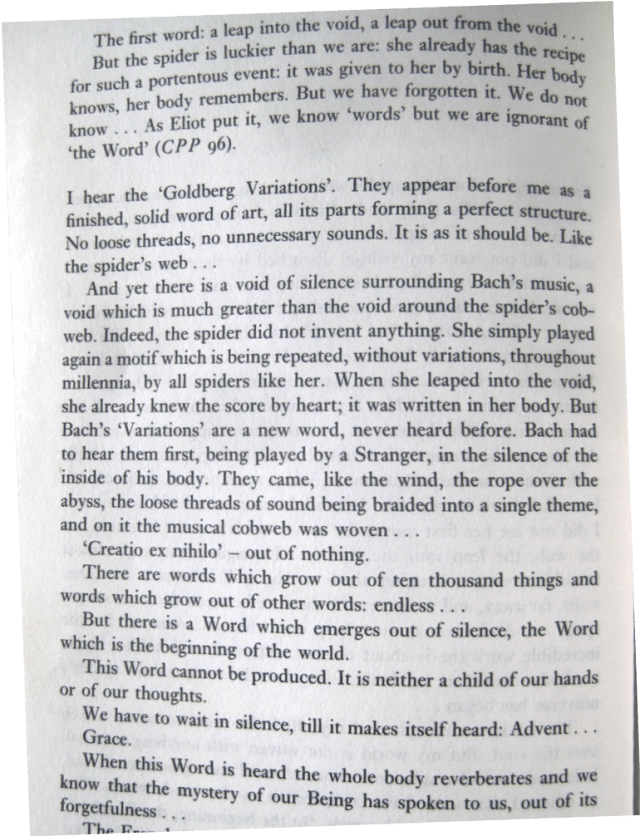
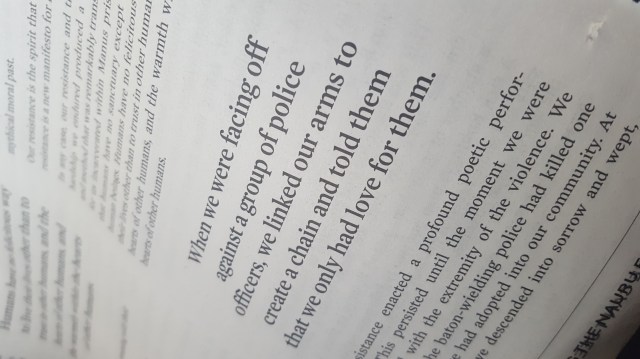
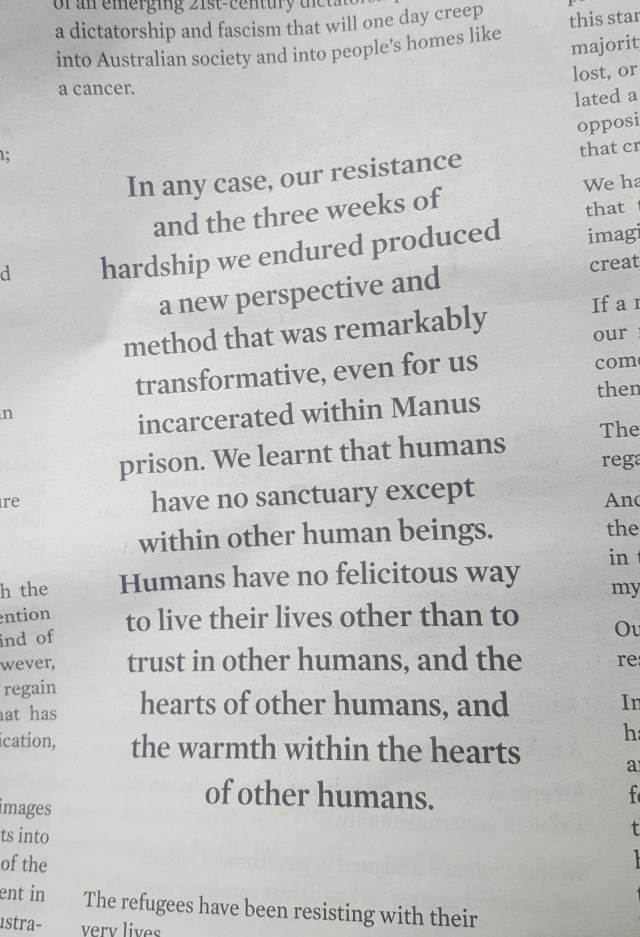
alves spider 1Alves spider 2

Although Stanley Hopper and David Miller are credited with coining the term theopoetics, and  Amos Wilder’s “Theopoetics: Theology and the Religious Imagination” is considered the seminal text of the field, Rubem Alves’ writing takes credit as a premium model of the style – combining theology and poetry.

Theopoetics is an interdisciplinary field of study that combines elements of narrative theology, poetic analysis, process theologyand postmodern philosophy.

Amos Wilder says: “Old words do not reach across the new gulfs, and it is only in vision and oracle that we can chart the unknown and new-name the creatures. Before the message there must be the vision, before the sermon, the hymn, before the prose, the poem.” Rubem calls us into an encounter of the Mystery of the Divine saying:

it’s not science that can explain this,
but our lived embodied experiences
.”


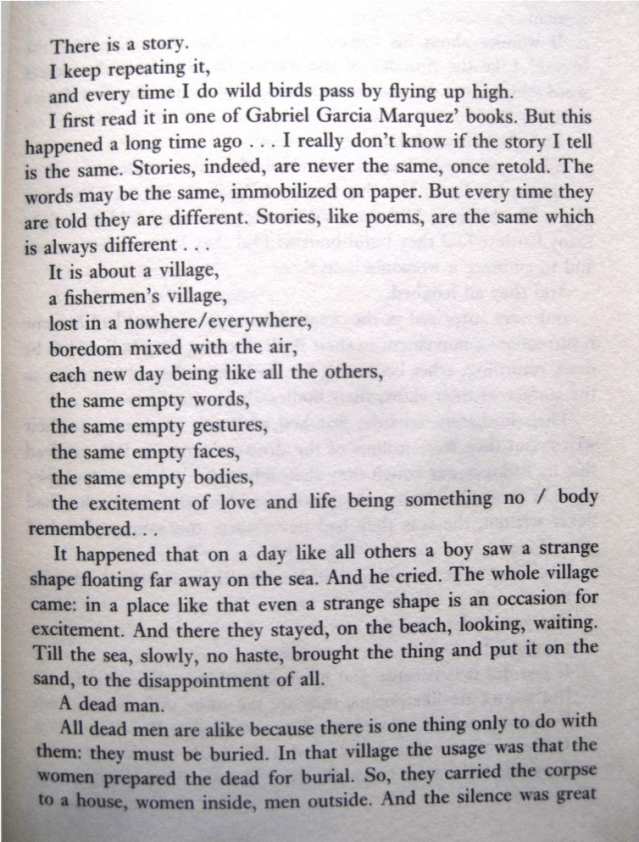
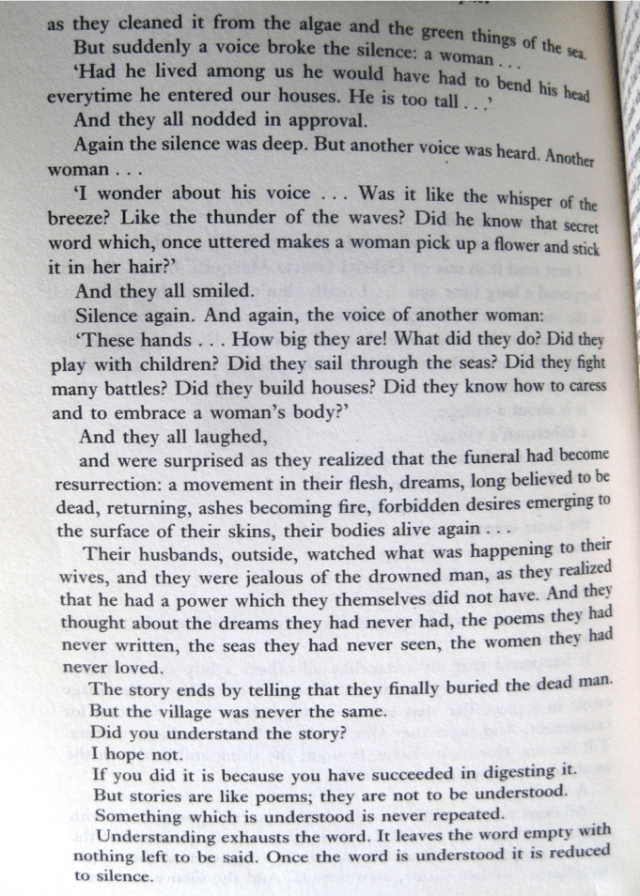
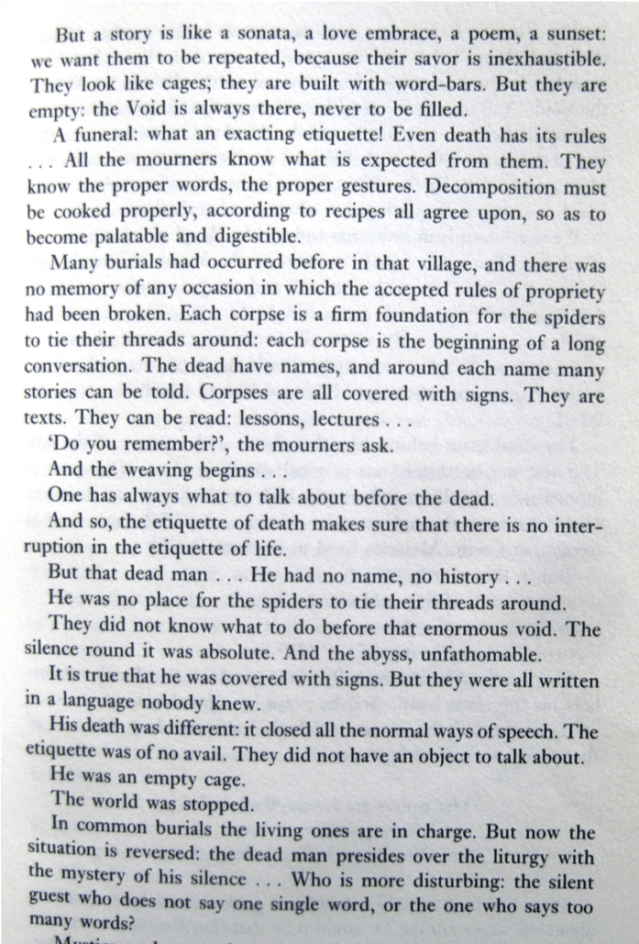
alves dead man 1Alves Dead Man 2Alves dead man 3

Rubem Alves was a forerunner of the liberation theology movement and key to the transformation of Christian social ethics in light of this thinking.  He was a writer, a psychoanalyst, a theologian, an educator, a storyteller, a poet…During his career, Alves collaborated with notable personalities such as Peter MaurinDorothy Day, and Paulo Freire. He was widely read and frequently included art and quotes from the work of others in confluence with his own including writers such as Rilke, Emily Dickinson, Tolstoi, e.e.cummings, Bonhoffer, and Sigmund Freud among others – 74 different references in these lectures alone… you gain from this a sense of a man who is listening to the world and taking it in. These lectures perhaps the map of some of Alves’ anthopophagus meals.  Alves was a prolific writer contributing over 100 books, some of these translated into six different languages, children’s books (“Happy Oysters Don’t Make Pearls”) and many articles on education, philosophy and religion.
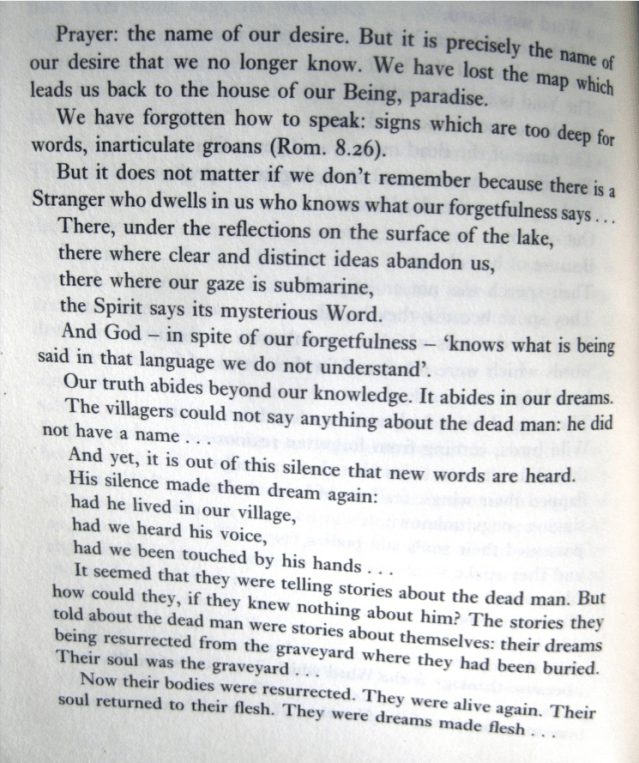
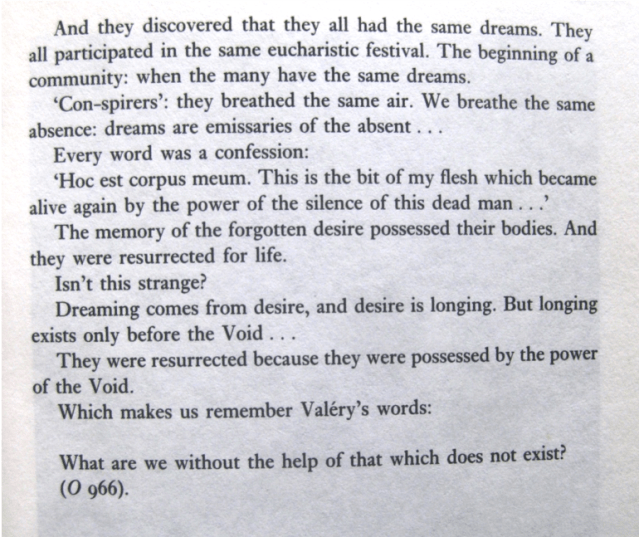
alves prayer 1Alves prayer 2

Rubem Alves was born in a small rural town, Boa Esperança, Minas Gerais, of Brazil in1933. His father was once rich but went broke during the depression and his family had to move to Rio de Janeiro where he was seen as a “hick” from the country.  This crisis was also what led his family to the church as, unable to afford to send the children to school, the family accepted assistance from Presbyterian missionaries to get their children an education.  After high school Alves studied theology, doing outreach to factory workers, then returning to his home state to serve as a pastor amongst simple and poor people (1957).  His religion was practiced and interpreted from the perspective of the poor.  Less about sin, and more about love and freedom, Alves saw religion as a means to improve the world of the living rather than guaranteeing something to people once they’re dead.  Much of what resonates in his writing is the way he takes ordinary human things and makes them sacred. The honesty with which he does this, asks listeners to consider the truth of themselves and invites them to know that as wholeness.  He writes about bodies, love, death, food, communion – universal themes…  and he writes beautifully… believing:

“…the goal of our struggle for justice and all political struggles is for the world to be more beautiful.  Poverty is horrid, it’s ugly. Poverty is death, death of children, suffering. These are terrible things! They must end!”

In 1959, he married Lídia Nopper and they had three children together — Sergio, Marcos, and Raquel.   Through the 1960s, Alves alternated between service as a Presbyterian parish pastor and study as a graduate researcher in theology. Alves went to New York to do his Masters but flew back to Brazil following the US-supported military coup of 1964. The Presbyterian Church of Brazil chose six intellectuals as scapegoats and offered these names to the new military dictatorship to avert persecution themselves.  Immediately upon his return to Brazil, rather than being reunited with his wife and children, Alves had to go into hiding. With assistance from Brazilian Freemasons and the Presbyterian Church in the United Stateshe returned to the US covertly 8 weeks later and secured an invitation from Princeton Theological Seminary  to commence doctoral studies there – where he hated it – he was not allowed to write using similes or poetry and thought this writing his ugliest. Alves received the lowest possible grade that was still a pass for his PhD. ( A Theology of Human Hope. Washington: Corpus Books. Revised version of his doctorate thesis, originally titled Towards a Theology of Liberation.) Of this academic theological approach Alves commented:

“Theology is not a net that is woven in order to capture God in its meshes,
for God is not a fish but Wind that no one can hold.  

Theology is a net which we weave for ourselves so that
we may stretch out our body in it”
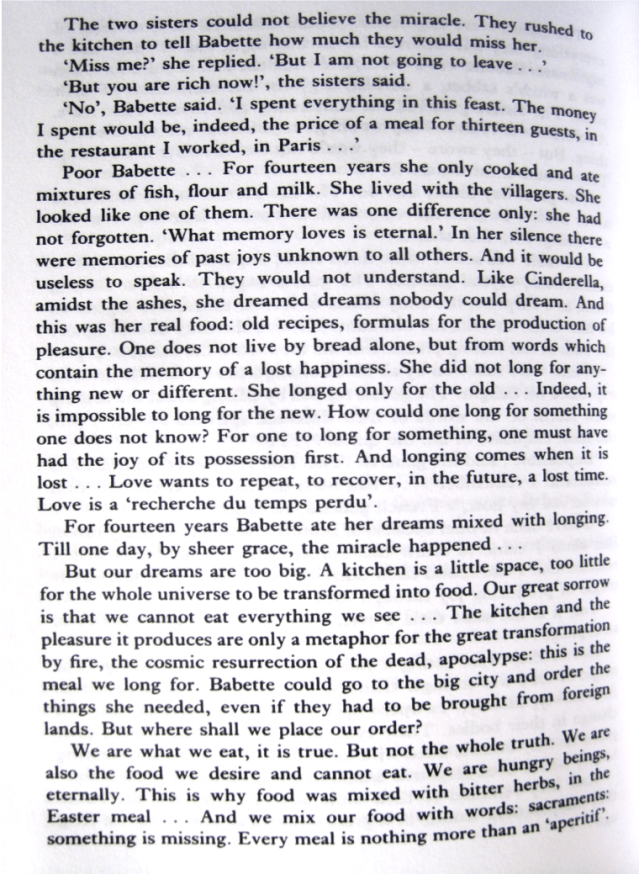
 

Alves babettes Feast 1Alves Babette's feast 2

When he eventually returned to Brazil in 1974, Rubem became a University Professor.  Having been expelled by the denomination he belonged to, Rubem (along with other communities and pastors) had a painful period of isolation and dispersion until 1978, when together they founded the National Federation of Presbyterian Churches which, from 1983 on was named the United Presbyterian Church of Brazil (IPU). Rubem made significant contribution to the founding documents of this new church and it was said of this work by The Rev. Sonia Gomes Mota: “He was not interested in giving us moral lessons or transmitting the absolute and indisputable truth. As a good theologian, philosopher and educator, he was more interested in making us think, reflect and question the immutable truths of theology and urged us to envision new possibilities and new ways of living our faith. Rubem led us to deserts and invited us to be gardeners and planters of hope.”

Born in a context of political and social oppression,preaching and teaching of God’s word as well as social programmes such as nurseries, sewing workshops, health centres, psychological services, and literacy courses are just a few examples of the integrated activities developed by these new church communities. They were the first Presbyterian church in Brazil to ordain women.

Alves once remarked,

“Prophets are not visionaries who announce a future that is coming. Prophets are poets who design a future that may happen. Poets suggest a way.”

Rubem Alves would go on to add psychotherapy to his portfolio and establish his own clinic. In later life, although he maintained a pastoral and prophetic touch with the people he encountered, Rubem’s association with institutional religion became more detached as he came to believe that space, that curiosity, that out of the “nothing” offered by poetry, more good could come than of liberation theology.
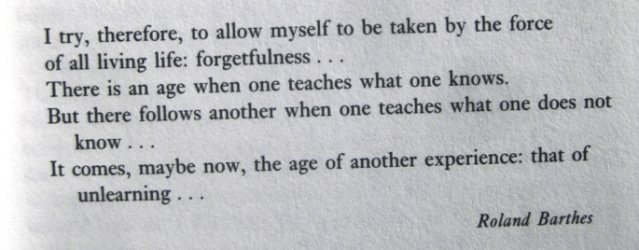
Alves unlearning