Category: influential reading material


IMG_4684

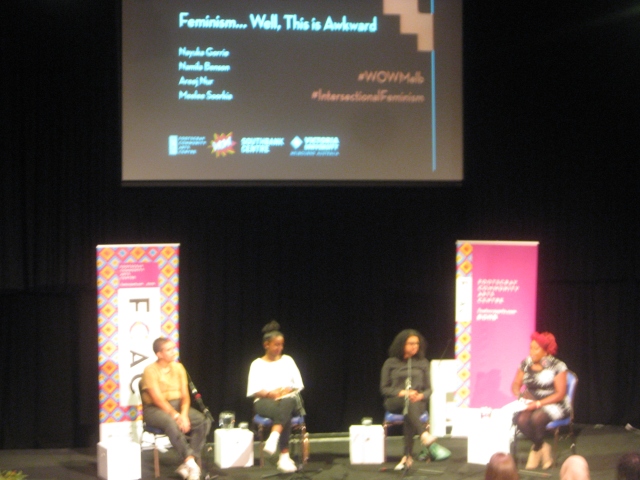
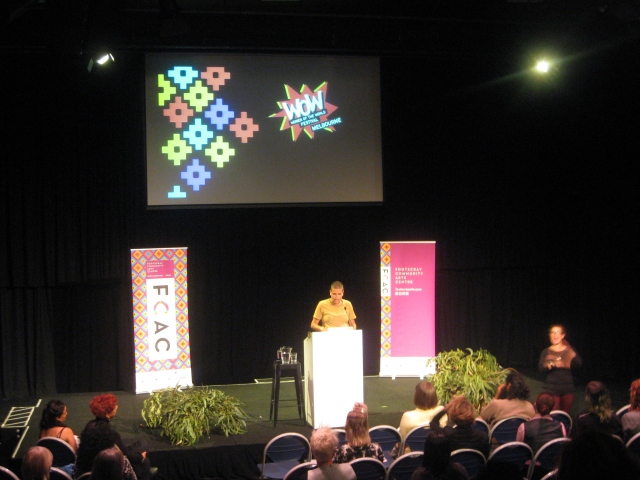
Panel: Nayuka Gorrie, Areej Nur, Meelee Soorkia, Namila Benson


I wrote a book. It brought together other women like me.
I was not ‘other’ anymore.

Meelee Sorkia

Those pink pussy beanies at the Women’s March,
as a black, trans, feminist – what is my “in”?
White women can assume they’re your ally
but I might identify with other labels more.

Nayuka Gorrie

There is such silencing and erasure of women of colour.
Constantly thinking about ‘how do I put myself forward’ in a space?

Namila Benson

There a tenets of of feminism that are important.  Living that and being active in it is really important. We need paid opportunities, spaces that are ‘ours’ to help others out – support, build up, encourage other women of colour. Building and supporting other women in my community is my priority. I’m not interested in helping white women.

Areej Nur

Do the work.  What role do you have?
What opportunities do you have that other women don’t?
Please be self aware.

Meelee Sorkia

Just listening instead of defensive, derailing, silencing. Take up the generous labour of being in the space. Take advantage of the chance to learn something. Know your place. That’s it: Listening and give space. It’s fatiguing [to keep explaining].

Namila Benson

IMG_4655


IMG_4660

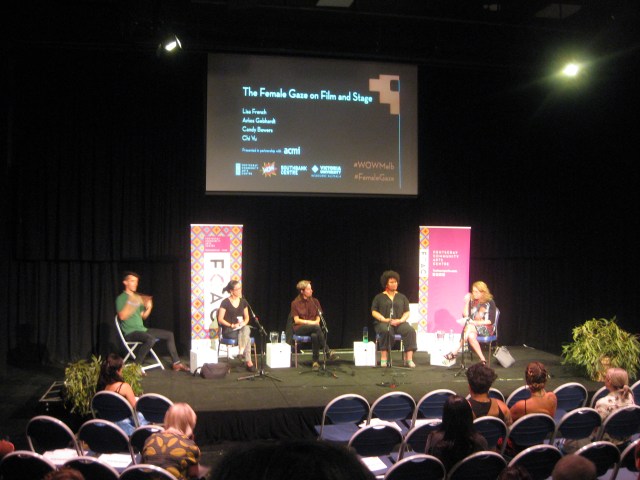
Panel: Chi Vu, Amos Gebhardt, Candy Bowers, Lisa French

Writers are men, Directors are men. I realised ‘That’s where the influence is’. No one asked me to audition for those roles… I had to write my own where black characters are at the centre – not “other” or sidelined… sick of the male storyline, had it for 100 years, can we hear 100 years of women’s stories now?

Candy Bowers

Have to resist the ‘gaze’.  Hollywood is the value-driver of who we are to love, to empathise with, who to victimise, who to villainise… there’s a distance from male/female to this non-conforming space. You can have a binary conversation about art-making. Alternative gaze: all women, women of colour, all oppressed by these stories… perspective as an artist is gender fluid.

Amos Gebhardt

I’m Vietnamese. I was born here but Vietnamese is my first language.  I was thinking and dreaming in Vietnamese until I was 12.  I’m bilingual, not two monolingual languages in one person.

Chi Vu

We know the tropes of the male gaze. Their product and process… set, thinking, psychology… very fast. That’s male. It would be great to see something more embodied, with more emotionality, given space.

Amos Gebhardt

Female gaze can be a starting point – not codifed though – but to open space for exploring other view points. Where there is a minor character we are invited to dislike, someone else liking them draws you closer to them… the audience member flips perspective.  The “alternative gaze” is not a fixed gaze but fluid.

Chi Vu

Of those coming through NADA 90% are white.
How do we create beyond our colonisation?
We’re yet to see the fullness of what’s possible.

Candy Bowers

I know this movie was directed by a woman because my emotions are being prioritised over what’s getting done.

Lisa French

When we create new worlds we can create safety. [eg. sci-fi/fantasy]
Allows space to take greater aesthetic risk – culture, gender, etc…

Chi Vu

This  is what success looks like: I’m the only black woman in the room.  Wardrobe can’t do my hair and makeup. We need cultural safety and support.  I need people expert in ‘me’ around me.
When it’s there… feel more free.

Candy Bowers

Language exists in a moment.  Not forever.
Female and Asian… don’t always want that label.

Chi Vu

Feel held if filmmaker is listening.
Spiritual dimension and depth of characters on screen.

Amos Gebhardt

Fear and freedom.  We’re all trying to get a gold star.
It’s a risk to try something new. In the end the final panel is 4 white men.  Don’t want to have to try and impress them anymore.
Activism is built into the struggle.

Candy Bowers

There are different well-worn roads, the Hollywood Highway.
Going a different way there can be a small or no path.
It takes longer. There is no one around you.
If you’re lucky, you might meet someone else stumbling around,
then it might go faster. It takes courage to go off the path.

Chi Vu

The female gaze is the collection of all other gazes.

Lisa French

IMG_4672

IMG_4662

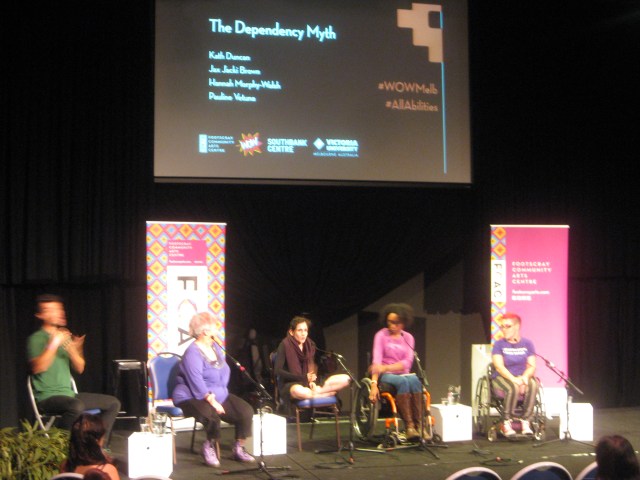
Panel: Kath Duncan, Hannah Murphy-Walsh, Pauline Ventuna
and Jax Jacki Brown


The assumption that people with “disability” need help doesn’t allow for mutuality. Just like everyone else there are all kinds of relationships and power exchanges – ours just might be more obvious.

Jax Jacki Brown

I became a wheelchair user at 14.
Learned at the Rehabilitation Hospital about independence,
being able to direct your own care) is tied to adulthood.
Losing physical ability means becoming infantilised.
Affects our ability to be able give to society
and whether society values that.

Pauline Vetuna

It’s bullshit. Not an idea we need to address.
Need other human beings, need agency… everyone does.

Hannah Murphy-Walsh

I’m comfortable with the word ‘disability’ and identifying with it but it took time.  Acquired injury stigma was an internalised stigma.
Disabled people are marginalised externally
being disabled is not the problem but all the shit that comes with it.

Pauline Vetuna

Societal space see us as tragic or inspirational – we don’t get to be full human beings.

Jax Jacki Brown

When dependence is seen as bad then
independence is seen as good – we need interdependence.

Kath Duncan

With my cultural background I just ‘get it’.  Independence is also a myth, not just dependence. Independence is valorised e.g. paid work, not seen as contributing.

Pauline Ventuna

People assume we can’t/don’t contribute in meaningful ways.  We’re seen as less than other people.  People assume my partner must do all these things for me but we work it out… negotiate like any other relationship.

Jax Jacki Brown

Agency gives us the right t withdraw as well as the right to contribute.  I’m very dependent, rely on my friends for everything.  I have something to give, so do they.  We don’t get lost in the bottom line.  Slow down. Recognise. Make a human connection.

Hannah Murphy-Walsh

A user-based system is best for the strongest advocates, everyone else falls through the cracks… as much faith in the NDIS as any other government scheme.

Hannah Murphy-Walsh

If the choices are infiltrate or dismantle I’m a ‘dismantler’. I don’t see this as an individual problem but a human rights issue.

Jax Jacki Brown

We need to shift the way people see disability.
I still have to point out blind spots to my own community.
We need to manage ableism the same way we manage racism.

Pauline Ventuna

The standard needs to be universal access –
a change for one is a change for the group –
makes it better for everybody.

Jax Jacki Brown

The conflict across abilities is unnecessary –
adaptations can be ignored or used.
We all move through and take up space differently.

Kath Duncan

The idea of ‘needing to be fixed’ (influences of society and culture) – body or mind is a bad starting point.  Meeting their perspective of normal and being as close to normal as you can.

Jax Jacki Brown

IMG_4687 - Copy

JUDE KELLY

My grandmother did two things for me: let me use teatowels as costumes (we had no dress-up box) and encouraged my singing… she taught me that I was entitled to dreams and hopes and that those hopes and dreams were valid.

What have we done to make the
umbilical cord of history so thin?
[of voice/story]

We have a WOW because we want to celebrate what women are doing.
It starts with a “Think In” – what does WOW look like where you are?
They are a network of caring.  Two things you can say about women:
they are tired and they’re frightened.

When Somaliland’s First Lady wanted to
build a maternity hospital
the builders said they didn’t have time.
She answered: “Teach me to make a brick”.

IMG_4691 - Copy

HANA ASSAFIRI

Social justice is not discretionary.

The future is ours to make.

Intersectionality is embodied in the margins.
Social context, empowerment, employment and education
are where social change meets intersectionality in a practical way.

Where we feel an intuitive connection
we have an intuitive intelligence. We need
to back ourselves on what we feel and what we know.

Communities are strengthened through diversity.

IMG_4692 - Copy

MARIA KATSONIS

“We tell ourselves stories in order to live” – Joan Didion

I have to be authentic to who I am.

The nature of my ambition has changed.
I believe in the power of one to affect social change.

IMG_4696 - Copy

TANIA CANAS

We are theory and theory is ours.
Arts, politics… theory is everyday life.

Education in Australia separated self and theory.  
Theory became externalised from the body.
It went from everywhere to nowhere.
Not ‘by us’ but ‘to us’. Not changing, but static.
Institution imposed a hierarchy of knowledge.
The indigenous people of Central America knew  astrology, geography, how to make chocolate.  They wrote in hieroglyphics and were writers, philosophers, theorists… there has been a genocide of knowledge = epistemicide.
They have colonised not just our bodies but our minds.

In my culture, cooking is at the centre of community.
With white feminism – I didn’t want to learn my mother’s cooking.
Now I am looking to bruja feminism, because the white feminism didn’t
acknowledge my ancestors, my mother or the role of hospitality as resistance – my mother cooked for the group that met at the house.

Not buried, didn’t die, not lost –
these ways of knowing are resistance.

It’s not known or recognised how strong women of colour are.
You will be marginalised: you need to ask:
will I notice, will I do something?

It’s hard. That’s why we need you to be there.

Research is embodied.  We write struggle.
When we theorise, we write with our bodies.
To write/use a theory, you need to embody it. Resist epistemicide.  
You write and exist in the in-between. Don’t lose yourself.


IMG_4720

I went to the angel and asked him to give me the little scroll.
He said to me, ‘Take it, and eat it.’
Rev 10.9

IMG_4698


IMG_4640

ELAINE BROWN

There is no such thing as a part-time revolution.

We’re not here for black liberation but for all liberation.

We didn’t come here for a better life,
or religious freedom [like migrants to US],
we came kicking and screaming.

We provided the conditions for people to bring about the revolution –
gave them free education, a free breakfast, access to a free clinic…
they have the human right to food, to health care –
we gave them the experience of something worth fighting for.

Are we breaking the glass ceiling to be oppressors ourselves?!
No. We have a common enemy.
Can’t see ourselves in competition with anyone else.
What is our agenda as women?
To find solidarity with the others who are suppressed.

IMG_4644

PAOLA BALLA

Learn how to situate yourself.

Do not let your feminism drive your racism.

Mind and heart, mine is a matriarchal tradition – 
you experience yourself as a part of others.

Activism is radical self-care.
It is a form of activism to thrive, not just survive.
Art is not living but living can be art.

“The world will crumble one day.
It’s ok. We know how to be poor.
We know how to live without electricity…”
– Rosie Egan

IMG_4652

NAYUKA GORRIE

(of WOW/speakers)
To see your reality reflected back you.
Very powerful.

How much of my gender came out of a book? A ship?
The convent that beat my grandmother?
We need to consider: how is gender colonised?

Your black body is never quite yours in this country.
Hyper-sexualised vs. not attractive at all. Strong vs. not strong at all.
Used for labour (work) vs. in labour (baby)
A shaved head means either a Britney melt down (dysfunctional)
vs. fundraising for cancer (held up as a role model) –
What other personal reclamations can I make of my own body?

Keep this flesh vessel tight [runs regularly].
Doing well is resistance.

IMG_4619.JPG

IMG_4617

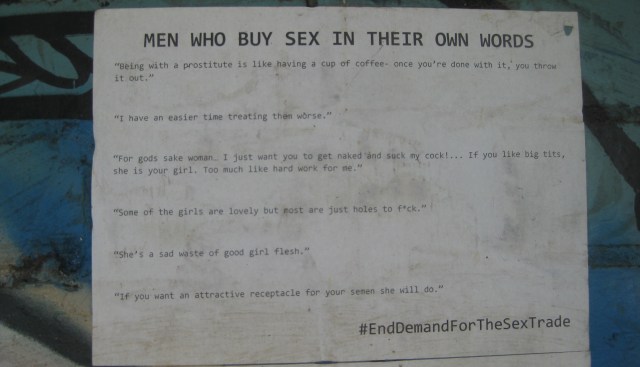
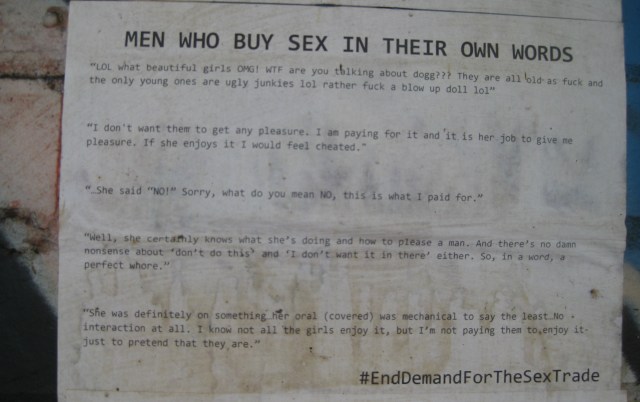
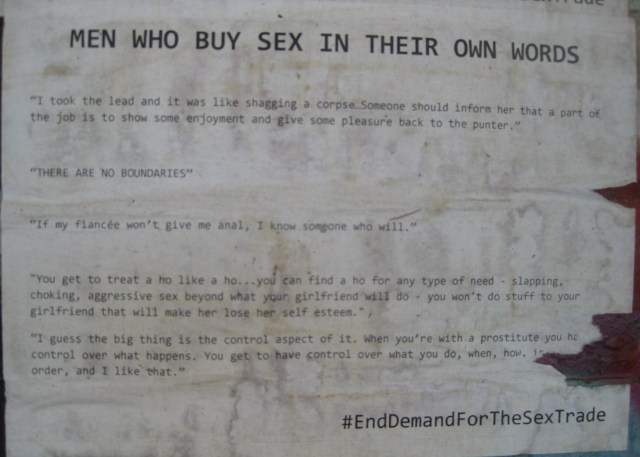
Trigger warning: there’s a lot that’s demeaning and dehumanising in this – whatever your gender and sexual orientation

IMG_4630

IMG_4631

IMG_4632


Just in case you missed it – the Sovereignty exhibition at ACCA was stunning.

This slideshow requires JavaScript.


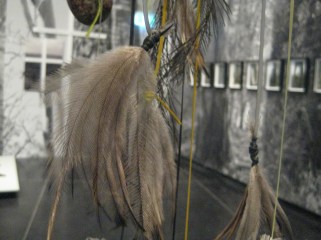
We need to keep leaning into the truth that colonisation isn’t a “once upon a time…” story of something that happened long ago and far away but is still happening here and now. On land that was never ceded – what does being “Australian” look like or mean? You see in the piece by Clinton Nain Water Bottle Bags something beautiful made of found objects: plastic bottles, emu eggs, emu feathers, electrical cable, wire, string… a mix of  what is natural and man-made, a mix of traditional and contemporary.  What does it mean that the contemporary is waste, or is it in the hands of the custodians? What does traditionally acquired knowledge – a different understanding of the world and how to engage it have to teach us? This exhibition provoked this reflection and many more. See more photos and read the (highly recommended!) Sovereignty publication on the ACCA website:


To be sovereign is in fact to act with love and
resistance simultaneously. Uncle Banjo Clarke, the
late Gunditjmara statesman, said we must ‘fight
hate with love.’2 If there is a thread that connects
all the artists across the wide diversity of practices
represented in Sovereignty it is this deep love for
family, for truth telling and for beauty.

– Paola Balla –


Sovereignty

ACCA is proud to present Sovereignty, an exhibition focusing upon contemporary art of First Nations peoples of South East Australia, alongside keynote historical works, to explore culturally and linguistically diverse narratives of self-determination, identity, sovereignty and resistance.

Taking the example of Ngurungaeta (Elder) and Wurundjeri leader William Barak (c.1824–1903) as a model – in particular Barak’s role as an artist, activist, leader, diplomat and translator – the exhibition presents the vibrant and diverse visual art and culture of the continuous and distinct nations, language groups and communities of Victoria’s sovereign, Indigenous peoples.

Bringing together new commissions, recent and historical works by over thirty artists, Sovereignty is structured around a set of practices and relationships in which art and society, community and family, history and politics are inextricably connected. A diverse range of discursive and thematic contexts are elaborated: the celebration and assertion of cultural identity and resistance; the significance and inter-connectedness of Country, people and place; the renewal and re-inscription of cultural languages and practices; the importance of matriarchal culture and wisdom; the dynamic relations between activism and aesthetics; and a playfulness with language and signs in contemporary society.

Sovereignty provides an opportunity to engage with critical historical and contemporary issues in Australian society. The exhibition takes place against a backdrop of cultural, political and historical debates related to questions of colonialism and de-colonisation, constitutional recognition, sovereignty and treaty.

Curators
Paola Balla and Max Delany


ArtistsIMG_4154
Brook Andrew
William Barak
Lisa Bellear
Jim Berg
Briggs
Trevor Turbo Brown
Amiel Courtin-Wilson / Uncle Jack Charles
Maree Clark
Vicky Couzens
Destiny Deacon & Virginia Fraser
Marlene Gilson
Korin Gamadji Institute
Brian Martin
Kent MorrisIMG_4420
Clinton Nain
Glenda Nicholls
Bill Onus
Steaphan Paton
Bronwyn Razem
Reko Rennie
Steven Rhall
Yhonnie Scarce
Warriors of the Aboriginal Resistance (WAR)
Peter Waples-Crowe
Lucy Williams-Connelly