

Category: the art of discipleship
I will tell you something that has been a secret; that we are not all going to die, but we shall be changed.
1 Cor 15
I am hungry. I am full. I am empty. I am all these things in You.
These words from Corinthians bear hope for me. They give me a sense of space and flexibility where I have felt rigid and tight. This is the gift of Your grace and I am grateful for it.
We draw lines in the sand and then are constricted by the confines of the smallness of our own imaginations. This is why we require You and cannot trust to our own abilities. Let me confess I am slow to seek You, You speak but I do not hear, I look but do not see what You would show because I imagine I know. Give me the grace to know all I do not know, humble me to be dependent on You always and in all things.
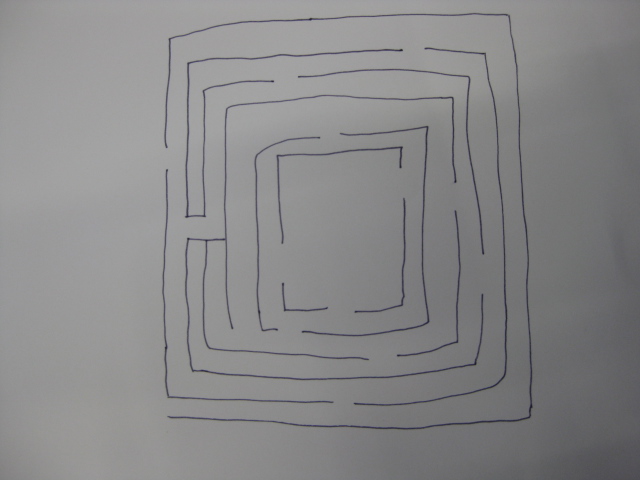
Is our destination to You outside of ourselves or inwards? Both at the same time? It was clever for cities of old to be built as a maze with the church at the centre. You would always have a sense that you could not get lost because you’d have some understanding of where you stood in relation to God at all times. Sometimes near. Sometimes far. Even a deadend is useful in that we have learned the way not to go. Perhaps we find a place along the Way that is comfortable and we do not wish to go any further? Perhaps if we go too far we will not be able to find our way back? …but that is a fallacy – there is only ever forwards. Our commitment to God needs to be this, that ‘I will keep on moving forwards’. This page, limited to two dimensions, the image could seem to ascend or descend but it would be better to imagine some sort of Cubist mobile suspended in space and time in constant motion.
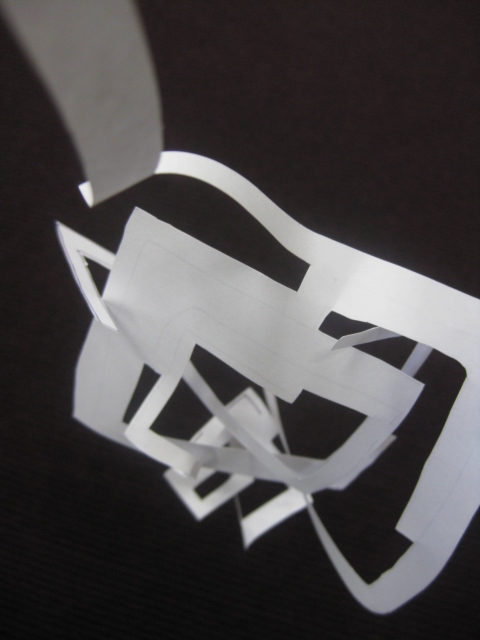
This is our God.
This is why I – and you – can be made new
in every moment, made anew, renewed
in every moment.

This beautiful artwork is used with permission of the talented artist Liz Braid www.lizbraid.com
As of April 2014 there are 1138 children in detention in Australia’s detention centres. It has been hard to know how to respond in the face of Australia’s inhospitable and inhumane policies/treatment of refugees seeking asylum.
Our God is Undocumented, a book by Ched Myers, offers a biblical exegesis for the American context and is drawn on below to consider the Australian context through the use of reflective prayer stations.
map of  the world – how can we identify with the journey of refugees, pin where we are from, our parents, our grandparents… use different coloured pins {Our God is Undocumented, p.10 “We should never forget that the first immigration “crisis” on this continent came as a result of European colonisation of the Americas. This resulted in three great disasters: the obliteration of First Nations sovereignty and cultures, the violent removal of millions of Africans to the Americas in the slave trade, and the impoverishment of countless people due to relentless resource and labor extraction… poor immigrants today are simply following the trail of wealth stolen from their land centuries ago.}
Australian has its own unreconciled history with its First Nations Koori people. Koori people have lived on this land for 50,000 years, us white folk less than 250 years. There is a bit of a “We outnumber you and ours is the dominant culture, why don’t you just assimilate/get with the programme” Where do we belong? What right did our ancestors have to arrive by boat for resources such as land and gold or to avoid famine? How can we use our own personal stories/history to develop a sense of compassion for those still arriving today? As can been seen at the Melbourne Immigration museum there have been waves of refugees from Vietnam, Philippines, Africa (Ethiopian, Eritrean, Sudanese…), Middle East (Iran, Iraq, Lebanon…) – what is the role of Australia in conflict/securing resources in these areas?
Say (or hear) Lords Prayer together in different languages. Spirit of Pentecost Acts 2.6,8,11 …in their own tongue. Didn’t all understand Latin/Greek but heard scripture in their own language. {Our God is Undocumented p.28 “Perhaps it recognises that language is one of the fundamental things that makes us human and that linguistic distinctiveness characterised the original forms of human organisation before the rise of imperial monocultures. The ancient wisdom preserved in this story reminds us that cultural heterogeneity is as essential to human social ecology as species diversity is to a healthy biosystem… more than 95% of the world’s spoken languages have fewer than 1 million native speakers. Half of all the languages have fewer than 10,000 speakers. A quarter of the world’s spoken languages and most of the sign languages have fewer that 1,000 users… It has been estimated that 20-50% of the world’s languages are already moribund, and that 90% (possibly even more) may be moribund or will have disappeared by 2100.”}
Does your congregating community have members from other cultures who attend? If not, why not? What are some ways to acknowledge, celebrate and affirm the cultural differences within our community? Language/stories/songs, festivals, wisdom of prophets/spiritual leaders, colours/fabrics/flags, food at morning tea, clothing… we all of us are made in God’s image – male/female, brown/yellow/black/white, no matter where we’re born. How can we draw on the richness of diversity in the God we worship?
 share communion together {Our God Is Undocumented p. 200 “Remember what has been dismembered. This exhortation lies at the heart of the church’s eucharistic ritual, repeated with each element for emphasis. It reiterates and sums up the deep wisdom of biblical faith, the product of a people all too familiar with distress, displacements and near disappearance. Whenever you ingest this memory, said Jesus on the eve of his execution, you join yourselves to our historic struggle to make the broken body whole. It was, and is, both invitation and imperative, equally personal and political. If we refuse to heed it, we are doomed to drift forever on or be drowned by the tides of empire, refugees all.”}
This is one loaf of bread. One body.
It’s broken.
As Jesus’ body was broken on the cross for us.
this bit might be me…
this bit might be Jarra…
this bit might be Ahmed…this bit might be Rajesh…
this bit might be Sam, or Maya, or Bob, or Shirley…
When we eat this bread it is a reminder that we are all part of one whole – we might be a different colour, we might be a different size of a different shape – but we are all part of the same body… connected. And we are all of us broken. In each taking a piece, and eating it at the same time, we are invited back into wholeness with God and with each other.
Angels – paper cut out? Something we can take away with us/put somewhere prominant to remind us to welcome the other {Our God Is Undocumented p.67 “…account of the angel travellers similarly attacked in Sodom, a violation that also ended in that city’s destruction (Jgs 19:15-25-Gn 19:1-11). …cautionary tale… “Do not neglect to show hospitality to strangers, for by doing this some have entertained angels without knowing it” (Heb 13:2).
#LoveMakesAWay is a movement of Christians seeking an end to Australia’s inhumane asylum seeker policies through prayer and nonviolent love in action, you can see their Facebook page here. This is high-level commitment advocacy but there are less “extreme” places to start…
There is an initiative in Switzerland that suggests putting stickers on your mailbox to let your neighbours know what is available to borrow – we used to be able to knock on our neighbours door but nowadays spend more time online than in realtime…
Communities like Urban Seed in Melbourne offer a free meal to those marginalised by homelessness in Melbourne – but here’s the thing, they don’t only offer food to people who are homeless, they offer food to anyone that shows up for lunch as they explore what it means to be good neighbours in a busy city of commuters and extend us the invitation/challenge to do the same through their Strangers Are Fiction campaign.
Who are your neighbours? Do you know their names? What might be one thing you could do that might lead you into connecting with them? [fruit or flowers from the garden you want to share, or baking, maybe you take the initiative to borrow something next time you realise you’re low on milk or the grass is getting tall…] …who knows where this might lead?
Dolls house – have sample forms and invite people to write their own and take them home as a way of symbolically creating space for the other in your home {Our God Is Undocumented p.107 In my fathers house there is lots of room (Jn 14:2)
I went to an art exhibition last week with some art works around the theme of showing welcome to refugees such as that by Liz Braid above – they had some mock forms on the wall that said things like:
ASYLUM SEEKER
PROCESSING FORM
Please come in. What a
terrible journey you’ve had!
I’m so glad you have arrived
safely and to imagine, once
you’re healed, how much you
have to offer us. Let me help
you with your bags, we’ll have
you unpacked in no time…
You are welcome here. APPROVED
Invite people to write their own words of welcome, take them home and put them in a room of our own house with some intentionality and deliberation – symbolically creating space for the other is a good place to start and this can create some mindfulness to extending hospitality/welcome when an opportunity presents itself.
Anne Lamott has said, “Hope begins in the dark, the stubborn hope that if you just show up and try to do the right thing, the dawn will come.”
Let us hope. Let us try and do the right thing.
Some prayer stations we set up around our backyard, if you’re interested in this as a resource just post your email address in the comments and I’ll send it through (or email me directly if you know me). Set-ups aren’t meant to be prescriptive, use whatever you have lying around… the numbering on the stations isn’t significant, you can do one or two, or them all in any order…
——
Welcome
Please come around the side of the house
Just in case you haven’t come across them before.
Prayer stations are essentially several points of “focus” that invite you to encounter God in some way. You can spend all your time at one or make your way around several, or all of them, as you like – spend as much or as little time at each of them as you like.
This space is for silent, personal reflection.
You are welcome to come inside for a cuppa, catch up, time of sharing afterwards or you can go – however you feel…
—–
Station #1
Set-up: A bicycle propped in a bush so the wheels were free-spinning.
“Spin the wheel of the bike fast, then watch it slow… more of the detail comes into focus instead of being blurred. Is there an area of your life where things are moving fast right now? They will slow. Think about your breathing. Be present in your own body… become aware of where things feel tight, or weighed down… This time, spin the wheel again, then close your eyes and breathe more slowly and deeply as the wheel slows. Do this as often as you need.”
Station #2
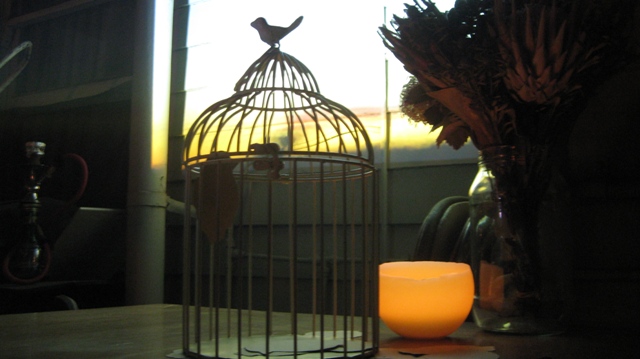
Set-up: Cut bird templates and a birdcage.
“We can sometimes feel bound by the things we feel we ought to or should do… there are roles we play ‘responsible mother’, ‘dutiful daughter’, ‘reliable helper’
In your mind, complete the sentence “I would love to ____________ but I can’t because…”
Give freedom to that part of you today that feels bound.Take a piece of paper out of the birdcage as a symbol of release/freedom from this captivity. Write on it.
Pray for the thing that binds you, or for freedom from that.
Choose.
Do you take it with you or is it left behind still stuck?
Station #3
Set-up: Video footage/photo of the desert with soundtrack from Beirut playing
“This video footage is of sunset over the Nullarbor.
We can often think of the desert as a bleak, harsh, a dry, desolate and deadly place.
Hosea 2:14 says “Therefore, behold, I will allure her [Israel] and bring her into the wilderness, and I will speak tenderly and to her heart.”
The desert is not where God isn’t, where life isn’t… but where God is, where life is…
Watch and listen to God soeak tenderly to you. What life-giving thing is God calling you to?
Station #4
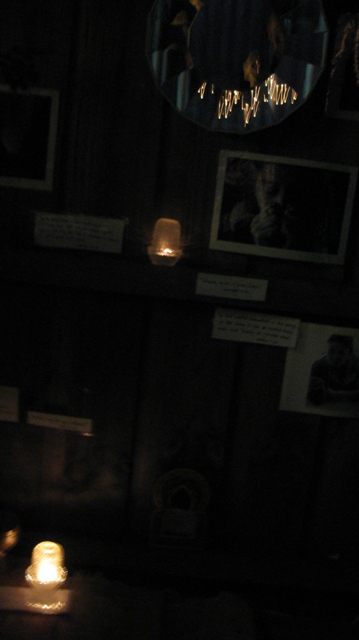
Set-up: Chair set up facing a corner with pictures of women posted all around (different ages, different nationalities, different religions, different social class, different capacities, different life stages…) and a mirror.
“All around you are images of normal everyday women – made in the image of God… rest in these images and feminine words and phrases from the bible and know also that you are made in the image of God. Blessed are you among women. You have found favour in God’s sight.”
Station #5
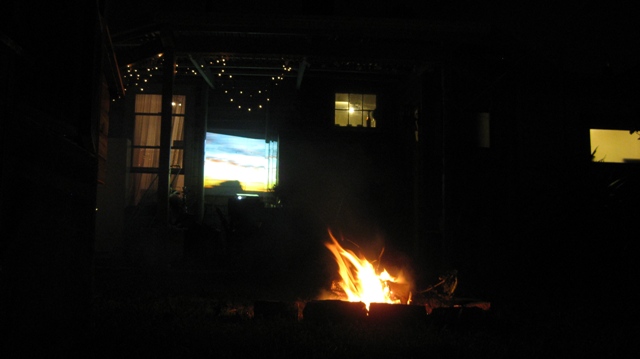
Set-up: Fireplace/brazier
“Fires can be captivating sources of light and warmth;
Feed the fire.
Feel the light and warmth pour over you
Feel the nourishment of the Holy Spirit
pour over and around you.”
Light of the world, we confess that you are here
Shine your light into the hidden places of our lives
and bring warmth to the cold places of our hearts.
Station #6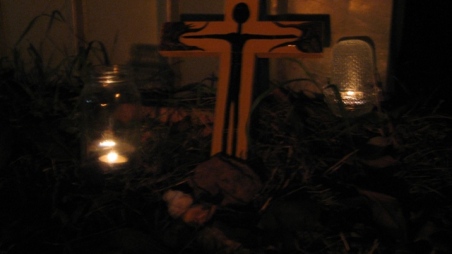
Set-up: Small stones and a cross
“What is weighing on your mind/heart right now?
(locally, globally, personally…)
Hold a rock as you pray for these heavy things you carry
Then put them down as a symbol of giving these concerns into God’s care.”
Station #7
Set-up: Some blankets and pillows laid out under a night sky
lift up a stone and
you will find me there
I am the hole of your doughnut
the spaces between
the stars
I am down behind the sofa
cushions with the lint and
loose change
I can be seen in raindrops
sliding down the window pane,
smelled in Johnsons baby shampoo,
heard in the drawer opening
to put away your clothes.
In the soft folds of the wrinkles
at the corners of your eyes
I am there
Lie back.
Look at the stars, the bats flying overhead
Listen… what can you hear?
Be present to the God that is with you always.
This months Spiritual Reading group looked at the written works of Dag Hammerskjold – particularly Markings, you can read the notes here.
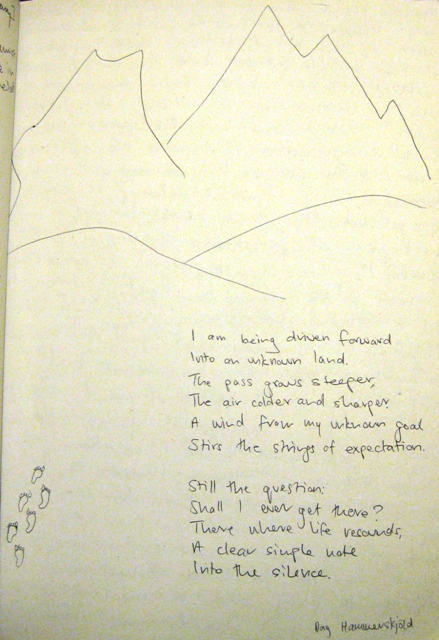
I found myself thinking in the session, ‘How did I not hear of Dag Hammerskjold before today?’ The book Markings is a fascinating insight to the work of God in someones life and the privilege of private insight into the struggle and conflict within ourselves from who we are to whom You intend for us to become. Dag Hammerskjold was known as a diplomat and economist – predominantly for his role as Secretary-General at the UN. it was only when Markings was published posthumously that we discover he was also a theologian – vocationally a secular monastic – he didn’t join an order or marry but found his own way ‘what makes loneliness an anguish in not that I have no one to share my burden, But this: I have only my burden to bear…’ Dag seems to have lived a selfless life. I am certain he was not perfect and would lay honest claim to his own hard-headed mistakes but he sought and he found something and I think that is the best of what any of us can hope for.
Tired
And lonely,
So tired
The heart aches.
Meltwater trickles
Down the rocks,
The fingers are numb,
The knees tremble.
It is now,
Now that you must not give in.
On the path of the others
Are resting places,
Places in the sun
Where they can meet.
But this
Is your path,
And it is now,
Now that you must not fail.
Weep
If you can,
Weep,
But do not complain.
The way chose you –
And you must be thankful.

 itellyouarise