
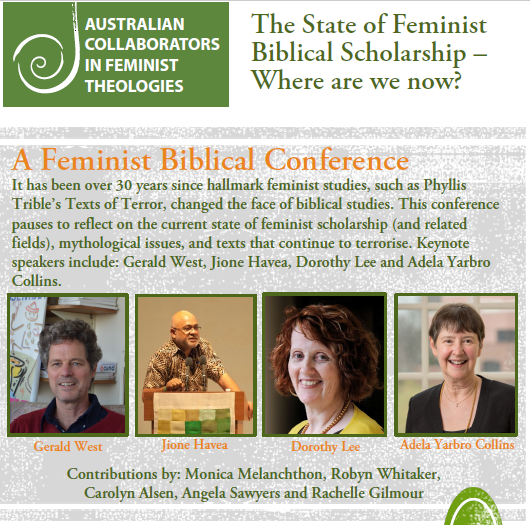
The title of the upcoming Australian Collaborators in Feminist Theologies network event poses this exact question and I wonder… less postgrads, less promotion, less published – where are the female-centric stories and who is telling them?
I want to get to hear about the Nuns (Adorers of the Blood of Christ, environmental protectors and activists) blocking the Standing Rock gas pipeline development. I want to hear more about Teresa Lee, Emily Wood, Leonnie Wickenden, and Abigail Benham-Bannon – Christian women getting arrested for Love Makes a Way for their belief in, and support of, the rights of asylum seekers arriving by sea. I want to hear more about Aunty Sharyn, an Indigenous Christian leader from Brisbane, called to a vocation rising out of her personal experience who has started up B’ira Women’s Ministry – a significant community ministry addressing domestic violence and sexual abuse in Indigenous communities. I want to hear more because I do not doubt that there is a strong biblical theology that underpins the choices of these women to put themselves in the way and turn out fear for their faith.
Bir’a is Wakka Wakka Language for ‘High Spirit’ and is all about when ‘Women meet Jesus’. Bir’a run yarning circles – providing a safe space to talk through grief, trauma, healing and relationships and do art therapy for when women can’t find, or just don’t have, the words to describe what has happened to them.
Hearing about this ministry I was put in mind of the women in Mark (5:21-43). Jesus is walking along with his disciples and a leader of the Synagogue comes along asking for healing for his daughter who is unwell. Jesus agrees to come, yet along the way a bleeding woman who, against all purity codes, reaches out to touch a Jewish man in the desperation and hope of being healed. This woman reaches out for and takes what will heal her. v.29 “Immediately her haemorrhage stopped; and she felt in her body that she was healed of her disease.” but v.33-34 goes on to say “the woman, knowing what had happened to her, came in fear and trembling, fell down before him, and told him the whole truth”. He said to her, “Daughter, your faith has made you well; go in peace, and be healed of your disease.” She had already been healed of the physical symptoms (v.29), this second healing aims to address the mental stress of what the disease had cost: exclusion from temple which was a central part of life; if she had a husband perhaps he left – not being able to touch what she had touched or share intimacy; perhaps people worried they might catch the disease; or perhaps the priests tried various means and methods of cleansing or praying out demons… what isolation and exclusion had this woman known over these 12 years? How long does it take to pour out this tale of grief, fear and loneliness? Long enough for the Synagogue leaders daughter to die – does one persons healing come at the cost of another’s? No. Jesus goes on to ‘wake’ her.
What part do women’s truth and storytelling have to play in our healing – personal, family, community, political…? We need times and spaces to hear truth, we need to be willing to tell our whole truth, we need to be willing to listen to others’.
Lydia Wylie-Kellerman reminds us “Telling stories is an act of resistance. It is part of discipleship. It is movement work. Stories are provocative and powerful while at the same time nourishing. They hold us. They remind us who we are. They help us know who we want to become.”
We need learn from the wisdom of women’s ways of knowing. We need to learn from the wisdom of women’s encounters with Spirit, Christ, God and what calls them to move. The powerful experiences, perspectives and stories of women have much to teach us and we need to pay attention. Thirty years on from Phyllis Trible’s pioneering Christian feminist perspective to biblical scholarship (Texts of terror, 1984), the upcoming conference pauses to reflect on the current state of feminist scholarship, mythological issues and texts that continue to terrorise. Issues worth thinking about for all those students, researchers, ministers, faithful, knowing women contributing now, and emerging, to remind us who we are and who we want to become.
You are invited.
Location:
Centre for Theology and Ministry
29 College Crescent, Parkville VIC 3052
Cost:
$40.00 waged / $20.00 unwaged
includes a catered lunch and snacks
Bookings:
www.trybooking.com/366028

The chairs have been stacked, the glitter has been swept up, and our all-gender bathrooms have been returned (alas) to their ‘male’ and ‘female’ binary designations. Better Together 2018 was an inspiring two-day showcase of the depth of thinking and passion of our LGBTIQ community of communities.
Over those two short days, 647 LGBTIQ people and allies attended 56 sessions with dozens of speakers and facilitators to revive the legacy of the National Homosexual Conferences of the 1970s and 80s and establish a new 21st-century platform for conversation, collaboration and action on LGBTIQ rights and social justice.
The Equality Project was founded to open up space for talking more deeply about how our communities work together and how we support others in the social justice movements to achieve genuinely meaningful and lasting social change.
Our biennial conference is just part of that.
We need to keep the conversation going and continue to build bridges that support all of our communities and achieve our vision of a world that values and affirms all LGBTIQ people as full citizens.
– The Equality Project Team
Discussion:
Further Reading:
Australian skeptics https://www.skeptics.com.au/
YouTube The Atheist Experience
Contact Geoff if you’re interest in being part of something local – formal or informal.

GM: Interaction and intersectionality can often feel like groundhog day. Frequently have people approach and ask things like: how do you fuck? how do you do yoga? what’s wrong with you? you are so inspirational! … our story must necessarily inspire or be tragic. How or have you experienced this?
JB: Repetitive and a stereotype. My life must be terrible or tragic… that’s not my truth… I don’t tell a sad story because I don’t have one. People don’t know how to respond. I can get practical assistance with access t housing, employment, etc. but what about access support to explore sexuality and inclusion?
AB: Mine is a neurological diagnosis. I’m a person – mind, heart, body, soul… treat me like anyone else. Within LGBTIQ+ community… feel a bit judged. Don’t fit. Sitting at equal eye level and making eye contact is important. Sets us more equally.
MR: I’m non-binary, am autistic and have Tourettes…. only diagnosed at 29. Until that point I had been told I had behavioural issues. I’m not aware when my tone and expression change. Sound is deafening – sights, sounds, smell, touching…. sensory issues. I want to engage but I have to leave. Are there quiet networking spaces? I get worries that people don’t understand me.They think I mean it (raised voice or swearing) but I don’t. I swear at the doctor, the chemist, in restaurants… to be around me you have to accept who I am.
JB: Around privacy and consent, we have to overshare to get access. Weave the personal with our rights. We not taught our bodies belong to us – it seems it belongs to doctors, belongs to those trying to make me “normal”. Never given space to accept my ability as who I am. calling body ‘home’ instead of being exiled from my own skin… feel to move in this body and my chair like I need a lot of distance, not to take up space or be different, I need to inhabit and call this body mine. I get to say what I’m going to share and not. My hair is bright red – as a flag to others who are queer but also sometimes because it means I get to participate in a conversation about that instead of my disability.
AB: I choose to participate in tests and trials. I hope to make it better for the next person. I’m happy to be used as research.
MR: Before I was diagnosed… my parents would talk about me. They wanted support for how hard it was raising me. The online spaces are filled with parents (they post photos, videos, stories of behaviour seeking advice and sympathy without consent). I’m still trying to find online spaces where I can be myself. I’m an over-sharer but I’m making that choice.
GM: How important is choice?
JB: When I was young my family were involved in medical practice, tests, etc.I didn’t have a choice. I do now. People have been so disempowered. when you ask: “what do you want? Where do you see yourself?” They don’t know how to answer. Lack of choice. We are denied so much that’s taken for granted – that one day you will live out of home, with a partner… receive care from family members not staff so you can’t advocate for what you can’t imagine you could have. Medical appointments… take a lot of effort and capacity – it is like running a business to co-ordinate getting the services you need.
AB: Access isn’t safe on PT at night. There might be a ramp and signage but what about being deaf, queer, managing loud noise (autism)… Access means and looks like lots of different things
MR: After I resolve an issue people often want a hug/comfort. I don’t. Not my problem. Need my boundaries. There’s a lot of drinking and drugs in the LGBTIQ+ culture and I want to feel safe.
JB: we need improved mental health services. when I had depression in my 20s it was assumed the cause was my chair not because I was heartbroken and queer… it was nothing to do with my chair. I have to do Jax 101 with every doctor > this is profoundly disempowering. I have to be in this advocacy role and I don’t want to be. Have depression, must = chair. I have to educate. I can’t just be who I am.
AB: I have scoliosis so was put on female growth hormones. experienced weight gain from the drugs. No youth helpline and online chat rooms – had family only. I ate a lot.
GM: It’s hard to find an advocate – eg. a minority within a minority e.g. Gay and in a chair… started to take drugs… became a regular meth user… for the first time felt connected to community. I had somewhere to go and something to everyday.
How can we create better space?
The Equal Voices campaign invite all Christians to make the following apology.
Beyond “sorry”, what does this apology look like at work (lived out)
Allies need to stand up. People will often say: “But I haven’t done anything” … yes. You haven’t done anything. You haven’t done anything to discover whether your church is a safe or welcoming space for those LGBTIQA+ identifying and create the foundation if it is not. This work is left to them. You haven’t had conversations with those who find inclusion and acceptance of LGBTIQA+ identifying folk at church difficult. This work is left to them. You haven’t fought for recognition and acceptance of all humankind – made by God, in the image of God, loved by God. This work has been left to them… what could you do that isn’t “nothing”? What consultation and listening might we be able to undertake from the wisdom of those who have been largely carrying the burden of this work alone? And how might we come alongside as allies and advocates?
An apology to my LGBTIQ+ friends, and to all who have been adversely affected by the teachings and behaviour of Christians and their churches
Considering the ways in which you have been hurt by me, and by other Christians and churches, I ask for your forgiveness:
- For being too slow to acknowledge that we need to say sorry to you;
- For not speaking up against the damaging, isolating, and often violent mistreatment you have been subjected to;
- For speaking about you, without first listening to you;
- For not creating safe environments within our churches where people can speak openly and honestly about their struggles and understandings;
- For perpetuating stereotypes, and for not taking full account of your actual lived experiences;
- For talking to you or about you in such a way as to suggest that sexual and gender differences are not part of your true identity as humans made in the image of God;
- For perpetuating the mistaken belief that sexual orientation and gender identity should be treated, healed or changed;
- For rejecting and harming people with intersex variations because we fail to understand or accept your non-binary biological sex characteristics;
- For not acknowledging that Christians who are seeking to be faithful to their Lord and to the Scriptures are coming to different conclusions on matters of gender, sexual orientation, non-binary biological sex, and marriage.
I commit myself to:
- honour and support you in every way I can;
- be open to your correction and gentle guidance;
- act in love to hold others to account for words, behaviour or practices which hurt, harm or exclude;
- promote respectful, inclusive and informed discussion about issues of Biblical interpretation and application;
- work with you to bring about transformative change within our churches.
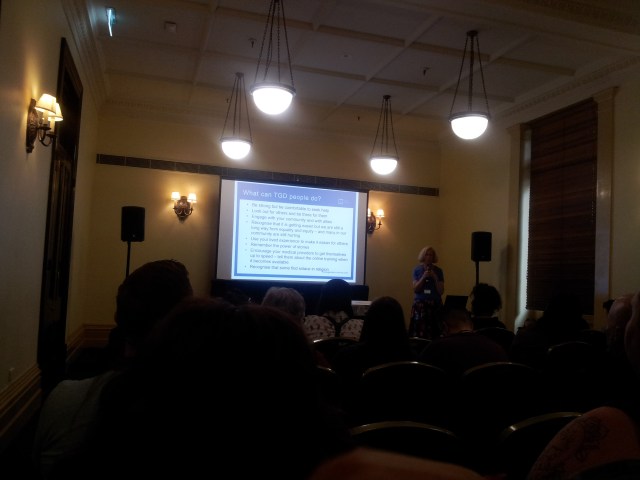
Inclusive practices
We need to remove systemic barriers
There are no LGBTIQ/TGD mental health programs at state, national, local levels. Nothing to address it. Nothing changes. What needs to be done?
A LOT!! URGENTLY!!
…suicide, self-harm, eating disorders. 48.1% attempt suicide by 25 years old.
Trans and Gender Diverse (TGD) people can
DON’T PUT THE BURDEN ON US TO BE EDUCATORS
Families can do:
What needs to be done short term?
What needs to be done medium term?
What needs to be done long term?
A network of BI+ within queer community. 22 members, 3 aims:
Triple Bi-Pass show – listen to podcast episodes
Discussion:
Full session talk and slides here:
http://www.abbi.org.au/2018/01/the-lgbti-community-and-the-christian-church/

Ask of four faith leaders – what do you do at your church?
Beck Bower – Northern Inclusive Church
You have more friends than you know. You don’t have to surrender yourself to your faith. was at the Justice Conference…. this is a better conference. You are preaching a powerful message. I try not to do anything different on the basis of someones sexuality. Someone comes and asks: My son is trans, he’s 8 years old – will you baptise him? Yes. want everyone to be their most authentic self. want people to find belonging in a faith community that supports you when you need support. You are loved. Listen to people and love people, support people. Answer any questions… can you help me find a friendly/understanding hairdresser? What does the bible say about people like me? Transgender Vic/Family… our church tithes 10% of its income to these organisations. Acknowledge we don’t have all the answers.
Rev Susan Townsend – Metropolitan Church
Everyone created equally Psalm 139 – loved and cherished just how they are. All CC churches. Participate on Board, as pastors, community volunteers. Angel – studies re how churches can be more inclusive. Pronouns on our name tags, gender neutral bathrooms at conferences. Language for non-gender God, use the word siblings not brother/sister, etc. Acknowledge Intersex Remembrance day.
Rabbi Jonathan Keren-Black – Leo Baeck Centre
Progressive Jewish movement – readings, Torah, Prayer books use non-gendered language and move away from King/Lord/Master language. Have a statement on our handouts – “people of any religion and sexual identity welcome” Religion needs to change to become progressive religion. All are made in the image of God and the essence of God is within them. Love is a response to God’s presence in the world, irrespective of who its between. Progressive Rabbis – post-plebiscite… asked for legislation to be passed immediately. Been conducting same-sex commitment ceremonies in last 10 years… not a queue of people waiting to marry so far. Daughters of Israel and sons of Zion > binary language. Need to drawer from those elders you admire.
Sedat Annis/Omis (sorry I’m sure that’s spelt incorrectly!) – Buddhist Order
To develop greater and great depths of compassion is the path: intention – generosity, kindness… founder was gay. Becomes meaningless when you are fully embodied/authentic self. we do meditation and study in gender groups. Join whichever one you feel is the authentic you. when events are male/female… if you are non-binary, which do you go to? Retreats and events are mixed now so that it doesn’t matter.
Ask of four trans people: how does my faith support my trans/gender journey and personally?
Michelle – 40s, autism, Christian, queer-trans, work at a bank. Grandfather was a Sydney Anglican. I have a theology degree. Good man or woman of God. Melbourne affirming and inclusive. Attend Fitzroy North Community Church. I’m wonderfully and beautifully made and they love me. Life of Jesus… I’m a human person like he was… inclusion, acceptance, kindness, compassion. Don’t have to wear a mask or pretend to be something that I’m not. There are people like me in the church that don’t have the love and support that I have had – they don’t know how to come out/live their truth and maintain their faith. Be patient and tell stories. This works. It’s not contrary.
Nero – artist, author, faith/spirituality, mental health, Jewish culturally but not by religion. Language, food, art, community. Judaism and trans not conflicted. Not just tolerant but embracing… if I want to live immersed in Jewish community need to be south, if with my queer community need to live in the northern suburbs. I have to choose who I’m close to. I do speeches with my Mum to more conservative Jewish audiences – went back to my school King David. Have a Facebook group:Here, queer and Jewish…don’t have to choose in this space. Have Sabbath dinners with this group. Need faith along the journey for mental health and wellness.
Terry Anne O’Donnell – “Why did You make me like this?!” years of pain/considering suicide.”Why didn’t you give me a girls body?” Left-handed, dyslexia, called dumb at church, a sinner and a cissy. Took a long time to know I am loved just as I am. Feels like yesterday but it was 1997 when I started that process. T.I.L.G.B.Q.A Diana West, Christian faith. Bullied to ‘toughen you up’. You need to find a Trans-elder… they guide in challenges and have love in their hearts. Be kind to those who are angry/hurting. Sometimes you need to walk on/move on. Became homeless and metstreet church crew who feed those on the street. Show people you have a faith people can get up and walk to.
Michelle – gay monk came out. can change faith communities – work with them to change. Of the four church leaders here the three females are all lesbians. It’s about becoming and living as your authentic self.
What are some of the roadblocks?

It’s a new day and I like it.
Soft folds of cotton wool mist crept in while we were sleeping and I don’t ask:
“What is out there?”

but:
“What might be out there?”
As the shrouding evokes wonder and possibility.
The noise of the world seems slightly muffled and its bustle muted.

Maybe in our bruised and weary brokenness God says I will hold you tenderly in cotton wool today and hold you safe.
A whimsy perhaps of my battered brain.






 itellyouarise