
What words are here?
What silence?
I brought hope and fear with me
I yield both to You
And still have eveything.
What words are here?




Come. Sit here beside me.
Away from the city. Be re-created.
That is what this space is for. Re-creation.
Tune in. Listen.
Who are you now? Who were you Made to be?
Listen.
Its calling you.
Its calling you by name.
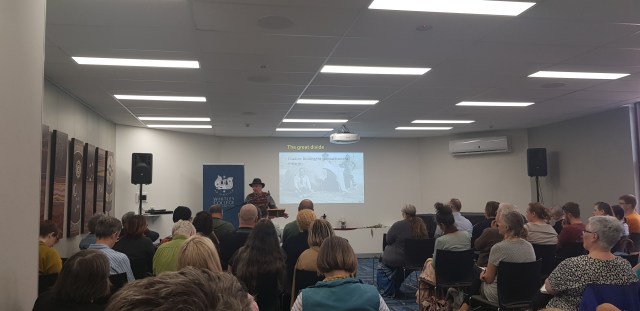
Uncle Dr Terry LeBlanc: ‘Native perspectives on Land and Place’
We are all related. Connected together. We touch one another with life lived on the land together. Interrelated and interdependent with the land.
NAIITS stands for North American Institute for Indigenous Theological Studies, partnering to become an indigenous learning community here at Whitley.
The land is not to be feared or conquered but is part of us. Adam (adamah – earth) red dust on the ground. We are dust. We are the same dust.
THEOLOGY OF LAND
The Great Divide
Invited to do a welcome to Christian and Muslim refugees in Canada and was able to say: As I’ve welcomed the 500 years of refugees represented behind me I also want to welcome you. I’m sorry you’ve had to flee violence, to lose connection to the land of your ancestors.
Place – security, growth, wonder, sights smells… experience what God has for us in this place.
Utilitarian View of Land
Colonisers saw indigenous people as godless heathen savages. We can do this to Muslims still – see them as godless people of a godless land but this isn’t truth. This belies a faith that says God is everywhere and all are made in the image of God.
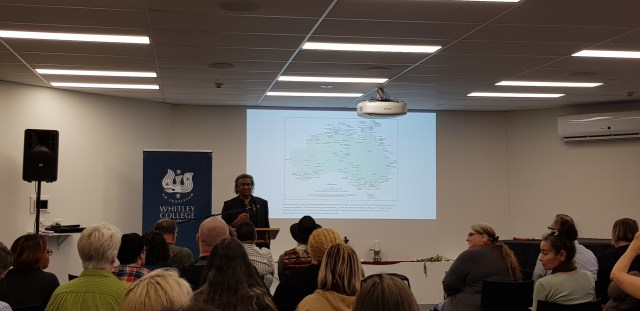
Uncle Rev Ray Minniecon: ‘Walking the Land’
How as people and pastors can we operate to be authentically indigenous and authentically Christian? I ask myself these questions:
We are always in search of our people. We meet and tell our stories. Sometimes our great, great, grandparents lived at the same mission. Did they have other brothers and sisters? We don’t always know. People from a different family, from a different mob, from a different country might hold part of our story that hasn’t been heard.
I am confronted by racism everyday. I have learned how to have faith and to draw on the strength of the ancestors… ‘so that your faith might rest not on human wisdom but on the power of God’. (1 Cor 2:5). This includes church who continue to exclude us. I’m invited to speak about aboriginal issues but not to preach the gospel. That is why I started a little congregation in community at St John’s Anglican in Glebe called ‘Scarred Tree Indigenous Ministries‘. We are grateful to work on land that has the last Scar Tree in Sydney CBD. It is a way for us to connect to our history and to the gospel. we have to confront Australia’s history as a church, neighbourhood and community. we would lose our minds, selves, souls if we don’t stand up.
TALKING CIRCLES
Someone in our group shared their story adding, “when you don’t know who you are, there are no reference points.”
Psalm 68:5-6 (NIV)
5 A father to the fatherless, a defender of widows,
is God in his holy dwelling.
6 God sets the lonely in families,
he leads out the prisoners with singing
God as Father gave me a sense of who I am. Knowing this, no one is a mistake. Then I had a moment on country in a park with sunlight… I knew I belonged to the land and felt known. Mother (Nature) – living and breathing.
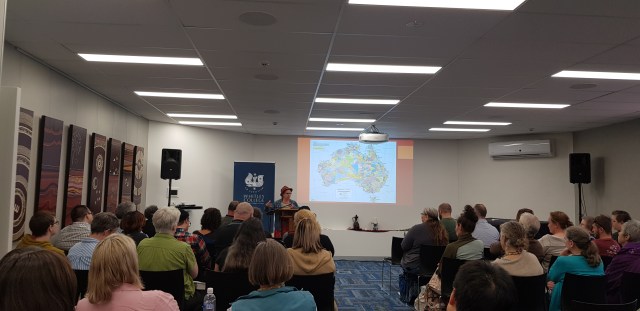
Aunty Rev Patricia Courtenay: ‘Aboriginal spirituality in an era of displacement’
IDENTITY
Where did I grow up? What country is that and what language is spoken there?
ASSIMILATION
RESPONSES
Our language is not ‘lost’, our home is not ‘lost’, we are disconnected from them.
Why would you want to identify as aboriginal?
I am supported, protected and reminded who I am by my ancestors and totem animals. My strength is in my spirituality.
How can you identify as Aboriginal and a Christian?
I can separate the faith of the missions from Christianity. There is a spiritual basis for this – acceptance of all – Jew and Gentile… 1 Cor 7:17-20. Live the life that the Lord has assigned… obey the commands of God in all things. You were provided identity at birth. Who were you called to be? Dualistic enquiry – I can be Christian without denying or giving up my cultural identity or heritage. Who I am is rooted in belonging and connectedness.
CULTURALLY SPIRITUAL WAYS OF KNOWING AND BEING
Aboriginal Australia still exists. When we gather and tell our stories ‘the land is speaking’. As guardians of the the land ‘we are speaking for the land’. The Creator Spirit/God’s relationship with indigenous people does and will continue to exist. Language, world views, etc. can be shared with those willing to listen.
CREATING AN AUSTRALIAN CHRISTIAN
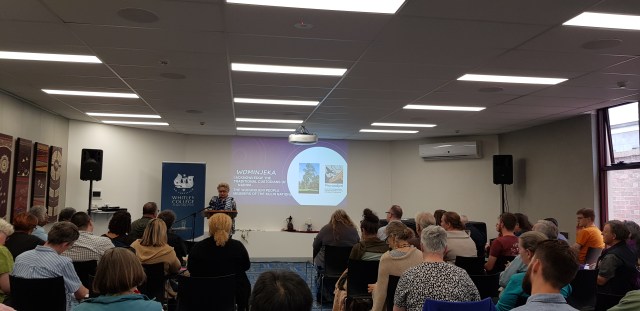
Aunty Rev Janet Turpie Johnstone: ‘Bunjil weaves past and future in the present’
Wominjeka – ‘we have come together for good purpose’
When we have shared stories and place, that goes with us when we leave.
Bunjil patterns the past and future in the present. We’re not Animist, we don’t worship animals but are related to them and to the river.
Can we live with the land and waters so that everything has a place to live?
Reconciliation:
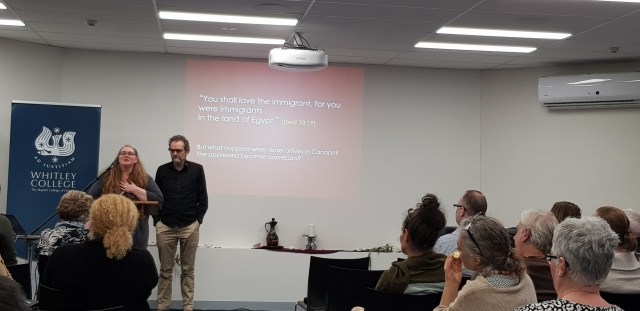
Professor Mark Brett & Naomi Wolfe: ‘Traditional Land and the Responsibility to Protect Immigrants: A Dialogue between Aboriginal Tradition and the Hebrew Bible’
“You shall love the immigrant, for you were immigrants in the land of Egypt” (Deut 10:19)
But what happens when Israel arrive sin Canaan? The oppressed become oppressors?
Indigenous mob don’t need a qualification to be who they are. But this partnership has arisen from an international journey and collaboration.
Strangers, immigrants, sojourners… it’s the story of people who took others’ land. If you don’t take care of the widow, orphans, migrants… you will lose your country.
Indigenous: country knows them, calls them home. There’s a kinship system and people are looked after. ‘no one should be left behind’
Jer 26: 8-9 and Jer 26:16-19 people hated what he had to say… except some elders. Not citing Deuteronomy but oral storytelling – there moral compass is somewhere else. In the Samaritan story, who do indigenous people see themselves as in the story? Where are the settlers in the story?
We’re all Gentiles. Settlers brought the thinking, they are the new Israel. They have the right to take the country. That’s wrong. They think they’re superior and that God is on their side. There is a theological problem with this logic. White people are not the new Israel.
There is an idea that our liberation is bound to native title, but that’s extinct in Tasmania. So what does freedom look like for those of use from there?
Reinterpreting our stories:
Every identity therefore is a construction… a composite of different histories, migrations, conquests, liberations and so on. We can deal with these either as worlds at war or as experiences to be reconciled. Edward Said.
What next?
Reading the Bible as Israel is toxic for Gentiles. Colonised people are colonising.
Our beliefs are already here, we don’t need yours. Our sacred land is right here. Our text is the land – we hear it with our feet and our hearts. It is broader and more inclusive.
We can have/give/build what was denied to earlier generations if we’re strong in culture.
Wonderful animation…
Bunjil The Creator: Bunjil’s Flight to the Stars
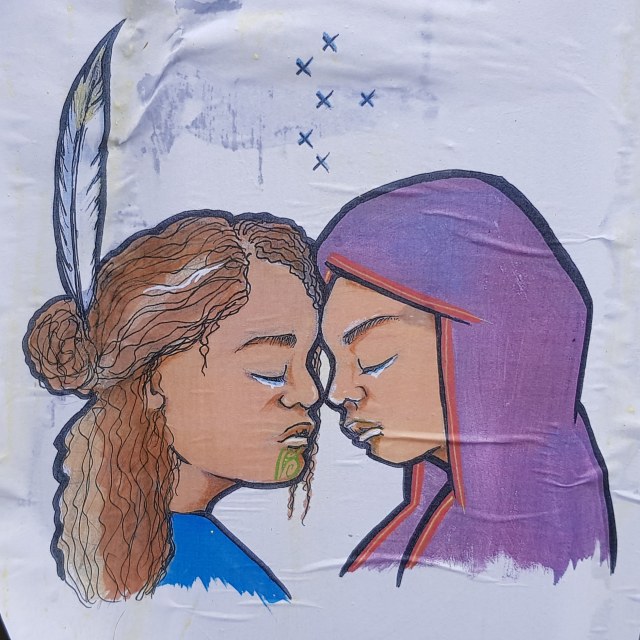
Paste up in Paraparaumu today

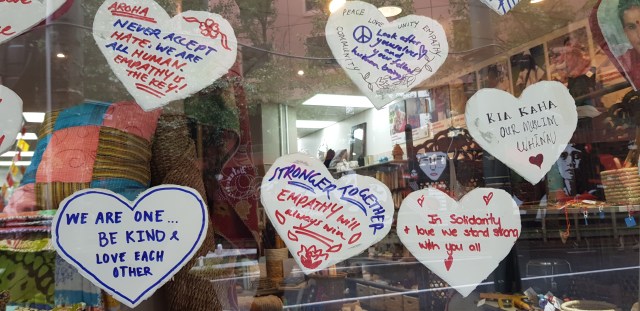
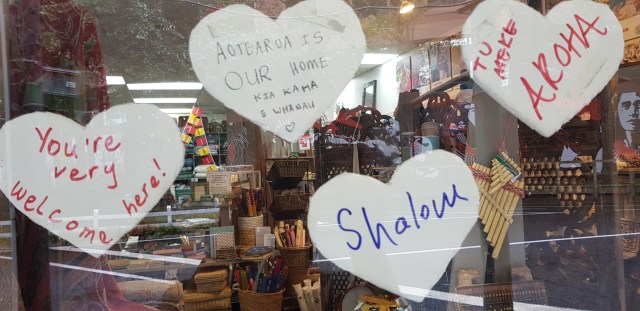
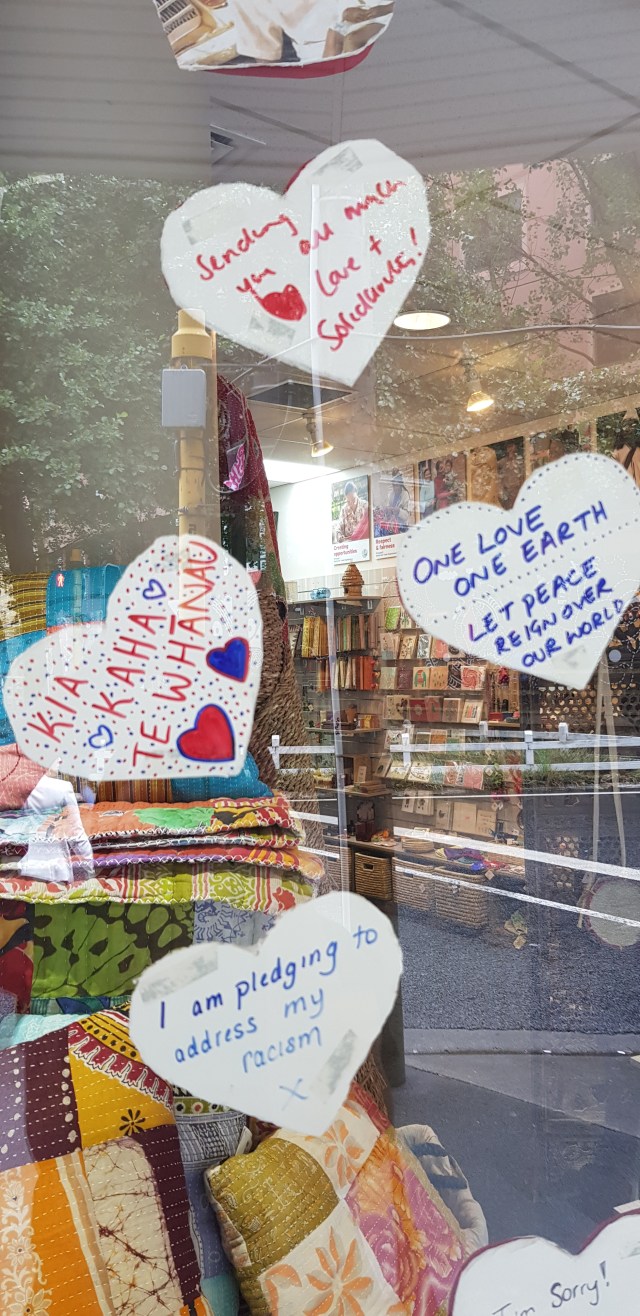
Kia Kaha Otautahi, Stay Strong Christchurch, is a recurring theme in the outpouring of grief and love happening in New Zealand in response to the attacks of 15 March 2019 at the Al Noor Mosque and Linwood Islamic Centre that killed 50 and injured 50 more.
In the Christian tradition this is the season of Lent, a time to remember Jesus’ 40 days and 40 nights in the desert. The word “Lent” comes from the old English, “lencten,” which means “spring.” What struggle takes place in this desert? What are the questions we wrestle with? What are the demons we wrestle with? What spring might arise in this desert?
The saying “Kia Kaha Christchurch” came into use after the earthquakes in 2010 and 2011 that decimated the city centre and in which many lives were lost. It was used by committed friends and family to affirm and encourage each other in rebuilding their lives and their city. We say ‘stay strong’ because the people of Christchurch are not strangers to death or loss, nor resiliency.
We say ‘stay strong’ because members of our Muslim community and all people of colour face experiences of racism, hate speech, violence and vilification every day, those of Muslim faith are not strangers to death or loss, nor resiliency.
We say ‘stay strong’ calling everyone impacted into the best truth of ourselves and our beliefs because we all know that it is easier in these times to hate, and be angry, than to love. And we rise.

Rallies against racism, vigils and tributes of flowers outside mosques are happening across New Zealand and around the world. Faith leaders of different religions, Muslim, Jewish, Sikh, Buddhist, Christian, and Hindu, lead these gatherings in prayer in many different languages.
 A mere two days after the shooting, the Islamic Council of Victoria go ahead with their annual mosque open day – opening their doors and sharing with guests their faith and culture. Opening their hearts to those grieving and with questions to which no one knows an answer, like: ‘Why did this happen?’
Their own hearts must be sore and grieving, and their actions speak yet to welcome, hospitality and courage. Choosing this, is spring.
Australian social commentator Waleed Aly in a poignant statement shares that the gunman was greeted “Welcome, brother” upon arriving at the mosque, those within were gathered kneeling, in silent communal prayer. They would be facing Mecca and have their backs to the door, unaware of any danger. And they will do this next Friday, and the Friday after that, and every Friday. Jacinda Ardern, the Prime Minister of New Zealand, has announced that today’s Muslim call to prayer will be broadcast nationally on TV and radio and a two minute silence will be held as, nationally, we want to reclaim and hold that space as safe and sacred. We say ‘stay strong’ but this doesn’t mean you have to do it on your own. We know we are stronger together.
Choosing this, is spring.
 “In the bonds of love we meet” (cover image) is a line from New Zealand’s national anthem and is on the banner I carry to a vigil. It is a signal to other New Zealanders where I am from and many give that head tilt of acknowledgement or stop to say “kia ora”.
The vigil leaders say from the front: “If you’re comfortable, hug or shake hands with the people nearest you” and, in this moment, in hugging one Muslim ,I feel I am hugging all Muslims; to hug one Kiwi, it feels I am hugging all Kiwis. Choosing this, is spring.
The vigil is over and people are drifting away to make their way home. A remnant of us gather to sing: people of different faiths, different cultures, speaking different languages. We sing for over an hour… Te Aroha (see image above for lyrics), the NZ national anthem in English and Maori, John Lennon’s Imagine, and Dave Dobbyn’s Welcome Home. (written in response to seeing anti-racism protests in Christchurch back in 2005). His words and melody are just as now poignant as they were then. What an extraordinary and beautiful thing to come of something so awful. Choosing this, is spring.
Meet in the bonds of love. Stay strong.
Choosing this, is spring.
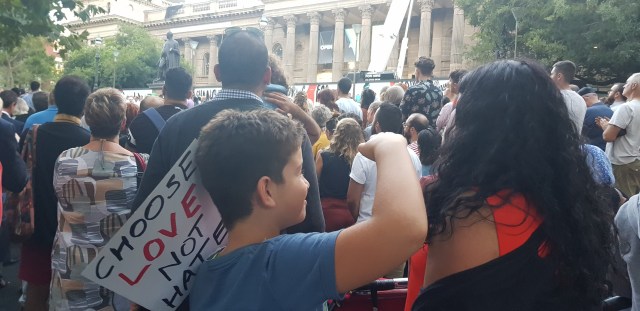
Images and moments from the Christchurch vigil in Melbourne hosted by the Islamic Council of Victoria at the State Library… #chooselovenothate
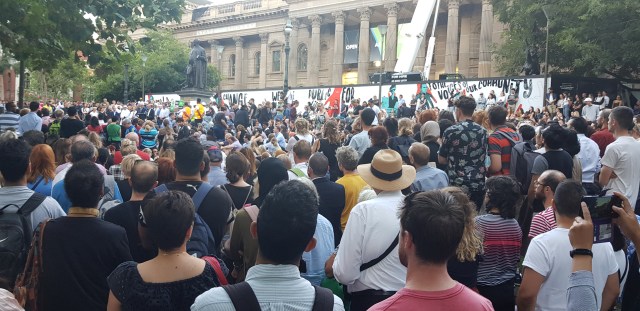
Muslim, Jewish, Sikh, Buddhist, Christian, Hindu and other religious leaders led those gathered in prayer.
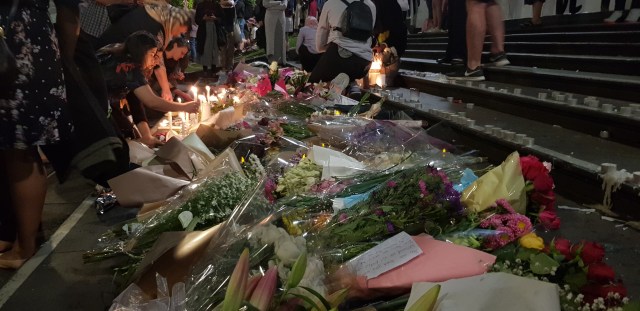
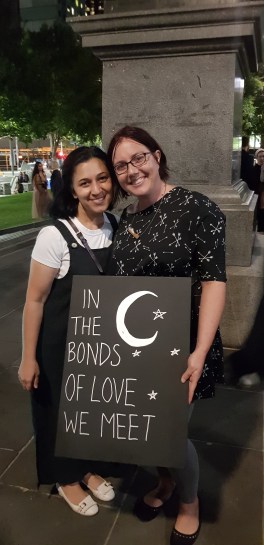
K and I meet early in the vigil when she invites me to stand with her family.
K: I think New Zealanders are taking it harder actually. Muslims… we’re used to it. When I first heard, I assumed it was Muslims against Muslims. I guess we’re desensitized maybe. Things like this happen to Muslims all the time.
T: But how awful… that this should happen so often that you could become desensitized to it. Things like this rarely happen in NZ.
K: For us, they are all martyrs.
T: Is it an honour, to die this way?
K: No… It is still a pain. It means a lot that New Zealanders feel that with us… are you from Christchurch?
T: No, Wellington. But I still feel it. What you need to understand about us is that once you’ve welcomed someone onto the marae, they’re not a guest anymore – they’re family. I don’t need to have ever met them. This week all New Zealanders grieve because we have lost members of our family.
…we hug, and stand together through the vigil.
They say from the front, if you’re comfortable, hug or shake hands with the people nearest you, and in this moment: all Muslims are hugged, all Kiwis are hugged. I hope you feel that.
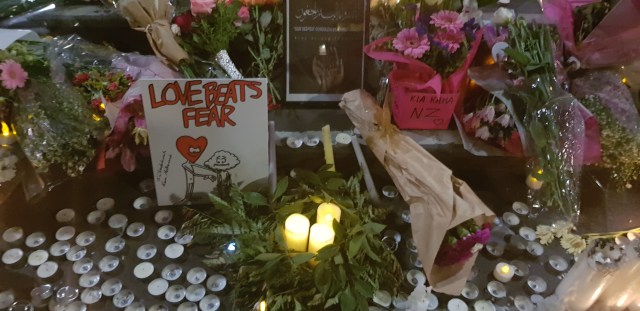
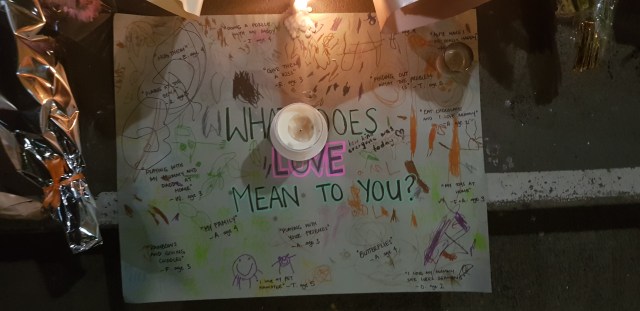
A group of us sing – Muslims and Kiwis together… Te aroha, the national anthem in English and Maori “…in the bonds of love we meet“, Dave Dobbyn’s Welcome Home and John Lennon’s Imagine… what an extraordinary and beautiful thing to come of something so awful.
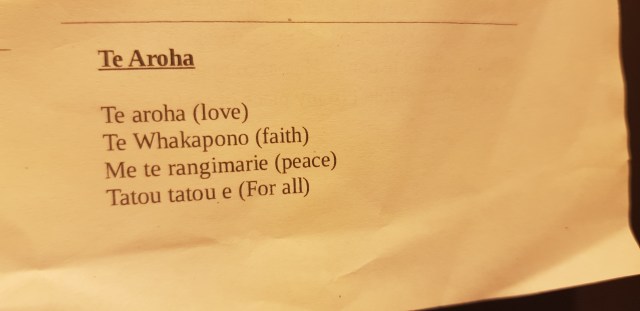
Tutira mai nga iwi, (Line up together, people)
tatou tatou e (All of us, all of us)
Tutira mai nga iwi, (Stand in rows, people)
tatou tatou e (All of us, all of us)
Whai-a te marama-tanga, (Seek after knowledge)
me te aroha – e nga iwi! (And love of others – everybody!)
Ki-a tapatahi, (Be really virtuous)
Ki-a ko-tahi ra (And stay united)
Tatou tatou e (All of us, all of us)
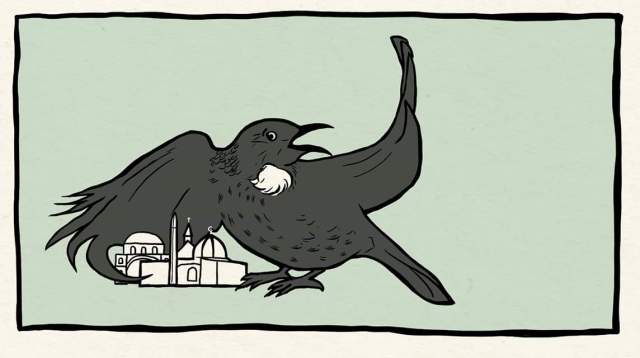
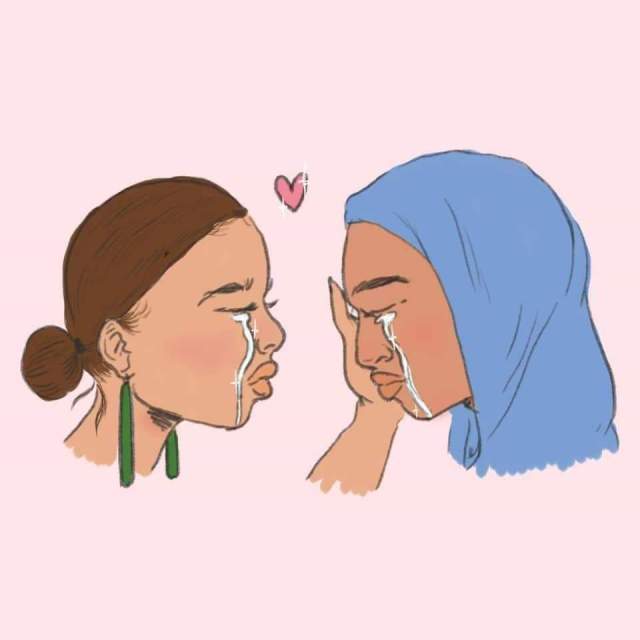
Artwork by Rowena Fry
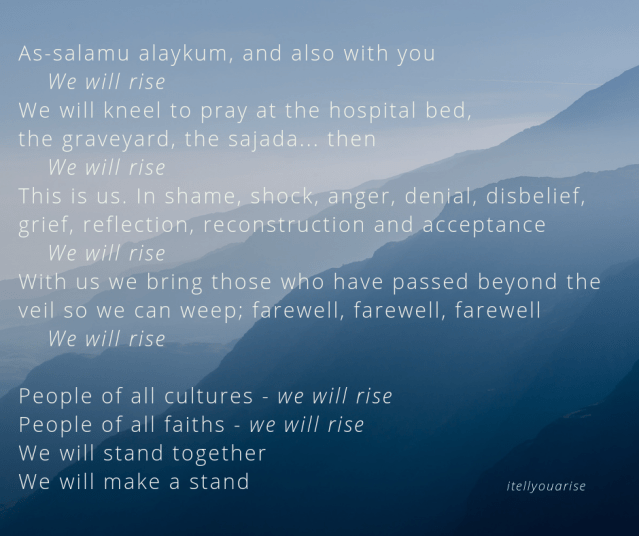
 itellyouarise