By Lydia Wylie-Kellermann. Published in Geez Magazine‘s most recent issue on Gender Flex.
“Mommy, baby is tired. I need to put baby in the pack and walk,” says Cedar, my two-year-old. I quickly design a make shift baby carrier tying his baby doll to his stomach. He walks back and forth across the house and then stops and sways. After five minutes, he heavy sighs and says disappointedly “baby is still awake.” He walks on mumbling to himself about how baby needs his milk and how the baby is too little to drink water out of a cup and baby just needs his milk.
There are times in life
when we are called to be bridges,
not a great monument spanning a distance
and carrying loads of heavy traffic
but a simple bridge
to help one person from here to there
over some difficulty
such as pain, fear, grief, loneliness,
a bridge which opens the way
for ongoing journey.
When I become a bridge for another,
I bring upon myself a blessing, for I escape
from the small prison of self
and exist for a wider world,
breaking out to be a larger being
who can enter another’s pain
and rejoice in another’s triumph.
I know of only one greater blessing
in this life, and that is
to allow someone else
to be a bridge for me.
The characters in this story are 5 and 6 but it is WAY to scary for kids that age (Badjelly turns kids into sausages). Spike Mulligan does all the voices in this creative and absurd story and there’s a fairly intense soundtrack (fyi his work was a big influence on the Monty Python crew). Essentially little kids Tim and Rose wander into the woods after their lost cow Lucy and meet various enchanted woodland characters like Binklebonk and Mudwiggle… OMG a rumour website tells me Tim Burton might be making this into a movie 2020 – that could be fun… stinkypoo and knickers of fun.
Folks might also remember one of his most famous nonsense poems and a good example of his style:
On the Ning Nang Nong
On the Ning Nang Nong
Where the Cows go Bong!
and the monkeys all say BOO!
There’s a Nong Nang Ning
Where the trees go Ping!
And the tea pots jibber jabber joo.
On the Nong Ning Nang
All the mice go Clang
And you just can’t catch ’em when they do!
So its Ning Nang Nong
Cows go Bong!
Nong Nang Ning
Trees go ping
Nong Ning Nang
The mice go Clang
What a noisy place to belong
cause it’s the Ning Nang Ning Nang Nong
Aah, like so many of the great lights of comedy it seems Spike struggled with nervous breakdowns and depression… this piece is called “Manic Depression” and is very evocative. Vale Spike Mulligan – we are grateful for your silliness and sensitivity and the gift of your art.
The pain is too much
A thousand grim winters
grow in my head.
In my ears
the sound of the
coming dead
All seasons, all same
all living
all pain
No opiate to lock still
my senses.
Only left, the body locked tenser.
If nurture (per the nature/nurture debate) is to be weighed with me then the moralistic Serendipity book series by Stephen Cosgrove might have something to answer for. I recall a box full of them, a rainbow of spines, and particular favourites I asked for on repeat – perhaps some morals I was more interested in cultivating than others.
It’s the illustrations that bring the series to mind now more than the stories. Something of a vibrant, sumptuousness, with their wide-eyed woodland creatures and forests.
The wiki entry for the series has a list of the lessons from fairly basic ideas such as “You are special” and “Don’t take more than you need” to things that seem complex to think on explaining to a child now… “when we exaggerate everything, we forget what the truth is” and “fear of losing what you have can rob you of the joy of sharing”. Though my adult brain wants to presume they’d be trite to read now maybe they still have something to say after all that would speak yet to our times.
Incidentally, one of the fun things about rummaging through my brain archives and trying to find sources for half-forgotten stories is learning things I never knew about them in the first place such as that these books inspired episodes of an anime series in 1983 combined in a movie here. I’ve just watched the first 20 mins and I’m not seeing much resemblance but you know… fascinating.
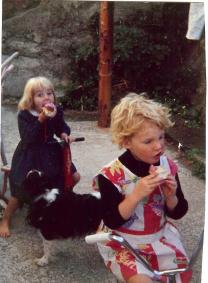
This is me with my very best kindy friend Hannah. I remember reading to her sometimes… Meg & Mog or Spot books. I imagine she thought I could read, I’m pretty sure I thought I could too but I’m certain now I only thought I could and had just memorised them off by heart.
The anticipation of lift-the-flap books and the sound effects of Meg’s spells going wrong…
“Fog in a bog, Bat in a hat, Snap, crackle, pop And fancy that… BOOM!”
…height of entertainment when you’re 4!
Now, Where’s Spot? And where’s my pink sticky bun.
As I recall I came across Miss Mary Mack Mack Mack Mack in one of the School Journals … oh, man, school journals! The author of this piece seems to be unknown but this is a suggested origin… “slave children were taught corn ditties (the original name for Negro spirituals) to take their young minds off harsh plantation life. They would work & clap their hands in rhythm while singing. Miss Mary Mack was symbolic in that the Merrimack was an ironclad Union ship coming to fight the confederate army. It built with rivets (silver buttons) & ships have always been referred to as females. There is also symbolism behind asking her mother (the Confederate States of America) for fifty cents (a metaphor for change) to see the elephants (symbol of the Republican party who “freed the slaves”) jump the fence (Mason-Dixon line).”
Miss Mary Mack Mack Mack
All dressed in black, black, black
With silver buttons, buttons, buttons
All down her back, back, back.
She asked her mother, mother, mother
For 50 cents, cents, cents
To see the elephants, elephants, elephants
Jump over the fence, fence, fence.
They jumped so high, high, high
They reached the sky, sky, sky
And they didn’t come back, back, back
‘Til the 4th of July, ly, ly!
Here’s a cute Dad and Daughter video if you want to teach/learn the clapping routine…
In the middle of our porridge plates
There was a blue butterfly painted
And each morning we tried who should reach the
butterfly first.
Then the Grandmother said: “Do not eat the poor
butterfly.”
That made us laugh.
Always she said it and always it started us laughing.
It seemed such a sweet little joke.
I was certain that one fine morning
The butterfly would fly out of our plates,
Laughing the teeniest laugh in the world,
And perch on the Grandmother’s lap.
We will teach our children justice. This is a beautiful story by Lydia Wylie-Kellermann for her son… and her Dad. If you are thinking, why go to protests? …why resist? the answers are here.
I wrote this as a children’s book for Isaac during the Poor People’s Campaign. He was very concerned about why Grandpa kept going to jail when we were also teaching about how we dont believe in jails and prisons. So, I wrote this to try to explain it to him. We printed it out and he and Cedar and Ira and their friend helped illustrate it as a birthday gift to my dad.
Why is Grandpa in jail?
We don’t like jails. We think they shouldn’t exist.
If people make bad choices, there are better ways to help them be better.
Talking.
Caring.
Paying attention to what they need.
Teaching.
Loving.
Locking people up for years of their life only….
Takes them away from their families.
Makes people feel lonely.
Takes them away from the sun and the trees.
Amelia Bedelia gets a job as a maid and, although she’s well-meaning and tries her best she gets everything wrong (by following the instructions literally) and then is forgiven because she bakes.
I see a lot of myself in her.
It’s dated, but I definitely identified with poor Amelia Bedelia getting things wrong all the time… like the time I said scathingly if I won Lotto I wouldn’t spend the money on a pool because it came from ‘a total prize pool of…’ obviously I’d already have a pool and want to send the money on something else. Or when I was told what someones birthday present would be and entrusted to keep it secret, I could somehow never manage to keep the secret if they said they’d keep it too, somehow that made complete sense to me and I’d inevitably spoil the surprise. There was definitely a moratorium on telling me anything for a few <cough> years there.
The same way children delight in the seeming magic of the Knock, Knock joke. This was some of my first exposure to the idea of words having different meaning depending on your perspective because Amelia Bedelia wasn’t technically incorrect but was somehow always in the wrong… Oh Amelia Bedelia.


 By Lydia Wylie-Kellermann. Published in Geez Magazine‘s most recent issue on Gender Flex.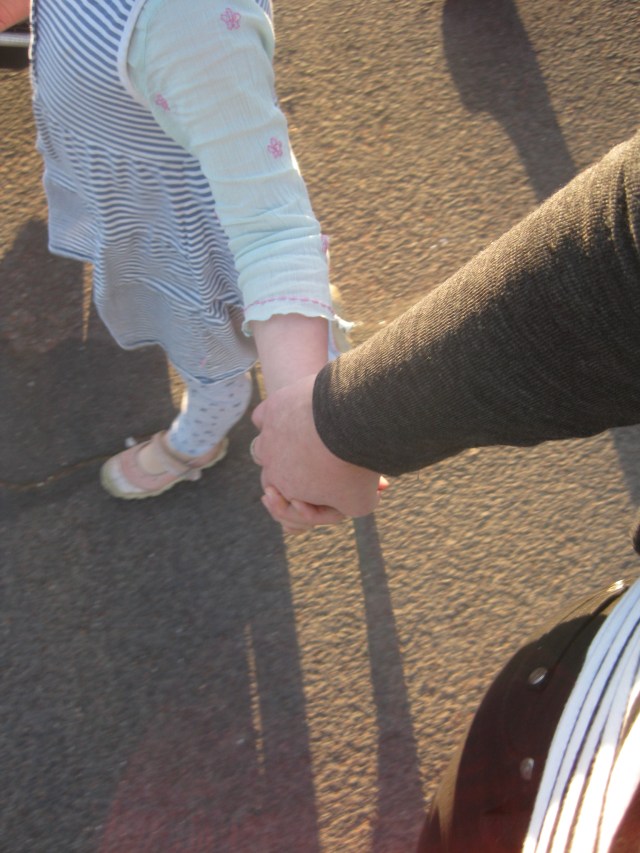
 If nurture (per the nature/nurture debate) is to be weighed with me then the moralistic Serendipity book series by Stephen Cosgrove might have something to answer for. I recall a box full of them, a rainbow of spines, and particular favourites I asked for on repeat – perhaps some morals I was more interested in cultivating than others.

 This is me with my very best kindy friend Hannah. I remember reading to her sometimes… Meg & Mog or Spot books. I imagine she thought I could read, I’m pretty sure I thought I could too but I’m certain now I only thought I could and had just memorised them off by heart.
 Miss Mary Mack was symbolic in that the Merrimack was an ironclad Union ship coming to fight the confederate army. It built with rivets (silver buttons) & ships have always been referred to as females. There is also symbolism behind asking her mother (the Confederate States of America) for fifty cents (a metaphor for change) to see the elephants (symbol of the Republican party who “freed the slaves”) jump the fence (Mason-Dixon line).”
 By Lydia Wylie-Kellermann
 itellyouarise