Latest Entries »

IMG_5252

[n.b. this is communion and collection at the same time]

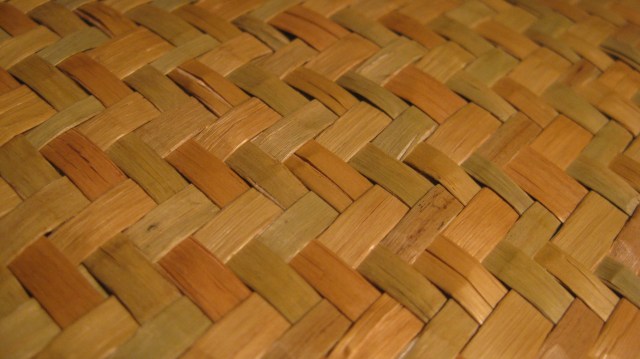
What’s this I’ve got here? (holding basket/kete)

What’s it made of? (grass/flax)
I’ve got a piece of grass here, is it strong? Pull it with me.  (it breaks)
What about this? (indicating the basket – pull, doesn’t break)
One strand of grass by itself isn’t very strong but the basket is lots of pieces woven together. So it’s strong. I can hold a lot.

Is there anything inside it? (let the kids come around and have a look, no it’s empty)

Let’s put some things inside.  What have we got to give to God today? (nothing?)
How are you feeling today? (invite children to reach into the basket with their hand and let go as they say how they’re feeling)
What news have we learned this week? (put in the basket)
What have you got to give? (include talking to adults) time? energy? money?  (put in my tithe) Maybe what we have is that we don’t have enough of these things, we can put that in the bag too. Everyone has something they can put in the basket, even if our something is our nothing.

Is it too heavy? (test it/pass it around children, not heavy)

Is it full?  (Children look inside, not full)

Room for more? (yes) Let’s pass it around the grown ups and see if the grown have anything they want to put in.  Grown ups you can say aloud what you’re putting in if you want but you don’t have to. Whether you have something in your hands or your hand is empty, everyone can hold, and reach into the basket.

Once it’s done the rounds, take it to the table where the communion is set up below the cross.  Rest the basket below the cross.

Jesus wants you to have this so you remember how much God loves you.  

We take everything we are, everything we have and bring it here to God.  Then we take the bread and the juice and we share them around – everybody gets some… Does [Molly] get all the bread while everyone is hungry? (No! We share it!)  Does [Simeon] get all the juice while everyone else is thirsty? (No! We share it!)

Does one of us get all the sad things that went in the basket? Or one of us all of the happy things? No.  We share it.

We bring it together then we share it out so I can taste your joy and share your burdens.

Jesus wants you to have this so you remember how much God loves you.

We can take that inside us and then when we take the bread and juice inside us, we have God’s love inside us and that way if my little brother gets hurt and I give him a hug, it’s like Jesus giving him a hug.

Today when we give out the bread and juice – don’t wait, don’t hold on to them – gobble them right up and take that in.  (pass around the bread and juice)

Let’s pray…

God, we bring this stuff to you, all mixed up together. Thanks that we can bring you the good stuff and the bad stuff, those things where we have lots or not enough.  We are grateful to share life with You and with each other.  Please use all these things  we give You to make the world a better place for everyone who lives in it. Amen


Facilitated by Mehrin Almassi from the Indigenous Hospitality House, in this bible study series we will seek to make connections between the story of the nation of Israel told in Lamentations and our own national story. We will look to see whether this book may help us to address our shared histories of displacement and endeavour to distill how we might move forward as a nation in light of the biblical example.

Connection to Creator (Spirit)

What do we think of when we hear the word Spirit? What do we think of when we hear the words Spirit of God?
What do we think about when we hear the term Creator Spirit?
What do we think is meant by each of these phrases? Are they related? Could they be?

Read Lamentations 3

Did the Israelite people have a sense of the Spirit of God – the Creator Spirit?
What was God like for the people of Israel? What was their experience of relating to God?
How do we relate to and/or experience God? Is our experience different to that of the Israelites? If so, can we think why?

Let’s read the Boon Wurrung Story.

What might this story teach us about the way the Boon Wurrung people experience the Creator Spirit?
What may this story teach us about the importance of our own stories in relation to local, national and international issues?
How else might we apply important narratives of the past to current situations needing attention?

Kids Activity

In parallel to grown ups run a kids session: talk about pictures as stories, songlines and place.

Will need:

  • messy clothes (if painting)
  • paint and brushes and/or lots of sticky dot stickers
  • paper
  • photos (bring along some or a camera to take some on the day)

What do you like about stories?
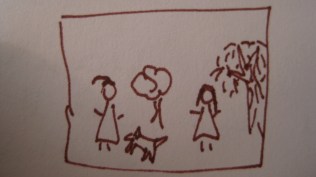
Look at this image? What is this a picture of?

IMG_6499


(girls, dog, trees…)

This picture tells the story of the time Talitha and Bron went to the park with Gracie.

11834903_10153063761386868_8866957583155349394_o

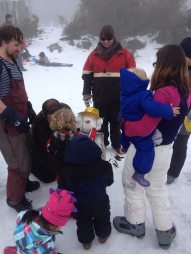
 What about this image? what’s happening here? who was there? but they aren’t in the picture… how do you know they were there?

(pictures can capture a “moment”, some part of a bigger memory, tobogganing and snow angels, other friends… reminder of something bigger that we can no longer see)

Pictures have two things, a place and a “happening”.

Using your pictures so far, talk about where they are happening and what is happening.

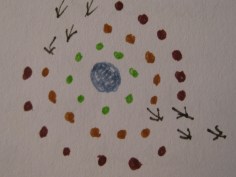
IMG_6501Indigenous stories tell something about a place and also about something happening there.
WHERE: Maybe there is a waterhole (blue), things grow there (green), drier sand/soil as you move away (orange), day rocks (red).

WHAT: An animal comes to the watering hole and then goes (tracks).

Ask children to share a memory, a story, and make a picture – collectively or individually (age depending). Then ask of each: Where is your story taking place? What is happening there?

How would you feel if you couldn’t got there again?  If you couldn’t do that again? (sad)

Today the grown ups are talking about the story of lamentations – a lament is a sound of grief and sorrow.  That’s what people in the story did when they couldn’t go back to the place they remembered or do the things they used to do there.

Learning:

our stories and our pictures can be used to tell each other about places we haven’t been and things we haven’t done, remembering and reminders can comfort us when we feel sad

let’s take a photo now, today of all of us together, making and telling stories so that we have a memory-capture. It’s good to take photos and write stories and make pictures because they help us remember

take your picture now to a grown up – tell them your story – use things inside the picture and outside the picture


this, a little oasis

IMG_5187

this
a little oasis of
in between
that will not last
a hiatus
a breath
a moment
to be
made and remade
I am
sitting on a little
patch of earth
somewhere between
there and here
thinking
very little of anything

Talitha Fraser

grace

“You should share communion together,
it has a unique power to unite beyond words”
Peter (Chappo) Chapman

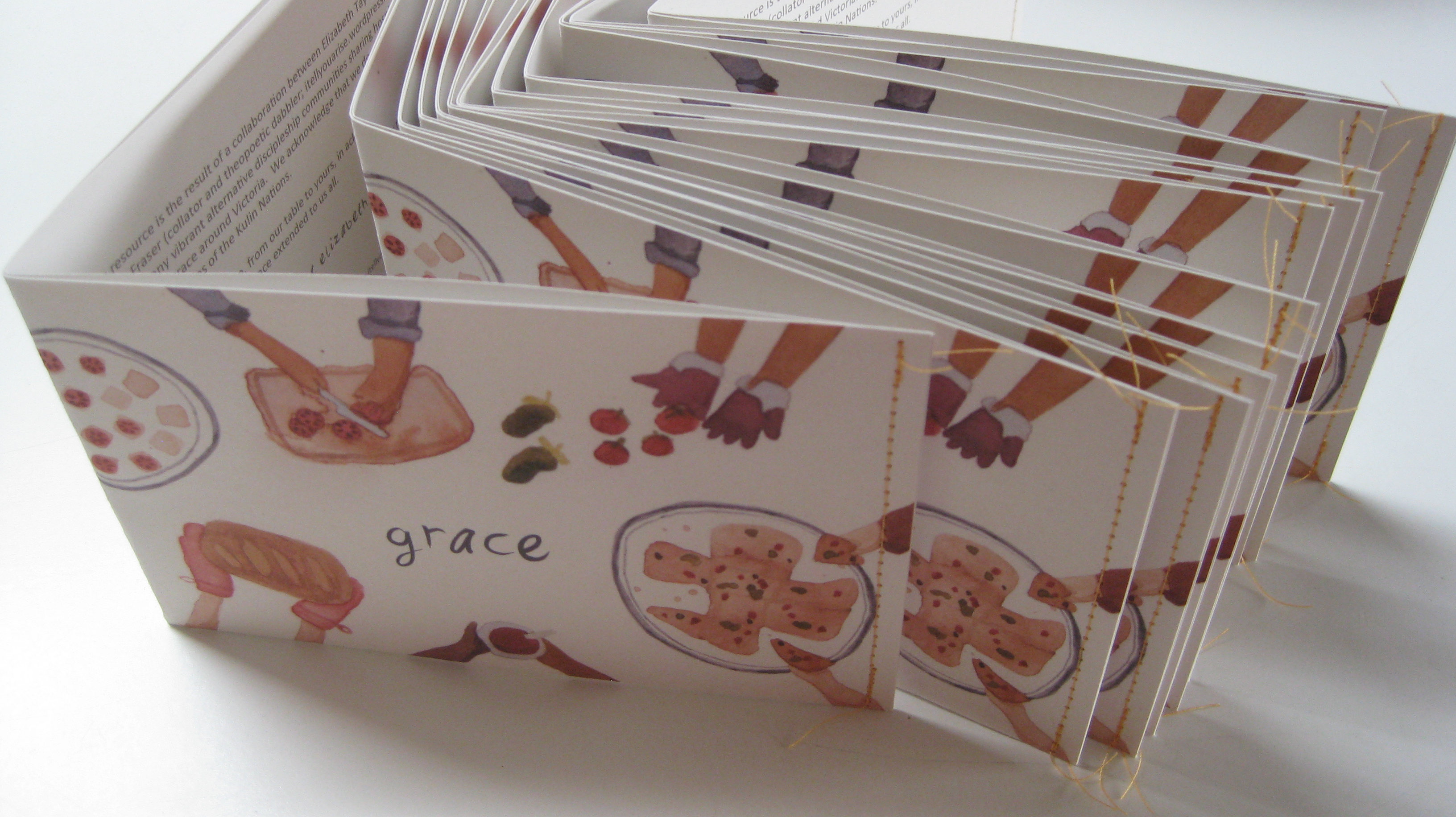
Very pleased to present this little number…

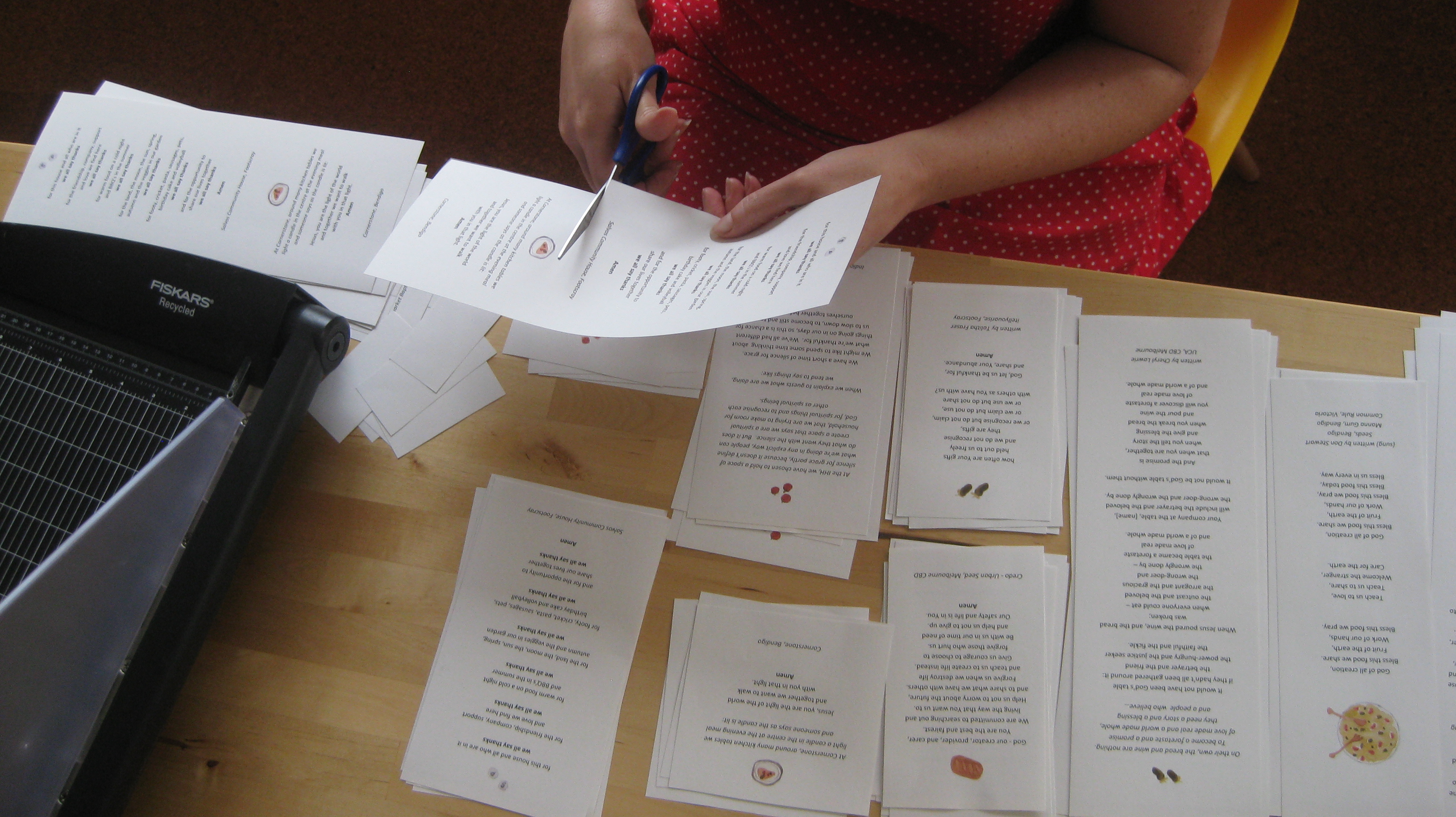
This resource is the result of a collaboration between Elizabeth Taylor, myself and the many vibrant alternative discipleship communities sharing hospitality and, indeed, grace around Victoria. Such as: Common Rule, Cornerstone, Footscray Salvos, GraceTree, Indigenous Hospitality House,  MannaGum, Missio Dei,  Newmarket Baptist Church, Seeds, The Cave & Transfiguration Community, UCA, Urban Seed and the many more who serve, share and speak grace spontaneously, silently or scarcely – you know who are.  We acknowledge that we do so on the land of the peoples of the Kulin Nations.

We decided to make this as a kind of snapshot in time of radical discipleship expression in and around Melbourne and to encourage one another – we don’t often get to get around the table together but we do go back to our separate spaces and share meals in community.

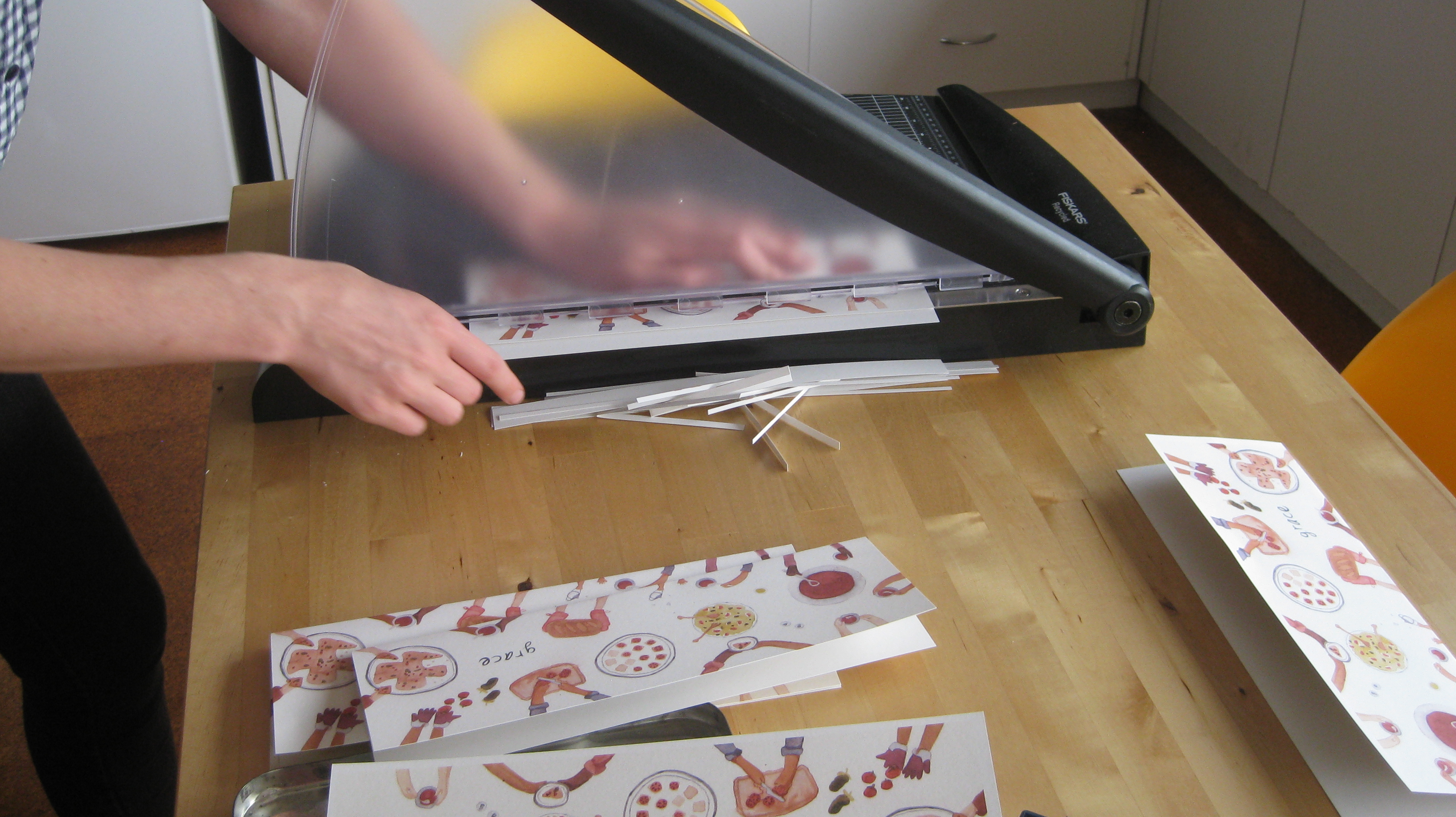
Elizabeth’s beautiful and colourful visual images were inspired by the language of the prayers, varied and lovely. Done in a loose watercolour style we are offered a birdseye view of a table full of food, with hands around the edges sharing and eating, different types of food, the hands that prepare and acknowledgement of the earth that produces.

We share this abundance, from our table to yours,
in acknowledgement and celebration of the bigger Grace extended to us all.

Free PDF (or LMS accessibility supported copy) available by request.

IMG_5172

IMG_5175

IMG_5173


IMG_5145

Facilitated by Mehrin Almassi from the Indigenous Hospitality House, in this bible study series we will seek to make connections between the story of the nation of Israel told in Lamentations and our own national story. We will look to see whether this book may help us to address our shared histories of displacement and endeavour to distill how we might move forward as a nation in light of the biblical example.

Connection to Place

What role does a sense of place play for each of us?
What is our connection to the environment?
What is our relationship with the land?

Are there any natural places which hold significance for you? If so, how do those places make you feel?
What happens to us when we are in a place which is significant to us?
What happens when we are unable to be in places which are significant to us?

Read Lamentations 2.

What can we understand of the Israelites’ connection to place through this narrative?
How connected do they seem to their places of significance?
what impact does not being able to access their important places have on them?

Listen to Kev Carmody’s song  This Land Is Mine.

How might the biblical account help us to appreciate the experiences of the First Peoples of this land?
In what ways might we help promote reconnection with land/place/environment for indigenous peoples? For ourselves?
How might this reconnection relate to indigenous people’s experience of God? How might it relate to our experience of God?


You persistently and insistently

353


You
persistently and insistently
speak love into my life
giving comfort and solace
even as I try to deny I need help
You see through me
You see into me, into my heart
and simply state ‘I love you’
no more or less than that
for me to respond or react
irregardless
You speak love into me
the medicine I don’t want to take
and need so desperately to live
there is no denying or demurring
You
persistently and insistently
speak love into my life
and I am grateful.

Talitha Fraser

Welcome, we acknowledge that we gather on the land of which the people of the Kulin Nations have been custodians since time immemorial.

This is our second in a series called The Art of Discipleship where we showcase the material of different books and engage with their material creatively.

WEEK TWO

The activity this week is taken from:

Christi-Anarchy: Discovering a Radical Spirituality of Compassion and you can read a little more about it here from the first time I read it if you’re interested.

This book by Dave Andrews goes into the fact that Jesus Christ preached a gospel of love and peace with justice but the history of the Christian religion is littered with every kind of evil – What went wrong?

Mediation:  Dave Andrews poem speaks to Jesus’ compassion, his hunger for justice,  and desire to work with marginal groups for real transformation in our world – inviting us to live this way too through the eyes of the disciple Peter.

The prologue of Christi-Anarchy: Discovering A Radical Spirituality Of Compassion retells Dave’s unfortunate history of being kicked out of YWAM many years ago.  This lays the foundation for the rest of the book – a grave injustice done in the name of Christ. At micro and macro levels…

The very first chapter of Dave Andrews book is called:

A History of Christianity: A History of Cruelty

And it’s broken down into 4 areas:

-Councils, Creeds & Coercian: ca. AD 100-500
-Emperors, Popes & Power: ca. AD 500-1000
-Crusades, Inquisitions & Control: ca. AD 1000-1500
-Worldwide Evangelism, Witch Hunts & Genocide: ca. 1500-2000

So you can see how this is not an easy read – to really ‘look’ at the history of the church (our church) and to try and grapple with how this relates to our own understanding of who Jesus was and the way that he lived.

What I’m hoping to create tonight is a bit of a meditation space reflecting on Dave Andrews words speaking to Jesus’ compassion, and his hunger for justice, his desire to work with marginal groups for real transformation in our world and inviting us to live this way too through the eyes of the disciple Peter – speaking into the disillusionment or cynicism we might sometimes feel towards our own church/discipleship movement.

To give you a bit of an overview about where this is going – you will want to make yourselves comfortable because I’m basically going to try and read this like a play/well… a monologue… and it’s going to take about 20 minutes – I’m going to make the room dark because I want you to try and  visualise the scene  and put yourself in  Peter’s shoes.  I’ll leave things dark and quiet for a few minutes while people reflect and then bring us back together for sharing/prayer…

IMG_5066

So, from the macro to the micro for Peter to set the scene and condense the bible into a paragraph… we know from the oral history passed down and recorded that the people of God were slaves under Pharoah, led across the Red Sea to freedom, wanderers in the desert and led across the River Jordan into the Promised Land – Jerusalem, they finally have their own sovereignty: a line of Kings: Joshua, Saul, David, and Solomon … who turns from God’s ways and the city is destroyed in Chronicles, rebuilt in Ezra,  and restored in Isaiah then a series of prophets come… the day is coming when Israel will be judged for its sins, prophesies of the birth of one to come… after Babylonion captivity, they are under the domination of Persia…IMG_5065

We fast forward 400 years between the
Old Testament and the new – and Rome is now the dominant power… Herod the “great” is slaughtering male children, under a star somewhere in Bethlehem a child is born, in a dark and troubled place…

Jesus is born – the next great political leader, descending of Kings, fulfilling the prophecies –  who would lead the uprising to free the people from Roman oppression and win back the independence of the Jews!!  Jesus says “Truly, this very night, before the rooster crows you will deny me 3 times” and Peter responds, “Even if I have to die with You, I will not deny You.” And all the disciples agreed.

Except that Jesus didn’t really behave the way people expected… didn’t lead the way we expected, fight the way we expected… died when we didn’t expect it

Arrested, disgraced and denied three times… Peter broke down and wept.

(here follows the reading of the poem, n.b. not complete in these images)

IMG_5051

IMG_5057

IMG_5058

IMG_5060

Reflection questions:

  • what thoughts/feelings are arising?
  • …since I read this on the internet it must be true: Palestine is the most fought-over country in the world, and Jerusalem is the most captured city in all history. It has been pillaged, ravished, burned and destroyed more than 27 times in its history… paradox of peace and conflict in this area…
  • What is Andrews’ Jesus role modelling here around community conflict? (e.g. promises we make and can’t keep) what pathways back to wholeness are role modelled here? (e.g. be honest with one another, share meals, communicate openly…)  What can you honestly and openly offer? What are our experiences of where this has worked/not worked well?

Time of prayer for ourselves and others.

IMG_5048


Wake up

My alarm went off at 7.30am. “Wha-?” Snooze.

Why did I set it early again? Not work… Oh. I remember I need to walk to Maidstone via an ATM to collect a network repeater I bought off the local Buy/Swap/Sell Facebook group.

The alarm sounds again. Snooze.

This is not how I thought my weekend was going to go… I had Friday/Saturday clear – maybe to write and have some sacred space. One housemate is away at a wedding and school holidays have started, things will be quiet around the house.  Yet somehow a conversation has started up about supporting a family of refugees who are staying in two rooms at The Palms. They’re approved for housing but the waiting list could mean anywhere between days and months or, let’s face it, months and years before a 5 bedroom place with disability access comes up.  At the motel they will run through their income for a fortnight purely on accommodation leaving nothing for transport and food.  It seems on Monday they will move in with us.

I wonder whether anyone might imagine that this is some extraordinary thing?

The room swap for my shift-working housemates’ peace may now be a bit redundant.  We have four bathrooms between three units which felt very luxurious not to have to negotiate, though to cycle through 6 new others might take some negotiation, similarly with the use of the kitchen when dinner is in progress.  My head keeps going through the details – need: beds, bedding, another fridge…

The alarm sounds again. Snooze.

…and more internet, which means a wireless signal repeater, which means you have to get up now and go and collect it.


The signal repeater is in place.  The signal is extending further than it did before but it’s not any stronger.

These are the the basic tenets of our faith: I was homeless and you gave me shelter, hungry and you gave me something to eat, disconnected and you gave me connection.

This is what we are called to.

Is how it will inconvenience us the place to start our discernment about it?

I believe in Your ability to provide not only the practical and material things but also for the mental, emotional and spiritual needs of our community.

I do not need to be able to see the way forward as long as I can see You in what we are setting out to do – trusting that You know all that has been, is, and will be.

This is it. Are you ready?


I confess I cried a little today, re-packing and putting away boxes I had unpacked with such gratitude only days before, to make space for the others coming.  I go and walk it off: “Who is this space home for? It’s called a’share house’, what were you expecting? I want to build a foundation that is strong. Rooted.  I have lived here two weeks. Who am I to extend safety and stability to anyone else?”

I turn up a side street to get home only to realise it is a dead end. I double-back on myself and notice a cane basket of clothes out as hard waste on the verge.  I pick it up and carry it with me… a physical manifestation of providence… feel the weight of this, touch it, look at it, take it with you. Providence.  And, somehow, I feel better.

Reassured of my physical capacity for carrying things.


We try and create a sense of welcome.

We know there’s limited language between us so we create a bi-lingual, pictorial noticeboard that will have all our names, where we are, what we’re doing. We clear out, clean and label the cupboards our new roommates can use in the kitchen and decorate with a Somali proverb we think speaks to the the sense of home we want to create.

IMG_5018  IMG_5021

somali welcome  somali proverb

And yeah.

They are not literate in Somali or English.

So, just in case anyone is ever wondering whether it is an extraordinary thing to live with a family of refugees, this is how it comes about: a series of small and ugly thoughts, some big, bright, beautiful thoughts, and some well-meaning but misguided good intentions.

Sometimes you say the wrong thing, sometimes you do the wrong thing.
Sometimes you say the right thing, sometimes you do the right thing.
You can do that in any family.

I am blessed in the trying.
My life is more noisy, more colourful, more crazy and I am the happier for it.
It starts when you stop pressing “Snooze”.

that is where I am

IMG_5043

that is where I am right now
in a cloud of unknowing
I cannot see the way forward
I cannot tell if I am falling, floating
or still
I say “Here I am, send me”
trusting You to lead me through
my fears
and I will not go back


Talitha Fraser


taking a macro break