Tag Archive: bible study


IMG_0146

We are running a fortnightly bible study following our community dinner looking at the exegesis (interpretation) of the bible passages that underpin each of our community values. You can read the list of Values here so you know what’s coming up next.

These values can be relevant whatever context you live and work in just make the Word you own.


Value 1: Partnering with God

We value the opportunity of participating in the Missio Dei (mission of God). Through persistence in prayer, we seek to recognise where God is at work in Footscray, and become co-workers with Christ.

Biblical basis: Psalm 127:1, Luke 18:7, 1 Cor 3:9


Let’s read the value together. What words stand out? Any you don’t know?

What does being a partner mean? What are some different examples of partners?

business partner, relationships, sport teams, partner in crime, duet…

What sorts of things do partners do for each other?

work together, help out, trust, backup in tough times, share responsibility…

Read the bible. What words/ideas stand out?


Psalm 127:1-2

Unless you’ve commissioned the building project, LORD,
……..attempting construction would be futile.
Unless you’re in charge of security, LORD,
……..our gates and guards are a waste of effort.
We could work ourselves to the bone for nothing;
……..first on the job in the morning, last home at night,
…………….and what would we have to show for it?
……..Nothing but heartaches and ulcers.
You, LORD, long for us to slow down.
……..We can relax and trust in your loving care.


©2000 Nathan Nettleton LaughingBird.net


Luke 18: 1-8

Jesus told this story to encourage people to be persistent in prayer and never lose heart:

Once upon a time there was a town magistrate who took no notice of God and had no respect for anyone. There was a widowed woman in the town who had very little in the way of resources or influence, but who kept contacting the magistrate and demanding that he take action to protect her rights in a dispute with a powerful opponent. For a while he just kept brushing her off, but eventually he said to himself, “I couldn’t care less what happens to this woman, and all her talk of God’s justice means nothing to me; but I’m going to give her what she wants because I’m sick to death of her nagging and I just want to get her off my back.”

And the Lord commented on his story, saying:

“Do you hear the point in what the callous magistrate is saying? If he can be pressured into acting for justice, can’t you see how much more certain it is that God will bring about justice for those who have dedicated themselves to God and cry out for help night and day. Will God brush them off and ignore their pleas. You can take it from me: God will waste no time in bringing about justice for them. And yet, will the New Human find much of that sort of persistent faith on earth when he makes his entrance?

©2001 Nathan Nettleton LaughingBird.net

1 Cor 3:5-9

 Who do you think Paul is, anyway? Or Apollos, for that matter? Servants, both of us—servants who waited on you as you gradually learned to entrust your lives to our mutual Master. We each carried out our servant assignment. I planted the seed, Apollos watered the plants, but God made you grow. It’s not the one who plants or the one who waters who is at the center of this process but God, who makes things grow. Planting and watering are menial servant jobs at minimum wages. What makes them worth doing is the God we are serving. You happen to be God’s field in which we are working.

 The Message


Reflection time

What can we learn from the bible about living the value of “Partnering with God”?

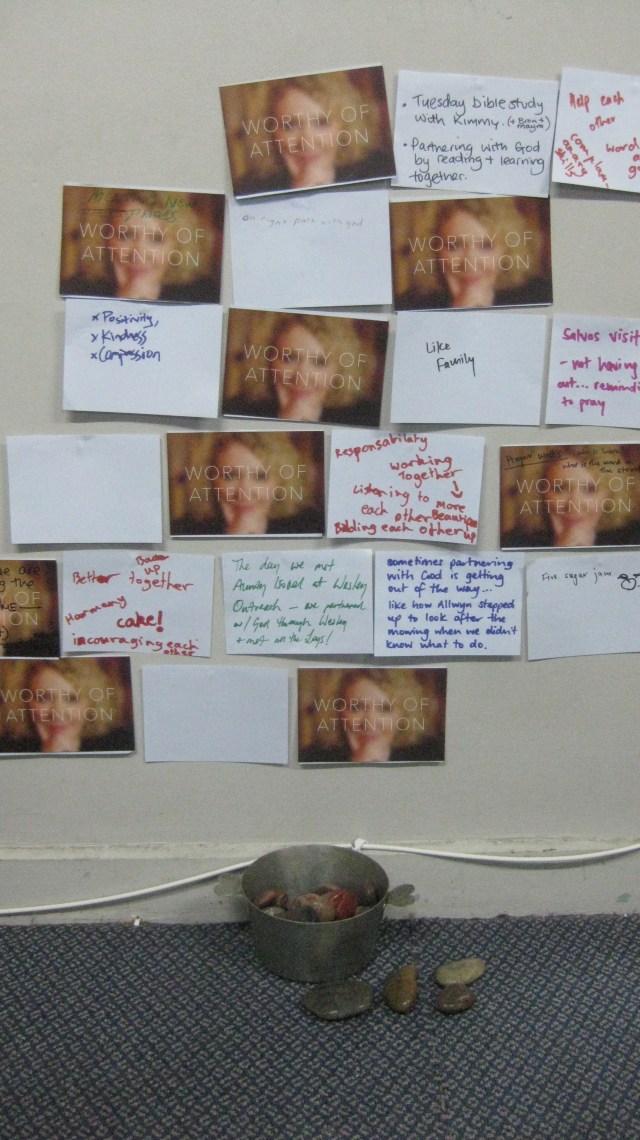
  • Building bricks… Some of these things that we said partners do for each other – how are we doing them for God now? Or how could we start? Share a story…
  • Postcards… Persistence in prayer… what is God telling us is worthy of attention in Footscray? What should we focus on?
  • Stones… is there anything that should be left out of what we are building together here? What are the things that stop us choosing the right bricks?


IMG_0154

On Writing…

12615553_10208956638538959_4864462156527056558_o

Recently I had a look at the stats page of this blog and realised I had missed, if I had thought to consider it, a 5 year milestone of writing.  So and so number of posts, so and so number of visitors to the page over those 5 years – what do those numbers mean?  When I created this page in Feb 2011, it was September before I posted anything to it.  I felt like I had to know the answers to all these questions: who are your audience? why are you writing?

I suppose I still don’t really know the answers to those questions but I suppose I care less that I do not know.  I will confess I have been known to answer facetiously “I write because I get something out of it, if you get something out of it – it’s Gods fault”. Do what you want with that.

I think all I ever hold of anything are fragments.  One of the reasons I think I’ve found it hard to classify “what I’m writing” or “who for”, is that what I post here is so mixed – things I write, things other people write, stories, poems, quotes, photos… life.  These aren’t considered think pieces or articles, I don’t have any 5-point plans to answer any of your questions, I’m not here to teach you anything or be an expert about anything.

I write because…

I participated in a bible study session with my small group towards the end of last year… it’s small, and I’ve known some of them a long time but, despite this, as we’re introducing the topic for discussion I can sometimes get this hot flush through my body, a rising sense of discomfort, I’m not sure I agree with what you’re saying but I can’t articulate why.   In the interim, others weigh in: “I haven’t heard it put like that before…”, “I agree…”

What I have to express at this time is “I’m not sure I agree with that…” or “That isn’t how I would see it”.  The difficulty in expressing that, is that it begs the obvious follow up questions “How do you see it?” or “What do you think is happening in the passage instead?” I know I don’t have the answers for those questions yet.

What is the value in pointing out to someone you think there’s an alternative interpretation if you cannot articulate it? My silence is my mind working a mile a minute to process what I’m thinking but in the meantime the conversation moves on – there is further affirming of the original interpretation and as each layer/next question is applied to the text, they are read within the lens of this.

Now I am still working on what I think but there is increasing pressure – it was going to be awkward suggesting an alternative interpretation to one person (what if the ‘revelation’ of this study hangs on the basis of this suggested interpretation?) but now others have concurred and the conversation has moved on, jumping in now will actually be disruptive and, as others also agreed with the original interpretation, I feel as if need to ‘make a case’ solid or justifiable enough to de-rail the conversation.

I opt out of the chat, no new input until I can get my head around the initial idea. Session winds down and I take my journal and sit outside and scribble – it helps me to think about an idea to take it out and look at it.

I write to say the things unsaid and to know myself better.   We need to communicate in different ways, yes, and we need to listen in different ways and have different spaces to communicate in. I write to explore what all these might be and what I might be.


I write because…

Lydia Wylie-Kellerman wrote a beautiful sermon for Pentecost and also to honour her Dad’s 10 years of ministry at St Peter’s Episcopal Church in Detroit… asking what does it mean for us to be followers of a subversive Storyteller?  Some excerpts:

“Stories are about communication, about when to listen and when to speak, and understanding in our own language…”

“Storytelling spaces are disappearing.”

“Telling stories is an act of resistance. It is part of discipleship. It is movement work. Stories are provocative and powerful while at the same time nourishing. They hold us. They remind us who we are. They help us know who we want to become.”

With social media the world seems terribly small sometimes – just these past weeks my Facebook feed has been filled with the trial outcome of the rape of a woman at Stanford and now this terrible shooting at the gay bar Pulse in Orlando (on a Trans and Latino/Latinx night on Puerto Rican Heritage Day during Pride Month).  There would have been a time when such events were beyond the scope of knowing occurring far away but now, for days at a time, we are touched by layers of pain from such events.  I don’t personally know anyone impacted first hand by these events but I know many impacted by the ripples as each new headline flashes up like a neon sign advertising darkness.  “My FB feed has been filled”… I think of the native wisdom of the story of the two wolves  and wonder if I have not lost my appetite.  You see it’s not the stories of rescue, or redemption, or hope that seem to go ‘viral’ but the brokenness that seems to be replicated over and over again until it is part of the perpetuating harm itself.  Is there any way it could be different? What choices are we making about what stories, voices, news, good news, we are perpetuating?  What is in the ‘feed’ you are serving?

Jenny Peek at Yale Divinity School puts it like this: “I don’t want this fear to have the final word, because all too often fear is at the root of our hatred, disgust, and division. So instead I want to share a verse that continues to give me hope and direction even in times like this:

1 John 4:11-12 – Beloved, since God loved us so much, we also ought to love one another. No one has ever seen God; but if we love one another, God lives in us, and his love is made complete in us.”

I write because I want to read stories that nourish me (and I try not to ask of others what I’m not willing to do myself). I want us to understand and to love one another.  The world is inexplicably wounded and inexhaustibly good… tell me about that… don’t leave out the inexhaustibly good part.


I write because…

Last month I was privileged to meet Aunty Sharyn an Indigenous Christian leader from Brisbane and hear her story.  A vocation rising out of her own personal experience, Aunty Sharyn has started up B’ira – a significant community ministry addressing domestic violence and sexual abuse in Indigenous communities. Bir’a Women’s Ministry (Bir’a is Wakka Wakka Language for ‘High Spirit’) is all about when ‘Women meet Jesus’. They run yarning circles – providing a safe space to talk through grief, trauma, healing and relationships and do art therapy for when we can’t find, or just don’t have, the words to describe what has happened to us. I was put in mind of the women in Mark (5:21-43).

Jesus is walking along with his disciples  and a leader of the Synagogue comes along asking for healing for his daughter who is unwell. Jesus agrees to come, yet along the way a bleeding woman who, against all purity codes, reaches out to touch a Jewish man in the desperation and hope of being healed. This woman reaches out for and takes what will heal her.  v.29 “Immediately her haemorrhage stopped; and she felt in her body that she was healed of her disease.” but v.33-34 goes on to say  “the woman, knowing what had happened to her, came in fear and trembling, fell down before him, and told him the whole truth.  He said to her, “Daughter, your faith has made you well; go in peace, and be healed of your disease.”  She had already been healed of the physical symptoms (v.29), this second healing (v.34) addresses the mental anguish of what the disease had cost. Exclusion from temple which was a central part of life, if she had a husband perhaps he left – not being able to touch what she had touched or share intimacy, to spend time with her would be to take on the limitations of impurity and ritual cleaning yourself, perhaps people worried they might catch the disease, perhaps the priests tried various means and methods of cleansing or praying out demons… what isolation and exclusion had this woman known over these 12 years?  How long does it take to pour out this tale of grief, fear and loneliness?  Long enough for the Synagogue leader’s daughter to die – does one person’s healing come at the cost of another’s? No.

I write because I want to encounter God, I want to be heard and healed and whole, and for others to have that too.  What part does truth telling have to play in our healing? {personal, family, community, political…?} We need times and spaces to hear the whole truth, we need to be willing to tell our truth, we need to be willing to listen.

You see.  All I have are fragments. Fragments of listening, voices – others and my own – word weaving or stitching together some patchwork of understanding from stories…

I don’t know that you can call this “feminist theology”.  This is only what theology has ever been – codified collective human experience – stories, poems, liturgy, literature, prophecy and cultural influences trying to understand the shape of something bigger and beyond ourselves.

It is not finished.

strategies-in-conflict-transformation

I’m puddling my way through the Bartimaeus Institute Restorative Justice online course – and am struck anew by what it means to have teaching that holds the bible in one hand and the newspaper in another, historical contextual interpretation and current relevance… Ched and Elaine re-frame the above tool in such terms as peace keeping, peace making, peace building and peace waging.


When Jesus saw the city he wept over it, saying,
“Would that you knew the things that make for peace!”
Luke 19:42

This is good theological meat and you should eat some.  Lots of free access articles and webinars on their website too…

IMG_7876

Doing the BCM Restorative Justice unit, here’s a link to one of the articles.

“This theology of radical inclusion was disconcerting to both Jewish ethnocentrism and Hellenistic ideologies of superiority.  In Greco-Roman antiquity the cultural, economic and political enmity between Jew and Gentile was profound. These two communities were institutionally and historically alienated—not unlike the modern legacy of racial apartheid or the protracted struggle between Israelis and Palestinians or Protestant Loyalists and Catholic Republicans in Northern Ireland. But Paul refused to abide by the social divisions around him, instead trying to build bridges called churches.”

So here I sit with:

  • who is reconciliation to be accomplished by?
  • what do we refuse to abide by?
  • who/where are the bridge builders? (or alternative societies being modelled)?
  • what are we called to be fools for?

IMG_7300


Facilitated by Christop Booth from the Indigenous Hospitality House, in this bible study series we will seek to make connections between the story of the nation of Israel told in Lamentations and our own national story. We will look to see whether this book may help us to address our shared histories of displacement and endeavour to distill how we might move forward as a nation in light of the biblical example.

Connection to Community

Who do you think of as community?

What forms of sharing are undertaken within these communities? (what is personal, what is communal?)

Read Lamentations 5

What type of people made up the Israelite community?

What did they share together? What experiences/materials/stories?

How connected were the Israelite people to one another at the time this poem was written?

What do we think of when we think of Aboriginal communities?

Watch clip from move The Sapphires [singing for soldiers during the war, Manager is injured and they’re separated, have to decide to go on or go back]

What kind of sharing takes place?

What part does shared suffering play in the building of community or extent of connectedness experienced?

Does being Aboriginal increase the likelihood of connection experienced by an individual? Does belief in God?

Can we identify any other factors which promote community building and connectedness?

How might we offer and/or provide aspects if community connectedness for others and ourselves at a local, national and international level?


The most significant religious events recounted in the Bible do not occur in ‘temples made with hands.’ The most important religion in that book is unorganized and is sometimes profoundly disruptive of organization. From Abraham to Jesus, the most important people are not priests but shepherds, soldiers, property owners, workers, housewives, queens and kings, manservants and maidservants, fishermen, prisoners, whores, even bureaucrats. The great visionary encounters did not take place in temples but in sheep pastures, in the desert, in the wilderness, on mountains, on the shores of rivers and the sea, in the middle of the sea, in prisons…. Religion, according to this view, is less to be celebrated in rituals than practiced in the world.

IMG_5264

Welcome, we acknowledge that we gather on the land of which the people of the Kulin Nations have been custodians since time immemorial.

This is our third in a series called The Art of Discipleship where we showcase the material of different books and engage with their material creatively.

WEEK THREE

The activity this week is taken from:

Binding the Strong Man: A Political Reading of Mark’s Story of Jesus


This book by Ched Myers looks at the book of Mark as a manifesto for radical discipleship — i.e., Jesus as exemplar of nonviolent resistance to the powers-that-be in his day, and ergo in ours.  We will be reading Mark, all of it, in one go and sitting in the queries; “What do the questions Jesus poses to the disciples have to say to us today?”

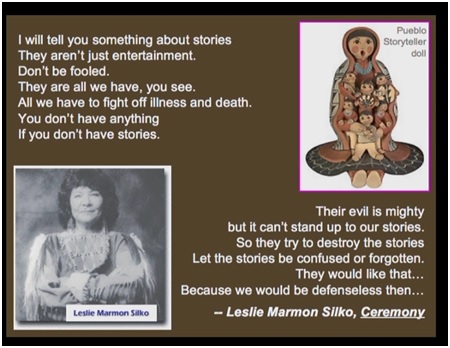
The Word is removed from us in time and space. We all tell stories and know how to tell stories. It is a common language that bridges other cultural gaps between us. These stories are not just entertainment but they actually educate and nourish us. BUT because they are good and healing stories, there are powers out there that will try to destroy them or… “let them be confused or forgotten” – BUT these evil powers cannot stand up to these stories (a statement of faith – conviction -hope that there is a power greater than what we face).  So what we are doing, reading scripture is counter cultural – sitting down and sharing, taking time.

silko

Radical – arising from or going to a root or source. From latin radicalis, having roots.

Radical simply means to go to the roots. Twin task of going to roots of tradition in scripture and in spirituality and in social solidarity and in roots of our contemporary pathologies to deal with root causes and not symptoms.

What are the current issues these stories could be informing?

  • War Israel/Palestine/Afghanistan/Syria/Russia
  • Riots/protests throughout middle east – for democracy and Europe/America in relation to global financial crisis.
  • Isaiah 14.:8: strategic asset Cedars of Lebanon, oil of the ancient times. What was empire then and what is it now? Phonecia, Babylon, Rome – clear cut the cedars for masts for ships and bearing poles for temples. Ecological justice.
  • Matt 1-2, Luke 1-2 Christmas story sentimentalised – imperial violence and human displacement, infanticide as a matter of domestic policy.
  • Road to Emmaus – story of courage and resistance, within a few days of crucifixion. Easter Luke 16:31 – under the shadow of death, not a zen walk down a country road. What is the meaning of the death of our leader for our movement.
  • Immigration/boat people – Isaiah 56, scripture and restorative justice – right using the bible to exclude immigrants and gay people. Radical
  • Matthew 18 restorative justice, ambassadors of reconciliation 2 Corinthians 5:16-6:2.

Draw parallels and analogies with our current context.

  • Ambassadors in chains Ephesians 2-3 & MLK letter from a Birmingham jail (Eph 3:10, 6:1)

How does the story read in our own context?

allegory

As we read be mindful of the following:

  • Oral tradition – uses language to set the scene – are we at the seaside or in the city now?  Look for introduction of new characters, new settings, changes in plot.  Often read the bible like a 5 minute segment out of an entire movie  – how can you understand what’s going on when you come in part way through the story? Need to rebuild critical literacy.
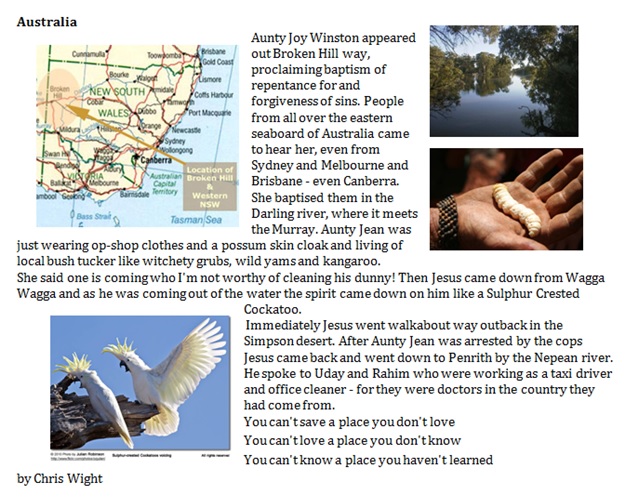
  • We can romanticise the Roman Empire – nothing nice about it.  I am a descendant of the colonising empire – British Empire, conquest, world sovereignty, racial superiority and global management.  Empire looks very different from the bottom IMG_5266up, than the top down – victims are always reminded of their vassalage. Money replaced with that with an image of Emperor or Queen.  The Romans were driven out of Judea and then they struck back. Jerusalem was laid siege, conquered and burned.  The book of Mark was written during this war.  Empire can be defined as the rule of the centre over the periphery.
  • Mark 1:7 baptiser – One is coming who is stronger than I am.  Power contesting power.  Not baptised with only water but the holy spirit and fire.  Baptism was and is a personal and political statement in a social context calling on the Holy Spirit of water and fire out in the undomesticated wilderness against the struggle of empire.
  • “True evangelical faith cannot lie dormant. It clothes the naked, it feed the hungry, it comforts the sorrowful, it shelters the destitute, it serves those that harms it, it binds up that which is wounded, it has become all things to all people” Menno Simons 16th century.  This is a discipleship of struggle and resistance as well as renewal.  Will it have a cost?  Baptism into Christ and into Christs death.  When Jesus was baptised he went right under into the Jordon, shedding  everything of socialisation – rises up completely unobligated to empire.  Jesus was baptised into a specific watershed/river, a specific story, a specific (un)kingdom.


Working from the same copy, read the – whole – book of Mark aloud in one session. The document below, to help with the sense on one whole flowing story (as the oral tellers would speak it), has had all chapter and verse numeration and story “titles” removed.

Mark stripped back

First thoughts?
Sound/feel different than it usually does? What stands out?
Have some general discussion around the ‘mindful’ notes re our ideas about – stories, empire, baptism, discipleship…

Facilitated by Mehrin Almassi from the Indigenous Hospitality House, in this bible study series we will seek to make connections between the story of the nation of Israel told in Lamentations and our own national story. We will look to see whether this book may help us to address our shared histories of displacement and endeavour to distill how we might move forward as a nation in light of the biblical example.

Connection to Creator (Spirit)

What do we think of when we hear the word Spirit? What do we think of when we hear the words Spirit of God?
What do we think about when we hear the term Creator Spirit?
What do we think is meant by each of these phrases? Are they related? Could they be?

Read Lamentations 3

Did the Israelite people have a sense of the Spirit of God – the Creator Spirit?
What was God like for the people of Israel? What was their experience of relating to God?
How do we relate to and/or experience God? Is our experience different to that of the Israelites? If so, can we think why?

Let’s read the Boon Wurrung Story.

What might this story teach us about the way the Boon Wurrung people experience the Creator Spirit?
What may this story teach us about the importance of our own stories in relation to local, national and international issues?
How else might we apply important narratives of the past to current situations needing attention?

Kids Activity

In parallel to grown ups run a kids session: talk about pictures as stories, songlines and place.

Will need:

  • messy clothes (if painting)
  • paint and brushes and/or lots of sticky dot stickers
  • paper
  • photos (bring along some or a camera to take some on the day)

What do you like about stories?
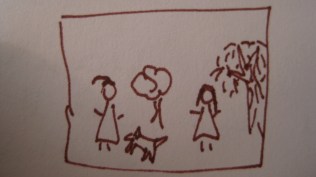
Look at this image? What is this a picture of?

IMG_6499


(girls, dog, trees…)

This picture tells the story of the time Talitha and Bron went to the park with Gracie.

11834903_10153063761386868_8866957583155349394_o

 What about this image? what’s happening here? who was there? but they aren’t in the picture… how do you know they were there?

(pictures can capture a “moment”, some part of a bigger memory, tobogganing and snow angels, other friends… reminder of something bigger that we can no longer see)

Pictures have two things, a place and a “happening”.

Using your pictures so far, talk about where they are happening and what is happening.

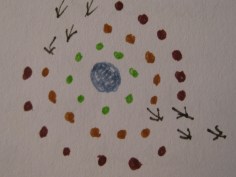
IMG_6501Indigenous stories tell something about a place and also about something happening there.

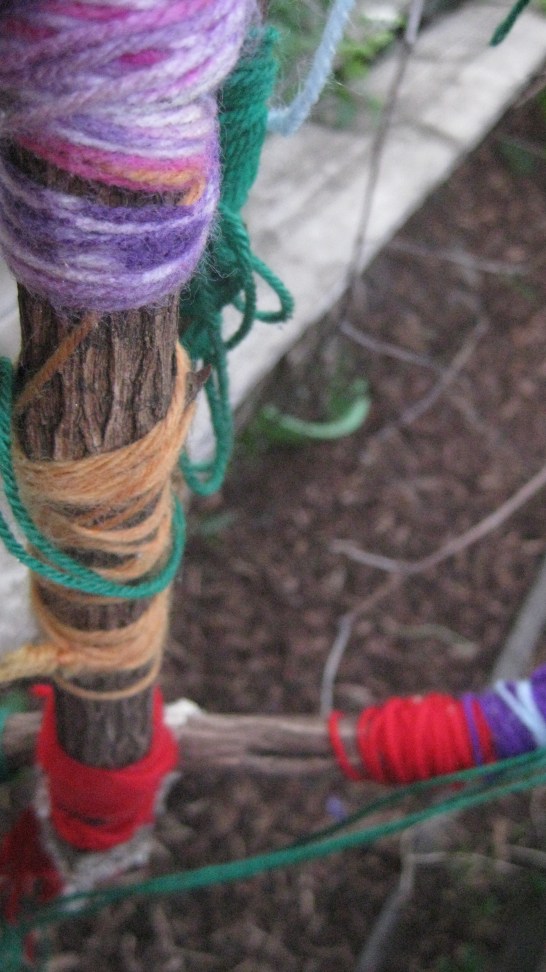
WHERE: Maybe there is a waterhole (blue), things grow there (green), drier sand/soil as you move away (orange), day rocks (red).

WHAT: An animal comes to the watering hole and then goes (tracks).

Ask children to share a memory, a story, and make a picture – collectively or individually (age depending). Then ask of each: Where is your story taking place? What is happening there?

How would you feel if you couldn’t got there again?  If you couldn’t do that again? (sad)

Today the grown ups are talking about the story of lamentations – a lament is a sound of grief and sorrow.  That’s what people in the story did when they couldn’t go back to the place they remembered or do the things they used to do there.

Learning:

our stories and our pictures can be used to tell each other about places we haven’t been and things we haven’t done, remembering and reminders can comfort us when we feel sad

let’s take a photo now, today of all of us together, making and telling stories so that we have a memory-capture. It’s good to take photos and write stories and make pictures because they help us remember

take your picture now to a grown up – tell them your story – use things inside the picture and outside the picture


IMG_5145

Facilitated by Mehrin Almassi from the Indigenous Hospitality House, in this bible study series we will seek to make connections between the story of the nation of Israel told in Lamentations and our own national story. We will look to see whether this book may help us to address our shared histories of displacement and endeavour to distill how we might move forward as a nation in light of the biblical example.

Connection to Place

What role does a sense of place play for each of us?
What is our connection to the environment?
What is our relationship with the land?

Are there any natural places which hold significance for you? If so, how do those places make you feel?
What happens to us when we are in a place which is significant to us?
What happens when we are unable to be in places which are significant to us?

Read Lamentations 2.

What can we understand of the Israelites’ connection to place through this narrative?
How connected do they seem to their places of significance?
what impact does not being able to access their important places have on them?

Listen to Kev Carmody’s song  This Land Is Mine.

How might the biblical account help us to appreciate the experiences of the First Peoples of this land?
In what ways might we help promote reconnection with land/place/environment for indigenous peoples? For ourselves?
How might this reconnection relate to indigenous people’s experience of God? How might it relate to our experience of God?