
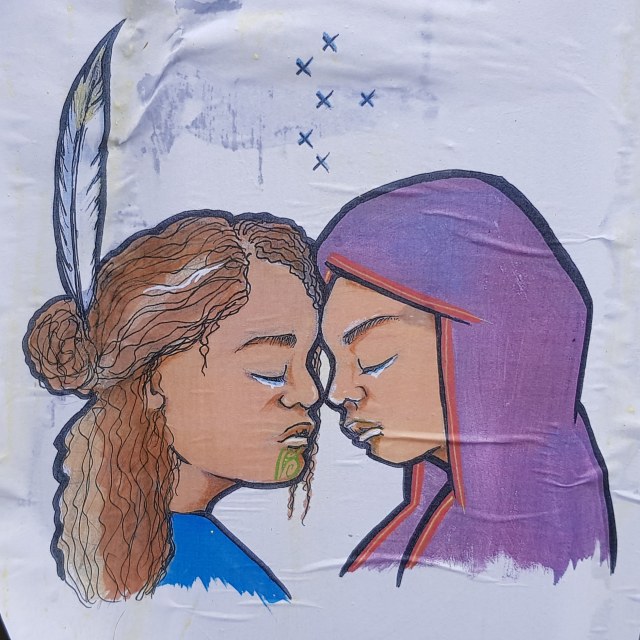
Paste up in Paraparaumu today
Paste up in Paraparaumu today
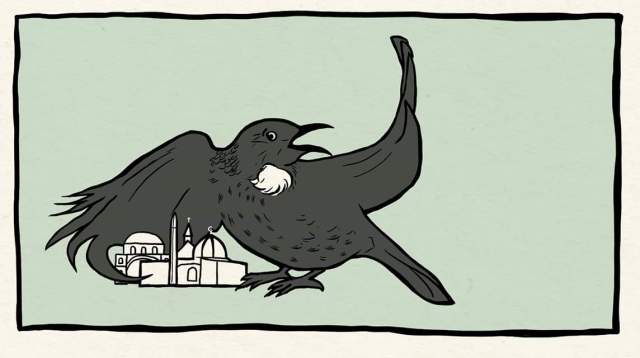
Artwork by Rowena Fry
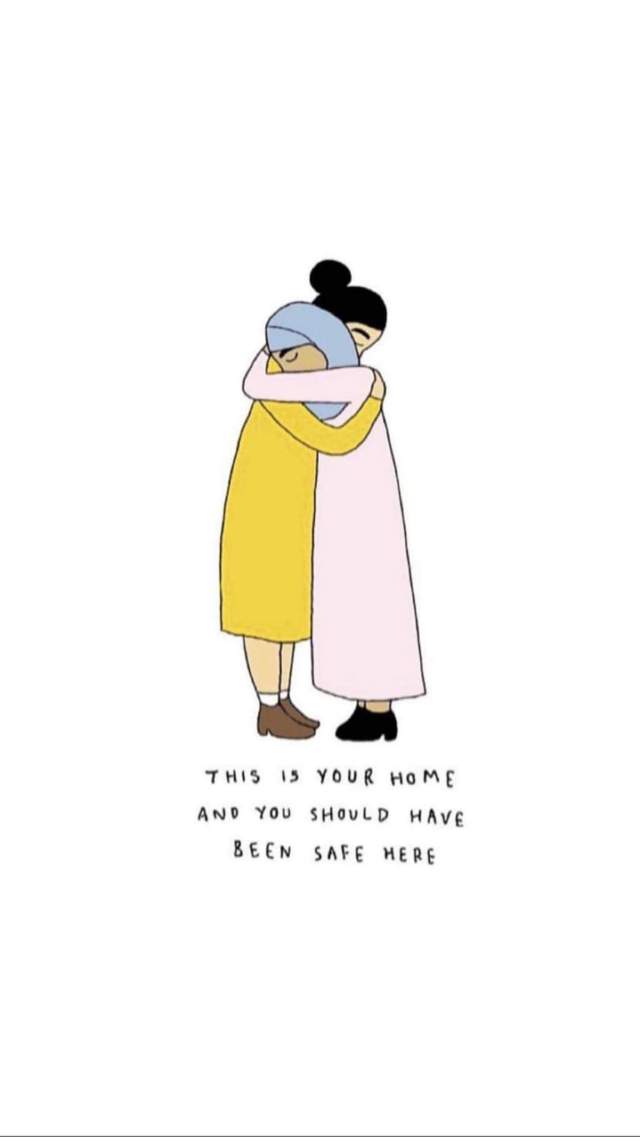
This is your home and you should have been safe here
by Wellington artist Ruby Jones
CL: First heard the term “intersectionality” after starting my blog Black Feminist Ranter which ticked several “oppression” boxes. It was a label applied to me to inform a sense of ‘place’. A description of where the intersections of oppression are overlapping. It’s in the feminist sphere that is being played out but dividing and othering instead of being done well. It’s not being used to subvert and challenge systems but by those wanting “ally credit”.
RH: How we use the word… it’s made equivalent to representation e.g. have a quota of female politicians but the systems don’t change. What about sweatshops? What about Western interventions in the Middle East? Supporting Hillary and the first potential female President is great but don’t say “She’s going to be great for all women” – be specific. Say “some of her policies are good” or “Hillary being President will be a good start” but not making sweeping statements like: “What’s good for women is good for all women”, that erases the experience of those her policies don’t benefit.
CL: Why did that election result get pegged on the non-white women? Hate that… everyone asking: Where are the African-American women? Stats show it’s white women that didn’t vote for Hillary.
RH: They had to ask – “Who will be worse?” All minority groups voted for Clinton.
CL: Similar here re Gillard. First Australian Prime Minister – a win for dissecting feminism but she was legislating in NT and making cuts to single mother benefits… I couldn’t fight on those issues because I had to defend on the left re gender. We are being compromised in these situations.
RH: Allies need to understand the dilemma and acknowledge it. Intersectional feminism should understand that dilemma but it doesn’t. It needs to acknowledge the reasons others might be unsure and have concerns. For example, media around the Wonder Woman film discussed the Zionist views of the lead actress and called for boycott. I didn’t advocate for that. It’s only one woman’s opinion. It should be ok that Arab women might not be able to jump on this empowerment train. Allies need to understand. There’s a refusal to see. e.g. “The Wonder Woman character existed long before this actress – the movie’s still worth celebrating!” I was called racist. Intersectionality was used against me… disappointing. This placed not just Eastern feminism against Western feminism but feminism within the West. Behind the scenes analysis of the politics what appears and doesn’t is far more interesting to me than the actual movie.
CL: My voice can be sought out to fill a diversity quota. e.g. speaking on Aboriginal Beauty Pageants – didn’t see celebration of Aboriginal beauty as worth working for (dress, heels, make up…) told I’m denigrating my racial identity. White panellists get slut shaming… called fat… whore… but not racial commentary.
RH: I get racial and gendered criticism. “This Ruby Hamas bitch has both clit-envy and penis-envy” – manages to be offensive on Arabic, Muslim, terrorist, gender – so many layers! I shared it on my page to diffuse it. Not about me but anyone who shares these characteristics.
CL: Comments on how I look, highly gendered, but go back to words like “quadroon”. I sometimes take the piss or shut it down… I’d like to be called a whore for once and not something that’s dissecting my race! I was on a panel of feminists once – I said something about “smashing systems” in my introductory statements and was sidelined for the rest of the panel – the white feminists talked amongst themselves. Those that have to navigate gender + race + disability – they are more extreme/radical because they have more to overcome. It was a horrible experience. It was a basic entry-level discussion, why weren’t we part of that conversation? I was only asked for “special comments” re race in the closing questions.
RH: Any event invitation I receive I’m asking , am I token or not? Do they value my voice and what I have to say? And then I say, whatever… they’re still giving me a platform. I long for the day I’m asked to talk about politics, and my experience… not as a labelled pigeon-hole “Muslim” or “Aboriginal”.
CL: The person who is Trans and Aboriginal and woman and has a disability and from a low class background… we need to amplify her voice. Smash at all those levels at once.
RH: If they are liberated, everyone is liberated. “identity politics” shouldn’t set us against but with. I’ve always tried to bring identity politics back to broader oppression.
CL: The show the Handmaids Tale – loved it at first, then I started to see the mainstream reaction. Women enslaved, bred, imprisoned… with religion used as justification. That was one generation ago for me. Oh, white women are going to be treated like Aboriginal and African-American women. In the book the slaves are unequivocally white, coloured people are shipped off to die from radiation. Some kudos to the author for sticking to what she knows but in the TV show, in this Fascist, Puritan, authoritarian world… women of colour are also selected for breeding with wealthy white men and I should believe it?! This is white-washing racial dynamics. “This is just around the corner for us” This white response is not helpful compared to that of people of colour which says: welcome to our world – this has already happened and is happening.
RH: “Can you imagine if there’ll be a war?!” [re Trump/Korea] Yes. I have already lost half my family to that. I don’t need to imagine what that’s like.
CL: When we are blended into white narrative, we’re not given our own.
RH: Given a female Dr. Who – that was a big deal. An Arab actor was recently cast to play the leading role in Aladdin. An Arab not in a role as a terrorist or savage illiterate – those roles that have been used to perpetuate negative stereotypes. Can’t just think about gender (woman as Dr. Who), that an Arab man is cast in the role of Aladdin is far more significant for me. Is feminism the new weapon of whiteness? We hardly heard anything about that casting at all.
Question: How do you balance the need to be calm to be taken seriously vs. expressing righteous/legitimate anger?
CL: A bit of anger is good, use it to tear the system apart. I have no obligation to make racist, sexist, wealthy people feel safe. e.g Heritier Lumumba in doco Fair Game, laughed along with racist insults in the locker room to try and fit in… you never win that way. We need to use our anger in legitimate and practical ways.
Question: What would your top-three recommended structural interventions be?
CL: I’m part of the union movement. Anything that draws attention to the structural issues. Intersectional engagement is often superficial. Highlighting – make sure other voices are heard e.g. An Aboriginal man will have different views than me, or a more conservative woman… there is not one homogenous view for women or for Aboriginal people.
RH: Acknowledge there is a problem. Still at that level… can’t think of a list of structural changes yet when still trying to get people to acknowledge that there’s a problem. Need to be given power/influence – in media, politics… I guess I’m still trying to find that answer. I don’t think we’re close to solving that. Need to see more women from non-white backgrounds opinions valued… to talk in general terms.
Question: Do you have any advice for emerging voices? How do you decide which point of view will be appropriate to speak from, how do you get past that/prevent silencing?
RH: I didn’t write about anything happening in the Arab/Muslim sphere for ages. Mortified when something I wrote was appropriated by people who hate me. I don’t wear a veil but cultural still encouraged to be quiet, modest… I learned to pick a time to broach it. Try to ever do it in a way that isolates Muslims, there’s sexism and racism across all cultures. I cop a lot of backlash from my community but lovely messages from young Muslim women makes it worthwhile – scarcely – becomes ammunition for racists. I had to learn that I can’t be responsible for how they use or mis-use my words.
CL: I was terrified to talk about violence against Aboriginal women. That conversation is used to assimilate to whiteness and religion, a conversation owned by conservative Aboriginal people, for example if I write a piece protesting Dondale and Invasion Day turn around and say “why don’t you care about violence towards Aboriginal women?” Used to indicate that I don’t care. Exhausting process to do but I counted the numbers over the past two years. I need to defend space for my own voice. This argument is used to denigrate my other work.
Ethnic church:
What was/is your experience of ethnic church or the first time you experienced being it as ‘different’?
~ Confucius quotes ~ learning memory verses ~ emphasis on listening to your elders (honour your mother and father) ~ formal dress = not refugees, we will dress well to reflect our new status ~ a successful look synonymous with a Western look ~ In India we would dress nicely for church but here in Australia no, I’m daggy when I go back! ~
Berry’s Acculturation Model
In transition between old culture to new people will typically have one of 4 main responses:
Marginalisation {not identifying with the host culture}
Assimilation {absorbed into the new culture}
Integration {previous culture maintained and participate in the new culture}
Separation {previous culture maintained and new culture rejected}
This is frequently a zero-sum game – how do we forge new opportunities?
When did you first experience race?
~ moving from one country to another: Philippines to India, then to Oz ~ excursion protocol – don’t know what’s happening (have to learn) ~ sports team – they wouldn’t pass the ball to me ~ not around coloured people until Uni, grew up in a white neighbourhood ~ First day of Year 1, got asked: “Where are you from?” …I was born in this town, I’d never had a sense of being from somewhere else! ~ Broke up with my boyfriend and got called “Ching chong” and told to “go back to where you came from” ~
What is race?
Transmission of these ideas about race occur in representation and are reiterated until ‘race’ becomes realities. eg. if pen (object) and writing (concept) communicated through language – the pen (signifier) therefore the meaning becomes attached to the object.
Media perpetuates these myths/representations e.g Vietnamese community treating international students badly that work in their restaurants, Vietnamese community wasn’t consulted or invited to speak to the issue > don’t get to choose the story that gets told about our community.
Who do you identify as?
~ I call myself second generation Korean but I don’t like it when others do it (bring what they think that means) ~ pass… Australian… Child of God ~ Child of God first, Vietnamese and Australian ~ NZ European/Pakeha and Maori (Ngai Tahu) claim this when it feels like it’s a benefit eg. Maori electoral roll >representation in NZ Parliament but not to claim/take anything ~ Indian-Australian (rejection of Indian culture, don’t know enough about culture & history) ~ Australian/Filipino – never one or the other ~
Ref: The Whiteness Project (youtube)
Ref: Race the Power of an Illusion (documentary)
Johann Blumenbach came up with the categories:
Caucasian – white
Mongolian – yellow
Malayan – brown
Ethiopian – black
Rev James Black Roland: “Let us keep before us the noble ideal of white Australia, a snow white if you will. Let us be pure and spotless.”
How does ‘whiteness’ function in your life? (personally, professionally, at church…?)
~ my workplace, need representation of other people of colour on the Council ~ white, straight hair, feminine = beautiful. Tried to be something I’m not eg. Jonah from Tonga show ~ Safest I’ve ever been. Can figure out what “Indian” means for me ~feel the poverty of being ‘stuck’ with white people – established systems and processes both at work and in community ~ Party culture – don’t fit in. Assimilated Asians treat me badly. Need to be funny, out-spoken, tell stories… church is accommodating > understand each others brokenness. Asian guy – Maths or The Hangover archetypes ~ “If you want to be competitive with white people you need to overachieve” (YES from the group) became my coping mechanism. Colonised at home/church, assume you’re assimilated and it’s used against you. Have learnt now to feel more comfortable there (white space than I do within my own cultural community). Jarring moments of being brought to awareness of your non-whiteness eg. insult calling based on colour (school had felt like safe space until then) ~
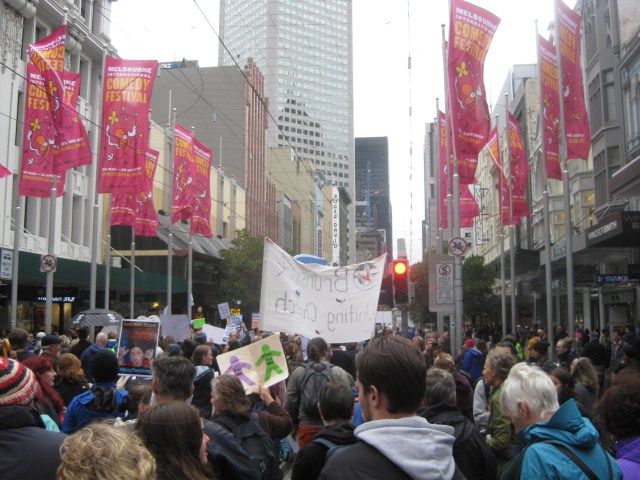
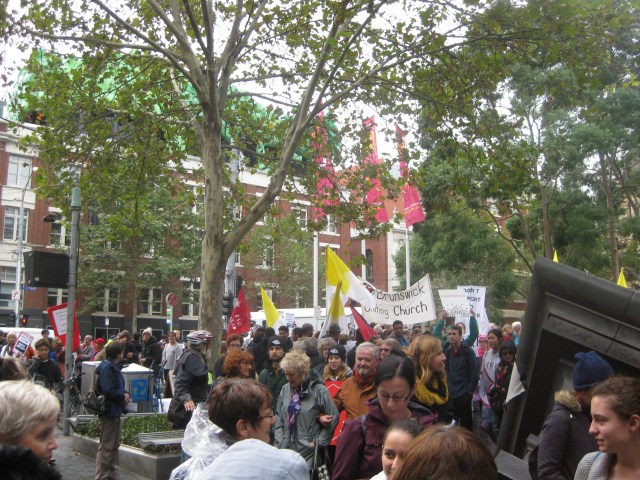
The Walk for Justice for Refugees is about standing up for the human rights of those seeking asylum in Australia. This largely secular action is held on Palm Sunday – as people of faith, knowing there is a way where it seems there is no way – how might we hold a space to liturgise and lament and to sing within this broader movement? The following is a bit of a photo essay from the day with some of our thinking around what we are trying to create and hold space for by participating in events like these.
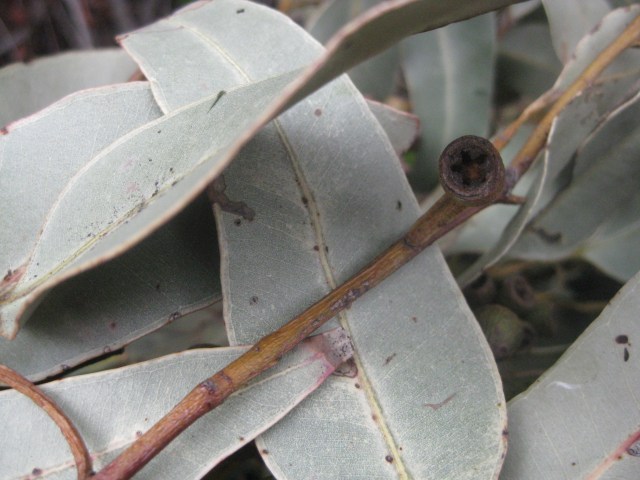
Welcome is a complex issue on un-ceded land. Although palms might be the branch of Welcome in Jerusalem in this country gum leaves have a lot of symbolism – burned they are said to have healing and cleansing properties of bad spirits. How spirit-sore and shadowed are refugees arriving in Australia? If a member of the Wurundjeri offers you gum leaves they are indicating that you are welcome to everything from the tops of the leaves to the roots of the earth, we are symbolically linked and share in honouring the ancestors that have tended the land for many, many thousands of years. Is it appropriate to carry gum leaves in the walk? Or both gum leaves and palm fronds to acknowledge this complexity?
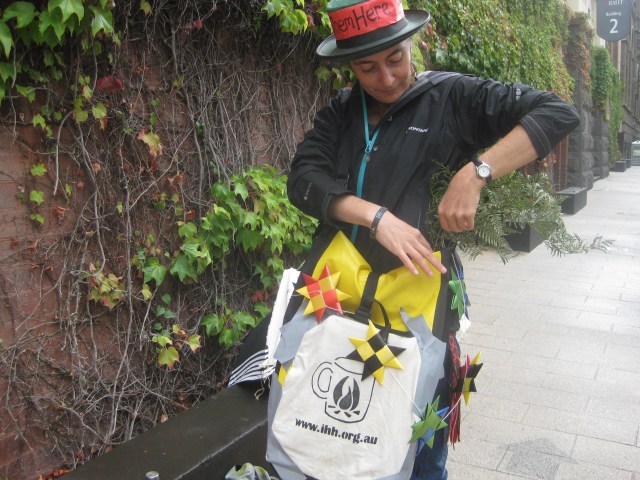
This group is about attending the Palm Sunday march as a cohort – how might we want to distinguish ourselves within the broader crowd? what message of kingdom-on-earth do we have to communicate? One example is that often the crowd chants at these configure themselves as “anti” something and can communicate negativity, what might a message be that communicates hope and indicates what we are “for”?
Above Sam has an IHH bag, her LMAW #Bringthemhere hat, some of the Million Stars Against Violence and bracken from Gembrook Retreat as her foliage.
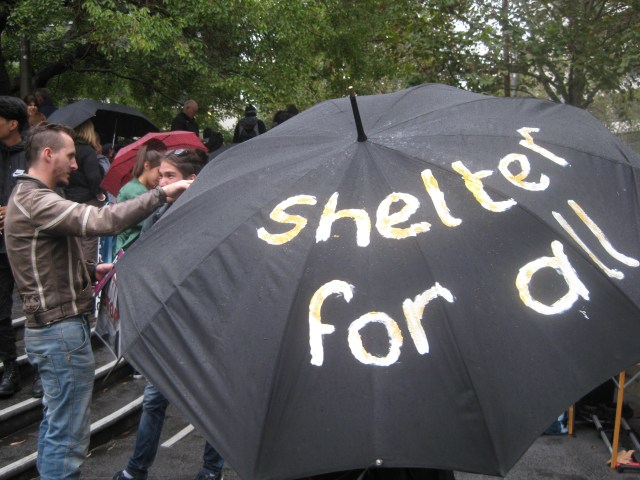
Welcoming people from other countries since time immemorial. Responding to “boat people” since 1788. The walk is coming up this Sunday – what do you want to say about welcome this weekend? Is it short, percussive and meaningful? How about: “Bring them here. Let them stay. We believe love makes a way”? What is the sound bite and deep heart’s call to justice you want to hear called out?
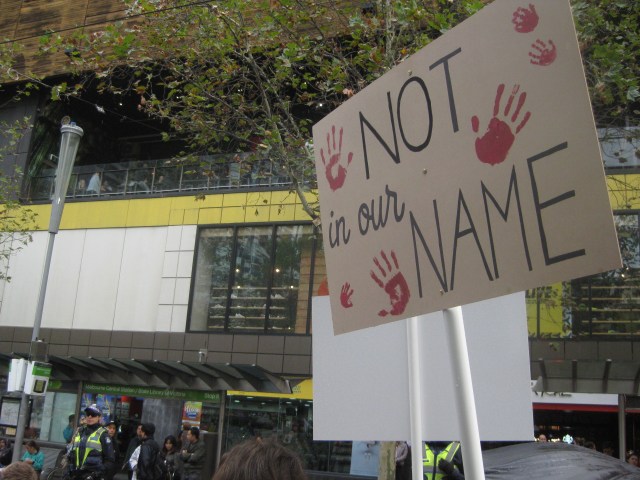
Here’s some feel-good clickbait if you haven’t already seen it (watch it again anyway), when we stop using labels that create designations of ‘them’ and ‘us’ we might have more in common than we know. I was listening to Fly My Pretties yesterday, the lyrics of the song are “We can make a life, we can make a life worth living”. That is a hope of people arriving here and for all of us who see the image of God in every person we meet and want to see God’s kingdom here on earth – let’s make the world we want to live in.
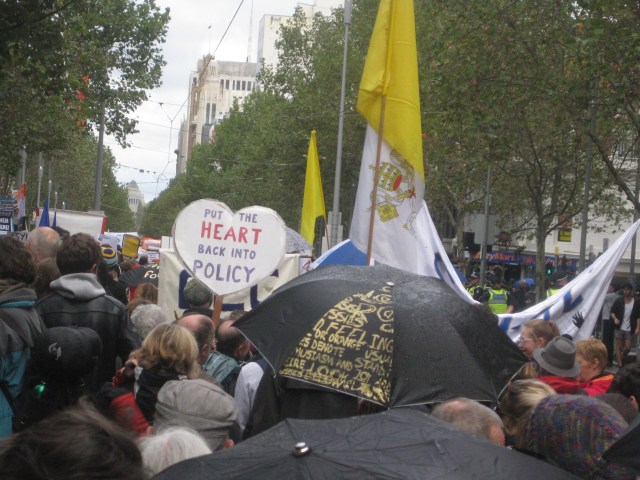
Anne Lamott has said, “Hope begins in the dark, the stubborn hope that if you just show up and try to do the right thing, the dawn will come.” Here are some examples of prayer stations that explore this idea of “You are welcome here” using scripture references from Ched Myers book Our God is Undocumented” – whose voices set and shape the ways you show welcome?
What is your cultural tail? 28% of Australians were born overseas (Census 2016), many more would have parents born overseas. When we say things like “I’m nothing” or “I have no culture” it’s worth noting that only the dominant-culture can say that, this white-washing language (pun intended) at best colonises existing culture and at worst ignores it: the legacy of Terra Nullius continues. Naming our own cultural tail is significant for relating well to the culture that was and is already here as well as affirming and celebrating cultural diversity generally in Australia. Is there something you can wear to the Palm Sunday march that could celebrate cultural diversity? An item of clothing or jewellery, a badge or flag that celebrates your cultural history and thereby all culture – past and present?
On singing: many songs we might sing together are short, rounds, call and repeat don’t worry about song sheets or knowing the words… please bring your own too – we love learning new ones so that we can sing about it until it can be realised!
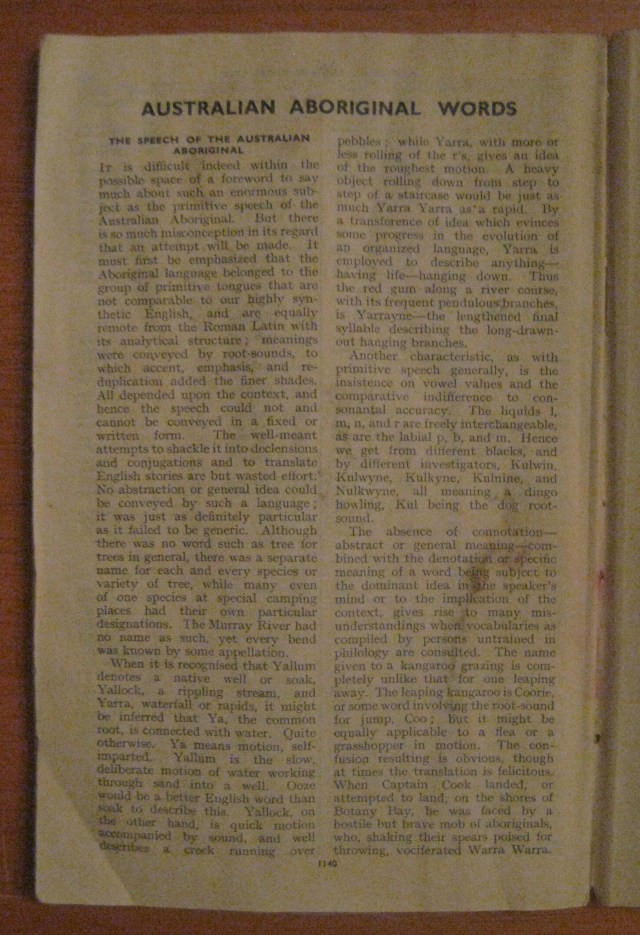
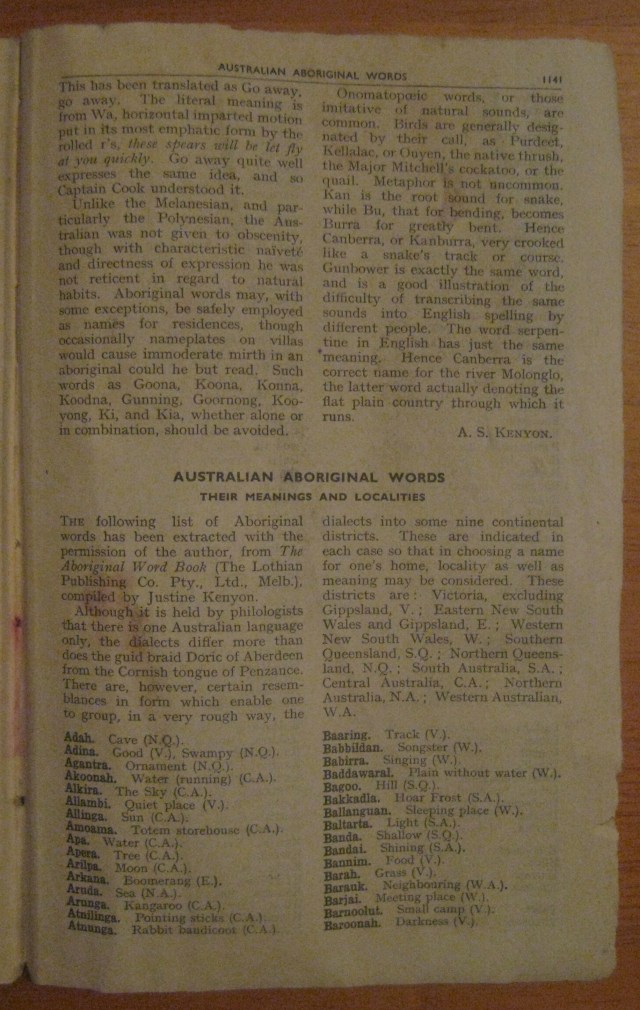
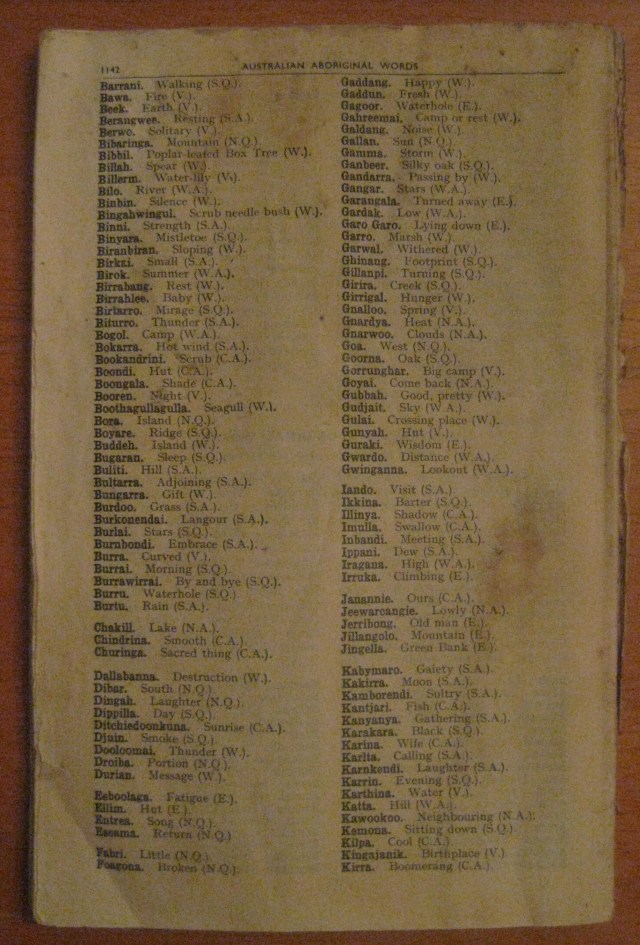
Walking home one night, I came across what looked like a torn up dictionary outside the McDonalds on Ballarat Rd. I’m into a bit of upcycling and paper craft – it makes sense to use books/paper that are being thrown out anyway and this has little illustrations… No cover, torn in sections, mouldy and weathered, unwanted… except for me who’s picking up rubbish thinking “Cute.” and “Score!”
Looking more closely once I got my prize home, I realise it’s not a dictionary but rather some sort of encyclopaedia and it’s old. Really old. Old enough that it’s quite offensive – mostly for its omissions rather than what it explicitly says, for example in a section called “Australia’s History: Chief events in chronological order…”spanning 1788-1939, I can see only one reference made regarding an aboriginal person or place and that was “1876 Death of Truganini, last of Tasmanian aborigines”. I look her up online to know her story.
A visitor on country myself, I have not (and continue) not to know very much about what right relationship looks like between people and the land. Not having the right words and being afraid of saying the wrong ones, I try and stay silent. To listen and to learn. I have heard people talk about their family members, homes, and culture being lost through colonisation. I have heard them talk about losing language and here am I finding some lying by the side of the road. I find myself wishing I could give it back to who it belongs to.
West Writers Festival Artwork by Aysha Tea
When they speak, it is scientific; when we speak, it is unscientific;
When they speak, it is universal; when we speak, it is specific;
When they speak, it is objective; when we speak, it is subjective;
When they speak, it is neutral; when we speak, it is personal;
When they speak, it is rational; when we speak, it is emotional;
When they speak, it is impartial; when we speak, it is partial;
When they speak, they have facts; when we speak, we have opinions;
When they speak, they have knowledge; when we speak, we have experiences.
These are not simple semantic categorizations; they possess a dimension of power that maintains hierarchical positions. We are not dealing here with simple semantic, but rather with a violent hierarchy, which defines who can speak.
Grada Kilomba
* EPISTEMOLOGICAL ZERO-POINT “Europeans are people who do not know their place because they have not explored it yet. People living there have situated knowledge and knowledge grounded in their experiences… Operating under the hubris of zero-point blinds you to the fact that other people, with their own existence and knowledges, do not have the same problems that you have and therefore could care less about your knowledge, until the moment that you impose it on them and tell them they do not know about themselves what you know about them. You conclude that they are inferior and ignorant, that their reasoning is defective, that their sense of beautiful doesn’t exist. You do not stop to think that they are as ignorant of your interests and values as you are of theirs. However, you assume you “know” them because you describe them and include them in your system of knowledge and in your epistemic architectonic.” – Walter Mignolo
example:
“What are you?”
“I’m Vietnamese. What are you?”
“Nothing”
Vietnamese can’t be “nothing” without white people. White is the canvas of the world.
Who has the imperial power to “welcome”? We need to decolonise our aesthetic. Initiatives must critique to be de-colonising.
e.g. “Real Australians say welcome” – posters do not critique or #RefugeesWelcome these are not decolonising initiatives.
 itellyouarise