
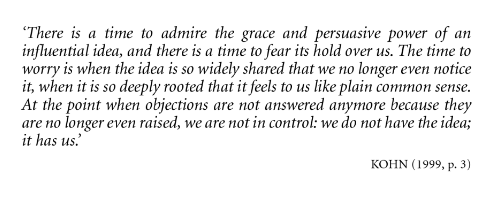
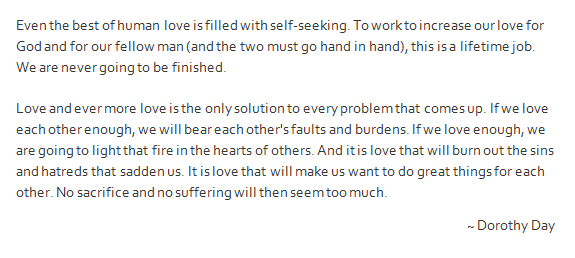
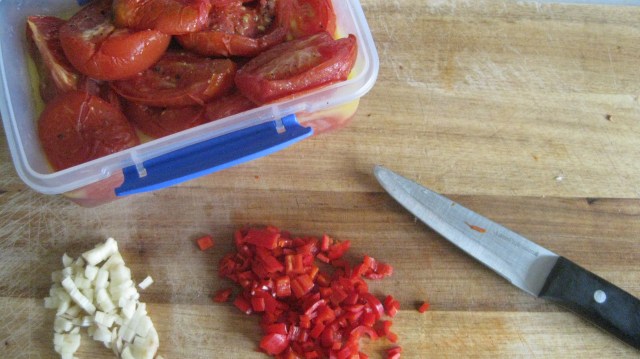
Inspiration takes time I think. Being present to what IS. Seeing, hearing, touching, tasting what is already there as if with new eyes, new ears, new hands, new lips – appreciating with reverence and joy or delight the sacredness of ordinary things. In this way: rocket from a friends garden, dived potatoes and tomatoes, eggs picked up by a housemate who also brings back that first coffee of the day. The meal is symbolic of more than the sum of its parts, overtones of love and life, aromas of sharing and community, flavour and savour more than mere fuel. I wish everyone’s life could be made up of recognising these things that make life worth living… we get busy and we get blind.
I will taste the joy of being awake.
Of communion, Jesus says I will not take this drink again until
I drink it new with you in my Father’s kingdom.
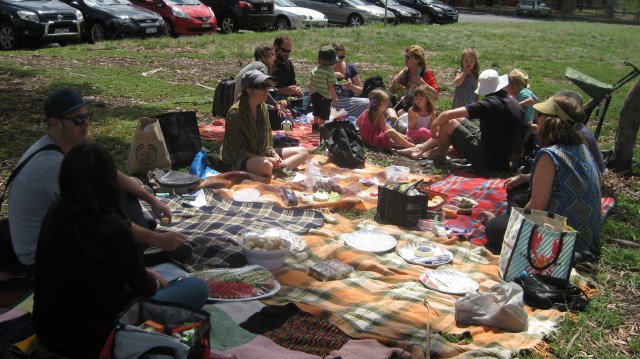
On Sunday 14 February we held a picnic lunch at the immigration detention centre in Maribyrnong. The first Sunday of Lent (and Valentines Day- let’s show the love) would often have a focus theme of a continued call to conversion the intention of the picnic was to physically create the space we would like to live in – that kingdom where Jesus might join us for a drink – even if only for an hour. How can we make that grass verge feel like space of celebration and welcome? How can we extend the expression of hospitality and welcome that we would like to see shown to refugees and asylum seekers?
With yarn bombing, banners, different flags, welcome in different languages, families and at each picnic blanket a spare place set at the table – a visual demonstration that there is room at the table for the ‘other’ and enough food to share.
In the face of the continued and indefinite detention of refugees and asylum seekers including children and New Zealanders now the second highest number of those held in off-shore detention – we seek to respond with an act of hospitality, an act of welcome, and act of love – witnessing there is room at THIS communion table.
***
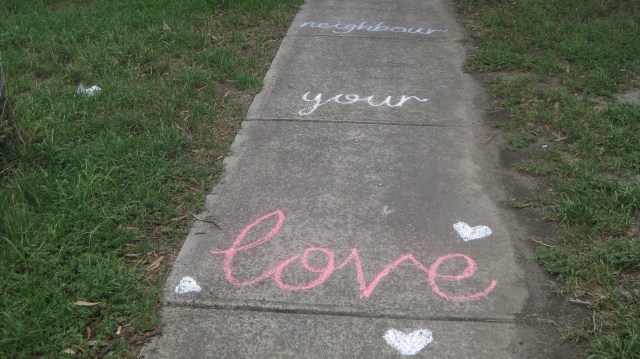
Wominjeka, we acknowledge that we gather on the land of which the Wurundjeri people of the Kulin Nation have gathered since time immemorial to tell stories, sing songs and share food together. We are gathered here today to do a little of all these things ourselves: tell stories, sing songs and share some food together around this idea of showing welcome to refugees and asylum seekers and we have chosen a specific place, time and context in which to do that.
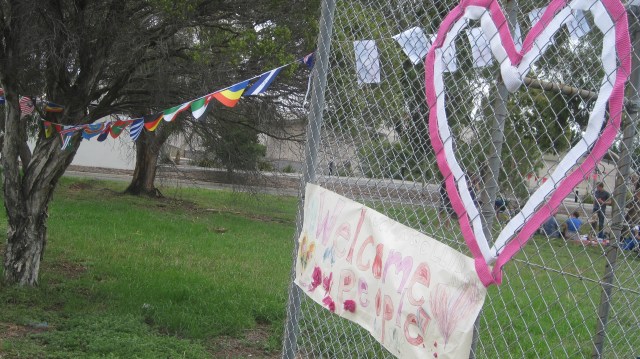
We are standing here in the carpark of what is now the VicUni Student Village…this used to be the site of the Pyrotechnic Section of an Explosives Factory (1942) which was built to produce flares, tracers and smoke grenades during the Second World War… a section of this was converted to the Maribyrnong Migrant Hostel (1966). Over here behind us is the new purpose-built Maribyrnong Immigration Detention Centre (1983) – we are standing where refugees and migrants have been arriving for the last 50 years.
We are standing here at a particular time. Today is Sunday 14 February, the first Sunday of Lent and Valentines Day – let’s show the love! The first Sunday of Lent would often have a focus theme of a continued call to conversion and the intention of this picnic is to physically create the kingdom space we would like to live in – demonstrating the kind of welcome and abundant hospitality we as Christians believe Jesus might extend and asking of our own discipleship how we feel called to respond.
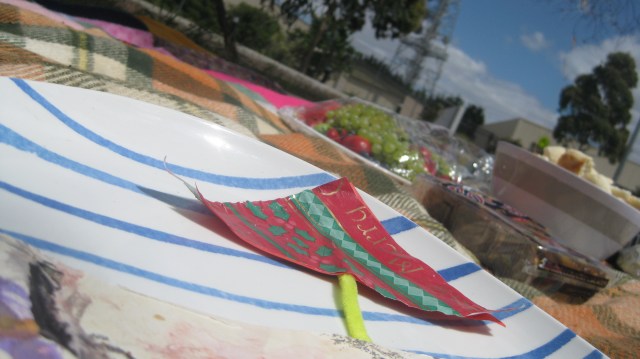
We are gathering during a particular context. The Premier of our own state has come out against the federally legislated law, medical practitioners are refusing to sign off of returning patients to off-shore detention and the UN has condemned the treatment of refugees as breaching human rights… the government, media, society are all sending strong messages – in an environment that seems more focused on reacting out of fear than love, how might we respond with clarity and compassion?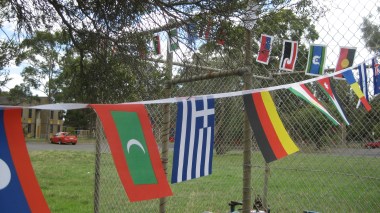
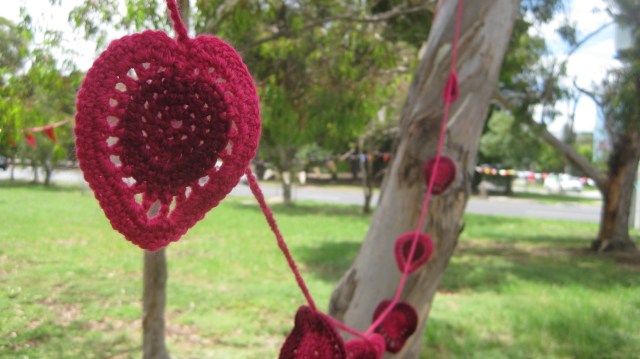
We have folded layers of symbolism into our picnic today… you can see the crocheted heart bunting by Bron for Valentines Day, we have flags representing some of those countries and cultures making up the population of those in our detention centres, and we have empty plates – places set at the table for the ‘other’. We live with asylum 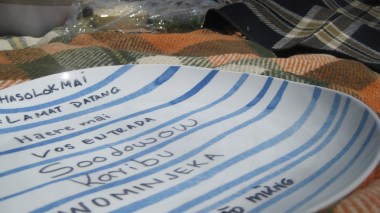 seekers and refugees, we invited them to write the word WELCOME in the language of their cultures on one of the plates and symbolically be represented here and we remember those stories that are still unfolding.
That is about as much story as there is from me, so let’s move on to the singing! We’re very lucky to have Sam here to be the lead liturgist today so look to her for any cues – we’re not going to sing these through a set number of times or anything, we’ll just keep going until she signals otherwise.
So, I will invite you to stand if you want to, in this place, at this time in this context and sing with me, this is not a new idea… we sing in the tradition of so many justice movements: civil rights, suffragettes, apartheid, slavery…in the words of Ched Myers to “Sing about it, until it can be realised”.
This first one is from the Ngatiawa River Monastry, up the Kapiti Coast of New Zealand, a contemporary contemplative community retreat centre.
Given for you [link here to original version on the Ngatiawa website]
This is my body given for you
Remember me.
This is my blood of forgiveness,
Remember me.
Tricia Watts is an Australian singer, composer, she’s used singing and dance for advocacy and therapy and to call people to unite in heart and voice. This next song is from her resource titled ‘Sanctuary’. We want to offer Sanctuary, we want to link hand in hand, we want to hear the voice of justice cry.
Justice Cry
Hear the voice of justice cry,
Moving through our land,
Ringing out o’er hills and plains,
Linking hand in hand.
Well, I guess the credit or the blame for this one is on me… many of you will have heard of the Love Makes A Way movement. They have undertaken a variety of actions but in particular sitting in politicians offices and praying for them has attracted media coverage. What might be less known, is that while the actions are being undertaken inside, there is a support team outside praying, singing and bearing witness to, and holding vigil with, what happens within. Samara has been one of the people playing that part and collating a Love Makes A Way song book. And as we were talking about it once we remarked the we were drawing heavily on the Freedom songs of the civil rights movement but their style and language were written for a particular context and a particular time – certainly we can borrow their songs but Samara posed the questions “Where are our songs? Where is the style or the voice arising out of our own context?” This song came out of trying to answer that… as I looked at the Freedom songs I felt like they communicated grief but called for hope, they were often short and memorable because as your walking around you need songs people can just pick up even if they don’t have the words in front of them. I wrote this trying to find words for a situation I don’t have words to explain. You might feel moved to offer your own words here in a verse … there is room for the children, there is room in our playgrounds… feel free to lead us! Speaking specifically to context, this was originally written “Let them in, let them in” but with the Sanctuary #LetThemStay initiative just this past week as we were rehearsing we changed it to read “Let them in, let them stay”
There is room
There is room at the table (x3)
Let them in, let them stay.
There is room at the border (x3)
Let them in, let them stay.
There is room in our hearts (x3)
Let them in, let them stay.
There is hope for a new tomorrow (x3)
Let them in, let them stay.
Flowing on from the last song and our desire to have local songs coming out of our own context, I had a look around for who might already be producing words that hold this sense of lament and hope, short and memorable… this led me to make up the melody for the round you’re about to hear to Leunigs Love Is Born. I think Leunig is a bit of a prophet, speaking out of hope and darkness, on behalf of many voices… I think “love is born”.
Love is Born [link here to a recording by Nathan Brailey]
Love is born with a dark and troubled face
When hope is dead and in a most unlikely place
Love is born,
Love is always born.
Love is born,
Love is always born.
This little ‘set’ wouldn’t be complete without a rousing Hallelujah chorus from the Freedom songs of the civil rights movement – it’s hard to know who to give credit to because groups of musicians gathered for “Sing for Freedom” workshops and wrote them together. These songs were written to be a call for integration and confrontation of the status quo. African-Americans in the 60s in the South were singing “We’re gonna sit at the welcome table”, today we have to acknowledge that we’re already sitting at the welcome table, or the welcome picnic blanket… Again, you might be moved to call out a chorus of your own making! {e.g. We’re gonna share our songs and stories} By Samara’s hand now we will sing “they’re” as we aspirationally hold space and hope that those inside will one day come outside and join us at this table.
They’re gonna sit at the welcome table
They’re gonna sit at the welcome table
They’re gonna sit at the welcome table one of these days (hallelujah)
They’re gonna sit at the welcome table
Sit at the welcome table one of these days (one of these days)
They’re gonna feast on milk and honey
They’re gonna feast on milk and honey one of these days, (hallelujah)
They’re gonna feast on milk and honey
Feast on milk and honey one of these days (one of these days)
A-ll God’s chil-dren gonna sit to-ge–ther
Yes, a-ll God’s chil-dren gonna sit together one of these days (hallelujah)
A-ll God’s child-ren gonna sit to-ge–ther
All God’s children gonna sit together, one of these days (one of these days)
They’re gonna sit at the welcome table
Yes, they’re gonna sit at the welcome table one of these days, (hallelujah)
They’re gonna sit at the welcome table
Sit at the welcome table one of these days (one of these days)
Sit at the welcome table one of these days, (one of these days)
Gonna sit at the welcome table one of these days (one of these days)
Thanks so much for making the time today to come here – to stand, to sing, in a particular place, at a particular time, in a particular context to say something.
Let’s enjoy the picnic!
Further rough notes for those interested in the background of how this picnic came about:
Last year, Mayra and I went to a conference called the Kinsler Institute and heard an amazing activist and speaker Bill Wylie-Kellerman doing a session on ‘Liturgy as Activism’. He is the Minister of an Episcopal Church in Detroit where they’re experiencing some severe water cut offs and he described a Good Friday Stations of the Cross walk where they stood outside the water company, at the river, at block where there is only one house with people still living in it… there was something about singing or praying or standing in a particular place, at a particular time, in a particular context to say something that made it more powerful.
We came back from that conference inspired to imagine what a Stations of the Cross walk might look like for our own context here in Footscray – we went to the Palms Motel where they provide crisis accommodation for people experiencing homelessness, we went to the river and reflected on the impacts of climate change, we came here to the Maribyrnong detention centre … most of you will know of the Christian tradition of communion, sharing bread and wine together, this is done symbolically because Jesus says ‘I won’t eat this again with you until I see you in my Father’s kingdom’. In a church we have communion and we eat it as a reminder of that promise… well, we came here and compared what it must feel like for refugees who take a long and dangerous journey to get here, who expect to find shelter, and safety and hospitality and instead… we passed around an empty cup and an empty plate as a symbol of the kind of hospitality people have experienced arriving here.
Of communion, Jesus says I will not take this drink again until
I drink it new with you in my Father’s kingdom.
We decided on Sunday 14 February we would hold a picnic lunch at the immigration dentention centre in Maribyrnong.
The first Sunday of Lent (and Valentines Day- let’s show the love) would often have a focus theme of a continued call to conversion the intention of the picnic was to physically create the space we would like to live in – that kingdom where Jesus might join us for a drink – even if only for an hour. How can we make that grass verge feel like space of celebration and welcome? How can we extend the expression of hospitality and welcome that we would like to see shown to refugees and asylum seekers?
With yarn bombing, banners, different flags, welcome in different languages, families and at each picnic blanket a spare place set at the table – a visual demonstration that there is room at the table for the ‘other’ and enough food to share.
In the face of the continued and indefinite detention of refugees and asylum seekers including children and New Zealanders now the second highest number of those held in off-shore detention – we seek to respond with an act of hospitality, an act of welcome, and act of love – witnessing there is room at THIS communion table.
Why here? A conversion of the New Pyrotechnic Section of the Explosives Factory Maribyrnong established in 1942 to produce flares, tracers and smoke grenades – the Maribyrnong Migrant Hostel first opened in 1966. Part of an ambitious assisted migration scheme that was implemented by the Commonwealth government in the late 1940s in order to increase Australia’s population. Until it was discontinued in 1981, this program saw thousands of British, European and Asian migrants start a new life in this country, temporarily accommodated in government hostels until they were able to buy or rent a house of their own. The Hostel has accommodated migrants from almost every national group that has arrived in Australia since World War II. Initially these were people from Britain and Europe but the later migrants arrived from Asia and South America and people escaping political upheavals in places such as Hungary, Chile and Vietnam. The hostel at various times also accommodated naval personnel, apprentices and evacuees from Darwin after Cyclone Tracy in 1974. Attempts by migrants to personalise their surrounding are apparent in a mural of windmills and tulips by Dutch migrants painted on the side of one of the surviving concrete bunker structures and a mural of an Asian scene that appears to have been painted by Vietnamese migrants on a section of wall of one of the ammunition stores located next to the Phillip Centre. This building also includes a number of paintings by children on its walls. Staff of the migrant centre also erected a large aviary attached to the former electrical substation that was part of the pyrotechnic works. (onmydoorstep.com.au/heritage-listing/35583/former-maribyrnong-migrant-hostel). These site spaces are now occupied by Victoria University and in the last few years used predominantly for student accommodation.
The current, purpose-built, Maribyrnong Immigration Detention Centre (IDC) was opened in 1983, set up for people who have over-stayed their visas, had their visa cancelled, or who have been denied entry into the country through international airports and seaports. Unlike the Broadmeadows IDC which has been home to families and children, Maribyrnong IDC has been home for mostly adult single male detainees identified as medium/high risk and therefore it is a site that has had higher security.
In June, the Australian Citizenship Amendment (Allegiance to Australia) Bill 2015 was passed. The Citizenship Act has always said that if a foreign citizen or foreign national fights for a foreign country at war with Australia, they automatically cease to be an Australian citizen. Fair enough. The Bill adds three new categories of circumstances which will bring about the same result.
The protocol is that ASIO notices you’ve done a particular thing and tells the Immigration Minister who deports you. To do that, he has to accept that the factual allegations are correct. You have no right to be heard before he does so. You can contest it later but by this time you’re already on a plane.
(you can read more about this here if you’re interested: abc.net.au/news/2015-06-25/bradley-how-you-could-lose-your-citizenship/6572382)
At 30 December 2015, there were 1,792 people in held immigration detention facilities. Of these 1,792 people, around 18.6 per cent were from Iran, 10.2 per cent were from New Zealand, 8.0 per cent were from Sri Lanka, 6.5 per cent were from China and 6.3 per cent were from Vietnam. (Department of Immigration and Border Protection).
New immigration laws brought into effect back in December 2014 mean that anyone who has served a jail sentence of 12 months or more in Australia could be deported. “We don’t want people who get into trouble, who have a criminal record, and those who fit into that category will have their visas cancelled and sent back to where they came from,” Australian senator Ian Macdonald said, saying that New Zealanders can’t expect special treatment.
“We love our cousins across the ditch but they must be subject to the same laws as everyone else.” [ The Australian, 29 Sept 2015]
It may be that New Zealanders thought they were being treated by the same laws as everyone else when they were convicted, served time and released just as an Australian might be. That once they had observed due process and due punishment they were free to resume normal life, 5000 New Zealanders have done time in the last 10 years and these changes mean they can retrospectively be sent home. I’m not trying to be permissive or whitewash anything these people have done. Clearly they are convicted criminals all. But surely we must ask whether it is fair to punish them now, again, a new law applied to an old crime? These who might have family here, work here, barrack for an AFL team here… is it justifiable? Is it justice?
With all these legislative changes, the population of the Maribyrnong IDC has housed both of these groups – convicted criminals whose visas are cancelled and are being sent back to where they came from side by side with refugees seeking asylum and safety. I can’t find a number for 2015 but between 2010-2014 the number of “boat people” identified as legitimate refugees is over 90% in each year. The treatment of the asylum seekers and the treatment of the criminals is the same. “Hard-line” centre managers from the prison system have been brought in – ex-prison guards who have a very different culture and mentality to officers who have been trained to guard asylum seekers amidst outbreaks of racial violence and hunger strikes .
People come to Australia with the hope of a better life but they are kept in the same place, and in many ways treated similarly, as criminals. A friend of ours who has visited here – a refugee herself – has shared stories of the intimidation to herself of the conditions of entry; the boredom, the frustration, the fear, the hopelessness, the despair of those she met inside. She had her own complex needs but returned again and again not only to meet the hunger for Arabic home cooking, but for stories and news of life outside.
The latest development is this: all refugees in Maribyrnong are due to be moved to Broadmeadows which has recently had a high security upgrade. They were due to be moved already but it hasn’t happened yet – we have no way of knowing if this will occur prior to 14th of February. This comes at a high cost to those at Broadmeadows IDC because along with the higher fence, more guards and greater security screening, comes heavier dehumanisation.
And, you know, some of the symbolism of our picnic is lost.
Or is it?
What a contrast over fifty years between a hostel and a prison, between encouraging people to move to Australia and border control to keep them out… but this place, this space, is where weapons were made that were used during World War II then offered a new start to some of the refugees of that conflict. What has been used for building harm in this place has been transformed for building hope before… maybe we can build it again.
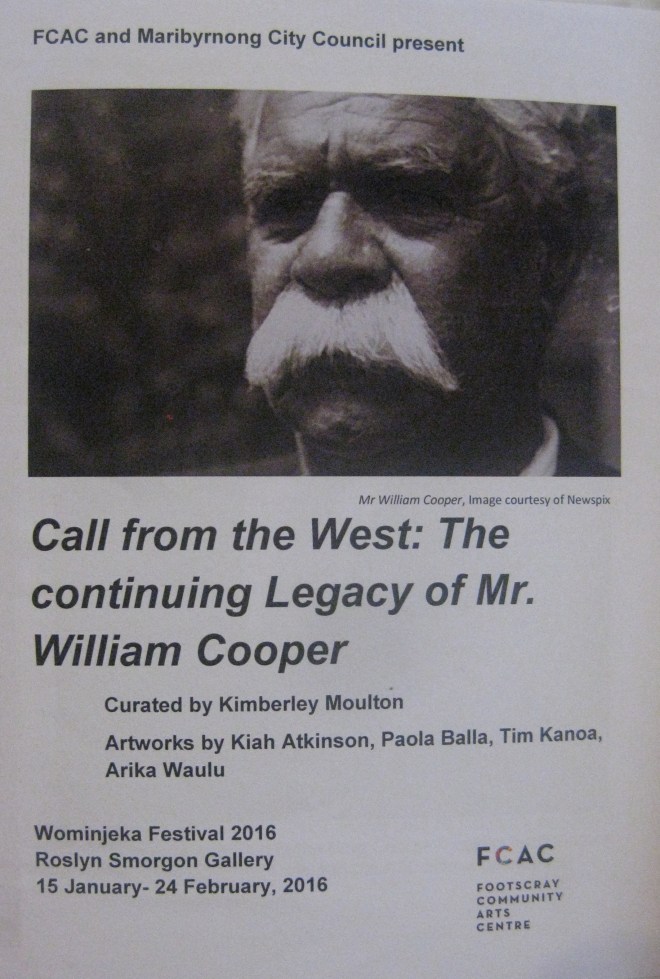
As a nation we have not been taught about our own black heroes, we learn about great civil rights leaders from around the world. Dr Martin Luther King and Rosa Parks are familiar within our vernacular however the black freedom fighters of our own country are left out of the history books. From first contact through to today we have Aboriginal leaders like William Cooper that have shifted the course of history, that have resisted the colonial order of the nation and have led us in the ongoing goal to de-colonise our space, for equality, for better living condition, for health and legal care, for land rights. These are the legacies that are left to be continued by the next generation of Aboriginal women and men.
The ‘tide of history’ has not washed away our connections to country or culture, it is our sovereign right and it is our obligation to our old people to maintain these.
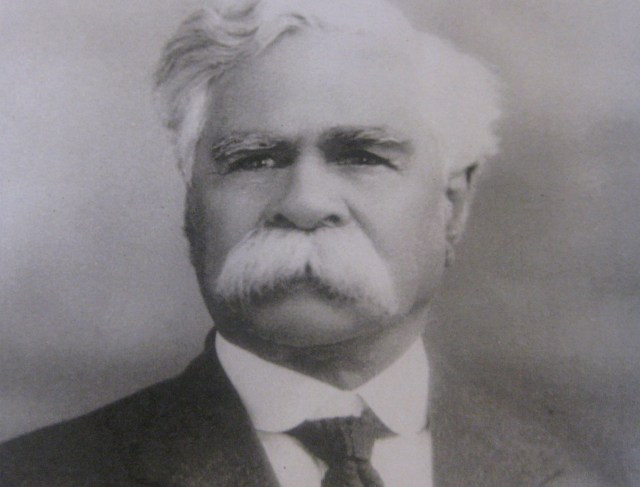
William Cooper
Source: Museum Victoria
Yorta Yorta man Mr William Cooper had a vision for his people to live a better life, to be treated as equal citizens in a land that as he stated, by ‘divine right’ was theirs. His story is remarkable and of great courage and strength, he fought for not only his people but for others around the world being persecuted. William was a humanitarian on a mission to create change.
Born on the banks of the Dungala (Murray River) in 1861 William lived his youth witnessing the frontier of change. He saw the destruction of his homelands and the dispossession of Aboriginal and Torres Straight Islander people across the country but his strength as a proud Yorta Yorta man could not be taken and he dedicated his life to fighting for better rights of his people.
William had many hardships in his life, losing two children including Daniel Cooper who lost his life fighting in the First World War and also two wives, in this time raising his family in regional Victoria and NSW travelling to where he could work. As an elderly man he moved from Cummeragunja mission to Melbourne to be able to receive the old age pension. This was a time where many Aboriginal people were fleeing missions across the state, walking off in the hope for better living conditions and making their way to Melbourne. The West, Fitzroy and Northcote were community hubs of Aboriginal people congregating, building a life in the city.
In this time he formed the Australian Aborigines League (AAL) and they would meet at his house in Footscray. The AAL demanded that Aboriginal people should enjoy the same rights as all Australians. William became secretary and began writing many letters and petitionings to government on behalf of the AAL calling for civil rights and changes in government policy. In this time he led many significant protests including a petition to King George V calling for Aboriginal representation in parliament. He and the AAL also supported the Cummerangunja walk off in protest of the appalling living conditions and brutality inflicted on the community. In 1938 William led a deputation from Footscray, walking into the city where thy presented the German Consulate with a letter demanding the Nazi government stop the ‘cruel persecution of the Jewish people’, this is the only known protest of its kind recorded in the world at that time. Both his petition to the King and the deputation’s letter to the German government were refused. William in his life time wrote over eighty letters petitioning for Aboriginal rights, equality and human rights and he never gave up the fight and his vision for a better future for his people.
This legacy has been carried on by his descendants including his grandson Uncle Alf ‘Boydie’ Turner who in recent years has accomplished his grandfathers work getting a new petition to Queen Elizabeth. With his great nephew Kevin Russell and other family and supporters, he re-enacted the deputation to the city, marching to the German Consulate and handing over the letter that his Grandfather had tried to do many years before.
Four Koorie artists in this exhibition respond to notions of legacy and current political realities for our community.
Kiah Atkinson is an emerging artist and a relative of Mr William Cooper, Kiah’s sound piece tracks William’s journey from Yorta Yorta country to Footscray, creating an audio journey.
Paola Balla is an artist, writer and activist whose work ‘the homes that we had known’ is a personal story of connection to William through her Great Grandmother Mariah or ‘Puppa’ as she was known, who travelled 1500km on her own to attend the Day of Mourning in 1938. Paola’s installation includes a bed frame with earth, leaves and flowers from her country; a poetic reflection to the hardship of mission life that her grandmother Rosie describes in a poem. Paola commemorates the struggle of our ancestors whilst highlighting the strong Aboriginal women who were protesting and raising families in some of the most challenging conditions.
Tim Kanoa is a photographer who has been capturing the recent rallies against the forced closure of Aboriginal communities in WA. Tens of thousands of people gathered to protest in 2015 and Tim’s work Ignite looks at how the legacy of protest and standing up continues to burn strong.
Arika Waulu’s work legacyliveson is a powerful meditation on sovereignty and the next generation of activists. Arika’s projection of the 2015 rallies led by the Warriors of Aboriginal Resistance along with an illustrated portrait of William is projected onto a wall of paper bark visas which are representations of sovereign nations.
The ‘tide of history’ has not washed away our connections to country or culture, it is our sovereign right and it is our obligation to our old people to maintain these.
Reflection questions:
What does the term ‘legacy’ evoke?
What is the significance of the actions of Uncle Alf ‘Boydie’ Turner and Kevin Russell?
What do you think Uncle Turner means when he refers to a ‘greater purpose’?
What ways do you/do you not feel connected to country and culture?
What vision do you have for a whole or healed world?
What could/are you doing to participate in building that vision to be a reality?
Do you think Aboriginal people have the same rights as other people in Australia now?
The following are some of the values which outline the purpose and core ideology of the community and are used to guide and inform our decision-making. It is always good to start off a new year checking in – are these still relevant? how are we doing? what might these look like in the year ahead?
Partnering with God
We value the opportunity of participating in the Missio Dei (mission of God). Through persistence in prayer, we seek to recognise where God is at work in Footscray, and become co-workers with Christ.
Biblical basis: Psalm 127:1, Luke 18:7, 1 Cor 3:9
In it for the long haul
We value being a constant in an inconsistent world, expecting and persevering through hard times. Our long-term commitment allows us to build trust and respect with those in our community, as we try to reflect God’s unconditional love and grace.
Biblical basis: Hebrews 10:36
Being amongst the people
We value sharing life with our neighbours, as a real expression of the kingdom amongst the marginalised. Our everyday involvement and identification means our mission is not so much what we do, but who we are.
Biblical basis: John 1:14, Philippians 2:1-11
Seeking justice for the poor
We value God’s priority for the poor and seek to prioritise the marginalised of Footscray. We do not want to just show mercy, but instead offer in our lives, in voice and activity, with those who we seek to serve.
Biblical basis: Jeremiah 22:16, James 2: 1-5
Becoming family
We value the intimacy of relationship we can have with Christ, and the belonging found in growing closer to God and therefore to each other. Our goal is to be family for those facing loneliness and social isolation.
Biblical basis: 1 John 3:16-18, John 13: 34-35
Being honest about who we are
We value the humility and forgiveness required to live transparent lives in community. We want to submit to each other in accountability and honesty, allowing Christ to use our weaknesses and failings.
Biblical basis: 2 Corinthians 12:9-10, 2 Corinthians 3:18
Doing the hard yards
We value servanthood in the big and the small – choosing to do the “crappy” stuff. We want to be people of personal and spiritual maturity (enduring personal cost) in order that the vision is accomplished.
Biblical basis: James 5:7-11
Travelling light
We value the difference that can be made when we sacrifice personal gain, pouring out our rich resources in an act of worship. Through simplicity, good stewardship and a common commitment to sharing our lives with others, we seek to lessen the power imbalance in Footscray.
Biblical basis: Luke 9:23-24

Some fine Saturday I would like to recommend you idle away an afternoon doing the Billibellary’s Walk at the University of Melbourne. I work in the precinct so it felt like a good fit to contextualise what was happening in this specific place 300 years ago, 200 years ago, 100 years ago, now… or maybe what’s not happening…?
Billibellary’s Walk is named after the Ngurungaeta, or clan head, of the Wurundjeri people at the time of Melbourne’s settlement. The walk is a cultural interpretation of the University’s Parkville campus landscape that provides an experience of connection to Country which Wurundjeri people continue to have, both physically and spiritually.
The walk is designed to help participants hear the whispers and songs of the Wurundjeri people that lie within the University of Melbourne’s built environment. The walk alerts us to signs and stories that may not be apparent to visitors, but which provide some insight into the experience of the Wurundjeri people of the Woiwurrung language group who have walked the grounds upon which the University now stands for more than 40,000 years. It is intended to provide the impetus for further exploration of issues pertinent to the Aboriginal community.
http://www.murrupbarak.unimelb.edu.au/
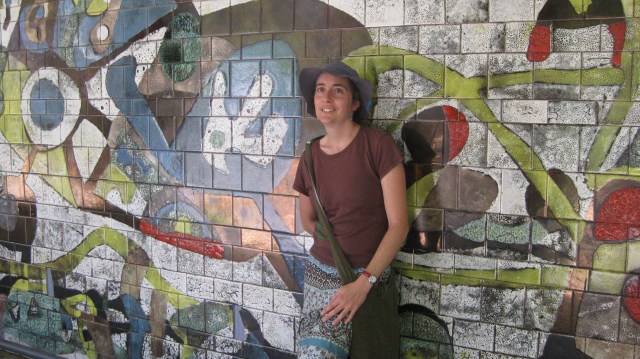
The actual talking-point sites around the campus don’t often have a strong link to what you’re talking through but probably understanding that little remains from earlier times is precisely part of the journey they are taking you on. I was lucky enough to do it with Samara from the Indigenous Hospitality House in Carlton so the talking points and questions were enriched by having someone along so much more deeply invested and holding wisdom in cultural awareness. You could do it as a tourist, as a social studies class, as someone seeking to hear truth… being open to ideas, history, stories and what they have to teach us about the impacts of colonisation. You could do it as someone who likes to look at a big, tall, beautiful tree and know that it’s been there since before you came along and will stand for many years after you go – bearing witness.

The walk poses a lot of questions. It doesn’t necessarily have the answers. You have to sit in that. Not having the answers. This is something we’re still living out hey…
I find myself getting fired up as our conversation canvasses: religion, authoritarianism, institutionalisation…. from colonisation to terrorism to the Royal Commission investigating child abuse… it all somehow feels like the same thing and it feels broken.
“We’re not going to be the ones who fix it” Samara points out.
“Then who?” I demand.
“We be a part of it.”
This walk invites you to do that. Be a part of it.

I have started reading The Jihad of Jesus by Dave Andrews. With a title like that I think it confronts and offends peoples sensibilities before they ever read a page. I can assure you there is plenty of scope for it to confront and offend sensibilities once you open it too. How can it not? This is a self-effacing story. I’m only 30 pages in but I understand that it costs something – before I can preach to you about non-violence I must confess the horrendous history of violence, rape, torture, murder done in Your name. It makes you wonder, why anyone might align themselves with such a thing as this? How can you be associated with Christians, with religion, when it has not just participated in but driven so much atrocity in the world?
I do find it hard to align with the structure, the culture of the “institution” of the church. I can feel very far away from You when I am in these walls. It is necessary for healing, on both sides, to participate in building a world that is different. Who is sick? Who needs to be saved? We do not send a doctor for those who are well but those who are sick. I know I am sick. I know I need help. I need help everyday. I must take the plank out of my own eye before I look at the speck in yours. Do you not want to be well? I do. I long to be well. It hurts. It’s uncomfortable, it’s sickening to read these things and understand that they form part of the cultural tail I claim. But we get Martin Luther King and Mother Teresa too. What is stopping you from being the next Martin Luther King? These were imperfect human beings – MLK cheated on his wife with some regularity I believe and MT was someone who set such high standards she was difficult to please and work with. Side by side with them they might not be so easy to admire and love as their reputations act like airbrush to photography. I am not so easy to love up close. Religion is not so admirable up close either.
We judge those harshly who have gone before. In our current age where brain comes before brawn we think “how savage“, we want to know how these actions might conceivably be justified and the only response we have is “they know not what they do”. We know now – issues of indigenous land rights and protection of culture, mandatory detention of refugees, family violence, climate change, water shut offs in Detroit, war and genocide… we have our own share in stupidity or willful blindness or whatever you want to call the gross injustices of our own time… consumption climbing relative to our social isolation as we look for the things that will fill us but not to each other.
[p.1, The Jihad of Jesus]
“Jihad is an Islamic term referring to a religious duty for Muslims.
In Arabic, the word jihad translates as a noun meaning “struggle”… there are two commonly accepted meanings of jihad: an inner spiritual struggle and an outer spiritual struggle.
The “greater jihad” is the inner struggle by a believer to fulfill his or her religious duties. This non-violent meaning is stressed by both Muslim and non-Muslim religious authors.
The “lesser jihad” is the physical struggle against oppressors, including enemies of Islam. This physical struggle can take a violent or non-violent form.”
If fulfilling your greater struggle is to follow the call to living a life of love, peace, forgiveness… then this “lesser” struggle needs to be framed by the principles of the first.
I am grateful for smart, wise elders who can write these books, have these conversations, articulate what needs to be said – even if it confronts and offends.
Welcome, we acknowledge that we gather on the land of which the people of the Kulin Nations have been custodians since time immemorial.
This is our second in a series called The Art of Discipleship where we showcase the material of different books and engage with their material creatively.
WEEK TWO
The activity this week is taken from:
Christi-Anarchy: Discovering a Radical Spirituality of Compassion and you can read a little more about it here from the first time I read it if you’re interested.
This book by Dave Andrews goes into the fact that Jesus Christ preached a gospel of love and peace with justice but the history of the Christian religion is littered with every kind of evil – What went wrong?
Mediation: Dave Andrews poem speaks to Jesus’ compassion, his hunger for justice, and desire to work with marginal groups for real transformation in our world – inviting us to live this way too through the eyes of the disciple Peter.
The prologue of Christi-Anarchy: Discovering A Radical Spirituality Of Compassion retells Dave’s unfortunate history of being kicked out of YWAM many years ago. This lays the foundation for the rest of the book – a grave injustice done in the name of Christ. At micro and macro levels…
The very first chapter of Dave Andrews book is called:
A History of Christianity: A History of Cruelty
And it’s broken down into 4 areas:
-Councils, Creeds & Coercian: ca. AD 100-500
-Emperors, Popes & Power: ca. AD 500-1000
-Crusades, Inquisitions & Control: ca. AD 1000-1500
-Worldwide Evangelism, Witch Hunts & Genocide: ca. 1500-2000
So you can see how this is not an easy read – to really ‘look’ at the history of the church (our church) and to try and grapple with how this relates to our own understanding of who Jesus was and the way that he lived.
What I’m hoping to create tonight is a bit of a meditation space reflecting on Dave Andrews words speaking to Jesus’ compassion, and his hunger for justice, his desire to work with marginal groups for real transformation in our world and inviting us to live this way too through the eyes of the disciple Peter – speaking into the disillusionment or cynicism we might sometimes feel towards our own church/discipleship movement.
To give you a bit of an overview about where this is going – you will want to make yourselves comfortable because I’m basically going to try and read this like a play/well… a monologue… and it’s going to take about 20 minutes – I’m going to make the room dark because I want you to try and visualise the scene and put yourself in Peter’s shoes. I’ll leave things dark and quiet for a few minutes while people reflect and then bring us back together for sharing/prayer…

So, from the macro to the micro for Peter to set the scene and condense the bible into a paragraph… we know from the oral history passed down and recorded that the people of God were slaves under Pharoah, led across the Red Sea to freedom, wanderers in the desert and led across the River Jordan into the Promised Land – Jerusalem, they finally have their own sovereignty: a line of Kings: Joshua, Saul, David, and Solomon … who turns from God’s ways and the city is destroyed in Chronicles, rebuilt in Ezra, and restored in Isaiah then a series of prophets come… the day is coming when Israel will be judged for its sins, prophesies of the birth of one to come… after Babylonion captivity, they are under the domination of Persia…
We fast forward 400 years between the
Old Testament and the new – and Rome is now the dominant power… Herod the “great” is slaughtering male children, under a star somewhere in Bethlehem a child is born, in a dark and troubled place…
Jesus is born – the next great political leader, descending of Kings, fulfilling the prophecies – who would lead the uprising to free the people from Roman oppression and win back the independence of the Jews!! Jesus says “Truly, this very night, before the rooster crows you will deny me 3 times” and Peter responds, “Even if I have to die with You, I will not deny You.” And all the disciples agreed.
Except that Jesus didn’t really behave the way people expected… didn’t lead the way we expected, fight the way we expected… died when we didn’t expect it
Arrested, disgraced and denied three times… Peter broke down and wept.
(here follows the reading of the poem, n.b. not complete in these images)


Reflection questions:
Time of prayer for ourselves and others.
My alarm went off at 7.30am. “Wha-?” Snooze.
Why did I set it early again? Not work… Oh. I remember I need to walk to Maidstone via an ATM to collect a network repeater I bought off the local Buy/Swap/Sell Facebook group.
The alarm sounds again. Snooze.
This is not how I thought my weekend was going to go… I had Friday/Saturday clear – maybe to write and have some sacred space. One housemate is away at a wedding and school holidays have started, things will be quiet around the house. Yet somehow a conversation has started up about supporting a family of refugees who are staying in two rooms at The Palms. They’re approved for housing but the waiting list could mean anywhere between days and months or, let’s face it, months and years before a 5 bedroom place with disability access comes up. At the motel they will run through their income for a fortnight purely on accommodation leaving nothing for transport and food. It seems on Monday they will move in with us.
I wonder whether anyone might imagine that this is some extraordinary thing?
The room swap for my shift-working housemates’ peace may now be a bit redundant. We have four bathrooms between three units which felt very luxurious not to have to negotiate, though to cycle through 6 new others might take some negotiation, similarly with the use of the kitchen when dinner is in progress. My head keeps going through the details – need: beds, bedding, another fridge…
The alarm sounds again. Snooze.
…and more internet, which means a wireless signal repeater, which means you have to get up now and go and collect it.
The signal repeater is in place. The signal is extending further than it did before but it’s not any stronger.
These are the the basic tenets of our faith: I was homeless and you gave me shelter, hungry and you gave me something to eat, disconnected and you gave me connection.
This is what we are called to.
Is how it will inconvenience us the place to start our discernment about it?
I believe in Your ability to provide not only the practical and material things but also for the mental, emotional and spiritual needs of our community.
I do not need to be able to see the way forward as long as I can see You in what we are setting out to do – trusting that You know all that has been, is, and will be.
This is it. Are you ready?
I confess I cried a little today, re-packing and putting away boxes I had unpacked with such gratitude only days before, to make space for the others coming. I go and walk it off: “Who is this space home for? It’s called a’share house’, what were you expecting? I want to build a foundation that is strong. Rooted. I have lived here two weeks. Who am I to extend safety and stability to anyone else?”
I turn up a side street to get home only to realise it is a dead end. I double-back on myself and notice a cane basket of clothes out as hard waste on the verge. I pick it up and carry it with me… a physical manifestation of providence… feel the weight of this, touch it, look at it, take it with you. Providence. And, somehow, I feel better.
Reassured of my physical capacity for carrying things.
We try and create a sense of welcome.
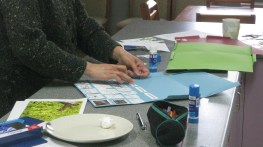
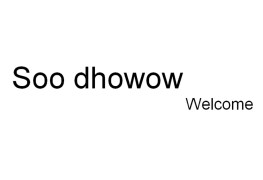
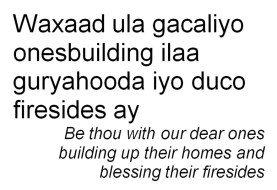
We know there’s limited language between us so we create a bi-lingual, pictorial noticeboard that will have all our names, where we are, what we’re doing. We clear out, clean and label the cupboards our new roommates can use in the kitchen and decorate with a Somali proverb we think speaks to the the sense of home we want to create.

And yeah.
They are not literate in Somali or English.
So, just in case anyone is ever wondering whether it is an extraordinary thing to live with a family of refugees, this is how it comes about: a series of small and ugly thoughts, some big, bright, beautiful thoughts, and some well-meaning but misguided good intentions.
Sometimes you say the wrong thing, sometimes you do the wrong thing.
Sometimes you say the right thing, sometimes you do the right thing.
You can do that in any family.
I am blessed in the trying.
My life is more noisy, more colourful, more crazy and I am the happier for it.
It starts when you stop pressing “Snooze”.



 itellyouarise