
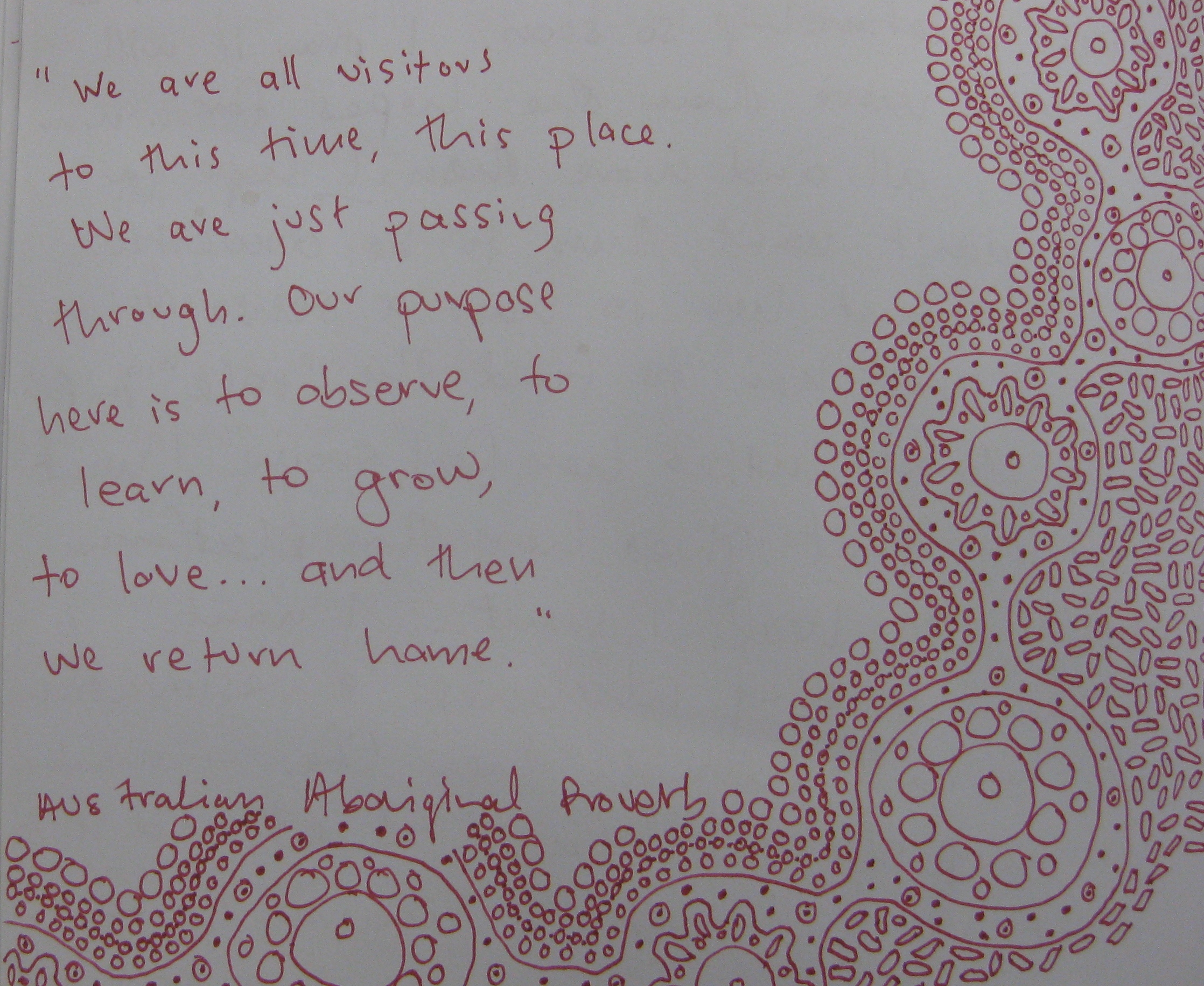
Tag Archive: home

black front
enters from the south
invading blue-white sky
a deep inhalation of raw wind
outlines the ribcage with pain
as it scourges clean
all in its path
Talitha Fraser

Maori continued with the task unarmed and, to a person, they declined to respond to aggression when removed. Go, put your hands to the plough. Look not back. If any come with guns and swords, be not afraid. If they smite you, smite not in return. If they rend you, be not discouraged. Another will take up the good work. If evil thoughts fill the minds of the settlers and they flee from their farms to the town, as in the war of old, enter not . . . into their houses, touch not their goods nor their cattle. My eye is over all. I will detect the thief, and the punishment shall be like that which fell upon Ananias. When the ploughmen asked Tohu what they should do if any of their number were shot, he replied, ‘Gather up the earth on which the blood is spilt and bring it to Parihaka’ (Scott, pp 56-57).
February 6th is Waitangi Day in New Zealand, the anniversary of the signing of the Treaty of Waitangi in 1840. To the British this achieved full sovereignty and government of the country but Maori thought, while giving authority to govern, they would still be entitled to manage their own affairs in their own way. Similarly to Australia Day on January 26th being known as “Invasion Day” to the First Peoples of that nation, Waitangi Day is often attended by protest as well as being a celebration of nationhood.
What perhaps not enough New Zealand settler descendants may know is that there were Taranaki chieftains who never signed the Treaty of Waitangi, steadfast in their refusal to acknowledge foreign sovereignty in preference for maintaining their own way of life on their own land – the pa at Parihaka became a sanctuary for Maori forced, fought, deceived off their land. Likened forerunners to Ghandi and Martin Luther King, Te Whiti and Tohu ran a campaign of non-violence spanning 40 years sheltering the dispossessed.
The Waitangi Tribunal[1] published “The Taranaki Report: Kaupapa Tuatahi” in 1996 saying, “ If war is the absence of peace, the war has never ended in Taranaki, because that essential prerequisite for peace among peoples, that each should be able to live with dignity on their own lands, is still absent and the protest over land rights continues to be made.” Contrary to the belief held by many New Zealanders that in an acknowledged first equal language, proportional representation in government and other policies we might be considered advanced in our journey of equality and reconciliation, in fact we are the only colonising country where there is no land held and managed autonomously by the indigenous population (Ch.8 Parihaka).
The title of Dick Scott’s book is a quote from Te Whiti, Chieftain at Parihaka who says:
Ask that mountain – here before us, it will be here when we are gone – that mountain as witness, can we honestly say that we have done everything we can? That everything is ‘right’?
These are the questions we need to ask ourselves and the stories that should continue to be told if we are to participate in the journey of healing between the people and the land.
It is often difficult to know where to start in confronting these issues, I have more questions than answers yet I have hope. I have ordered a T-shirt from the Emmaus Rd community, on the front it reads Arohamai which means “sorry” or “forgive me” and on the back are a list of some of the injustices as occurred over those 40 years and are carried yet in our dreams and bones today:
I’M SORRY FOR THE
// INVASION OF YOUR VILLAGE – 5th NOV
// UNJUST ARREST AND EXILING OF TE WHITI AND TOHU
// LOOTING BY THE ARMED CONSTABULARY / 8th NOV
// DESTRUCTION OF THE WHARENUI & CROPS / 20th NOV
// FORCIBLE EJECTION OF 1,556 PEOPLE FROM THEIR HOMES /20th NOV
// RAPE OF YOUR WOMEN
// CONGENITAL SYPHILLIS IN YOUR CHILDREN
ALSO FOR THE:
// IMPRISONMENT WITHOUT TRIAL OF 420 PLOUGHMEN AND 216 FENCERS FOR TWO YEARS
// DEVASTATING EFFECT ON THEIR WIVES AND CHILDREN
// UNJUST CONFISCATION OF YOUR LAND
// BACKDATING OF LEGISLATION TO MAKE LEGAL THE GOVT’S ILLEGAL ACTS
AND OUR FAILURE AS A NATION TO FACE THESE ISSUES
In her Booker Prize Winning novel The Bone People Keri Hulme writes, “I was taught that it was the old people’s belief that this country, and our people, are different and special. That something very great had allied itself with some of us, had given itself to us. But we changed. We ceased to nurture the land. We fought amongst ourselves. We were overcome by those white people in their hordes. We were broken and diminished. We forgot what we could have been, that Aotearoa was the shining land. Maybe it will be again… (p.364)
I will wear this T-shirt as an act of public witness, as a peacemaker wanting to put things right personally and as someone who believes the people of New Zealand are different and special and in faith that the mountain will stand to see a shining land, whole and restored, again.
[1] The Waitangi Tribunal was established in 1975 by the Treaty of Waitangi Act 1975. The Tribunal is a permanent commission of inquiry charged with making recommendations on claims brought by Maori relating to actions or omissions of the Crown that breach the promises made in the Treaty of Waitangi. The full text of The Taranaki Report: Kaupapa Tuatahi can be found on the website http://www.waitangitribunal.govt.nz/.
I shifted over from NZ in July & started connecting regularly with Seeds from about October 2007. I have spent a lot of time since then trying to figure out exactly what “community” is. Marcus regularly talks about this concept of “growing home”, meeting to prepare and share a meal together, to be neighbours and engaged in the community together – that’s where church happens.
This tapped into this greater struggle I already had going in my head: relating to missing family and friends back home, to feeling like I have no support networks here. In a new city nothing is familiar; the streets, street/place names, the skyline, the public transport system – going out, it feels like you need to arm yourself for a hostile environment. Can feel vulnerable and insecure all the time.
When I started learning about the work of Urban Seed, I approached it based on the assumption that I would be on the ‘giving help to homeless people’ side of the service. I didn’t realise that actually, I am homeless myself…
“homelessness” is nothing to do with not having a house. Urban Seed doesn’t provide housing, Urban Seed provides an opportunity to be connected in a community. Feels like a really profound revelation for me – my definition of homeless was quite narrow:
Homeless: Without a home. Persons who lack permanent housing.
But in reality, homelessness is:
Homeless: ‘An inadequate experience of connectedness with family and/or community.
If we use the latter definition, does that change the number of homeless people you know?
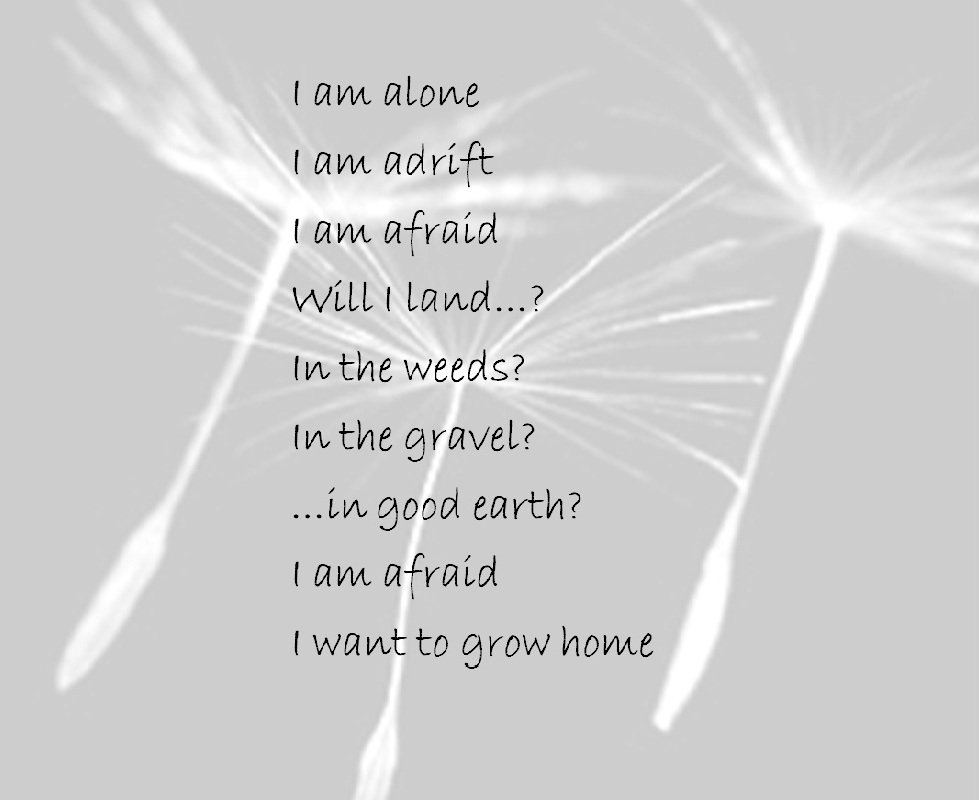
The picture at the top is a poem I wrote when in this space – trying to express something of my experience of the state of homelessness…
This is loosely based on the parable of the farmer in the gospels (Matthew), the farmer scatters seed and the stuff on the road gets eaten by birds, the seed in rocky ground grows but gets scorched and some landed in the weeds and got choked but some landed in good earth and produced 100/60/30x what was planted.
I have times when I wonder whether shifting here was the right thing to do. I keep waiting to see one of those big signs like you have on the highways here that say WRONG WAY, TURN BACK! I am afraid that I might not flourish here, that I might not find good earth I which to put down strong roots.
Marcus pointed out that we’re all homeless, all on a journey back to our heavenly home – having to leave the home we know, that’s part of our history.
This kingdom of faith is now your home country. You belong here… God is building a home. He is using you in what he is building. He used the apostles and prophets for the foundation. Now he’s using you, fitting you in brick by brick, stone by stone, seed by seed with Jesus as the cornerstone that holds everything together. We see it taking shape day after day… (slight paraphrasing, Ephesians 2:19-22)
I was feeling adrift, like I wasn’t connected to anything, reading this was really grounding, it gave me something concrete to hold onto – it was such a relief to have something I felt certain about.
Maybe I’ve been homesick all my life, homesick for heaven, and because all of the things that made my life full I couldn’t see it as clearly. Perhaps because my environment was known and familiar I could pretend that was enough, and it’s only through shifting to a new country that I’ve had to question what I think I know.
2 Corinthians 5:4 reads “For while we are in this tent, we groan and are burdened, because we wish to be clothed with our heavenly dwelling, so that what is mortal may be swallowed up by life.” Perhaps the pursuit of happiness in this life is really part of the search for home, a search for heaven. Maybe this life is never meant to be completely satisfactory, the passage goes on to say God has given us the Spirit as a deposit, guaranteeing what is to come. So we have this Spirit within us that is always longing for God, to be with God… longing for home.
For a lot of people in the pursuit of happiness, they express dissatisfaction with their tents by redecorating them or damaging them. Perhaps no one’s quite sure what our home’s supposed to be, we live by faith not by sight, but it seems we’re all agreed that it’s something other than what we have. What we’re pursuing is change, what we long for is to grow home…
Now when I go back to NZ I found it very valuable in helping me to see how much progress I’ve made towards growing a home here. Urban Seed is helping me do that, helping a lot of people do that. That’s what Urban Seed/Seeds is about: It’s about providing good earth, where people can put down some roots and grow, it’s about providing spaces where people who feel homeless can experience connectedness while on the journey to grow home.
 itellyouarise