Tag Archive: hospitality


“hanging around”

Caught sight of someone “hanging around” our fence, thought “What on earth are they doing?” Sort of bobbing up and down against the fence… moved out of my line of sight so I shrugged and went about my day…

I wandered out the front half an hour later to realise with dismay my bobbing friend was still pacing out the front of our house.

“Hello?” I say, “Are you alright? Do you need any help?”

“Thank you for stopping.  I’m not a bad person. I know how this must look…”

“Where are you going? Do you need anything? Directions?”

“Cigarettes.”

“Oh, I’m sorry I don’t smoke… wait, you want to buy cigarettes? There’s a milk bar just up the road there… where the traffic lights are…”

“Thank you.  Thank you so much for stopping.”

I don’t know what condition he might have that would make him bob up and down or become disorientated. I don’t know if he’d had a serious fall or been beaten or why… I do know we were courteous to one another and it was ‘enough’.

Webinar is available at chedmyers.org but here are some snippets…

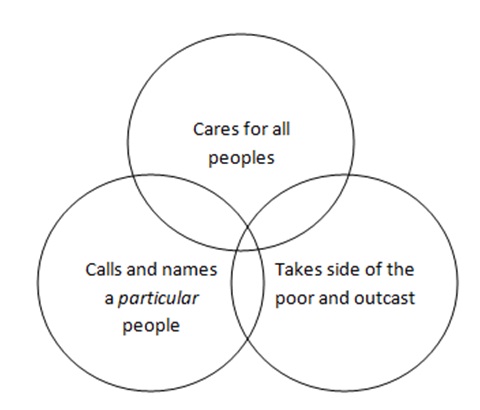
There is a “trialectic” biblical narrative concerning God’s relationship with human beings in the bible.

Image


Jesus embraces all three characteristics: loving both national enemies and intimate betrayers, calling disciples and living among the marginalised.

Isaiah I (Ch. 1-39) Isaiah II (Ch. 40-55) Isaiah III (Ch. 56-66) – different authors.

(p.96-97) But third Isaiah goes on to address specifically those parts of the community that are being legally and socially targeted:

Let not the foreigners say…
Let not the eunuch say…
For this is what God says… (Isaiah 56:3f)

This verse seeks to animate the voices of those who have internalized their rejection by the dominant culture because of how they are perceived and publically caricatured.  “The LORD will surely separate me from his people,” says the inner voice of the foreigner; “I am just a dry tree,” intones the introjected contempt of the eunuch.  Second-class citizens in our own history know all too well this self-hatred.  Black children have tried to scrub their skin white, immigrants have changed their names, women have kept silent, and gays and lesbians have stayed deep in a destructive closet – all to avoid the contempt of a society that barely tolerates them.  Internalised self-negation and external oppression are like a constant  “acid rain”, as psychologist William Grier and Price Cobbs famously put it in their landmark study Black Rage (1968). It is time, says Third Isaiah, for such dehumanisation to stop – because YHWH says otherwise.

What does this mean as a visitor, first-, second-, third-generation Australian?
Reflect on Australian immigration policy and response to “boat people”.
“Reconciliation” with indigenous First People  of these Nations.
Not only called to like pretty/smart/?/people, or people like “us” but specifically to welcome the hungry, the stranger, the ill…
Reflect on this: the maker of the outside also made the inside.

What credit it is it to you to only love those who are like you, to only love those who love you back, to only lend to those from whom you expect repayment – we are called to and Jesus role-modelled generous discipleship.

* I have purchased a copy of this book!

Urban Vision’s model is for those living in community to pay board and then share their room with a young person.

Luke 10 – sending out the 70

Three things:

1)      Don’t take purse, bag or sandals

Simplify your life.  Don’t take anything with you.  Feel like we need to have all of the resources/tools/time before we start.  Why would God give you a miracle when you already have stuff? (Jacqui Pullinger)

In order to be involved in significant hospitality in your house, what would you need to simplify? (discuss with person sitting next to you)

–          Queen-sized bed kills community (barrier to having people stay as compared with 2 single beds in a room)
–          Need a smaller couch (could move study into lounge then and have a spare room)
–          Work less hours
–          Be ‘present’ more
–          Share house to cover rent/mortgage

Hospitality means more if it costs you something e.g. person will know you are sacrificing privacy/personal space to have them. Sharing in economy of ‘enough’ rather than only giving out of my excess.

Average person has six groups of people they connect with:
–          family
–          work/study
–          worship/church
–          social/sport/bookclub
–          people we live with
–          Ministry e.g. youth work
Need to cull groups to create physical time.  Home can become a castle (has a moat, don’t let anyone in) or motel (only use it to drop gear off/sleep). We made a conscious decision to only have three groups: Family, work and then everything else combined into one.  Relocation is helpful.  Doing something like “Servants to Asia” easier than relocating in your own context.  We won’t initiate with wider group of friends – those who are committed to the friendship will be faithful to asking us.  Modular approach – go on holiday for a week – be deliberate about spending time with good friends then rather than catching up every week.

2)      Sending as lambs amongst wolves

Bad news for disciples.  Only thing he promises is that He will never leave or forsake us. Hospitality opens us to a level of vulnerability. Living in inner city, did I get beaten up? Yes. Can’t follow Jesus without it being dangerous.  You will disappoint your parents.  They love you and don’t want you to be hurt.

In order for me to do hospitality, what are the risks? What are you afraid of? (discuss with person sitting next to you)

–          duty of care/accusations (particularly for men around kids/youth work)
–          introversion of other housemates
–          are my kids safe?
–          my own personal safety (particularly for women)

Living in the centre of God’s will, safest place to be. Some lessons learned/benefits:
–          community
–          aunties and uncles
–          spend time debriefing
–          children are good observers but not good interpreters, blame themselves
–          know the background of those you take in (doesn’t necessarily mean that you don’t take them but you know what the risks are)
–          don’t have kids the same age as ours – creates a sense of competition/competing for space whereas if younger/older sense of difference and room for everyone.
–          don’t take anything into your house that isn’t going to be a blockage if you lost it e.g. ring from grandmother (hard to forgive if you lost it)
–          need to have a “no resentment policy” – nothing that will cause bitterness
–          once kids are at an age where looking for influence be careful about who you invite in, e.g. more cautious around that once children were teenagers.

3)      When you meet someone on the road, do not stop and talk. Stay only in one house.

What are the cultural distractions/idols that stop us from doing hospitality well? E.g. career, mortgage, super/retirement…

Downsize and take back control.

It is what you make here that is important not what you get there (illusion that grass is greener)

I am an introvert – throw yourself into it! For the first three months you love it and think everything is really great, for the next year and a half or so the noise of the people you live with feels like a constant annoying drone. Once you get to 2 years its background noise and you don’t notice it anymore.  Rhythm of prayer with focus on silence.  Run marathons – just me and the road.  Switch off into a book but can now do that while I’m in a room full of people.

Becomes obvious quickly where a young persons fragility lies.  Adults are better at hiding the dysfunction – structure our lives to account for our dysfunction. Once in community that doesn’t work, being in community wears down those self-managing boundaries.  Unprocessed-ness spills out onto other people (community will explode after 2 years).  If you want to have community need to have a high commitment and integrity to become who you are called to be.

There are always inclusion/exclusion factors/tensions.  In order to be inclusive at another level you have to be exclusive – want them to join kingdom of God, not to join us.  It is imperative that we have sustainability. Small core of committed people working to a common goal together.

Where do the people come from? Around Urban Vision, totally word of mouth. At Ngatiawa we get ex-prisoners, school guidance counsellor makes referrals. Need a maintain a balance between community members and punters – need more structures as you get bigger e.g. smoking circles. We made it a rule that no one was allowed to smoke with anyone else.

–          Don’t what it to be them and us, and this is a separation that reinforces that
–          Who is influencing? Those who are also struggling themselves
–          Have one struggler, bond with them before introducing another struggler
–          Strong sense of family/extended family (whanau) combine worlds.

When bringing in a new ‘struggler’ how do you find out what their issues are to measure/prepare appropriately for risks?

–          Can often find out some info from whoever is making the referral
–          Ask, what are you addicted to?
–          Ask, do you have any mental health issues?
–          Always other stuff that comes up as you get to know someone

~ I don’t want to know details/be polluted. Want to be able to relate to them as a person

Although technically the SAF event is on this weekend coming up (6-8 May) I hosted one at my house a week early so that Sarah could come – a community friend of mine who will be helping to prepare and serve food to guests this Friday.

I saw Sarah Wednesday and she asked “ooh, is there any chance I could try hangi?”, hmm… once I explained about digging the pit, huge bonfire, volcanic rock etc. it quickly became clear that it wasn’t going to be viable to pull together on short notice but we went with the NZ theme and had NZ cheeses & chutney, kumara & camembert cakes for an entree and salmon for a main with chocolate brownie for dessert (made with Whittakers naturally) and yoghurt flavoured with fijoa and manuka honey to take the edge off… just a little bit fancy!  Complemented by thyme and chillies from our garden – I had been shamefully neglecting my lawn but on the flipside we have three chilli plants! I’m sure if I had known they were there and tried to tend or water them they would have died off early… so procrastination is sometimes rewarded!

Sarah’s daughter Bella had us all drawing and, I will confess, no one resisted terribly hard – it was fun to have an excuse to be creative whether by our own inspiration or Bella’s firm requests! 🙂  Although everyone had pretty much met before, it was great to bring everyone into the room together and have some intentional time to get to know one another better.  From Lyn and Lyds fighting it out over who could go more chillies (those babies are HOT!), to laughing over my serving two types of potatoes with Aly who is Irish and thinks you can never have too many – it was a really fun night.

I guess the aim of these events is about stretching ourselves beyond the circle of who we know and who is familiar and reaching out beyond that circle.  Someone told me yesterday that English is one of the only languages that has the word “perfect” and its surrounding definitions of being very difficult to achieve.  The next closest word in other languages is “whole” – I think there’s something in that… remember, strangers are fiction…

Mobile hospitality


Fortnightly we do a blanket run – load blankets, a thermos of hot coffee and some bikkies on a trolley (in summer we switch to ice blocks and juice) and wander the streets and laneways of Melbourne on Sunday nights from about 9pm.

When we first started to do the run and we weren’t sure where we might find people, we’d often reflect on what we might look for ourselves in a place to sleep and then look for places that met those criteria – somewhere dark, sheltered from wind/rain, private…  it was interesting to learn that actually well-lit and populated places are much safer, for everyone actually but especially for a single woman. This was important in coming to understand why the issue of homelessness can feel like a ‘visible’ one. We did not end up needing to look very hard at all to find people to share hospitality with.

Three runs in a row we walked past a woman sleeping on the mat out the front of a jewellery store on a main street in the CBD.  Each time we saw her we offered her coffee or blankets and she didn’t speak – either mutely shaking her head or ignoring us completely.

The fortnight after that…?  We sat together for twenty minutes over a cup of coffee.  She told me her name, offered me a cigarette and told me a little about her three imaginary friends who were sitting with us.

The fortnight after that…? Just a silent head shake “no”

After that…?

I haven’t seen her since.

This isn’t a story about sharing the ‘good news’.  She didn’t start coming to the free lunch we run.  I didn’t advocate for her on any issue or find her housing or work or bring about reconciliation with her family.  I have no idea if she even needed any of that.

It’s hard sometimes not knowing what has happened to someone.  I noticed you were gone and I hope that you’re ok.