Tag Archive: indigenous


On the weekend of 24-25 September Whitley College hosted a conference called Constitutions and Treaties: Law, Justice, Spirituality – these are notes from session 6 of 9. We acknowledge that this gathering, listening and learning occurred of the land of the Wurundjeri People of the Kulin Nations and offer our respects to their elders past and present, and all visiting Aboriginal and Torres Strait Island visitors present.


“Wrongs to Rights”

i ways we talk about sovereignty

ii Treaty

iii acts of resistance

iv identity of the church


WAYS WE TALK ABOUT SOVEREIGNTY

Ask what does it mean for the identity of the church to recognise First People? Always about wealth: land, labour, wealth… when talking of treaty/constitutions always become justifying narratives. We cannot ignore the material component.

 Sovereignty? People aren’t sure about what the word means.

Confuses meaning when indigenous people are asking for it.

Rights and claims continuously negotiated e.g. human rights (allows some limits/accountability)

Four themes:

i ‘external’ or ‘internal’ authority. Boats vs. states/federal government.

ii power of institutions or powers of people

iii be sorted out legally or negotiated politically e.g. State of Victoria negotiating a Treaty.

iv sovereignty is capable of being shared > not absolute (Pakeha and Maori)


  1. separate and independent nation
  2. starting point to achieve rights and social inclusion
  3. authority inherent in them as individuals and as a people


Assertion: sovereignty reframing ongoing negotiating of claims in the community > nature of our settlement and how they live here.

Not disadvantage or reparations but ‘ancestral occupation’.  Not a gift of ours to give.

Recognises First People are a people with their own culture, land, language… have inherent rights.  Opens up a new negotiation for settlement.


img_1454


TREATY

‘shared house’ analogy… if you move in to a share house together there are rules – have to pay your share of rent, food, utilities… if some random moves in and uses everything. Eventually someone will say, we were here first – pay the board or move out.  There is a need to recognise our sovereignty.
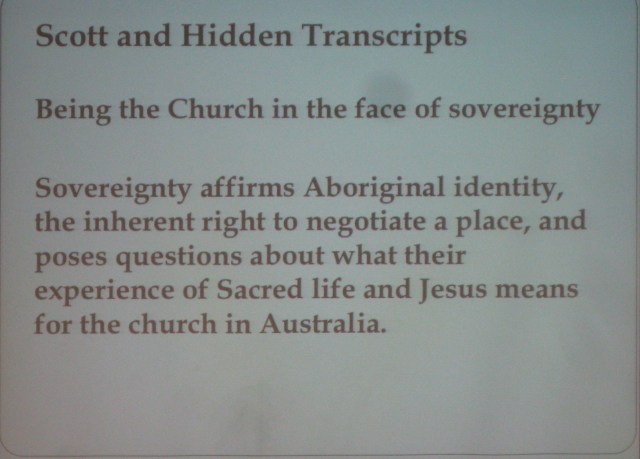


img_1456

ACT OF RESISTANCE

Narrative of explanation (public ideology that justifies current system e.g. invisible). Can’t critique publicly. Another narrative told in private places.

Did Jesus tell stories in public areas – in ways that didn’t threaten powers (used language and metaphors they didn’t understand) but reaches ‘those with ears to hear’. [hidden transcript]

Worth doing things people don’t understand – not taken seriously by Government but gives hope to those in the know.

What are you trying to fit into?
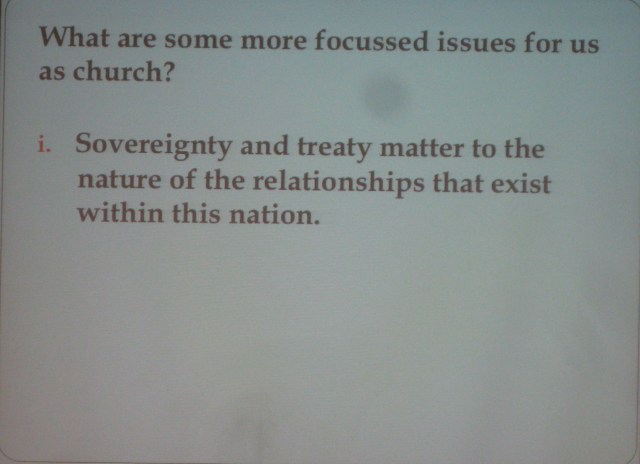


img_1457

ISSUES FACING CHURCH

i   church needs to weigh in on issue of sovereignty

ii   church came in with the invaders – there is an existing sacred relationship with the land (invite us to share that story)

iii   church needs to confront issues of land and reparation – material reparation (Zacharius)

iv   recognition challenges ideas of how we speak of faith and salvation.  Creation/sinned message makes indigenous relationship to land (sinful) need salvation/assimilation of this idea into church à trusted. Make it personal…

How does recognition of indigenous people alter my understanding of gospels?

Understand gospels in relation to /context of existing indigenous relationship to land not politicising the gospels with a liberation theology that retrospectively tries to make sense of that, this is not “special interest group theology” (black, feminist, etc.)

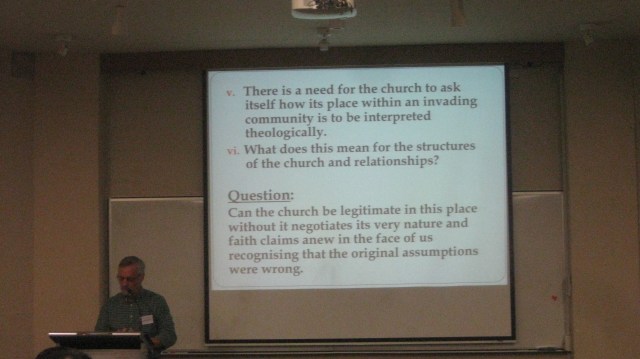
v   churches places within or on invading community is to be interpreted theologically .

vi   what does this mean for the structures of church and relationships?

vii   still a need to hear and honour history as a foundation for present and future relationships… own/confess/change it…
img_1458


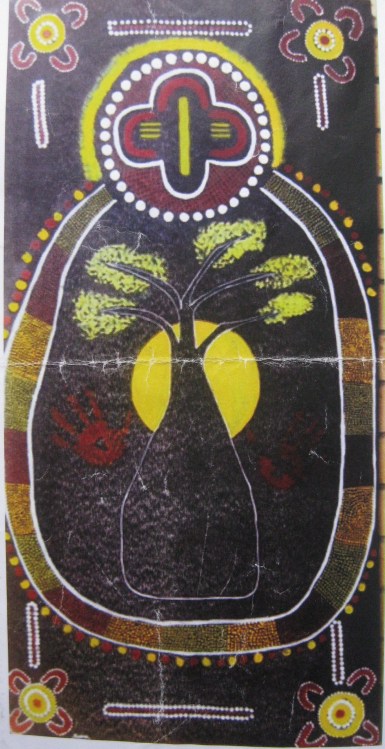
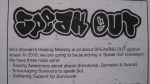
IMG_0080It was a privilege to meet Aunty Sharyn Bird on Thursday night – she was sharing her story and talking about the initiative Bir’a Women’s Healing Ministry she has started up that: raises awareness about abuse (emotional, domestic and sexual), encourages survivors to speak out, and gathers support for survivors .
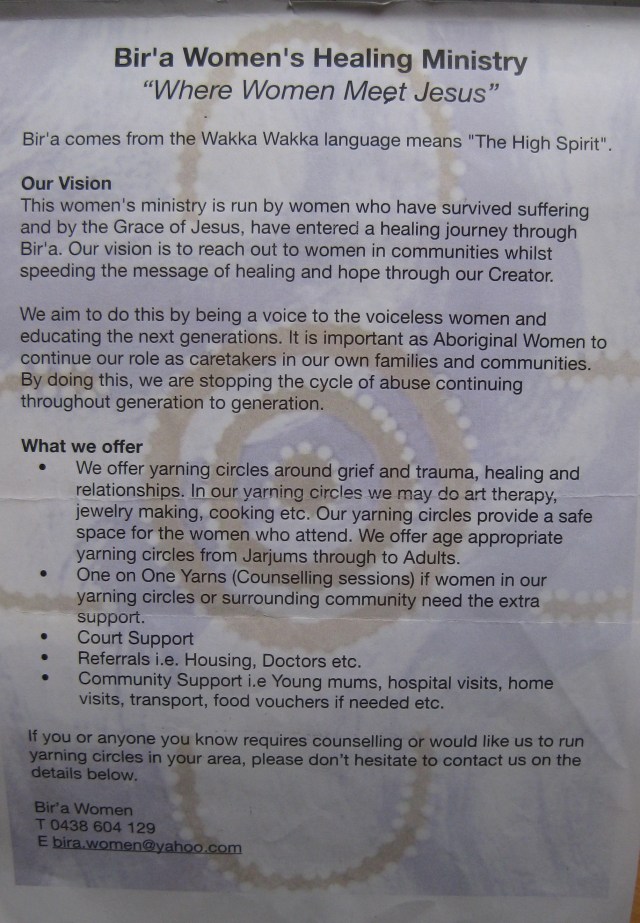
It’s not for me to try and tell anyone else’s story but if there’s an opportunity for you to hear Aunty Sharyn (or participate in a yarning circle yourself!) I would encourage you to take it. A visual representation of her story told in a painting (left)

I have been drawn to the way in the gospels Jesus’ touch heals but then he “hears her whole truth” [Mark 5:33] and she is healed again.  There is more than one layer to our healing.

What role can/does truth-telling and story-sharing have in our healing and wellbeing?

We need people willing to ask us our story; safe space to tell it; someone to listen.  Our wholeness (being healed and whole – all we were created to be) is tied up with being known, heard, understood…

How do we make/take time for this?

Aunty Sharyn held such a space – generosity in that  – and a lot of compassion.


You can read more about Bir’a below and make a gift to support their work through Jisas Wantaim ref: BiraWomen.

IMG_0079

The session put me in mind of the Cheryl Lawrie poem “This is my Body” from Easter – how might we engage in our own re-membering and bringing it about for others?

What do our re-membered selves look like?

What is one thing you could do right now to go from where you are now towards the ‘whole and healed’ version of you?


Aunty Carolyn did the Welcome to Country at the Emerging Cultural Leaders event at Footscray Community Arts Centre tonight.  She said:

“This is sacred land. One of the oldest existing.  Watched over by Bunjil the Eagle on land and Waa the Crow protects the waterways.  We are to respect the land, not destroy, and respect those to whom this country belongs.  Creation itself is sacred, so when we participate in right relationship, we participate in what is sacred… profanity is setting yourself against Creation. In being willfully blind we are supporting what is profane. By wasting food and water when others have none.  We don’t want to be discomforted or put out… there’s something sacred in being discomforted rather than doing what everyone else does.  Assimilation is just another word for massacre.”


emerging cultural leaders

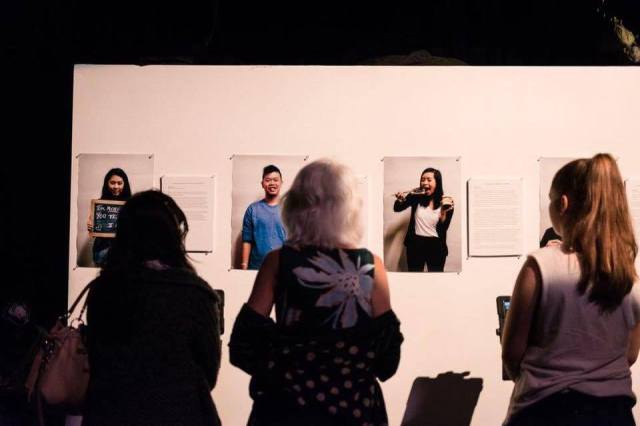
Photo credit: Minh Nguyen

Loved to have this introduction and ideas of belonging, culture, identity and place in shared space with my friend Minh’s installation piece…

BIO:  Minh Nguyen is currently completing her Masters of Applied Psychology. Her dissertation research explored constructions of ethnic identity amongst second generation Christian-affiliated Vietnamese in Melbourne. She found that through the negotiations between social relationships, and within one’s location in society, participants created a ‘different kind of Australian’ identity that accessed resources from the surrounding environment, their parent’s culture and experiences of racism and exclusion. This study provided an account of Vietnamese Christian identity construction, a particular historical, cultural, and social location within the complex world.

PROJECT: Immigrants are continually challenged by issues of settlement, sense of belonging, exclusion and identity construction.  These issues are also important life challenges for the children of immigrants, the second generation and the generation thereafter.  Chopsticks and Vegemite explores the identity construction of four people from a young Christian affiliated Vietnamese called Night Church.  Unlike their parents, they create their identities and evaluate themselves in relation to the structures and ideologies of the new society, in addition to the memories retold of their parents’ birthplace.  


IMG_5145

Facilitated by Mehrin Almassi from the Indigenous Hospitality House, in this bible study series we will seek to make connections between the story of the nation of Israel told in Lamentations and our own national story. We will look to see whether this book may help us to address our shared histories of displacement and endeavour to distill how we might move forward as a nation in light of the biblical example.

Connection to Place

What role does a sense of place play for each of us?
What is our connection to the environment?
What is our relationship with the land?

Are there any natural places which hold significance for you? If so, how do those places make you feel?
What happens to us when we are in a place which is significant to us?
What happens when we are unable to be in places which are significant to us?

Read Lamentations 2.

What can we understand of the Israelites’ connection to place through this narrative?
How connected do they seem to their places of significance?
what impact does not being able to access their important places have on them?

Listen to Kev Carmody’s song  This Land Is Mine.

How might the biblical account help us to appreciate the experiences of the First Peoples of this land?
In what ways might we help promote reconnection with land/place/environment for indigenous peoples? For ourselves?
How might this reconnection relate to indigenous people’s experience of God? How might it relate to our experience of God?


First things first

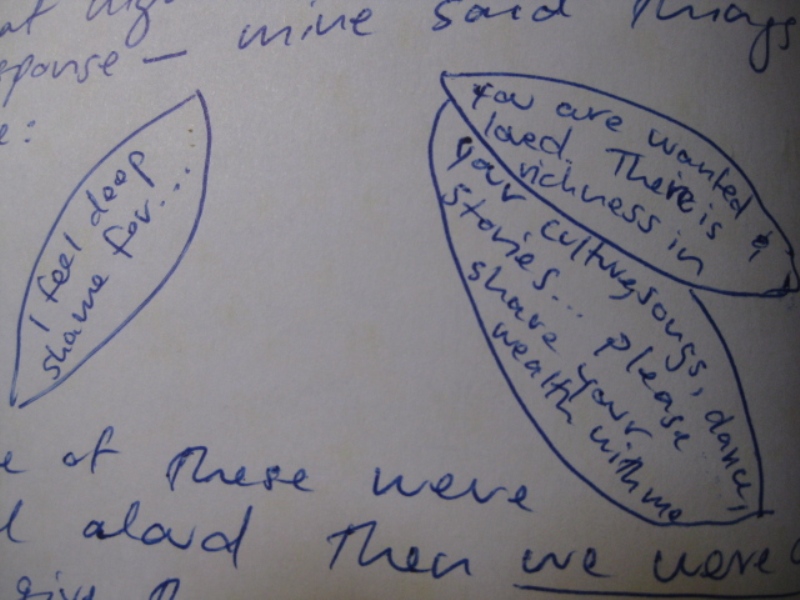
Last Friday the Indigenous Church community hosted an evening of celebration to mark the anniversary of Kevin Rudds apology. Welcome to Country then heard stories of several First Nation people – their life experience and where they were when they heard the apology (heard their ‘whole truth’) – stolen generation, called “filthy abbos”, told parents/family were dead, turfed out at 16 with next to nothing… humbling faith in the face of damage done in the name of “mission”.  Representatives of each First Nation family group given a box: tea bags, Tim Tams, bible passage, Whittakers peanut slab (gold, because you are a teasure to us).  Watched a video re-play of the apology, then seed shapes handed out to everyone and we were encouraged to reflect on K Rudds speech and everything else we had heard that night and write a response – mine said things like:

011


Some of these were read aloud then we were asked to give these seeds to a First Nations person sitting near us to put in their box.

How humbling! How arrogant are my words! How vulnerable am I made by giving away these innermost thoughts/prayers of confession?   …not as vulnerable as a child – taken from its parents/family, taken from the only home they has ever known, to have language and culture stripped away – made white.