

Christop Booth sharing a workshop on making a cup of tea -“at the Indigenous Hospitality House we’ve found that sharing tea can help to make space for the stranger and can be an opportunity for reconciliation”.
Make a cup of tea…
What are your associations?
What do we know about its origins and history?
When we reflect on any every day activity, we might consider…
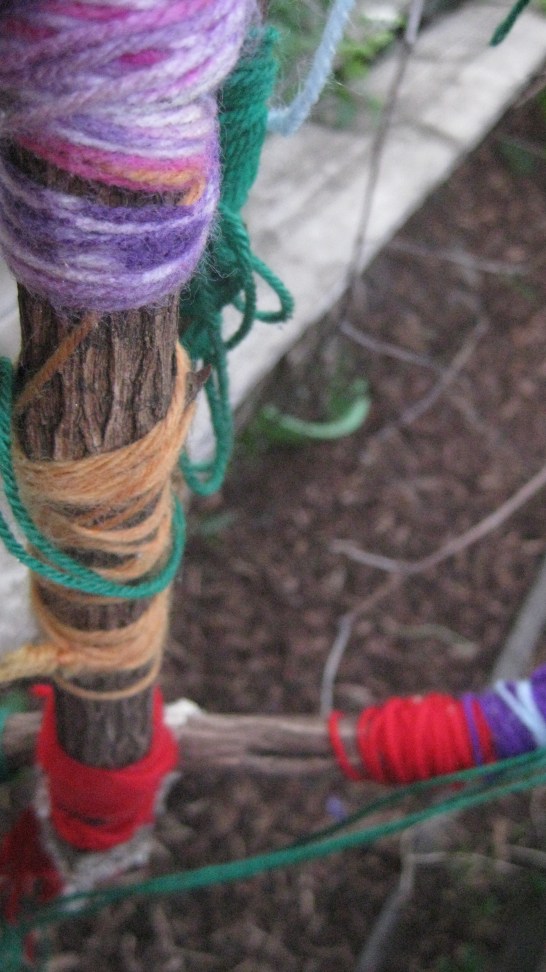
Facilitated by Christop Booth from the Indigenous Hospitality House, in this bible study series we will seek to make connections between the story of the nation of Israel told in Lamentations and our own national story. We will look to see whether this book may help us to address our shared histories of displacement and endeavour to distill how we might move forward as a nation in light of the biblical example.
Who do you think of as community?
What forms of sharing are undertaken within these communities? (what is personal, what is communal?)
Read Lamentations 5
What type of people made up the Israelite community?
What did they share together? What experiences/materials/stories?
How connected were the Israelite people to one another at the time this poem was written?
What do we think of when we think of Aboriginal communities?
Watch clip from move The Sapphires [singing for soldiers during the war, Manager is injured and they’re separated, have to decide to go on or go back]
What kind of sharing takes place?
What part does shared suffering play in the building of community or extent of connectedness experienced?
Does being Aboriginal increase the likelihood of connection experienced by an individual? Does belief in God?
Can we identify any other factors which promote community building and connectedness?
How might we offer and/or provide aspects if community connectedness for others and ourselves at a local, national and international level?

PRAYER
[p.31]
Lord Jesus, now that beneath those world-forces you have become truly and physically everything for me, everything about me, I shall gather into a single prayer both my delight in what I have and my thirst for what I lack; and following the lead of your great servant I shall repeat those enflamed words in which, I firmly believe, the christianity of tomorrow will find its increasingly clear portrayal:
‘Lord, lock me up in the deepest depths of your heart; and then, holding me there, burn me, purify me, set me on fire, sublimate me, until I become utterly what you would have me be, through the utter annihilation of my ego.’
[p.33]
Glorious Lord Christ: the divine influence secretly diffused and active in the depths of matter, and the dazzling centre where all the innumerable fibres of the manifold meet; power as implacable as the world and as warm as life; you whose forehead is of the whiteness of snow, whose eyes are of fire, and whose feet are brighter than molten gold; you whose hands imprison the stars; you who are the first and the last, the living and the dead and the risen again; you who gather into your exuberant unity every beauty, every affinity, every energy, every mode of existence; it is you to whom my being cried out with a desire as vast as the universe, ‘In truth you are my Lord and my God’.
‘Lord, lock me up within you’: yes indeed I believe – and this belief is so strong that it has become one of the supports of my inner life.
[p.34]
This is the criterion by which I can judge at each moment how far I have progressed within you. When all the things around me, while preserving their own individual contours, their own special savours, nevertheless appear to me as animated by a single secret spirit and therefore as diffused and intermingled within a single element, infinitely close, infinitely remote; and when locked within the jealous intimacy of a divine sanctuary, I yet feel myself to be wandering at large in the empyrean of all created being: then I shall know that I am approaching that central point where the heart of the world is caught in the descending radiance of the heart of God.
***
Through a marvellous combination of your divine magnetism with the charm and the inadequacy of creatures, with their sweetness and their malice, their disappointing weakness and their terrifying power, do you fill my heart alternately with exaltation and distaste; teach it the true meaning of purity: not a debilitating separation from all created reality but an impulse carrying one through all forms of created beauty; show it the true nature of charity: not a sterile fear of doing wrong but a vigorous determination that all of us together shall break open the doors of life; and give it finally – give it above all – through an ever-increasing awareness of your omnipresence, a blessed desire to go on advancing, discovering, fashioning and experiencing the world so as to penetrate ever further and further into yourself.
[p.35]
It is to your body in this its fullest extension – that is, to the world become through your power and my faith the glorious living crucible in which everything melts away in order to be born anew; it is to this that I dedicate myself with all the resources which your creative magnetism has brought forth in me: with the all too feeble resources of my scientific knowledge, with my religious vows, with my priesthood, and (most dear to me) with my deepest human convictions. It is in this dedication, Lord Jesus, I desire to live, in this I desire to die.
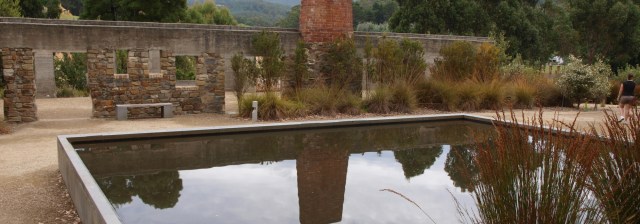
Port Arthur memorial garden, by Michael Rawle / Flickr.com
This article was published on the Sojourners blog 15/12/2015 .
“Death has taken its toll. / Some pain knows no release / but the knowledge / of brave compassion / shines like a pool of peace.”
These words are engraved on the memorial pond at the Port Arthur mass shooting site in Australia. Nearby, a wooden cross is inscribed with the names of the 35 men, women, and children who died here. In contrast, a brochure at hand provides a simple explanation of what occurred in this place; it notably does not name the gunman. 1996: Australia’s last mass gun death.
After any traumatic event we ask ourselves, “What saves the next person from what has happened to me? How can I make sure no one sees what I have seen? Goes through what I have gone through?”… as bereaved, survivor, emergency responder, community member, minister.
Glenn Cumbers became an ordained minister of the local Church of Christ a mere six weeks before the Port Arthur massacre. The morning service was over and he was enjoying lunch at a home nearby when the sounds of shooting were heard. He and his companions were among the first responders. In the days that followed, the church was open 24 hours for anybody to come for prayer or to feel a bit of peace and quiet. There was ministering to the community and leading memorial services, private and public, as well as advocacy urging gun owners to act in the national interest: “We ask that the minority be willing to forgo their short-term wants for the long-term good of Australia.”
It is not insignificant to have all the Federal, States and Territories Parliaments of Australia pass one universal law. There was lobbying by many parties after the 1987 Queen Street massacre and the 1991 Strathfield massacre.
As Australians, we are not so many generations removed from penal colony settlement or “subduing the natives” (those were massacres, too, it warrants mentioning) that saw an “every man for himself” attitude become culturally embedded. But the 1996 massacre in Port Arthur saw a tipping point where the law was far behind popular opinion.
 When changes to gun laws were first proposed, the member churches of the National Council of Churches welcomed the initiative and urged government to agree on and pass the legislation.
right: Minutes of The National Council of Churches in Australia (NCCA), Friday 12 July 1996
The New South Wales Farmers Association, with its high rate of gun owners, also gave its support for a total ban on semiautomatics firearms. And proving that you can have our guns but not our sense of humour, NSW Farmers pointed out that with reforming gun laws Australians will still be able to bear arms, such as: bolt-action, centre-fire military rifles; lever-action, centre-fire sporting rifles; pump-action, centre-fire sporting rifles; rim-fire rifles with bolt, lever or pump actions, and double-barrelled shotguns. Further, a farmer commented, “If a shooter cannot knock down a fox with one of the weapons I have mentioned, the solution is not a semiautomatic firearm but an ophthalmologist with a centre-fire laser or, alternatively, a return to basic training.”
No one was taking our guns — we were giving them up. The gun control question should not be prefaced by what you have to lose, but by what you have to gain.
Glenn Cumbers left the church in 2004. He could no longer work as a result of post-traumatic stress disorder that had not been supported. Pouring himself out to the community and addressing their healing was his job, but who was healing the healer? In 2008, Stephen Robinson published a practical guidebook called Ministry in Disaster Settings: Lessons from the Edge that investigates the experiences of ministers, like Cumbers, who have been on the ground for some of the worst disasters of Australian history. Cumbers says, “I found that book was really the first step on the long journey of healing for me.”
We always ask: What saves the next person from what happened to me? What does brave compassion look like where you are? I don’t know. But I do know that if I had a gun, I would say to any family touched by gun violence: “I cannot do much, but if the world is a better place with just one less gun, have mine.”
In the words of former Australia Premier Barrie Unsworth, who lost re-election in 1991 advocating for stronger gun law, “It is not too late to do something positive.”
by Talitha Fraser

Found this in an op shop and am loving it so can only imagine I will have to restrain myself from a public rendering of the entire tome… I’m not apologising for that… I think its too beautiful.
[p.24-25]
Through our thoughts and our human experiences, we long ago became aware of the strange properties which make the universe so like our flesh:
like the flesh it attracts us by the charm which lies in the mystery of its curves and folds and in the depths of its eyes,
like the flesh, it disintegrates and eludes us when submitted to our analyses or to our fallings off and in the process of its own perdurance;
as with the flesh, it can only be embraced in the endless reaching out to attain what lies beyond the confines of what has been given to us.
All of us, Lord, from the moment we are born feel within us this disturbing mixture of remoteness and nearness; and in our heritage of sorrow and hope, passed down to us through the ages, there is no yearning more desolate than that which makes us weep with vexation and desire as we stand in the midst of the Presence which hovers about us nameless and impalpable and is indwelling in all things.
Now, Lord, through the consecration of the world the luminosity and fragrance which suffuses the universe take on for me the lineaments of a body and a face – in you. What my mind glimpsed through its hesitant explorations, what my heart craved with so little expectation of fulfillment, you now magnificently unfold for me: the fact that your creatures are not merely linked together in solidarity that none can exist unless all the rest surround it, but that all are so dependent on a single central reality that a true life, borne in common by them all, gives them ultimately their consistence and their unity.
Shatter, my God, through the daring of your revelation the childishly timid outlook that can conceive of nothing greater or more vital in the world than the pitiable perfection of our human organism.
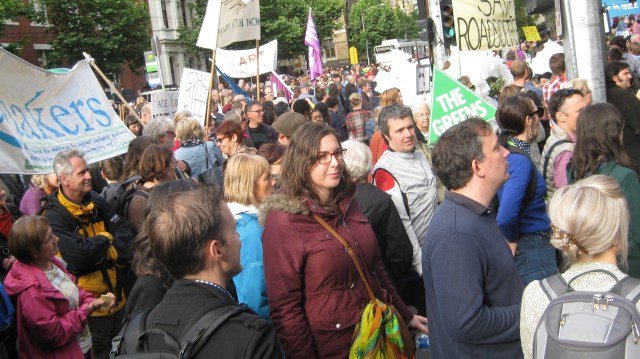


All the signs, front and back, seem to be indicating this climate change thing is something that anyone and everyone can get behind. That everyone should get behind. Action on climate change is a demand for justice for our children, grandchildren and future generations and also, here in this place, I think, a demand for justice for the indigenous people of this land who have lived in tune with and attuned to country since time immemorial. The traditionally acquired knowledge of our elders, their understanding of the interconnectedness of things, must surely have wisdom to offer and we must humble ourselves to the wilderness that cries out against its bondage to decay.
I imagine a time in the future when talking about flushing potable water sounds like heresy, when running under sprinklers in the summer sounds like a fairytale, a time when a child asks me: “But if you knew, why didn’t you do anything?”
It is little enough.
Today: “Across the globe, 785,000 people in 175 countries hit the streets at more than 2,300 People’s Climate March events. That’s three quarters of a million people. And in Australia, we came together in record breaking numbers in more than 50 towns and cities right across the country to show the world just how much we care.” (www.peoplesclimate.com.au)
With our bodies, with our feet, outside, we seek to be a face to and give a voice to creation at the UN climate change summit in Paris, to our own government and politicians, to those who don’t believe its real. …that will sound like the start of a joke but it isn’t.
It is little enough. Too little probably. The least we can do, certainly.

Aunty Carolyn did the Welcome to Country at the Emerging Cultural Leaders event at Footscray Community Arts Centre tonight. She said:
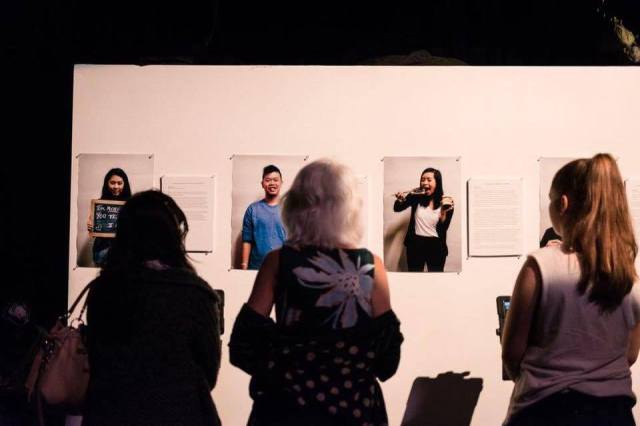
Loved to have this introduction and ideas of belonging, culture, identity and place in shared space with my friend Minh’s installation piece…
BIO: Minh Nguyen is currently completing her Masters of Applied Psychology. Her dissertation research explored constructions of ethnic identity amongst second generation Christian-affiliated Vietnamese in Melbourne. She found that through the negotiations between social relationships, and within one’s location in society, participants created a ‘different kind of Australian’ identity that accessed resources from the surrounding environment, their parent’s culture and experiences of racism and exclusion. This study provided an account of Vietnamese Christian identity construction, a particular historical, cultural, and social location within the complex world.
PROJECT: Immigrants are continually challenged by issues of settlement, sense of belonging, exclusion and identity construction. These issues are also important life challenges for the children of immigrants, the second generation and the generation thereafter. Chopsticks and Vegemite explores the identity construction of four people from a young Christian affiliated Vietnamese called Night Church. Unlike their parents, they create their identities and evaluate themselves in relation to the structures and ideologies of the new society, in addition to the memories retold of their parents’ birthplace.

[n.b. this is communion and collection at the same time]
What’s this I’ve got here? (holding basket/kete)
What’s it made of? (grass/flax)
I’ve got a piece of grass here, is it strong? Pull it with me. (it breaks)
What about this? (indicating the basket – pull, doesn’t break)
One strand of grass by itself isn’t very strong but the basket is lots of pieces woven together. So it’s strong. I can hold a lot.
Is there anything inside it? (let the kids come around and have a look, no it’s empty)
Let’s put some things inside. What have we got to give to God today? (nothing?)
How are you feeling today? (invite children to reach into the basket with their hand and let go as they say how they’re feeling)
What news have we learned this week? (put in the basket)
What have you got to give? (include talking to adults) time? energy? money? (put in my tithe) Maybe what we have is that we don’t have enough of these things, we can put that in the bag too. Everyone has something they can put in the basket, even if our something is our nothing.
Is it too heavy? (test it/pass it around children, not heavy)
Is it full? (Children look inside, not full)
Room for more? (yes) Let’s pass it around the grown ups and see if the grown have anything they want to put in. Grown ups you can say aloud what you’re putting in if you want but you don’t have to. Whether you have something in your hands or your hand is empty, everyone can hold, and reach into the basket.
Once it’s done the rounds, take it to the table where the communion is set up below the cross. Rest the basket below the cross.
Jesus wants you to have this so you remember how much God loves you.
We take everything we are, everything we have and bring it here to God. Then we take the bread and the juice and we share them around – everybody gets some… Does [Molly] get all the bread while everyone is hungry? (No! We share it!) Does [Simeon] get all the juice while everyone else is thirsty? (No! We share it!)
Does one of us get all the sad things that went in the basket? Or one of us all of the happy things? No. We share it.
We bring it together then we share it out so I can taste your joy and share your burdens.
Jesus wants you to have this so you remember how much God loves you.
We can take that inside us and then when we take the bread and juice inside us, we have God’s love inside us and that way if my little brother gets hurt and I give him a hug, it’s like Jesus giving him a hug.
Today when we give out the bread and juice – don’t wait, don’t hold on to them – gobble them right up and take that in. (pass around the bread and juice)
Let’s pray…
God, we bring this stuff to you, all mixed up together. Thanks that we can bring you the good stuff and the bad stuff, those things where we have lots or not enough. We are grateful to share life with You and with each other. Please use all these things we give You to make the world a better place for everyone who lives in it. Amen
 itellyouarise