Tag Archive: land


On the weekend of 24-25 September Whitley College hosted a conference called Constitutions and Treaties: Law, Justice, Spirituality – these are notes from session 4 of 9. We acknowledge that this gathering, listening and learning occurred of the land of the Wurundjeri People of the Kulin Nations and offer our respects to their elders past and present, and all visiting Aboriginal and Torres Strait Island visitors present.

Knowledge puffs up (self), love builds up (others) – Ray’s Dad… and 1 Cor 8:1

What do we know we know? What do we know we don’t know?


img_1400

img_1402

img_1403

img_1404img_1405

img_1406

img_1407

img_1408

img_1409

img_1410

img_1412

img_1413

img_1414

img_1415

img_1416

img_1417

img_1421

img_1423

img_1424

img_1425

IMG_7300


Facilitated by Christop Booth from the Indigenous Hospitality House, in this bible study series we will seek to make connections between the story of the nation of Israel told in Lamentations and our own national story. We will look to see whether this book may help us to address our shared histories of displacement and endeavour to distill how we might move forward as a nation in light of the biblical example.

Connection to Community

Who do you think of as community?

What forms of sharing are undertaken within these communities? (what is personal, what is communal?)

Read Lamentations 5

What type of people made up the Israelite community?

What did they share together? What experiences/materials/stories?

How connected were the Israelite people to one another at the time this poem was written?

What do we think of when we think of Aboriginal communities?

Watch clip from move The Sapphires [singing for soldiers during the war, Manager is injured and they’re separated, have to decide to go on or go back]

What kind of sharing takes place?

What part does shared suffering play in the building of community or extent of connectedness experienced?

Does being Aboriginal increase the likelihood of connection experienced by an individual? Does belief in God?

Can we identify any other factors which promote community building and connectedness?

How might we offer and/or provide aspects if community connectedness for others and ourselves at a local, national and international level?


IMG_5908

Some fine Saturday I would like to recommend you idle away an afternoon doing the Billibellary’s Walk at the University of Melbourne.  I work in the precinct so it felt like a good fit to contextualise what was happening in this specific place 300 years ago, 200 years ago, 100 years ago, now… or maybe what’s not happening…?


Billibellary’s Walk

Wominjeka. Welcome to Wurundjeri Country

Billibellary’s Walk is named after the Ngurungaeta, or clan head, of the Wurundjeri people at the time of Melbourne’s settlement. The walk is a cultural interpretation of the University’s Parkville campus landscape that provides an experience of connection to Country which Wurundjeri people continue to have, both physically and spiritually.

The walk is designed to help participants hear the whispers and songs of the Wurundjeri people that lie within the University of Melbourne’s built environment. The walk alerts us to signs and stories that may not be apparent to visitors, but which provide some insight into the experience of the Wurundjeri people of the Woiwurrung language group who have walked the grounds upon which the University now stands for more than 40,000 years. It is intended to provide the impetus for further exploration of issues pertinent to the Aboriginal community.

http://www.murrupbarak.unimelb.edu.au/

Smart phone App


IMG_5911

The actual talking-point sites around the campus don’t often have a strong link to what you’re talking through but probably understanding that little remains from earlier times is precisely part of the journey they are taking you on.  I was lucky enough to do it with Samara from the Indigenous Hospitality House in Carlton so the talking points and questions were enriched by having someone along so much more deeply invested and holding wisdom in cultural awareness.  You could do it as a tourist, as a social studies class, as someone seeking to hear truth… being open to ideas, history, stories and what they have to teach us about the impacts of colonisation.  You could do it as someone who likes to look at a big, tall, beautiful tree and know that it’s been there since before you came along and will stand for many years after you go – bearing witness.

IMG_5914

The walk poses a lot of questions.  It doesn’t necessarily have the answers.  You have to sit in that. Not having the answers.  This is something we’re still living out hey…

I find myself getting fired up as our conversation canvasses: religion, authoritarianism, institutionalisation….  from colonisation to terrorism to the Royal Commission investigating child abuse… it all somehow feels like the same thing and it feels broken.

“We’re not going to be the ones who fix it” Samara points out.

“Then who?” I demand.

“We be a part of it.”

This walk invites you to do that.  Be a part of it.


IMG_5915

IMG_5825

IMG_5826IMG_5821


IMG_5824


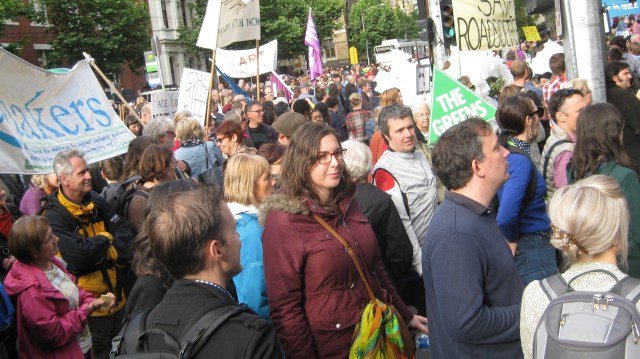
All the signs, front and back, seem to be indicating this climate change thing is something that anyone and everyone can get behind.  That everyone should get behind.  Action on climate change is a demand for justice for our children, grandchildren and future generations and also, here in this place, I think, a demand for justice for the indigenous people of this land who have lived in tune with and attuned to country since time immemorial.  The traditionally acquired knowledge of our elders, their understanding of the interconnectedness of things, must surely have wisdom to offer and we must humble ourselves to the wilderness that cries out against its bondage to decay.

I imagine a time in the future when talking about flushing potable water sounds like heresy, when running under sprinklers in the summer sounds like a fairytale, a time when a child asks me:  “But if you knew, why didn’t you do anything?”

It is little enough.

Today: “Across the globe, 785,000 people in 175 countries hit the streets at more than 2,300 People’s Climate March events. That’s three quarters of a million people. And in Australia, we came together in record breaking numbers in more than 50 towns and cities right across the country to show the world just how much we care.” (www.peoplesclimate.com.au)

With our bodies, with our feet, outside, we seek to be a face to and give a voice to creation at the UN climate change summit in Paris, to our own government and politicians, to those who don’t believe its real. …that will sound like the start of a joke but it isn’t.

It is little enough.  Too little probably.  The least we can do, certainly.

IMG_5822

Aunty Carolyn did the Welcome to Country at the Emerging Cultural Leaders event at Footscray Community Arts Centre tonight.  She said:

“This is sacred land. One of the oldest existing.  Watched over by Bunjil the Eagle on land and Waa the Crow protects the waterways.  We are to respect the land, not destroy, and respect those to whom this country belongs.  Creation itself is sacred, so when we participate in right relationship, we participate in what is sacred… profanity is setting yourself against Creation. In being willfully blind we are supporting what is profane. By wasting food and water when others have none.  We don’t want to be discomforted or put out… there’s something sacred in being discomforted rather than doing what everyone else does.  Assimilation is just another word for massacre.”


emerging cultural leaders

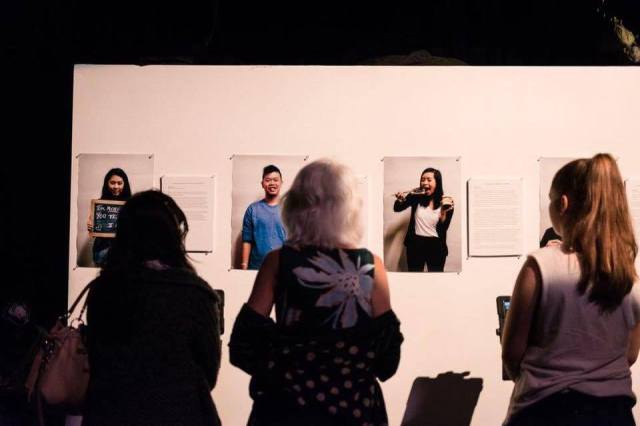
Photo credit: Minh Nguyen

Loved to have this introduction and ideas of belonging, culture, identity and place in shared space with my friend Minh’s installation piece…

BIO:  Minh Nguyen is currently completing her Masters of Applied Psychology. Her dissertation research explored constructions of ethnic identity amongst second generation Christian-affiliated Vietnamese in Melbourne. She found that through the negotiations between social relationships, and within one’s location in society, participants created a ‘different kind of Australian’ identity that accessed resources from the surrounding environment, their parent’s culture and experiences of racism and exclusion. This study provided an account of Vietnamese Christian identity construction, a particular historical, cultural, and social location within the complex world.

PROJECT: Immigrants are continually challenged by issues of settlement, sense of belonging, exclusion and identity construction.  These issues are also important life challenges for the children of immigrants, the second generation and the generation thereafter.  Chopsticks and Vegemite explores the identity construction of four people from a young Christian affiliated Vietnamese called Night Church.  Unlike their parents, they create their identities and evaluate themselves in relation to the structures and ideologies of the new society, in addition to the memories retold of their parents’ birthplace.  

Facilitated by Mehrin Almassi from the Indigenous Hospitality House, in this bible study series we will seek to make connections between the story of the nation of Israel told in Lamentations and our own national story. We will look to see whether this book may help us to address our shared histories of displacement and endeavour to distill how we might move forward as a nation in light of the biblical example.

Connection to Creator (Spirit)

What do we think of when we hear the word Spirit? What do we think of when we hear the words Spirit of God?
What do we think about when we hear the term Creator Spirit?
What do we think is meant by each of these phrases? Are they related? Could they be?

Read Lamentations 3

Did the Israelite people have a sense of the Spirit of God – the Creator Spirit?
What was God like for the people of Israel? What was their experience of relating to God?
How do we relate to and/or experience God? Is our experience different to that of the Israelites? If so, can we think why?

Let’s read the Boon Wurrung Story.

What might this story teach us about the way the Boon Wurrung people experience the Creator Spirit?
What may this story teach us about the importance of our own stories in relation to local, national and international issues?
How else might we apply important narratives of the past to current situations needing attention?

Kids Activity

In parallel to grown ups run a kids session: talk about pictures as stories, songlines and place.

Will need:

  • messy clothes (if painting)
  • paint and brushes and/or lots of sticky dot stickers
  • paper
  • photos (bring along some or a camera to take some on the day)

What do you like about stories?
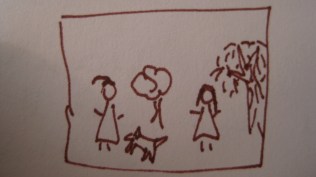
Look at this image? What is this a picture of?

IMG_6499


(girls, dog, trees…)

This picture tells the story of the time Talitha and Bron went to the park with Gracie.

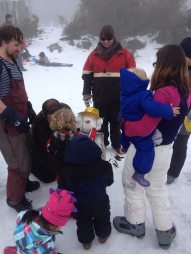
11834903_10153063761386868_8866957583155349394_o

 What about this image? what’s happening here? who was there? but they aren’t in the picture… how do you know they were there?

(pictures can capture a “moment”, some part of a bigger memory, tobogganing and snow angels, other friends… reminder of something bigger that we can no longer see)

Pictures have two things, a place and a “happening”.

Using your pictures so far, talk about where they are happening and what is happening.

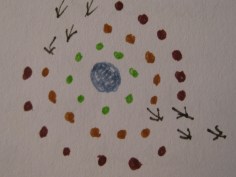
IMG_6501Indigenous stories tell something about a place and also about something happening there.
WHERE: Maybe there is a waterhole (blue), things grow there (green), drier sand/soil as you move away (orange), day rocks (red).

WHAT: An animal comes to the watering hole and then goes (tracks).

Ask children to share a memory, a story, and make a picture – collectively or individually (age depending). Then ask of each: Where is your story taking place? What is happening there?

How would you feel if you couldn’t got there again?  If you couldn’t do that again? (sad)

Today the grown ups are talking about the story of lamentations – a lament is a sound of grief and sorrow.  That’s what people in the story did when they couldn’t go back to the place they remembered or do the things they used to do there.

Learning:

our stories and our pictures can be used to tell each other about places we haven’t been and things we haven’t done, remembering and reminders can comfort us when we feel sad

let’s take a photo now, today of all of us together, making and telling stories so that we have a memory-capture. It’s good to take photos and write stories and make pictures because they help us remember

take your picture now to a grown up – tell them your story – use things inside the picture and outside the picture


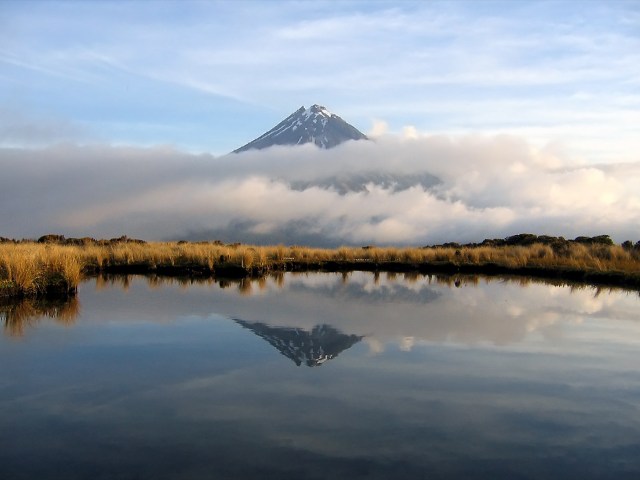
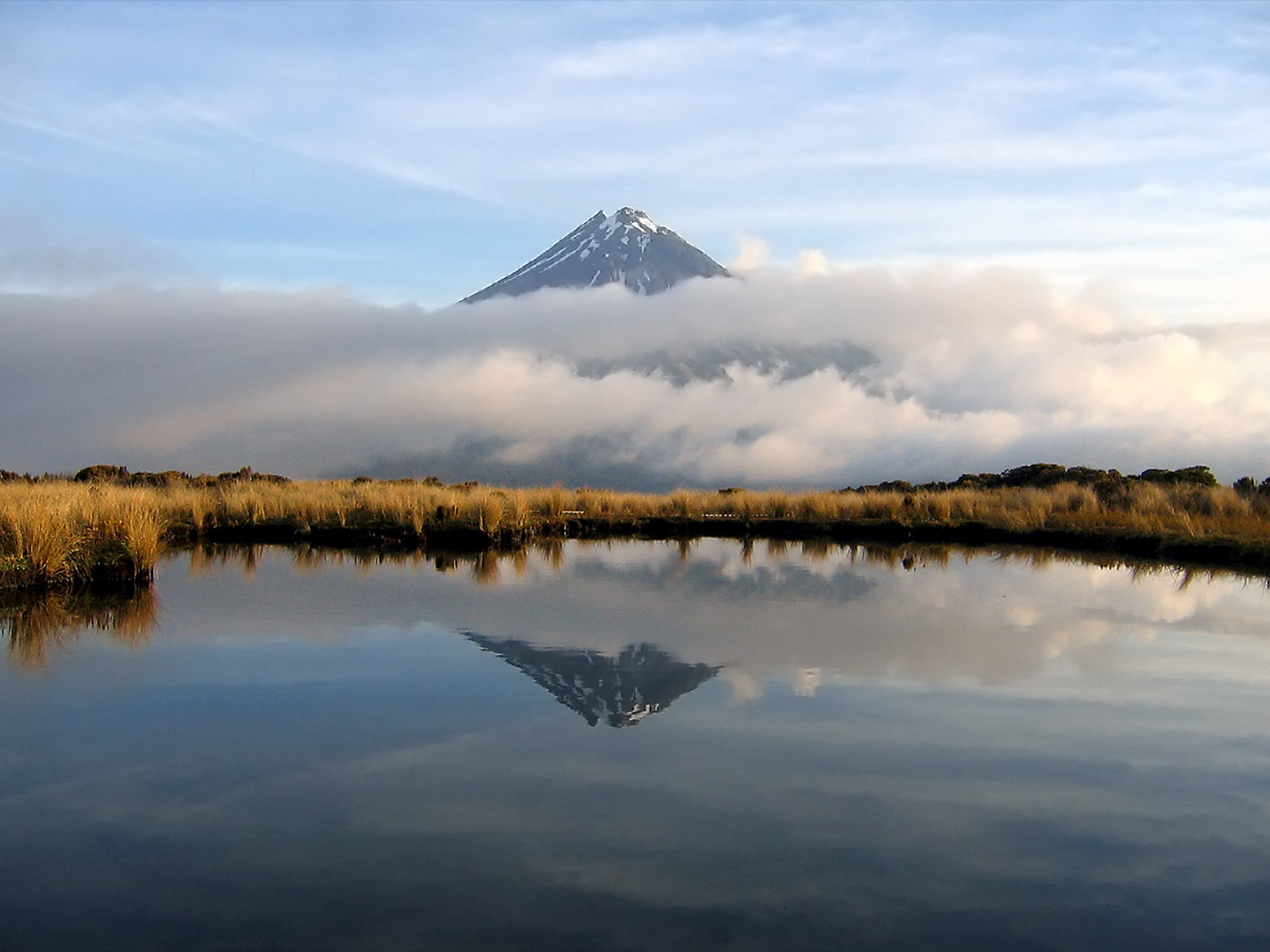
                                                           (photo of Mount Taranaki, Richard Crowsen)

Maori continued with the task unarmed and, to a person, they declined to respond to aggression when removed. Go, put your hands to the plough. Look not back. If any come with guns and swords, be not afraid. If they smite you, smite not in return. If they rend you, be not discouraged. Another will take up the good work. If evil thoughts fill the minds of the settlers and they flee from their farms to the town, as in the war of old, enter not . . . into their houses, touch not their goods nor their cattle. My eye is over all. I will detect the thief, and the punishment shall be like that which fell upon Ananias. When the ploughmen asked Tohu what they should do if any of their number were shot, he replied, ‘Gather up the earth on which the blood is spilt and bring it to Parihaka’ (Scott, pp 56-57).


February 6th  is Waitangi Day in New Zealand, the anniversary of the signing of the Treaty  of Waitangi in 1840. To the British this achieved full sovereignty and government of the country but Maori  thought, while giving authority to govern, they would still be entitled to manage their own affairs in their own way.  Similarly to Australia Day on January 26th being known as “Invasion Day” to the First Peoples of that nation, Waitangi Day is often attended by protest as well as being a celebration of nationhood.

What perhaps not enough New Zealand settler descendants may know is that there were Taranaki chieftains who never signed the Treaty of Waitangi, steadfast in their refusal to acknowledge foreign sovereignty in preference for maintaining their own way of life on their own land – the pa at Parihaka became a sanctuary for Maori forced, fought, deceived off their land. Likened forerunners to Ghandi  and Martin Luther King, Te Whiti and Tohu ran a campaign of non-violence spanning 40 years sheltering the dispossessed.

The Waitangi Tribunal[1] published “The Taranaki Report: Kaupapa Tuatahi” in 1996 saying, “ If war is the absence of peace, the war has never ended in Taranaki, because that essential prerequisite for peace among peoples, that each should be able to live with dignity on their own lands, is still absent and the protest over land rights continues to be made.”  Contrary to the belief held by many New Zealanders that in an acknowledged first equal language, proportional representation in government and other policies we might be considered advanced in our journey of equality and reconciliation, in fact we are the only colonising country where there is no land held and managed autonomously by the indigenous population (Ch.8 Parihaka).

The title of Dick Scott’s book is a quote from Te Whiti, Chieftain at Parihaka who says:

Ask that mountain – here before us, it will be here when we are gone – that mountain as witness, can we honestly say that we have done everything we can? That everything is ‘right’?

These are the questions we need to ask ourselves and the stories that should continue to be told if we are to participate in the journey of healing between the people and the land.

It is often difficult to know where to start in confronting these issues, I have more questions than answers yet I have hope.  I have ordered a T-shirt from the Emmaus Rd community, on the front it reads Arohamai which means “sorry” or “forgive me” and on the back are a list of some of the injustices as occurred over those 40 years and are carried yet in our dreams and bones today:

I’M SORRY FOR THE

// INVASION OF YOUR VILLAGE – 5th NOV
// UNJUST ARREST AND EXILING OF TE WHITI AND TOHU
// LOOTING BY THE ARMED CONSTABULARY / 8th NOV
// DESTRUCTION OF THE WHARENUI & CROPS / 20th NOV
// FORCIBLE EJECTION OF 1,556 PEOPLE FROM THEIR HOMES /20th NOV
// RAPE OF YOUR WOMEN
// CONGENITAL SYPHILLIS IN YOUR CHILDREN

ALSO FOR THE:

// IMPRISONMENT WITHOUT TRIAL OF 420 PLOUGHMEN AND 216 FENCERS FOR TWO YEARS
// DEVASTATING EFFECT ON THEIR WIVES AND CHILDREN
// UNJUST CONFISCATION OF YOUR LAND
// BACKDATING OF LEGISLATION TO MAKE LEGAL THE GOVT’S ILLEGAL ACTS

AND OUR FAILURE AS A NATION TO FACE THESE ISSUES

In her Booker Prize Winning novel The Bone People Keri Hulme writes, “I was taught that it was the old people’s belief that this country, and our people, are different and special. That something very great had allied itself with some of us, had given itself to us.  But we changed. We ceased to nurture the land.  We fought amongst ourselves. We were overcome by those white people in their hordes. We were broken and diminished. We forgot what we could have been, that Aotearoa was the shining land.  Maybe it will be again… (p.364)

I will wear this T-shirt as an act of public witness, as a peacemaker wanting to put things right personally and as someone who believes the people of New Zealand are different and special and in faith that the mountain will stand to see a shining land, whole and restored, again.


[1] The Waitangi Tribunal was established in 1975 by the Treaty of Waitangi Act 1975. The Tribunal is a permanent commission of inquiry charged with making recommendations on claims brought by Maori relating to actions or omissions of the Crown that breach the promises made in the Treaty of Waitangi. The full text of The Taranaki Report: Kaupapa Tuatahi can be found on the website http://www.waitangitribunal.govt.nz/.