

We come together today to walk the way of the Southern Cross, and visit seven sites from our shared history. There is suffering in these events, and there are questions for us to grapple with. We will hear the words of Christ on the cross, what might his words spoken in pain tell us? We seek to participate in a process of learning, repentance and healing in our land.
We acknowledge that we gather today on the land of the Marabalak people of the Wurundjeri tribe of the Kulin Nations – people who have known the Creator Spirit, shared stories, and walked in this place since time immemorial – our elders past, present and future.
With the Creator Spirit
We walk the way of the Southern Cross
Under the Southern Cross
We hear again the words of Christ on the cross
With God deep among us
We seek healing and justice in our land
Site 1: A thirst for justice

We are standing outside a house. As every person has a story, so does every house.
This house was a house of comfort.
It belonged to a woman called Sally Russell Cooper. In the 1930s’s she opened its front door as a low-income boarding house and welcomed Aboriginal people to come and live with her. There were three bedrooms inside and a spare room out the back. Sally kept her front door open to her people until the 1970’s. For many Indigenous Australians, this house was, as Elders Larry Walsh and Reg Bow once said, “a refuge from loneliness and homelessness for more than 40 years.”
This house was a house of protest.
The 1930’s onwards were a time of momentum for Aboriginal people. During the Depression and the Second World War many Aboriginal people came to Melbourne seeking work. The growing political movement for Aboriginal rights also attracted people to Melbourne’s west. Sally’s father, William Cooper, was a significant local figure in the Aboriginal political movement fighting for basic civil rights. For many of the Aboriginal people who stayed in this house, there was hope of work at Kinnears Rope Factory and other factories nearby. But the stronger hope was the hope of justice.
This house was a house of light.
Sally held lots of beautiful parties in this house. This was an important opportunity for Aboriginal people to socialise and support one another as society made it very difficult for Aboriginal people to gather together in groups. This house was well loved as a safe gathering place.
Consider this house. The door. The windows. The memory. Remember its story.

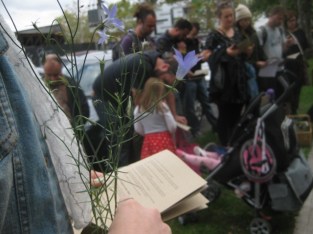
Action
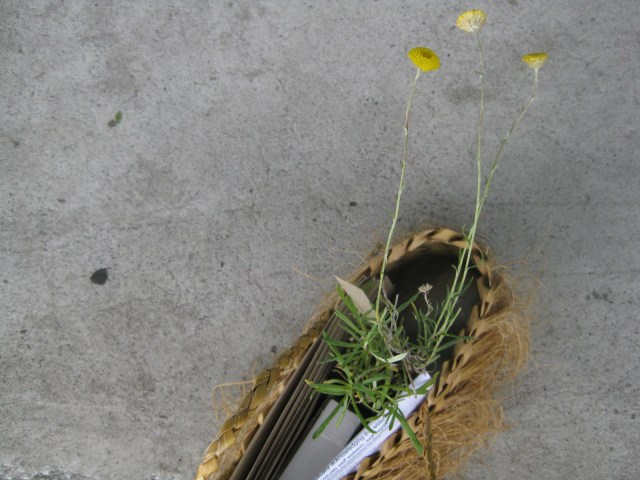
Choose a bushflower tube-stock from the basket, as an Indigenous version of the Hyssop plant, and take it home to a place of earth of your choice. Remember the story of the Aboriginal people in this country as you watch it grow.
Site 2: With and with each other
328 family violence incidents were reported in Maribyrnong in 2013 rising to 974 in 2016 – that increase in incidents, nearly tripling, is largely due to more people speaking out. We know that a woman is killed in Australia by her male partner or ex-partner nearly every week. The most common myths are that violence against women is caused by alcohol and drugs, a man’s violent upbringing, living in poverty, anger management problems or mental health problems but for violence against women to become a thing of the past we need to change the causes: gender inequality and rigid gender stereotypes.
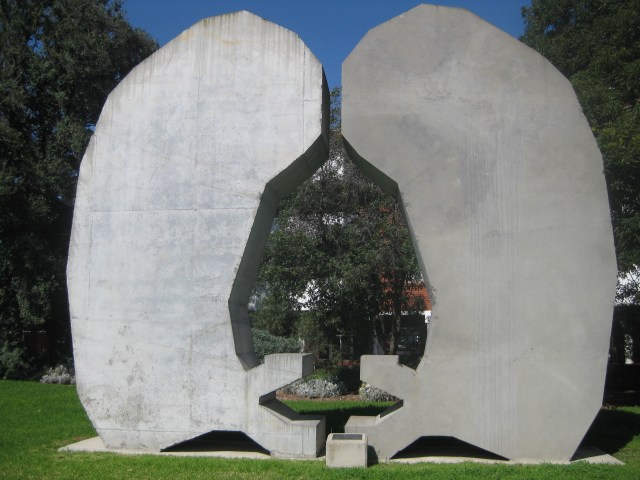
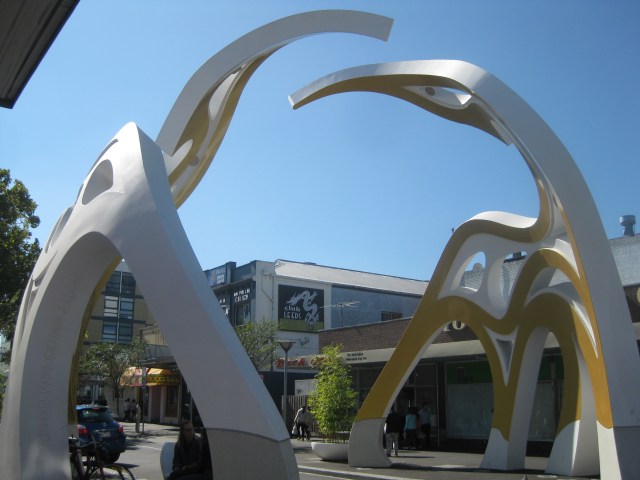
This sculpture is called With and With Each Other by artist Tom Bills and it feels like a fitting place to stand to think about equality.
Action
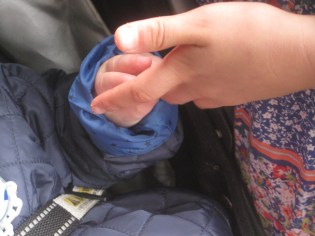
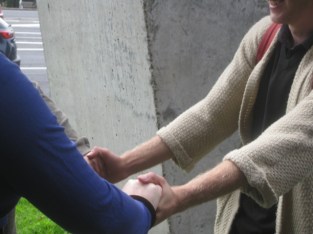
Let’s take hands and Pass the Peace – exchanging these words:
Say: Peace be with you…
Answer: And also with you.
How can we be doing this amongst our family, friends and neighbours? We need to know what safe touch looks and feels like through education and role modelling.
In making a circle with our arms we are symbolically acknowledging the widening ripples of the impacts of family violence on individuals self esteem, self-worth, physical, mental and spiritual wellbeing… The impacts on individuals, families, neighbours and communities… As we release our hands the circle opens, representing our commitment to breaking the cycles of violence.
Let’s walk with someone new, someone you don’t know or someone you don’t see as often as we move to the next station.
Site 3: Finding a place to call home
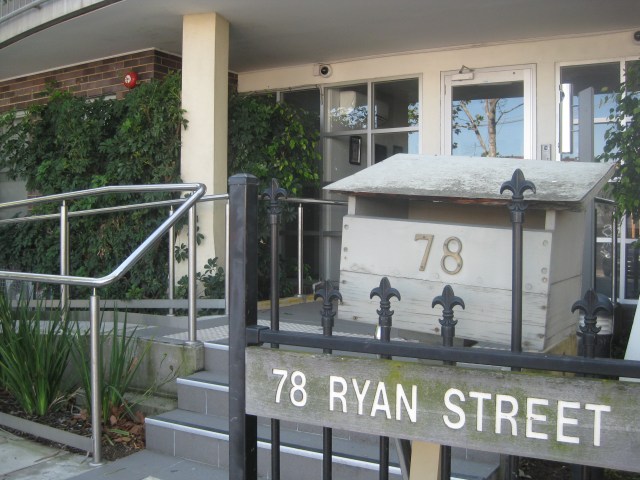
We are standing outside Foley House. This is a facility run by the Salvation Army that provides accommodation and support for 46 residents – all of whom have been homeless, and all of whom are living with a disability.
Finding a place to call home is one of our most basic needs. For our Aboriginal friends the trauma of being removed from their homes is still very real and present. For asylum seekers dislocation comes at great cost and much grief.
But homelessness does not discriminate – our social dysfunction makes it a real possibility for anyone. The loss or casualisation of a job, the breakdown of a family, the rent increase from a landlord, the need to flee violence in the home, the disintegration of health, the history of abuse or neglect that is relived on a daily basis, the self-medication through drugs or alcohol: these are all social realities that can thrust any of us into homelessness.
There were 762 people who were homeless in the electorate of Footscray on Census night in 2011. Things are getting worse: this figure is 29 per cent more than in 2006. Across Victoria, there are 22,000 people experiencing homelessness on any given night.
Even this is just the tip of the iceberg. A skewed housing market benefits some greatly but places unbearable pressure on those at the bottom end. The injustice is often felt most strongly for those enduring the uncertainty of the private rental market. We live in a community where houses are seen as investments, rather than homes in which to live and thrive.


Action
Walk with a stone in your shoe as we move to our next location; as a reminder of the constant pain and anxiety faced by those who are struggling to find a place to call home. Are you facing this anxiety yourself? Give your stone to a friend to hold.
Site 4: Room for all
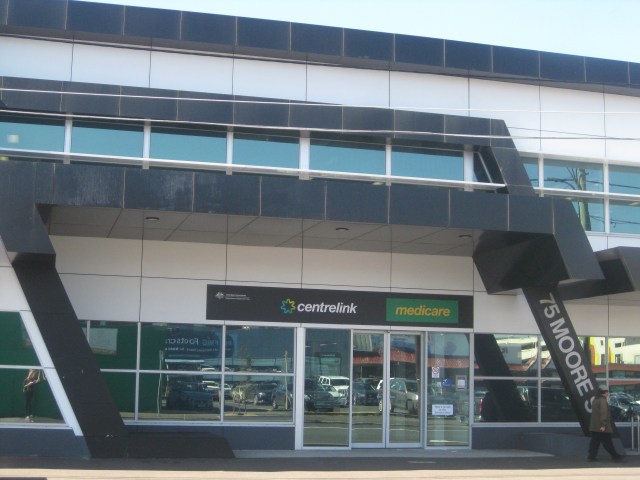
Sometimes coming to Centrelink can feel like our own crucifixion; Our dependence on a system for which we detest; An experience of isolation and abandonment, judgements from ourselves and others about how we do and don’t fit in; About whether we are enough. A painful waiting that only allows you to survive – and gives no kind word, no compassion, and no understanding of who you really are.
Inequality and poverty in Australia are growing. There are now about 2.9 million people living in poverty, including 731,300 kids. Centrelink will never be enough (not that that is new to anyone). It is like a well from which we draw water, and in Australia, it seems to be an increasing drought not only of money, but of healthy soil, and healthy people; people whose lives are rich in compassion, joy, generosity and the types of kindness that sows grace amongst the powers.
Today we remember that Christ became that spring when he called us into his family as he called John into his both spiritually and literally. He seeded in us the knowledge that we are duty bound to honour our mothers and fathers, our sons and daughters in faith. To know that our own growth and ability to live is intrinsically caught up in family; a family that transcends bloodlines, a family that invites us to make bigger our sense of home, that calls us to dig our own wells.


Action
Place a dollar (provided) on the note at the foot of Centrelink:
For our debts and for their debts, we cannot pay.
Christ is enough.
Power remember Mercy;
Remember where we grow.
Remember those who hold us.
Remember those who raise us.
Remember those who crush us.
Woman here lives your son. Son here lives your mother.
Remember your way home. Remember Me.
Site 5: Seeking refuge and finding welcome
Footscray is a community that generation after generation of migrant has made home. These days it is a multicultural hub with service providers such as the ASRC and community groups such as the Welcome West Wagon working alongside smaller community groups and individuals as well as movements such as Love Makes a Way to create welcome for people seeking asylum & refugees. People come to Australia with the hope of a better life but they are often left in limbo for many years.
A friend of ours, Maria, is an East Timorese woman who through a combination of civil war in her homeland, loss of family members and marriage breakdown has found herself stateless and alone with her young son in a foreign country. Under the terms of her temporary protection visa, she has limited work rights and little way to support herself and her son. She is reliant on friends and community agencies such as the Red Cross and the Asylum Seeker Resource Centre for accommodation, legal advocacy and food. At the present time she’s been in limbo for over five years, with little idea of when a decision may be handed down by the minister for immigration. She may be granted permanent residency and begin the process of building a life here, or she may be forced to leave. She prays every day for a permanent home in Australia. She lives generously in our community household, lovingly raising her son and extending friendship and help to others.
We acknowledge the perseverance of those seeking asylum and the commitment of all those who go out of their way to create a sense of welcome to refugees and those seeking asylum.


Action
With this chalk we leave our mark and remember that in this multicultural neighbourhood, we are mixed together: rich and poor; Vietnamese, Ethiopian, Italian, Scottish, indigenous; students, workers and non-workers; believers, agnostics and atheists; children and adults of all ages. We acknowledge the tensions and divisions that often exist between us.
We celebrate the diversity we see around us, and how it reflects the beauty of God. We leave our symbol of welcome to be reminded that we are created for connection; for family, for friendship, for shared work, for love. We leave our mark to remember that we need each other and that we are stronger.
Site 6: There is a place for you
 On a Friday night in November of 2016, three LGBT+ people were assaulted in Footscray after being chased by three men. Security did not step in to stop the attack, and the three LGBT+ had to wait for 25 minutes before deciding to walk to the police station because no patrol car showed up. When the victims reported that the assault was a hate-crime against transgender and queer people, those details were not included by police officers. Like so many others in history, the hatred against these people for their diversity was ignored. The identity of lesbian, gay, bisexual, transgender and intersex people has been ignored and persecuted in Australia.
When I was attending church, I was also asked not to raise my own questions, my doubts, my insecurities and my suffering as a gay person of faith. I was told, in person, that I was broken, and that my capacity for love was corrupted. After an act of honesty, the leadership of the church wanted me to silently accept that I would only be embraced in that faith community if I lived by standards which violated my own conscience and divine design.
We reflect on Jesus’ words to remember that ignorance, fear, and pride often stand in the way of our choice to extend Godly hospitality to our LGBT+ neighbour. In our own lack of love we fail to love our neighbour as we would ourselves. We reflect on the ways that we have excluded and silenced our LGBT+ neighbours, like the authorities attempted to silence the gospel. We reflect on the way that LGBT+ have been forsaken, like Jesus himself was on the cross.
Action
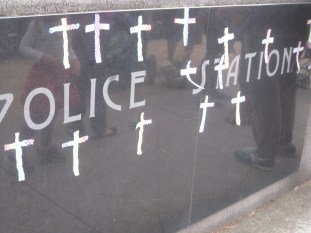
We now stand in silent prayer for 30 seconds to honour the suffering of LGBT+ people who were forsaken.
Together we pray aloud, ‘Help us, Lord of all, to no longer forsake our LGBT+ neighbour’.
Place the rainbow crucifix with a prayer on the wall of the police station as a sign of the visibility of LGBT+ suffering.
Site 7: Earth out of Balance
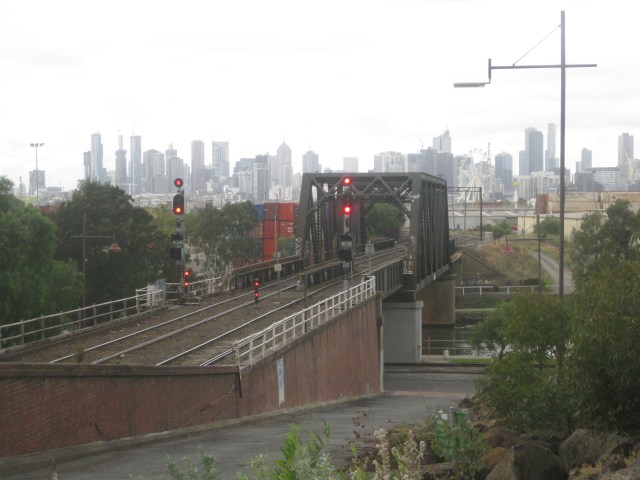
We all rely on the earth and its natural systems for life itself.
Its resources sustain us and grow us, yet our actions and failure to be good custodians continues to push things out of balance. Taking more than we need, prioritising short term gain over long term sustainable thinking – we are seeing mountains and rivers be given legal identity so that they can be given a voice to speak in their own best interests.
Human activity is altering the climate, changing rainfall patterns, reducing water availability, and increasing the frequency of severe weather events such as bushfires and storms such as cyclone Debbie and Cook, we acknowledge those yet rebuilding and recovering in the wake of these storms.
To emphasise this imbalance, sea levels are predicted to rise by at least 600mm by 2070… that’s within most of our lifetimes. At projected levels, this change in sea level will widen the Maribyrnong River, flood lower lying areas, and begin to change the face of our locality. A sea level rise of just 1m would threaten the surrounding homes and businesses and displace thousands. It would flood all of the city’s major cargo shipping docks and surrounding cargo storage areas, many of which are in our neighbourhood.
The call to be “custodians of creation” is a critical one, which drags us from the crushing weight of a global disaster to a place of restoration, respect and gratitude.


Action
Look around for something that doesn’t belong in this place; perhaps some rubbish or some weeds. Carry it with you as we start to travel to the next site, until you find a spot better suited for your rubbish to be placed.
Reflect on the ways your actions may keep creation out of balance.
Consider your role as a custodian.
Plan some simple steps to begin the healing process.
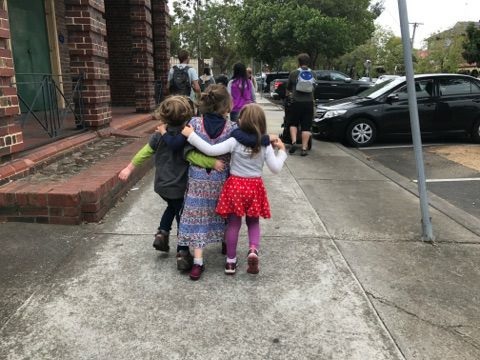
Photo credit: Maya Stark
Closure
Creator Spirit
Help us to uncover our hidden stories
Suffering God
Help our tears to flow for the pain
Reconciling Spirit
Heal our shame and our wounds, and call us into action.
Remember that justice is coming; God’s reign is coming
Acknowledgements and Story
Aunty Doreen Wandin renamed Spencer St station to Southern Cross because they were able to see stars at the homestead in Coranderrk. Aunty Joy Wandin named Wurundjeri Way… We identify this constellation with “home”, and commit to the journey of finding and following the way home under these stars.
Uncle Wanta Jampijimpa has preached on the correlation of the stars of the Southern Cross to the wounds on Jesus’ body… We acknowledge the terrible and complex legacy of the church as colonisers in this place and give deep thanks for elders wisdom and grace in leading us to deeper truth and understanding the Creator Spirit who has always been here in this place.
Bill Wylie Kellerman, co-author of “Resistance and Public Liturgy”, role models and teaches us that liturgy implicates. Undertaking activism on high holidays gives layers of meaning to the action. He said: “We believe God has already intervened, breaking in to break out on behalf of human kind. We recognise the authority of God [as bigger/beyond figureheads of power], we believe this is the meaning of the resurrection and we have come to say so”… What does it mean for us – in this time, this place, this context – to be mindful of and respond well to matters of justice from a framework of hope as people of all faiths and none?
The Indigenous Hospitality House (IHH) community who shared their resource with us based on the work of Dr Norman Habel, the author of “Reconciliation: Searching for Australia’s Soul” which outlines the model for combining storytelling to action as a means for right relationship between people and with the land… We seek to participate in a process of learning, repentance and healing in our land.





 (photo credit: chedmyers.org)





 itellyouarise