Tag Archive: stories


Hostility or hospitality?

059

I wake early on the second morning in my new house. I’m still learning the new sounds and lie half asleep trying to associate each noise to an action: that is a drawer opening, that is someone coming downstairs, that is someone going out the front door, that is someone being really careful to be quiet in the kitchen… How considerate. I roll up thinking: if I let them know I’m up, they can stop worrying about waking me.

The lights aren’t even on! How is anyone meant to get ready for work in the dark.  I flip them on to tease my housemate, “Thanks for being considerate but you don’t have to tiptoe around in the dark!”  and realise very quickly that this roughly-dressed man coming out of our pantry is not she.

I think we both froze and then I followed up with something stellar like, “Hey”

I follow that up with just what’s on the surface.

“Are you looking for something to eat?,” and continue babbling as I move into the kitchen, “Do you want toast? I could make toast. And coffee.  I can’t really function before I’ve had coffee.”

He says, “No thanks” and we move into a conversation about the purpose of the Footscray Community Outreach house.  He’s on the street and looking for housing but we’re really set up for families with children so he can’t stay here … “How did you get in?” I ask.  “Knocked”. He replies casually.

I talk about our open community dinner.  I don’t have housing referral information but if he comes back tonight I’ll print stuff out.  Eventually we run out of small talk and I indicate I need to start getting ready for work. “No problem,” he says, “I’ll show myself out.” But I follow him to the door anyway, see him out, check it latches, then check all the other latches. Just in case.

Later in the day I fire an email around: “Hey guys, think we need to be making sure the doors are secure at night. Found a community member in the kitchen at 6.30am!”

Aah, but, as it turns out, my new friend is not a known community member and I’ve been having a chat with someone whom I guess may have been casing the place looking for something to take.

There’s lots of different ways to respond to finding someone you don’t know in your kitchen at 6.30am.  Apparently, “What the hell are you doing in here? Get out!” {with optional further swearing for colour}, is a more common response…  and quite a confrontational one.

At the first point of contact, I am standing in the doorway that, as far as this guy might imagine, is the only way out of the room.  He will have to go through me to get out.

I’m in my pyjamas, I’m not wearing my glasses and (sorry to let the side down) I’m a girl.

I genuinely didn’t feel unsafe at the time.  My confusion was probably an advantage to him – had my housemate just let him in? was he known in the community? has he lived here before?  

What is your need?  I have just unpacked in the kitchen, bought some food… is there anything I would really miss? Anything I couldn’t give you?

It starts to sink in more as the community responds to my blithe email.  Housing referral information, sleeping bag, dinner, someone to be with me when he comes back to the house (it will be a bloke), clear boundaries to be communicated, all residents are informed and offered support – “How can we continue to make this feel like a safe space?”… it may have been out of the box, but as the story spreads beyond community to friends and work colleagues I am asked again and again “Why didn’t you tell him to get out!?”, I can only respond helplessly, “Well, if I’m choosing out of hostility and hospitality… I can back hospitality up yeah?”

In responding out of my pre-coffee and ignorant state I have possibly  dialed back a scenario that might have been unpleasant.  I’ll give you that.  But I am interested in what the factors were that made my response different from what it might have been  because it seems how spaces are set up and what our expectations are of those spaces purpose can impact the range of responses available to us when welcoming strangers:


  • I expected my home space to be a common one and for stranger to be welcome there
  • As a lead tenant of the house –  hosting folks who rock up is part of the position description
  • I expect people looking for something at 6.30am need it. I don’t do anything at 6.30am without a really good reason.


How can we make: “What is the need that brings you to this place?” our first consideration in responding to others? (whether that’s kids, partners, work colleagues, or randoms in off the street…)

Not a bad thing to pick up the first week on the job.


031

I have just collected my sister at the airport and Melbourne is flourishing with flowers to mark the occasion.

We’re walking home through the city following dumplings in Little China town on our way to the station, we go to cross Swanston Street near the State Library and we hear a voice exhorting in a microphone.

“What’s going on there?” asks my spiritual-not-Christian sister.

We have wandered along Southbank earlier tonight and watched the Crown flames shooting high against the dark night sky, seen a jugglers routine, listened to a buskers rendition of an Elton John classic… the city is in fine form but I sigh to see Cross Cultures church steps covered in handpainted signs saying:

“Repent!” and “Jesus gave his life for you!”

“Sorry,” I say, “someone soap-boxing repentance.” (I can’t even ad-lib here for you because I don’t remember what the words were they seemed so empty to me, I couldn’t hold them)

“Why are you sorry?” she asks.

“It offends me he can stand there and assume we don’t know God.  Everyone here (sweeping arm canvasses Melbourne nightlife) was made by God, in the image of God and is in a relationship with God whether they acknowledge it or not – his God is small, static, fixed and I imagine he puts more people off than he draws in… it puts me off!”

“Doesn’t any of it connect with you, speak to you,
remind you of old times?”

“No.” I respond flatly. But words of old times prompts the tune of Be Thou My Vision to mind and I lose track of the conversation for several metres… naught be all else to me save that Thou art, Thou and Thou only, Thou first in my heart, O be Thou my vision…

That was a close-ended answer. Answered for myself, out of my own filter and judgmental in its own way.  You have to think about what prompts a question and, defensive of potential association with street-side evangelisation, I did not inquire “Did any of it connect with you?”

ooOoo

I don’t suppose that an old man on the steps with his carefully handpainted signs and fervent faith is any threat to me so I don’t know why I need to set myself in opposition per se… are we ‘fighting for the same side’ or am I taking him down with ‘friendly-fire’? That has sometimes been the difference between good and evil winning in some significant cultural narratives. Ambitious in-fighting on the dark side vs. a coalition of goodies working together – Star Wars; The Lion, The Witch and the Wardrobe; Lord of the Rings… do you believe in fairytales?  Do I? Is that where I would look for answers? for truth?  Jesus set himself against the Pharisees, hanging out with Samaritans offended the Jews… he set himself against things as an outsider, ignored class rules and hung with homeless people and lepers.  Some of these stories have someone on the darkside who turns at an epiphany moment – Anakin Skywalker, Edmund, Boromir… and heroes that will die to achieve a greater good in Aslan and Frodo (although he doubts himself there at the end of all things)… at different points each lead has a mission they have to fulfill on their own, their own battle to fight in the bigger picture. Does it seem silly to try and use stories and ideas we already have to try and understand another Story?

We all choose stories to live by – from our families of origin, from our friends, gang, from TV/movies, books… but how many of us consciously choose what story we want to live by?

We have the power and the freedom to elect that as if our life were our very own pick-a-path adventure.

I went to see The Desolation of Smaug with friends and one commented upon coming out their frustration that “there’s no one in that film to look up to!” Thorin refuses to keep his promise to the people of Laketown, the people of Laketown get angry about that and side with the Elves who bring them food and supplies, the King of the Elves wants some of the treasure under the mountain for himself… the hero is the Hobbit yeah?  Bilbo may be keeping  the heart of the mountain to himself (albeit not for himself) so he’s not looking that good either… what a responsibility to have rest on individual people to see and work for a greater good that isn’t apparent to others and will cost you friendships and family along the way.

But what can you do to be in a position to see or know what the greater good is?

How do you know if your version of the truth or what you believe in will come to pass?  There must be a moment of risking everything, not knowing what will come of it, but knowing you have to make the next choice because it is necessary right in that moment and whatever comes next is beyond that.

What stories will you live by?

What stories will you choose by?

ooOoo

I followed up with my sister the next day:

“That guy, from the steps last night, did any of that connect with you?”

“Nah, I think I counted the word hell seven times
and didn’t see the word love once”

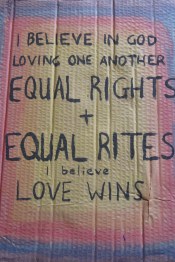
i believe love wins

007

Today feels like a day for bright colours.  Uncharacteristically I am wearing one of the skirts I have made – full and colourful, no one around today to comment on it and I love that – what would we wear any given day if we thought no one would ever say anything?

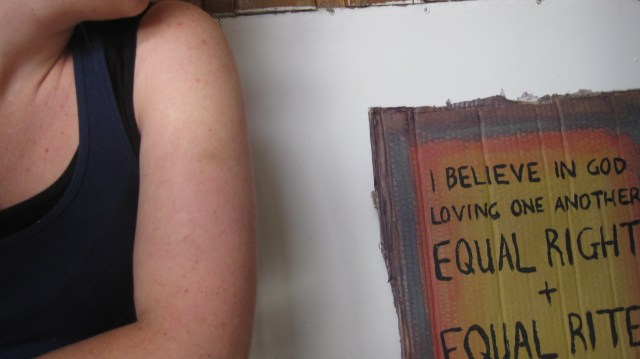
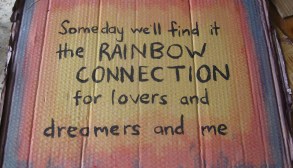
I feel nervous carrying my homemade 009signs to the marriage equality march – do I  carry them facing inwards until I get there?  Am I going to draw negative attention from people that are anti-gay or anti-Christian? You are making a choice, to set yourself out, apart, from ‘normal’ people going about their ‘normal’ day, doing ‘normal’things.

To be contrary, I line them up beside me on the seat at the bus stop while I wait – people idling in the weekend traffic read them but no one says 005anything and I am almost disappointed… let’s do it, let’s talk about how we’re treating one another.  People see the signs – rainbow broadcasting
makes the topic clear – no one says anything… aah, I have found a new way to be invisible.

Now at the train station, I put in my headphones as I step into the train carriage, block out an uncaring world and I am tapped on the shoulder…

“Hey, you want to join us here in the marriage equality corner?”

…I am welcomed in, a place, a space made for me and my signs.  they look me over assessingly, am I like them?

“I haven’t ever been to a rally before, But I have been to the Sydney Mardi Gras – I hope it’s like that – there’s a power in people coming together from all over, no matter what their age, race, religion, gender orientation is… there’s something really powerful about that, ay?”

Yes.  Yes there is.

How much riskier must it be if your clothes or mannerisms or something “give you away” and make you feel like you’re carrying a rainbow coloured banner with you everywhere you go… I’m embarrassed of the fear I felt of some kind of retaliation for sticking my neck out… is this a fear people live with going out their door every day?

The act of solidarity isn’t just showing up at the parade but being willing to put yourself in a position to share the experience of the person being marginalised – so what if someone did yell something out of a car on the way past or defaced the sign or comes into my personal space with aggression.  Is this something gay people ask of themselves every day? “Do I wave the banner today or mute something of who I am so I don’t attract attention?” As with all movements perhaps it requires some to be be ‘extreme’ with it to broaden the range of what’s ‘normal’… maybe that’s literally carrying a rainbow banner – drawing some of the attention away from you over there to me right here.

It’s not the same, hating me when it’s not my lifestyle choice.  You have to have a conversation with me to  find out why I’m doing it – and I’ll have a conversation with you about why you aren’t.


014

IMG_5004Talitha Fraser

Lest We Forget

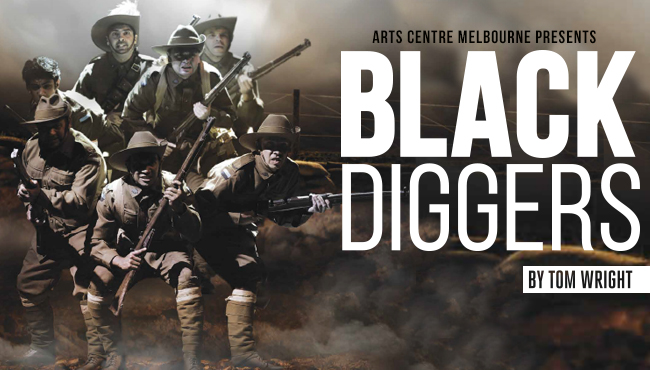
black diggers


I went to see Black Diggers at the Arts Centre with a friend last night who had free tickets – profoundly moving – literally telling the story of Aboriginal people who signed up to fight in the World Wars, painting their names high, drawing on postcards and letters home and journals.  The performances were authentic because the stories were true.  Mindful of how the other entertainments we consume – TV, reality TV, Facebook, Twitter… are shallow.  I click “like” on my housemates posts but I don’t see her for meals or ask her about her day.  This is the year of the ANZAC centenary… on one hand we might imagine there aren’t many around anymore to share their stories but there are the children who might remember… as, as the play pointed out, war is still being fought – for recognition of Aboriginal and Torres Straight Islander (ATSI) peoples and on foreign soil.  What are you fighting for?

A lot of us might say we’re peaceable people, not fighting for anything, but there’s a difference between conscientious objection and unconscious apathy.  You think because you are inactive you are inert but you are not.  If your ass is where your hope is an your ass is in front of the TV or the Playstation then your hope is in people and places and stories of people who do not exist… hoping another Stark doesn’t die in Game of Thrones or hoping a child doesn’t spend time in detention…

You might think, “It’s not MY problem” about the treatment of: ATSI peoples; refugees; those on Centrelink – pull one string and you will find the rest of the world attached but TV doesn’t come with any strings right? …except those that tie you to your seat immobile – bind your legs from walking in solidarity, bind your hands from helping, bind your lips from speaking out.  You have a choice to make it personal.  You are not friends with one refugee?  with one Aboriginal person?  with anyone who receives Centrelink?  …what does this say about you?  Do you spend any time with anyone who isn’t just like you?  It’s easy to be fair, inclusive, generous hey… when it’s to people just like you.  Of course you’re a good person.  You’re a good person to people just like you.

Songs and stories and names and voices… we are called to love one another.  How can you love who you do not know?  I am not unreasonable…

Move.

You heard me.  Move from your sofa at least… maybe even from your street… or your neighbourhood.  We are told the poor will always be with us and thank God for that because there is much we need to learn from them.

…Fifty years on the shrapnel works its way to the surface.  The pain will come out eventually – that needs to happen before wounds can fully heal.

How can we heal pain faster?

How can we reduce how much pain is felt?

How can we eliminate pain being afflicted in the first place?

But you aren’t in any pain are you… there in front of your TV… we should probably cut the funding to the public health care system.  No one I know needs it.  What a waste of my tax paying dollars.

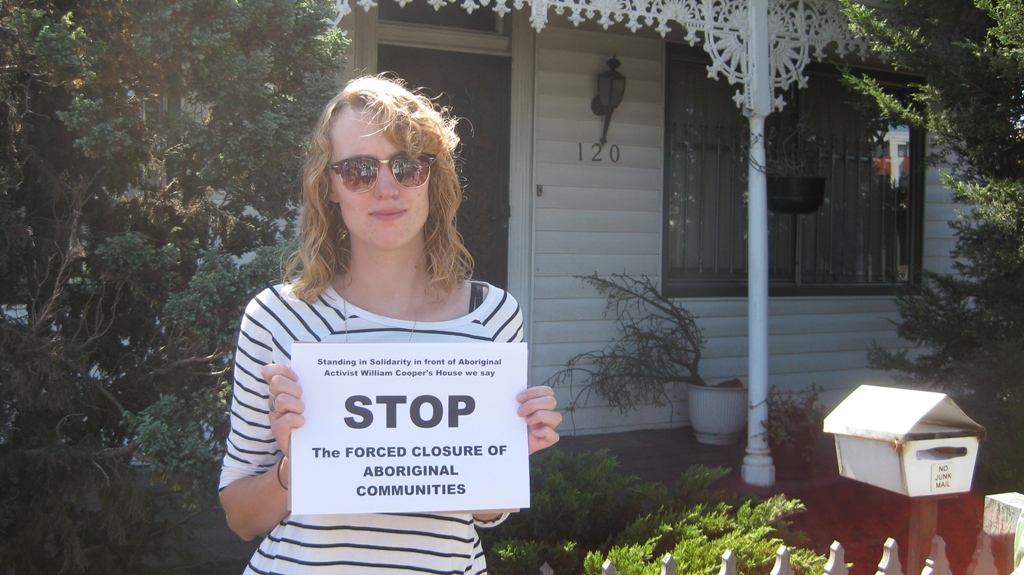
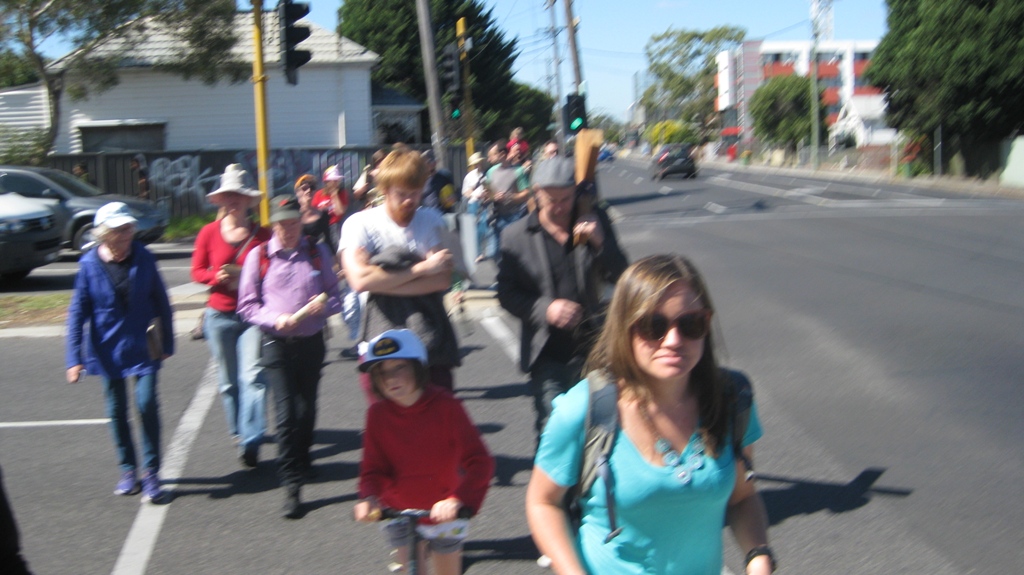
Mayra & I attended the Kinsler Institute earlier this year, and were impacted by Bill Wylie-Kellerman’s workshop on Resistance and Public Liturgy and felt inspired by the Detroit walk to imagine what this might look like for our own context – what are the significant places in our neighbourhood? what are the stories that we need to hear? that we need to tell? These questions were somehow infectious and representatives of different faith communities and social justice projects came together collaboratively in our neighbourhood in a really beautiful, special and significant way around the issues of forced closure of aboriginal land, treatment of detainees in detention centres; multi-faith and multi-cultural engagement, climate change, permaculture, homelessness, and asylum seekers.

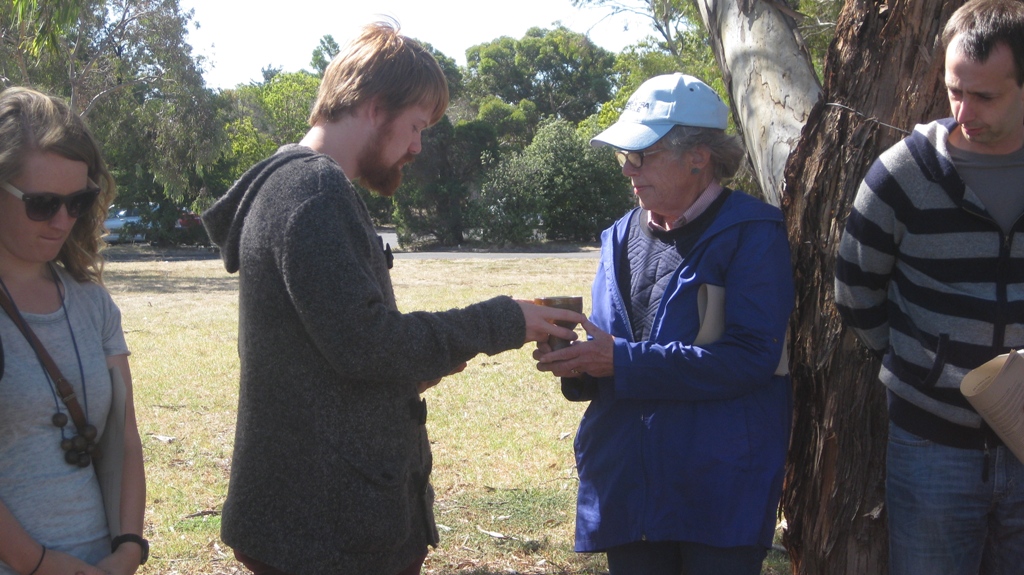
We wanted something specific to our cultural context and the resource  we based our walk on (7 Healing Rites for 7 Sites) draws on an indigenous reconciliation resource created by Dr Norman Habel – thank you Indigenous Hospitality House for pointing this out to us – and stories from our indigenous elders, Aunty Doreen Wandin on the Southern Cross constellation being a symbol of home and for navigation and Uncle Wanta Jampijimpa on the 5 stars correlating to the wounds of Jesus on the Cross.

This is a bit of a photo essay (we did an action at each stop as part of our response to the stories).

030 032 039 041 062 089 90 100 131

Creator Spirit
Help us to uncover our hidden stories
Suffering God
Help our tears to flow for the pain
Reconciling Spirit
Heal our shame and our wounds, and call us into action.
Remember that justice is coming; God’s reign is coming

054sml

[Earlier this year I had the great privilege and profoundly impacting experience of attending the BCM Kinsler Institute in Oak View, California – a.k.a a clusterfest: part birthday party, part conference, part church, part action planning meeting… – it’s worth noting that I can/am only speaking to my own notes from those sessions I attended and there were generally 5-6 options for every devotional and workshop spot so this is not conclusive coverage and the mistakes are my own. If you’re interested in this kind of reading there’s many more resources, articles and stories at the Bartimaeus Cooperative Ministries (BCM) and Radical Discipleship websites]


Bible Study: Jesus, Disciple of the Story – Ched Myers

Need to be literate in the story.

Jesus underwent formation and had to discern call. Jesus was shaped in/knew his tradition – quoting, embodying, referencing… informs his consciousness and animates his imagination. “As it is written…” rooted in the story.

I will tell you something about stories,
[he said]
They aren’t just for entertainment.
Don’t be fooled
They are all we have, you see,
all we have to fight off illness and death.
You don’t have anything
if you don’t have the stories.
Their evil is mighty
but it can’t stand up to our stories.
So they try to destroy the stories
let the stories be confused or forgotten
They would like that
They would be happy
Because we would be defenseless then.

Silko, Ceremonies

If we forget the stories, we are defenceless. If you aren’t grounded in this story, what are you grounded in? Land you are on is filled with stories – do you know them? Conquest, pain, animals… to be part of restorative justice in that place, need to know the stories.

Jordan is a river of stories (Red Sea) Exodus, Joshua 304. River is flooding, ford to cross. Israelites/Canaanites – Semitic tribes politically, socially and economically aligned with Egypt > tribute to pharaoh. Much as America don’t rule South America but control it through strategic leaders politically, socially and economically. Israel just got free, trying to be free of empire, the land they want is under empire/occupied.   This is why they go the long way round. Main roads controlled by Egyptians – undocumented immigrants finding another way >> old story. US Border Patrol, “boat people” in Australia. Chasing them or keeping them out. “The Man” holds the roads, bridges, fords…believe in a God who troubles the water. Ch.3 full chapter of ritual. The ark has to go first – carrier of the tablets. Instructions on how to be non-Egyptian. We are following a Way. Symbol – religious, social, cultural… Cherubim holding up a seat, empty, un-king. Manna economics, non-hierarchal structure of mutual aid. Ritual. Dip feet. Pick up stones, 12 stones, take them to the other side and build a cairn, 12 tribes. Alternative body politic with no king. Build a cairn on the Jericho side. Statement > attack Jericho. Dancing in the teeth of empire – started with going down to the river and getting stones. When Jesus goes down to the river – he dives down into the river – diving for stones. Lost the symbols because we’ve forgotten the stories or gotten confused about them. Elijah passing the mantle to Elisha (discipling) > first thing Jesus does is call disciples like Elisha did.

Apprentice of kingdom, land and story. Need to go into the left side of our bible to make sense of the right side – which constantly references the first half. New Testament stories are re-placed and re-grounded in the Old Testament.

Invites us as disciples to do the same. Let us be disciples of the kingdom as Jesus was, of land as Jesus was, of story as Jesus was. Scripture study informing out political and theological practice.


Walking Meditation: Charletta Erb & Todd Wynward

Mayra 11016722_10153155574714715_3033034683319964493_n (4)


Artist Manuel Cisneros, a native of Guanajuato, Mexico, came to California 12 years ago. The physical labor of moving large boulders around was satisfying, and the contemplative nature of balancing and composing his sculptures fed his soul. Often, he doesn’t know what a sculpture is going to look like until it’s finished; he enjoys the way the rocks, wind and ocean waves work their own magic on him. (quote from the Ventura County Reporter, 12/24/2014)


(photo credit: Mayra Stark)


Song:
Siyahamba (Zulu, we are walking in the light of God)
Siyahamba ekukhanyeni kwenkos yoyo’,
Siyahamba ekukhanyeni kwenkos’.
Siyahamba ekukhanyeni kwenkos’,
Siyahamba ekukhanyeni kwenkos’.
[ekukhanyeni kwenkos’]
Siyahamba… ooh
[Siyahamba, hamba, Siyahamba, hamba]
Siyahamba ekukhanyeni kwenkos’.
[ekukhanyeni kwenkos’]
Siyahamba… ooh
[Siyahamba, hamba, Siyahamba, hamba]
Siyahamba ekukhanyeni kwenkos’.


Song:
Christ came down that we might have love x 3 (hope, peace, joy…)
Hallelujah forever more


Song:
We shall not give up the peace
We have only started x3
Together we can work it out
If we only listen
Together we find victory
Hand holding hand


Song:
You shall be like a garden
Like a deep spring
Whose waters never fail
        (Isaiah)


Preacher: Rev. Jin Kim -“Wasting our life for Christ’s sake”

Mark 14: wasted ointment – waste/efficiency/frugality – breaking in with intimacy?

‘To waste’ and ‘to lose’ come from the same word…
whoever loses their life…
“wastes” their life.

birdThink about making something of ourselves or making ourselves nothing. Called to “be a loser”. Exodus: survival – significance – justifies the risk. I am now privileged. Christian domain – homeless, penniless… What are we leaving for our children that matters? Can’t crap in the living room, that will affect the whole house. We’re all dirt. All full of shit. Good soil or bad? Loving God and loving neighbour – generosity and hospitality.

Seriousness is a symptom of empire. Unless you have lightness, levity, joy, self-deprecating humour… your software has taken on the operating system of empire > fruits of the spirit (live in THAT!). Need to detoxify ourselves of empire. THEN reach out – physically, emotionally, spiritually… was Jesus a great prophet but failed evangelist? Message of surrender that no one wants to hear.


Song:
Guide my feet while I win this race x3
Oh I don’t want to run this race in vain
Light my path…
Hold my hand…
Set my feet…

(Kinsler Institute photo essay)
This emphemeral art piece was created by Ted
Lyddon Hatten:”…when you are looking at something
you know isn’t going to last from bud to bloom or a
baby that will grow… you appreciate it differently”


Plenary panel: Radical and Integrative Theological Education – Eric Brown and Ndume Olatushani (Proctor Institute); Jin Kim (Underground Seminary); Dee Dee Risher (Alternative Seminary); Solveig Nilsen-Goodin (EcoFaith Recovery); Kate Foran (Word & World); Rebecca Stelle (Church of the Savior)

Opportunity to hear from a variety of grassroots theological education initiative practitioners – use/addiction recovery model, small mission-minded groups, mentors + mission with intensives…

Seminary – comes from the word ‘seed’

Borders – places of convergence.

There’s a higher degree of diversity
and richness at the edges.

If we do our job properly then we should not be sure if we are in church or a classroom or at an organising meeting or in a field. Welcome to the “clusterfest”. Planting, reaping, harvesting > movement building, church renewal or social uprising?

  • Alternative publishing and seminary
  • Can’t learn the new construct from the old construct. What is full immersion? Enter into what is new.
  • Freedom Circle (12 steps) addict to the worlds sick way of being. Theological reflection happens later. Surrender is counter-cultural: full disclosure of finances, surrender authority to one another e.g. can I attend this conference?
  • Dorothy Day wasn’t just sitting around talking. Alternative Seminary: Credo (belief) and contextualisation of that is important, met in a homeless shelter, had a sliding pay scale, connect ecumenically – progressives from each tradition, can’t feel like school (competitive) or be disparaging of one another.
  • Word and World – how do you read? Learned in Greensboro (at the Beloved Community). Understand t agenda of people trying to preserve power > then hear stories and perspectives of others re-placing the stories. Be the student/intern – change the conversation. Too religious for political people and vice versa.
  • In cell – started to paint the things I wanted to see. Listen to what was within – I was fortunate. Chose not to have a TV for the first 10 years in prison (a lot of inmates live in/through that).

Knowledge makes us responsible

(cont.) …I had to educate others. Survival – keep getting up and moving forward. Always a chance to change the world around us. I couldn’t say that to others if I wasn’t doing – want to disrupt the system have to allow my voice at the table to describe what it looked like from the inside. Have to do everything I can so it doesn’t happen to anyone else. ‘Children’s Defence Fund’.

  • Poverty not only economic but internalised. Need to work on both generationally. First African American lawyer and founder of the Children’s Defence Fund. Civil rights pedagogy – not just talking but singing and preaching it and erupting and disrupting onto the streets.
  • Underground seminary: Took graduates – do an internship to undo/detoxing from professionalism. Between 20-40 years old, in debt, over-leveraged – everyone paid what they could afford. Made them live together 8-9 houses. Interns live 4 doors from church intentional. Philosophical and ideological text polluted by smog – if you don’t go to the mountains or fly above it then you can see/don’t know there is smog. As much about unlearning as learning. This way of understanding is integrated into my church and family life. It’s a natural part of our lifestyle – would happen even there were no students. Invigorating. Church gives time to it but holds it lightly. Like a flash mob. When needed, will happen; when not needed, won’t. Traditional in Asian culture to go to a school of “{person}” – personalised authority rather than a school.
  • People and churches going into “recovery”. Individualised recovery vs. communal. Have a grant that funds interns and mentors. Learn from students/cycles. Ecofaith recovery asks “what can we do?” Grief work. Part worship, part movement, self-work… A lot of people might think “I can’t give up my car so I can’t criticise petrol companies” – what are other ways we can engage with the environment?

Imagination lies underneath our grief.

Teach leadership development that is spiritually grounded and organisational skills.


conf

Workshop V: Immigrant Rights Organising – Guillermo Torres

We do advocacy. When undocumented people are picked up they are held by the police and then turned over to Immigration. Police are not qualified to make decisions about immigration.   Principles like these get used to abuse day labourers: utilise them then don’t pay them – they have no protection or right of redress.

What is the faith response to the crisis of children coming from South America? Have a vigil. Visit them and check the conditions where they are being held. Want to do more than pray… got together key faith leaders, politicians, service provision stakeholders and a refugee to tell her story. People that came to the US and were arrested for crimes then were sent home to Honduras and El Salvador – her house was in the middle of a gang shoot out… hunger… coldness… two days on a bus… rash… boy fell off the raft she was on and a another woman went into the water to get him… family were separated… father sent back to Honduras, they had no money and he is the main provider for their family… makes no sense? Kids who arrive in the US under 18 years of age get fast tracked and are given 7 days to make a case for why they should be allowed to stay.  Waves of immigration during the wars > became gangs in LA (shared language and friends) > deported back to El Salvador and keep gang structure.


(Kinsler Institute photo essay)

How do we connect to the children who have arrived? To their faith? To lawyers? To supplies? What if we created a collective network?

How do we find out where the kids are when this is confidential? Invited the people who might have that information to come to the meeting. What are the biggest needs?

  • Legal protection/services > Guardian Angels
  • Mental health services that can be used to build a case for asylum: violence, poverty, abandonment, sex trafficking (give me your daughter r we will kill the entire family)
  • Chaplaincy: sponsor, hospitality, integration into community, links to food/clothes/transportation, navigation.

250 kids were funded to get legal support, only operating at 40% because couldn’t reach more kids/families.

  • Accompany-er who is screened and trained who is with them through the whole process. Calls weekly. Moral and spiritual support.
  • Distribution centres for pallets of shoes, clothing, food, grant for $25K, vouchers for school uniforms.
  • Welcome centers/congregations – food, clothes, school supplies
  • Serving supplies (re job skill training)
  • Raise funds for legal aid
  • Skill/job training – sewing, welding…
  • New furniture

Doing all these things and haven’t
even named the coalition.

What can the church offer as special/unique gifts?

Love, compassion, justice – what moves you? …need to know what motivates groups.

Moral authority “self-interest” motivated by love and call of God on hearts – how are we awakened to our deepest connections? John 17:21 strategy > hope and compassion. Eph 2 implicit and explicit – explain and if you have to, use words. Immigrants become involved in advocacy and non-immigrant partners. Some politicians identify as religious – an interfaith response might canvas that, clergy bring influence and members bring influence.

Anyone plus God is a majority

Further reading on the Faith Communities Contribution to Unaccompanied Migrant Children see: Guardian Angels, Clergy and Laity United for Economic Justice of Los Angeles (CLUE-LA).
See also Our God is Undocumented – Ched Myers


Workshop VI: Messianism vs. Christology – Jim Perkinson

025

heidelberg project
Christianity needs to be redefined, transformed, reframed…

Make desperation yield beauty
in spite of itself

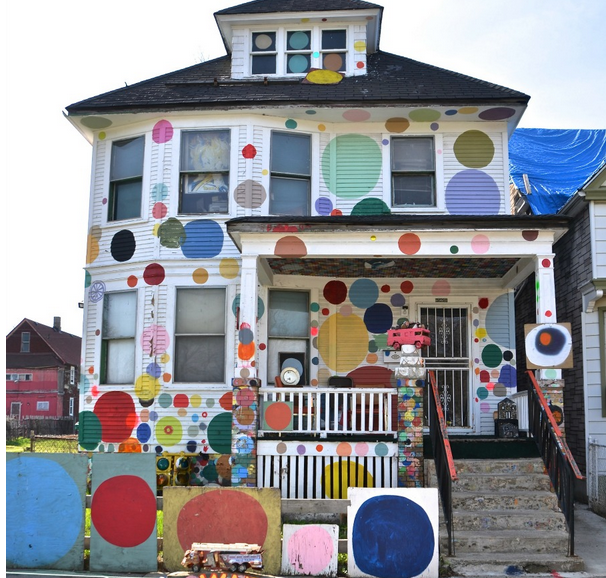
Google image search “The Heidelberg Project” – economic decline saw many factories closing and abandoned housing > lots of rubbish. This project using refuse as art attracts 2000 people a year – a community art project that is constantly evolving. Step out of art protocols – make people and places speak beauty. Utilises non-human actors: stones, water, clouds, doves, snakes… what is indigenous to the area. Detroit taught me to speak in tongues – use a difference vocab than your cognisance recognises. An African dance has motion/rhythm/call and response/exchange and a heightening of energy – they are learning how to speak the land, let them have space inside our bodies. The totem animal/plant has been there longer and knows how to survive. What voice is speaking in you? Big question. We are what we eat – is my ancestor my grandfather or possum or grubs? More honest to tell the story that way.

Domesticating ecology and dominating… 10,000 years domesticated plants, 500 years later domesticated animals to help with domesticating plants, now mostly metal technologies through fossil fuels. Functioned in band societies of c.150 people or less (most of us still only engage with about that number of people). We are not hardwired to violence – when have we lived not destructively? What do we have to learn from that period? Pastoral nomadism as resistance… Genesis 1-2-3… domestication happened as a result of the Fall not “advancement”, Cain and Abel – the farmer kills the pastoral nomad then builds the first city. Replacement for Abel is Seth (replacement), Inosh (vulnerable one) and Inoch (full metal jacket) > two lines out of Eve. Son of Man/Human One not Christ or Rabbi. Kibor Inosh in Daniel (one like the vulnerable one)… history of empire and kingship – Samuel – you will come to regret this… Saul, David, Solomon… 1&2 Samuel/1&2 Kings = forced labour of men and harems of women. Pastoral nomadism has counter imperial values. Abram first thing, leave the city, take animals, become herder, trees of Moray…

hospitality is how you hear
what’s going on in the next watershed

3 angels visit. Urban Sodom is degrading visitors.

David/Daniel/Isaiah – how does Jesus talk about them? Messianism

Abraham – hospitality
Moses – lives off the land
Elijah – fed by ravens > hunting
David – on the run renegade shepherds, playing the lyre, shamanic tradition
Paul – Galilean movement

We have enslaved matter.

Indigenous people are calling us to return not for in a forward spiral. To them space – organic life and everything else – squirrel and a rock have the same vitality.

Further reading: Principalities and Powers – Walter Wink

Building in cities represent the harnessed energy of animals, minerals, humans – they are still energised but they are warped. Bloated and starving. Hungry ghosts. “I am Legion” complexity of singular and plural. Internalised scribal principalities. Exorcises the people and the first thing that happens is people start asking “What was that? Haven’t seen that before!” >start asking questions.

Me. You. God has hundreds of faces. Return wild vitality to them. Jesus puts mud and spit on blind eyes and asks: “Can you see?”. Artists take mud caps and paint and ask us “Can you see?” The project was bulldozed twice and burned nine times – not everyone thinks it’s beautiful. Folk art marking it out as beautiful – as vital. Shocks you into recognition of where you are. Ethnic cleansing is happening through tax/mortgage/water cut offs. Detroit is seen as a blight and a problem. A deep weapon for surviving is codifying beauty out of pain: spirituals/blues/jazz/R&B/gospel/soul/funk/techno/hiphop… old school and underground forms… tagging, breakdancing, turntabling…Pain made into beauty.


Reflections from our chaplains

Lots of tensions/paradoxes:

Take seriously – not too seriously
Local – global
Find voice – listen
Be still – dance
Articulate – sit in silence
Doing a lot – not doing enough

 Isaiah 37:31 root downwards, fruit upwards.

Sometimes find ourselves with less time, less money, less love, less support than we would want. Not called to imitate as they did but the way they incarnated the Word/Spirit of God in their lives.

Digging down deeper – public acts of liturgy might encourage someone to go a little further.

Imaginative capacity – how do we expand this for ourselves and our imaginations. Easier to imagine another world than our own neighbourhood being radically different, incarnating a deeper imagination.

Moving from strength to strength:

  • Gifts of young ‘uns: new ways of seeing, energy, acontextual, less baggage
  • Keeping it real
  • Connections: art, music, cross denominations, people, creativity
  • Entrepreneurship
  • Manifestation of spirit
  • Ched’s jokes

The main thing is to keep the main thing the main thing – fuel, safe space, fresh air, spark rekindled.

Celebrate and nurture faithfulness.  Courageous is the loving thing to be.

We share with you
what we have received.

Movement – called to shine light not be stars, workers not heroes, move justly and lightly on the earth. “The world seen clearly, not sharp eyes but eyes moistened with tears…” Margaret Atwood.

Passion and compassion that leads us. Themes: touch my wound, leave sorrow behind >go to lead and feed.

We are enough.
Scattered but not alone.

Pick up seed and carrying it away – store, feed family, drop… grow

016sml[Earlier this year I had the great privilege and profoundly impacting experience of attending the BCM Kinsler Institute in Oak View, California – a.k.a a clusterfest: part birthday party, part conference, part church, part action planning meeting… – it’s worth noting that I can/am only speaking to my own notes from those sessions I attended and there were generally 5-6 options for every devotional and workshop spot so this is not conclusive coverage and the mistakes are my own. If you’re interested in this kind of reading there’s many more resources, articles and stories at the Bartimaeus Cooperative Ministries (BCM) and Radical Discipleship websites]


Bible study: “Jesus, Disciple of the Kingdom” – Ched Myers

Mark 1:9 In those days Jesus came from Nazareth of Galilee and was baptised by John in the Jordan

This is our introduction to Jesus in Mark, Nazareth is so small and insignificant that it’s not mentioned anywhere other than the New Testament – a marginal village at the margins of the country. Based on the outreaches of Sepharus (the admin base of Rome)… what was it known for other that being the birth place of Jesus? The Sepharus uprising. The Romans crushed Sepharus and enslaved everyone. Nazareth is only 4 miles from Sepharus and Jesus would have been 10 years old when this happened. Jesus and his Dad were techtons (labourers, construction workers) hired to help rebuild Sepharus. Labouring under the bitterness of colonial occupation… this would shape your consciousness, this would have a huge impact… this is why context is so important.

Of all the people Jesus could have gone to he went to John the Baptist. Calling for change. Peripheral/wilderness. Wildman. Elijah. Spoke truth to power – defending people whose land was being taken by the King. Jesus discipled in a deep tradition.

He was apprenticing himself to the peripheral
radical edge of his own tradition.

Mark doesn’t do genealogy but what ‘testimony’ is it giving us? Traditionally and consciously apprenticing to? (Mark written during the uprising to overthrow the Romans 30-40 years after Jesus was killed) The authors wanted to frame their ‘call’ drawing on the narrative weight of the example of Jesus.

Who are we apprenticed to? [BCM – Martin Luther King}

What does the kingdom of God mean?

The true king of the world is God, that’s who we’re called to follow, to penultimately obey – no one else is higher (conflictive political statement, no empire likes to hear that)

We are disciples of someone who was himself a member of this anti-kingship.

Jesus had dark nights of the soul – watching Sepharus burn, seeing his Dad going to work building empire…

The kingdom of God is imminent, it is here – first sermon of Jesus.


Worship: Rev Robert Two Bulls – Lokota Taize

Profoundly moving to sing together a Taize song in the Lokota language.  I could not capture it but here is a link to an article written by Rob in Sojourners about writing the chants… what would it mean to us here in the South Pacific to have Wurundjeri… all Kulin Nations, all Aboriginal and Torres Strait Islands language taize chants?


Preacher: Rev Arthur Cribbs

Isaiah 61 The Spirit of God is upon me
Mayra 11016722_10153155574714715_3033034683319964493_n (1)

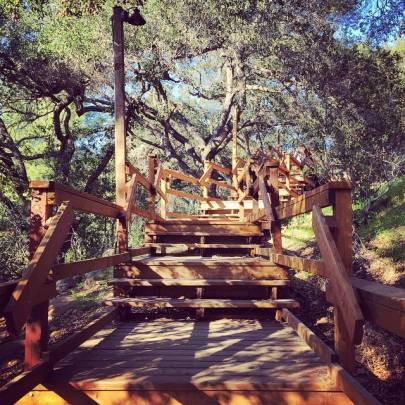
Jesus in the temple, those words are fulfilled in me today. Challenge on us to say/claim this for ourselves… people are treating people like they don’t matter. Reach out right now and touch someone else, reach those further away, reach those not here… every person is sacred across all borders. Are these words prophetic or historic? The Spirit of what is on who? We need to understand the importance of God’s presence with us.

Ethics for police officers (e.g. treatment of suspects on arrest), ask: “What do you do when you’re doing what you think is right, society says its right, law says its right and someone says ‘Ouch’?” …Be who God intended you to be because the world is waiting for YOU.

(photo credit: Mayra Stark)


Plenary Panel: Forty Years of Radical Christian Witness – Rose Berger (Sojourners), Myra Brown (Call to Action, Spiritus Christi,), Tensie Hernandez (Catholic Worker), Joerg Rieger (faith & labour), Steve Clemens (Koinonia Community, Clarence Jordan), Shady Hakim (Christian Peacemaker Teams)


Rev Nelson Johnson (Beloved Community Center, Greensboro) by video conference

Language and words, name and claim, have great meaning. Took us 35 years to get the language right (accident, massacre… murder, assault…) I was exhausted. What gave me faith and meaning was rediscovering my roots. Labour/low wage fights in Greensboro… built community… the community became the union. Can have national implications if you do your job right.

Important to learn the story of your place. [what is the name of the water source in your watershed?] River flowed before and flows after. What we’re doing and what needs to be done. Have to appreciate the context to appreciate what they were doing. Strongest and most enduring movements came from knowing stories of our mothers and fathers. Drill down in a place and then gather in that place – become a foundation – work becomes more powerful. Not heroes but ordinary common people standing up against bureaucracy.

The culture of domination – that will be in the language you use. Sometimes can’t say anything, have to sing it out… poetry… how we understand is important and language is what we have to convey that . Language has to call us together, set direction without making what we’re trying to do matter.

Appreciating the fear and the pain of those affected by social injustice, my parents, hope even though I can’t see it >> gives me courage. Gathering together now, strengthens courage, strength and resistance, mourn with those who mourn… share joy with those who feel joy… become a community and transcend ourselves. Not in the fight for ourselves but for our children and our children’s children.

Lion coming over the hill – climate change. New threat. All bad times >> been connected to others. We need to reconnect with natives who are connected to the earth and creation. Beaten down – think only of immediate survival. Need to bring issue in a way that connects to their reality right now… solar panels on buildings in poorest neighbourhoods – opened up discussion. Community gardens is another example of that. White people need to connect their struggle to others experience >> make connections. “We are hooked into a mutuality” – MLK


Question to the panel: If I’m 18, 25, 33 years old… why/how did the tradition that you’re now with grab you? Give us the biography of the movement history that has changed your life…

Tensie Hernandez (Catholic Worker)

Young. Traditional. Immigrant pious Catholic. Only in passing heard of Ghandi and St Francis. Mid-80s heard word of some nuns getting arrested and wondered… why? Churning heart. Came upon a vigil in downtown LA on Good Friday – wanted to hand out bread from holy Thursday at school to homeless. They held a banner “God died today in Central America” – not St Francis or Mother Teresa but close. Invited me in. Good Catholic, don’t eat Good Friday. Catholic Worker Homeless Soup Kitchen invited me in, “come and eat with us!” I can’t. Fasting. We’re having shrimp. I definitely can’t!   What would Jesus do? Courage to have a living faith. Where are the people and the issues that we choose to live with daily. “You become like that which you are habitually with” – Don Sheats. Be transformed by that.

Steve Clemens (Koinonia Community)

Don Sheats – multimedia values – materialism/competition/militarism vs. cooperation/compassion/non-violence. Ballot number was too high for the war in Vietnam, decided to sign up anyway. Challenged to respond a different way. Koinonia not resistance but calling to be alternative and sustainable.

Myra Brown (Call to Action)

Daughter of migrant farm workers. First four years – oppression – experience shaped me and prepared me to be “caught”. Black Catholic church, 16 years old, asked me to preach and I said “No.” He asked me to pray about it (my Grandmother said, “When God goes silent, that’s it”). I’m black, I’m a woman, Catholic… I said: You open the doors and I’ll trust You and step through them. At 25, heard about Corpus Christi, first time worked with white people that were compassionate and ‘got it’, who worked hard to create safe space. We can’t call you a pastor but we’ll give you a title and you can write your own job description. Launch black civil rights/justice issues and see the fruit of that. Build on that. Worked with me to see what my gifts/callings were.

Shady Hakim (Christian Peacemaker Teams)

Israel/Palestine conflict, people on the ground living gospel restored my faith (1996) 5-6 people living in the conflict zone. Met Ched and Elaine (1998)

Rose Berger (Sojourners)

Mennonites offered land if joined fighting and said no. Married Irish Catholics. Arkansaw – cross burned in their front yard. 4 years old seeing saints and angels. Emergency response card – Nicaragua. I anoint you in honour of Micheldech, kicked out of church – been kicked out of churches with my parents before… picked up a copy of Sojourners – advertised for an internship. Anti-nuclear protest/test site. Lord is there truth to be found here? I wake up and go to work. I hear: “Yes.”

 This festival is about hearing and telling these stories –
stories that have midwived these people,
now they midwive others…


Workshop I:
Resistance & Public Liturgy: Non-violent Direct Action as Gospel Witness


Bill Wylie-Kellerman (St Peter’s Episcopal Church Detroit)

Author of/Further Reading: Seasons of Faith and Conscience: Reflections of Liturgical Direct Action

Worship is categorically political – subverts all other allegiances. Baptism a sacramentum (protest against Caesar). Combined with civil resistance rather than direct action cloaked in piety. Ref: Freedom struggle ‘50s funeral liturgy “The Cross and the Lynching Tree” Emmett Tell addressed a white woman in a store, beaten, Mother insisted on an open casket. Liturgical confrontation. Montgomery bus boycott – Christmas, let’s not go shopping; Birmingham Children’s Crusade, running out of gas, put on jeans and walked – Good Friday; MLK arrested, wrote letter from jail – Easter Sunday. During the Freedom Struggle church was the place you went out from, sang songs and shared worship… by the time you went out the door the dogs and the hoses were already beaten… singing went out into the streets. Liturgical dimension to those directions – trained with Ghandi. Doing service and worship at the same time. Direct action involved both of these things at the same time. Cadenceville, Berrigan brothers – homemade napalm burning files – standing in a circle praying. Stringfellow “politically informed exorcism”.

 Liturgical action
implicates the church

Good Friday – blood
Ash Wednesday – nuclear ash/fires
High feasts like Easter and Pentecost – power/fear of death/bondage of death liturgy and action
Passover – liberation
Beneath the feasts are egrarian – lambing, harvest, earth, turning world… layered with history and politics
Pentecost – first time the disciples act

This is the Gospel pattern we are invited into.

Steve Clemmens (Koinonia Community)

In the year of the election, made a roster, each peace group had a week of public action at the Pentagon. Did a prayer Pilgrimage to the Plantex Plant in Texas in February 1981. 3 days of prayer and discussion prior to the action. Ephesians Ch. 6. Gathered in a circle. Scaling fences in blizzard. When act on faith not fear, faith increases. I had no fear that morning. Reading scripture – on the run, in jail, in exile – a lot of it was written by these people. Became a front page story. Raised questions for a Catholic staff member who asks his priest who asks the Bishop who issues a statement telling them to walk off the job. Would fund people who did that as choice of conscience… 25 years later in 2005 School of America vigil, Centre for Global Education visit where Romano executed along with Jesuit priests and women. Abu ghraib (treatment of Iraqis in prisons) – enter base to pray in front of school. Never act alone, community “with” me. Gathered two days before trial to discuss, how to bear witness, pray “don’t contest” pro se plea. 3 months in prison. Listened to my fellow inmates. Listening in the belly of the beast. Heshua’s “incarnating our prayers”. Conversation with family of origin. Prayer vigil. Labour Day weekend – bloody handprints (Bill Wylie-Kellerman). Ploughshares > beating swords into Ploughshares. Larry Rosenbaum – retreat to discern action. In community, go around circle and name fear.

Inside: in service of power – get out in service of the action/Holy Spirit. Lit Paschal candle.

Seal on the tomb : cut the fence even though we could’ve climbed under it – resurrection.

Want to write “Christ lives, disarm” in paint but it was snowing. Renewed baptismal vows. Renounce Satan and all his works.Liturgy and location informs things. Did Eucharist at gun point.

“we believe God has already intervened. Breaking in to break out on behalf of humankind. Recognise authority of God,
not of [name who…]
we believe [name what…]
we believe in the meaning of the resurrection
and we’ve come to say so”

Further reading: Catonsville 9 Statement by Daniel Berrigan
Further reading: Tribes of Yahweh – Norman Gottwald

Where is resurrection happening? Move stations every year. Waterboarding > read story of washing feet. Moral conviction – what if people had sat on the tracks in front of trains into Auschwitz?

 Good news is relative to how
willing you are to read the bad news.

Workshop II: The friendship of Berrigan and Stringfellow – Bill Wylie Kellerman

Futher reading: Stringfellow “Instead of Death”; Dorothy Day; Merton “Desert Fathers”; Underground Seminary; Jacques Ellul… “I freaked in” (instead of “I freaked out”); Modern Spiritual Masters series, “Stringfellow: Essential Writings”

Further watching: Hit and Stay: History of Faith and Resistance” (video) – not hit and run but hit and stay >consequences and responsibility.

While the trial was on – festival of life every night. “Death shall have no dominion”
Act of resistance as simple as offering hospitality (hiding Berrigan for c. 6 months)
Paradox: It’s worse than you think it is, you are freer than you think you are… (Stringfellow)

—-

A Statement by Anthony Towne and William Stringfellow of Block Island, Rhode Island, concerning Indictment No. 7709 in the United States District Court for Rhode Island:

Grave charges have been made against us by the public authorities and we have pleaded innocent to those charges because we are innocent. In due course, a jury of our fellow citizens will have opportunity to uphold our innocence and we await their verdict with cheerful expectations.

Daniel Berrigan is our friend. We rejoice in that fact and strive to be worthy of it. Our hospitality to Daniel Berrigan is no crime. At a certain time and in a certain place we did “relieve, receive, comfort and assist” him and we did “offer and give sustenance and lodging” to him. We did not “harbor” or “conceal” him. We did not “hinder” the authorities.

Father Berrigan has and had no need to be concealed. By his own extraordinary vocation, and by the grace of God, he has become one of the conspicuous Christians of these wretched times. We have done what we could do to affirm him in this regard. We categorically deny that we have done anything to conceal him.

We are not disposed to hide what light there is under a bushel.

Our indictment has not happened in a void. We cannot ignore the scene in which such a remarkable event takes place: the manifold and multiplying violence of this society, the alienation between races and generations, the moral fatigue of Americans, the debilitating atmosphere in which citizens become so suspicious and fearful of their own government that they suppose silence is the only safety and conformity the only way to survive.

Because we are innocent, we believe that we would not have been indicted but for the pervasiveness of the spirit of repression which has lately overtaken the nation.

In that respect, we consider that whatever happens to us will in truth be happening to all Americans.

And so, to our fellow citizens, we say:

The violence must end.

All violence must stop.

The vainglorious war in Asia must now cease, but, more than that, the war enterprise must be dismantled and the military predominance in our society must be reversed.

And the violence of political terrorists must end now. Arson, kidnapping, bombing in fact sabotage the social change the nation so pathetically needs, and such tactics are just as wrong and just as futile as the violence of war and racism and repression.

The psychological violence, sometimes officially condoned, by which citizens are accused and impugned without opportunity for appropriate reply and are otherwise harassed, spied upon, frightened or intimidated must be stopped now.

These are all works of death. Only when our country is free of them will it be a society in which men can rejoice as human beings.

We make this statement as our Christmas greeting—especially to Daniel and Philip Berrigan, to all prisoners of conscience, and to all Americans who wish to be free.

William Stringfellow

Anthony Towne

Block Island, Rhode Island

Honouring the Cloud of Witnesses – Susie Henderson Hanson

Memorial Altar Building050copy
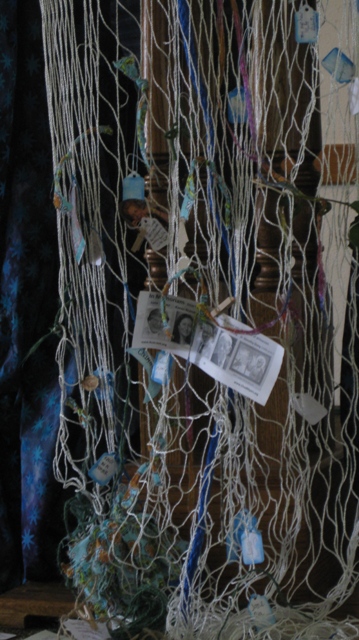
Over the time of the conference a space will be set up to go to remember those who have gone before or cannot be here with us. We do this remembering for many reasons:

As an act of resistance to those who want efficiency, to get ‘over it’ quickly

  • Stages of grief
  • Tasks of mourning
  • Reclaim burial ground
  • Institutionalised
  • Indigenous
  • e.g. Cyclers who do a memorial ride every time someone dies riding a bike – laid down their bikes, reclaimed the street, pause traffic.
  • Isaiah 61 – restoration is work done by the mourners, through process of mourning

Beyond reminiscing

  • Cloud of witnesses that came before
  • In the river
  • Stronger
  • Belong in community
  • Gives courage and hope

Go and honour own sense of life. Honour those who have gone before. Cast a net. Tie a prayer tie, write a name, share tobacco… cut or mend or adorn the net – welcome to engage with it – alone or with a friend.

Keynote: Myra Brown and Rev Mary Ramerman (Spiritus Christi Church)

Song:
Up above my head I hear freedom/justice/healing/music in the air (x3)
And I really do believe there’s a heaven somewhere

Asked: “Jesus, can I go with You?”

Role of layperson/women in the Catholic church – got in trouble for touching the Eucharist, asked “If it is Jesus, why isn’t it okay for a woman to touch Jesus?”
(photo credit: Mayra Stark)
Mayra 11016722_10153155574714715_3033034683319964493_n (5)>importance to speak from my own voice for what I deeply believe
> cannot make everyone happy

LGBT community: everyone counts, everyone is welcome, sharing night once a week.

2 Hands – one extending welcome, one outstretched to poor.

3000 people at the church. 1000 met to organise/advocate to save Corpus Christi. You can cut back the flowers but you can’t hold back spring.  Corpus Christi (body) > became Spiritus Christi (spirit) } Catholic but inclusive.

God has given a message – we are created in God’s image. Not allowed to be priests mocks this message. How we’re treated at church reinforces the messages of how we are treated at work an at home. Conversation provoked in offices/workplaces around the city and the state > look to the church for leadership. When Matthew Shepherd, a young gay man, was crucified on a cross – the church was silent.

Young man says to a wise man “How do I get to be enlightened like you?”
“Are you willing to be called names, dragged through the mud, vilified until you’re 45?”
“Yes.   …what happens when I turn 45?”
“Oh… you get used to it.”

Became able to say you know what? I don’t deserve that. People are more sacred than the altar. People are gifted with dreams and visions – community is to celebrate that with joy. Ubuntu: I am because we are. Do ministry that does people no harm. Make a decision – participate in my own oppression or stand up for my community. I have been liberated, no one is free until everyone is free… relationships that were there at the start won’t be there at the end and that’s ok.

Our dreams need to be bigger than our fear.

Song – Seth Martin
(tune of Are You Sleeping?)
I know nothing x2
Not a thing x2
Nothing about anything x2
This is good x2

ched&elaine(Elaine Enns and Ched Myers – photo credit: Reconciliasia)

“What is Radical Discipleship?” by Ched Myers

What this week is really about is to commemorate 40 years of the Radical Discipleship movement.  Radical Discipleship is NOT a dope slogan, or a mobilizing soundbyte, or a hip brand, or an ironic twitter handle.  Hell, these terms aren’t even cool anymore.  “Radical” is a term as unfashionable today as it was trendy in the 1960s.  The notion of “discipleship,” meanwhile, is entirely shrugged off in liberal church circles, and trivialized in conservative ones.  So let me explain why this is the handle of this Festival, why we insist on using the phrase.  The etymology of the term radical (for the Latin radix, “root”) is the best reason not to concede it to nostalgia.  If we want to get to the root of anything we must be radical.  No wonder the word has been demonized by our masters and co-opted by marketing hucksters, and no wonder no one in conventional politics dares use the word favorably, much less track any problem to its root.   //more

It is both curious and revealing that the notion of discipleship, in turn, is so marginal in our churches.  Curious, because discipleship is so unarguably the central theme of the gospels.  Revealing, because it shows how wide the gulf between the seminaries, the sanctuaries and the streets has become in North America.  The prevailing expressions of faith Among Protestant churches—evangelical decisionism, mainline denominationalism and fundamentalist dogmatism—are each deeply problematic in a society that is mired in dysfunctional politics, delusion economics and a distractive culture.  Faith as discipleship remains the “road rarely taken” here at the heart of empire.  We have yet truly to reckon with Dietrich Bonhoeffer’s famous warning, delivered under the shadow of fascism, that “cheap grace is grace without discipleship.”

More than a half century ago the great Swiss New Testament scholar Eduard Schweizer reiterated Bonhoeffer’s dictum by asserting that from the perspective of Mark’s gospel, “discipleship is the only form in which faith in Jesus can exist.”  This theological challenge was subsequently advanced by Schweizer’s Australian student Athol Gill, whose teaching of Mark as a manifesto of radical discipleship helped animate renewal movements in the 1970s and 80s Down Under and deeply influenced our community in Berkeley.  I am thus a child of that theology, and so, in some direct or indirect way, are each of you.

Radical Discipleship is about nothing more and nothing less than laying bare the roots of the personal and socio-political pathologies of our imperial society and its dead-end history, even as we seek to recover the roots of our deep biblical tradition: namely, the messianic movement of rebellion and restoration, of repentance and renewal, a “Way out of no way” that has been going on since the dawn of resistance to the dusk of empire.

This Way was birthed when Creator scattered humans from centripetal Babel in centrifugal liberation, and continued when Abram and Sarai bailed out of Ur and Moses and Myriam busted out of Egypt, and when Jordan’s waters rose up and Jericho’s walls came tumbling down.  Though often beat down and always marginalized, this vision of truth-telling and reconciliation-dreaming was remembered when Elijah read the riot act to Ahab, and Isaiah sang a lovesong lament to the vineyard, and Jeremiah bought a field in the bear market of occupation, and Ezekiel saw the wheel within the wheel, way up in the middle of the air.

It was this tradition that animated John the Baptist to go feral, troubling Herod’s business as usual and then troubling Jordan’s waters to re-birth a certain Nazarene upon whom the old Spirit of the Movement came to rest like a condor.  He rebooted the old movement afresh, accompanied only by clueless fishermen and faithful women of ill repute, by demoniacs liberated from imperial possession and peasants armed only with palm branches.  Jesus faced down the Mammon system with loaves and fishes in the wilderness, remembering the old catechism of Manna; redirected our attention away from Temples and toward wildflowers and birds; raised up street beggars and brought down fatcats to co-inhabit the Jubilee common ground his mama had sung to him about as a baby.  The Nazarene’s movement ground to a halt on a Roman cross, on which the imperial bill for the cost of discipleship came due; only to be rebooted again at an empty tomb from which the stone of impediment had been rolled away, so they say, so they say.

Which strange lacuna spawned a Pentecost insurrection of multicultural restoration and economic redistribution, a strange unleashing of tongues and pocketbooks that spilled out of a safe house attic into the streets in a popular theater of protest and proclamation just a few blocks from where Jesus had been lynched.  These shenanigans of course earned official backlash, which only spawned a smackdown of restorative payback, in which the murderous chief head of security charged with strangling this inconvenient movement in its crib broke down in the middle lane of the Damascus Road, struck blind with visions of his victims.  This chief prosecutor ended up defecting to the movement he sought to destroy, such that he had to be smuggled out of town in a basket like baby Moses, the hunter become the hunted.  This unlikely turnabout spawned little ecclesial communities of nonconformity, bread breaking and discipleship to Jesus throughout the empire, which we know about only through the tattered fragments of correspondence and liturgy and catechism that survive in what we call the Second Testament, today every bit as misunderstood and abused as the First.

These little communities spawned martyrs who rendered to God everything and to Caesar not much at all; and monastics who returned to the wilderness in the waning days of a decadent Roman empire in order to rediscover the evangelical disciplines of fidelity and poverty.  The movement was remembered by Franciscan nuns and friars, who bound themselves to nature and to the poorest of medieval society;   and by 14th century communitarians who defied feudal canons of hierarchy and vengeance; and by 16th century radical Anabaptists who refused to participate in the bloody religious wars of Christendom.  It was invoked by Baptist radicals and Methodist reformers, by Quaker abolitionists and Anglican visionaries in Europe and the New World, against the grain of colonial plunder and genocide.   It was the ground on which 18th century “Levelers” stood in their struggle against the privatization of the Commons–“Since then this Jubilee, Sets all at Liberty, Let us be glad!”—as did Luddites resisting factory culture in early industrial England, as did immigrant Wobbly and Jewish labor organizers a century later in Guilded Age America.

Above all, this tradition was preserved for us all by 19th century African slaves under American apartheid, who knew who Pharaoh was and where the Promised Land was, and who journeyed there on an underground railroad, singing:

  • “Go down, Moses, way down to Egypt land…” and
  • “I looked over Jordan, and what did I see…” and
  • “Nobody knows the trouble I seen…” and
  • “Oh freedom, Oh freedom over me…”

These old Jubilee anthems came alive again in the 20th century Civil Rights movements that reached from Selma to Soweto.  Indeed, a freedom song that was birthed in a Jim Crow jail was blown by the Spirit to cross-pollinate all the way to the Berlin Wall and Tianmen Square and the streets of Manila: “Deep in my heart, I do believe, that we shall overcome someday!!”

This vision animated as diverse a band of practitioners as Lutheran theologian Dietrich Bonhoeffer and Catholic laywoman Dorothy Day, Baptist preachers Martin Luther King Jr. and Clarence Jordan, Archbishop Oscar Romero and missionary nun Dorothy Stang (the 10th anniversary of whose martyrdom we commemorate this week).  From immigrant agricultural laborers organizing with the United Farm Workers in California’s fields of wrath in 1968 to store-front Pentecostals in Appalachia sitting down in front of massive coal trucks during the Pittston coal miner’s strike in 1989, the church has been reborn time and again whenever it has remembered that it is first and foremost a movement for radical personal and political transformation accountable to God’s dream of justice and shaIlom.

It is all this that we refer to this week in shorthand as the struggle for “radical discipleship.”  This conspiracy of life, hatched in a distant Sinai past, has ebbed and flowed ever since, right down to our time and place.   It lives among gay bishops and lesbian evangelists; Christian Peacemaker Teams accompanying those under Occupation in Baghdad or Bethlehem; Catholic Workers sharing life with the homeless; immigrant rights organizers celebrating Posadas sin Fronteras at the US Mexico border; and tree sitters defying pipelines.  It is embodied by every addict who walks the Twelve Steps to recovery, by every sinner who makes that long march up to the altar of repentance, and by every activist who seeks to bring comfort to the afflicted with gospel compassion, and to afflict the comfortable with gospel justice.  For only those who know their captivity can carry on this Freedom story.

We are here tonight, having gathered from the Four Directions, to remember, to celebrate, and to incubate another round of this long tradition of soul searching and struggle.  “Since we are surrounded by so great a Cloud of Witnesses,” as the writer to the Hebrews exhorts us, “let us too lay aside every weight and sin that restricts us, so that we too might run this race”  (Heb 12:1).

For us—most of us persons of relative privilege and mobility—Radical Discipleship is a call on our lives, one that disrupts the chronos timetables of empire with a divine kairos moment for transformation.   This summons from the undomesticated God originates outside of civilization, but also from deep within a groaning creation and groaning communities of struggle.  It challenges the entitlements and conveniences of the religion business as usual.  And the disturbing, animating thing about this call is that it always is before us, like Mark’s Risen Christ who can only be seen on the Way in Galilee.  No matter how long we’ve been in this or at this, we can never presume to have “arrived,” or known or done enough to be off the hook of this challenge, lest we think we “got this,” or worse, have “grown out of it.”  We are ever invited to encounter Messiah afresh on the Way.  But let us be clear, this One is almost always in disguise.

Which is why it is a good thing to convene as a community of conviction around this radical tradition once in a while, as kindred spirits struggling to make it flesh in our time.   We believe that movement-building is indivisibly relational, that no amount of social media sophistication can replace face time networking.  As my friends at Jonah House taught me 40 years ago, “the most apostolic duty of all is to keep one another’s courage up.”  We believe in curating spaces where radical Catholics and Anglicans and Baptists and Presbyterians and Anabaptist-curious types and Non-denoms and old and new monastics and seekers and post-whatevers and refugees from toxic Christian institutions can find and embrace each other as family.  Not only that, but also to BE church together.

Most of us spend a lot of time working the margins of our native or adopted traditions, and we know in our bones what it means to be demonized or tokenized, dismissed or invisible.  It is important sometimes to come together to realize that we have more in common with each other that with our respective institutional affiliations (if any), and that we can be more than the sum of our diverse parts if we decide to build common cause.  Here is this circle, you can talk freely and without apology about Jesus and justice, inclusion and discipline, grace and hard work, prayer and politics.

There is a ceremonial side to this gathering too.  To inhabit a deep tradition like the Radical Discipleship stream requires us to honor the past, to listen to elders, and to learn stories and histories.   We are delighted with the mix here, especially the different generations of the movement represented in this room, from old Palestine and disarmament heads to young permaculturists and Black Lives Matter activists.  We’ve tried to reflect that generational mix in the various workshops. But let’s face it, we activist types do not celebrate enough.  So above all, we are here to celebrate that which the dominant culture would render invisible.   We are family, and our movement will not be disappeared.

This week began yesterday with the Feast of the Transfiguration, that gospel encounter with both raw wilderness power on the mountain, and with the sacred story and the community of cousins committed to it.  So, may our faces shine this week as a result of such encounters.

(this and many other great articles, webinars, stories and books are available from BCM)

139

On the 410 bus…

{for your entertainment, please note that font size denotes volume of the conversation happening on a crowded peak hour bus}

“How old are you?!”

“33”

“What?”

“33”

“Are you married?”

“No.”

“I’m looking for a woman!”

“…spoken for though”

“What?”

“Spoken for.”

“What?”

         “I’m not available!”

(silence)

“You dye your hair.”

“YOU DYE YOUR HAIR?!”

“Yes, yes, I dye it”

“What colour is that?”

“Red.”

“Oh. What colour will you dye it next time?”

“The same.”

“Oh. What colour is it underneath?”

“Blond”

“You follow footy?”

“No.”

“What’s your name?”

“Talitha, what’s yours?”

“Stanley”

#communityengagementinFootscray #onyastanley #thisismystop