Tag Archive: strangers


Hostility or hospitality?

059

I wake early on the second morning in my new house. I’m still learning the new sounds and lie half asleep trying to associate each noise to an action: that is a drawer opening, that is someone coming downstairs, that is someone going out the front door, that is someone being really careful to be quiet in the kitchen… How considerate. I roll up thinking: if I let them know I’m up, they can stop worrying about waking me.

The lights aren’t even on! How is anyone meant to get ready for work in the dark.  I flip them on to tease my housemate, “Thanks for being considerate but you don’t have to tiptoe around in the dark!”  and realise very quickly that this roughly-dressed man coming out of our pantry is not she.

I think we both froze and then I followed up with something stellar like, “Hey”

I follow that up with just what’s on the surface.

“Are you looking for something to eat?,” and continue babbling as I move into the kitchen, “Do you want toast? I could make toast. And coffee.  I can’t really function before I’ve had coffee.”

He says, “No thanks” and we move into a conversation about the purpose of the Footscray Community Outreach house.  He’s on the street and looking for housing but we’re really set up for families with children so he can’t stay here … “How did you get in?” I ask.  “Knocked”. He replies casually.

I talk about our open community dinner.  I don’t have housing referral information but if he comes back tonight I’ll print stuff out.  Eventually we run out of small talk and I indicate I need to start getting ready for work. “No problem,” he says, “I’ll show myself out.” But I follow him to the door anyway, see him out, check it latches, then check all the other latches. Just in case.

Later in the day I fire an email around: “Hey guys, think we need to be making sure the doors are secure at night. Found a community member in the kitchen at 6.30am!”

Aah, but, as it turns out, my new friend is not a known community member and I’ve been having a chat with someone whom I guess may have been casing the place looking for something to take.

There’s lots of different ways to respond to finding someone you don’t know in your kitchen at 6.30am.  Apparently, “What the hell are you doing in here? Get out!” {with optional further swearing for colour}, is a more common response…  and quite a confrontational one.

At the first point of contact, I am standing in the doorway that, as far as this guy might imagine, is the only way out of the room.  He will have to go through me to get out.

I’m in my pyjamas, I’m not wearing my glasses and (sorry to let the side down) I’m a girl.

I genuinely didn’t feel unsafe at the time.  My confusion was probably an advantage to him – had my housemate just let him in? was he known in the community? has he lived here before?  

What is your need?  I have just unpacked in the kitchen, bought some food… is there anything I would really miss? Anything I couldn’t give you?

It starts to sink in more as the community responds to my blithe email.  Housing referral information, sleeping bag, dinner, someone to be with me when he comes back to the house (it will be a bloke), clear boundaries to be communicated, all residents are informed and offered support – “How can we continue to make this feel like a safe space?”… it may have been out of the box, but as the story spreads beyond community to friends and work colleagues I am asked again and again “Why didn’t you tell him to get out!?”, I can only respond helplessly, “Well, if I’m choosing out of hostility and hospitality… I can back hospitality up yeah?”

In responding out of my pre-coffee and ignorant state I have possibly  dialed back a scenario that might have been unpleasant.  I’ll give you that.  But I am interested in what the factors were that made my response different from what it might have been  because it seems how spaces are set up and what our expectations are of those spaces purpose can impact the range of responses available to us when welcoming strangers:


  • I expected my home space to be a common one and for stranger to be welcome there
  • As a lead tenant of the house –  hosting folks who rock up is part of the position description
  • I expect people looking for something at 6.30am need it. I don’t do anything at 6.30am without a really good reason.


How can we make: “What is the need that brings you to this place?” our first consideration in responding to others? (whether that’s kids, partners, work colleagues, or randoms in off the street…)

Not a bad thing to pick up the first week on the job.


I followed

IMG_5600

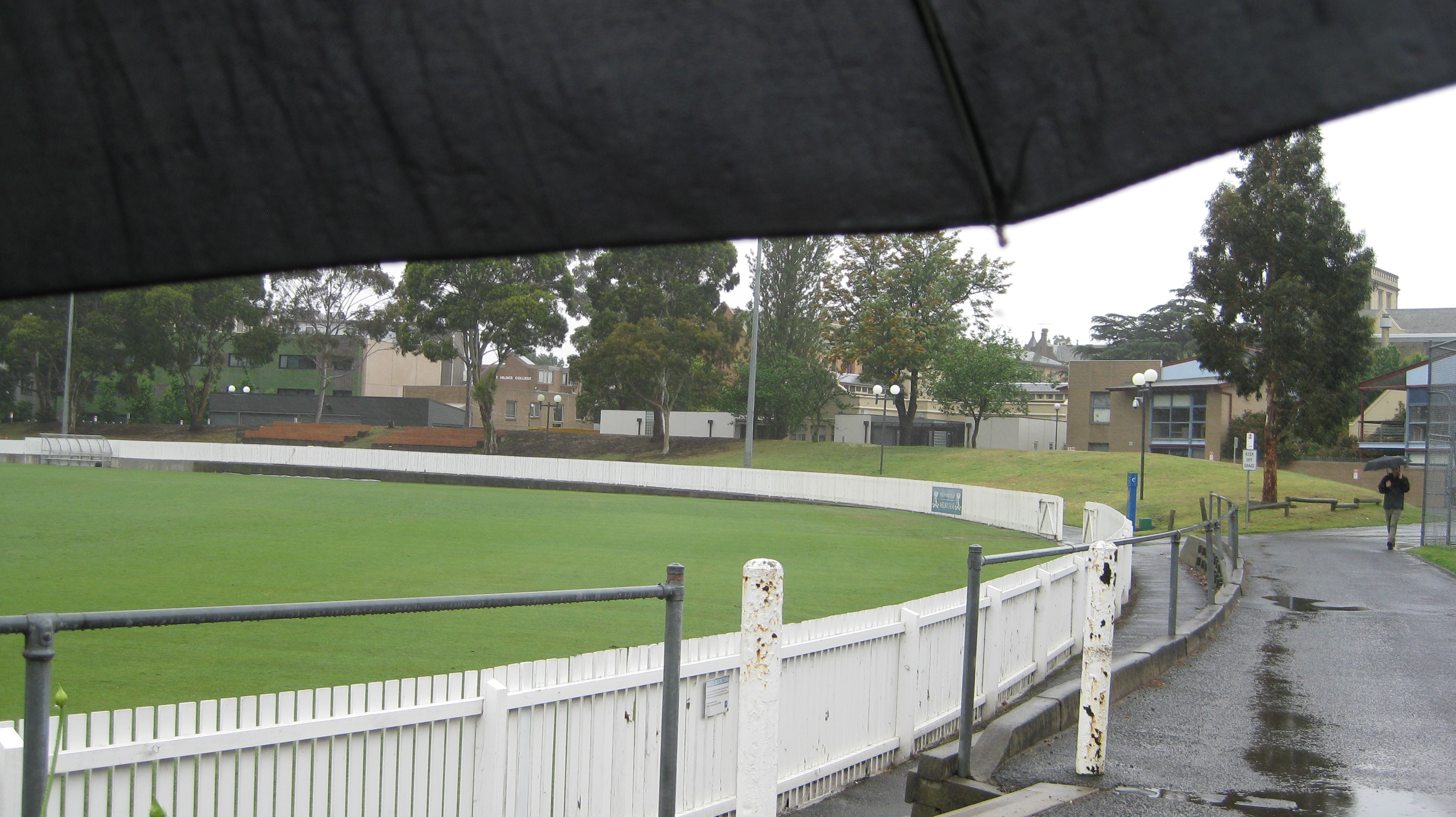
I followed the three
through the gate
past the roadworks
down the track
imagining they led the Way.
They climbed a fence.
I spoke from my side:
“I thought you knew the Way!”
“We know a Way.”
“Oh. Well, I supposed I should follow?”
“Here.  Let us help you.”
Holding my sandwich and handbag
they politely look aside as I clamber
awkwardly to where they are standing.
“A ten for execution?”
We laugh and go On.

Talitha Fraser

139

On the 410 bus…

{for your entertainment, please note that font size denotes volume of the conversation happening on a crowded peak hour bus}

“How old are you?!”

“33”

“What?”

“33”

“Are you married?”

“No.”

“I’m looking for a woman!”

“…spoken for though”

“What?”

“Spoken for.”

“What?”

         “I’m not available!”

(silence)

“You dye your hair.”

“YOU DYE YOUR HAIR?!”

“Yes, yes, I dye it”

“What colour is that?”

“Red.”

“Oh. What colour will you dye it next time?”

“The same.”

“Oh. What colour is it underneath?”

“Blond”

“You follow footy?”

“No.”

“What’s your name?”

“Talitha, what’s yours?”

“Stanley”

#communityengagementinFootscray #onyastanley #thisismystop

welcome


This beautiful artwork is used with permission of  the talented artist Liz Braid www.lizbraid.com

As of April 2014 there are 1138 children in detention in Australia’s detention centres.  It has been hard to know how to respond in the face of Australia’s inhospitable and inhumane policies/treatment of refugees seeking asylum.

Our God is Undocumented, a book by Ched Myers, offers a biblical exegesis for the American context and is drawn on below to consider the Australian context through the use of reflective prayer stations.

map of 006the world – how can we identify with the journey of refugees, pin where we are from, our parents, our grandparents… use different coloured pins {Our God is Undocumented, p.10 “We should never forget that the first immigration “crisis” on this continent came as a result of European colonisation of the Americas. This resulted in three great disasters: the obliteration of First Nations sovereignty and cultures, the violent removal of millions of Africans to the Americas in the slave trade, and the impoverishment of countless people due to relentless resource and labor extraction… poor immigrants today are simply following the trail of wealth stolen from their land centuries ago.}

Australian has its own unreconciled history with its First Nations Koori people.  Koori people have lived on this land for 50,000 years, us white folk less than 250 years.  There is a bit of a “We outnumber you and ours is the dominant culture, why don’t you just assimilate/get with the programme”  Where do we belong? What right did our ancestors have to arrive by boat for resources such as land and gold or to avoid famine?  How can we use our own personal stories/history to develop a sense of compassion for those still arriving today?  As can been seen at the Melbourne Immigration museum there have been waves of refugees from Vietnam, Philippines, Africa (Ethiopian, Eritrean, Sudanese…), Middle East (Iran, Iraq, Lebanon…) – what is the role of Australia in conflict/securing resources in these areas?009

Say (or hear) Lords Prayer together in different languages.  Spirit of Pentecost Acts 2.6,8,11 …in their own tongue. Didn’t all understand Latin/Greek but heard scripture in their own language.   {Our God is Undocumented p.28 “Perhaps it recognises that language is one of the fundamental things that makes us human and that linguistic distinctiveness characterised the original forms of human organisation before the rise of imperial monocultures.  The ancient wisdom preserved in this story reminds us that cultural heterogeneity is as essential to human social ecology as species diversity is to a healthy biosystem… more than 95% of the world’s spoken languages have fewer than 1 million native speakers.  Half of all the languages have fewer than 10,000 speakers.  A quarter of the world’s spoken languages and most of the sign languages have fewer that 1,000 users… It has been estimated that 20-50% of the world’s languages are already moribund, and that 90% (possibly even more) may be moribund or will have disappeared by 2100.”}

Does your congregating community have members from other cultures who attend? If not, why not? What are some ways to acknowledge, celebrate and affirm the cultural differences within our community? Language/stories/songs, festivals, wisdom of prophets/spiritual leaders, colours/fabrics/flags, food at morning tea, clothing… we all of us are made in God’s image – male/female, brown/yellow/black/white, no matter where we’re born. How can we draw on the richness of diversity in the God we worship?

020share communion together {Our God Is Undocumented p. 200 “Remember what has been dismembered.  This exhortation lies at the heart of the church’s eucharistic ritual, repeated with each element for emphasis. It reiterates and sums up the deep wisdom of biblical faith, the product of a people all too familiar with distress, displacements and near disappearance.  Whenever you ingest this memory, said Jesus on the eve of his execution, you join yourselves to our historic struggle to make the broken body whole.  It was, and is, both invitation and imperative, equally personal and political.  If we refuse to heed it, we are doomed to drift forever on or be drowned by the tides of empire, refugees all.”}

This is one loaf of bread. One body.
It’s broken.

As Jesus’ body was broken on the cross for us.

this bit might be me…
this bit might be Jarra…
this bit might be Ahmed…
this bit might be Rajesh…
this bit might be Sam, or Maya, or Bob, or Shirley…

When we eat this bread it is a reminder that we are all part of one whole – we might be a different colour, we might be a different size of a different shape  – but we are all part of the same body… connected.  And we are all of us broken.  In each taking a piece, and eating it at the same time, we are invited back into wholeness with God and012 with each other.

Angels – paper cut out? Something we can take away with us/put somewhere prominant to remind us to welcome the other {Our God Is Undocumented p.67 “…account of the angel travellers similarly attacked in Sodom, a violation that also ended in that city’s destruction (Jgs 19:15-25-Gn 19:1-11). …cautionary tale… “Do not neglect to show hospitality to strangers, for by doing this some have entertained angels without knowing it” (Heb 13:2).

#LoveMakesAWay is a movement of Christians seeking an end to Australia’s inhumane asylum seeker policies through prayer and nonviolent love in action, you can see their Facebook page here.  This is high-level commitment advocacy but there are less “extreme” places to start…

There is an initiative in Switzerland that suggests putting stickers on your mailbox to let your neighbours know what is available to borrow – we used to be able to knock on our neighbours door but nowadays spend more time online than in realtime…

Communities like Urban Seed in Melbourne offer a free meal to those marginalised by homelessness in Melbourne – but here’s the thing, they don’t only offer food to people who are homeless, they offer food to anyone that shows up for lunch as they explore what it means to be good neighbours in a busy city of commuters and extend us the invitation/challenge to do the same through their Strangers Are Fiction campaign.

Who are your neighbours? Do you know their names? What might be one thing you could do that might lead you into connecting with them? [fruit or flowers from the garden you want to share, or baking, maybe you take the initiative to borrow something next time you realise you’re low on milk or the grass is getting tall…] …who knows where this might lead?

Dolls house – have sample forms and invite people to write their own and take them home as a way of symbolically creating space for the other in your home {Our God Is Undocumented p.107 In my fathers house there is lots of room (Jn 14:2)

I went to an art exhibition last week with some art works around the theme of showing welcome to refugees such as that by Liz Braid above – they had some mock forms on the wall that said things like:

ASYLUM SEEKER
PROCESSING FORM

Please come in. What a
terrible journey you’ve had!
I’m so glad you have arrived
safely and to imagine, once
you’re healed, how much you
have to offer us.  Let me help
you with your bags, we’ll have
you unpacked in no time…
You are welcome here. APPROVED

Invite people to write their own words of welcome, take them home and put them in a room of our own house with some intentionality and deliberation – symbolically creating space for the other is a good place to start and this can create some mindfulness to extending hospitality/welcome when an opportunity presents itself.


Anne Lamott has said, “Hope begins in the dark, the stubborn hope that if you just show up and try to do the right thing, the dawn will come.”

Let us hope. Let us try and do the right thing.


“hanging around”

Caught sight of someone “hanging around” our fence, thought “What on earth are they doing?” Sort of bobbing up and down against the fence… moved out of my line of sight so I shrugged and went about my day…

I wandered out the front half an hour later to realise with dismay my bobbing friend was still pacing out the front of our house.

“Hello?” I say, “Are you alright? Do you need any help?”

“Thank you for stopping.  I’m not a bad person. I know how this must look…”

“Where are you going? Do you need anything? Directions?”

“Cigarettes.”

“Oh, I’m sorry I don’t smoke… wait, you want to buy cigarettes? There’s a milk bar just up the road there… where the traffic lights are…”

“Thank you.  Thank you so much for stopping.”

I don’t know what condition he might have that would make him bob up and down or become disorientated. I don’t know if he’d had a serious fall or been beaten or why… I do know we were courteous to one another and it was ‘enough’.

Webinar is available at chedmyers.org but here are some snippets…

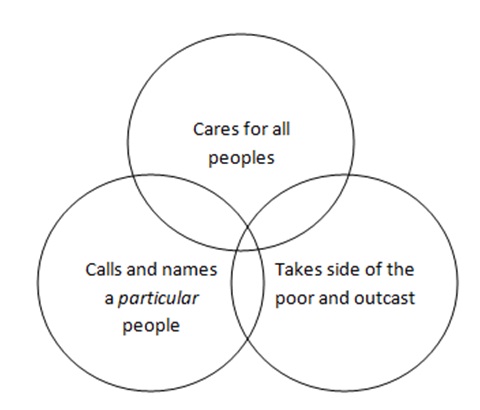
There is a “trialectic” biblical narrative concerning God’s relationship with human beings in the bible.

Image


Jesus embraces all three characteristics: loving both national enemies and intimate betrayers, calling disciples and living among the marginalised.

Isaiah I (Ch. 1-39) Isaiah II (Ch. 40-55) Isaiah III (Ch. 56-66) – different authors.

(p.96-97) But third Isaiah goes on to address specifically those parts of the community that are being legally and socially targeted:

Let not the foreigners say…
Let not the eunuch say…
For this is what God says… (Isaiah 56:3f)

This verse seeks to animate the voices of those who have internalized their rejection by the dominant culture because of how they are perceived and publically caricatured.  “The LORD will surely separate me from his people,” says the inner voice of the foreigner; “I am just a dry tree,” intones the introjected contempt of the eunuch.  Second-class citizens in our own history know all too well this self-hatred.  Black children have tried to scrub their skin white, immigrants have changed their names, women have kept silent, and gays and lesbians have stayed deep in a destructive closet – all to avoid the contempt of a society that barely tolerates them.  Internalised self-negation and external oppression are like a constant  “acid rain”, as psychologist William Grier and Price Cobbs famously put it in their landmark study Black Rage (1968). It is time, says Third Isaiah, for such dehumanisation to stop – because YHWH says otherwise.

What does this mean as a visitor, first-, second-, third-generation Australian?
Reflect on Australian immigration policy and response to “boat people”.
“Reconciliation” with indigenous First People  of these Nations.
Not only called to like pretty/smart/?/people, or people like “us” but specifically to welcome the hungry, the stranger, the ill…
Reflect on this: the maker of the outside also made the inside.

What credit it is it to you to only love those who are like you, to only love those who love you back, to only lend to those from whom you expect repayment – we are called to and Jesus role-modelled generous discipleship.

* I have purchased a copy of this book!

Although technically the SAF event is on this weekend coming up (6-8 May) I hosted one at my house a week early so that Sarah could come – a community friend of mine who will be helping to prepare and serve food to guests this Friday.

I saw Sarah Wednesday and she asked “ooh, is there any chance I could try hangi?”, hmm… once I explained about digging the pit, huge bonfire, volcanic rock etc. it quickly became clear that it wasn’t going to be viable to pull together on short notice but we went with the NZ theme and had NZ cheeses & chutney, kumara & camembert cakes for an entree and salmon for a main with chocolate brownie for dessert (made with Whittakers naturally) and yoghurt flavoured with fijoa and manuka honey to take the edge off… just a little bit fancy!  Complemented by thyme and chillies from our garden – I had been shamefully neglecting my lawn but on the flipside we have three chilli plants! I’m sure if I had known they were there and tried to tend or water them they would have died off early… so procrastination is sometimes rewarded!

Sarah’s daughter Bella had us all drawing and, I will confess, no one resisted terribly hard – it was fun to have an excuse to be creative whether by our own inspiration or Bella’s firm requests! 🙂  Although everyone had pretty much met before, it was great to bring everyone into the room together and have some intentional time to get to know one another better.  From Lyn and Lyds fighting it out over who could go more chillies (those babies are HOT!), to laughing over my serving two types of potatoes with Aly who is Irish and thinks you can never have too many – it was a really fun night.

I guess the aim of these events is about stretching ourselves beyond the circle of who we know and who is familiar and reaching out beyond that circle.  Someone told me yesterday that English is one of the only languages that has the word “perfect” and its surrounding definitions of being very difficult to achieve.  The next closest word in other languages is “whole” – I think there’s something in that… remember, strangers are fiction…

…but it’s broken

A Chinese man with a cane tied my old chest of drawers to his wife for her to carry to their home which I hope was somewhere nearby! I kept repeating “but it’s broken” and he kept repeating “very thank you, very thank you” – a western suburbs multilingual misunderstanding? Or a message of there always being something of value, something that can be put to good purpose, in the broken things – even if we can’t see it…

The other night I went to the 10th Annual Homeless Memorial. Once a year this motley community gathers to remember those ‘streeties’ or ‘parkies’ who have passed away. You can get hot soup, a hot dog, and warm clothes are available to take away. But it is about more than that. We are offered an opportunity to reflect on those people with whom we create connections, those with whom we feel ‘at home’, regardless of any material shelter. We remember those who now or have in the past offered light or warmth to our lives. Voice is given to the pain of separation from parents, siblings, children, society. Voice is given to the pain of decisions that cannot be unmade, things which cannot be unsaid and knowledge that we cannot go back – only forward. A humble gratitude is offered to ‘the people from the organisations represented here’, supported with warm applause from the crowd in and around the marquee.

We sing: songs we all know the words to. We don’t need song sheets. We cradle our lit candles and sprigs of rosemary.

Please swallow your pride
If I have things you need to borrow
For no one can fill those of your needs
That you don’t let show
For it won’t be long
‘Til I’m gonna need
Somebody to lean on


They say we stand for nothing and
There’s no way we ever could

Now we see everything that’s going wrong
With the world and those who lead it
We just feel like we don’t have the means
To rise above and beat it
So we keep waiting
Waiting on the world to change
It’s hard to beat the system
When we’re standing at a distance
So we keep waiting
Waiting on the world to change


We hold a minute’s silence, and it is deep and rich and full. There are names unspoken…tears unshed…and hope unlooked for. We only need to look around to know we are not alone in this grief. We only need to look around to have more than our hunger fed, our coldness clothed… instead we know the truth. We are not strangers to one another as we thought. And a last a cappella chorus rings out…

Amazing Grace, how sweet the sound
That saved a wretch like me
I once was lost but now am found
Was blind but now I see

As I board the tram this morning, jostling for position and validating my ticket I become aware of a man who is obviously upset. His voice loud but incoherent, I can only catch occasional words and phrases; openly weeping he says something about the Japanese and Americans, numbers of people who had died, lamenting “the children… the children…” Some people openly stare, others deliberately looked away, avoiding eye contact.  A child wearing a pink backpack, pink hat and pink scarf burrows her heads into her mother’s side, covering her other ear to block out his voice.  We are all afraid of him; at the very least he makes us uncomfortable.  Why doesn’t he sit quietly and mind his business like everyone else?  There is a hush on the tram and only this elderly mans querulous and confused voice asking “Why?”

I consider engaging him in conversation but a young woman beats me to it… “Hi, I’m here to help you.  Can you lower your voice? Ssh. You’re scaring people.  I am your friend.  What is your name?  Where are you going?”  The man does not know.  The tram has halted and everyone now openly watches the scene unfold.  An older man comes up behind her, backup against the unexpected.  The lights change to red twice, three times, and the elderly man cannot answer the questions.  A police vehicle pulls up at the lights beside us. The older man jumps out and taps on their window, and they pull over.  The woman, his new friend, tells the elderly man some more friends have arrived, they’re going to give him a ride to the city, to come with her.  He is assisted from the tram and led away.

The aberrant element removed, the lights change and our tram moves off, a relieved babbling fills the hush “…must be dementia”,  “I know, my grandfather…” But some are silent witnesses, beginning to end and I wonder whether, like me, they think of how they could or should have responded. Internally, I have a querulous and confused voice that joins in asking “Why?”