

excerpt from Estranged Relatives – Mediation and Nonviolent Direct Action (A Conversation between Ched Myers and Elaine Enns)
excerpt from Estranged Relatives – Mediation and Nonviolent Direct Action (A Conversation between Ched Myers and Elaine Enns)

God
waves crest
and music
a note
calling
see sharp
sweeping
crescendo
builds
and breaks
me
Talitha Fraser

this
a little oasis of
in between
that will not last
a hiatus
a breath
a moment
to be
made and remade
I am
sitting on a little
patch of earth
somewhere between
there and here
thinking
very little of anything
Talitha Fraser
photo source: http://www.eremos.org.au
Late 20th century saw a resurgence of contemplative practice, Merton, Keating, John Main – disciplined practice of silent prayer – waiting on God in deepening receptivity.
Not our own thoughts, even spiritual ones. Contemplative practice is healing for our culture – slowness, connectedness, way/method of prayer – grow into a personal relationship with God. Mystic = personal experience of God. Not a passing emotional state or passed down from leaders. In meditation we verify the truths of our own faith. What can mediation offer to the whole church body? Reconnects to gospel death and resurrection – engaging the decline and disorientation. “Emptiness” in he life of faith. Meditation – laying aside thought and waiting on God – demanding practice. Planning, worrying, daydreaming… need to lay aside self-consciousness itself. Thoughts carry egoic identification with it. Deep subversion of the self. It takes nerve to become quiet. Radical self-forgetting. Described by Cassian – “complete simplicity that demands not less than everything”; Buddhist – “eye that sees everything but not itself”; Main – “hand yourself over and hold nothing back, become self-dispossessed so as to receive our life back as a gift”. Experienced differently as individuals, how will it be experienced as a church? Jesus gives self to God. We claim vocation to be like Christ. Church won’t give it’s life/identity over – seeks to secure its identity – doesn’t like questions or change. Fails to realise the transformation it proclaims. What does ecclesial emptying look like?
liturgy
In ‘Writing the Icon of the Heart’, Ross describes being on a boat surrounded by icebergs and glaciers “stupefied by glory” – went to do communion. Inadequate to where they were. Cup and wine were an intrusion. Would have been okay if reached for our hands in silence or to pass elements but no, pulled out the book and started to read the words I usually loved. Words that shrank rather than grew…Distraction. Not illuminating. Need to get in touch with alienation… playacting. Not in touch with God, or my sin, or grace – went home frustrated.
Liturgy needs to point beyond itself, not be – or try to make itself – at the centre. Needs to emerge from deep listening and pre-packaged agenda is IN the way not OPENING up a way. our lives are already sacred and liturgy tries to remind us of that (doesn’t give us/make us sacred).
Words affect who we are and our becoming – affect our formation. Liturgy can’t be an end to itself. Must be willing to talk about self-dispossession and be willing to be dispossessed… not more relevant or ‘contemporary’ – a liturgy will be effective only insofar as it effaces itself. Every true sign must be self-effacing. Must start in silence and be listening and responding to what is given.
mission
does your church have meetings about getting new people to come and how to make them stay? do we extend good hospitality? is our community growing? sustaining? are we seen as welcoming? are we living up to our own idea of how welcoming we are? Genuine desire to do justice and be justified (confirmed we’re doing the right thing). Self-referencing and self-conscious… self-centred instead of “just”.
Genuine desire to welcome, but also desire to be ‘seen’ as “most inclusive parish” >> this is death dealing. Reassured not to see identity as “good”, give ourselves wholly, handing over ecclesial consciousness instead of wondering how we’re doing it >> get on with it.
Other experiences of Benedictus:
Community made up of secondary teachers (high needs students: drugs), climate change scientists, paediatrician, counsellors, lawyers, healthcare workers… don’t want to take energy from their vocation. Encourage and resource them to do the good work they are already called to… church might not “socially engaged”. Freedom, integrity and passion to love.
Encourage formation in contemplative ways – engage the world in different ways. Reflective peer groups. Signs of life and new ways of being. Relate to unhelpful patterns with awareness. “Why do I have this conversation with my mother every time…” , complaints about work but not making change… structured formation, how can you be liberated? Church calls us to this. Formation… in God’s work in the world, lay formation/lay ministry… not calling people into church building but equipping and sending out. Take these vocations as seriously as it takes its own. Can the church serve people as they serve the world? Not a church trying to preserve its own place and identity. But one that consents to its own self-effacement – we might not know if this group makes a different in individuals visiting once or regulars going back to their work… we might never know. Faithful communities point away from themselves. Well-meaning/patronising/complacent when needing the accolade of knowing the difference its making. Church needs to be faithful to its own vocation, as it discerns.
There is still gender related injustice. Anglican delegation of women in ministry “keep agitating”, lots of energy but little progress. Agitating a sign of false spirit. Agitating is a block to healing – avoiding what was necessary. Stop. Risk being fully present to the worlds pain and our response to it… discern your response out of that. Social action… not saying ‘do nothing’ but Rowan Williams ‘internal contemplation, makes space for truth, for Gods’s reality to come through.’
Depth, broken openness required of us as individuals and communities. Transformation of imagination and relationships – climate change, reconciliation with indigenous, gender… need to become aware of what we resist and fear. Let our hearts break open to receive larger vision. UN: St George slaying the dragon/Isaiah weapons to ploughshares… Leunig does this through prophetic invitation that inspires a bigger imagination.
what can we do?
Prayer of the heart: poverty/listening. Formation/contemplative action. Gift of our present ecclesial circumstances (moments of unintentional contemplation – moment of truth/revelation, stripped of illusion) inner alien and unsettling truth. Discovering ourselves to be less than we thought. Inadequacies. Deprived of familiar comforts – social status, political power… running on empty. Stave off descent into emptiness. What if rather than resisting we embrace the empty space? Disciples – didn’t know what they were hoping for. Poverty o spirit – reaching of our boundaries of being (can’t go on by ourselves) – made bigger. Be with broken-heartedness and poverty… live into the gift of new and expanded life. Not all at once… but little bits.
Need to be adequate to depths of worlds need, let go of limiting identity – let ourselves go – fall empty-handed into the hands of the living God. Follow Jesus into depth of death and chaos.
Anabaptist/Quaker traditions haven’t had the identity/power in the same ways – what can these traditions offer us? Still need to be accountable to self. Still ways to manipulate e.g. silence can be wielded to mean something. Is the leader and the liturgy connected to deep ground? Not about individual preference/styles or arguing against communal worship. Sign is the vehicle that takes us to the encounter.
The church has no place of its own to secure and no need to be defensive.

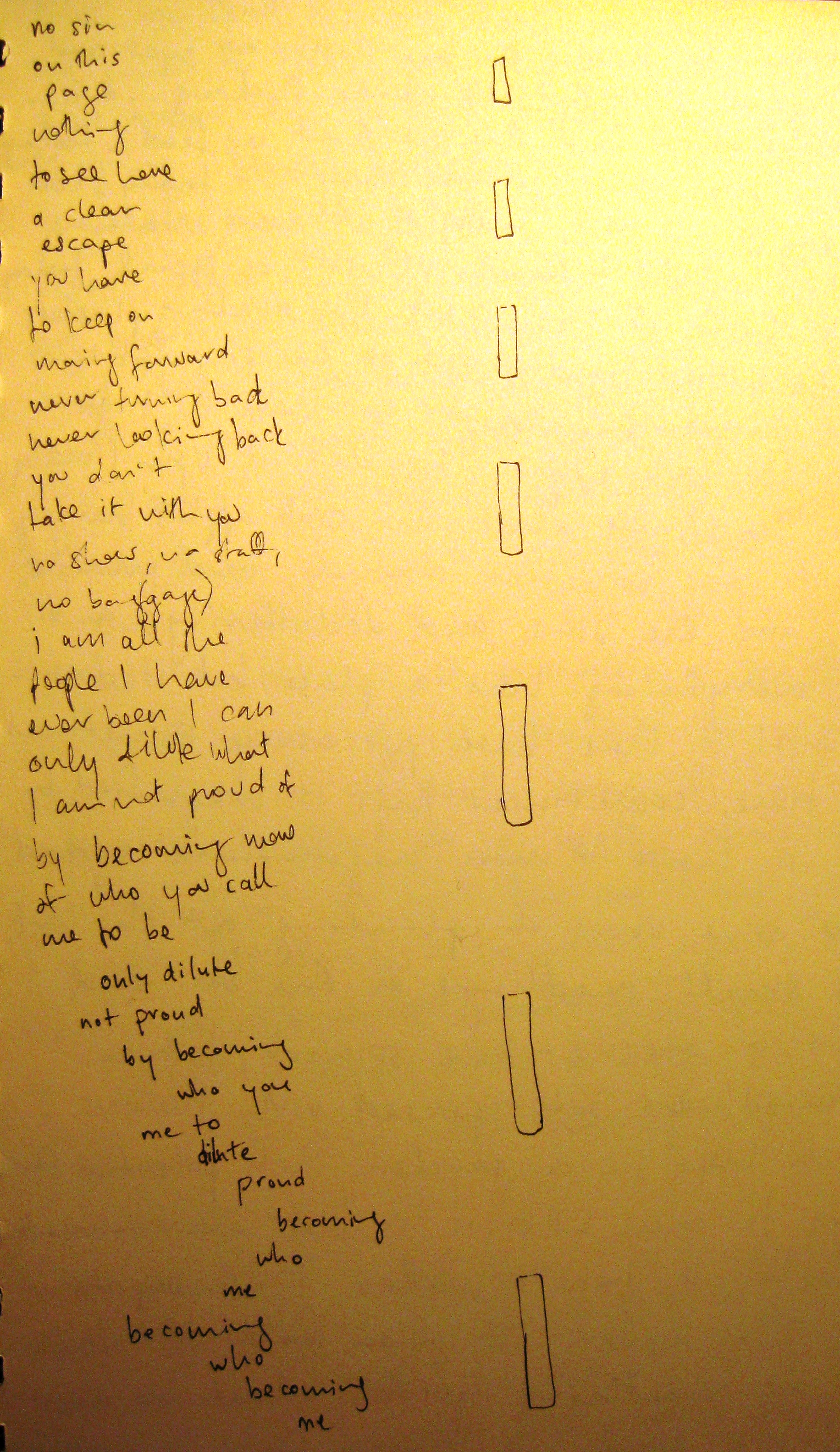
the toast rack of reproach
balefully squats
on the coffee table
that’s really for
tea and hospitality
and other nice things
the crooked bend
of things to do
that Newton’s forces of physics
are required to move
external impetus
gives momentum
the toast is shared out –
refreshments flow.
Talitha Fraser
Talitha Fraser

Andre Gide
THE SPIRITUAL PROBLEM (diagnosed for the Western church)
4 things:
Mystical theology – full acknowledgement of revelation and full acknowledgement of personal experience across all sensory perceiving. Goal to be immersed in God like a drop in an ocean… guiding preoccupation with listening, personal experience of divine love… liberates!
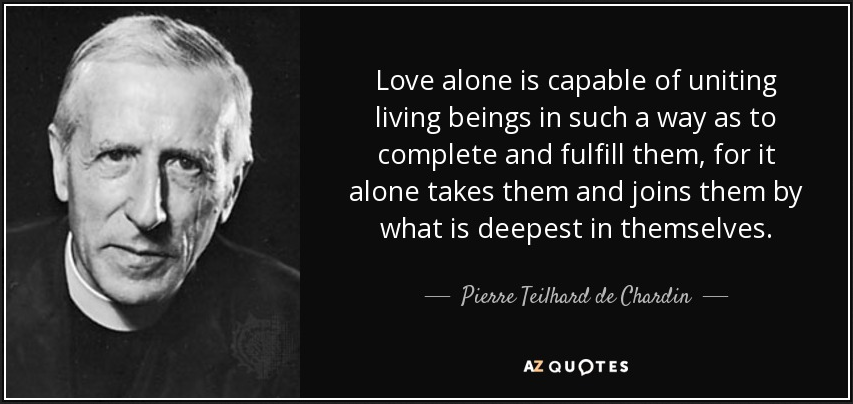
Teilhard was a French palaeontologist and a Jesuit priest > stretcher-bearer “writings in time of war” Gave his spiritual works to a lay woman who published them! Teilhard was deeply distressed by the one sidedness of both science and religion, and by the unnecessary and tragic consequences of their bifurcation. .. devoted equal commitment to internal and external facts. His writing has had a profound effect on 20th century thinking across many disciplines: science, history, international development. Critiques: didn’t engage with other faiths, didn’t go ‘far enough’ into consciousness.
Genesis is an ongoing state of becoming > what is Christs role then? Christ is the driving loving energy of cosmogenesis. Teilhard: looking for Christ the evolver. Not King and Master outsider/adjudicator but Christ who fills and moves all things.
Evolution is the process if suffering > creation is groaning > has casualties. At cosmos and individual level (stars explode and new ones are born).
‘to bear the sins of the guilty world’ means precisely, translated and transposed into terms of cosmogenesis, ‘to bear the weight of a world in a state of evolution. (Christianity and Evolution, p218-219)
The recognition that ‘God cannot create except evolutively’ provides a radical solution… to the problem of evil (which is a direct ‘effect’ of evolution), and at the same time explains the manifest and mysterious association of matter and spirit. (Christianity and Evolution, p179)
Christ must no longer be constitutionally restricted in his operation to a mere ‘redemption’ of our planet. (Christianity and Evolution, p241)
If a Christ is to be completely acceptable as an object of worship, he must be presented as the saviour of the idea and reality of evolution. (Christianity and Evolution, p78)
I can only be saved by becoming one with the universe. (The Heart of Matter, p78)
Development of consciousness – choice and decision-making > ethics
Something is wiped out and something else comes? Way we are broken open that are impelling is to grow. Earthquake – want to hold onto everything, for it to stay the same (building), cosmos says “No”, need to re-build, change, evolve. Progression vs. regression – want to lock it down to earlier ‘known’ state. Christianity wants to find a culprit, aggression and blame with preaching love that does not make sense to people outside the church. Not merely – sin will be made clean but an invitation to participate in the ascent of creation.
Have to experience something that will actually change us.
We are star dust.

Hubble Heritage Team/NASA/ES
“Above all, trust in the slow work of God.
We are quite naturally impatient in everything
to reach the end without delay.
We should like to skip the intermediate stages.
We are impatient of being on the way to something
unknown, something new.
And yet it is the law of all progress
that it is made by passing through
some stages of instability –
and that it may take a very long time.
And so I think it is with you;
your ideas mature gradually – let them grow,
let them shape themselves, without undue haste.
Don’t try to force them on,
as though you could be today what time
(that is to say, grace and circumstances
acting on your own goodwill)
will make of you tomorrow.
Only God could say what this new spirit
gradually forming within you will be.
Give Our Lord the benefit of believing
that his hand is leading you,
and accept the anxiety of feeling yourself
in suspense and incomplete.”
 There is in us an instinct for newness, for renewal, for a liberation of creative power. We seek to awaken in ourselves a force which really changes our lives from within. And yet the same instinct tells us that this change is a recovery of that which is deepest, most original, most personal in ourselves. To be born again is not to become somebody else, but to become ourselves.
~ Thomas Merton



 itellyouarise