Tag Archive: voice


083

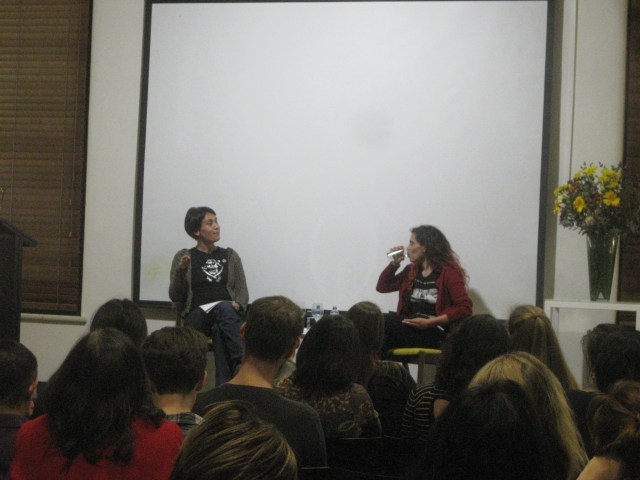
CL: First heard the term “intersectionality” after starting my blog Black Feminist Ranter which ticked several “oppression” boxes. It was a label applied to me to inform a sense of ‘place’. A description of where the intersections of oppression are overlapping. It’s in the feminist sphere that is being played out but dividing and othering instead of being done well. It’s not being used to subvert and challenge systems but by those wanting “ally credit”.

RH: How we use the word… it’s made equivalent to representation e.g. have a quota of female politicians but the systems don’t change. What about sweatshops? What about Western interventions in the Middle East? Supporting Hillary and the first potential female President is great but don’t say “She’s going to be great for all women” – be specific. Say “some of her policies are good” or “Hillary being President will be a good start” but not making sweeping statements like: “What’s good for women is good for all women”, that erases the experience of those her policies don’t benefit.

CL: Why did that election result get pegged on the non-white women? Hate that… everyone asking: Where are the African-American women? Stats show it’s white women that didn’t vote for Hillary.

RH: They had to ask – “Who will be worse?” All minority groups voted for Clinton.

CL: Similar here re Gillard. First Australian Prime Minister – a win for dissecting feminism but she was legislating in NT and making cuts to single mother benefits… I couldn’t fight on those issues because I had to defend on the left re gender.  We are being compromised in these situations.

RH:  Allies need to understand the dilemma and acknowledge it. Intersectional feminism should understand that dilemma but it doesn’t. It needs to acknowledge the reasons others might be unsure and have concerns. For example, media around the Wonder Woman film discussed the Zionist views of the lead actress and called for boycott.  I didn’t advocate for that. It’s only one woman’s opinion.    It should be ok that Arab women might not be able to jump on this empowerment train. Allies need to understand.  There’s a refusal to see.  e.g. “The Wonder Woman character existed long before this actress – the movie’s still worth celebrating!” I was called racist. Intersectionality was used against me… disappointing.  This placed not just Eastern feminism against Western feminism but feminism within the West.  Behind the scenes analysis of the politics what appears and doesn’t is far more interesting to me than the actual movie.

CL: My voice can be sought out to fill a diversity quota.  e.g. speaking on Aboriginal Beauty Pageants – didn’t see celebration of Aboriginal beauty as worth working for (dress, heels, make up…) told I’m denigrating my racial identity. White panellists get slut shaming… called fat… whore… but not racial commentary.

RH: I get racial and gendered criticism. “This Ruby Hamas bitch has both clit-envy and penis-envy” – manages to be offensive on Arabic, Muslim, terrorist, gender – so many layers! I shared it on my page to diffuse it. Not about me but anyone who shares these characteristics.

CL: Comments on how I look, highly gendered, but go back to words like “quadroon”.  I sometimes take the piss or shut it down… I’d like to be called a whore for once and not something that’s dissecting my race! I was on a panel of feminists once – I said something about “smashing systems” in my introductory statements and was sidelined for the rest of the panel – the white feminists talked amongst themselves.  Those that have to navigate gender + race + disability – they are more extreme/radical because they have more to overcome. It was a horrible experience. It was a basic entry-level discussion, why weren’t we part of that conversation? I was only asked for “special comments” re race in the closing questions.

RH:  Any event invitation I receive I’m asking , am I token or not? Do they value my voice and what I have to say? And then I say, whatever… they’re still giving me a platform.  I long for the day I’m asked to talk about politics, and my experience… not as a labelled pigeon-hole “Muslim” or “Aboriginal”.

CL: The person who is Trans and Aboriginal and woman and has a disability and from a low class background… we need to amplify her voice.  Smash at all those levels at once.

RH: If they are liberated, everyone is liberated. “identity politics” shouldn’t set us against but with. I’ve always tried to bring identity politics back to broader oppression.

CL: The show the Handmaids Tale – loved it at first, then I started to see the mainstream reaction.  Women enslaved, bred, imprisoned… with religion used as justification. That was one generation ago for me. Oh, white women are going to be treated like Aboriginal and African-American women. In the book the slaves are unequivocally white, coloured people are shipped off to die from radiation.  Some kudos to the author for sticking to what she knows but in the TV show, in this Fascist, Puritan,  authoritarian world… women of colour are also selected for breeding with wealthy white men and I should believe it?! This is white-washing racial dynamics. “This is just around the corner for us” This white response is not helpful compared to that of people of colour which says: welcome to our world – this has already happened and is happening.

RH: “Can you imagine if there’ll be a war?!” [re Trump/Korea] Yes. I have already lost half my family to that. I don’t need to imagine what that’s like.

CL:  When we are blended into white narrative, we’re not given our own.

RH: Given a female Dr. Who – that was a big deal.  An Arab actor was recently cast to play the leading role in Aladdin. An Arab not in a role as a terrorist or savage illiterate – those roles that have been used to perpetuate negative stereotypes.  Can’t just think about gender (woman as Dr. Who), that an Arab man is cast in the role of Aladdin is far more significant for me.  Is feminism the new weapon of whiteness? We hardly heard anything about that casting at all.

Question: How do you balance the need to be calm to be taken seriously vs. expressing righteous/legitimate anger?

CL: A bit of anger is good, use it to tear the system apart. I have no obligation to make racist, sexist, wealthy people feel safe.  e.g  Heritier Lumumba in doco Fair Game, laughed along with racist insults in the locker room to try and fit in… you never win that way.  We need to use our anger in legitimate and practical ways.

Question: What would your top-three recommended structural interventions be?

CL: I’m part of the union movement. Anything that draws attention to the structural issues.  Intersectional engagement is often superficial.  Highlighting – make sure other voices are heard e.g. An Aboriginal man will have different views than me, or a more conservative woman… there is not one homogenous view for women or for Aboriginal people.

RH: Acknowledge there is a problem.  Still at that level… can’t think of a list of structural changes yet when still trying to get people to acknowledge that there’s a problem. Need to be given power/influence – in media, politics… I guess I’m still trying to find that answer.  I don’t think we’re close to solving that.  Need to see more women from non-white backgrounds opinions valued… to talk in general terms.

Question: Do you have any advice for emerging voices?  How do you decide which point of view will be appropriate to speak from, how do you get past that/prevent silencing?

RH: I didn’t write about anything happening in the Arab/Muslim sphere for ages.  Mortified when something I wrote was appropriated by people who hate me.  I don’t wear a veil but cultural still encouraged to be quiet, modest… I learned to pick a time to broach it. Try to ever do it in a way that isolates Muslims, there’s sexism and racism across all cultures.  I cop a lot of backlash from my community but lovely messages from young Muslim women makes it worthwhile – scarcely – becomes ammunition for racists.  I had to learn that I can’t be responsible for how they use or mis-use my words.

CL: I was terrified to talk about violence against Aboriginal women.  That conversation is used to assimilate to whiteness and religion, a conversation owned by conservative Aboriginal people, for example if I write a piece protesting Dondale and Invasion Day turn around and say “why don’t you care about violence towards Aboriginal women?” Used to indicate that I don’t care.  Exhausting process to do but I counted the numbers over the past two years.  I need to defend space for my own voice. This argument is used to denigrate my other work.


I’m just doing me

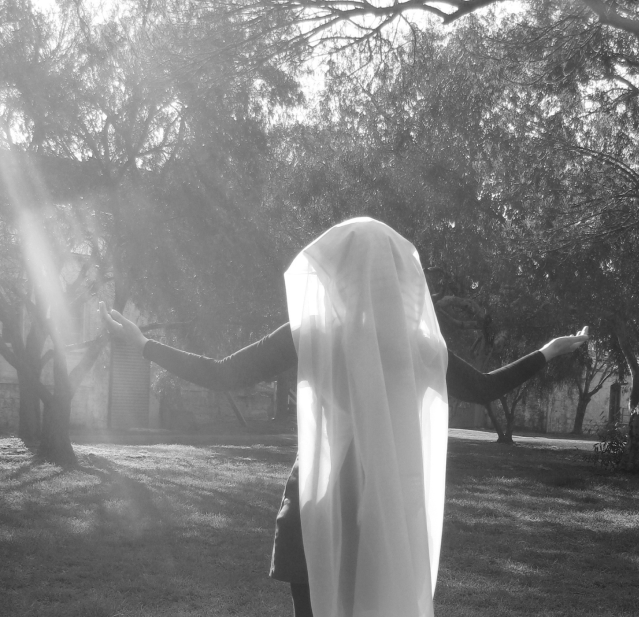
woman in veil bathed in light

Joined with the eternal transcendent
Love forms one with our body.
The humble praxis of my body
saves a seat at the table for You.

I’m just doing me

In wilderness and desert we will make a home
and grow the land of promise where
milk and honey flow.

I’m just doing me

Words of my mouth naming and knowing
because there is one Word, one Body, one Liturgy
for our longing, our life, our love.

I’m just doing me

The Word is being made flesh now
being filled with Divine Breath now and
living that out. Standing here,
with the Other in their otherness,
solidarity affirms life – of others and myself –
thanks to You.

I’m just doing me

Sojourner Truth calls out:
“Ain’t I a Woman?”, “Ain’t I a Woman?”
and the women answer: “YES!”
I am the Other.

I’m just doing me

It doesn’t matter if you’re in the garden or
renovating that old house but that you have that
indoor/outdoor flow calling you to contribute your
best self, calling you to contribute, calling you too…
and you shrug, …whatever

I’m just doing me

Sometimes I wish my eyes hadn’t been opened
But my heart says ‘yes’ and my feet say ‘go’.
In veiled resistance I make you question what
You think you see, what you think you know about me.
My weapon my very invisibility.
I will not conform to your norms or your gaze.
Angels fell and still…

I’m just doing me

Faithful women stand and say:
I have not lost my voice today.

I’m just doing me


Talitha Fraser


A poet-in-residence reflection on some highlights from the Saturday workshop sessions at the “With All Due Respect” conference.

IMG_8209

In July a friend posted a link to this article “Against Self-Criticism: Adam Phillips on How Our Internal Critics Enslave Us, the Stockholm Syndrome of the Superego, and the Power of Multiple Interpretations” – it’s one of those rabbit hole things where you follow links within links to whole other articles… in a good way.  I think I experience some intersectionality in self-criticism being female and having a spirituality that calls me to try and live as a “good” person. Parking tidbits here so I keep thinking about them.

  • what kind of person would your critic be if you met them in person?
    boring? cruel? bully? abusive? would you keep them in your life?
  • if the critic mutilates, deforms, distorts our character… whose voices do you trust to speak to your character? what would you say if it were happening to someone else? what does it look like to defend yourself the way you would defend someone else against this kind of negativity? what techniques do you have for combating the critic when it’s a voice that feels loud?
  • the article refers to this critic as a mechanism of “unrelenting internal violence”. As an advocate of non-violence what tools and techniques are available to you to respond to, engage with and mitigate the impact of the critic?


“…in our capacity for merciless self-criticism. We tend to go far beyond the self-corrective lucidity necessary for improving our shortcomings, instead berating and belittling ourselves for our foibles with a special kind of masochism.”

“In Freud’s vision of things we are, above all, ambivalent animals: wherever we hate, we love; wherever we love, we hate. If someone can satisfy us, they can also frustrate us; and if someone can frustrate us, we always believe that they can satisfy us. We criticize when we are frustrated — or when we are trying to describe our frustration, however obliquely — and praise when we are more satisfied, and vice versa. Ambivalence does not, in the Freudian story, mean mixed feelings, it means opposing feelings… these contradictory feelings are our ‘common source’ they enter into everything we do. They are the medium in which we do everything. We are ambivalent, in Freud’s view, about anything and everything that matters to us; indeed, ambivalence is the way we recognize that someone or something has become significant to us… Where there is devotion there is always protest… where there is trust there is suspicion.”

“You can only understand anything that matters — dreams, neurotic symptoms, literature — by overinterpreting it; by seeing it from different aspects as the product of multiple impulses. Overinterpretation here means not settling for one interpretation, however apparently compelling it is. Indeed, the implication is — and here is Freud’s ongoing suspicion, or ambivalence, about psychoanalysis — that the more persuasive, the more compelling, the more authoritative, the interpretation is, the less credible it is, or should be. The interpretation might be the violent attempt to presume to set a limit where no limit can be set.”

4 – 5 August 2017, the Australian Collaborators in Feminist Theologies curated a symposium to explore feminist theological perspectives on dialogue, disagreement and conflict, as well as the intersections of theology with ethnicity, race, and cultural “norms”. Welcoming international keynote speakers M. Shawn Copeland (Boston College, Boston), Ruth Duck and Cynthia Wilson (both Garrett-Evangelical Theological Seminary, Chicago). 

IMG_7998

Elizabeth Boase

Came up with the topic of this session/panel through an open process of listening… counter-cultural and subversive. How can our medium be our message?

Katherine Massam

“If you persist in your efforts to influence the official church, to become part of its decision-making, you will only break your heart and lose hope. What you must do is go around to the back and CREATE A GARDEN. Some day they will look out and see its beauty and marvel at its life.” – Anne Thurston

See the reality. Patriarchy is real. We can become socialised and complicit. Benefit ourselves from the patriarchal system. It is a personal (individual) and systemic (collective) task to change this. Need to create a new ecosystem that’s collaborative. The top-down systems are easier, faster, feel more efficient… than being collaborative, must choose not to want to replicate or reinforce existing structures.

God comes to us disguised as our lives. #mystics #incarnation.

We must reflect on our experience.  While this can be seen as “pooling our ignorance” or becoming “stuck”. Transformative education should see everyone in the room learning. Teachers and student.

Ref: Pedagogy of the Oppressed – Paulo Freire

Ref: “Aint I a Woman?” speech by Sojourner Truth

4 touchstones:

  • experience, shared
  • reflection, deepended
  • faith, expressed
  • insights, reinforced

Stand and stretch: Open posture = strength and confidence, closed posture = stress.

Tania Wittwer

As a member of committees or commissions work to have more female members.  Not merely top-down leadership but appeal and create opportunities for mediation and consensus decision-making. Create sub/small working groups as an opportunity to develop trust. Coach and support up and sideways. Whiteboard ALL the ideas, then ask: What’s worth fighting over? Headship/submission >> connection to domestic violence.

Deidre Palmer

As a young adult participated in life-giving community and unjust structures.

Ref: In Memory of Her: A Feminist Theological Reconstruction of Christian Origins – Elisabeth Schüssler Fiorenza

Ref: The Church and the Power of the Spirit – Jurgen Moltmann

Church as a liberation community. Non-hierarchal. Acknowledge. Affirm. Name power balances. Job titles reflect the role your play, NOT status.

Changes forged out of pain.Movement of the Holy Spirit, moves toward equality. Apart from and despite the church. Need to partner, be active learners and work with God to mend Creation. Justice is integral to the gospel.  The political is personal. We must raise up those whose voices have been silenced or diminished.

In the Uniting Church, the power is shaped by Councils – not individual but collective.  Rotating and reviewed leadership.  There has been a resistance to structures… making decisions as ‘synods’ and ‘assemblies’ instead of small groups, power-concentrated and speaking for others. There is a commitment to keep our foundations broad and have full participation. Individual voices and gifts are affirmed within the collective.

Look around and ask: where are the places and spaces where things are working well now? What makes them different? How do you resist? What does formation look like there?

In-table discussions: We extend the metaphor – first woman makes a garden (outside patriarchal systems), second woman dwells in the house trying to renovate it while it’s inhabited (working within patriarchal systems) third woman describes open-plan design with indoor/outdoor flow (something that combines both elements)… sometimes easier to know what your role is, to resist/advocate/speak-up when working within the patriarchal system.


Poem: I put my piece of truth – Talitha Fraser


People of Colour @ Australian Collaborators in Feminist Theologies – Seforosa Carroll

Yesterday there was a separate gathering for Aboriginal and those identifying as People of Colour.  Acknowledge the paradox of this: the need to have a gathering separate from this one (not participating) and being allowed to gather separately (so valued that this is resourced however is needed).

Last year was the inaugural gathering of this group and there were perhaps 3 POK here. This year that is more like 20. Want to acknowledge what has gone into that increase. While there is interest in our theologies and our feminist theologies – this is not the platform where we can discern what that is for us – we want other space.  We want to encourage and mentor POK women to do papers.  We think our creativity and cultural epistemology have something to contribute. We want to do our own work to grow, to develop our confidence and voice… down the track we hope to then be able to share that in this space. To come together and find comfort en masse.

We each have a uniqueness in God – that uniqueness celebrates and glorifies God. We don’t meet separately to ‘keep ourselves apart’ but to move from what is common to what we can say about our difference – in this way we can learn from each other and keep our identity – Adele Ventris

IMG_8041

Africana Womanist Theology: A Hermeneutic of Suspicion and Hope – Rev. Cynthia Wilson

The marginalised bring their hermeneutic to their marginalised space.

Born in New Orleans: black, woman, pastors kid, one of six children (only girl). Had to figure it out for myself.  This was in some ways insulated because my brothers and father were protective but I feared for the men’s lives daily in the bayou and cypress trees where black bodies swung.  I sang because I wanted to cry out for life for my brothers.  The dark cloud hanging overhead was overcome through song… Holy Ghost will not descend without a song.  African proverb: When you sing, you pray twice.

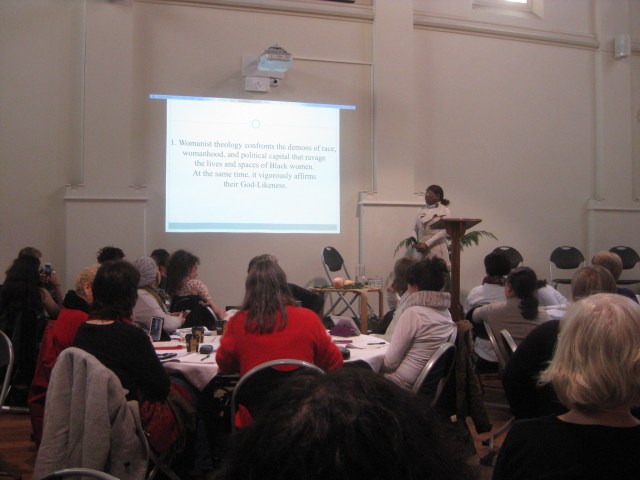
  1. Womanist Theology confronts the demons of race, womanhood, and political capital that ravage the lives and spaces of Black women. At the same time, it vigorously affirms their God-likeness.
  2. Womanist Theology acknowledges, affirms and critiques the attributes of their faith community, the church and beyond.
  3. Womanist Theology seeks to call into question forces that suppress Black women’s voices while investigating certain epistemological presuppositions.
  4. Womanist Theology interrogates the theology of Black males, replacing it with more inclusive, liberating reconstruction of knowledge and authority.
  5. Womanist Theology utilizes an anthropological and dialogical method utilizing the following sources: personal narratives, domestic violence, psychological trauma, womanist ethnography, and syncretistic religiosity, real life stories of poor/Africana women, and other women of colour throughout the world.
  6. Womanist Theology turns up the volume of voices that are illiterate, economically deprived, that hold the environment in high regard, and that are typically ignored by this 21st century capitalist world.
  7. Womanist Theology re-kindles AND validates Africana women ancestors through Ritual “Re”-membrance.

UBUNTU “I am because you are.”

SAWABONO “I see you.”

Personal pronouns don’t function he/she, me/you but are grounded in the universal “we”.

Eschatological hope, although sometimes I wish my eyes hadn’t been opened, “my heart says yes and my feet say Go!“…someday we will be the free people we were created to be.

IMG_8058

Veiled Resistance: The Cognitive Dissonance of Vision in Genesis 38 – Carolyn Alsen

Helpful if you read Psalm 38 for context

Wearing a veil is seen as touching on two issues gender domination/headship and ethnicity. Wearing a veil is carrying these dual layers and wearers are doubly ‘colonised’. Who is the ‘ideal reader’ that Genesis 38 is written for? …white, Israelite, male?

Tamar, through choosing her clothes, can identify as “foreign woman” or “Israelite woman” and as widowed or prostitute.  There are social and cultural norms about how she is seen and not seen according to what she is wearing. Reading through the passage: who sees and doesn’t see her? In this story Tamar employs the conforming veil as an act of resistance.

Woman using perceptions of the veil as a weapons is still happening now > suicide bombers in Nigeria.

To wear a veil meant you were upper-class and married. If you wore them when you weren’t these things > punishable offence.

The Bible mistranslates “temple officiates” as “temple prostitutes”

zonar (gendered) social position of women (or subordinated men) when they sell sex.

hatas’if, veil (non-gendered) take off, wrap up, cover, put on.

Is it to be punished for the wrong use? Or is it normative use?
Licit – accepted socially but not morally vs. deviant.

        Remove widows garments :: have meeting in veil :: put on widows garments again.
could get in trouble
(tribe)

what is seen and not seen?
‘gaze’ and ‘identity’

– what is going on between how others see Tamar and how she sees herself?

Law-keeping ?          Law-breaking?
Israelite?                    Canaanite?
Solidarity/priest       Othering “zonah” fetishcised

Unresolvable.  Ambiguity of identity contrasted with public visibility.

Hera and Judah have different opinions of Tamar – who’s right or who’s wrong? Is Tamar both?

IMG_7996

“Because of the Angels”: The Unveiling of Women and the Body Politic – Sally Douglas

Helpful if you read 1 Cor 11:1-10 for context

Paul gives three reasons why women should have their heads covered:

  • inferiority
  • cultural norms
  • “because of the angels”

“The angels” refers here to those evil angels fallen from the Heavenly Court who rape and wreak havoc. (Gal 1:8) Enochian angels fell from heaven for women “going to them”. The consequences of this rape ruined men, women and the earth… > gave birth to giants >responsible for evil in the world. Killed in the Flood but spirits stay on the earth. Rise up against women and children because they come from them >>climate change.

Veiling is a source of conflict.

Try saying it’s down to individual choice but that seems insufficient. Still perceived that it stops a woman’s flourishing and personhood. The “malevolent constructed male gaze” exists to the detriment of women AND men. As objects of male desire we can reduce the risk from male gaze by altering our dress/wearing veil.

Irony – genital mutilation – advocate in the east but it’s happening in the west.

Commodity either way.  A woman might well feel liberated by wearing a veil or genital mutilation, not arguing that, but dehumanising malevolent constructed male gaze needs to be named and called out. What might safe-guard women now?

If the gaze of Christ is given precedence. Not the white skin, blue eyed, blond, pretty Jesus but the One, Cosmic, Sophia… that nourishes. 2 Cor 3: Veiling and unveiling of Moses. Collective language, shared experience and ongoing.

13 We are not like Moses, who would put a veil over his face to prevent the Israelites from seeing the end of what was passing away. 14 But their minds were made dull, for to this day the same veil remains when the old covenant is read. It has not been removed, because only in Christ is it taken away.15 Even to this day when Moses is read, a veil covers their hearts. 16 But whenever anyone turns to the Lord, the veil is taken away. 17 Now the Lord is the Spirit, and where the Spirit of the Lord is, there is freedom.18 And we all, who with unveiled faces contemplate[a] the Lord’s glory, are being transformed into his image with ever-increasing glory, which comes from the Lord, who is the Spirit. (2 Cor 3)

2 Cor 4: Mystical gaze of Jesus, we are gazed upon, encounter Divine, are changed.

And even if our gospel is veiled, it is veiled to those who are perishing. The god of this age has blinded the minds of unbelievers, so that they cannot see the light of the gospel that displays the glory of Christ, who is the image of God. For what we preach is not ourselves, but Jesus Christ as Lord, and ourselves as your servants for Jesus’ sake. For God, who said, “Let light shine out of darkness,”[a] made his light shine in our hearts to give us the light of the knowledge of God’s glory displayed in the face of Christ…. 18 So we fix our eyes not on what is seen, but on what is unseen, since what is seen is temporary, but what is unseen is eternal.

The same lens through which we see God, each other and ourselves can give us freedom. In this gaze we can be liberated from the power of all other gazes. There is an invitation and provocation in that.
We are given a choice – not controlled or influenced by nor in resistance to. We are all beloved subjects of the Divine.

Exorcism is for victims.  Not much about evil spirits in the Old Testament but then in the New Testament – boom!

IMG_8064

Hillary, Shame and Psalm 71 – Michelle Eastwood

Hillary Rodham Clinton 1975 m. Bill Clinton, 1980 had daughter Chelsea, 1993 First Lady.
BA and Yale Law.  Awarded “Most Admired Woman” 20 times altogether and 14 years in a row.

Moses vs. Aaron and Miriam – cloud makes, only, Miriam leprous. Only woman is affected. Author trying to minimise her leadership.

Abortion reduces both maternal and infant mortality. Hillary grilled for her position. Evangelical Christian Right’s perception is that bible gender roles are under attack (by feminists for their own power and glory), values compromised, slippery slope to decline of the world as we know it.

Bill’s infidelity held against Hillary… didn’t handle it well, misogyny, sexism…

Helpful if you read Psalm 71 for context

Psalm 71 is a song of lament and a cry for justice.  Women are shamed a lot in the Bible.  In this passage shame is shifted to dealers. v7 I have been a portent (faithfulness) v18 grey hairs (Hillary still stands, a testament to those who have tried to shame her). The shame is not destroyed but displaced. Evangelical Christian Right their own undoing > Trump. In the gospels Jesus is shamed – a sense we become more godly through experiencing shame.

IMG_7531

IMG_6851

Ethnic church:

  • challenges for the younger generation
  • parents history
  • ethnic culture and values
  • links to culture and religion
  • evangelism and discipleship approach – believe need to be saved rather than a gracious understanding of faith and relationship with God
  • parents acculturation response
  • younger generation’s experiences with culture, identity and belonging

What was/is your experience of ethnic church or the first time you experienced being it as ‘different’?

~ Confucius quotes ~ learning memory verses ~ emphasis on listening to your elders (honour your mother and father) ~ formal dress = not refugees, we will dress well to reflect our new status ~ a successful look synonymous with a Western look ~ In India we would dress nicely for church but here in Australia no, I’m daggy when I go back! ~ 

Berry’s Acculturation Model

In transition between old culture to new people will typically have one of 4 main responses:


Marginalisation {not identifying with the host culture}

Assimilation {absorbed into the new culture}

Integration {previous culture maintained and participate in the new culture}

Separation {previous culture maintained and new culture rejected}


This is frequently a zero-sum game – how do we forge new opportunities?

When did you first experience race?

~ moving from one country to another: Philippines to India, then to Oz ~ excursion protocol – don’t know what’s happening (have to learn) ~ sports team – they wouldn’t pass the ball to me ~ not around coloured people until Uni, grew up in a white neighbourhood ~ First day of Year 1, got asked: “Where are you from?” …I was born in this town, I’d never had a sense of being from somewhere else! ~ Broke up with my boyfriend and got called “Ching chong” and told to “go back to where you came from” ~

What is race?

  1. Arbitrary system of classification
  2. Hierarchal system (superior and inferior)
  3. Naturalise and make the system the norm, make invisible the effects e.g. denial of rights, wealth and resource distribution

Transmission of these ideas about race occur in representation and are reiterated until ‘race’ becomes  realities. eg. if pen (object) and writing (concept) communicated through language – the pen (signifier) therefore the meaning becomes attached to the object.

Media perpetuates these myths/representations e.g Vietnamese community treating international students badly that work in their restaurants, Vietnamese community wasn’t consulted or invited to speak to the issue > don’t get to choose the story that gets told about our community.

Who do you identify as?

 ~ I call myself second generation Korean but I don’t like it when others do it (bring what they think that means) ~ pass… Australian… Child of God ~ Child of God first, Vietnamese and Australian ~ NZ European/Pakeha and Maori (Ngai Tahu) claim this when it feels like it’s a benefit eg. Maori electoral roll >representation in NZ Parliament but not to claim/take anything ~ Indian-Australian (rejection of Indian culture, don’t know enough about culture & history) ~ Australian/Filipino – never one or the other ~

Ref: The Whiteness Project (youtube)

Ref: Race the Power of an Illusion (documentary)

Johann Blumenbach came up with the categories:

Caucasian – white
Mongolian – yellow
Malayan – brown
Ethiopian – black

Rev James Black Roland: “Let us keep before us the noble ideal of white Australia, a snow white if you will. Let us be pure and spotless.”

How does ‘whiteness’ function in your life? (personally, professionally, at church…?)

~ my workplace, need representation of other people of colour on the Council ~ white, straight hair, feminine = beautiful. Tried to be something I’m not eg. Jonah from Tonga show ~ Safest I’ve ever been. Can figure out what “Indian” means for me ~feel the poverty of being ‘stuck’ with white people – established systems and processes both at work and in community ~ Party culture – don’t fit in. Assimilated Asians treat me badly. Need to be funny, out-spoken, tell stories… church is accommodating > understand each others brokenness. Asian guy – Maths or The Hangover archetypes ~ “If you want to be competitive with white people you need to overachieve” (YES from the group) became my coping mechanism.  Colonised at home/church, assume you’re assimilated and it’s used against you.  Have learnt now to feel more comfortable there (white space than I do within my own cultural community). Jarring moments of being brought to awareness of your non-whiteness eg. insult calling based on colour (school had felt like safe space until then) ~

Operating across a lot of levels: personal/institutional/systemic…
how do we develop racial literacy?

IMG_6290

You can buy artworks by Abbas Al Aboudi here. Abbas does original works or can replicate your favourite photo… Below is a bit about Aboudi’s life and where this image came from. I asked for a copy of this, an image previously painted, because living through these times I wanted to capture something by asylum seekers for asylum seekers that speaks in their own voice to their own experience of these times. Also, because something of the image speaks to my own journey of starting to write/find my voice.

Painting a lifeline

Turning to art in desperation, he has discovered a way of processing the trauma and depression that threatened to engulf him. Exhibiting daring colour sense, he creates works that are fresh and haunting. One picture shows Aboudi′s handcuffed hands holding a pencil and references the humiliation he experienced while still a resident of the camp.

An Australian refugee advocate had sent him some painting supplies. When he went to pick them up from the parcel delivery centre, the camp guards would not let him back in with them. His pleas falling on deaf ears, Aboudi was at least able to secrete his supplies in a hiding place outside the camp. Later a sympathetic guard helped him smuggle them in. Others depict the despair and hopelessness which is the daily bread of asylum seekers on Nauru. Most of the refugees, including Al Aboudi, can’t return to their countries of origin for fear of persecution and Australia doesn’t allow any refugees into the country who arrived by boat post-July 2013. For many, the future looks bleak.

A glimmer of hope

Al Aboudi, who recently celebrated his twenty-eighth birthday in austere conditions, cracks a shy smile. About a month ago, he was asked by the contracting company that runs the Nauru detention centre whether he would like to be resettled in the United States. Three hours of thorough vetting and several weeks later and still no word.

All Abbas Al Aboudi can do is paint and hope.

My Art is My Saviour, Qantara.de, March 2017

Demonstrators in Australia held paintings by Alaboudi in August this year [2016] during nationwide protests urging the government to end offshore detention of refugees.

Alaboudi was heartened by this use of his canvases, which depict the conditions faced by refugees, such as a child behind bars and a portrait of Omid Masoumali, an Iranian who burnt himself alive on Nauru in May.

The Madness is Eating Us Alive, South China Morning Post, Oct 2016


IMG_4684

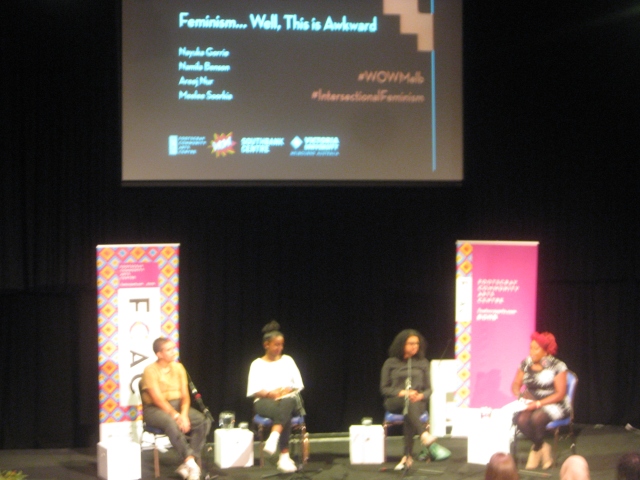
Panel: Nayuka Gorrie, Areej Nur, Meelee Soorkia, Namila Benson


I wrote a book. It brought together other women like me.
I was not ‘other’ anymore.

Meelee Sorkia

Those pink pussy beanies at the Women’s March,
as a black, trans, feminist – what is my “in”?
White women can assume they’re your ally
but I might identify with other labels more.

Nayuka Gorrie

There is such silencing and erasure of women of colour.
Constantly thinking about ‘how do I put myself forward’ in a space?

Namila Benson

There a tenets of of feminism that are important.  Living that and being active in it is really important. We need paid opportunities, spaces that are ‘ours’ to help others out – support, build up, encourage other women of colour. Building and supporting other women in my community is my priority. I’m not interested in helping white women.

Areej Nur

Do the work.  What role do you have?
What opportunities do you have that other women don’t?
Please be self aware.

Meelee Sorkia

Just listening instead of defensive, derailing, silencing. Take up the generous labour of being in the space. Take advantage of the chance to learn something. Know your place. That’s it: Listening and give space. It’s fatiguing [to keep explaining].

Namila Benson

IMG_4655

IMG_4687 - Copy

JUDE KELLY

My grandmother did two things for me: let me use teatowels as costumes (we had no dress-up box) and encouraged my singing… she taught me that I was entitled to dreams and hopes and that those hopes and dreams were valid.

What have we done to make the
umbilical cord of history so thin?
[of voice/story]

We have a WOW because we want to celebrate what women are doing.
It starts with a “Think In” – what does WOW look like where you are?
They are a network of caring.  Two things you can say about women:
they are tired and they’re frightened.

When Somaliland’s First Lady wanted to
build a maternity hospital
the builders said they didn’t have time.
She answered: “Teach me to make a brick”.

IMG_4691 - Copy

HANA ASSAFIRI

Social justice is not discretionary.

The future is ours to make.

Intersectionality is embodied in the margins.
Social context, empowerment, employment and education
are where social change meets intersectionality in a practical way.

Where we feel an intuitive connection
we have an intuitive intelligence. We need
to back ourselves on what we feel and what we know.

Communities are strengthened through diversity.

IMG_4692 - Copy

MARIA KATSONIS

“We tell ourselves stories in order to live” – Joan Didion

I have to be authentic to who I am.

The nature of my ambition has changed.
I believe in the power of one to affect social change.

IMG_4696 - Copy

TANIA CANAS

We are theory and theory is ours.
Arts, politics… theory is everyday life.

Education in Australia separated self and theory.  
Theory became externalised from the body.
It went from everywhere to nowhere.
Not ‘by us’ but ‘to us’. Not changing, but static.
Institution imposed a hierarchy of knowledge.
The indigenous people of Central America knew  astrology, geography, how to make chocolate.  They wrote in hieroglyphics and were writers, philosophers, theorists… there has been a genocide of knowledge = epistemicide.
They have colonised not just our bodies but our minds.

In my culture, cooking is at the centre of community.
With white feminism – I didn’t want to learn my mother’s cooking.
Now I am looking to bruja feminism, because the white feminism didn’t
acknowledge my ancestors, my mother or the role of hospitality as resistance – my mother cooked for the group that met at the house.

Not buried, didn’t die, not lost –
these ways of knowing are resistance.

It’s not known or recognised how strong women of colour are.
You will be marginalised: you need to ask:
will I notice, will I do something?

It’s hard. That’s why we need you to be there.

Research is embodied.  We write struggle.
When we theorise, we write with our bodies.
To write/use a theory, you need to embody it. Resist epistemicide.  
You write and exist in the in-between. Don’t lose yourself.