Tag Archive: voice


Gilead I

p.34-35200px-Gileadcover

She makes an unlikely preacher’s wife.  She says so herself.  But she never flinches from any of it.  Mary Magdalene probably made an occasional casserole, whatever the ancient equivalent might have been… I mean only respect when I say your mother has always struck me as someone with whom the lord might have chosen to spend some part of His Mortal time… There is an earned innocence, I believe, which is as much to be honoured as the innocence of children… When the Lord says you must ‘become as one of these little ones’ , I take Him to mean you must be stripped of all the accretions of smugness and pretense and triviality.  “Naked I came out of my mother’s womb’, and so on… It has pleased me when I have thought your mother felt at home in the world, even momentarily.  At peace in it, I should say, because I believe her familiarity with the world may be much deeper than mine.  I do truly wish I had the means to spare you the slightest acquaintance with that very poverty the Lord Himself blessed by word and example… still it shames me to think that I will leave you and your mother so naked to the world – dear Lord, I think, spare them that blessing.


p.45

I get much more respect than I deserve.  This seems harmless enough in most cases.  People want to respect the pastor and I’m not going to interfere with that. But I’ve developed a great reputation for wisdom by ordering more books that I ever had time to read, and reading more books, by far, than I learned anything useful from except, of course, some very tedious gentlemen have written books.  This is not a new insight, but the truth of it is something you have to experience to fully grasp.

                                Thank God for them all, of course, and for that strange interval, which was most of my life, when I read out of loneliness, and when bad company was much better than no company.  You can love a bad book for its haplessness or pomposity or gall, if you have that starvling appetite for things human, which I devoutly hope you will never have.  ‘The full soul loatheth an honeycomb; but to the hungry soul every bitter thing is sweet.’ There are pleasures to be found where you would never look for them.

 p.51

A good sermon is one side of a passionate conversation.  It has to be heard in that way.  There are three parties to it, of course, but so are there to even the most private thought – the self that yields the thought, the self that acknowledges and in some way responds to the thought, and the Lord.  That is a remarkable thing to consider.

p. 54-55

I read somewhere that a thing that does not exist in relation to anything else cannot itself be said to exist.  I can’t quite see the meaning of a statement so purely hypothetical as this, though I may simply lack understanding… My grandfather had nowhere to spend his courage, no way to feel it in himself.  That was a great pity.

…I can’t tell you though, how I felt, walking alon

g beside him [my father] that night, along the rutted road, through that empty world – what a sweet strength I felt, in him, and in myself, and all around us.  I am glad I didn’t understand, because I have rarely felt joy like that, and assurance.

protest

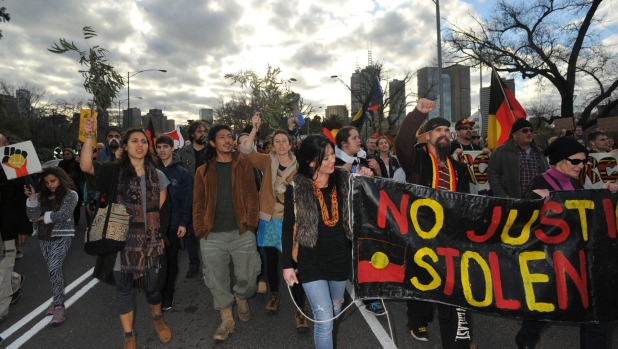
Protesters make their way across Princes Bridge. Photo: Joe Armao

This month the Government announced that they were going to turn off/stop maintaining access to water, electricity, etc. in multiple rural indigenous communities and this protest came very quickly in response.  We like to think that “taking the land away” or dispossession was something that happened long ago and far away and has nothing to do with me but then something like this happens to bring it front and centre and our willful blindness is confronted by the reality: this is still an issue and it is still happening.

These are the words the protestors called in chorus:

“Always was, always will be, Aboriginal land”

Talk to me about economics. Talk to me about closing the supermarket so people had to travel for food, closing the school so families with children had to travel or move, talk to me about closing the petrol station – it might be true that some of these communities have only 4 people living in them but there used to be many more.

“Always was, always will be, Aboriginal land”

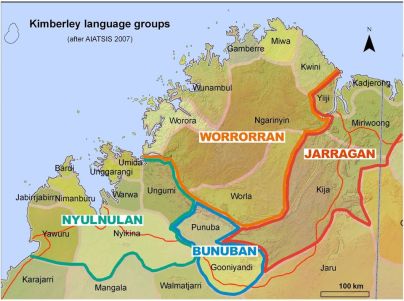
Talk to me about land and place.  There’s hardly any of them, why should they get special treatment? They can move to the nearest big town… to give you a sense of scale Kimberley is c. 3 times the size of England and has a population of 40-50K people.  The nearest town is, well, pretty darn far away – what we white fullas can forget is that indigenous Australia is a lot kimberleymore like Europe, made up of many different countries with their own language, and myths, and dances and traditions… this map on the left is rough overview of the First Nations Peoples and language groups in Kimberley.  This is their map of how they see the world –  we wouldn’t expect it to be reasonable to ask the Italians to move to the nearest town in France and give up everything that informs their own unique culture and identity and we should not ask it of Aboriginal people here either.

photo credit: kimberleyfoundation.org.au

“Always was, always will be, Aboriginal land”

Talk to me about civilisation.  We brought civilisation with us, did we not?  Are these people not better off because we bought them farming and livestock and tools and machinery they didn’t have before?  We brought in the piped water and wired electricity and overrode the old ways with our better new ways…?  There might not be many left who remember and could live by the old ways.  We’ve created a dependence and now you want to take the civilisation away? Did our civilisation include the law, and does the law include provision for human rights like access to water?  What is civilisation?

“Always was, always will be, Aboriginal land”IMG_5269

Tell me a story.  Tell me who your people are and where you are from.

At the start of some (too few) events, ceremonies or proceedings you might hear an Acknowledgement of Country… We acknowledge that we gather on the land of which the Peoples of the Kulin Nations have been custodians since time immemorial.  I went to a cultural awareness training day with Aunty Doreen Garvey-Wandin a few years ago and she did this activity with sticky dots to illustrate how Aboriginal people have lived here for 50,000 years – if each dot is equivalent to 1,000 years – then this black drawing, on the very last dot, represents the 200 years of contact/settlement with us white fellas.  We are a blip on a landscape that was here long before we came.  We need to understand and be reminded of our place in the story of things from Aboriginal peoples point of view. While, I’m here I’ll point out that this is what makes “Australia Day” also so hard.  It marks (and celebrates) the anniversary of colonisation over the culture that had existed here many thousands of years prior.  These acknowledgements should not be empty words.  We eat, we play, we gather, we work – on land where indigenous people were here before us – doing those things first – for many, many years.

“Always was, always will be, Aboriginal land”

Talk to me about belonging.  Do we “belong” here?  I think there is something in the psyche of all of us asking this question because at some level, perhaps we sense the truth of having displaced others to enjoy the space we now hold.  I am from New Zealand, and we have our own history and yet unfolding story of fair trade for land, foreshores and fish – and who should be the custodians of these things.  We need to respect Traditionally Acquired Knowledge more than we do because people lived and ate seasonably and sustainably and can probably teach us a thing or two about living well in this climate and speak wisely into other current social issues.  Do I belong here in this crowd? It can be easy to feel smug – Maori is taught in our schools, we had a treaty and are hearing settlement claims, we have a Ministry for Maori Development… but that is not enough: Te Whiti, a Maori Chieftain, exhorts us to “Ask that mountain” – the land itself bears 076witness to what takes place beyond any particular action of my lifetime whether we have done everything that we can to make things right.  How might the Great Barrier Reef answer? Or Uluru? or The Big Pit in Kalgoorlie? I was proud to see the Maori flag raised and carried alongside the Aboriginal flag in solidarity.  Others who have experienced displacement themselves – they do not forget.  We need to recognise that living in a world that has more languages, more dances, more patterns, more stories makes it a more enriching place for all of us and is worth protecting and defending by us all.

We chant it together.  We claim and proclaim it publicly:

“Always was, always will be, Aboriginal land”

“When you haven’t got a homeland or place to go, you lose your identity,and personality and you become sick.
Where are these communities going to go?”

Indigenous activist, Rieo Ellis

Thanks to ANTaR for this summary of the issue:

Announcement to discontinue funding essential services in remote communities

  • In September 2014 the Federal Government announced that it would no longer fund essential municipal services including supply of power, water, and management of infrastructure in remote Aboriginal communities in Queensland, Victoria, NSW, Western Australia, and Tasmania, despite having done so for decades.
  • The South Australian government refused to sign an agreement, and the Western Australian government signed an agreement with the Federal Government for funding of $90 million which would fund services until June 2016.
  • The WA government announced that it would not pick up the bill beyond that time and would instead close between 100 and 150 of the 274 remote Aboriginal communities in the state.
  • The decisions by both the Federal and the State Governments occurred without any consultation with Aboriginal people in the affected communities.

How many people live in these communities

According to the WA Department of Aboriginal Affairs, there are around 12,000 Aboriginal people currently living in the 274 communities in WA, with around 1,300 living in 174 of the smallest. In 115 of those communities, there are around 500 people in total, or an average of 4.4 people per community.

What will the impact be of shutting down communities

Premier Barnett himself acknowledged that closing communities would:

“…cause great distress to Aboriginal people who will move, it will cause issues in regional towns as Aboriginal people move into them.”

Professor Patrick Dodson, Yawuru man from the Kimberley, who authored a review of small homeland communities for the NTgovernment said closing down communities would:

“…be disastrous, increasing access to drugs and alcohol and exacerbating social tensions,  which would flow on to antisocial behaviour and incarceration. The immediate consequences would be to create an internal refugee problem for the indigenous people.

He also said that breaking people’s connection to land:

“…would threaten the survival of Aboriginal knowledge and culture, because in towns people were restricted from camping, lighting fires, hunting and fishing.” 

What criteria will be used to close communities

It is not known where any closures might occur, nor what criteria might be used.  In fact, there has been great anxiety and uncertainty over this, particularly as no consultation has occurred prior to the statement being made by Premier Barnett.

The Federal Government prepared a document in 2010 titled “Priority Investment Communities – WA” which categorised 192 of 287 remote settlements as unsustainable. The majority of those assessed as unsustainable are in the Kimberley, with 160 communities in the region.

Non-Indigenous communities

We could not find any examples of government decisions to refuse to fund essential municipal services for non-Indigenous communities, including small communities in remote areas in WA. For example, the non-Indigenous community of Camballin (of about 300 people) is located near Looma (an Aboriginal community of around 370 people) in the Kimberly. Looma will be assessed by the Western Australian government for funding whereas Camballin will not.

013

In addition to the Carmelite Library in Middle Park, I have been known also to haunt the State Library of Victoria, it’s central, so so pretty, an easy place to occupy oneself before, after and between things and I love their exhibit of the written word from carved stone tablets, hand-drawn illuminated manuscripts and giant atlases to the printed word.  It is a creative space and that is what I go there and “take out”.

“Libraries are reservoirs of strength, grace and wit,
reminders of order, calm and creativity, lakes of mental energy”
– Germaine Greer (one of the big quotes on the wall)

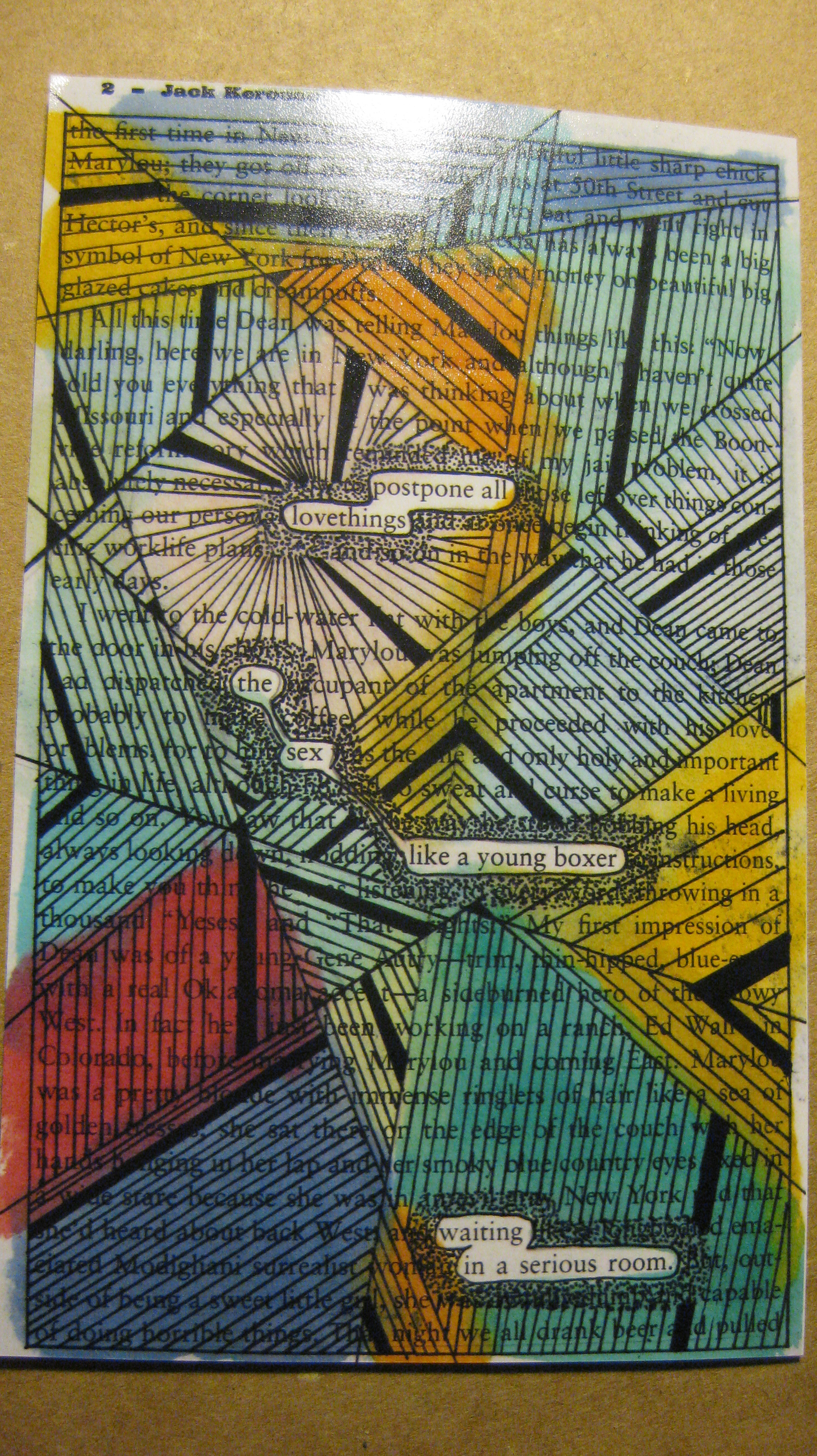
Today I find myself in ‘LT A821 Poetry’ and I take two books off the shelf back to my spot in the carrels, called “Poems from Prison” and to contrast perhaps, “Sometimes Gladness” but, first things first, this fell out as soon as I opened it:

131130

Who is the Reverse Butcher? <obviously as I was sitting in the library, I did not know, but that’s that magic of time and connectivity, I can insert the link right here and you can have a look!>

Speaking of time – has this poem been tucked inside the book since last year or was it written then and only placed in the book today?

This is an intriguing and colourful way to communicate… it might be a fun exercise to attempt in fact – isolating words on a page to say something quite different that what the original author intended… can you still cal it an original artwork when you have literally carved it out of someone elses work? It is fascinating I think, our capacity to take things others have said or taught or done and make them our own.

How much does it cost to get postcards made up?  what is it for? what does it do? anything? Perhaps it is not its purpose to do anything but ‘be’.  Outside of the normal rules of submitting poetry this is anonymous and there are no criteria to fulfill… I’m a little #antiresidency myself, at least as far as The Establishment is concerned did it feel ironic (or clever?) to tuck it between the pages of a book on “Poems from Prison”?  So many questions!

Now, I actually copied quite a few poems out (how often do you get to hear poems written by people who are in prison after all?), this is their truth and, I think, something of their healing… I’ll limit myself to two.

I LAY DOWN WITH ME TO FORGET YOU – JACK MURRAY

I don’t want to believe
the message on your face
inches away
through the rust wine
finger-clutched smooth
by husky love promises
but my eyes
blind to all
blind to nothing
tell
that it’s true
true

But I remember when
one summer day
we held hands like children
and went into a
brand-new empty house
smelling of paint and plaster
and looking out strange windows
we could see
the wilderness over the back fence

so we made love
on the fresh-sanded floor
and your thighs
tasted of sawdust
happy but sad too
we went outside to our
mickey mouse car
with the baby on the back seat
and left

like love was
left on the stove
to stew and simmer until
all the impurities evaporated
and nothing
remained but enough tasty poison
to murder us both
or me
was I such an enemy?

You
wise but helplessly dumb
touched with a little style
guile-smart with experience but
gifted only with the power
to live your life in more sadness
than
a normal person could
think of

Four foot round the chest
I opened bottles with my teeth
tore Rod McKuen books
in half
with my bare hands
but I wasn’t strong enough
to make you happy
remember?
how could you forget
blame never alters
kind words are hard to find

—————————————————–

I WANT TO WRITE A BOOK ABOUT ANGER – ROBIN THURSTON

I want to write a book about ANGER
about how anger CAUSES things
I want to do this.  I’ll show it SUBTLY and
in various stages.
I’ll do it something like Bronte did love.
I’ll show anger in DEGREES.
I’ll build it past recompense,
demonstrating how a moment’s ANGER
can warp a whole LIFE,
and give a man a fork through his lip
or an empty eye socket,
or maim him all in a minute
to be endured forever.  The book
will be MATURE, and for adults.
It should be a masterpiece of informed
intelligent writing.

…and from “Sometimes Gladness” by Bruce Dawe (because sometimes poets can say things our spirit knows but can’t find words for)

HAPPINESS IS THE ART OF BEING BROKEN (p.37, v.2)

Always the first fragmentation
Stirs us to fear… Beyond that point
We learn where we belong, in what uncaring
Complex depths we roll, lashed by light,
Tumbling in anemone-dazzled fathoms
Seek innocence in surrender,
Senility an ironic act of charity
Easing the agony of disparateness until
That day when, all identity lost, we serve
As curios for children roaming beaches,
Makeshift monocles through which they view
The same green transitory world we also knew.

ADVICE TO AN INTERPLANETARY VISITOR

When you find him,
that last citizen,
hiding wherever there is left to hide,
too timid to surface,
living on nuts or whatever was at hand
when the flash came
– be kind to him, comfort him,
break the news to him gently
that he is the sine qua non, the ultimate reason
for everything.

Let him walk where he will,
let him reassure himself with trees, yes, and the light
walking between them, let him listen to waters
conversing like children, the rain
telling its secular tears, let him
lose himself in what was, roaming
the city streets where wires hang
like ganglia, let him touch things
and remember. Soon enough
logic may cross his brow
like an evil shadow.

When you find him
– give him your alien kindness,
stroke him with feelers of love.

IMG_5009To know the gaze of God – Sister Miriam

St Teresa is convincing because she is speaking out of her experience.  We don’t have to guess about her interior life.  She is anxious to explain herself truthfully – hard on herself – a light fault is serious if it goes against His Majesty.  She would see herself as like the Samaritan Woman and pray “God, give me that water”.  She was dedicated to hours of prayer – even when praying hour would be over. “more enabled to bear the beams of love” – Blake. Saw prayer as the only way to deeper connection – God did in a moment what she could not have done in years on her own.  Stick with it, Godwards (inward) our centre whether we know it or not.

Prayer consists not in thinking much
but in loving much.

Each person inexhaustible – there are many rooms in our interior castle.  There is a call to growth – face to face encounters with the living Christ.  Steady unwavering gaze of God kindles love.

In the measure you seek Him, you will find Him.

Hone focus and choices > prayer fosters “presence” to unfathomed, unconditional love, Under His gaze, joys and sadness are given perspective.

 St Teresa had a spontaneity and gladness to her interior life > personal gratitude.  You must put on the new self that is clothed in God’s likeness. Mystical experiences ‘more’ real than ‘normal’ life > reformer.  Energy/capacity to write, correspond despite illness… by their fruits shall you know them.  Her way, her truth, her life.

Sips of what we hope for.
Lives with very determined determination.

He who lives in God, lives in love and God lives in him.

St Teresa’s gift of wisdom – Sister Paula

Wisdom illuminated her life and vision.  Learned through fidelity in prayer.  Knowledge and understanding acquired in life brought to thoughts.  Trustful confidence and hope.  Listened to voice of God in her heart > sought counsel.  So enriching, longed to share it… this is possible for everyone.  Practical and idealistic.  Lived simply and appreciated beauty.  Wrote hundreds of letters – family, convents, business, books… 1562 St Jospehs of Avila dedicated to prayer and contemplation, 3 essentials:

  • love for one another
  • detachment
  • humility

Pure love without self interest does not lower itself to seek recognition.
For love you were fashioned.

“This is the love wisely sought IMG_5008by the pure of heart”
God/Trinity always to be found in human heart, a familiar homeliness not a remote establishment. Captivates soul with fresh encounters.

Love is complete in giving itself
and serving.

Appreciated holiness and integrity in others.  Priceless treasures with glimpses of eternity.  Everyday common sens and compassion.  Let down by friends > loneliness > let nothing bother you because God alone suffices.

There was no  conflict between her inner life and actions because all was one.  If noticed foibles in others, looked beyond to how God saw them.  Fostered friendship, encouragement, support between sisters. Contemplative but enmeshed in practical affairs.

“Seek yourself in Me,
seek Me in yourself”

Know sublime truths.  New depths of human capability, certainty from her own experience.Love at the beating heart of the universe enables us to participate in the resurrection. It is not the greatness of the works that are done but the love with which they are completed.  Each person is gifted individually and has something unique to share.  Gifts are multiplied when they are shared.


Jesus Christ, St Teresa’s true friend and companion: Her definition of prayer – Sister Angela

Loneliness and longing for God.  Desire for love and wholeness > struggle fraught with conflict.  Minority: Jewish blood/conversas (objects of hatred and suspicion); woman; ecstatic experiences and wrote books > threat/pollutant. Despite obstacles – pursued goals determinedly. Sought advice from highest theologians – proof. Love, affection, legitimacy, acceptance: she was warm and extroverted.  Shadow: crippling dependent relationships at the expense of inner truth and full Surrender to God.

Defines prayer in terms of love: frequently and secretly sharing with Him …grew in intensity and Presence.  Human personality caught up in Christ.

Forsaken moments alone and afflicted – Gethsemane/cross.  Could accept her in brokenness and poverty. Consoling Him.  Consoling each other. This became habitual. “Tried to keep God present within me.”  That was my method of prayer…

I’m not asking you to do anymore than look at Him.
The truth of who He is will be imprinted in us.

Humble ourselves and delight in the Lords presence.

Maintained presence:

  • identifying with people in gospels
  • those who needed redemption – Mary Magdalene, Peter in tears after denying Jesus, John at the foot of the cross, Samaritan woman…
  • moment after receiving eucharist, receive divine gift within her.
  • Not just inner prayer but human limitations and conflicts > see transformative power of Jesus at work.  Battle between being friends with the world and friends with God (stalled growth for 20 years).

St Teresa felt an inner conflict/fragmentation – unable to commit herself fully to God.  Likened it to a voyage on tempestuous seas and sought a remedy.  “Life I was living was not life”. Let go of trusting herself > trust God.  39 years old when she had a conversion experience.  God lived in her – act of surrender, discovered Christ, healing and transforming her.  Desired by God, in her entirety, as she was.  Set free of needing to be ‘approved’, rooted in Jesus Christ. “Jesus As Friend And Liberator” permeates her Christian life.  Satisfied all desires.  All sufferings and trials – related back to his humanness and limitations.

Body needs to be integrated in our search for God.  Life is hard.  Need example and companionship of one who has gone before.  Reality and weakness of human experience… could converse continually.

God understands our miserable make up.  Flesh and blood, life and death, joy and sorrow – embrace this reality with trust and love.  Freed to live more fully.  Obedience to life under God’s conditions. The will of the Beloved became her sole compass.


St Teresa’s writings – Sister Teresa

“I am yours born for you, what do you want from me? …move me from here to there… sorrowing or exalting… what do you want form me?”

Living and developing her great gifts.  Asked friends to pray she would do God’s will.  Moved by servile fear – then had her conversion – served by love.  Receive s graces, calls within herself, encounters to follow vocation .

“Those things of God made me happy,
the things of the world made me bound”

Self judgement critiquing her earlier life.  Had darkness and dryness, moments of light. Mental prayer – intimate sharing between friends with Him who we know loves us.  Vocal prayer – liturgy – not thoughtless recitation but mindful.  Come to prayer with self-awareness of our brokenness and need for grace.  Adamant of building solid foundation of prayer – virtues: detachment, humility, charity and obedience. Don’t stand still! Don’t be dwarfs! Space in her teaching – desire that all will reach prayer God is offering.  Criteria for holiness in doing God’s will and charity.  Call addressed to everyone not just religious.

 Grace always costs.

Gave writings to mentors and confessors – anything wrong, cut it out!  Resolve to do the little I can do (as a woman, scope was limited).  Reform of Carmel (hermits 1200s) solitude and space.  Value silence and solitude and live in continual prayer.  Liturgical prayer (church), contemplative prayer (individual). Small in number.  All in house must be friends with each other “all made of the same clay”. United in love of God and prayer for the church. Peace and joy in community and life.  God spare us from sorry saints! Give me Calvary or Tabor.  The castle is the masterpiece of the interior journey.  The soft whistle of the Shepherd can be heard through all the spaces.  My daughters, good work, my God wants good works.

Yours I am…


St Teresa’s Conversion: The movement from performer to beloved – Adrian Jones

Live out of a role – profession/family/community… the way we are socialised to behave.

1538-1565 move beyond ‘role’ to her loved self.  Feisty and an adventurer.  Loved by her family and she loved them.  Didn’t want to married (one of ten children herself).  Family of faith > raised in that atmosphere.  Her father didn’t want her to join the Carmelites.  Ran away at 20 to join.  Lived faithfully and with energy > liturgical prayer and community life.  Individual prayer not at the fore (Latin/couldn’t read… not easily accessible). “midlife crisis” had become burdensome – plateau.  Felt torn between the satisfactions of life and the stirrings of God.  Best reminded about what was going on during prayer life… continually checking in… being present to God.  18 years trying to hold the middle road.  Tried to have effective control, everything under her control, God wanted affective control – trusting God and things find their own place.  Know depths of God’s love and her own hearts desire… invitation to come close to God.  Call to religious life not questioned but can I let God be God?

Absorb story through immersion.
A living in Christ.

Loving God drew her to the centre to “be” with God.  “We” might have a good book with us > she and God hanging out together.  The Samaritan Woman and Mary Magdalene (in John) had strong conversion experiences with strong emotions.

Turned by love.

Only wrote after 1565 had established ideas  and experiences.  The reality of God, the presence of God, not doctrine (in Teresa we stand in the presence of God) – trying to describe/explain that.  Time between rising something new and familiar practice.  Not here or there.  In the middle is where we’re supposed to be.

1st mansion – become aware of God in our life. Self-awareness.

2nd mansion – awareness of that.  Must answer, become aware of implications too.

3rd mansion – taken or living for God, “perfect” Christian. Downside, miffed with god (entitlement). God: love yourself or do you love me?

4th mansion – God wants to wound us.  Doing things for God.  Can’t avoid.  Struggle living with it.  Let go of control, let God be in charge > be grateful.


St Teresa approach to community living – Richard Hallett

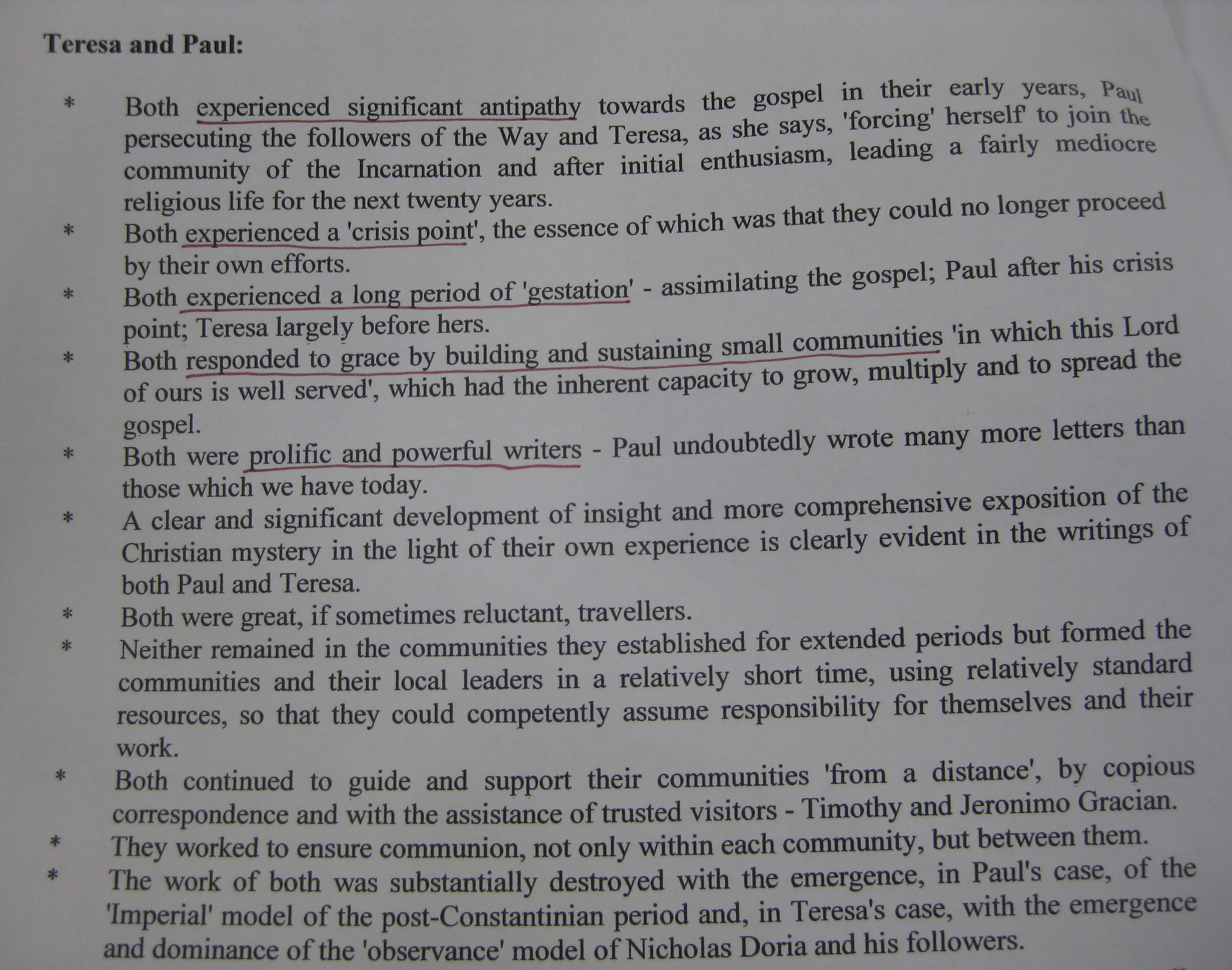
Teresa wrote constitutions for the communities she established.  Teresa, Paul and Alberts constitutions for sustainable community (handout). Doing very poorly at Sundays in our communities > 12 years a minister.  Work in Catholic schools and talk to families who can’t connect to Sunday services.  “ekklesia” means the group who gathers.

If the quality of inter-personal relationships among those who gather are weak, the ekklesia is weak, weak in the quality and scope of its service; weak in its power to transform and save lives.

Whether she was explicitly aware of it or not, Teresa established her communities on the same model employed and developed by Paul of Tarsus:
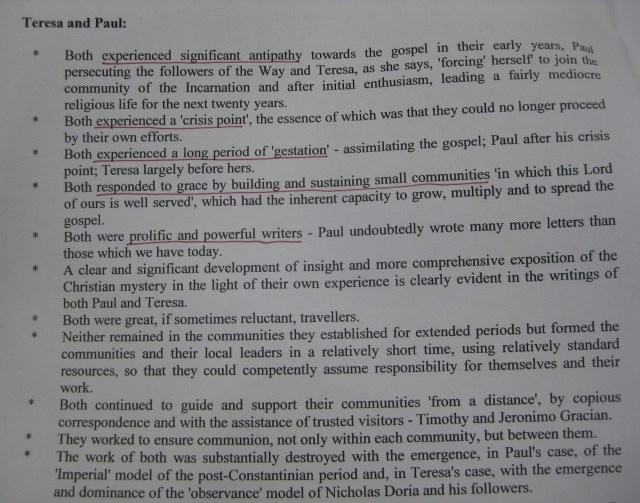
IMG_5068


Teresa did not consider that she was doing anything particularly original. Her aim was to establish and sustain an environment in which her contemporaries would have the opportunity to respond to divine Grace in the greatest liberty of spirit and to live life to the full.  She recognised that her Carmelite history, if honestly implemented, provided just such an opportunity.

p.314 St Teresa ‘The Constitutions’

What stands out in the guidelines for the Teresian life is balance. We find an interweaving of eremitism and cenobitism, or work and contemplation, of liturgical and extra-liturgical prayer.

Eremite: hermit of recluse
Cenobite: member of monastic community sharing common life.

p.324

#18 The Sisters should pay no attention to the affairs of the world, nor should they speak about them.  They may do so if the matter concerns something for which they can offer a remedy or help those with whom they are speaking, assist them in finding the truth, or console them in some trial.  If no effort is being made to make the conversation a fruitful one, they should bring it to a quick conclusion, as was said.  It is very important that those who visit us leave with some benefit, and not after having wasted time, and that we benefit too.


A Bernard McGinn retrospective – Philip Harvey

Inner life and connection with God.  First female ‘doctor’ of Catholic church.  “New mysticism” actively going out and doing things.  Democratisation, mysticism for everyone/anyone, vernacular (not just in Latin).

Read widely: Augustine… Jerome…

Creating new: Prayer of Quiet, sleep of the faculties…

Mystical theology – whole of life, hidden presence of God. [Teresa was the last of the old line not early in the new]

Def. That part of religion deepening consciousness of God in our life and lives of others.  Not intellectual, found in other religions, in eucharist, etc.  Thousands of rooms (Teresa only writes about the ones she knows about).

  • Thinking, knowing, acting, deciding out of context with
  • Personal and transpersonal
  • Absence as well as presence of God

Every baptised Christian called to mystical life.  To love God and neighbour.

Cataphic and ataphatic/positive and negative.

Dedicated to outreach of spiritual life.

A mystic doesn’t need to be a ‘drop out’ of society. Confined to cloister not ends but means > to love God and love others.  True active contemplative.

 “do not be sad
for I will give you an inner book”

Liber experienciae.

  1. The Slacker
  2. The Contemplative
  3. The Contemplative in Action

Others wrote their own spiritual expression or related them to confessors but never combined with apostolic action.  Union of inner and outer worlds.  Reactive > social reform.  Teresa: political, fundraising, leaders of reform (training others to continue her work), participation in community.  No rank within monasteries.

Mary & Martha//Raptures?? Grace of spiritual marriage. Need a uniting of Mary and Martha to host the Lord well.  Prayer will be more powerful for its responsibility/relationship > pray for those you know.

Action and contemplation not opposed but mutual.  Two lives are equal and active ways of loving God.  We should not build castles in the air but work with love.


For whom did Teresa write?  Reading the Interior Castle today – Father Greg

Like the ocean – shallow enough anyone can walk in, deep enough for anyone to swim in.

Teresa was not writing a DIY manual for mystics.

  • For drunks and prostitutes, drug users, alcoholics anonymous, AIDs clinics, out where my people are.
  • 12 steps not n alcohol or self but higher power of God > sobriety of life.
  • 7 steps – realisation one is loved and worthwhile, self worth given as a gift to be received gratefully. Love and therefore loveable – changed how she understood God. Response of a person loved by God/freedom/love God/love others/love church.

Humility aka authenticity.  Detachment aka spiritual freedom > moved to love others.

That which makes me most me is also that part which I’m to share with everyone else > dignity of the human person.  Sense of the importance of her own experience.  What she understands a mature Christian to be – submitting wholly to God.  Just read the 7th dwelling place… know where you’re going.  Within each dwelling place are sets of relationships:

  • Others
  • God
  • Action
  • Prayer

First 3 dwelling places – co-operation with God’s grace in our lives:

  1. God exists
  2. Following
  3. Well ordered – judgemental

Next three dwelling places – lose control, God works without us planning or co-operating:

  1. Praying not praying
  2. Rest and work
  3. Grace and receiving

Invalid>dynamic/active.  Visions, locutions, shadow of the cross. Changing memories and hope and how and who we love… LONG JOURNEY

Last/7th dwelling place – profound transformation, live in a different way.  God working with us in our lives.  Moat outside filled with vipers, toads and vermin >> do not know that you are loved.  Knock on the door through prayer, reflection on self, scripture, liturgy of the church.  Parents have seen who you will marry – caught sight of your “intended”. SEEING/BETROTHAL/CONSUMMATION commit to each other.

  1. Sharing the passion

Encounter God as Trinity. Christ-centric >Trinitarianism (with others) ekklesia.


God is not static. Creation still happening now.  Species just beginning to understand now.  Incarnation happens in us, death in us and ascension >> Marriage and the House of Divine Love.  God doesn’t give Teresa a wedding ring but a nail from the cross.  Pray with eyes open.  Prayer for others… good works, called beyond ourselves to hospitality of others > most mature and developed human/Christian. Hungry, cold, poor, excluded >> wok for the benefit of others is to be alive. “Seek yourself in Me”.

Seeking God would be very costly if
we could not do it until
we were dead to the world.


–ooO0Ooo–


SUMMARY RESONANCE

God give me that water

For love you were fashioned

Seek yourself in me,

Seek Me in yourself

Set free of needing

to be approved

Tried to keep God

present within me

Grace always costs

God spare us from sorry saints

Yours I am, I am Yours

A living Christ

Do not be sad for I will

give you an inner book

Sense of the importance

of her own experience

Seeking God would be very costly if

we could not do it until we

were dead to the world.

038


  • Puts recommended reading lists in the back of his books – framed withn broader context.  Uses quotes and stories
  • Writes out of an experiential way of living
    • find God in place and memory
    • apprehend not truth about God but truth of God.

Six ideas about John O’Donahue’s writing:

  1. Circular ideas/prose.  Has one main theme with smaller ones around it like a celtic knot “eye of imagination follows a circle” not logical/rational/linear > miss the gift.  Risk/openness of circular way subverts this.  Won’t bear the scrutiny of reason.
  2. Not interested in reason but contemplation.  Always a movement away from itself.  Series of non-sequiturs. Read a little then pause and reflect.  Not along >>> but down. Quarter mile long, fathoms deep. “the eternal is at home within you”
  3. Contemplative world waits on the edge of things/imagination (light/dark, edge/centre). Realm of invisible. “Hidden 7th chapter” is silent and hidden within ourselves > a longing never stilled. “invests every action with possibility and pathos…” Prayer is an invisible world and contemplative.

Listen in the abyss of nothingness
for the whisper of the beautiful

4. Made up of these elements: body/landscape/transcience/memory. Body (trust/belonging); landscape (location, know and approach things and people); transcience (always passing away); memory (body, place and passing held together where our vanished lives remain alive – selective transfiguration)

5. Encourages us to break open and unpack internal and external landscapes e.g. root words. Break open familiar and see afresh. When we’re locked/blocked > impoverished. Remove the wall you have put between yourself and the light.

6. Seeks to find blessing. Invocation- calling forth… Calls for change and transformation.

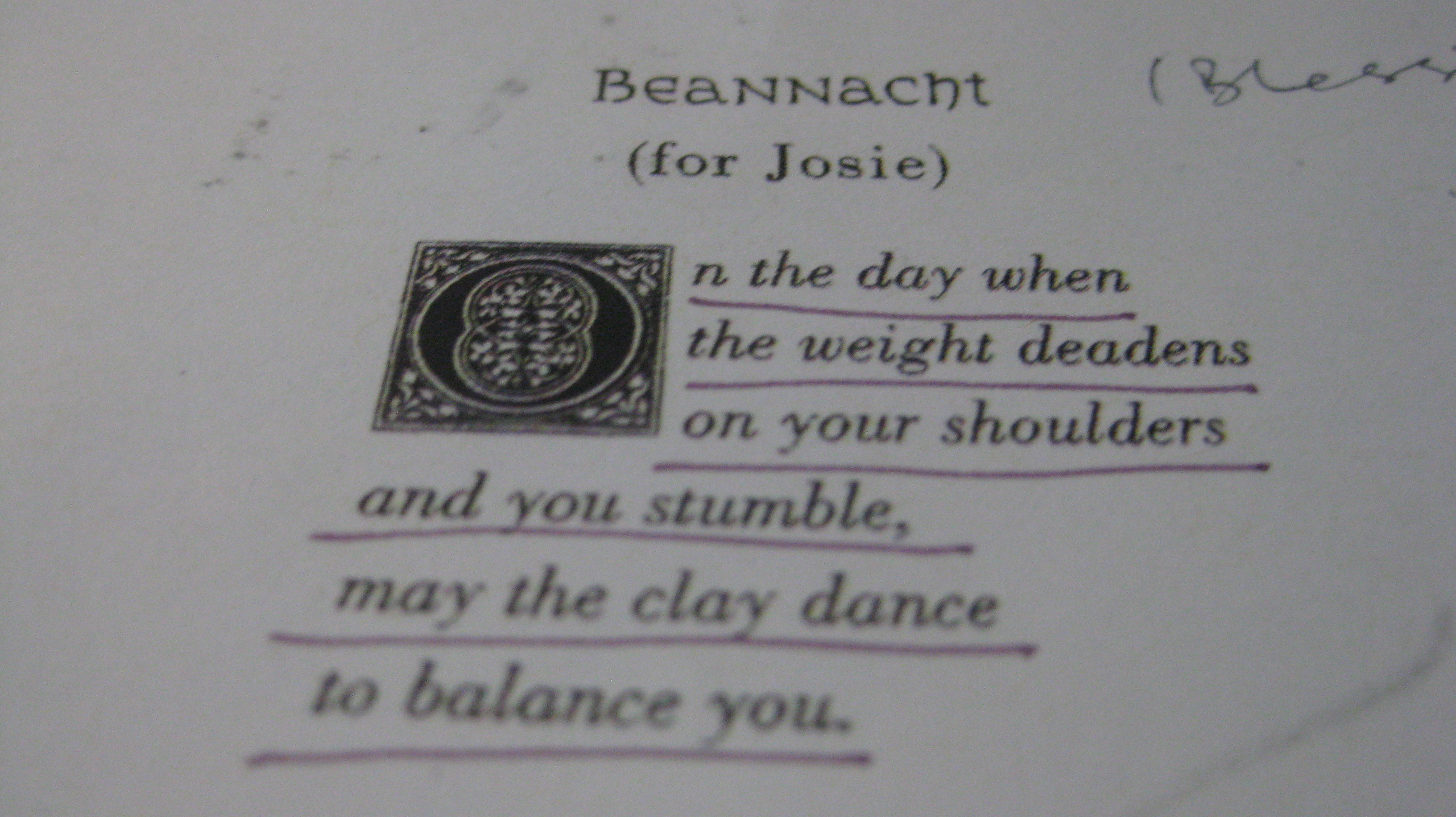
Beannacht

Summer 12-13 058On the day when
the weight deadens
on your shoulders
and you stumble,
may the clay dance to balance you.

And when your eyes
freeze behind
the grey window
and the ghost of loss gets into you,
may a flock of colours,
indigo, red, green
and azure blue
come to awaken in you
a meadow of delight.

when the canvas frays
in the curach of thought
and a stain of ocean
blackens beneath you,
may there come across the waters
a path of yellow moonlight
to bring you safely home.

May the nourishment of the earth be yours,
may the clarity of light be yours,
may the fluency of the ocean be yours,
may the the protection of the anscestors be yours.

And so may a slow
wind work these words
of love around you,
an invisible cloak
to mind your life.


A philosopy of Ducas

“The longing of a people is caught in the web of their language. Dreams and memories are stored there. A language in the inner landscape where a people can belong. When you destroy a people’s language through colonisation or through the more subtle, toxic colonisation of consumerism, you fracture their belonging and leave them in limbo.  It is fascinating how a language fashions so naturally the experience of a people into a philosophy of life. Sometimes one word holds centuries of experience; like a prism you can turn it to different angles and it breaks and gathers the light of longing in different ways… the phrase ‘ag fillead ar do ducas‘ means returning to your native place and also the resdicovery of who you are.  The return home is also the retrieval and reawakening of a hidden and forgotten treasury of identity and soul.  To come home to where you belong is to come into your own, to become what you are, to awaken and develop your latent spiritual heritage… Ducas also refers to a person’s deepest nature. It probes beneath the surface images and impressions of a life and reaches into that which flows naturally from the deepest well in the clay of the soul. It refers in this sense to the whole intuitive and quickness of longing in us that tells us immediately how to think and act; we call this instinct… You belong to your ducas; your ducas is your belonging. In each individual there is a roster of longing that nothing can suppress.”

Summer 12-13 052


The Stranger (Eternal Echoes)

“It is impossible to be on the earth and avoid awakening.  Everything that happens within and around you calls your heart to awaken.  As the density of night gives way to the bright song of the dawn, so your soul continually coaxes you to give way to the light and awaken.  Longing is the voice of your soul; it constantly calls you to be fully present in your life: to live to the full the one life given to you.  Rilke said to the young poet: ‘Live everything’. You are here on earth now, yet you forget so easily. You have travelled a great distance to get here.  The dream of your life has been dreamed from eternity. You belong within a great embrace which urges you to have the courage to honour the immensity that sleeps in your heart.  When you learn to listen to and trust the wisdom of your soul’s longing, you will awaken to the invitation of graced belonging that inhabits the generous depths of your destiny.”

Summer 12-13 133

MATINS

I.

Somewhere, out at the edges, the night
Is turning and the waves of darkness
Begin to brighten the shore of dawn.
The heavy dark falls back to earth
And the freed air goes wild with light,
The heart fills with fresh, bright breath
And thoughts stir to give birth to colour.
II.
I arise today
In the name of Silence
Womb of the Word,
In the name of Stillness
Home of Belonging,
In the name of the Solitude
Of the Soul and the Earth.

I arise today

Summer 12-13 160
Blessed by all things,
Wings of breath,
Delight of eyes,
Wonder of whisper,
Intimacy of touch,
Eternity of soul,
Urgency of thought,
Miracle of health,
Embrace of God.
May I live this day
Compassionate of heart,
Gentle in word,
Gracious in awareness,
Courageous in thought,
Generous in love.


010– poetry + aesthetics + theology = theopoetics
– if theology is logical applied to God then theopoetics is poetry applied to God
– sense of place and spiritual quest = songlines

Poetry is ontology – Rowan Williams

Work of love. Poet is a seer/prophet/the songman > the paths we must take and sing in order to renew the world. “This becomes obvious the closer you are to death… I do not aspire to anything anymore except to be invaded by the roses in the garden”.

In the end end it’s a journey of imagination.

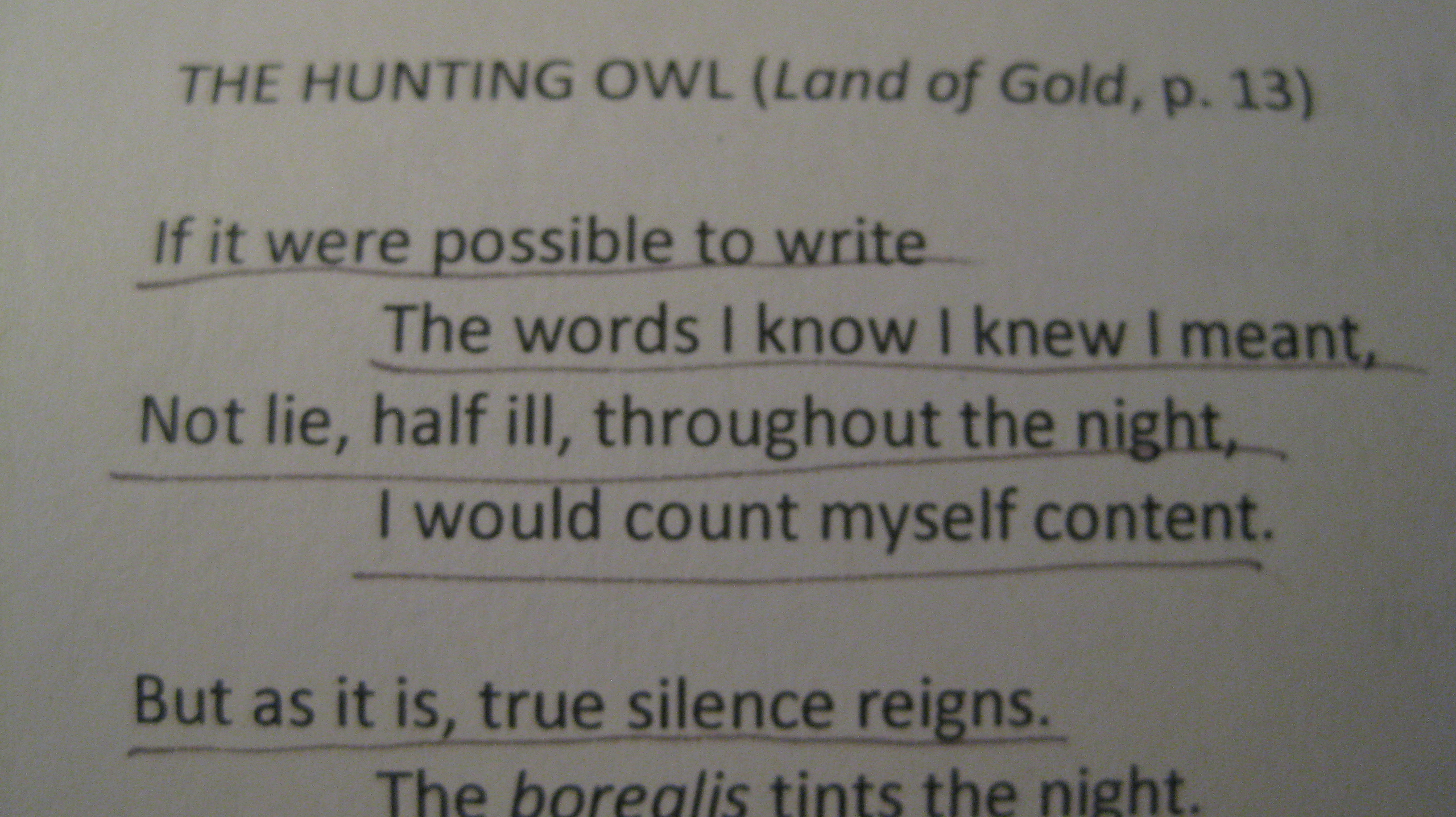
HOMO SAPIENS (Land of Gold, p.21)

If, to be alive, I am alive,
And if the witness to this
Is I, myself, watching the grass grow,
What is the meaning of the river?

Why does it sparkle, why does it twist?
In a slow meander, why do the weeds
Grow into islands, why is the sun
Sucking it into the sky?

Long have I dreamed
On the borders of creation
But seldom have I seen
The meaning of the river.

Now it is clear,
Established by the ages,
The river is myself,
An artery of the sky.

Sebastian Barker

7 Sacred Pauses

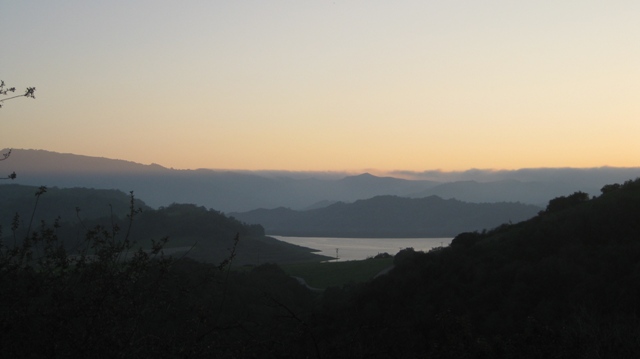
sunset lake cassitasI have carried this book 7 Sacred Pauses in my handbag for months – I was invited to a contemplative retreat where this is the tool used to frame the rhythm of prayer and I wanted it to be familiar. If I posted here everytime I’ve copied out a passage of the book in my journal I would have breached copyright by now – pulled it out on the bus, in my lunch hour, waiting on someone to show up… incidental rather than disciplined sacredness but it sings to my soul and I highly recommend it (if you’re into that sort of thing).

Macrina Wiederkehr, Seven Sacred Pauses, .p62

Gently lay your hands upon your lips, longing for the grace to speak only words that are helpful this day. Remember the words that you have already spoken. You cannot take them back. Bless them and let them go.

O Word Made Flesh, stand guard at the gate of my mouth. Be my voice this day that the words I speak will be healing, affirming, true and gentle. Give me wisdom to think before I speak. Bless the words in me that are waiting to be spoken. Live and abide in my words so that others will feel safe in my presence. Surprise me with words that have come from you. Oh, place my words in the kiln of your heart that they may be enduring and strong, tempered and seasoned with love and resilience. Give me a well-trained tongue that has been borne out of silent listening in the sanctuary of my heart. May my words become love in the lives of others.

#freepostcards

124

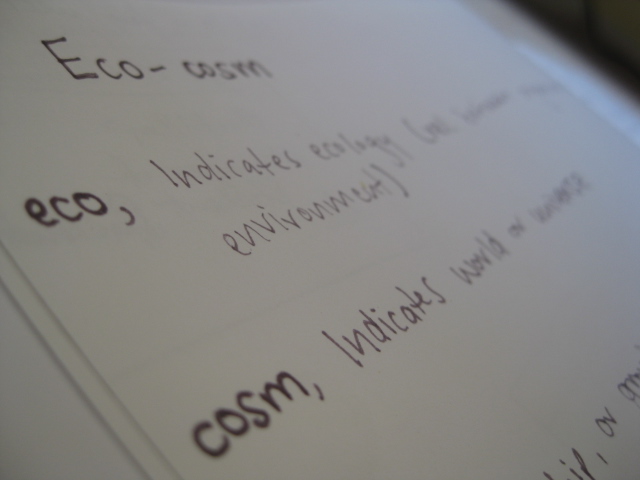
Eco-cosm

blog 004

This discipleship, or growing up, or whatever you want to call it is the process of discovering and defining our own ecocosm.  Each book of spirituality invites me to visit other peoples’ ecocosms and this is useful in as much as it assists with the awareness and structuring of my own.  This is where churches suit or not, where communities thrive or not… space needs to be allowed/created for the expression and fuelling of our individual ecocosms. In knowing others better I know myself and this is the strongest recommendation I can make for living in community.  In clarifying all the ways that I can understand 1-am-not-you, I can be affirmed in all the ways-I-can-be-my-best-self. We are each of us individually knitted in the womb, the hairs on our head counted, each of us made by God, each of us co-creators with God. Walk the path set before you to walk.  God is with you exactly where you are right now.  God has put people around you who need you, God has put people around you who can help you, inspire you, teach you… Ask always “What is the next step?” What is your leading edge? Our God moves and invites us to walk along the Way.  Pray “Here I am send me” and take a copy of Dr Seuss’s ‘Oh, The Places You’ll Go’ because it’s the closest thing to a handbook there is.  I’m a Type 2 in the Enneagram, I am INFJ in Myers-Briggs, my top 5 in Strengths Finder are: Belief, Restoration, Responsibility, Individualisation and Strategy, I am single in a world where marriage is the dominant culture, I am a woman in a male-dominated culture, I am mad in several specific but (hopefully) endearing ways and a product of my family of origin and the sum of all my life experiences to date.  I am my own ecocosm.  I need to own my own ecocosm.  No one else will tend it for me. I need to consciously tend my ecocosm – who can I meet up with? what can I read? where can I travel? how can I see anew, with new eyes, those familiar things that are so easy to take for granted or become complacent about the vital life breath of why-I-am? This might be right within the four walls of exactly, specifically, particularly where I am right now.  There is a story of an American Indian elder speaking with his grandson:

“…there is a battle between two wolves inside us all. One is evil. It is anger, jealousy, greed, and resentment. The other is good. It is joy, love, hope, humility, kindness, empathy, and bravery.”

The boy thought about it, and asked, “Grandfather, which wolf wins?”

The old man quietly replied, “The one you feed.”

i tell you arise

My loneliness has a “voice”.  There is a Presence within the void. Deep friendships have brought me to this and the inevitable goodbyes. I meet my loneliness.  And I learn that nothing else remains to be discovered except compassion.

~ Patrick J. Connolly