Tag Archive: discipleship


“The radical church is the fastest-dying church in the world”

Myers, C. (1988) Binding the Strongman Orbis.

DISCIPLESHIP AND FAILURE: “YOU WILL ALL DESERT ME”

At the time, his words could hardly have hit home any harder, I ws still recovering from the painful breakup of my own community, the loss of home and marriage.  I had never expected that the “cross” would take this shape. If readers of this book still feel it is an exercise in imaginative idealism, they should be aware that Mark’s vision is flesh to me, flesh seared and scarred. I have seen business-as-usual rudely disrupted by the kairos of the call, seen the vision of radical discipleshhip community realized.  And more importantly, I have also seen those dreams fade, seen our best attempts to weave a fabric of hope and wholeness unravel, seen good persons bail out.

The radical discipleship movement today is beleaguered and weary. So many of our communities, which struggled so hard to integrate the pastoral and prophetic, the personal and the political, resistance and contemplation, work and recreation, love and justice, are disintegrating.  The powerful centrifugal forces of personal and social alienation tear us apart; the “gravity” exerted by imperial culture’s seductions, deadly mediocrities, and deadly codes of conformity pull our aspirations plummeting down.  Our economic and political efforts are similarly beseiged.  The ability of metropolis to either crush or co-opt movements of dissent seems inexhaustable.

To Be Someone – Unique Identity & Personal Value

  • How big is the question ‘Who am I?’ in your life? What have you learned about living with this question?
  • How big is the question ‘What am I worth?’ (and ‘to who?’) in your life? What have you learned about living with this question?

To Be At Home – Security & Loving Harmony

  • What forms of security do you feel a need for? How have you pursued these in helpful or unhelpful ways? WHat have you learned about security?
  • In what living situations, communities and friendshios have you most experienced ‘loving harmony’? When was it lacking? How do you experience & nurture this now?

To Be Going Somewhere – Purpose & Progress

  • How big is the question ‘What am I here for?’ in your life? What have you learned about livign with this questions? How do you continue to discern your ‘vocation’?
  • What motivates you to develop and keep offering your best gifts and energies to God’s work on earth?
Used by GROW peer mental health support groups around Victoria

I want to dream

I want to dream
I want to dream together
I want to dream together and for your vision plus my vision
to surpass anything either could imagine on our own
I want to use my gifts to serve your vision, and
for you to do the same for me
I want the dream to be organic and to change
as you and I change
I want the dream to look different in different kinds of light
– sunlight, moonlight…
and seasons
– spring, autumn…
I want to talk about the dream as we walk along, catch the bus, share a meal together
I want to know the intimacy of shared thoughts with you
common and sacred at the same time
I want a dream that in its dreaming makes me smile in my sleep and
hold hope for a whole world through the day
I want a dream that needs a roll of butchers paper, five colours of post it notes and
four coloured marker pens to explain and still doesn’t really capture its soul
I want to dream together with you
I want to dream together
I want to dream

Talitha Fraser

Webinar is available at chedmyers.org but here are some snippets…

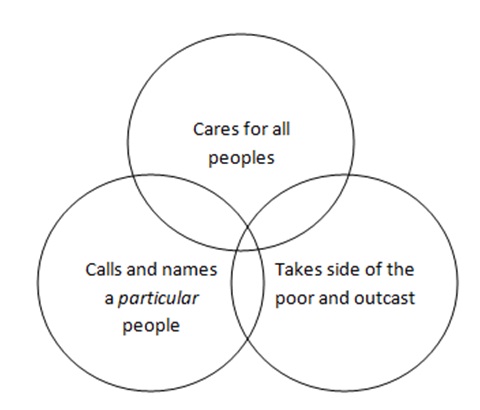
There is a “trialectic” biblical narrative concerning God’s relationship with human beings in the bible.

Image


Jesus embraces all three characteristics: loving both national enemies and intimate betrayers, calling disciples and living among the marginalised.

Isaiah I (Ch. 1-39) Isaiah II (Ch. 40-55) Isaiah III (Ch. 56-66) – different authors.

(p.96-97) But third Isaiah goes on to address specifically those parts of the community that are being legally and socially targeted:

Let not the foreigners say…
Let not the eunuch say…
For this is what God says… (Isaiah 56:3f)

This verse seeks to animate the voices of those who have internalized their rejection by the dominant culture because of how they are perceived and publically caricatured.  “The LORD will surely separate me from his people,” says the inner voice of the foreigner; “I am just a dry tree,” intones the introjected contempt of the eunuch.  Second-class citizens in our own history know all too well this self-hatred.  Black children have tried to scrub their skin white, immigrants have changed their names, women have kept silent, and gays and lesbians have stayed deep in a destructive closet – all to avoid the contempt of a society that barely tolerates them.  Internalised self-negation and external oppression are like a constant  “acid rain”, as psychologist William Grier and Price Cobbs famously put it in their landmark study Black Rage (1968). It is time, says Third Isaiah, for such dehumanisation to stop – because YHWH says otherwise.

What does this mean as a visitor, first-, second-, third-generation Australian?
Reflect on Australian immigration policy and response to “boat people”.
“Reconciliation” with indigenous First People  of these Nations.
Not only called to like pretty/smart/?/people, or people like “us” but specifically to welcome the hungry, the stranger, the ill…
Reflect on this: the maker of the outside also made the inside.

What credit it is it to you to only love those who are like you, to only love those who love you back, to only lend to those from whom you expect repayment – we are called to and Jesus role-modelled generous discipleship.

* I have purchased a copy of this book!

Four responses often overlooked:

  1. Exercise critical literacy in the social, economic and political geography we inhabit as church, proclaiming God’s sovereignty in ways that engage/challenge the entities that tend to rule our minds, hearts and societies;
  2. Understand that the gospel is first supposed to represent “good news for the poor”, and socially locating accordingly;
  3. Discern what it means to “go after big fish” today;
  4. Reach out to both victims and oppressors (restorative justice, building community across social boundaries)

(case in point the “Occupy” movement)

Full recording of the webinar should be available at www.chedmyers.org in a few days…

Yesterday I attended a service at the Bethel African Methodist Episcopal Church. On the eve of Martin Luther Kings birthday it felt significant to visit somewhere where I was the ‘other’, I think I thought that experience would be something I was there to learn from, but we were met with a warmth and welcome that moved me in a way that is hard to express in words… “there is no such thing as a visitor in the house of God because we are all one body are we not?” and then hugged by almost everyone there – and not a formal, awkward or side-on hug – but a proper drawing in to the warmth of another person and being held in their arms. How can anyone doubt their welcome in the face of such hospitality?

The service started with a responsive litany:

Pastor: A child once dreamed the Voice was calling his name Samuel; fishermen once heard the Voice when a young man bid them follow; And still the Voice beckons today… can you hear?

Congregation: Here I am. Send me

Pastor: Moses protested vehemently as the Voice spoke at the burning bush; Mary stood amazed as the Voice proclaimed impending birth; And still the Voice beckons today… can you hear?

Congregation: Here I am. Send me

Rosa Parks followed the Voice to the front of the bus; Martin Luther King Jr. Heard the Voice as the bullet shattered; And still the Voice beckons today… can you hear?

Congregation: Here I am. Send me

The Voice beckons from humble places… in the tears of hungry children, in the cries of the frail and frightened elderly, in the pleas of those whose dreams have been too long deferred; and still the Voice beckons today… can you hear?

Congregation: Here I am. Send me

All: A timid believer pauses to listen to the Voice; a struggling church hears the Voice and turns; And the voice still beckons today… can you hear?


Psalm 37:23-26
The LORD makes firm the steps  of the one who delights in him;
though he may stumble, he will not fall,  for the LORD upholds him with his hand.
I was young and now I am old,  yet I have never seen the righteous forsaken
or their children begging bread.
They are always generous and lend freely;  their children will be a blessing

Rev Dr Martin Luther King was a compelling orator and a good man. God works through good people – not perfect people.  He once said “Injustice anywhere is a threat to justice everywhere”, we know his legacy in the civil rights movement in America, but did you know he advocated for South Africans in the struggle against apartheid, was an anti-war activist of the Vietnam war – he didn’t only care about desegregation, but voter registration, education and housing…?

“Why are you talking about having no bread? Do you still not see or understand? Are your hearts hardened?  Do you have eyes but fail to see, and ears but fail to hear?” saith the Lord (Mk 8:17-18)

Martin Luther King said, “The ultimate measure of a man is not where he stands in moments of comfort and convenience, but where he stands at times of challenge and controversy.” A strong representative for Black civil rights, many advisors thought it would dilute their agenda for King to advocate on other issues, but he believed so strongly in what was right, in all matters of justice being equal even as all people are created equal that he was willing to pay the cost of losing those friendships and in the end his life (King was shot while in Memphis speaking to the rights of the city sanitation workers).  He received threats against himself, his family, and his home but he kept doing the work he was called to.

“You do not have in mind the concerns of God, but merely human concerns. Whoever wants to be my disciple must deny themselves and take up their cross and follow me.For whoever wants to save their life will lose it, but whoever loses their life for me and for the gospel will save it. ” saith the Lord  (Mk 8:33-36)

Martin Luther King said, “Darkness cannot drive out darkness; only light can do that. Hate cannot drive out hate; only love can do that. In the End, we will remember not the words of our enemies, but the silence of our friends. Life’s most persistent and urgent question is, ‘What are you doing for others?’ “  Today at lunch we reflected on the life of Martin Niemoeller a German U-Boat commander, turned Lutheran pastor, prisoner then pacifist who said:

“First they came for the Jews and I did not speak out, because I was not a Jew.
Then they came for the Communists and I did not speak out, because I was not a Communist.
Then they came for the trade unionists and I did not speak out, because I was not a trade unionist.
Then they came for me and there was no one left to speak out for me.

“But what about you? Who do you say I am?” saith the Lord (Mk 8:29)

What is God calling you to? What does the still small Voice say to you at night as you fall asleep? What does the Voice say to you in the rising and setting of the sun or the flight of a bird? What does the Voice say to you as you check on your sleeping children before finding your own rest? What does the Voice say to you when you are watching the news or reading the paper? “What is the essence of being a prophet? A prophet is a person who holds God and men in one thought at one time, at all times. Our tragedy begins with the segregation of God, with the bifurcation of the secular and sacred. We worry more about the purity of dogma than about the integrity of love. We think of God in the past tense and refuse to realize that God is always present and never, never past; that God may be more intimately present in slums than in mansions, with those who are smarting under the abuse of the callous.” From “Religion and Race,” in The Insecurity of Freedom, pp. 110-111.

“Take courage! It is I. Do not be afraid.”.” saith the Lord (Mk 6:50)

Martin Luther King is perhaps less well known for saying, “I don’t mind saying to you tonight that I’m tired of the tensions surrounding our days. I don’t mind saying to you tonight that I’m tired of living every day under the threat of death. I have no martyr complex. I want to live as long as anybody in this building tonight and sometimes I begin to doubt whether I’m going to make it through. I must confess I’m tired.”

Rev Dr Martin Luther King was a compelling orator and a good man, a prophet and a witness of our time and yet ‘just’ a human man.    Jesus said, “Blessed are they that hear the word of God and keep it”  (Luke 11.28) By Jesus’ definition, for women as well as men, biology is not destiny. Rather spiritual commitment is destiny. [An] internal willingness to cooperate with the larger plan of God.  The same kind of blessedness is available to every person, Jesus implies, whether that person happens to be male or female, healthy or crippled, old or young, single or married (Mollenkott, 1977) The pastor at Bethel said, “Do you have air in your lungs? Blood pumping through your heart? …then the Lord is not finished with you yet, the Lord is not finished with you yet.”

The Voice beckons today… can you hear it? The best thing we could do to honour this man and continue his legacy would be to listen to that Voice and answer “Here I am Lord, send me.”


I arrived Sunday and am settling into life in Oak View –

so far we breakfast at 7.30am and have a reading from the Anabaptist Prayer Book “Take Our Moments and Our Days”, we have a lunchtime (scrummy bean burritos!) post-prandial reflection from “All Saints: Daily Reflections on Saints, Prophets and Witnesses for Our Time” by Robert Ellsberg, before dinner I’m reading a little something from the Anglican English/Maori Book of Common Prayer “The New Zealand Liturgy 1970” and we will be reading aloud of an evening – potentially – “Ask That Mountain” which is the story of Parihaka, a little-known Maori chieftain who was doing non-violent resistance before Ghandi*.  But not on Tuesdays, when we will take turns at leading Vespers, or Thursdays when we will be praying through prayer points from a community called Sabeel in Jerusalem with whom Ched & Elaine have a connection… and, uh, we haven’t had a conversation about my specific study plan yet.

I’m rolling in the big leagues of Type 5! And yet,

The main foci of the BCM are as follows:

1. Radical Discipleship in the Christian tradition
2. Education “between the seminary, sanctuary and the streets”
3. Full spectrum restorative justice & peacemaking
4. Biblical literacy with an emphasis on social context
5. Movement history and interconnectivity
6. Ecojustice and sustainability
7. Indigenous justice/racism/Truth & Reconciliation

The importance of the story of their name ‘Bartimaeus’ is in the discipleship journey from the “blindness of denial to the sight of engagement” (Ched) and as Lanza del Vasto would say (one of my new Saints) “one could not hope to resolve the problems of the world as long as one was a part of them”… There is a sense of solidarity in learning together.  Ched and Elaine are inviting me (us!) into their discipleship journey and I just hope I can keep up!

Na, i tenei kapua nui o nga kaiwhakaatu e karapoti nei i a tatou, whakarerea e tatou nga whakataimaha katoa, me to hara whakaeke tata, kia manawanui hoki tatou ki te oma i te omanga e takoto nei i to tatou aroaro.          Hiperu 12:1

Since we are surrounded by so great a cloud of witnesses, let us lay aside every weight, and sin which clings so closely and let us run with perseverence the race that is set before us.                                                 Hebrews 12:1

*note that Ched is providing me with these resources I didn’t bring them with me and can claim no prior knowledge!

You are called

You are called.

Check out this post by Christop and be affirmed in ‘knowing’ you are a contributing part of the body of Christ.

‘to love our neighbours as ourselves’ is a common belief across all faiths.

Sometimes feel depressed – actually those are things worth feeling depressed about (global financial crisis, global warming…) We are complicit in an exploitative system.  Fills us with sorrow.  Accept it as a reasonable response and don’t let it incapacitate me.

Joy and sorrow can co-exist.  Sadder the older I get.

Nehemiah – the joy of the Lord is my strength. In the midst of my sorrow need to find a reason for hope/joy.  God is always there.  God brings joy.  Need a spiritual discipline of finding God in sorrow.  In all things God is working for good.  When we find God in a situation we will find good.  Get up everyday and find something I can rejoice in: within myself, in my relationship with my wife, my family, my community…

Action research – look for problems.  Find them. Generate more à become overwhelmed e.g. “what do you see as the problems in our relationship?”, ask your partner that question and you will have found some problems to work on!

Appreciative research – peak experience, best practice.  What do you like about our relationship? Why? How could we do this more often in the future? E.g. what are the best times we’ve had together? What made them good? How could we have them more often?

Dealing with the negative in a more positive framework is more energy-giving.

What is truly there? Something about how it operates that sustains it – start from that.  E.g. people will keep running a programme long beyond when it is sustainable, it must be because there is something in that worth saving.

Positions polarise – close down options into one of two.  Those positions harden and it becomes difficult to see resolution.  Ask “why?” of both sides to draw out fears and desires.  See if there are solutions beyond their positions that meet desires and address fears. Not easy and not quick.  Fear of the process greater than need to change. E.g. building mosque – the side against were concerned about increased traffic flow and parking, Muslim people feared religious intolerance in their community.

Several options that can look like:
–          No existing relationship, no interest in a common goal
–          Committed to action, regardless of how it affects other relationships
–          Relationship so important, need to NOT act. Can’t risk it.
–          Do have a relationship – are interested in resolution (partial/unlimited)

Community with family:

Plan our time together and there are different kinds:
–          Non-negotiable time, this belongs to my wife and family and it cannot be given away
–          Non-negotiable time, give freely to everybody – don’t need to talk about it
–          Negotiable, to family or community

It is easy to give up something that is not important to yourself on behalf of someone else e.g. living without a fridge in India – easy for Dave to commit to but not for his wife àfundamental injustice.  Only sacrifice what is mine, not what belongs to others. Sometimes excruciating to negotiate, ‘worst way of doing it, apart from all the other ways’. Consequences of not negotiating – more painful.  Negotiating is a heavy process. Something that is life-giving for me might also be death-giving t someone else – have to negotiate to a cost. Often these aren’t win:win but rather choose what is life-giving for her this time and hope that it will roll around to my turn next time.  Important to be putting the other person first.

When first started this work it was all or nothing. Gave freely and fully. Became hurt. You can help and resource others without risking anything but you can’t love them.  Need to be willing/able to be vulnerable. I was becoming increasingly hardened. Prayed. God is love.  To reflect God to the world need to show love.  Get hurt along the way and now scared.  Need to ask ourselves: what can we do today to reach out to those around us so if its not reciprocated or appreciated it won’t destroy us?

Want to risk but can’t take the same amount every day.  A given that we will reach out but give ourselves permission to say how much we are able to risk. E.g. could be the difference between jumping in my car to go to work and only waving at my neighbours on the ways past, or walk out the door and seek people out but only talk about what is ‘light, right, nice, polite’ – no capacity to go to the depths, or go up to one person and go deep: “I’m sorry that we aren’t getting on so well, love to shout you a coffee sometime and talk about it…”

Need to monitor our own degrees of vulnerability.  Become bitter if give more than we can give happily.

Sacrificial giving – condemn Pharisees who only give a little themselves and exploit widows.  Exploit our desire to be generous and then guilt-trip is for more. Jesus was willing to die but not every day, most times Jesus ran away – only died once.  No one takes my life from me but I can lie it down. Sacrifice. We will take a stand and get done over, but not every day.

Need to think about our choices in relation to our partners/kids. E.g. if I am away on holiday for 14 days – need to manage myself to be back, present and attentive, on day 15.  Otherwise that is time that I have stolen from my wife and kids.

So many voices, culture, choices in our head driving us – seek out still small voice (role of the Holy Spirit). For myself, get a blank piece of paper and write things down with an arrow beside them

Arrow pointing upwards: things I want to ask God
Arrow pointing downwards: things God tells me
~ this becomes my ‘to do’ list

Prayer: God grant me the serenity to accept the people I cannot change, the courage to change the one I can and the wisdom to know it’s me.

Turning inwards, that job will never be complete.  But others seeing you on the journey might be inspired to become more like you. Teach me the lessons I need to learn so that I can be useful to someone else in the future.

Appreciative inquiry – if actions are oppressing a third party: have to intervene. In some occasions you can avoid/walk away but others you must intervene.

Becoming involved in conflict:

Keep your distance – a) helps situation not to escalate and b) gives you a head start if you need to run. Say something like “hey mate, can I help you something?” address the perpetrator not the victim.  Will think you’re on their side.  Want to protect them from harm themselves. Always frightened and fearful when getting involved.  If fair fight might sometimes keep walking but not if someone is out-numbered or overpowered.

Be gentle on ourselves. Can be our own worst enemy and our own best friend.  Rather than seeking validation from others, seek how God sees me. My needs and ideas are valid too.  Can’t wait for someone else to tell me that.  Desire for acceptance/approval. “The Lucifer effect”

In the context of God’s validation, accept ourselves.

Activist/doing – gets approval.  Hard work of seeking God and being still – becoming aware of our own faults and limitations. Can ‘survive’ and not maintain your soul. What is the bottom line of what you are willing to compromise of your faith/values? E.g. in a concentration camp: some did anything to survive, even kill other jews (had a life, but no soul), others were reformers preaching hope/outspoken, executed quickly (had soul but not their life), third type would not intervene in someone being beaten but would not engage in brutality themselves (both soul and life).

Whether they fire or shoot me  won’t do ….

What is the bottom line of what you are willing to compromise of your faith/values?

The Word of God is written on our hearts not in our hearts.  Our hearts need to be broken for the word to come in.

Spirit is God travelling incognito – us!

The Spirit breathes energy into our tired souls.  Sustaining anonymously until we know we need a breath of fresh air.  It’s when we feel breathless/”’I can’t breathe” – we cry out for fresh air and the Spirit rises to answer.  Ezekiel’s vision of dry bones. Yahweh a wind that comes like a rush of air àrevival of a group of people.  God will breathe within it.  Coming of the Spirit restored that nation, giving strength and resolve to its people.

Jesus told disciples – not the rules and regulations but the Spirit at the heart of his being that gave him energy to be who he was.  They didn’t get it.  Be empty, open, receptive, create a hospitable space in your heart for the Spirit to come.  Disciples spent time in prayer – not rushing around but waiting until the Spirit came. Pentecost came and they were ready, speaking in tongues. I will pour out my spirit on all people. Spirit descends in ‘tongues of fire – takes ‘nobody’ disciples and makes them somebody.  In touch with core passion – who we were created to be in the first place.  Desire to fulfil our potential.  Creates more light than heat – we won’t burn out if we are being true to who God created us to be.  Need to be our true selves authentically in any situation.

Engage with struggle. No one with an unmet need – glimpses of glory in community.  Disciples fought over distribution of resources – sought the power of the Spirit.  Greater collective and individual control.  In Acts – they choose 7 men who are strong in the Spirit.  All agreed to give power to the minority.  Marginalised given authority to have control and manage affairs for themselves ‘today scripture is fulfilled in your hearing’.  Spirit is not only working in us but working in others – no culture, church, tradition where Spirit is not already working.  Go with the flow.  Grieve when it ends and wait for the breath of fresh air to come again. Fruits of the spirit are love, peace, joyfulness, self control… à where the fruit is, that is where the Spirit is already working.  Arrogant to think it arrives with me. Work with a Spirit of forgiveness and compassion, follow the spirit of text rather than the law. Pray “God fill us with the Spirit that was in Jesus” – a spirit of love and justice.  We don’t have a monopoly on the Spirit but we need to be open/receptive to it.