Tag Archive: feminist theology


In practice and in theory, feminist theology has always sought to give space for women’s stories.  Sometimes that has been an act of self-authorising and at other times, an act of retrieval, drawing from forgotten or ignored stories of the past. To take up and hear these stories is also a way of moving forward. Stories are, as we know, powerful. And as such, our stories are complicated: they change over time, have ethical implications, are put to work in making meaning and shaping desire. Put simply, we are caretakers of the stories we tell as well as those we forget. Our 2023 conference, co-hosted by WATAC Inc. (Women and the Australian Church) and the Australian Collaborators in Feminist Theologies (ACFT), will explore the ways in which we engage our caretaking role and the ongoing place of stories and narrative within feminist theology. 
______

When the Bible became king: Sermons, Stories and Silence

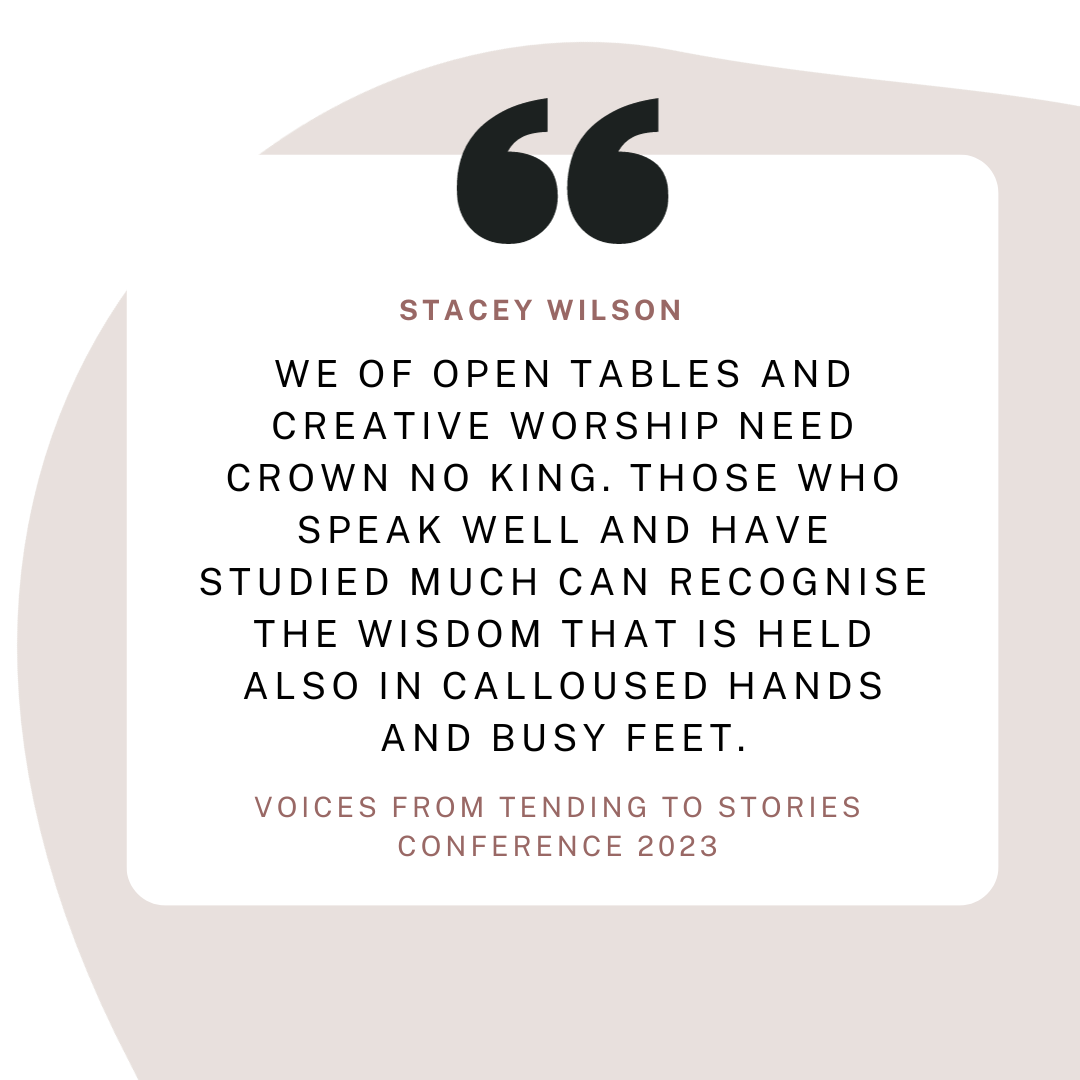
Tending to the stories shared with the Royal Commission into Institutional Responses to Child Sexual Abuse requires a willingness to examine even our most embedded faith practices, including the dominance of the clerical model of leadership within the western church. Its worst form, clericalism – the veneration of those holding positions of church leadership – has consistently demonstrated causal significance in the risk of abuses within religious institutions and congregations. Clericalism generates institutional hierarchies of power and influence that in turn protect the structural and systemic status quo thus maintaining the authority and status of the institution. 

The beating heart of clericalism in the western church is the sermon. The single voice, articulate and educated, offering instruction and exhortation to the community. A practice, with its roots in the rhetoric traditions of the Greek and Roman empires, that has been a key feature of protestant liturgy since the European Reformation. The significance of the sermon is demonstrated by the fact that preaching has become one of the key indicators of leadership. Being ‘qualified to preach’ now shorthand within debates over who is authorised to hold ministry roles.

The Ignatian spiritual practice of communal discernment offers an alternative to traditional from the front, education focused discipleship. This paper will explore the use of silence, story, curiosity and creativity in theological and exegetical tasks. It will argue that these practices honour the knowledge, wisdom and capacity for discernment present within communities of faith and counter the spiritual passivity and learned helplessness that clericalism fosters. 

Stacey Wilson is a qualitative research consultant with The Recollective. Her role also includes resource development, training and mentoring. This paper builds on her work, Theology and Abuse: Vulnerability in the Midst of Religious Institutions, published in Children’s Ministry and the Spiritual Child (Robin Turner and Trevecca Okholm, editors. Abilene Christian University Press, 2023). 
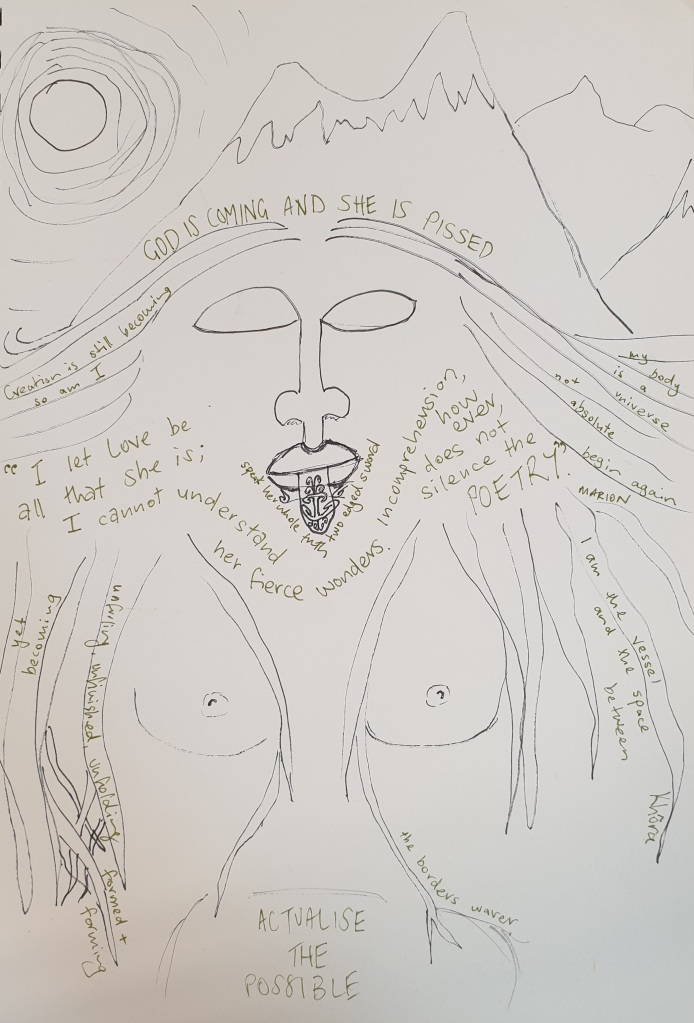
A creative reading today of Intercarnations : Exercises in Theological Possibility by Catherine Keller, Chapter 1: Returning God: Gift of Feminist Theology…

“I let Love be all that she is; I cannot understand her fierce wonders.
Incomprehension, however, does not silence the poetry”

Hadewijch of Brabant (a 13th-century poet and mystic), Minne
Is it dry?
Is it a spring?
Is it a, somehow, living thing?
It is a song.
It is the bird.
It is the book.
It is the Word.

#spring #puna

Shameless

a picture of the cover of shameless by nadia bolz-weber. A black white image of the garden of Eden but the humans and the snake are in colour.

“This is the body of Christ, every lump and scar and curve of it. We are present to God and to each other and God is present in these human bodies. All of them.

God is made known: in the miracle of our infant bodies, so recently come from God that you can smell God on their heads; in the freedom of our childs bodies as they were before shame and self-consciousness entered into them; in the confusion of our pubescent bodies and the excitement of our teenage bodies as they become familiar with desire; in the fire and ice of our young adult bodies as they connect with each other; in the goddamn mind-blowing magic of our baby-making bodies; in the wisdom in our aging bodies, and in the so-close-to-God-you-can-smell-God beauty of our dying bodies.

Incarnation, Carne, Flesh

Nadia Bolz-Weber, Shameless 2019

Nadia Bolz-Weber’s writing reminds me of Anne Lamott’s – raw honest stories. You can’t deny that kind of witness to ‘holy resistance’ that says: I will testify to the experience of my body and the experience of my God to what the truth is.

We get so many messages about what are bodies are, what they aren’t, what they’re supposed to be. What we should eat, not eat, go on a diet, eat a pie, you should be thin but men like a woman with some meat on her bones.

Indeed, we all feel gnawed on by the relentless message to be something other than what we are. Let this book be the sip of living water that affirms you. Affirms your body. Affirms your sexuality. Affirms your identity, made in the image of God.

Why do shameless and shameful mean basically the same thing? Shameless: brazen, barefaced, brash, impudent, unblushing. These adjectives apply to that which defies social or moral proprieties [Free Dictionary].

Be shameless then. Be defiant. Be shamefreely and defiantly you. Made in the image and sexuality of God.

Leaf prints in Carlton, Melbourne from ochre coloured dust swept off
Latji Latji Country, 540 kilometres away

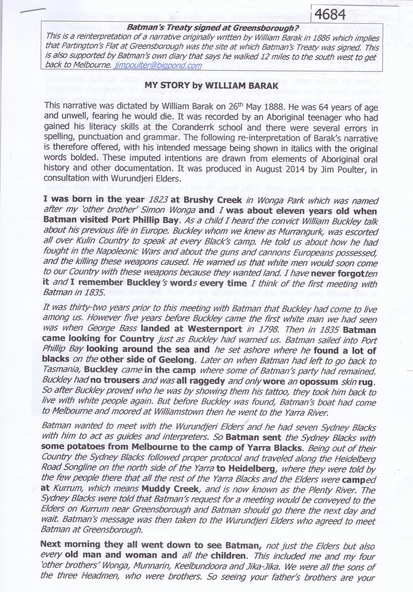
Read these brief stories about Jesus and William Barak. How can stories of others’ formation, knowing the lives they went on to live, inform how we might live out our own discipleship or radical discipleship within community?

Mark 1:9 In those days Jesus came from Nazareth of Galilee and was baptised by John in the Jordan

This is our introduction to Jesus in Mark. Nazareth is so small and insignificant that it’s not mentioned anywhere other than the New Testament – a marginal village of maybe 400 people at the margins of the country Israel. Nazareth was based on the outreaches of Sepharus (the admin base of Rome and capital of Galilee)… other that being the birth place of Jesus this is mainly known for the Sepharus uprising, a rebellion of the Jews against Roman occupation. The Romans crushed Sepharus and enslaved everyone. Nazareth is only 4 miles from Sepharus and Jesus would have been 10 years old when this happened and he would have been able to see the city burn. Jesus and his Dad were techtons (labourers, construction workers) hired to help rebuild Sepharus for the colonial occupiers.

[Ched Myers, Bible studies series at the BCM Kinsler Institute 2015]

William Barak was born into the Wurundjeri clan of the Woi wurung people in 1823, in the area now known as Croydon, in Melbourne. His father Bebejan was a ngurunggaeta (clan head) and his Uncle Billibellary, a signatory to John Batman’s 1835 “treaty”, became the Narrm (Melbourne) region’s most senior elder. As a boy, Barak witnessed the signing of this document, which was to have grave and profound consequences for his people. (Culture Victoria)

Note: This Treaty was overruled by NSW within months.

And the second paragraph here, “I was born…”

william barak my story

What arises for your community with these readings?
Who are your community apprenticed to?
(traditions, elders, movements… tell these stories)
In either our personal stories, if people want to share them, or in the history of the community – what are the significant events of our formation?  What powers shaped us?
What powers might be shaping us/influencing our formation now?

tree with overarching branches

You are God’s servants, gifted with her Wisdom and visions
Upon you rests the grace of God like a woven cloak
Love and serve the Divine in the strength of the Spirit.
May the deep peace of God take root in you, the open arms of Christa sustain you and the eucharistic power of the Holy Spirit transform you in every way.

A feminist reworking of the Urban Seed/Credo/Seeds benediction for the Australian Collaborators in Feminist Theologies planning day.

mujerista theology

I am currently reading “Mujerista Theology: A Challenge to Traditional Theology” by Ada Maria Isasi-Diaz and am struck by the way Isasi-Diaz uses Latina words and concepts to describe the theology and methodology of Latina women; the role this plays in identity and belonging of the group and in grounding the words and praxis of Latina theologians in a cultural context.

Here’s an excerpt:

…Lo cotidiano for us is also a way of understanding theology, our attempt to explain how we understand the divine, what we know about the divine. I contrast this to the academic and churchly attempts to see theology as being about God instead of about what we humans know about God. Lo cotidiano makes it possible for us to see our theological knowledge as well as all our knowledge as fragmentary, partisan, conjectural, and provisional.  It is fragmentary because we know that what we will know tomorrow is not the same as what we know today but will stand in relation to what we know today.  What we know is what we have found through our experiences, through the experiences of our communities of struggle. What we know is always partisan, it is always influenced by our own values, prejudices, loyalties, emotions, traditions, dreams, and future projects.  Our knowing is conjectural because to know is not to copy or reflect reality but rather to interpret in a creative way those relations, structures, and processes that are elements of what is called reality. And, finally, lo cotidiano, makes it clear that, for mujerista theology, knowledge is provisional for it indicates in and of itself how transitory our world and we ourselves are.

Ada Maria Isasi-Diaz, Doing Mujerista Theology pp71-72.


As a Pakeha/Ngai Tahu woman living as a visitor on the unceded lands of the Wurundjeri people of the Kulin Nations – how do my cultural identity and location within place inform my writing, thinking and theology? And the language that I use to communicate my ideas?

In my experience, most books of theology loaned or recommended to me have come from a predominantly North American or northern hemisphere context. There is a disconnection and displacement in that which feels rarely spoken of or acknowledged, for instance when the symbolism, art and exegesis are located in a different hemisphere but used in ours – an easy example is noting such times like Easter (darkness) and Christmas (cold).

Acknowledging of course, all those women of colour and woke women who are and do use language and cultural context in their theological exegesis, for those who aren’t using ‘local’ language in our theological discernment and writing, what are we offering that is specific to our personal and geographic context?  Is this language lack linked to the disconnection from our cultural tale?

We cannot tell a story we do not know.

How do the ideas of Kaupapa Maori or Mana Wahine, or unresolved Australian identity politics and influences of policies such as Terra Nullius, already influence and inform my thinking, theology and writing in conscious and unconscious ways?

I think there might be an idea that our writing is more professional, academic or more universally relevant if these “personal” elements are left out, but are we still looking to our euro-centric, patriarchal forebears to tell us what to do and how to do it rather than finding God here, on this country, and speaking to that? What are words and ideas we could be drawing on that shape and inform our feminist praxis and writing based out of the Pacific?

Tell me, and show me, what can the South Pacific theology offer to the North?

That is the book I want to read.

Submissions to the Australian Collaborators in Feminist Theologies call for papers are due tomorrow and the words for the theme play over in my brain, “Power, Authority, Love: Write, Rite, Right”.

I’m not great at drawing but this sketch came to me this morning… my first attempt at icon arrives as an Eve figure with attitude.

She’s not taking any of your crap or blame and she hates it when people say: “I’ve never thought about it like that before” in a condescending tone as if a woman doing theology was as much a marvel, or as clever, as a dog learning to rollover. She is smart, she is strong, she sees right through you and in her deep well of silent appraisal is your sinking self-awareness. Check it – those earring are available from Haus Of Dizzy.

Dr Alana Harris Kings college gender equity in academia

The Athena SWAN Charter was established in 2005 “to encourage and recognise the commitment to advancing the careers of women in science, technology, engineering, maths and medicine (STEMM) employment in higher education and research” In 2015 the scheme was extended to arts, humanities, social science, business and law (AHSSBL) subjects. Dr Alana Harris and Professor Abigail Woods participated in the bronze accreditation being rolled out at King’s College, London but also headed the project to analyse and assess across an audit of the framework which institutional contexts, working practices and interventions are most conducive to advancing gender equality…  for more information read the report or play a round of Gender Equity Snakes and Ladders.

  • When we looked at lecturing staff the gender ratio of men to women was 60:40 but when you look at professorial level that ratio shifts to 80:20. At the age you might be offered that seniority, women are often caring either for children and/or aging parents.
  • Doing a staff survey in real time gave everyone a voice and ensured they felt heard. Respondents replied more honestly. When you are sitting in a room with your colleagues and x indicate they “don’t feel they are consulted or able to contribute to decision making”, you feel that in the room and its powerful.
  • In an assessment of staff shared working space…  70% of women were sharing and only 7% of men.
  • If you are to apply for the Athena SWAN Bronze Award that work needs to be resourced. Attainment of the first level takes 5 years. It’s a commitment to a process.
  • A cultural shift is not just about women joining in more to existing structures. Change happens with longevity and legacy.  In staff meetings we use a collaborative process of decision making.  This has been habituated into virtue and staff would revolt now if someone tried to take it away.

Is there anything feminist about the framing of this model?

It looks different on the ground everywhere its been applied.  Sometimes women are empowered to lead it and sometimes men encouraged to so it’s not seen as just “a women’s thing”.  When you start looking at systems and structures for parity you very quickly see beyond gender and that informs the process. Eg  in auditing assigned reading lists, how many readings are by women? You can’t help but also ask, how many by people of colour? Creating assessment tools for LGBTIQ inclusion and religious diversity will be next.


Anything you would suggest for consideration by the Australian Collaborators in Feminist Theologies at the University of Divinity?

You are named in the Strategic Plan “To be a centre of excellence in feminist theological scholarship and in mentoring academics so as to challenge and transform patriarchal structures and assumptions in the academy, church, and wider world.”  You need to have impact beyond being UD strategic aim 3.  What impact into other areas of work, institution and structure can be implemented?

Hold events during the day, not evenings. Our event are not held in a pub, moving away from the ‘old boy club’ feel. We host an academics book party once a year at 3pm in the afternoon and cross-read our texts eg. modern history lecturer trades their book with the medieval history teacher.

It seems senior male academics support younger counterparts but senior women don’t? External support scaffolding, if it’s not available within the institution, can be really useful. Ref. Facebook group: ‘Women in Academia Support Network’ or Australian Collaborators page.

What are the vision and mission statements of the UD?  These set the culture of the institution and its frameworks – if these have inclusive language then then culture will be inclusive and staff attracted to that culture be drawn to work for that organisation.  If your work sits outside the scope of these statements you may not be fighting only students to accept new ideas and thinking but other staff.

What do you do with the resistant remnant?

Isolate them. Move them to one side where they can do the least harm. If they’re not able to support or participate in change their means to prevent it needs to be minimised.

You’ll always get people who will say: “There aren’t women to cite. They aren’t there”, if you were taught to a reading list that was all male, the conference speakers you here are male, the professors you look up to are male… we need to be able to interrogate our own networks of influence.

Activist fatigue is real.  You need allianceships. Rather than being  one strident voice… ask someone else to raise it in a meeting and lend your voice to theirs. Need mix gender mentoring and people who will back you up in meetings… and at conferences introduce you to the right people.

If you are looking for increased balance in curriculum and representation… crowd source knowledge from within the network. Aim for 25% female.

Questions to ponder:

  • Would the UD undertake an audit of its course set reading lists? Or undertake the Athena SWAN Bronze accreditation?
  • What does ‘external support scaffolding’ look like? Can/should we provide it?
  • What are the precedents? eg. getting a researcher when you come back from mat leave. Case study for part time work…If something’s offered at another like University/College/ department, you might be able to use that as leverage at yours.
  • In what ways can the Australian Collaborators in Feminist Theologies stimulate and promote momentum in the areas of feminist and minority voices at the UD?
  • What are the vision and mission statements of the UD?

Our Vision

Together we empower our learning community to address the issues of the contemporary world through critical engagement with Christian theological traditions.

Our Mission

We fulfil our vision through:

  • excellence in learning, teaching, and research;
  • growth of our resources and capacity; and
  • engagement with the churches and community in Australia and internationally.

https://divinity.edu.au/university-of-divinity/about-us/our-vision-and-mission/

20181101_194851