Tag Archive: living


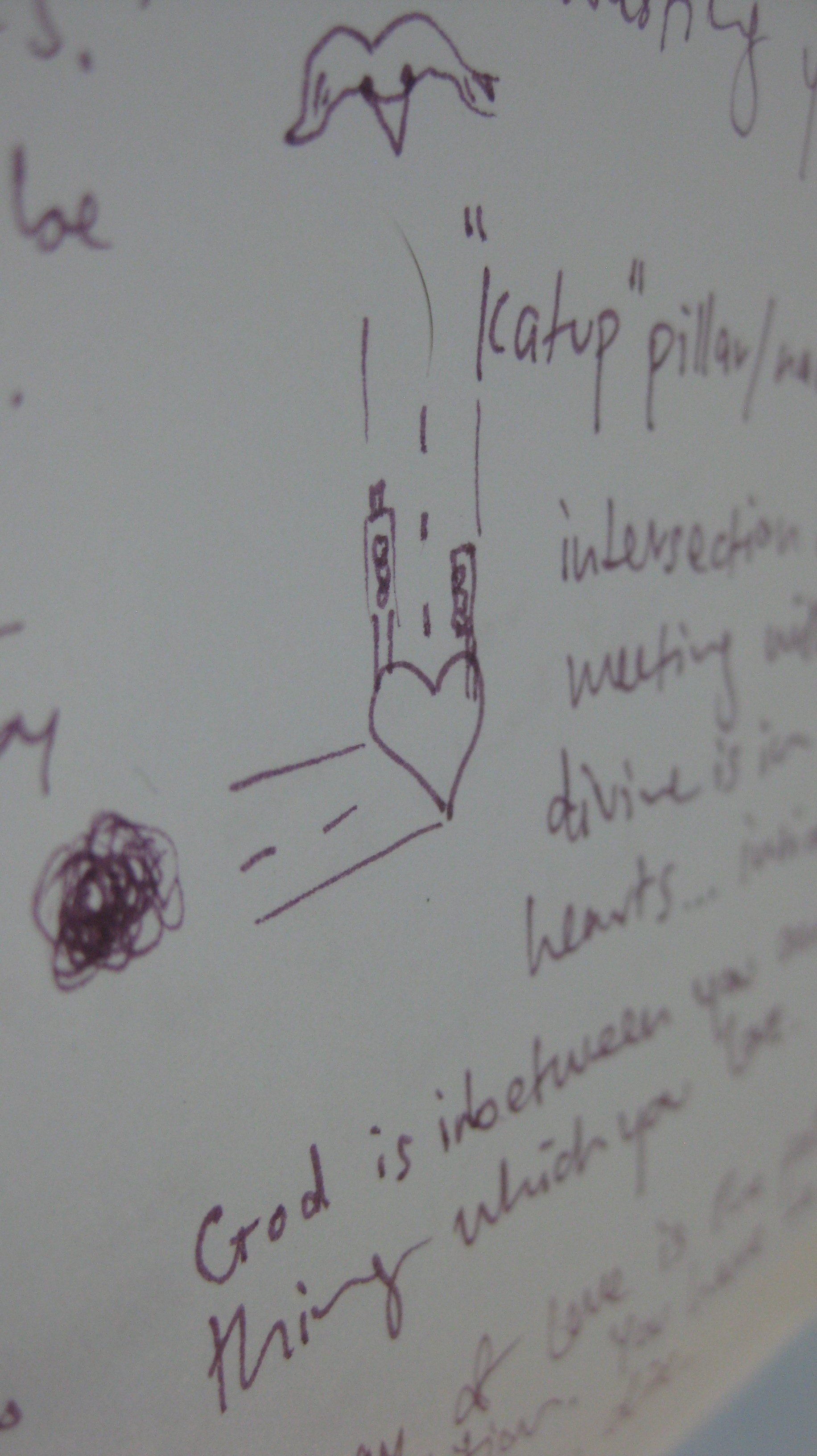
“This is giving your life to the one within that you know as Lord, which is a totally private matter. No one except you can judge how that is going. But if you’re not doing it, Rumi says, you are wasting your time here.” Coleman Barks. Preface, pg xv

058

The Way of Love is:

  • the path of annihilation – die before you die
  • not religious
  • escaping into silence

Love writes a transparent calligraphy, so on
the empty page my soul can read and recollect.

  •  a mystical conversation or shobet
  • is learning through grief

My work is to carry this love
As comfort for those that long for you,
To go everywhere you’ve walked
And gaze at the pressed down dirt.

  •  discipline – polishing the mirror

 Rumi says an ecstatic human being is a polished mirror that cannot help reflecting. What we love, we are. As the heart becomes cleaner, we see the kingdom as it is. We become reflected light. The polishing may be related to practices, a devotion we do everyday that is an emptying out…

 What does it look like to remember who we are (our best selves) and acting from there?

What practices could we engage in that help us remember?

Drowning

What can I say to someone so curled up
with wanting, so constricted
in his love? Break your pitcher

against a rock. We don’t need any longer
to haul pieces of the ocean around.

we must drown, away from heroism,
and descriptions of heroism.

Like a pure spirit lying down, pulling
its body over it, like a bride her husband
for a cover to keep her warm.

Longing

Longing is the core of mystery.
Longing itself brings the cure.
The only rule is, suffer the pain.

Your desire must be disciplined,
and what you want to happen
in time, sacrificed.

we share life together

we share life together
you and I
you know me and I know you
I try to tell you about my day
while we load the dishwasher, bathe the kids, clear the
table, sign the permission slip, find today’s
reader, break up the fight…
Are you listening to me?
I don’t feel heard.
I do things for you all the time
and you do them for me
we’ve been at this for a while
and we have our rhythms and habits…
do you think though, we could ask more often
“What do you need?”
I suppose I want to pick and choose
only being helpful in those ways
I like
we each need the reminder that
love finds a way
you know me and I know you
you and I
we share life together


Talitha Fraser

…metabolise pain as energy.  The key to doing that is to know, to trust, and to act as if a silver lining exists if you are only willing to look at the work differently or to walk through a different door, one that you may have baulked at.

(p.135, Julia Cameron, The Artists Way)

023


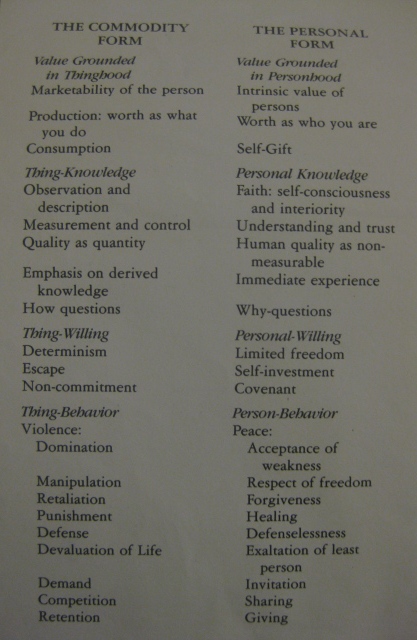
A community of this kind must be (a) consciously choiceful, (b) explicitly committed to and willing to be called to life in the Gospels, (c) open to change through the authentic living-out of its principles, and willing to be challenged to fuller Christian praxis, and (d) prepared to confront the patterns of the Commodity Form – injustice, manipulation, domination, dishonesty, escape – not only as they appear in the culture at large but also as they surface within the group itself.

…The continued intimacy of shared life which is open to new life, however, is one which necessarily entails the suffering of growth and of daily dying to immediate gratification, to the satisfaction of one’s clamoring ego, and to one’s defenses against self-revelation.

~ John F. Kavanaugh, S.J.

Teaching 12 – The Root of Suffering

What keeps us unhappy and stuck in a limited view of reality is our tendency to seek pleasure and avoid pain, to seek security and avoid groundlessness, to seek comfort and avoid discomfort.  This is how we keep ourselves enclosed in a cocoon.  Out there are all the planets and all the galaxies and vast space, but we’re stuck down here in this cocoon.  Moment after moment, we’re deciding we would rather stay down in that cocoon than step out into that big space.  Life in our cocoon is cosy and secure.  We’ve gotten it all together  It’s safe, it’s predictable, it’s convenient, it’s trustworthy.  If we feel ill at ease, we just fill those gaps.

Our mind is always seeking zones of safety.  We’re in this zone of safety and that’s what we consider life, getting it all together, security.  Death is losing that.  We fear losing our illusion of security – that’s what makes us anxious.  We fear being confused and not knowing which way to turn.  We want to know what’s happening.  The mind is always seeking zones of safety, and these zones of safety are continually falling apart.  Then we scramble to get another zone of safety back together again. We spend all our energy and waste our lives trying to re-create these zones of safety, which are always falling apart.  That’s the essence of samsara – the cycle of suffering that comes from continuing to seek happiness in all the wrong places.


Teaching 20 – Solgan: “All activities should be done with intention”

Breathing in, breathing out, feeling resentful, feeling happy, being able to drop it, not being able to drop it, eating our food, brushing our teeth, walking, sitting – whatever we’re doing could be done with one intention.  The intention is that we want to wake up, we want to ripen our compassion, and we want to ripen our ability to let go, we want to realise our connection with all beings.  Everything in our lives has the potential to wake us up or put us to sleep.  Allowing it to awaken us is up to us.


Teaching 37 – The Practice of Compassion

We cultivate compassion to soften our hearts and also to become more honest and forgiving about when and how we shut down.  Without justifying or condemning ourselves we do the courageous work of opening to suffering.  This can be the pain that comes when we put up barriers or the pain of opening our heart to our own sorrow or that of another being.  We learn as much about doing this from our failures as we do from our successes.  In cultivating compassion we draw from the wholeness of our experience – our suffering, our empathy, as well as our cruelty and terror.  It has to be this way. Compassion is not a relationship between the healer and the wounded. It’s a relationship between equals. Only when we know our own darkness well can we be present with the darkness of others. Compassion becomes real when we recognize our shared humanity.


Teaching 43 – Tonglen: The Key to Realising Interconnectedness

…when anything is painful or undesirable, breathe it in.  In other words, you don’t resist it.  You surrender to yourself, you acknowledge who you are, you honour yourself.  As unwanted feelings and emotions arise, you actually breathe them in and connect with what all humans feel.  We all know what it is to feel pain in its many guises.

You breathe it in for yourself, in the sense that pain is a personal and real experience, but simultaneously there’s no doubt that you’re developing your kinship with all beings.  If you can know it in yourself, you can know it in everyone.  If you’re in a jealous rage and you have the courage to breathe it rather than blame it on someone else, the arrow you feel in your heart will tell you that there are people all over the world who are feeling exactly what you’re feeling.  This practice cuts through culture, economic status, intelligence, race, religion.  People everywhere feel pain – jealousy, anger, being left out, feeling lonely.  Everyone feels it in the painful way you feel it.  The storylines vary, but the underlying feeling is the same for us all.

By the same token, if you feel some sense of delight – if you connect with what for you is inspiring, opening, relieving, relaxing – you breathe it out, you give it away, you send it out to everyone else… If you’re willing to drop the storyline, you feel exactly what all other human beings feel.  It’s shared by all of us.  In this way, if we do this practice personally and genuinely, it awakens our sens eof kinship with all beings.

Teaching 86: Six ways to be Lonely

Usually we rgard loneliness as an enemy.  It’s restless and pregnant and hot with the desire to escape and find soemthing or someone to keep us company.  When we rest in the middle of it, we begin to have a non=threatening relationship with loneliness, a cooling loneliness that turns our usual fearful patterns upside down.  There are six ways of describing thsi kind of loneliness:

1. LESS DESIRE is the willingness to be lonely without resolution when everything in us yearns for something to change our mood.

2. CONTENTMENT means that we no longer believe that escaping our loneliness is going to bring happiness or courage or strength.

3. AVOIDING UNNECESSARY ACTIVITIES means that we stop looking for something to entertain us or to save us.

4. COMPLETE DISCIPLINE means that at every opportunity, we’re waiting to come back to the present moment with compassionate attention.

5. NOT WANDERING IN THE WORLD OF DESIRE is about relating directly with how things are, without trying to make things okay.

6. NOT SEEKING SECURITY FROM ONE’S DISCURSIVE THOUGHTS means no longer seeking the companionship of constant conversation with ourselves.

Last night we had “Prayers in the Pergola” reflecting on Armistice day and peace, William Stringfellows article ‘The Marks of Involvement’ was referenced:

“Christians are those who take history very seriously.  They regard the day-to-day existence of the world realistically, as a way of acknowledging and honouring God’s own presence and action in the real world in which human beings live and fight and love and vote and work and die. And Christians know, more sensitively and sensibly than other people, that this is a fallen world, not an evil world but the place in which death is militant and aggressive and at work in all things. Christians know that in this world in which, apart from God’s work in all things, death is the only meaning, all relationships have been broken and all human beings suffer enstrangement from one another and alienation from themselves. Of all people, Christians are the most blunt and relentless realists.  They are free to face the world as it is without flinching, without shock, without fear, without surprise, without embarrassment, without sentimentality, without guile or disguise. They are free to live in the world as it is.”

How are we living into this understanding of reality? We are called to see and understand… perhaps especially those things at which it is uncomfortable to look too closely. We do not live in isolation. In a world where war and violence affect so many – not only today’s fight but the generationally wounded – how can we speak resurrection and hope into that?


A staff member shared this reflection at prayers a few months ago:

A person kneels to contemplate a tree and to reflect the troubles and joys of life. It is difficult to accept that life is difficult; that love is not easy and that doubt and struggle, suffering and failure, are inevitable for each and every one of us. We seek life’s ease. We yearn for joy and release, for flowers and the sun. And although we may find these in abundance we also find ourselves lying awake at night possessed by the terrible fear that life is impossible. Sometimes when we least expect it we wake up overwhelmed by a massive sense of loneliness, misery, chaos and death: appalled by the agony and futility of existence. It is difficult indeed to accept that this darkness belongs naturally and importantly to our human condition and that we must live with it and bear it. It seems so unbearable. Nature, however, requires that we have the darkness of our painful feelings and that we respect it and make a bold place for it in our lives. Without its recognition and acceptance there can be no true sense of life’s great depth, wherein lies our capacity to love, to create and to make meaning. A person kneels to contemplate a tree and to reflect upon the troubles and joys of life. The person imagines mornings and evenings in a great forest of prayers, swarming and teeming with life… The person is learning how to pray.

Prayer Tree – Leunig

Jean Varnier in “Community & Growth” says:

I am more and more struck by people in community who are dissatisfied. When they live in small communities, they want to be in larger ones, where there is more nourishment, where there are more community activities, or where the liturgy is more beautifully prepared.  And when they are in large communities, they dream of ideal small ones.  Those who have a lot to do dream of having plenty of time for prayer; those who do have a lot of time for themselves seem to get bored and search distractedly for some sort of activity which will give a sense to their lives. And don’t we all dream of the perfect community, where we will be at peace and in complete harmony, with a perfect balance between the exterior and the interior, where everything will be joyful?

It is difficult to make people understand that the ideal doesn’t exist, that the personal equilibrium and they harmony they dream of come only after years and years of struggle, and that even then they come only as flashes of grace and peace.  If we are always looking for our own equilbrium, I’d say even if we are looking too much for our own peace, we will never find it, because peace is the fruit of love and service to others… look instead at your brothers and sisters in need.  Be close to those God has given you in community today… everything will resolve itself through love.
More and more I am coming to understand that it is our brokenness that binds us rather than our perfection.  In a consumer society where it always feel like the grass is greener somewhere else it is important to buy-in somewhere and commit to growth in your own patch of the neighbourhood.  In owning the brokenness and needs I bring to community I am humbled to extend to others the welcome I myself receive.  Those plants I want to see the fruit of? I have to help them grow… I pray that you will know  a flash of grace and peace this week.


‘to love our neighbours as ourselves’ is a common belief across all faiths.

Sometimes feel depressed – actually those are things worth feeling depressed about (global financial crisis, global warming…) We are complicit in an exploitative system.  Fills us with sorrow.  Accept it as a reasonable response and don’t let it incapacitate me.

Joy and sorrow can co-exist.  Sadder the older I get.

Nehemiah – the joy of the Lord is my strength. In the midst of my sorrow need to find a reason for hope/joy.  God is always there.  God brings joy.  Need a spiritual discipline of finding God in sorrow.  In all things God is working for good.  When we find God in a situation we will find good.  Get up everyday and find something I can rejoice in: within myself, in my relationship with my wife, my family, my community…

Action research – look for problems.  Find them. Generate more à become overwhelmed e.g. “what do you see as the problems in our relationship?”, ask your partner that question and you will have found some problems to work on!

Appreciative research – peak experience, best practice.  What do you like about our relationship? Why? How could we do this more often in the future? E.g. what are the best times we’ve had together? What made them good? How could we have them more often?

Dealing with the negative in a more positive framework is more energy-giving.

What is truly there? Something about how it operates that sustains it – start from that.  E.g. people will keep running a programme long beyond when it is sustainable, it must be because there is something in that worth saving.

Positions polarise – close down options into one of two.  Those positions harden and it becomes difficult to see resolution.  Ask “why?” of both sides to draw out fears and desires.  See if there are solutions beyond their positions that meet desires and address fears. Not easy and not quick.  Fear of the process greater than need to change. E.g. building mosque – the side against were concerned about increased traffic flow and parking, Muslim people feared religious intolerance in their community.

Several options that can look like:
–          No existing relationship, no interest in a common goal
–          Committed to action, regardless of how it affects other relationships
–          Relationship so important, need to NOT act. Can’t risk it.
–          Do have a relationship – are interested in resolution (partial/unlimited)

Community with family:

Plan our time together and there are different kinds:
–          Non-negotiable time, this belongs to my wife and family and it cannot be given away
–          Non-negotiable time, give freely to everybody – don’t need to talk about it
–          Negotiable, to family or community

It is easy to give up something that is not important to yourself on behalf of someone else e.g. living without a fridge in India – easy for Dave to commit to but not for his wife àfundamental injustice.  Only sacrifice what is mine, not what belongs to others. Sometimes excruciating to negotiate, ‘worst way of doing it, apart from all the other ways’. Consequences of not negotiating – more painful.  Negotiating is a heavy process. Something that is life-giving for me might also be death-giving t someone else – have to negotiate to a cost. Often these aren’t win:win but rather choose what is life-giving for her this time and hope that it will roll around to my turn next time.  Important to be putting the other person first.

When first started this work it was all or nothing. Gave freely and fully. Became hurt. You can help and resource others without risking anything but you can’t love them.  Need to be willing/able to be vulnerable. I was becoming increasingly hardened. Prayed. God is love.  To reflect God to the world need to show love.  Get hurt along the way and now scared.  Need to ask ourselves: what can we do today to reach out to those around us so if its not reciprocated or appreciated it won’t destroy us?

Want to risk but can’t take the same amount every day.  A given that we will reach out but give ourselves permission to say how much we are able to risk. E.g. could be the difference between jumping in my car to go to work and only waving at my neighbours on the ways past, or walk out the door and seek people out but only talk about what is ‘light, right, nice, polite’ – no capacity to go to the depths, or go up to one person and go deep: “I’m sorry that we aren’t getting on so well, love to shout you a coffee sometime and talk about it…”

Need to monitor our own degrees of vulnerability.  Become bitter if give more than we can give happily.

Sacrificial giving – condemn Pharisees who only give a little themselves and exploit widows.  Exploit our desire to be generous and then guilt-trip is for more. Jesus was willing to die but not every day, most times Jesus ran away – only died once.  No one takes my life from me but I can lie it down. Sacrifice. We will take a stand and get done over, but not every day.

Need to think about our choices in relation to our partners/kids. E.g. if I am away on holiday for 14 days – need to manage myself to be back, present and attentive, on day 15.  Otherwise that is time that I have stolen from my wife and kids.

So many voices, culture, choices in our head driving us – seek out still small voice (role of the Holy Spirit). For myself, get a blank piece of paper and write things down with an arrow beside them

Arrow pointing upwards: things I want to ask God
Arrow pointing downwards: things God tells me
~ this becomes my ‘to do’ list

Prayer: God grant me the serenity to accept the people I cannot change, the courage to change the one I can and the wisdom to know it’s me.

Turning inwards, that job will never be complete.  But others seeing you on the journey might be inspired to become more like you. Teach me the lessons I need to learn so that I can be useful to someone else in the future.

Appreciative inquiry – if actions are oppressing a third party: have to intervene. In some occasions you can avoid/walk away but others you must intervene.

Becoming involved in conflict:

Keep your distance – a) helps situation not to escalate and b) gives you a head start if you need to run. Say something like “hey mate, can I help you something?” address the perpetrator not the victim.  Will think you’re on their side.  Want to protect them from harm themselves. Always frightened and fearful when getting involved.  If fair fight might sometimes keep walking but not if someone is out-numbered or overpowered.

Be gentle on ourselves. Can be our own worst enemy and our own best friend.  Rather than seeking validation from others, seek how God sees me. My needs and ideas are valid too.  Can’t wait for someone else to tell me that.  Desire for acceptance/approval. “The Lucifer effect”

In the context of God’s validation, accept ourselves.

Activist/doing – gets approval.  Hard work of seeking God and being still – becoming aware of our own faults and limitations. Can ‘survive’ and not maintain your soul. What is the bottom line of what you are willing to compromise of your faith/values? E.g. in a concentration camp: some did anything to survive, even kill other jews (had a life, but no soul), others were reformers preaching hope/outspoken, executed quickly (had soul but not their life), third type would not intervene in someone being beaten but would not engage in brutality themselves (both soul and life).

Whether they fire or shoot me  won’t do ….

What is the bottom line of what you are willing to compromise of your faith/values?

Urban Vision’s model is for those living in community to pay board and then share their room with a young person.

Luke 10 – sending out the 70

Three things:

1)      Don’t take purse, bag or sandals

Simplify your life.  Don’t take anything with you.  Feel like we need to have all of the resources/tools/time before we start.  Why would God give you a miracle when you already have stuff? (Jacqui Pullinger)

In order to be involved in significant hospitality in your house, what would you need to simplify? (discuss with person sitting next to you)

–          Queen-sized bed kills community (barrier to having people stay as compared with 2 single beds in a room)
–          Need a smaller couch (could move study into lounge then and have a spare room)
–          Work less hours
–          Be ‘present’ more
–          Share house to cover rent/mortgage

Hospitality means more if it costs you something e.g. person will know you are sacrificing privacy/personal space to have them. Sharing in economy of ‘enough’ rather than only giving out of my excess.

Average person has six groups of people they connect with:
–          family
–          work/study
–          worship/church
–          social/sport/bookclub
–          people we live with
–          Ministry e.g. youth work
Need to cull groups to create physical time.  Home can become a castle (has a moat, don’t let anyone in) or motel (only use it to drop gear off/sleep). We made a conscious decision to only have three groups: Family, work and then everything else combined into one.  Relocation is helpful.  Doing something like “Servants to Asia” easier than relocating in your own context.  We won’t initiate with wider group of friends – those who are committed to the friendship will be faithful to asking us.  Modular approach – go on holiday for a week – be deliberate about spending time with good friends then rather than catching up every week.

2)      Sending as lambs amongst wolves

Bad news for disciples.  Only thing he promises is that He will never leave or forsake us. Hospitality opens us to a level of vulnerability. Living in inner city, did I get beaten up? Yes. Can’t follow Jesus without it being dangerous.  You will disappoint your parents.  They love you and don’t want you to be hurt.

In order for me to do hospitality, what are the risks? What are you afraid of? (discuss with person sitting next to you)

–          duty of care/accusations (particularly for men around kids/youth work)
–          introversion of other housemates
–          are my kids safe?
–          my own personal safety (particularly for women)

Living in the centre of God’s will, safest place to be. Some lessons learned/benefits:
–          community
–          aunties and uncles
–          spend time debriefing
–          children are good observers but not good interpreters, blame themselves
–          know the background of those you take in (doesn’t necessarily mean that you don’t take them but you know what the risks are)
–          don’t have kids the same age as ours – creates a sense of competition/competing for space whereas if younger/older sense of difference and room for everyone.
–          don’t take anything into your house that isn’t going to be a blockage if you lost it e.g. ring from grandmother (hard to forgive if you lost it)
–          need to have a “no resentment policy” – nothing that will cause bitterness
–          once kids are at an age where looking for influence be careful about who you invite in, e.g. more cautious around that once children were teenagers.

3)      When you meet someone on the road, do not stop and talk. Stay only in one house.

What are the cultural distractions/idols that stop us from doing hospitality well? E.g. career, mortgage, super/retirement…

Downsize and take back control.

It is what you make here that is important not what you get there (illusion that grass is greener)

I am an introvert – throw yourself into it! For the first three months you love it and think everything is really great, for the next year and a half or so the noise of the people you live with feels like a constant annoying drone. Once you get to 2 years its background noise and you don’t notice it anymore.  Rhythm of prayer with focus on silence.  Run marathons – just me and the road.  Switch off into a book but can now do that while I’m in a room full of people.

Becomes obvious quickly where a young persons fragility lies.  Adults are better at hiding the dysfunction – structure our lives to account for our dysfunction. Once in community that doesn’t work, being in community wears down those self-managing boundaries.  Unprocessed-ness spills out onto other people (community will explode after 2 years).  If you want to have community need to have a high commitment and integrity to become who you are called to be.

There are always inclusion/exclusion factors/tensions.  In order to be inclusive at another level you have to be exclusive – want them to join kingdom of God, not to join us.  It is imperative that we have sustainability. Small core of committed people working to a common goal together.

Where do the people come from? Around Urban Vision, totally word of mouth. At Ngatiawa we get ex-prisoners, school guidance counsellor makes referrals. Need a maintain a balance between community members and punters – need more structures as you get bigger e.g. smoking circles. We made it a rule that no one was allowed to smoke with anyone else.

–          Don’t what it to be them and us, and this is a separation that reinforces that
–          Who is influencing? Those who are also struggling themselves
–          Have one struggler, bond with them before introducing another struggler
–          Strong sense of family/extended family (whanau) combine worlds.

When bringing in a new ‘struggler’ how do you find out what their issues are to measure/prepare appropriately for risks?

–          Can often find out some info from whoever is making the referral
–          Ask, what are you addicted to?
–          Ask, do you have any mental health issues?
–          Always other stuff that comes up as you get to know someone

~ I don’t want to know details/be polluted. Want to be able to relate to them as a person


Of all the virtues we’ve explored,
love is surely the most comprehensive,
the most all-encompassing,
and the most slippery of them all.

What is love?

The word is used so loosely,
widely and indiscriminately,
it’s hard to pin down.
so generic is ‘love’
its substance evaporates.

I love my wife,
I love my iPhone;
I love God,
I love coffee.

Love is all you need apparently.

Love rules,
love triumphs over all.

Love obligates,
love liberates;
love is fickle,
love is strong;
love is free,
love costs;
‘greater love hath no man that this,
that he lays down his life for a friend’

We fall in love,
we make love,
we search for it on-line.

We give it generously,
sacrificially,
resentfully,
inadequately,
tentatively.

We long for love,
we dream of it;
we crave it,
we weep for it.

Love compels us,
love eludes,
confounds and distracts us.
love fulfils us and makes us sad.

Love enrages,
infuriates,
intoxicates
and blinds us.

Love lets us down,
love fails,
loves end.
And when love is lost
it leaves an ache so deep it scars.

So love is many things.

But today we celebrate the love of God.

It is a different love, a holy love.
It is also a love of complexity,
but one of such depth
and breadth
and height
and length
it renders all other loves
insignificant by comparison.

At this table we hold love in our hands:
the bread and the wine,
the body and the blood of Christ.
it is a love of such pain
and cost and sacrifice,
it leaves us speechless.

It is a love that reaches into
the depths of human experience
in all its beauty and ugliness,
it glory and depravity.

It’s a love that knows no bounds,
no limits,
no exclusions.
There’s no fine print.

It is a love that confronts,
names honestly,
forgives completely,
heals and restores.

It is perfect love.

It is this love that
1 Corinthians 13 describes,
the perfect love of God.
It is this love
we are now called to emulate.
Quite frankly, it’s beyond us.

It’s a high calling,
a big ask, this love.
it’s always patient,
always kind,
never boastful,
envious or rude.
It’s eternally selfless,
without a hint of malice,
irritation or resentment.
It rejoices in truth and transparency
no matter what the cost.
It bears all things,
believes all things,
hopes all things,
endures all things.
It never ends.

All in all, impossible really;
yet possible in the smallest of ways.

We are not called to perfection,
but we are called to follow, to try,
to keep believing when we fail,
to rise again when we fall.

Through simple words of affirmation:
‘You are precious!’
Through warm embraces
and tender brushes of the cheek;
through daily actions of welcome,
surrender and service;
by giving preference
to the meek, and the poor and the sick;
by sitting with the marginalised
and the grieving;
by speaking against wrong-doing
and unfairness.

By cooking when we don’t feel like it
persisting when we would rather resign,
forgiving when we would rather keep a grudge warm,
serving others when we would prefer to sit alone.

In all of these ways
and a thousand others,
we give hands and feet to love.
Trifling efforts they may be,
fraught with mixed motives
and uneven results.
but in our feeble efforts
at love in daily life,
we touch a love so much deeper,
so much higher,
so much more all-encompassing
than anything we can conjure up ourselves.
‘For now we see in a mirror, dimly,
but then we will see face to face.’
‘And now faith, hope and love abide,
these three: and the greatest of these is love.’

Thanks for the blessing of these words Simon Holt, CSBC