Tag Archive: stories


There is a disconnection within me between who I am and who I feel called to be but it doesn’t feel like a change I can effect in any way on my own although I recognise all the ways I seek to control such things and be the change I want to see. Does it count if you go through the motions of being something in the hopes that you become it?

Come down from the tree Zacchaeus. It does no good to ask the experts anymore.  Get your feet dusty and your hands dirty, keep asking the same questions… The disciples were always asking questions. Being a disciple isn’t “knowing”. It’s being committed to going and picking up what you can along the Way from whomsoever you meet – your family, your friends, your neighbours, your teachers, your priests, your politicians, your encounters with random strangers… all hold a line of the story.  What story do you want to hear? You must seek those people out.

Jesus meets all these different people, perhaps only once. What story can you tell? What can you communicate in one conversation with a person that might change the course of their life? Jesus was something of an epiphany-dealer: what is right? what is clean? what is sin? You can’t yield the principle of the argument. It’s not enough to heal your body if I do not address the system that harms you.  It’s not enough to mend your madness if I do not address the systems that drive you insane. It’s not enough to touch you if I don’t address the systems that label you untouchable.  It’s not enough to include you if I do not also address the systems that have no place for you.

He touches them and they are healed, he hears their whole truth and they are healed again. It’s not only Jesus who hears, not only the healed, but disciples and crowds gathered round… what power is there in a story to effect change? Whose stories are we telling? Whose stories are we listening to?

I am telling my own story. That is the story that I know.

Who am I to try and tell anyone elses story?

Let me tell the story of the time You healed my body, let me tell the story of the time You healed my mind, let me tell the story of the time You took me in and I found belonging.

IMG_4698


IMG_4640

ELAINE BROWN

There is no such thing as a part-time revolution.

We’re not here for black liberation but for all liberation.

We didn’t come here for a better life,
or religious freedom [like migrants to US],
we came kicking and screaming.

We provided the conditions for people to bring about the revolution –
gave them free education, a free breakfast, access to a free clinic…
they have the human right to food, to health care –
we gave them the experience of something worth fighting for.

Are we breaking the glass ceiling to be oppressors ourselves?!
No. We have a common enemy.
Can’t see ourselves in competition with anyone else.
What is our agenda as women?
To find solidarity with the others who are suppressed.

IMG_4644

PAOLA BALLA

Learn how to situate yourself.

Do not let your feminism drive your racism.

Mind and heart, mine is a matriarchal tradition – 
you experience yourself as a part of others.

Activism is radical self-care.
It is a form of activism to thrive, not just survive.
Art is not living but living can be art.

“The world will crumble one day.
It’s ok. We know how to be poor.
We know how to live without electricity…”
– Rosie Egan

IMG_4652

NAYUKA GORRIE

(of WOW/speakers)
To see your reality reflected back you.
Very powerful.

How much of my gender came out of a book? A ship?
The convent that beat my grandmother?
We need to consider: how is gender colonised?

Your black body is never quite yours in this country.
Hyper-sexualised vs. not attractive at all. Strong vs. not strong at all.
Used for labour (work) vs. in labour (baby)
A shaved head means either a Britney melt down (dysfunctional)
vs. fundraising for cancer (held up as a role model) –
What other personal reclamations can I make of my own body?

Keep this flesh vessel tight [runs regularly].
Doing well is resistance.

by Talitha Fraser with Kaumatua Gregg Morris
[this piece first appeared on Radical Discipleship‘s website 17/02/2017]

Allow me to invite you to join in for a game of kilikiti, to sing and dance with us, to walkabout…  sit here at the campfire and I will tell you story…

Coranderrk was one of several Aboriginal missions set up in Victoria .  Wurundjeri leaders William Barak and Simon Wonga advocated for Aboriginal people to live in their own place, their own way. Many times to petition the Victorian Government Barak and Wonga would gather a delegation together, speak to motivate and inspire them, then they would walk together the 60 miles (12 hours) to deliver the message: “Please leave us alone, give us our land back, don’t take it away again”. Leaders of one people to another, approaching as equal and in person.

The Mau was a passive resistance movement seeking Samoan Independence.  When hundreds of members were arrested, hundreds more turned themselves in until all were released because there were more than the system could contain.  People stopped paying taxes and gave the money to the Mau. All local Councils and committees stopped meeting, children stopped turning up to Government run schools which were forced to close, instead of working in the plantations to harvest bananas and coconuts the women would play kilikiti all day.

Communities at Ratana, Hiruhārama, and Parihaka in New Zealand saw a farm converted to a township as taking people was more urgent than the harvest; a poet-led commune of Maori and Pakeha living together; an invading army greeted on the marae with songs, food, and children holding white feathers of peace running counter to the cultural tradition of utu.

All of these expressions of non-violent resistance share elements in common:

  • they were born out of an intention to create safe space – refuge for the dispossessed. Any political activism or engagement brought about was a by-product, not an intention, of what these places existed to protect.
  • they were led by or held in close relationship with indigenous peoples of the land.
  • there was, be it tendril or tap root, a connection to and influence of Christian belief.

Having people elected over you who are imposing laws and structures that are not aligned with what we know about how to live in harmony with each other and with the land is not a new idea.  Romans 12:20 says: “If your enemy is hungry, feed him; if he is thirsty, give him something to drink. In doing this, you will heap burning coals on his head.”  How may we engage a world that is broken, challenging what comes our way – to change it or be unchanged by it – preserving our peace and not be overcome?

As High Chief and leader of the Mau, Tupua Tamasese Leolofi III, lay dying his last words were, “My blood has been spilt for Samoa. I am proud to give it. Do not dream of avenging it, as it was spilt in peace. If I die, peace must be maintained at any price.”  The message of  Te Whiti o Rongomai and Tohu Kakahi, leaders of Parihaka: “Just as night is the bringer of day, so too is death and struggle the bringer of life.”

We need to tend to the sovereignty of our own belief in what is right, to the inspiration of ideals bigger and beyond ourselves, to seek the Spirit and be led thereby to feel and act. Who do you look to, to define who you are? Come, sit here at the campfire and tell me a story…

IMG_0595

Human consciousness projects itself.  It is dynamic and daimonic.  Its excess – like the imagination of a child – cannot be content with immediate appearance and actuality but transfigures these and moves in new geographies.  As a listener becomes aware of higher and deeper octaves, so more generally man-in-the-world takes possession of ever richer and more subtle registers of existence and maps them as best he can.

No one is going to stop human nature from its impulse to shape the mystery that lies about us. Thank the powers that be that we can dream in this sense, that we can send out feelers in the unknown and fly coloured kites into the azure or the storm.  It is as natural to fabulate as to breathe, and as necessary… the human heart would suffocate if it were restricted to logic.

p.74-75 Theopoetics, Amos Niven Wilder


An effective social action will operate at a deeper level where the wrestling is with the loyalties, barriers and spells that rule a way of life and its institutions.  In such an arrangement no doubt occasions of public confrontation will arise.  When they do Christian action will have a symbolic or dramatic character, enforcing its deeper persuasions.  Early Christianity was more like guerilla theater than social revolution, but it overthrew principalities and powers.

A revitalised message comes out of drastic involvement in the life-options of the situation… there are many areas of solidarity with human scandal and many forms of private and costly wrestling with pervasive tyrannies old and new… but imaginative solidarity with our modern disorders informs all such resistance both public and private.  It is in this crucible that the powerful new rhetoric and witness are forged, and the revolution of images.

p. 27-29, Theopoetics

This slideshow requires JavaScript.

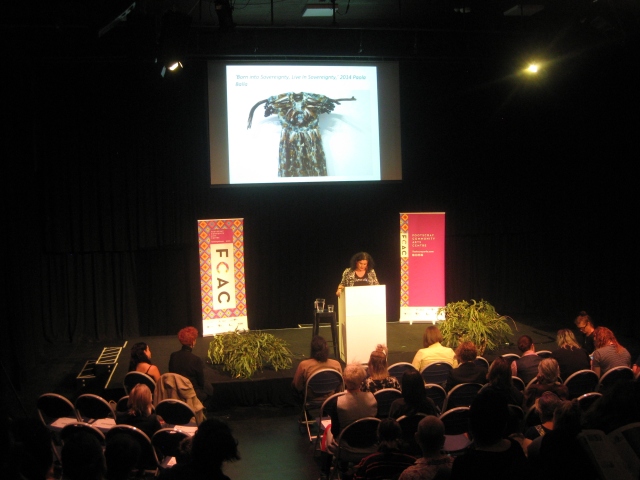
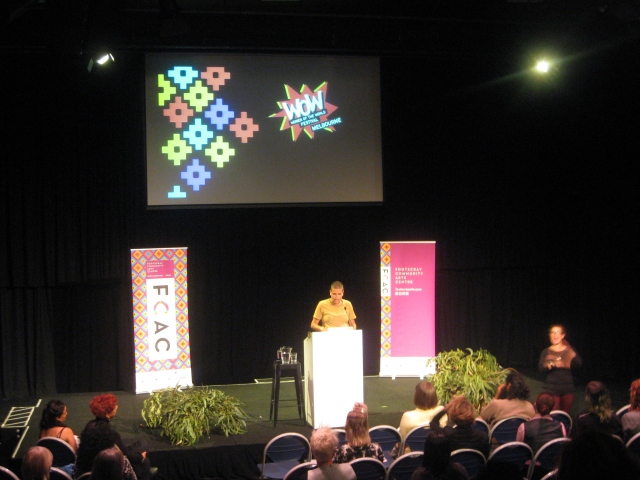
IMAG0559

I arrived late and missed Miliwanga Wurrben but both wonderful and powerful to see the work of young artists presented at Scribe.

Hannah Donnelly read some segments of recent work – dystopian young adult fiction exploring the long term impacts of climate change in Australia.  Asking the audience questions between readings like:

  • what Country do you live on?
  • what water system is on the Country where you live?
  • what is your future? …your children’s future?

Prompting important self-reflection on the ways we are (or aren’t) aware of the impacts of climate change and the ways we’re complicit in not taking good care of Country.

HANNAH DONNELLY

Hannah Donnelly is a Wiradjuri writer who grew up on Gamilaroi Country. She is the creator of Sovereign Trax, an Indigenous music blog which aims to foreground the consumption of music that speaks to collective stories and identities. Hannah’s writing experiments with speculative fiction and Indigenous responses to climate change.


IMAG0561

It’s hard to find words to describe what Jack Sheppard shared – all about words but using few he shared a story using his body and video footage of two friends who recently committed suicide, the piece capturing the evolution of his grief, healing and response to that.  Their stories are written on his body and he carries them with him. This evoked the sense of a beginning in an ending and possibility in a situation that feels hopeless. Where he is, they are. The gift of his work was holding space for the piece to mean whatever it might seem or need to mean to each person watching it… below is my attempt to express some of what that was for me watching him.

JACK SHEPPARD

The Honouring is a presentation of a physical theatre work in development, paying homage to Indigenous life and culture in its hardships, beauty and spirituality. Using movement, dialogue, video installations and poetry, the work is influenced by Aboriginal and Torres Strait Islander totems and landscape, with the story journeying to parts of Australia of deep significance to Jack Sheppard.


Pen to heart
writing is a full body experience
physical and not just head.
Disparate ideas and pieces of a life
you try to fit together
but they don’t come.
Voice.
Listen.
What are you trying to say?
What are you trying to read?
Winds blow,
walking in your own mess,
dance like no one is watching.
All about words but silent.
I lost my voice again today…
Cuddle up to the pieces
keeping you warm at night.
Collect the pieces up,
we must nurture the ghosts
that lie down with us,
check and care for them.
Shedding clothes,
layers of skin,
who we are.
Naked, unfolding a
piece of paper with the
whole story.
Reflection of self
wraps around you
like a cocoon.
Lie with the dead,
those we can’t save.
I want to sleep but I can’t.
Awake, I’m still awake.

Talitha Fraser


img_8303

p.86-87

“I spent the mornings writing letters in answer to advertisements in the paper; in the afternoons I went for walks round the creek.  I was experiencing a sense of freedom and elation that my failure to find work could not subdue. The renewing of my association with the clean world became almost an identification with tree and bird and sun.  The sharpness of my pleasure in rediscovery was sometimes so intense I could have shouted and flung my arms wide or lain with my face against the earth listening to music only the enchanted hear.

Quartz gravel, dry gum-leaves, bleached twigs and pieces of bark were rich with meaning. The floor of the bush was a narrative poem, the bush an evocation.

Shadow and sunlight, reaching limbs of trees, the rustle of grass, shapes and colours and odours, demanded a complete absorption to uncover the heart of their beauty. I felt I had been imprisoned for a lifetime in a dungeon and now, freed, the revelation of a communicating beauty lying confined in all that I was seeing brought with it a frustrating awareness of my inability to release it so that it would surround men and women for ever. There was an anguish in this unattainable desire, and tear, and a sense of deprivation.

I wanted to proclaim my message, if not in books then by talking.

Sometimes I had attempted, when stirred by the sight of a spider orchid, maybe, or the flight of a bird, to take adults on a fanciful journey of the spirit, in search of a truth beyond what the eye was seeing. It demanded of them an emotional response suggestive of children and this they could rarely give. They associated it with immaturity.

Shielded by books and facts and their belief in accepted authorities, they were incapable of becoming participants in wonder, only kindly and critical observers of those experiencing it. The years of development they had left behind were sprinkled with stars – the sharp lights of remembered experiences. The same experiences in later years never created a light.

What was once a magical experience becomes commonplace with repetition and there comes a time in the lives of most people when the eyes and ears fail to register an unadulterated wonder and excitement, but are used as instruments to revive memories that flicker like a match for a moment and die away.  It had all happened before; it would happen again.  But I knew that each moment contained something unknown, something never experienced before, an enchantment only it could provide.”

On the weekend of 24-25 September Whitley College hosted a conference called Constitutions and Treaties: Law, Justice, Spirituality – these are notes from session 6 of 9. We acknowledge that this gathering, listening and learning occurred of the land of the Wurundjeri People of the Kulin Nations and offer our respects to their elders past and present, and all visiting Aboriginal and Torres Strait Island visitors present.


“Wrongs to Rights”

i ways we talk about sovereignty

ii Treaty

iii acts of resistance

iv identity of the church


WAYS WE TALK ABOUT SOVEREIGNTY

Ask what does it mean for the identity of the church to recognise First People? Always about wealth: land, labour, wealth… when talking of treaty/constitutions always become justifying narratives. We cannot ignore the material component.

 Sovereignty? People aren’t sure about what the word means.

Confuses meaning when indigenous people are asking for it.

Rights and claims continuously negotiated e.g. human rights (allows some limits/accountability)

Four themes:

i ‘external’ or ‘internal’ authority. Boats vs. states/federal government.

ii power of institutions or powers of people

iii be sorted out legally or negotiated politically e.g. State of Victoria negotiating a Treaty.

iv sovereignty is capable of being shared > not absolute (Pakeha and Maori)


  1. separate and independent nation
  2. starting point to achieve rights and social inclusion
  3. authority inherent in them as individuals and as a people


Assertion: sovereignty reframing ongoing negotiating of claims in the community > nature of our settlement and how they live here.

Not disadvantage or reparations but ‘ancestral occupation’.  Not a gift of ours to give.

Recognises First People are a people with their own culture, land, language… have inherent rights.  Opens up a new negotiation for settlement.


img_1454


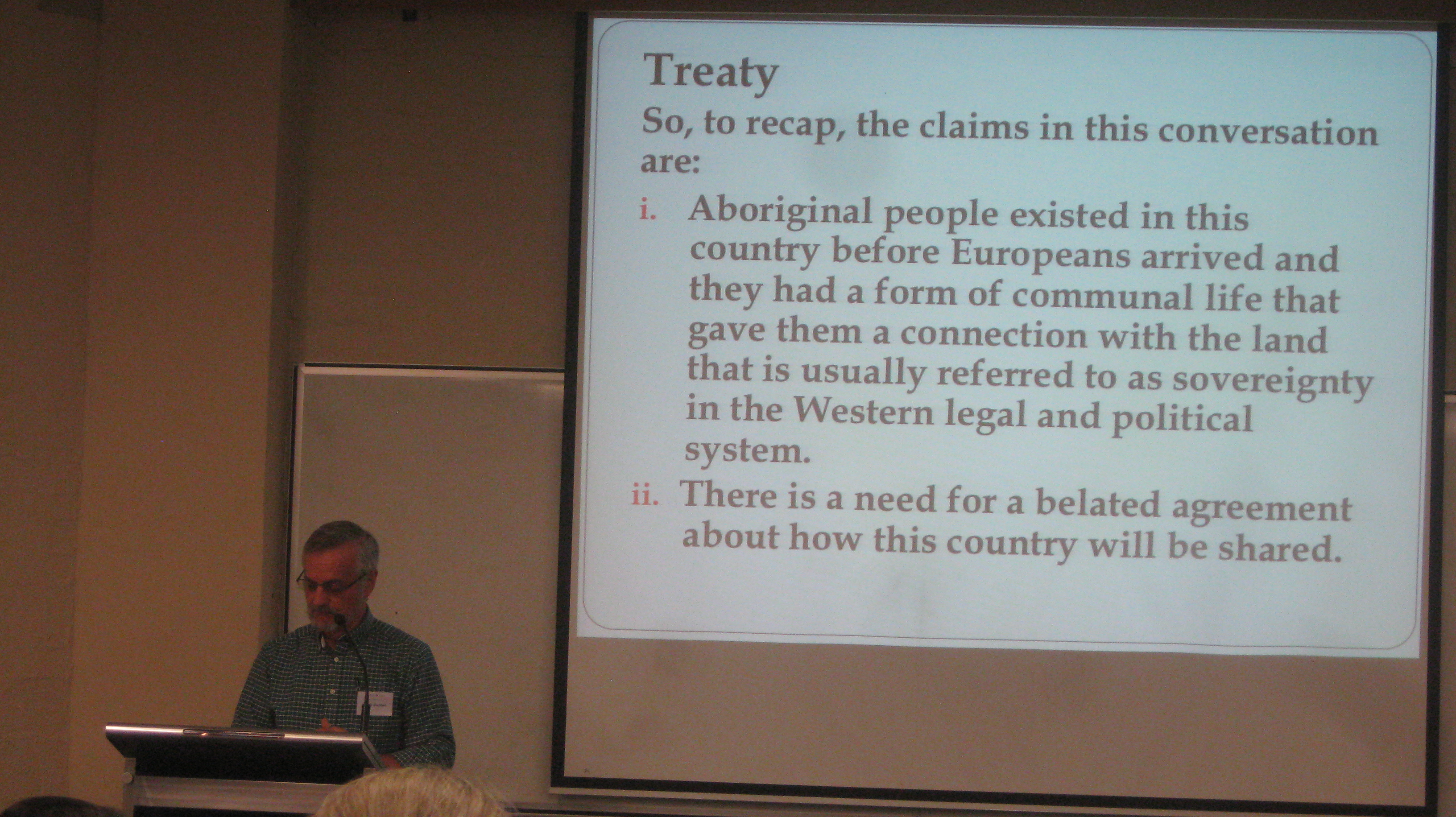
TREATY

‘shared house’ analogy… if you move in to a share house together there are rules – have to pay your share of rent, food, utilities… if some random moves in and uses everything. Eventually someone will say, we were here first – pay the board or move out.  There is a need to recognise our sovereignty.


img_1456

ACT OF RESISTANCE

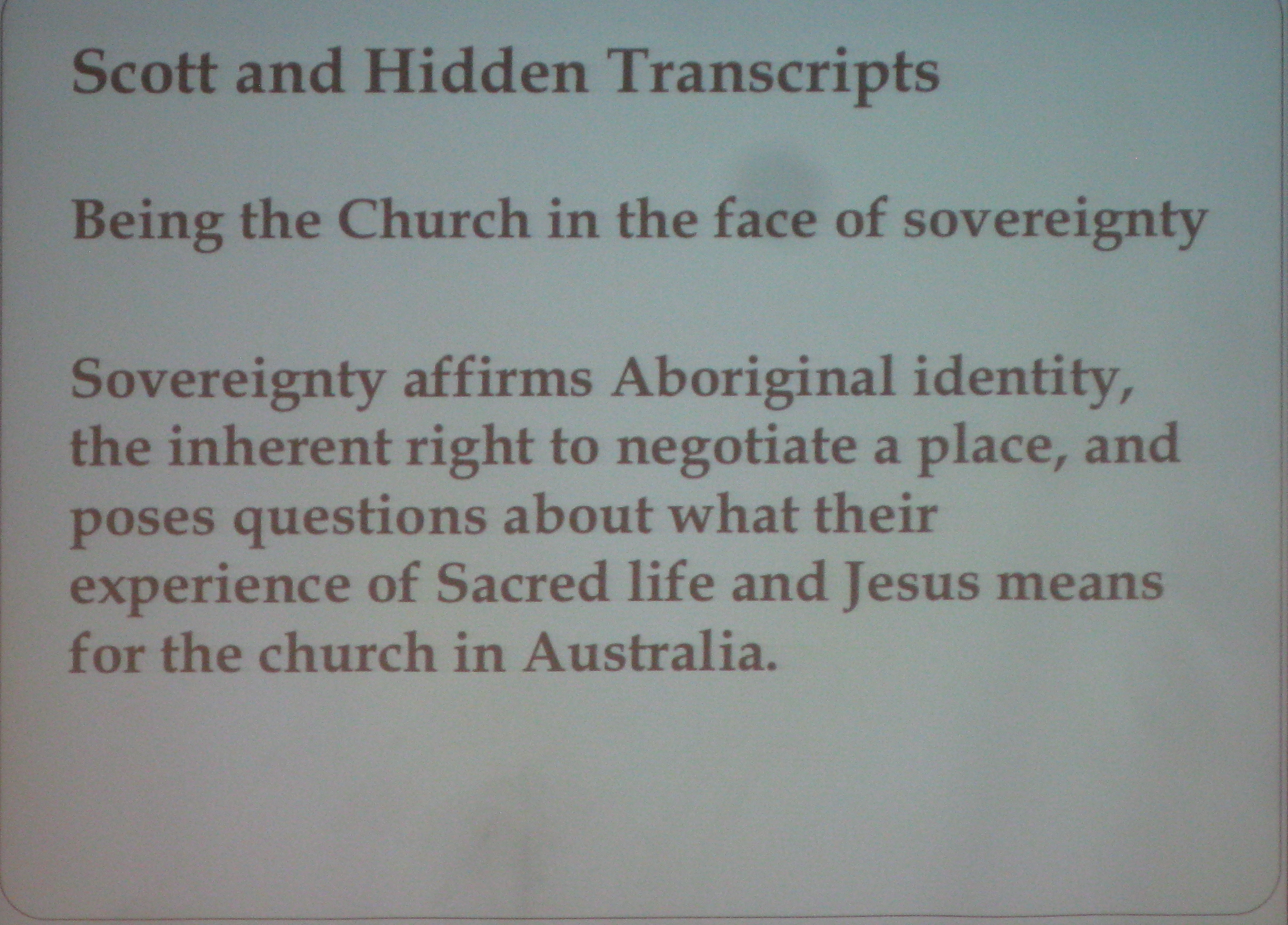
Narrative of explanation (public ideology that justifies current system e.g. invisible). Can’t critique publicly. Another narrative told in private places.

Did Jesus tell stories in public areas – in ways that didn’t threaten powers (used language and metaphors they didn’t understand) but reaches ‘those with ears to hear’. [hidden transcript]

Worth doing things people don’t understand – not taken seriously by Government but gives hope to those in the know.

What are you trying to fit into?


img_1457

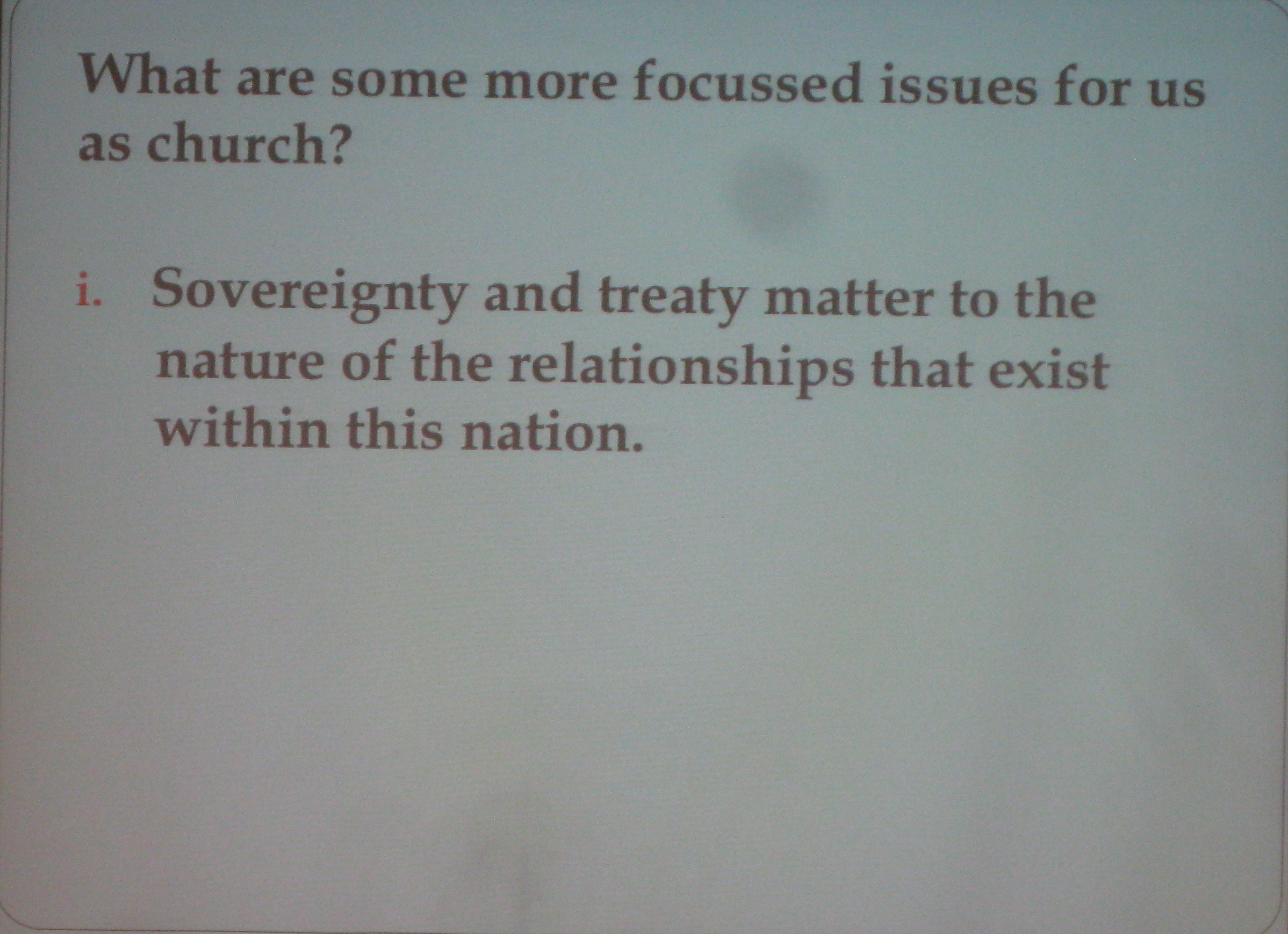
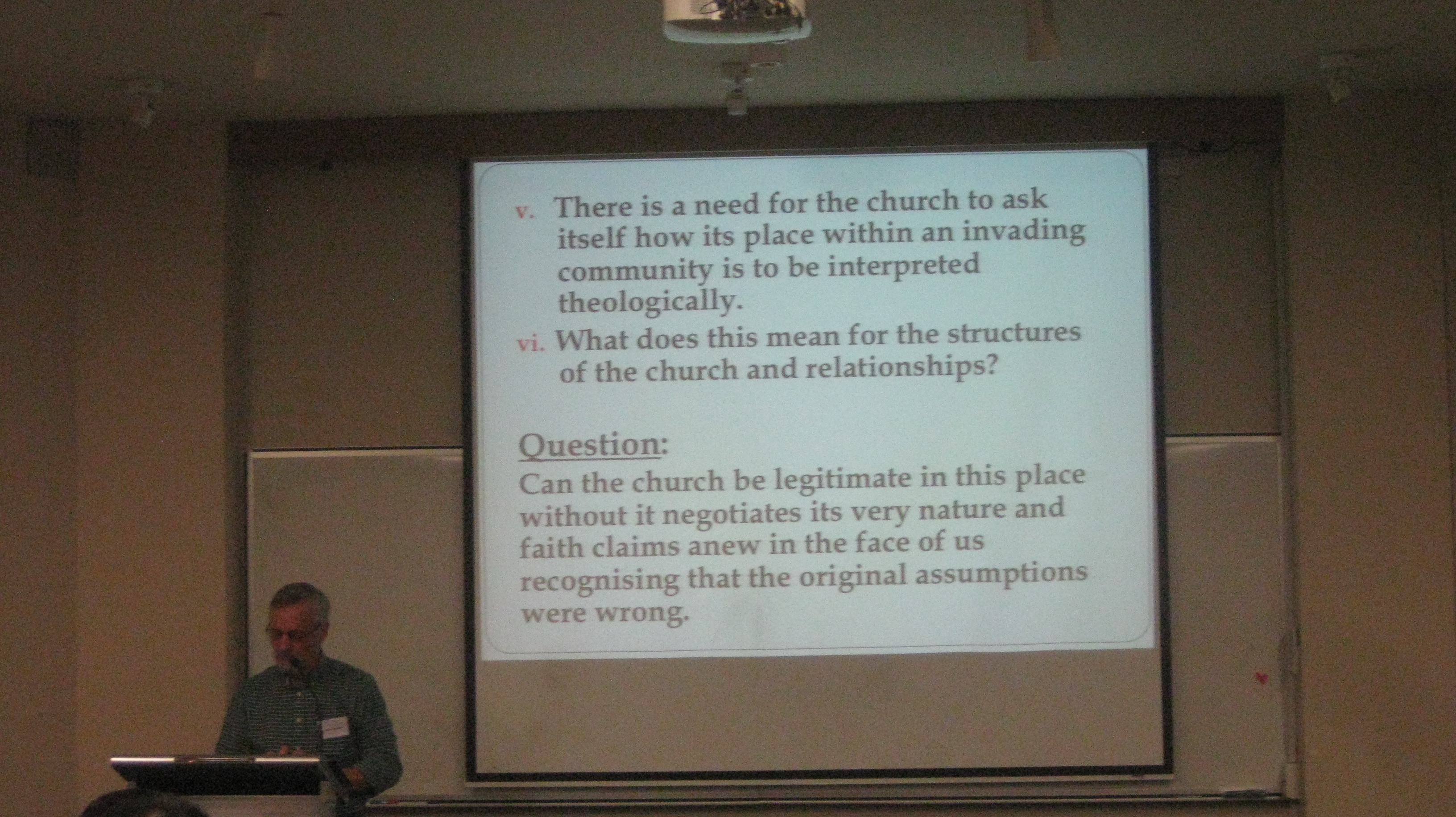
ISSUES FACING CHURCH

i   church needs to weigh in on issue of sovereignty

ii   church came in with the invaders – there is an existing sacred relationship with the land (invite us to share that story)

iii   church needs to confront issues of land and reparation – material reparation (Zacharius)

iv   recognition challenges ideas of how we speak of faith and salvation.  Creation/sinned message makes indigenous relationship to land (sinful) need salvation/assimilation of this idea into church à trusted. Make it personal…

How does recognition of indigenous people alter my understanding of gospels?

Understand gospels in relation to /context of existing indigenous relationship to land not politicising the gospels with a liberation theology that retrospectively tries to make sense of that, this is not “special interest group theology” (black, feminist, etc.)

v   churches places within or on invading community is to be interpreted theologically .

vi   what does this mean for the structures of church and relationships?

vii   still a need to hear and honour history as a foundation for present and future relationships… own/confess/change it…

img_1458


2016-wwf-artwork-by-aysha-tea_02_web-890x500

West Writers Festival Artwork by Aysha Tea

When they speak, it is scientific; when we speak, it is unscientific;
When they speak, it is universal; when we speak, it is specific;
When they speak, it is objective; when we speak, it is subjective;
When they speak, it is neutral; when we speak, it is personal;
When they speak, it is rational; when we speak, it is emotional;
When they speak, it is impartial; when we speak, it is partial;
When they speak, they have facts; when we speak, we have opinions;
When they speak, they have knowledge; when we speak, we have experiences.
These are not simple semantic categorizations; they possess a dimension of power that maintains hierarchical positions. We are not dealing here with simple semantic, but rather with a violent hierarchy, which defines who can speak.

Grada Kilomba

Epistemic struggle

  • imperial based identity
  • colonised
  • don’t think of themselves as “indigenous”, they don’t need to
  • needs to critique; not only the centre but different voices (otherwise issues remain invisible)
  • speak to defining powers
  • theorising as a community member not for. Invited to participate for skills not your cultural identity.
  • protect space – doesn’t respect all knowledge and doesn’t deserve all knowledge


Decolonising the Narrative

Characteristics

  • is an epistemic struggle
  • not answering set questions, it sets the questions
  • changes terms of the enunciation/conversation
  • process not fixed point
  • creates pluriversality, rather than universality
  • makes visible the epistemological zero-point*


* EPISTEMOLOGICAL ZERO-POINT “Europeans are people who do not know their place because they have not explored it yet. People living there have situated knowledge and knowledge grounded in their experiences… Operating under the hubris of zero-point blinds you to the fact that other people, with their own existence and knowledges, do not have the same problems that you have and therefore could care less about your knowledge, until the moment that you impose it on them and tell them they do not know about themselves what you know about them.  You conclude that they are inferior and ignorant, that their reasoning is defective, that their sense of beautiful doesn’t exist. You do not stop to think that they are as ignorant of your interests and values as you are of theirs. However, you assume you “know” them because you describe them and include them in your system of knowledge and in your epistemic architectonic.” – Walter Mignolo

example:

“What are you?”

 “I’m Vietnamese. What are you?”

“Nothing”

Vietnamese can’t be “nothing” without white people. White is the canvas of the world.

Who has the imperial power to “welcome”? We need to decolonise our aesthetic.  Initiatives must critique to be de-colonising.

e.g. “Real Australians say welcome” – posters do not critique or #RefugeesWelcome these are not decolonising initiatives.


Walter Mignolo on Decolonial Thinking

  • who is the knowing subject? What is his/her material apparatus on enunciation? (Who gets to say who can speak or when?) Construction of visibility.
  • what kind of knowledge/understanding is s/he engaged in generating, and why?
  • who is benefitting or taking advantage of such-and-such knowledge or understanding
  • what institutions (universities, media, foundations, corporations) are supporting and encouraging such knowledge and understanding e.g. Rhodes scholars – took the statue down. Yale cafeteria staff smashed a window depicting slaves.


Being an advocate is speaking to my cohort…
awareness brings change