Latest Entries »

IMG_0146

We are running a fortnightly bible study following our community dinner looking at the exegesis (interpretation) of the bible passages that underpin each of our community values. You can read the list of Values here so you know what’s coming up next.

These values can be relevant whatever context you live and work in just make the Word you own.


Value 1: Partnering with God

We value the opportunity of participating in the Missio Dei (mission of God). Through persistence in prayer, we seek to recognise where God is at work in Footscray, and become co-workers with Christ.

Biblical basis: Psalm 127:1, Luke 18:7, 1 Cor 3:9


Let’s read the value together. What words stand out? Any you don’t know?

What does being a partner mean? What are some different examples of partners?

business partner, relationships, sport teams, partner in crime, duet…

What sorts of things do partners do for each other?

work together, help out, trust, backup in tough times, share responsibility…

Read the bible. What words/ideas stand out?


Psalm 127:1-2

Unless you’ve commissioned the building project, LORD,
……..attempting construction would be futile.
Unless you’re in charge of security, LORD,
……..our gates and guards are a waste of effort.
We could work ourselves to the bone for nothing;
……..first on the job in the morning, last home at night,
…………….and what would we have to show for it?
……..Nothing but heartaches and ulcers.
You, LORD, long for us to slow down.
……..We can relax and trust in your loving care.


©2000 Nathan Nettleton LaughingBird.net


Luke 18: 1-8

Jesus told this story to encourage people to be persistent in prayer and never lose heart:

Once upon a time there was a town magistrate who took no notice of God and had no respect for anyone. There was a widowed woman in the town who had very little in the way of resources or influence, but who kept contacting the magistrate and demanding that he take action to protect her rights in a dispute with a powerful opponent. For a while he just kept brushing her off, but eventually he said to himself, “I couldn’t care less what happens to this woman, and all her talk of God’s justice means nothing to me; but I’m going to give her what she wants because I’m sick to death of her nagging and I just want to get her off my back.”

And the Lord commented on his story, saying:

“Do you hear the point in what the callous magistrate is saying? If he can be pressured into acting for justice, can’t you see how much more certain it is that God will bring about justice for those who have dedicated themselves to God and cry out for help night and day. Will God brush them off and ignore their pleas. You can take it from me: God will waste no time in bringing about justice for them. And yet, will the New Human find much of that sort of persistent faith on earth when he makes his entrance?

©2001 Nathan Nettleton LaughingBird.net

1 Cor 3:5-9

 Who do you think Paul is, anyway? Or Apollos, for that matter? Servants, both of us—servants who waited on you as you gradually learned to entrust your lives to our mutual Master. We each carried out our servant assignment. I planted the seed, Apollos watered the plants, but God made you grow. It’s not the one who plants or the one who waters who is at the center of this process but God, who makes things grow. Planting and watering are menial servant jobs at minimum wages. What makes them worth doing is the God we are serving. You happen to be God’s field in which we are working.

 The Message


Reflection time

What can we learn from the bible about living the value of “Partnering with God”?

  • Building bricks… Some of these things that we said partners do for each other – how are we doing them for God now? Or how could we start? Share a story…
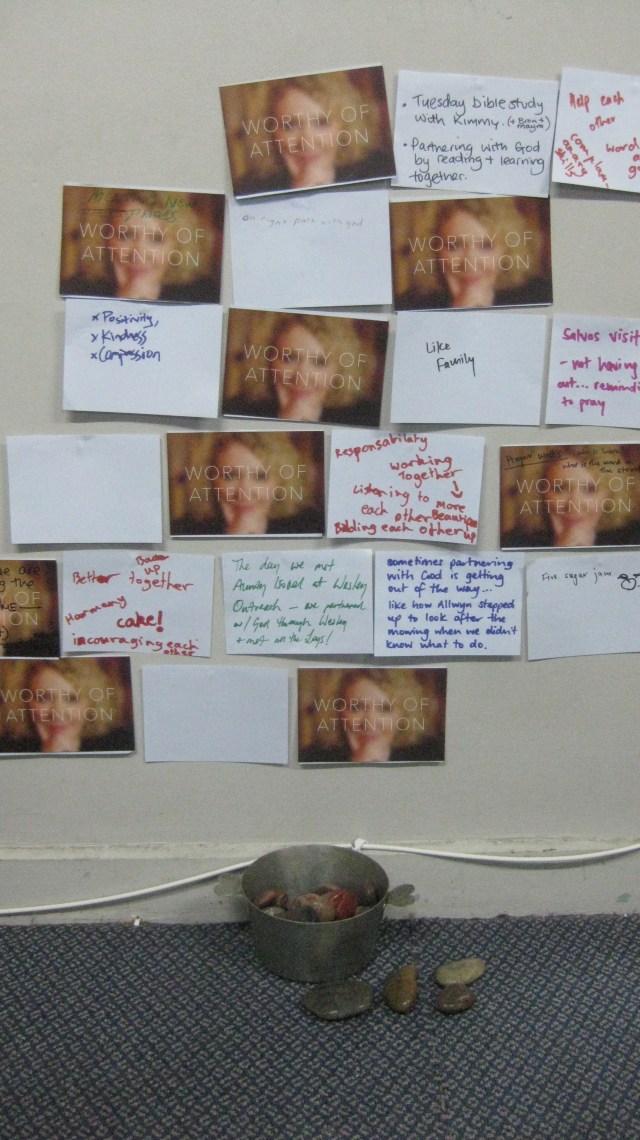
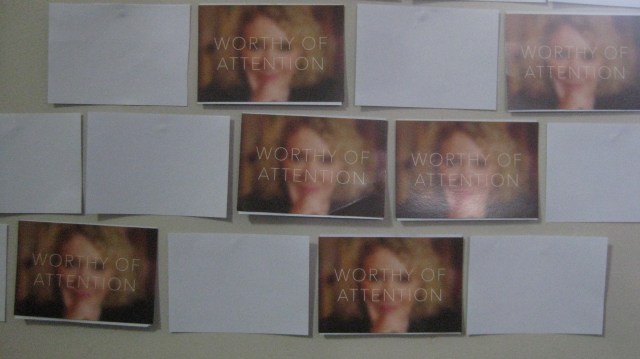
  • Postcards… Persistence in prayer… what is God telling us is worthy of attention in Footscray? What should we focus on?
  • Stones… is there anything that should be left out of what we are building together here? What are the things that stop us choosing the right bricks?


IMG_0154

Ten stolen minutes

img_9981


Ten stolen minutes

to say

to see

all there is to see

all there is to say

all there is to be

to breathe

take ten minutes

and breathe


Talitha Fraser

2016-wwf-artwork-by-aysha-tea_02_web-890x500

West Writers Festival Artwork by Aysha Tea

When they speak, it is scientific; when we speak, it is unscientific;
When they speak, it is universal; when we speak, it is specific;
When they speak, it is objective; when we speak, it is subjective;
When they speak, it is neutral; when we speak, it is personal;
When they speak, it is rational; when we speak, it is emotional;
When they speak, it is impartial; when we speak, it is partial;
When they speak, they have facts; when we speak, we have opinions;
When they speak, they have knowledge; when we speak, we have experiences.
These are not simple semantic categorizations; they possess a dimension of power that maintains hierarchical positions. We are not dealing here with simple semantic, but rather with a violent hierarchy, which defines who can speak.

Grada Kilomba

Epistemic struggle

  • imperial based identity
  • colonised
  • don’t think of themselves as “indigenous”, they don’t need to
  • needs to critique; not only the centre but different voices (otherwise issues remain invisible)
  • speak to defining powers
  • theorising as a community member not for. Invited to participate for skills not your cultural identity.
  • protect space – doesn’t respect all knowledge and doesn’t deserve all knowledge


Decolonising the Narrative

Characteristics

  • is an epistemic struggle
  • not answering set questions, it sets the questions
  • changes terms of the enunciation/conversation
  • process not fixed point
  • creates pluriversality, rather than universality
  • makes visible the epistemological zero-point*


* EPISTEMOLOGICAL ZERO-POINT “Europeans are people who do not know their place because they have not explored it yet. People living there have situated knowledge and knowledge grounded in their experiences… Operating under the hubris of zero-point blinds you to the fact that other people, with their own existence and knowledges, do not have the same problems that you have and therefore could care less about your knowledge, until the moment that you impose it on them and tell them they do not know about themselves what you know about them.  You conclude that they are inferior and ignorant, that their reasoning is defective, that their sense of beautiful doesn’t exist. You do not stop to think that they are as ignorant of your interests and values as you are of theirs. However, you assume you “know” them because you describe them and include them in your system of knowledge and in your epistemic architectonic.” – Walter Mignolo

example:

“What are you?”

 “I’m Vietnamese. What are you?”

“Nothing”

Vietnamese can’t be “nothing” without white people. White is the canvas of the world.

Who has the imperial power to “welcome”? We need to decolonise our aesthetic.  Initiatives must critique to be de-colonising.

e.g. “Real Australians say welcome” – posters do not critique or #RefugeesWelcome these are not decolonising initiatives.


Walter Mignolo on Decolonial Thinking

  • who is the knowing subject? What is his/her material apparatus on enunciation? (Who gets to say who can speak or when?) Construction of visibility.
  • what kind of knowledge/understanding is s/he engaged in generating, and why?
  • who is benefitting or taking advantage of such-and-such knowledge or understanding
  • what institutions (universities, media, foundations, corporations) are supporting and encouraging such knowledge and understanding e.g. Rhodes scholars – took the statue down. Yale cafeteria staff smashed a window depicting slaves.


Being an advocate is speaking to my cohort…
awareness brings change


Artwork by Aysha Tufa

I’m spending my weekend popping in and out of varied sessions of the Footscray Arts Centres West Writers Forum – the description for a workshop I made it to today reflected on language:

As our world grows smaller and people become more familiar with one another through daily cross-cultural interactions, what stops us from finding ourselves or losing ourselves in each other’s stories? Is translation the final frontier in creative writing? Can we achieve fluid creative and cultural exchanges through the translation of stories? Or will some things always remain lost in translation? Join moderator Mridula Nath Chakraborty in conversation with academics Sanaz Fotouhi and Dr Nadia NiazLily Yulianti Farid and Josiane Behmoiras for this panel.

 Lots of different ideas came through –

The minute you write – let it go.
It will mean something different to every reader.
You can put forward your intention for the words
but that may or may not be picked up.

Josianne Behmoiras

Contextual translation is more important that word-by-word.
You need to translate meaning to a medium your audience can understand…

The interpreter makes their own “work”.

Dr Nadia Niaz

The original word in Buginese “Mukkunrai”
had to remain to carry the meaning – the English translation
“female” doesn’t capture all of the cultural meaning.
(on the title of her short story collection)

Lily Youlanti

All of us find ourselves constantly
translating and transitioning,
asking: “Where do I sit?”

Sanaz Fotouhi

This quote got shared; Charles Simic’s take on the magical absurdity of translating poetry: “It’s that pigheaded effort to convey in words of another language not only the literal meaning of a poem but an alien way of seeing things … To translate is not only to experience what makes each language distinct, but to draw close to the mystery of the relationship between word and thing, letter and spirit, self and world.” (and the article I found it in from The New Yorker mentions many of the panel-referenced works re the translation movement in Japan).

This panel of five had cultural tails in the following languages: French, Hebrew, Latino, Turkish, Kurdish, Buginese, Bahasa, Urdu, Bengali and more I’m sure… a lot of the focus of the session was around translating into English and how you break into, speak into, build an audience amongst English (white middle-class) readers (they are mostly the ones buying books/running the theatres/festivals/publishing houses, etc.).

I found myself thinking about Te Reo Māori (the native language of New Zealand where I am from) and how few speakers there are – there is a need to find reasons to use this language.  What might it look like to translate poems – not word for word – but their meaning.   This kind of interpretation lends itself to crafting something new. What does it mean to take the words I have written to be grounded back into where I come from? What might I discover through that process? Like the Treaty of Waitangi we will end up with 3 versions: original English, Māori translation and then a translation of the Māori back into English… apologies to anyone fluent in Māori who reads these as I’m bound to make gaffes in grammar and word choice… {if you want to collaborate on correct translations get in touch!}

i.

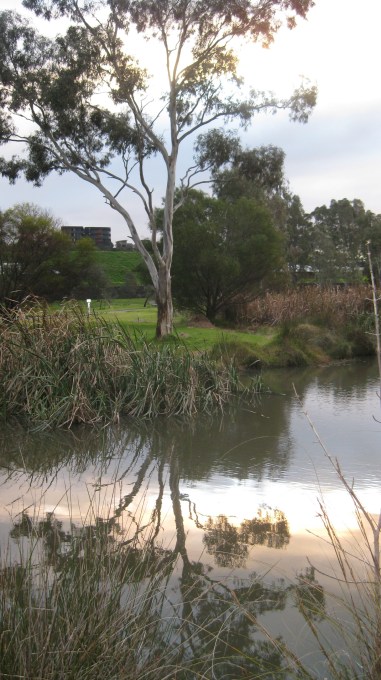
I sit down in the middle of the river

The river sits in the middle of me

Won’t you come and sit by the river?

Sit by the river awhile with me

ii.

Enoho au ki roto i te awa
Aparima enohoana ki roto iho
Haere tahi i roto ki te awa?
Haere mai ki te Mātāpuna a muri ngākau ahau

iii.

I sit down in the middle of the river
Aparima* sits always at the heart of who I am
Will you keep me company at the river?
You are welcome at the Source that sits at the heart of me

(* Aparima is the name of the river that I identify with in my mihi, it denotes the acknowledgment of place/where I am from)


i.

There is Room at the Table (originally written as a song to welcome asylum seekers/boat people coming to Australia, used at a Welcome Picnic outside a local detention centre)

There is room at the table x3
Let them in, let them stay

There is room at the border x3
Let them in, let them stay

There is room in our hearts x3
Let them in, let them stay

There is hope for a new tomorrow x3
Let them in, let them stay

ii.

He wāhi anō kai roto i te tēpu mo tētahi atu tangata?
Haere mai ra, haere mai ra, haere mai ra
Haere mai, nau mai, e ngā iwi e

He wāhi anō kai roto i te rohe mo tētahi atu tangata?
Haere mai ra, haere mai ra, haere mai ra
Haere mai, nau mai, e ngā iwi e

He wāhi anō kai roto i te to tatou ngākau mo tētahi atu tangata?
Haere mai ra, haere mai ra, haere mai ra
Haere mai, nau mai, e ngā iwi e

Nāu te rourou, nāku te rourou ka ora te manuwhiri
Haere mai ra, haere mai ra, haere mai ra
Haere mai, nau mai, e ngā iwi e

iii.

Is there space at the table for one more person?
Welcome, everyone is welcome

Is there space at the border for one more person?
Welcome, everyone is welcome

Is there space in our hearts for one more person?
Welcome, everyone is welcome

We will all contribute what we have and there will be enough to share
Welcome, everyone is welcome


Queries:

What is notable about the differences in the English translations?

What does such an exercise tell us about the significance of interpretation in translation?

If you look up mihi (tradition Maori introduction – reference in poem 1) and karanga (traditional Maori welcome – style observed in poem 2), does this change your understanding of these poems meaning? How?

Any reflections on Simic’s idea that: “To translate is not only to experience what makes each language distinct, but to draw close to the mystery of the relationship between word and thing, letter and spirit, self and world.”?

N.B. this story contains offensive language and swear words


The streets of Melbourne speak.  Buskers busk, beggars beg and people hand out pieces of paper offering good deals on diamonds, discounted burgers or advocating for autonomy of Tibet – everyone has something to say. Mostly we veer round them, but not me.  I have started a new job working with a Christian community development organisation supporting the homeless in Melbourne CBD – these people out on the street are my neighbours, my friends, and I am going to help them and I will make a difference in their lives.

Speak Melbourne, I am listening.

I hop on the 57 tram at Collins St. As it is standing room only, I loiter near the rear door and sitting side-on to me is a man holding a bottle in a paper bag already quite drunk.  He looks old but probably isn’t. A face weathered by life’s experiences and dirt. He clears people to the other end of the tram by being, loudly, verbally offensive to everyone around us.

To the Indian couple opposite chatting softly, “Can’t you speak English? Speak English! F-ing come to our country, you can speak our f-ing language.”

To the Chinese woman beside him, “I can speak your language, sushi! Chopsticks! Kamakaze! Karate!”

To a young Middle Eastern girl, “You’re quite pretty… how much would it cost to buy you? That’s what you do where you come from, right?”

Everyone on the tram pretends to ignore him and looks away – whatever you do, don’t make eye contact with the crazy guy. I felt angry, and ashamed, worried that all these people might think that by staying silent we agree as I find I look away too.  Eventually, a young white guy halfway up the tram calls out, “Keep your peace mate, no one wants to hear what you have to say.”

Crazy Guy stands quickly, “You trying to be a f-ing hero? Showing off for your girlfriend?  None of your f-ing business.”

He has pulled a broken bottle out of his bag and is waving it threateningly. Collectively everyone on the tram holds their breath, still not sure where to look.  Eventually Crazy Guy sits back down again but the ‘hero’ turns to say something to the guy behind him and he’s up again throwing candles at him from his bag shouting, “Shut up! I’m going to burn your f-ing eyes out you c-!”

All of this over a surreal twenty minute ride. I arrive at my stop in North Melbourne and hop off, relieved, so very relieved, the Crazy Guy does not.  I have done nothing, said nothing, and feel upset and guilty.  “Aren’t I meant to know how to do this?”

I ask a colleague Gin the next day, “What I could have done differently?”

“What was his name?”

“Uh, I didn’t exactly introduce myself….” my tone quavering somewhere between sarcasm and incredulity.

“…next time, try and find out what his name is, it really helps to connect with people if you know their name.”

Oo0oO


Some weeks later I am hosting dinner at my place unwinding with others from work. The share house I’m in doesn’t have much of a backyard and we have improvised with fish and chips in the middle of the 5-way roundabout where Haines, Dryburgh and Shiel Sts intersect.  It’s a beautiful Melbourne summer evening and we jockey for the minimal shade offered by the three yet-young eucalypts as summer light fades into dusk.  We’ve been there a while when a man crosses the road to ask us, “You got anything to eat?” and we share what we have.

He hangs with us a bit under the darkening sky, asks if we’re Aboriginal, if we’re sitting here because the land is significant to us, and asks my friends Christop and Mehrin when they are getting married, “I can just tell…” though they were only dating then.

Gin asks “What’s your name?”

“Gordy.”

“Where are you staying?”

He points to the flats across the road.

Crazy Tram guy is my neighbour, and now I know his name.

I wait till Gordy leaves to tell the others the connection.  My workmates have been helping me process the experience I had on the tram and it’s almost hard to credit this could be the same person. Calm, softly spoken, clean-shaven, friendly, interesting and interested in who we are.

Gordy is my neighbour, and now I know his name.

IMG_0835 - Copy

Oo0oO

homeless memorial service 005 - Copy
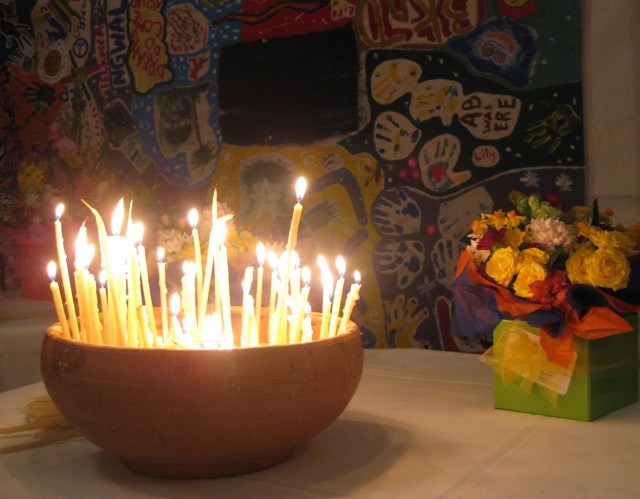
I go to the 10th Annual Homeless Memorial. Once a year a motley community gathers to remember those ‘streeties’ or ‘parkies’ who have passed away. You can get hot soup, a hot dog, and warm clothes are available to take away but it is about more than that. It offers an opportunity to reflect on those people with whom we create connections, those with whom we feel ‘at home’, regardless of any material shelter. We remember those who now, or have in the past, offered light or warmth to our lives. Voice is given to the pain of separation from parents, siblings, children, society. Voice is given to the pain of decisions that cannot be unmade, things which cannot be unsaid and knowledge that we cannot go back – only forward. A humble gratitude is offered to ‘the people from the organisations represented here’, supported with warm applause from the crowd in and around the marquee.

We sing. Songs we all know the words to, or hum, or make up. There are no song sheets. You  don’t have to have learned to read to belong here. Our hands are free to cradle lit candles and sprigs of rosemary.

Please swallow your pride
If I have things you need to borrow
For no one can fill those of your needs
That you don’t let show
For it won’t be long
‘Til I’m gonna need
Somebody to lean on


They say we stand for nothing and
There’s no way we ever could
Now we see everything that’s going wrong
With the world and those who lead it
We just feel like we don’t have the means
To rise above and beat it
So we keep waiting
Waiting on the world to change
It’s hard to beat the system
When we’re standing at a distance
So we keep waiting
Waiting on the world to change


We hold a minute’s silence, and it is deep and rich and full.

There are names unspoken…tears unshed…and hope unlooked for. We only need to look around to know we are not alone in this grief. We only need to look around to have more than our hunger fed, our coldness clothed… instead we know the truth.


We are not strangers to one another as we thought when we arrived.


And a last a cappella chorus rings out…


Amazing Grace, how sweet the sound
That saved a wretch like me
I once was lost but now am found
Was blind but now I see


Oo0oO

Another pleasant Melbourne evening, my housemate Freya and I are walking her gentle dog Nala to the oval for a play. We have an Ultra Grip Ball Launcher and even with both of us humans to the one of her we know well who will get tired of the game first.

We meet up with Gordy as we cross the road, he is heading home as we head out: “What kind of dog is that? Bitch looks like a dingo.  I’ve killed two dogs with my bare hands, they were coming at me and I just grabbed their front legs and ripped ‘em apart.”

Once he’s gone I try and explain how I don’t think he’s a risk to our pet but I think I make a bad job of it and there’s heightened awareness and extra company on walks in the weeks that follow.  I know enough to know now that Gordy was pretty level tonight.  Eyes clear and cleaned up, he must be in a good place.  He’s just making conversation.  Speaking his truth.  Why do we think about what we need to do to protect our dog and not think about what happened to Gordy that he’s in a situation somehow where he’s defending himself, his life, with his bare hands?

I used to look for the right answers once.  Now I look for the right questions.

Oo0oO

A stranger stops my friend Lyn and I, as we are walking down Swanston Street, to ask an inane question.   She and I do lunch now and then to catch up since I dropped off the corporate ladder. I say something harsh and unkind about him once he leaves. Gormless.

My friend smiles and says, “Sometimes you are very Christian, and sometimes you are so not.”  My smile twists and becomes wry, “No. I’m a Christian all the time,” I say, “…sometimes I’m better at it than others.”

I used to think that helping the poor would make me holy somehow. But I am as holy, and as human, as I have ever been.  Riding that 57 tram home later that day, I see Gordy again. He stands up to let a lady sit down and, when other women get on board, chastises other guys into giving up their seats too.  He flirts with a few girls and makes general conversation, “Hot ain’t it? Where you goin’?”

He says hello to me and I reply “Hi, Gordy, how are you?”

Confused, he answers “I don’t know you, I don’t know you”

I explain about meeting a few times, a long time ago and far apart but he just repeats, again and again, “I don’t know you”.  I get off at the stop after ours, cut home through the park, following the path that winds back and forth instead of cutting across the grass directly like I usually would.  It’s slower. I hold Gordy in my mind. I hold scared Gordy in my mind and slowly make my way home, hoping he’s made it ok to his.

Oo0oO


[Five years later…]

I am making my way to Coles to pick up some ingredients for dinner on the way home from work when I see Gordy sitting on the corner of Flinders and Elizabeth St with the cutest puppy sleeping on a blanket at his feet.  My momentum carries me past before my brain catches up and my spirit stirs.  I hesitate, and go back.  “Hey Gordy, I’m just heading into the Coles here, have you eaten? Can I pick up anything for you or the puppy?”

He says, “Nothing for me” proudly, “but some biscuits for the puppy would be great.”

I head in and dither over what to buy: puppy vs. adult food, large dog vs. small dog food, how big a bag if Gordy has to carry it around vs not being generous.  I finally get clear and head to the corner and… I can’t see them… oh.

My mind starts running, Gordy had sort of flinched when I used his name.  He never remembers me.  Maybe he felt suspicious of my motives, paranoid?  I check all directions from the intersection, check out the tram stops hoping to catch sight of him.  Damn it.  I just spent $15 on dog food I don’t have a use for.  Should I leave it here at the corner in case he comes back?  Did I take too long?  Did he assume I wasn’t coming back? Sigh.  The reasons for stopping in the first place were right.  It doesn’t matter that he isn’t here.

But it does.

I am disappointed by the ‘squandered’ generosity that goes unappreciated.

Oh well, Ray and Ben’s dogs will have a litter of puppies soon – it will be used eventually…

I cross to Flinders St Station and wait on the platform for the train. Last I know he lived in North Melbourne – I’m heading to Footscray where I live now – same line so I’m still scanning the platforms hoping to catch sight of him. Nothing. No sign. I find an empty seat on the train when it pulls up and slump down in the keep-to-myself-don’t-talk-to-me mode I generally assume on public transport.  The train moves off, the doors at the back of the carriage open and I idly muse on what it is people are looking for when they move down through the train while it’s moving when there are free seats everywhere? As I stare blankly at the dark tunnel walls slipping past.  The group, two guys and a girl, sit down across the aisle from me, and… beside me.  One of them is Gordy.

I very casually say, “Oh, could you pass this over for me?’

I see the surprise. Surprise I see them? That I will talk to them? That I will recognise Gordy without his hand out?  That I actually came through with the dog biscuits? Gordy moves to sit next to me with the puppy so ‘he’ (the puppy) can thank me, he is soft and adorable.  We chat all the way to Footscray, one of his mates eats the Snickers I threw in. Gordy says “I’ll definitely remember you this time.” I have my doubts and sitting together, sharing together, it feels entirely unimportant.  Though I have hope.

I’m still not holy.  Gordy isn’t a hero in this story, nor am I. We’re pretty much still the people we were at the start.  Still living.  I have learned that I can’t wait on the world to change. I have to start with myself.  Our conversation falls into silence, and it is deep and rich and full.

I don’t need Gordy to remember my name; that might be too hard or asking too much.  What I want him to remember is being reached out to, the mutuality of our exchanges. Equal parts in the same whole… it humbles and humiliates me.  I hope he feels looked for, I hope he feels found – as I have been.

The streets of Melbourne speak.  Buskers busk, beggars beg and people hand out pieces of paper offering good deals on diamonds, discounted burgers or advocating for autonomy of Tibet – everyone has something to say. Mostly we veer round them, but not me.  I’m in a different job these days, these are still my neighbours though and my friends – I know better now.  We help each other sometimes and our lives are different, better, for the knowing of each other. Listen Melbourne, I am speaking…

“What’s your name?”


Talitha Fraser


I wrote this piece a short story entry for the inaugural Brotherhood of St Lawrence Hope Prize “to encourage writing that transcends stereotypes of ‘the poor’ and reflects the resilience we know that people show in the face of poverty and testing times”. I didn’t win or anything so I can share my piece here – the years that I worked with the homeless community (largely through Seeds and Urban Seed) in Melbourne were transformative and it feels good to have an opportunity/ excuse to reflect on and share some learnings from that time. Thanks to Katherine, Susan and Sally for handholding me through the writing and editing process – this is noticeably tighter than my usual work thanks to you!

img_0039

I had the privilege of meeting Mrs. ITWG… in musing on voice, centre and margins, what is heard and not heard I have permission to share with you what she shared with me.

img_0040img_0041img_0042img_0043img_0044img_0046img_0047img_0048img_0049img_0050img_0055img_0056img_0057

img_0035

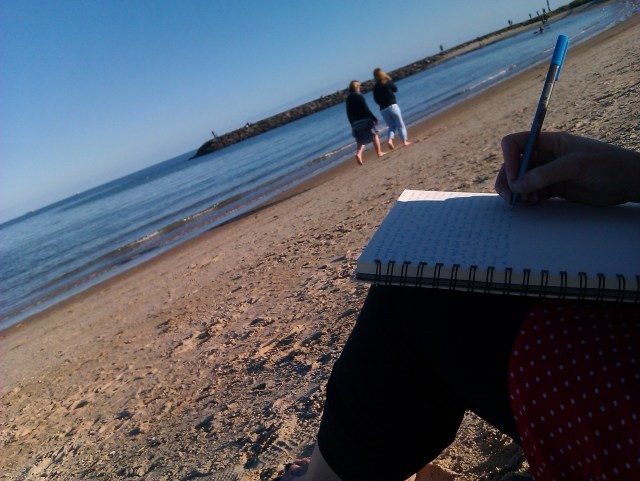
The water laps

imag0237


The water laps
soothing the disquiet
of all things unknown.
There are larger,
cycles and tides…
rhythms at work…
you will not ever
know the music to.
But you might,
if you are still,
hear an echo.

Talitha Fraser

Randomly yes, I am bringing you the graffiti from the women’s toilets of a well-known Melbourne pub as a juxtaposition to the Leunig and Mother Teresa and such… from promoting social justice issues, expressions of love/hate, to relationship advice… it’s arguably, not that different – you can learn a lot from this type of bathroom wall wisdom… you might not like it all or agree with it… but you will assuredly learn something.


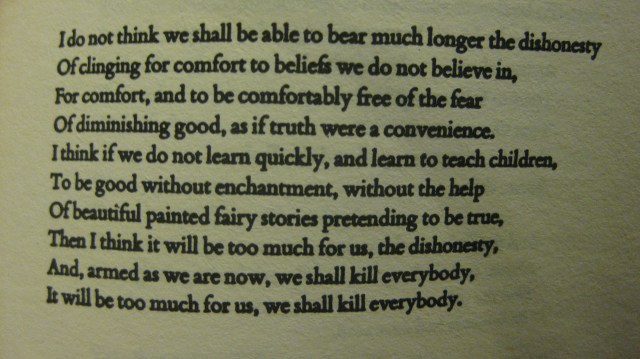
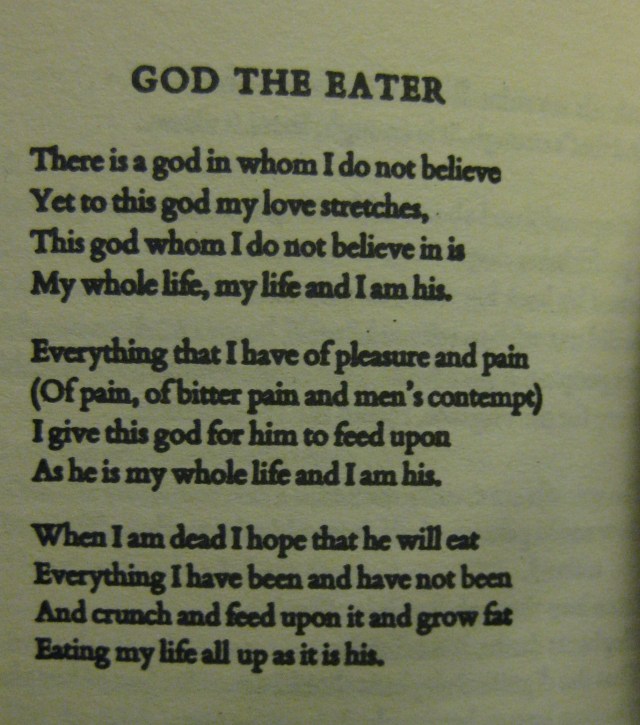
Housesitting and off the shelf of an extraordinary library I discover the poetry of Stevie Smith… I think she and I have become friends and I just may have to visit again…

img_9980

img_9974

img_9975

img_9979