Category: influential reading material


Teaching 12 – The Root of Suffering

What keeps us unhappy and stuck in a limited view of reality is our tendency to seek pleasure and avoid pain, to seek security and avoid groundlessness, to seek comfort and avoid discomfort.  This is how we keep ourselves enclosed in a cocoon.  Out there are all the planets and all the galaxies and vast space, but we’re stuck down here in this cocoon.  Moment after moment, we’re deciding we would rather stay down in that cocoon than step out into that big space.  Life in our cocoon is cosy and secure.  We’ve gotten it all together  It’s safe, it’s predictable, it’s convenient, it’s trustworthy.  If we feel ill at ease, we just fill those gaps.

Our mind is always seeking zones of safety.  We’re in this zone of safety and that’s what we consider life, getting it all together, security.  Death is losing that.  We fear losing our illusion of security – that’s what makes us anxious.  We fear being confused and not knowing which way to turn.  We want to know what’s happening.  The mind is always seeking zones of safety, and these zones of safety are continually falling apart.  Then we scramble to get another zone of safety back together again. We spend all our energy and waste our lives trying to re-create these zones of safety, which are always falling apart.  That’s the essence of samsara – the cycle of suffering that comes from continuing to seek happiness in all the wrong places.


Teaching 20 – Solgan: “All activities should be done with intention”

Breathing in, breathing out, feeling resentful, feeling happy, being able to drop it, not being able to drop it, eating our food, brushing our teeth, walking, sitting – whatever we’re doing could be done with one intention.  The intention is that we want to wake up, we want to ripen our compassion, and we want to ripen our ability to let go, we want to realise our connection with all beings.  Everything in our lives has the potential to wake us up or put us to sleep.  Allowing it to awaken us is up to us.


Teaching 37 – The Practice of Compassion

We cultivate compassion to soften our hearts and also to become more honest and forgiving about when and how we shut down.  Without justifying or condemning ourselves we do the courageous work of opening to suffering.  This can be the pain that comes when we put up barriers or the pain of opening our heart to our own sorrow or that of another being.  We learn as much about doing this from our failures as we do from our successes.  In cultivating compassion we draw from the wholeness of our experience – our suffering, our empathy, as well as our cruelty and terror.  It has to be this way. Compassion is not a relationship between the healer and the wounded. It’s a relationship between equals. Only when we know our own darkness well can we be present with the darkness of others. Compassion becomes real when we recognize our shared humanity.


Teaching 43 – Tonglen: The Key to Realising Interconnectedness

…when anything is painful or undesirable, breathe it in.  In other words, you don’t resist it.  You surrender to yourself, you acknowledge who you are, you honour yourself.  As unwanted feelings and emotions arise, you actually breathe them in and connect with what all humans feel.  We all know what it is to feel pain in its many guises.

You breathe it in for yourself, in the sense that pain is a personal and real experience, but simultaneously there’s no doubt that you’re developing your kinship with all beings.  If you can know it in yourself, you can know it in everyone.  If you’re in a jealous rage and you have the courage to breathe it rather than blame it on someone else, the arrow you feel in your heart will tell you that there are people all over the world who are feeling exactly what you’re feeling.  This practice cuts through culture, economic status, intelligence, race, religion.  People everywhere feel pain – jealousy, anger, being left out, feeling lonely.  Everyone feels it in the painful way you feel it.  The storylines vary, but the underlying feeling is the same for us all.

By the same token, if you feel some sense of delight – if you connect with what for you is inspiring, opening, relieving, relaxing – you breathe it out, you give it away, you send it out to everyone else… If you’re willing to drop the storyline, you feel exactly what all other human beings feel.  It’s shared by all of us.  In this way, if we do this practice personally and genuinely, it awakens our sens eof kinship with all beings.

Teaching 86: Six ways to be Lonely

Usually we rgard loneliness as an enemy.  It’s restless and pregnant and hot with the desire to escape and find soemthing or someone to keep us company.  When we rest in the middle of it, we begin to have a non=threatening relationship with loneliness, a cooling loneliness that turns our usual fearful patterns upside down.  There are six ways of describing thsi kind of loneliness:

1. LESS DESIRE is the willingness to be lonely without resolution when everything in us yearns for something to change our mood.

2. CONTENTMENT means that we no longer believe that escaping our loneliness is going to bring happiness or courage or strength.

3. AVOIDING UNNECESSARY ACTIVITIES means that we stop looking for something to entertain us or to save us.

4. COMPLETE DISCIPLINE means that at every opportunity, we’re waiting to come back to the present moment with compassionate attention.

5. NOT WANDERING IN THE WORLD OF DESIRE is about relating directly with how things are, without trying to make things okay.

6. NOT SEEKING SECURITY FROM ONE’S DISCURSIVE THOUGHTS means no longer seeking the companionship of constant conversation with ourselves.
Today I am reading a copy of the Gnostic Bible (Barnstone & Meyer).

Gospel of Thomas:

(38) Often you have wanted to hear these sayings I am telling you, and you have no one else from whom to hear them.  There will be days when you will seek me and you will not find me.

women of spirit 010

For prayers at community dinner last week we reflected on the Seeds query What does it mean for us to be the body of Christ? and the words of Joy Cowleys psalm…

Seeing

Dear God,
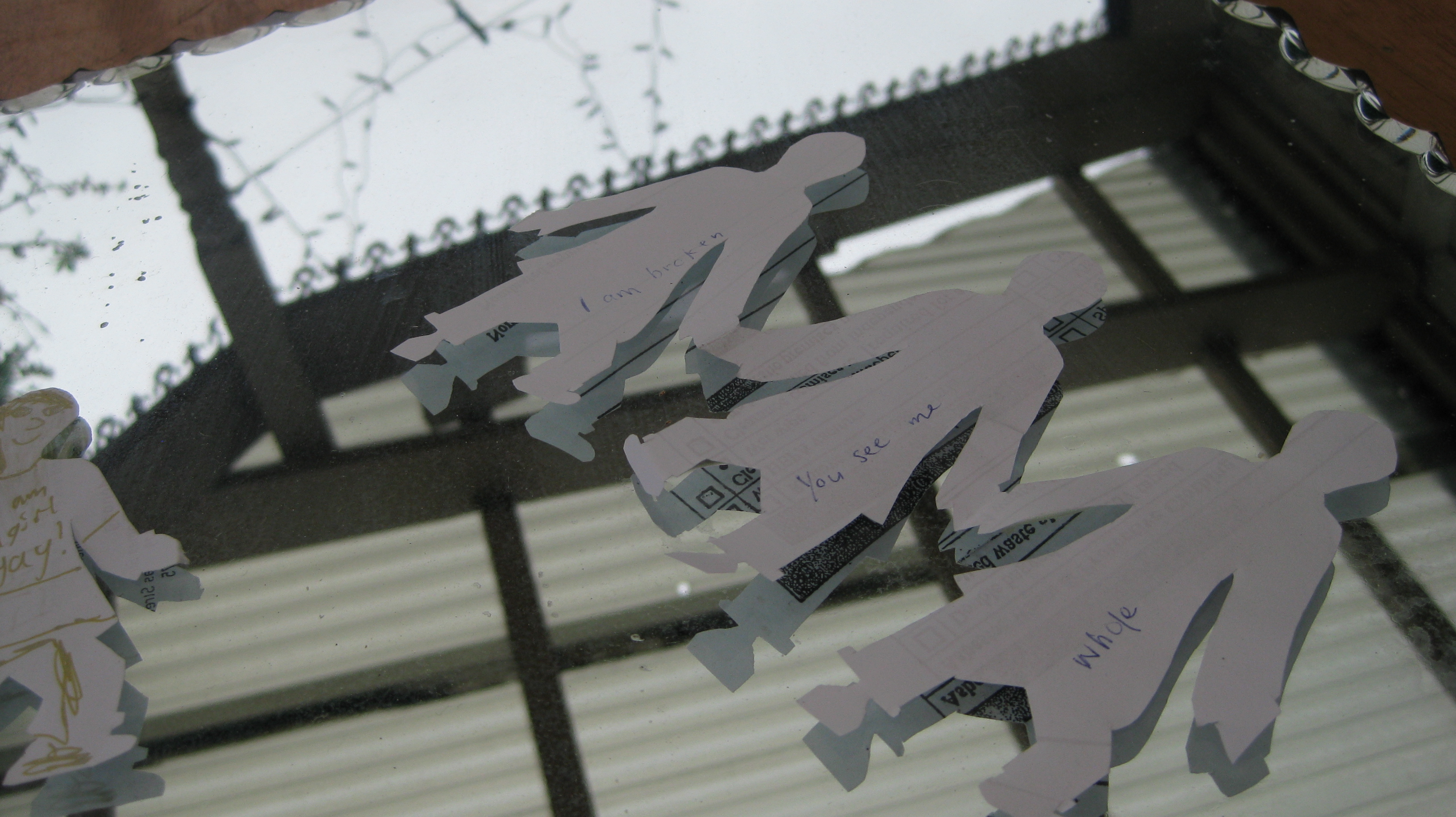
I need to see myself
as you see me.
My own vision is fragmented.
I try to divide up my life
and reject those parts of me
I consider to be weak.
I waste time and energy
in the battle of self against self
and Lord, I always end up the loser.

Dear God,
help me to see myself
as you see me.
I forget that you made me just as I am
and that you delight in your creation.
You do not ask me to be strong;
you simply ask me to be yours.
You do not expect me to reject my weakness,
merely to surrender it to your healing touch.

Dear God,
when I can see myself
as you see me,
then I will understand
that this frail, tender, fearful, aching, singing
half-empty, shining, shadowed person
is a whole being made especially by you
for your love.

Joy Cowley

“The radical church is the fastest-dying church in the world”

Myers, C. (1988) Binding the Strongman Orbis.

DISCIPLESHIP AND FAILURE: “YOU WILL ALL DESERT ME”

At the time, his words could hardly have hit home any harder, I ws still recovering from the painful breakup of my own community, the loss of home and marriage.  I had never expected that the “cross” would take this shape. If readers of this book still feel it is an exercise in imaginative idealism, they should be aware that Mark’s vision is flesh to me, flesh seared and scarred. I have seen business-as-usual rudely disrupted by the kairos of the call, seen the vision of radical discipleshhip community realized.  And more importantly, I have also seen those dreams fade, seen our best attempts to weave a fabric of hope and wholeness unravel, seen good persons bail out.

The radical discipleship movement today is beleaguered and weary. So many of our communities, which struggled so hard to integrate the pastoral and prophetic, the personal and the political, resistance and contemplation, work and recreation, love and justice, are disintegrating.  The powerful centrifugal forces of personal and social alienation tear us apart; the “gravity” exerted by imperial culture’s seductions, deadly mediocrities, and deadly codes of conformity pull our aspirations plummeting down.  Our economic and political efforts are similarly beseiged.  The ability of metropolis to either crush or co-opt movements of dissent seems inexhaustable.

Padraig O Tuama is in town as resident poet for 3 months with the Uniting Church, I believe his greatest gift to me has been sharing his whole truth and the space that he creates that invites me to share my own – and the shared healing that is found through that.

These are snippets from tonight “poetry, prayer, promise & protest speaking to humanity’s hidden yearning for decency, goodness, survival and companionship” which may not make sense out of context but might be enough to inspire you to look further (books on Amazon) or ask me about it someday…

Trinity in me: hopeful theist, agnostic and someone in pain

In Irish no words for yes or no. Will answer “I will”, “I can”, “Tis”, “May be so”

God of watching * God of silence * God of darkness

Why do we have to dehumanise to delineate?

Once I was blind, now I’m blinder still

The people stood in darkness and in it became their light.

Appearance of the Blessed Virgin Mary (BVM)
“You never liked me much did you..”
“No. No, I didn’t”
“That’s ok”

Moments of consolation in the midst of desolation

God is the crack where the story starts and we are the crack where the story gets interesting.

“It is in the shelter of each other that people live”

To Be Someone – Unique Identity & Personal Value

  • How big is the question ‘Who am I?’ in your life? What have you learned about living with this question?
  • How big is the question ‘What am I worth?’ (and ‘to who?’) in your life? What have you learned about living with this question?

To Be At Home – Security & Loving Harmony

  • What forms of security do you feel a need for? How have you pursued these in helpful or unhelpful ways? WHat have you learned about security?
  • In what living situations, communities and friendshios have you most experienced ‘loving harmony’? When was it lacking? How do you experience & nurture this now?

To Be Going Somewhere – Purpose & Progress

  • How big is the question ‘What am I here for?’ in your life? What have you learned about livign with this questions? How do you continue to discern your ‘vocation’?
  • What motivates you to develop and keep offering your best gifts and energies to God’s work on earth?
Used by GROW peer mental health support groups around Victoria

just one

I ask for just one miracle this weekend:
that I will no longer believe the impossible is.

That I will find the faith to believe
that liberation will come
for those who are imprisoned by their own
– or another’s –
fear and judgement.

That I will find the faith to believe
that the most intractable minds can be changed
– even my own.

That i will find the faith to believe
a different world will be born
from the empty hells of this one.

That I won’t stop living for the end
of all that would destroy us.

Me?

“Me? I’ve been lonely my whole life for as long as I can remember, since I was a child.  Sometimes being around other people makes it worse… When you’re young, you think its going to be solved by love. But it never is. Being close – as close as you can get – to another person only makes clear the impassable distance between you.”

“If being in love only made people more lonely,
why would everyone want it so much?”

“Because of the illusion. You fall in love its intoxicating, and for a little while you feel like you’ve actually become one with the other person.  Merged souls, and so on.You think you’ll never be lonely again.  Only it doesn’t last and soon you realise you can only get so close, and you end up brutally disappointed, more alone than ever, because the illusion – the hope you held onto all those years – has been shattered.

But see, the incredible thing about people is that we forget.  Time passes and somehow hope creeps back and sooner or later someone comes along and we think this is the one. And the whole thing starts all over again.  We go through our lives like that, and either we just accept the lesser relationship – it may not be total understanding, but its pretty good – or we keep trying for that perfect union, trying and failing, leaving behind us a trail of broken hearts, our own included.  In the end, we die as alone as we were born, having struggled to understand others, to make ourselves understood, but having failed in what we once imagined was possible.

How to be alone, to remain free, but not feel longing, not to feel imprisoned in oneself. That is what interests me.”

He spoke of human solitude, about the intrinsic loneliness of a sophisticated mind, one that is capable of reason and poetry but which grasps at straws when it comes to understanding another,
a mind aware of the impossibility of absolute understanding.
The difficulty of having a mind that understands that it will always be misunderstood.

“But as it stands, true empathy remains impossible.  And so long as it is, people will continue to suffer the pressure of their seemingly singular existence.”

“And mistreat each other, won’t they?”

Ray nodded. “Horrendously.”

(quote from “Man Walks into a Room” – Nicole Krauss)

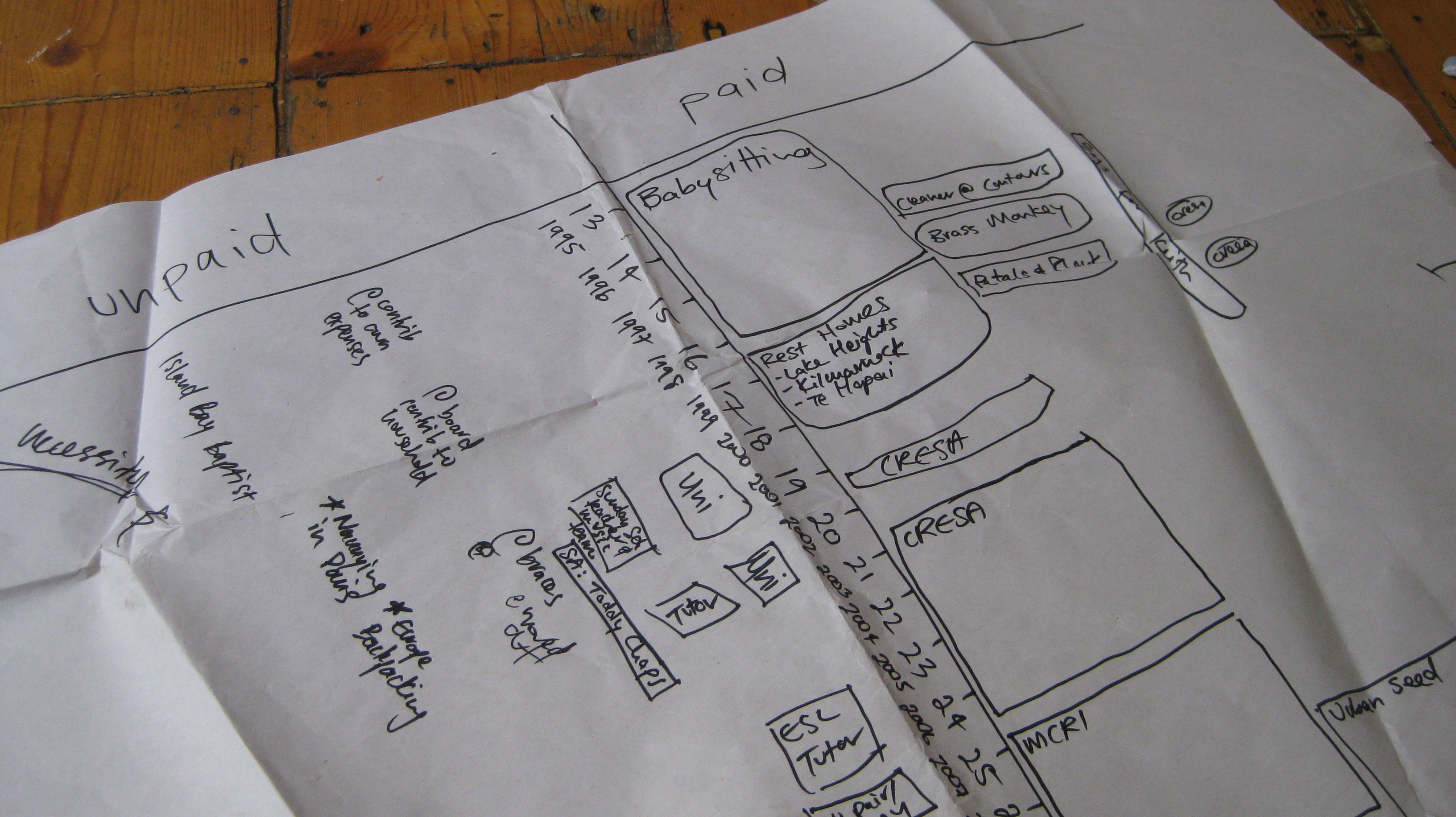
Grab some paper & pens (a long roll and colours might inspire some creative enthusiasm)

draw a horizontal axis through the middle of your sheet – this is for time (your age, the year, whichever you prefer…)

draw a vertical axis on the left hand side of your sheet – this is for showing paid work (above the line) and unpaid work (below the line) and should provide an exercise to map how much you’ve had going on at once…

women of spirit 017

(apologies mine isn’t pretty, some of them were….)


Reflection Questions:

1. At different stages, what have been the priorities that have directed/influenced your work choices and balance between paid work, unpaid work & rest?

2. When you look at your journey, where have you found fulfillment?
In which role or balance of roles?

3. Does the work you do influence the way you feel about yourself?


Webinar is available at chedmyers.org but here are some snippets…

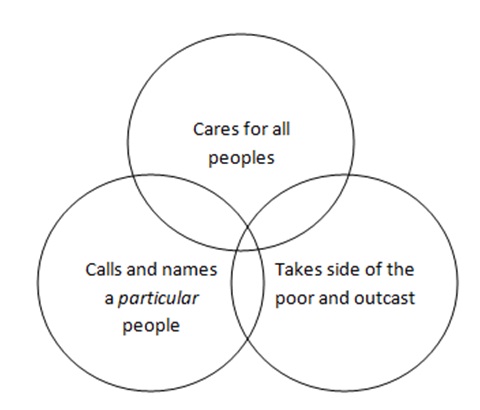
There is a “trialectic” biblical narrative concerning God’s relationship with human beings in the bible.

Image


Jesus embraces all three characteristics: loving both national enemies and intimate betrayers, calling disciples and living among the marginalised.

Isaiah I (Ch. 1-39) Isaiah II (Ch. 40-55) Isaiah III (Ch. 56-66) – different authors.

(p.96-97) But third Isaiah goes on to address specifically those parts of the community that are being legally and socially targeted:

Let not the foreigners say…
Let not the eunuch say…
For this is what God says… (Isaiah 56:3f)

This verse seeks to animate the voices of those who have internalized their rejection by the dominant culture because of how they are perceived and publically caricatured.  “The LORD will surely separate me from his people,” says the inner voice of the foreigner; “I am just a dry tree,” intones the introjected contempt of the eunuch.  Second-class citizens in our own history know all too well this self-hatred.  Black children have tried to scrub their skin white, immigrants have changed their names, women have kept silent, and gays and lesbians have stayed deep in a destructive closet – all to avoid the contempt of a society that barely tolerates them.  Internalised self-negation and external oppression are like a constant  “acid rain”, as psychologist William Grier and Price Cobbs famously put it in their landmark study Black Rage (1968). It is time, says Third Isaiah, for such dehumanisation to stop – because YHWH says otherwise.

What does this mean as a visitor, first-, second-, third-generation Australian?
Reflect on Australian immigration policy and response to “boat people”.
“Reconciliation” with indigenous First People  of these Nations.
Not only called to like pretty/smart/?/people, or people like “us” but specifically to welcome the hungry, the stranger, the ill…
Reflect on this: the maker of the outside also made the inside.

What credit it is it to you to only love those who are like you, to only love those who love you back, to only lend to those from whom you expect repayment – we are called to and Jesus role-modelled generous discipleship.

* I have purchased a copy of this book!